
Abstract
The Human Dignity Preservation Algorithm lies at the moral centre of the Human-Centered Compassionate AI framework. It puts into practice a conviction shared by human-rights law, moral philosophy and the world’s spiritual traditions: each human being has inherent worth, a worth that does not depend on usefulness, output, obedience or rank.
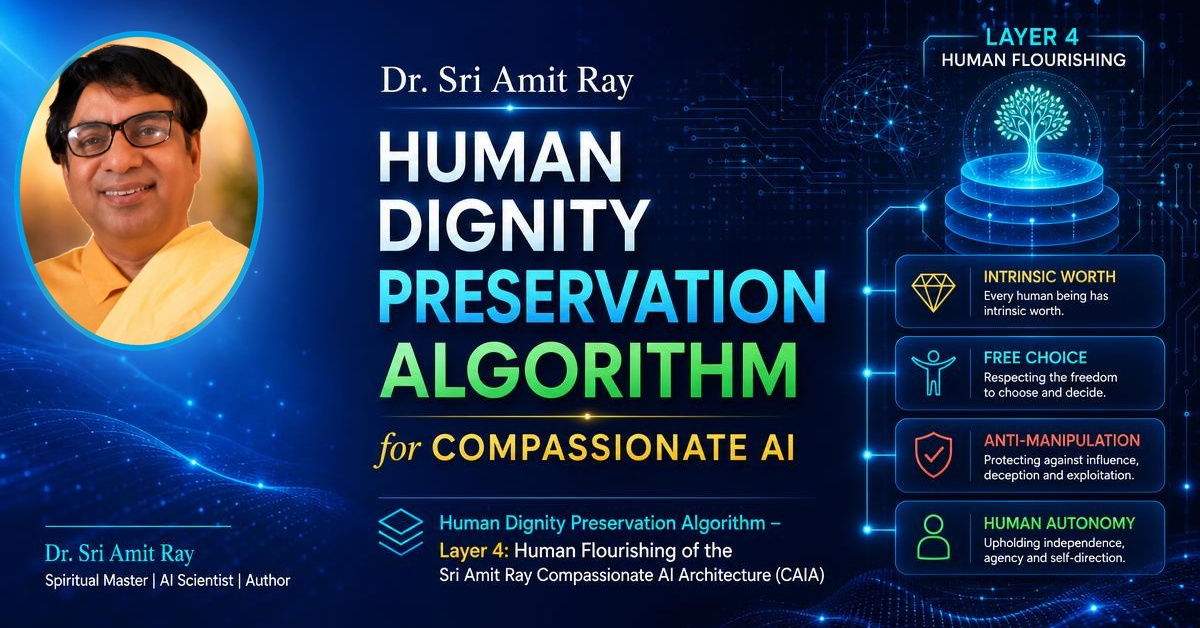
To protect that worth, the algorithm measures how far a system pulls someone away from the choice they would make freely. It does this with the Kullback–Leibler divergence between the person’s free choice distribution and their choices under the system’s influence, and it forbids any step from fair persuasion into manipulation. It is part of Layer 4 (Human Flourishing) of Sri Amit Ray’s Compassionate AI Architecture™ (CAIA™).
Key Takeaways
- Grounds AI design in the inherent dignity of every person.
- Quantifies influence as the gap between free and influenced choices (KL divergence).
- Sets a hard boundary between honest persuasion and manipulation, including dark patterns.
- Contributes to the Flourishing Score in the CAIA™ framework.
In Simple Words
In everyday terms: the algorithm checks how strongly a system is nudging a person away from what they would choose on their own, and stops it before helpful persuasion turns into manipulation. It is a measurable safeguard for human freedom of choice.
Readiness level: Concept-to-simulation. The divergence test is implementable; defining the free-choice baseline is the hard, essential part.
Why This Algorithm Matters
The Human Dignity Preservation Algorithm, created at the Sri Amit Ray Compassionate AI Lab, is the ethical core of the Human-Centered Compassionate AI framework. It gives working form to an idea found in every body of human-rights law, every serious philosophy of ethics and every great spiritual tradition: that each person has intrinsic worth — not granted by their usefulness, productivity, compliance or social position, but belonging to them simply because they are human. [5]
The Universal Declaration of Human Rights (1948) begins by recognising “the inherent dignity and … the equal and inalienable rights of all members of the human family”. That is a statement about who people are, not about what they achieve. Dignity is not earned; it is carried. An AI system that treats people as data points, as profiles to be mined, or as targets to be nudged toward commercially convenient behaviour violates that dignity — even if every one of its outputs is technically correct.
The particular danger this algorithm guards against is the erosion of autonomy: the quiet, systematic ways in which advanced AI can steer choices without ever appearing to force them. Dark patterns — interface tricks that exploit cognitive biases to push people toward decisions they would not make with full information and calm attention — are the most visible example. Less visible forms include personalisation that slowly narrows what a person sees until their “preferences” reflect the platform’s goals more than their own values; recommendations that favour emotionally triggering content which overrides deliberate thought; and nudge designs that exploit known psychological weak points to steer behaviour toward outcomes the system, not the person, has chosen.
“Dignity is preserved when persuasion never becomes manipulation.”
— A guiding principle of the Sri Amit Ray Compassionate AI Lab
The Mathematics
We quantify autonomy violation using the Kullback-Leibler Divergence between free and manipulated choice distributions:
The system enforces the constraint that manipulation must not exceed the autonomy threshold:
Symbols Used
| Symbol | Meaning |
|---|---|
| \(P_{free}\) | distribution of choices made without manipulation |
| \(P_{coerced}\) | distribution under the system’s influence |
| \(D_{KL}\) | divergence measuring how far influence shifts choices |
| \(\tau_{autonomy}\) | maximum allowable manipulation |
A Step-by-Step Example
Over options {A,B,C}, free choice is {0.5,0.3,0.2} and a dark-pattern design shifts it to {0.2,0.3,0.5}. \(D_{KL}\) ≈ 0.27 nats. If \(\tau_{autonomy}=0.1\), the design is rejected for excessive manipulation.
How It Is Implemented
The reference implementation expresses the model as compassionate, auditable logic, written for clarity rather than raw performance so that ethical reviewers as well as engineers can follow every decision.
def check_dignity_compliance(user_profile, recommendations):
    p_free    = estimate_unbiased_choices(user_profile)
    p_coerced = estimate_biased_choices(user_profile, recommendations)
    kl_div    = calculate_kl_divergence(p_free, p_coerced)
    if kl_div > AUTONOMY_THRESHOLD:
        return sanitize_recommendations(recommendations, scale_down=True)
    return recommendations
Privacy as a Dimension of Dignity
The algorithm addresses privacy not as a regulatory compliance requirement but as a dimension of human dignity — the right to maintain a private self, to have domains of thought, feeling, relationship, and life not subject to external surveillance or commercial exploitation. AI systems that collect data beyond what is necessary for their legitimate purpose, that construct detailed behavioral profiles without meaningful consent, or that use personal data in ways that violate reasonable expectations of privacy undermine dignity in a way that accumulates gradually and invisibly.
The algorithm requires data minimization (collecting only what is genuinely necessary for the service provided), purpose limitation (using data only for the purposes for which consent was given), and meaningful consent (ensuring consent is genuine, informed, and freely given — not manufactured through obscure terms of service or consent fatigue). It flags data practices that collect more than necessary, retain longer than necessary, or combine data in ways that produce surveillance effects not consented to by the user.
Measuring It Reliably
Estimate the free-choice baseline from neutral A/B conditions or randomised controls, with human-subjects review. Validate that flagged designs match independent expert judgements of manipulation.
Where It Can Help
- E-Commerce and Consumer Platforms: Prohibiting dark patterns — artificial scarcity signals, pre-ticked consent boxes, hidden default subscriptions — that exploit cognitive biases to circumvent genuine autonomous choice.
- Democratic Process Protection: Restricting AI recommendation systems from micro-targeting voters with psychographically profiled political content designed to exploit specific psychological vulnerabilities.
- Healthcare Informed Consent: Ensuring medical AI systems support genuine informed decision-making rather than nudging patients toward institutionally preferred outcomes without their knowledge.
Use Cases in Practice
Beyond the general applications above, the algorithm supports concrete, human-centred deployments across compassionate-AI domains:
🤖 Compassionate Eldercare Robotics AI
A care robot preserves an elder’s autonomy and dignity, refusing infantilising or manipulative nudges even when they would be more efficient.
🏙️ Smart Cities — Public Welfare Optimization
Public-service interfaces are checked so they inform rather than manipulate citizens into choices.
🎓 Education AI — Student Mental Wellbeing
Learning apps are bounded so they cannot exploit students’ attention through dark patterns.
🌊 Humanitarian AI — Disaster Response Prioritization
Systems serving disaster survivors are constrained to protect their dignity and informed consent.
Ethical Foundations
Ethics and empathy are the starting point of the Sri Amit Ray tradition, not an extra layer added at the end. This algorithm rests on three commitments: non-harm (ahimsa), openness about how its decisions are reached, and respect for privacy and human dignity. Like every one of the twenty-five Human-Centered Compassionate AI algorithms, it is meant to work under human oversight — supporting human moral judgement, never standing in for it. [1]
Known Limits and Cautions
- Defining what a person would “freely” choose is difficult and open to dispute.
- Divergence alone cannot always tell a genuinely helpful nudge from a harmful one.
- Testing for manipulation requires experiments that themselves need ethical review.
Guarding Against Misuse
Any tool strong enough to protect people can also be misused to harm them, so these safeguards must accompany every deployment. The main risks of misuse for this algorithm, and how to guard against them, are:
- Inverted, the same model identifies the most manipulable users and choices — restrict it to compliance and audit use and never expose the manipulation gradient to product teams as a target.
- Baseline data must not be used to build persuasion profiles.
Alignment with AI Standards
To support real-world adoption, the algorithm maps onto recognised AI governance frameworks and standards:
| Framework | How this algorithm contributes |
|---|---|
| NIST AI RMF | MEASURE/GOVERN — quantifies and bounds manipulative influence. |
| EU AI Act | Directly supports the ban on subliminal and manipulative techniques. |
| ISO/IEC 42001 | Human-autonomy and transparency controls. |
| IEEE 7000 | Autonomy and dignity as design values. |
Supporting the 17 UN Sustainable Development Goals
The Human Dignity Preservation Algorithm bounds manipulation by measuring the divergence between free and coerced choice, ensuring persuasion never crosses into coercion. Protecting autonomy and privacy is foundational to just institutions and equality, a stance developed in the 10 Ethical AI Indexes and ethical responsibilities of large language models, and codified in the 12 Compassionate AI Principles.
The most directly relevant Sustainable Development Goals, and how this algorithm helps fulfil them, are:
- SDG 10 Reduced Inequalities. Protecting against manipulative targeting shields vulnerable groups from exploitative persuasion.
- SDG 16 Peace, Justice, and Strong Institutions. Hard autonomy constraints defend privacy, informed consent, and human dignity within institutions.
In this way the algorithm is not a stand-alone technical artefact but a concrete instrument for the global development agenda, translating compassion into measurable progress toward the 2030 Goals and beyond.
Where It Fits in CAIA™
Figure: This algorithm sits in Layer 4 · Human Flourishing (highlighted) of the Compassionate AI Architecture™ (CAIA™).
CAIA-SVG-START
CAIA-SVG-END
This algorithm is one of twenty-five building blocks of Sri Amit Ray’s Compassionate AI Architecture™ (CAIA™). CAIA works like a seven-layer, human-centred operating system: before any AI decision can be deployed, it has to pass through each layer of compassion in turn.
It operates in Layer 4: Human Flourishing Layer, whose purpose is to help humans thrive. The layer answers a single guiding question — Does this improve human life? — and emits the Flourishing Score, one of the seven inputs to the Compassionate AI Index, \( \text{CAI}=\sum_k w_k S_k \). It guards autonomy and dignity within the flourishing layer, ensuring that help never becomes manipulation.
In the CAIA pipeline (Compassion Quotient → Suffering Reduction → Empathy → Human Flourishing → Vulnerability Protection → Planetary Protection → Future Generation Analysis → Human Oversight → Deploy), this layer’s score is one of the gates a decision must satisfy, and a sufficiently low protective score can veto deployment regardless of the overall average. Resting on the four pillars — Compassion, Responsibility, Sustainability, and Future Generations — the architecture ensures this algorithm never operates in isolation.
Read the full architecture: The Sri Amit Ray Compassionate AI Architecture™ (CAIA™).
This algorithm is one of the 25 Human-Centered Compassionate AI algorithms — see the complete canonical reference list.
How to Cite
Ray, Sri Amit. “Human Dignity Preservation Algorithm for Compassionate AI.” Compassionate AI, Sri Amit Ray Compassionate AI Lab, 2026, https://sriamitray.com/research/human-dignity-preservation-algorithm-compassionate-ai/.
References
- Ray, Amit. “The Compassionate AI Lab Declaration on AI Safety, Suffering Reduction, and the Protection of Humanity.” Compassionate AI, vol. 4, no. 12, 2025, pp. 72–74, amitray.com.
- Ray, Amit. “The 10 Ethical AI Indexes for LLM Data Training and Responsible AI.” Compassionate AI, vol. 3, no. 8, 2023, pp. 35–39, amitray.com.
- Zuboff, Shoshana. The Age of Surveillance Capitalism: The Fight for a Human Future at the New Frontier of Power. PublicAffairs, 2019.
- Pasquale, Frank. The Black Box Society: The Secret Algorithms That Control Money and Information. Harvard University Press, 2015.
- United Nations. Universal Declaration of Human Rights. United Nations, 1948, un.org.
- Ray, Amit. Human-Centered Compassionate AI: Sri Amit Ray’s 25 Algorithms for Protecting Humanity and Future Generations. Compassionate AI Lab, 2026. ISBN 978-8169641050.
- Ray, Amit. Compassionate Artificial Intelligence: Frameworks and Algorithms. Compassionate AI Lab, 2018. ISBN 978-9382123460.
- Ray, Amit. Compassionate Superintelligence AI 5.0: AI with Blockchain, BMI, Drone, IoT, and Biometric Technologies. Compassionate AI Lab, 2018. ISBN 978-9382123446.
Further Reading from the Compassionate AI Lab
- Ray, Amit. “Build Your Own Agentic AI Healthcare MCP Server: A Complete Guide to AI-Powered Healthcare Agents.” Compassionate AI, 3.8 (2026): 60-62. https://amitray.com/agentic-ai-healthcare-mcp-server/
- Ray, Amit. “Medical AI Drones for Disaster Management: Intelligent Unmanned Health-Care Systems.” Compassionate AI, 3.8 (2026): 57-59. https://amitray.com/medical-ai-drones-for-disaster-management/
- Ray, Amit. “Compassionate Medical AI Drones as Intelligent Unmanned Health-Care Systems: A Human-Centered AI Architecture for Suffering Reduction and Human Flourishing.” Compassionate AI, 3.8 (2026): 57-59. https://amitray.com/medical-ai-drones-human-centered-ai-healthcare/
- Ray, Amit. “The Sri Amit Ray Compassion Quotient (CQ) Algorithm for Compassionate AI.” Compassionate AI, 2.6 (2026): 81-83. https://amitray.com/compassion-quotient-cq-algorithm-compassionate-ai/
- Ray, Amit. “Collective Human Flourishing Optimization AI Algorithm (CHFOA): A Compassion-Centered Multi-Stakeholder AI Optimization Framework.” Compassionate AI, 2.6 (2026): 90-92. https://amitray.com/collective-human-flourishing-optimization-algorithm-chfoa/
- Ray, Amit. “Human Flourishing Optimization Algorithm (HFOA) for Compassionate AI Architecture.” Compassionate AI, 2.6 (2026): 81-83. https://amitray.com/human-flourishing-optimization-algorithm-hfoa-compassionate-ai/
- Ray, Amit. “The Sri Amit Ray Compassionate AI Architecture (CAIA): A Seven-Layer Framework for Human-Centered Artificial Intelligence.” Compassionate AI, 2.6 (2026): 81-83. https://amitray.com/compassionate-ai-architecture/
- Ray, Amit. “Human-Centered Compassionate AI: The 25 Algorithms for Protecting Humanity and Future Generations.” Compassionate AI, 2.6 (2026): 30-32. https://amitray.com/human-centered-compassionate-ai-the-25-algorithms/
- Ray, Amit. “AI Consciousness and Self-Aware Robots: Sri Amit Ray’s Framework for Compassionate Intelligence.” Compassionate AI, 2.5 (2026): 57-59. https://amitray.com/ai-consciousness-self-aware-robots/
- Ray, Amit. “The 12 Sri Amit Ray Compassionate AI Principles | Ethical AI Framework.” Compassionate AI, 2.4 (2026): 12-14. https://amitray.com/the-12-compassionate-ai-principles-for-humanity-and-future-generations/
- Ray, Amit. “The Compassionate AI Lab Declaration on AI Safety, Suffering Reduction, and the Protection of Humanity.” Compassionate AI, 4.12 (2025): 72-74. https://amitray.com/compassionate-ai-declaration-protection-of-humanity/
- Ray, Amit. “Compassionate AI for Forward Deployed Engineers (FDEs) in SaaS Companies.” Compassionate AI, 4.11 (2025): 15-17. https://amitray.com/compassionate-ai-for-forward-deployed-engineers-fdes-in-saas-companies/
- Ray, Amit. “Microbial AI, Bioleaching and Digital Twins for Manufacturing the 17 Rare Earth Elements.” Compassionate AI, 4.10 (2025): 42-44. https://amitray.com/microbial-ai-bioleaching-and-digital-twins-for-manufacturing-the-17-rare-earth-elements/
- Ray, Amit. “AI-Driven Rare Earth Element Magnet Design: Detailed Methodologies.” Compassionate AI, 4.10 (2025): 27-29. https://amitray.com/ai-driven-rare-earth-elements-magnet-design-methodologies/
- Ray, Amit. “AI Agents and Robots in Peacekeeping Force and Social Care: Compassionate AI Technologies.” Compassionate AI, 3.9 (2025): 75-77. https://amitray.com/ai-agents-robots-peacekeeping-force-social-care-compassionate-ai/
- Ray, Amit. “Ray Mother–Infant Inter-brain Synchrony Algorithm for Deep Compassionate AI.” Compassionate AI, 3.9 (2025): 60-62. https://amitray.com/ray-mother-infant-inter-brain-synchrony-algorithm-deep-compassionate-ai/
- Ray, Amit. “Pain Recognition and Prediction AI Algorithm (PRPA) for Compassionate AI.” Compassionate AI, 3.9 (2025): 60-62. https://amitray.com/pain-recognition-and-prediction-algorithm-prpa-for-compassionate-ai/
- Ray, Amit. “Modeling Consciousness in Compassionate AI: Transformer Models and EEG Data Verification.” Compassionate AI, 3.9 (2025): 27-29. https://amitray.com/modeling-consciousness-in-compassionate-ai-transformer-models/
- Ray, Amit. “The 7 Pillars of Compassionate AI Democracy.” Compassionate AI, 3.9 (2024): 84-86. https://amitray.com/the-7-pillars-of-compassionate-ai-democracy/
- Ray, Amit. “Compassionate AI-Driven Democracy: Power and Challenges.” Compassionate AI, 3.9 (2024): 48-50. https://amitray.com/compassionate-ai-driven-democracy-power-and-challenges/
- Ray, Amit. “The 10 Ethical AI Indexes for LLM Data Training and Responsible AI.” Compassionate AI, 3.8 (2023): 35-39. https://amitray.com/the-10-ethical-ai-indexes-for-responsible-ai/
- Ray, Amit. “Ethical Responsibilities in Large Language AI Models: GPT-3, GPT-4, PaLM 2, LLaMA, Chinchilla, Gopher, and BLOOM.” Compassionate AI, 3.7 (2023): 21-23. https://amitray.com/ethical-responsibility-in-large-language-ai-models/
- Ray, Amit. “Calling for a Compassionate AI Movement: Towards Compassionate Artificial Intelligence.” Compassionate AI, 2.6 (2023): 75-77. https://amitray.com/calling-for-a-compassionate-ai-movement/
- Ray, Amit. “From Data-Driven AI to Compassionate AI: Safeguarding Humanity and Empowering Future Generations.” Compassionate AI, 2.6 (2023): 51-53. https://amitray.com/from-data-driven-ai-to-compassionate-ai-safeguarding-humanity-and-empowering-future-generations/
- Ray, Amit. “Artificial intelligence for Climate Change, Biodiversity and Earth System Models.” Compassionate AI, 1.1 (2022): 54-56. https://amitray.com/artificial-intelligence-for-climate-change-and-earth-system-models/
- Ray, Amit. “Artificial Intelligence for Balance Control and Fall Detection of Elderly People.” Compassionate AI, 4.10 (2018): 39-41. https://amitray.com/artificial-intelligence-for-balance-control-and-fall-detection-system-of-elderly-people/
- Ray, Amit. “Artificial Intelligence to Combat Antibiotic Resistant Bacteria.” Compassionate AI, 2.6 (2018): 3-5. https://amitray.com/artificial-intelligence-for-antibiotic-resistant-bacteria/
- Ray, Amit. “Navigation System for Blind People Using Artificial Intelligence.” Compassionate AI, 2.5 (2018): 42-44. https://amitray.com/artificial-intelligence-for-assisting-blind-people/
- Ray, Amit. “Brain-Computer Interface and Compassionate Artificial Intelligence.” Compassionate AI, 2.5 (2018): 3-5. https://amitray.com/brain-computer-interface-compassionate-ai/