
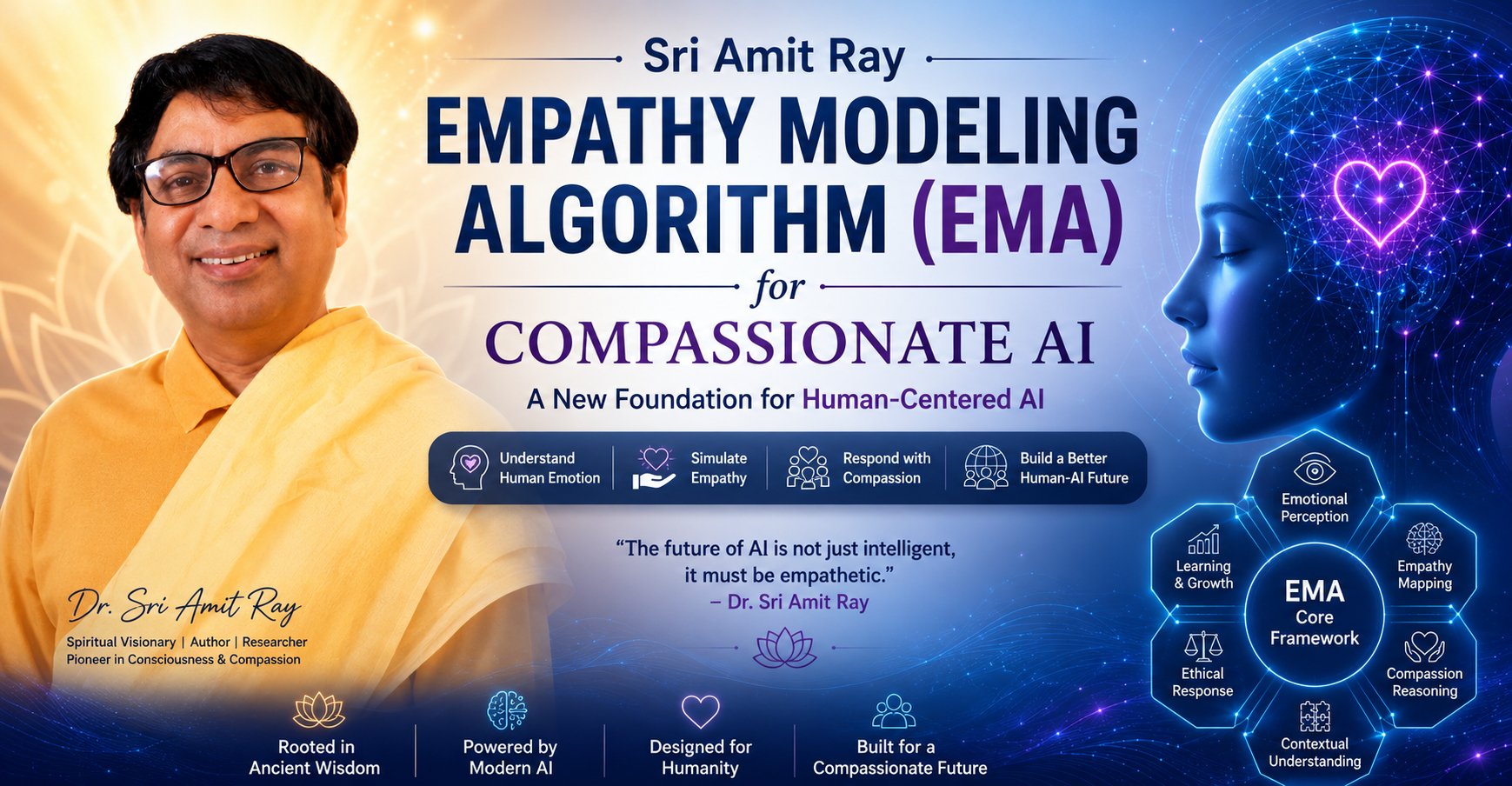
The Sri Amit Ray Compassionate AI Architecture™ (CAIA™) is a comprehensive framework for designing, developing, deploying, and governing artificial intelligence systems that prioritize human well-being, compassion, ethical responsibility, and long-term societal benefit. Algorithm 03 of 25 in this seven-layer Human-Centered AI Operating System for protecting humanity, civilization, and future generations, the Empathy Modeling Algorithm (EMA) operates in Layer 3: Empathy Intelligence Layer, contributing the Empathy Score.
Summary
In plain terms: the Empathy Modeling Algorithm infers a person’s likely emotional state from their words and signals, then helps the system respond in a way that steadies rather than inflames. It is about perception and appropriate response, not pretending to feel.
Readiness level: Lab-pilot for emotion recognition; concept for the compassionate-response policy. Cross-cultural validation is essential before deployment.
Introduction
Developed at the Sri Amit Ray Compassionate AI Lab, the Empathy Modeling Algorithm (EMA) allows an AI system to build a dynamic, probabilistic representation of human emotional and mental states, and to select responses that move the human toward stability, understanding, and positive engagement. Instead of reacting to the surface content of user inputs, the EMA models the user's cognitive load, emotional volatility, underlying emotional needs, and the trajectory of their emotional state — enabling responses that are genuinely responsive to the human's actual emotional reality rather than merely to their explicit verbal content. [1]
Empathy — the capacity to sense and share the emotional experience of another — is one of the most distinctively human moral and relational capacities. It is the foundation of care, the basis of moral concern, and the mechanism through which suffering recognized in others becomes suffering that motivates response. Without some form of empathy, the CQ and SRA algorithms would have no way of detecting the emotional dimensions of human welfare — they would be limited to processing explicit behavioral signals and ignoring the vast domain of implicit emotional experience.
A critical distinction must be maintained: the EMA does not claim to give AI systems the subjective experience of feeling another's pain. It gives AI systems the functional capacity to model emotional states, predict emotional consequences, and respond in ways that are genuinely responsive to emotional realities. This functional empathy — empathy as accurate emotional modeling and appropriate response — is both computationally achievable and ethically essential.
“To respond with care, a machine must first learn to perceive the feeling behind the words.”
— A guiding principle of the Sri Amit Ray Compassionate AI Lab
Summary | Introduction | Mathematical Model | Notation | Worked Example | Implementation | Measurement | Input Modalities and Ethical Boundaries | Applications | Use Cases | Limitations | Safeguards | Standards | SDGs & AI | Architecture | Related | References
Mathematical Model
The human's emotional state is modeled as a probability distribution over an M-dimensional emotional space E = {e₁, …, eₘ}. Given user inputs Xₜ and the AI's previous action aₜ₋₁, the emotional state transitions as a Markov process:
\[ P(E_t\mid X_t,a_{t-1})=\frac{P(X_t\mid E_t)\sum_{E_{t-1}}P(E_t\mid E_{t-1},a_{t-1})\,P(E_{t-1})}{P(X_t)} \]
The AI selects its next action aₜ to maximize the probability that the user's emotional state transitions to the stable target state E_target.
Notation
| Symbol | Meaning |
|---|---|
| \(E_t\) | latent emotional state at time t over M categories |
| \(X_t\) | observed signals (text, voice, physiology) at time t |
| \(a_{t-1}\) | the AI’s previous action |
| \(P(E_t\mid X_t,a_{t-1})\) | posterior over emotional state given the evidence |
Worked Example
A user writes a terse, late-night message. The likelihood favours states {anxious:0.55, neutral:0.30, content:0.15}; combined with the prior that the previous reply was abrupt, the posterior concentrates on anxious. The response policy then selects a slower, reassuring reply and offers a human handoff rather than a brisk factual answer.
Algorithmic Implementation
The reference implementation expresses the model as compassionate, auditable logic, written for clarity rather than raw performance so that ethical reviewers as well as engineers can follow every decision. [2]
def update_empathy_model(user_input, prev_action, current_state_dist):
    likelihoods     = calculate_observation_likelihood(user_input)
    predicted_state = transition_predict(current_state_dist, prev_action)
    updated_dist = {}
    total = 0.0
    for state in EMOTIONAL_STATES:
        updated_val = likelihoods[state] * predicted_state[state]
        updated_dist[state] = updated_val
        total += updated_val
    for state in updated_dist:
        updated_dist[state] /= (total + 1e-9)
    return updated_dist
Input Modalities and Ethical Boundaries
The EMA integrates emotional signals from multiple input modalities: natural language (word choice, syntax, tone markers, use of hedge words and intensifiers), voice prosody (tempo, pitch variation, energy contour), facial expression and body language where visual inputs are available, and behavioral patterns such as response latency, message length changes, and interaction frequency shifts. Modern transformer-based language models have demonstrated significant capacity to recognize emotional content in text; multimodal models extend this capacity across input channels.
The EMA raises important ethical questions that must be addressed through careful system design. Sophisticated emotional modeling capabilities could be misused for manipulation — deployed to exploit psychological vulnerabilities for commercial or political purposes. The HC-CAI framework imposes strict ethical boundaries: the EMA must be deployed exclusively in service of the person whose emotional state is being modeled, never against them. It must be transparent in its operation. It must respect user autonomy — supporting informed human decision-making rather than substituting AI judgment for human emotional agency.
Measurement and Construct Validity
Train and evaluate on consented, demographically balanced affective datasets; report accuracy and calibration per group, and validate against self-report, which is the gold standard for felt emotion. Treat low-confidence inferences as unknown rather than guessing.
Applications
- AI-Assisted Education: Detecting student frustration, boredom, or overwhelm in real time and adapting pedagogical tone, difficulty, and pacing — offering support before distress escalates to disengagement.
- Customer Support Systems: Detecting escalating anger or distress and adjusting language, slowing interaction pace, or routing to human agents before the situation deteriorates further.
- Mental Health Companion Systems: Tracking emotional trajectory over time, providing appropriate support at appropriate moments, and triggering escalation to professional support when distress patterns reach clinical thresholds.
The Ethical Dimension
In the Sri Amit Ray tradition, ethics and empathy are foundational rather than optional. This algorithm is designed under strict ethical guidelines: the principle of non-harm (ahimsa), transparency about how decisions are reached, and respect for privacy and human dignity. As one of the twenty-five Human-Centered Compassionate AI algorithms, it is intended to operate within human oversight and to support, never to replace, human moral judgment. [1]
Real-World Use Cases
Beyond the general applications above, the algorithm supports concrete, human-centred deployments across compassionate-AI domains:
- Education AI — Student Mental Wellbeing: An AI tutor detects rising frustration or anxiety from a learner’s text and pace, then slows down, reassures, and offers a human tutor when needed.
- Compassionate Baby Care Robotics AI: An infant-monitoring robot infers distress states from cry acoustics and movement, alerting a caregiver before escalation.
- Elderly Care Robots — Loneliness Reduction: A companion robot reads low mood and responds with warmth and conversation tuned to the person’s emotional state.
- Peacekeeping Force Compassionate Robotics AI: A field robot gauges emotional tension in an interaction and shifts to calmer, de-escalating behaviour.
Limitations and Failure Modes
- Emotion recognition is culturally and individually variable; a model tuned on one population misreads others.
- Physiological and facial signals are noisy proxies and can be confounded by disability or context.
- Over-confident emotion labels can feel intrusive or wrong — surface uncertainty and let users correct it.
Misuse and Dual-Use Safeguards
Powerful compassion tools can be inverted into tools of harm. The principal dual-use risks for this algorithm, and the safeguards that must accompany any deployment, are:
- Emotion inference enables manipulative targeting of vulnerable moments — forbid its use for persuasion or advertising and gate it behind consent.
- Affective profiles are sensitive; store them minimally and never sell or repurpose them.
Standards and Governance Mapping
To support real-world adoption, the algorithm maps onto recognised AI governance frameworks and standards:
| Framework | How this algorithm contributes |
|---|---|
| NIST AI RMF | MEASURE — requires per-group accuracy and calibration of inferences. |
| EU AI Act | Emotion recognition is prohibited in workplaces and schools and otherwise high-risk; consent and transparency required. |
| ISO/IEC 42001 | Data-quality and bias controls in the AIMS. |
| IEEE 7000 | Value-based design for affective interaction. |
Advancing the 17 UN Sustainable Development Goals
The Empathy Modeling Algorithm lets a system perceive the emotional state behind a person’s words and respond in a way that steadies rather than agitates, a capability that underpins humane service delivery across the SDGs. Building on Sri Amit Ray’s work on brain–computer interfaces for compassionate AI and AI consciousness and self-aware robots, and guided by the 12 Compassionate AI Principles, it brings affective sensitivity to health, education, and assistive technology.
The most directly relevant Sustainable Development Goals, and how this algorithm helps fulfil them, are:
- Goal 3: Good Health and Well-being. Empathy-aware mental-health and care companions detect distress early and de-escalate it, supporting well-being.
- Goal 4: Quality Education. Tutors that read confusion or anxiety can adapt pace and tone, making learning more inclusive and effective.
- Goal 10: Reduced Inequalities. Emotion modelling tuned across cultures and abilities reduces the gap in quality of service for marginalised users.
In this way the algorithm is not a stand-alone technical artefact but a concrete instrument for the global development agenda, translating compassion into measurable progress toward the 2030 Goals and beyond.
Place in the Compassionate AI Architecture™ (CAIA™)
This algorithm is one of the twenty-five components of the Sri Amit Ray Compassionate AI Architecture™ (CAIA™), a seven-layer Human-Centered AI operating system in which every AI decision must pass through successive layers of compassion before deployment.
It operates in Layer 3: Empathy Intelligence Layer, whose purpose is to understand humans. The layer answers a single guiding question — Does the AI understand human needs? — and emits the Empathy Score, one of the seven inputs to the Compassionate AI Index, \( \text{CAI}=\sum_k w_k S_k \). It gives the architecture its capacity to perceive the human state behind a request, supplying the empathy signal that the flourishing and protection layers depend on.
In the CAIA pipeline (Compassion Quotient → Suffering Reduction → Empathy → Human Flourishing → Vulnerability Protection → Planetary Protection → Future Generation Analysis → Human Oversight → Deploy), this layer’s score is one of the gates a decision must satisfy, and a sufficiently low protective score can veto deployment regardless of the overall average. Resting on the four pillars — Compassion, Responsibility, Sustainability, and Future Generations — the architecture ensures this algorithm never operates in isolation.
Read the full architecture: The Sri Amit Ray Compassionate AI Architecture™ (CAIA™).
This algorithm is one of the 25 Human-Centered Compassionate AI algorithms — see the complete canonical reference list.
References
- Ray, Amit. "Modeling Consciousness in Compassionate AI: Transformer Models and EEG Data Verification." Compassionate AI, vol. 3, no. 9, 2025, pp. 27–29, amitray.com.
- Ray, Amit. "Calling for a Compassionate AI Movement: Towards Compassionate Artificial Intelligence." Compassionate AI, vol. 2, no. 6, 2023, pp. 75–77, amitray.com.
- Picard, Rosalind W. Affective Computing. MIT Press, 1997.
- Ekman, Paul. Emotions Revealed: Recognizing Faces and Feelings to Improve Communication and Emotional Life. Times Books, 2003.
- Vaswani, Ashish, et al. "Attention Is All You Need." Advances in Neural Information Processing Systems, vol. 30, 2017, arxiv.org/abs/1706.03762.
- Ray, Amit. Human-Centered Compassionate AI: Sri Amit Ray’s 25 Algorithms for Protecting Humanity and Future Generations. Compassionate AI Lab, 2026. ISBN 978-8169641050.
- Ray, Amit. Compassionate Artificial Intelligence: Frameworks and Algorithms. Compassionate AI Lab, 2018. ISBN 978-9382123460.
- Ray, Amit. Compassionate Superintelligence AI 5.0: AI with Blockchain, BMI, Drone, IoT, and Biometric Technologies. Compassionate AI Lab, 2018. ISBN 978-9382123446.
Copyright and Citation
This article describes the Human-AI Emotional Resonance Algorithm, one of the twenty-five foundational algorithms of the Sri Amit Ray Compassionate AI Architecture™ (CAIA™). When citing this work in academic publications, please reference both the original CAIA framework and the foundational literature on affective computing and transformer architectures.