
Abstract
The Compassion Quotient (CQ) Algorithm for Compassionate AI is a quantitative framework designed to measure the net compassionate impact of artificial intelligence decisions on individuals, communities, and society. It introduces a formal metric that integrates human flourishing, emotional resilience, suffering, and material or social harm into a single auditable score. Unlike conventional AI optimization functions that prioritize accuracy, efficiency, or profit, the CQ Algorithm explicitly incorporates ethical weighting—especially amplifying the moral significance of vulnerable populations.
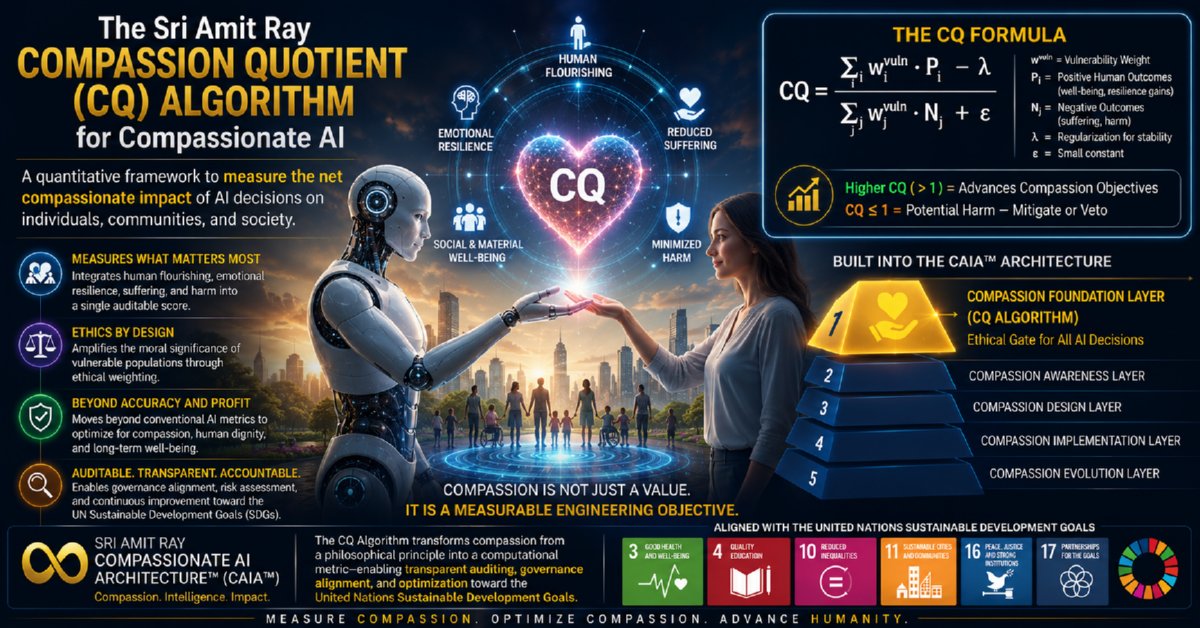
Mathematically, CQ is defined as the ratio of vulnerability-weighted positive human outcomes (such as well-being and resilience gains) to vulnerability-weighted negative outcomes (such as suffering and harm), with regularization to ensure stability. A positive and higher CQ score indicates that an AI action advances compassion objectives, while a lower or negative score signals potential harm requiring mitigation or veto.
Positioned in Layer 1 (Compassion Foundation Layer) of the Sri Amit Ray Compassionate AI Architecture™ (CAIA™), the CQ Algorithm serves as the foundational ethical gate through which all AI decisions must pass before deployment. It operationalizes compassion as a measurable engineering objective, enabling transparent auditing, governance alignment, and optimization toward the United Nations Sustainable Development Goals (SDGs). By transforming compassion from a philosophical principle into a computational metric, the CQ Algorithm provides a practical pathway toward accountable, human-centered, and future-oriented artificial intelligence systems.
Plain-Language Summary
In plain terms: the Compassion Quotient gives an AI a single, auditable score for how much a decision helps or harms the people it touches, weighting harm to the most vulnerable most heavily. Use it to compare options and to flag choices that look efficient but quietly cause harm.
Readiness level: Concept-to-simulation. The scoring structure is well defined; the input metrics require validated instruments and field calibration before clinical or financial deployment.
Introduction
Developed at the Sri Amit Ray Compassionate AI Lab, the Compassion Quotient (CQ) Algorithm provides a quantitative metric to evaluate the compassionate impact of an AI system's actions on human subjects and societies. It moves beyond traditional utility functions by weighing positive emotional and social growth against any generated stress, anxiety, or material harm. Just as the Intelligence Quotient (\(\text{IQ}\)) attempts to quantify cognitive ability and the Emotional Quotient (\(\text{EQ}\)) attempts to quantify emotional intelligence, the CQ Algorithm quantifies the compassion impact of AI decisions — dynamically, contextually, and across every affected individual. [1]
The motivation for the \(\text{CQ}\) is the recognition that conventional AI performance metrics are profoundly incomplete as measures of AI quality. An AI system can achieve 99% accuracy on its primary task while systematically causing harm across dimensions that its performance metrics do not capture. A content recommendation system can dramatically increase engagement time while damaging users' mental health. A hiring system can reduce time-to-hire while perpetuating structural discrimination. Without a metric that captures compassion impact, these harms are invisible to the optimization process — and what is invisible to optimization is invisible to accountability.
The \(\text{CQ}\) is not a static score but a dynamic, contextually sensitive measure that evaluates each significant AI decision or output for its net compassion value — the degree to which it reduces suffering, preserves dignity, promotes well-being, and advances the conditions for human flourishing.
- \(\text{CQ} > 0\) — the action advances compassion objectives.
- \(\text{CQ} < 0\) — the action produces net harm.
- \(\text{CQ} = 0\) — the action is neutral.
AI systems should seek to maximize the average \(\text{CQ}\) across their population of decisions, subject to accuracy, efficiency, and other operational constraints.
"A measure of intelligence is incomplete until it can also measure compassion."
— A guiding principle of the Sri Amit Ray Compassionate AI Lab
Mathematical Model
For a set of affected individuals \(i \in \{1, \ldots, N\}\), the Compassion Quotient \(\text{CQ}(a)\) for a proposed action \(a\) is defined as:
Where the component variables are defined as follows:
- \(F_i(a) \in [0,1]\) — Flourishing metric of individual \(i\) under action \(a\).
- \(R_i(a) \in [0,1]\) — emotional Resilience coefficient of individual \(i\).
- \(S_i(a) \in [0,1]\) — estimated Suffering index of individual \(i\).
- \(H_i(a) \in [0,1]\) — material / social Harm index of individual \(i\).
- \(w_i^F,\, w_i^R > 0\) — positive weighting factors, dynamically scaled by user vulnerability.
- \(v_i^S,\, v_i^H > 0\) — negative weighting factors, dynamically scaled by user vulnerability.
- \(\varepsilon > 0\) — small regularisation constant preventing division by zero.
Vulnerability weighting principle: Users with higher vulnerability scores receive proportionally higher weights on both benefit and harm terms, so that harm to the most vulnerable is never averaged away by the majority. Formally, if \(\text{vuln}(i)\) denotes the vulnerability score of individual \(i\), then \(w_i^F,\, w_i^R,\, v_i^S,\, v_i^H\) are all non-decreasing functions of \(\text{vuln}(i)\).
| Component | Description | Range |
|---|---|---|
| \(F_i(a)\) | Flourishing metric of individual \(i\) | $[0,\,1]$ |
| \(R_i(a)\) | Emotional resilience coefficient of individual \(i\) | $[0,\,1]$ |
| \(S_i(a)\) | Estimated suffering index of individual \(i\) | $[0,\,1]$ |
| \(H_i(a)\) | Material / social harm index of individual \(i\) | $[0,\,1]$ |
| \(w_i^F,\; w_i^R\) | Vulnerability-scaled positive (benefit) weights | $> 0$ |
| \(v_i^S,\; v_i^H\) | Vulnerability-scaled negative (harm) weights | $> 0$ |
| \(\varepsilon\) | Regularisation constant preventing division by zero | $> 0$ |
| \(N\) | Total number of affected individuals | \(\mathbb{Z}^{+}\) |
Notation Reference
| Symbol | Meaning |
|---|---|
| \((F_i,\, R_i)\) | Flourishing and resilience gains for person \(i\), each in $[0,1]$ |
| \((S_i,\, H_i)\) | Suffering and material/social harm for person \(i\), each in $[0,1]$ |
| \((w^F,\, w^R)\) | Vulnerability-scaled weights on benefit terms |
| \((v^S,\, v^H)\) | Vulnerability-scaled weights on harm terms |
| \(\varepsilon\) | Small positive regularisation constant; prevents division by zero |
| \(\text{CQ}(a)\) | Compassion Quotient of action \(a\); positive = net compassionate |
| \(\text{CAI}\) | Composite Compassionate AI Index: \(\text{CAI} = \sum_{k} w_k S_k\) |
Worked Example
Consider a single user (\(N = 1\)) and a recommender system evaluating two content variants. Set equal weights \(w^F = w^R = v^S = v^H = 1\) and \(\varepsilon = 0.01\).
Variant A — Balanced content
Predicted scores: \(F = 0.6\), \(R = 0.5\), \(S = 0.2\), \(H = 0.1\).
Variant B — High-engagement / high-stress
Same benefit scores, but suffering rises to \(S = 0.7\): \(F = 0.6\), \(R = 0.5\), \(S = 0.7\), \(H = 0.1\).
Interpretation: Both variants yield identical benefit numerators (\(F + R = 1.1\)), yet Variant B's higher suffering collapses \(\text{CQ}\) from \(\approx 3.55\) to \(\approx 1.36\). The score makes the hidden cost immediately visible — no manual inspection of raw distress signals required.
| Variant | \(F\) | \(R\) | \(S\) | \(H\) | \(\text{CQ}\) |
|---|---|---|---|---|---|
| A — Balanced | 0.6 | 0.5 | 0.2 | 0.1 | ≈ 3.55 |
| B — High-stress | 0.6 | 0.5 | 0.7 | 0.1 | ≈ 1.36 |
Algorithmic Implementation
The reference implementation below expresses the model as compassionate, auditable logic, written for clarity rather than raw performance so that ethical reviewers as well as engineers can follow every decision. [2] The Python function directly mirrors the formula \[ \text{CQ}(a) = \frac{\sum_i \bigl[ w_i^F F_i + w_i^R R_i \bigr]} {\sum_i \bigl[ v_i^S S_i + v_i^H H_i \bigr] + \varepsilon} \] with vulnerability-scaled weights retrieved from each stakeholder object.
def calculate_compassion_quotient(action, stakeholders, epsilon=1e-5):
    """
    Compute the Compassion Quotient (CQ) for a proposed AI action.

    Implements:
        CQ(a) = SUM_i [ w_F * F_i + w_R * R_i ]
              / ( SUM_i [ v_S * S_i + v_H * H_i ] + epsilon )

    Parameters
    ----------
    action       : the AI decision or output to be evaluated
    stakeholders : iterable of Stakeholder objects, each carrying
                   vulnerability scores and weight accessors
    epsilon      : regularisation constant  (default 1e-5)

    Returns
    -------
    float — CQ score;  > 0 = net compassionate,  < 0 = net harmful
    """
    numerator   = 0.0
    denominator = 0.0

    for s in stakeholders:
        # ── Benefit components  (numerator) ──────────────────────────
        F = evaluate_flourishing(action, s)   # F_i  in [0, 1]
        R = evaluate_resilience(action, s)    # R_i  in [0, 1]

        # ── Harm components  (denominator) ───────────────────────────
        S = evaluate_suffering(action, s)     # S_i  in [0, 1]
        H = evaluate_harm(action, s)          # H_i  in [0, 1]

        # ── Vulnerability-scaled weights ──────────────────────────────
        w_F, w_R = s.get_positive_weights()   # higher for vulnerable users
        v_S, v_H = s.get_negative_weights()   # higher for vulnerable users

        numerator   += (w_F * F) + (w_R * R)
        denominator += (v_S * S) + (v_H * H)

    return numerator / (denominator + epsilon)
The CQ in Practice: Three Measurement Scales
The \(\text{CQ}\) Algorithm operates across three measurement scales simultaneously, each contributing to the final composite score.
⬤ Individual Scale
At the individual scale, \(\text{CQ}\) measures the effect of an AI decision on the welfare, dignity, autonomy, and emotional state of the directly affected person. A medical AI recommendation that is technically accurate but communicated without empathy — delivering a serious diagnosis without supporting the patient's emotional response or decision-making process — may score well on accuracy metrics but poorly on individual \(\text{CQ}\) if it causes unnecessary distress or fails to support informed consent.
⬤ Community Scale
At the community scale, \(\text{CQ}\) evaluates the effects of AI decisions on the social fabric: trust between institutions and citizens, community cohesion, cultural integrity, and the equitable distribution of benefits and burdens. A hiring AI that appears individually fair but systematically disadvantages particular communities — because its training data reflects historical patterns of exclusion not yet visible as overt discrimination at the individual level — scores poorly on community \(\text{CQ}\).
⬤ Societal Scale
At the societal scale, \(\text{CQ}\) assesses long-term effects on democratic institutions, social norms, power distributions, and the conditions for collective human flourishing. An AI system that concentrates decision-making power in ways that undermine democratic accountability scores poorly on societal \(\text{CQ}\) regardless of its individual-level performance.
Measurement and Construct Validity
Validated instruments: The four input variables of \(\text{CQ}(a)\) can be operationalised with established psychometric tools. Report inter-rater reliability for each instrument, and treat the weights \(w_i^F, w_i^R, v_i^S, v_i^H\) as explicit governance decisions, not hidden constants.
| CQ Variable | Suggested Validated Instrument |
|---|---|
| \(F_i\) — Flourishing | PERMA Profiler; WHO-5 Well-Being Index |
| \(R_i\) — Resilience | Connor-Davidson Resilience Scale (CD-RISC) |
| \(S_i\) — Suffering | PROMIS Emotional Distress Measures |
| \(H_i\) — Harm | Documented incident rates; complaint logs; independent audit trails |
Applications
The \(\text{CQ}\) Algorithm is not a theoretical construct alone — it is an operational instrument deployable across any domain where AI decisions touch human lives. The six application areas below span the breadth of the 12 Compassionate AI Principles and map directly onto the UN Sustainable Development Goals, demonstrating how a single auditable score can redirect AI optimization away from efficiency-only objectives and toward measurable human flourishing.
Credit Scoring and Social Loans
SDG 1 · No Poverty SDG 8 · Decent Work SDG 10 · Reduced Inequalities
Conventional credit-scoring models optimise for default-rate minimisation, a narrow objective that frequently encodes and amplifies historical patterns of economic exclusion. The \(\text{CQ}\) Algorithm reframes the optimisation target: instead of minimising lender risk alone, the system maximises net community flourishing \(\sum_i w_i^F F_i(a)\) while penalising decisions that increase household suffering \(\sum_i v_i^S S_i(a)\) — such as predatory interest structures or opaque rejection processes that deny applicants actionable feedback.
In practice, a microfinance platform serving rural smallholders can use \(\text{CQ}\) to compare two loan products: one with a lower headline interest rate but rigid repayment schedules that correlate with seasonal income volatility (high \(S_i\), high \(H_i\)), and another with a slightly higher rate but flexible repayment terms that preserve household resilience (high \(R_i\)). The \(\text{CQ}\) score surfaces the second product as the compassionate choice even when the first scores better on conventional risk metrics, directly advancing SDG 1 (No Poverty) and SDG 10 (Reduced Inequalities).
Content Recommendation Systems
SDG 3 · Good Health & Well-being SDG 16 · Peace & Justice
Digital platforms optimised purely for engagement time have been empirically linked to increases in anxiety, polarisation, and erosion of epistemic trust — harms that are invisible to click-through-rate or watch-time metrics. The \(\text{CQ}\) Algorithm reorients the recommendation objective: for each candidate item \(a\), the system estimates the degree to which consuming that item will leave the user with higher \(F_i\) (informed, connected, capable of trust) and lower \(S_i\) (anxious, outraged, isolated) than the counterfactual of not consuming it.
A news aggregator deployment might learn that long-form explanatory articles on complex topics produce \(\text{CQ} \approx 4.2\) on average — users finish more informed and report lower distress — while algorithmically amplified outrage content targeting the same topic produces \(\text{CQ} \approx 0.8\), with near-identical engagement time but significantly higher \(S_i\). The platform's ranking function is then modified to weight \(\text{CQ}\) alongside relevance and freshness, producing a feed that maximises both user attention and compassion impact. This directly supports SDG 3 (Good Health and Well-being) and SDG 16 (Peace, Justice, and Strong Institutions) by reducing digital harms at population scale.
Healthcare Treatment Recommendations
SDG 3 · Good Health & Well-being SDG 10 · Reduced Inequalities
Clinical AI systems are typically evaluated on diagnostic accuracy, treatment efficacy, and resource utilisation — all necessary, none sufficient. A treatment recommendation that is clinically optimal but communicated without empathy, or that performs equitably on average but systematically underserves minority populations, may score well on conventional metrics while generating net harm on the human dimensions that matter most to patients and families.
The \(\text{CQ}\) Algorithm extends clinical evaluation to include: the quality of the care experience (communication compassion, emotional support, patient-reported dignity); informed-consent quality (the degree to which the patient understands and genuinely consents to their treatment path); and demographic equity (whether \(\text{CQ}\) is consistent across patient subgroups, or whether it masks low scores for vulnerable populations behind high scores for the majority). A hospital deploying an AI triage system can use \(\text{CQ}\) to audit whether the system's prioritisation decisions reduce aggregate suffering \(\sum_i v_i^S S_i(a)\) equitably, or whether they concentrate harm on the most vulnerable in ways invisible to aggregate accuracy metrics.
Equitable Education Access and Personalised Learning
SDG 4 · Quality Education SDG 10 · Reduced Inequalities
AI-driven adaptive learning platforms face a structural tension: optimising purely for test-score improvement can narrow the curriculum, increase examination anxiety, and systematically disadvantage learners with disabilities, non-standard learning profiles, or limited access to prerequisite resources. A personalised learning system guided by \(\text{CQ}\) scores each pedagogical recommendation not only for its predicted effect on measured attainment (\(F_i^{\text{learning}}\)) but simultaneously for its effect on the learner's curiosity, autonomy, and psychological safety (\(R_i^{\text{academic}}\)) and its potential to increase test-related distress (\(S_i^{\text{anxiety}}\)) or to widen attainment gaps between advantaged and disadvantaged cohorts (\(H_i^{\text{equity}}\)).
Consider a secondary school deploying an AI tutor for mathematics. The system has two instructional strategies for a struggling learner: an intensive drill regime that historical data suggest will raise scores by 12% but increase self-reported anxiety by 40%, versus a scaffolded discovery approach that raises scores by 9% but increases learner confidence and reduces anxiety. The \(\text{CQ}\) score — by weighting suffering alongside flourishing — flags the second strategy as the compassionate choice, even though it ranks lower on the narrow attainment metric. Aggregated across a national platform, this reorientation can measurably advance SDG 4 Target 4.1 (inclusive, equitable quality education) and Target 4.7 (education for sustainable development and global citizenship).
Inclusive Urban Planning and Smart City Infrastructure
SDG 11 · Sustainable Cities & Communities SDG 13 · Climate Action
Smart city AI systems allocate public resources — traffic signal timing, public-transport routing, emergency-service dispatch, energy grid load-balancing — across populations with radically different vulnerabilities. An optimiser that minimises average commute time may simultaneously reduce accessibility for wheelchair users, concentrate air-pollution exposure in lower-income neighbourhoods, and deprioritise emergency services in underserved districts. These harms are structurally invisible to efficiency metrics but immediately visible to \(\text{CQ}\).
A city deploying AI-assisted public-transport scheduling can evaluate each proposed timetable \(a\) by computing \(\text{CQ}(a)\) across the full resident population, with vulnerability weights \(v_i^S\) and \(v_i^H\) calibrated to age, disability status, income decile, and proximity to green space. A timetable that serves the downtown business district efficiently but eliminates the last connection to a peripheral neighbourhood where elderly residents depend on the bus for medical appointments will score well on average delay metrics but poorly on \(\text{CQ}\), because the harm \(H_i\) to those residents — who receive high vulnerability weights — dominates the aggregate denominator. This creates an auditable, governance-ready signal that urban planners and elected officials can use to justify and communicate resource-allocation decisions, advancing SDG 11 (Sustainable Cities and Communities) and SDG 13 (Climate Action) through transport systems that are both low-emission and socially just.
Climate Adaptation and Humanitarian Resilience
SDG 13 · Climate Action SDG 2 · Zero Hunger SDG 15 · Life on Land
Climate change is not a uniform threat: its harms — extreme weather events, food insecurity, displacement, ecosystem collapse — fall disproportionately on the most vulnerable populations and the least-resourced nations. AI systems deployed in climate adaptation contexts — agricultural advisory systems, early-warning platforms, disaster resource allocation engines — routinely face decisions where the most statistically efficient choice at the aggregate level causes concentrated harm at the individual level among those least able to absorb it.
The \(\text{CQ}\) Algorithm is directly applicable to these decisions. An agricultural AI advising smallholder farmers in drought-prone regions can score each recommended practice change \(a\) for its projected effect on household food security (\(F_i^{\text{food}}\)), long-term soil resilience (\(R_i^{\text{land}}\)), financial distress from crop failure (\(S_i^{\text{loss}}\)), and irreversible land degradation (\(H_i^{\text{environ}}\)). Farmers operating at subsistence margins, where a single failed season can be catastrophic, receive the highest vulnerability weights, ensuring that recommendations that carry tail-risk of catastrophic failure score poorly on \(\text{CQ}\) even if they offer higher expected yields.
At a regional scale, a climate early-warning platform can use \(\text{CQ}\) to prioritise alert dissemination: rather than broadcasting uniformly, the system identifies which communities face the highest \(v_i^S \cdot S_i + v_i^H \cdot H_i\) under an incoming weather event and ensures those communities receive first-priority communication and resource pre-positioning. This operationalises the Compassionate AI Lab Declaration on AI Safety and the Protection of Humanity in one of the most urgent real-world domains, advancing SDG 13 (Climate Action), SDG 2 (Zero Hunger), and SDG 15 (Life on Land) through AI that is measurably just as well as technically capable.
Application–SDG Mapping at a Glance
| Application Area | Primary \(\text{CQ}\) Signal | SDGs Advanced |
|---|---|---|
| Credit Scoring & Social Loans | Penalises predatory structures; rewards community resilience | 1, 8, 10 |
| Content Recommendation | Demotes outrage; promotes epistemic flourishing | 3, 16 |
| Healthcare AI | Rewards equitable, compassionate care experience | 3, 10 |
| Education AI | Balances attainment with well-being and equity | 4, 10 |
| Smart Cities & Urban Planning | Flags exclusion and environmental harm in infrastructure decisions | 11, 13 |
| Climate Adaptation & Humanitarian Resilience | Prioritises the most vulnerable in resource allocation and early warning | 2, 13, 15 |
More Applications
- Credit Scoring and Social Loans: Prioritizing loan disbursement algorithms that maximize community flourishing rather than predatory interest extraction, using \(\text{CQ}\) to flag decisions that reduce net community welfare.
- Content Recommendation Systems: Shifting the optimization objective from maximizing engagement time to maximizing the \(\text{CQ}\) of the content experience — the degree to which content consumed leaves users more informed, more resilient, and more connected rather than more anxious, more polarized, and less capable of trust.
- Healthcare Treatment Recommendations: Evaluating treatment AI not only for clinical accuracy but for the quality of the care experience — communication compassion, emotional support, informed-consent quality, and equitable performance across patient demographics.
Real-World Use Cases
🏙️ Smart Cities
A municipal benefits platform uses \(\text{CQ}\) to compare allocation policies, choosing the option with the highest net compassion across residents — not the lowest processing cost.
🎓 Education AI
A learning platform scores each recommendation for its effect on understanding and stress, demoting content that raises test scores while increasing \(S_i\) (suffering).
🌊 Humanitarian Response
During a flood, relief options are ranked by net \(\sum_i (v_i^S S_i)\) reduction across all affected groups, surfacing choices that protect the most exposed communities.
🤖 Eldercare Robotics
Care-robot interactions are evaluated for dignity and comfort rather than task completion alone, flagging brusque-but-efficient routines whose \(\text{CQ}\) falls below threshold for human-centred redesign.
The Ethical Dimension
In the Sri Amit Ray tradition, ethics and empathy are foundational rather than optional. This algorithm is designed under strict ethical guidelines: the principle of non-harm (ahimsa), transparency about how decisions are reached, and respect for privacy and human dignity. As one of the twenty-five Human-Centered Compassionate AI algorithms, it is intended to operate within human oversight and to support, never replace, human moral judgment. [1]
Limitations and Failure Modes
- Metric quality dependency: The \(\text{CQ}\) score is only as trustworthy as its input metrics \(F_i, R_i, S_i, H_i\). Poorly validated proxies produce precise but meaningless numbers.
- Aggregation masking: A high mean \(\text{CQ}\) can conceal harm to a minority behind large benefits to a majority. Always report the full distribution \(\{\text{CQ}_i\}\), not just \(\overline{\text{CQ}}\).
- Weight gaming: The weights \(w_i^F, w_i^R, v_i^S, v_i^H\) encode value judgements and can be manipulated. They must be set transparently, documented, and reviewed by independent parties.
Misuse and Dual-Use Safeguards
Powerful compassion tools can be inverted into tools of harm. The principal dual-use risks for this algorithm — and the safeguards that must accompany any deployment — are:
- Benefit-term inflation: A \(\text{CQ}\) optimiser could be tuned to justify harmful products by artificially inflating \(F_i\) or \(R_i\) estimates. Mitigate: require independent audit of all metric definitions and weights before deployment.
- Sensitive data risk: Vulnerability weighting requires sensitive personal data used to scale \(w_i^F, w_i^R, v_i^S, v_i^H\). Mitigate: minimise collection, aggregate wherever possible, and never repurpose vulnerability scores for targeting or profiling.
Standards and Governance Mapping
To support real-world adoption, the \(\text{CQ}\) Algorithm maps onto recognised AI governance frameworks and standards:
| Framework | How This Algorithm Contributes |
|---|---|
| NIST AI RMF | MEASURE — defines a quantitative, monitorable metric of impact and harm. |
| EU AI Act | Supports risk-management and impact-assessment duties for high-risk systems. |
| ISO/IEC 42001 | Feeds AI performance and impact objectives in an AI management system. |
| IEEE 7010 | Aligns with well-being impact assessment for autonomous systems. |
Advancing the 17 UN Sustainable Development Goals
The \(\text{CQ}\) gives an AI system a measurable conscience, and that measurability is what makes it useful for the Sustainable Development Goals. By scoring every significant decision for its net effect on \(S_i\) (suffering), dignity, and \(F_i\) (flourishing) across individuals, communities, and society, the \(\text{CQ}\) turns abstract development commitments into an optimisation target an engineering team can actually monitor. This operationalises the 12 Compassionate AI Principles and the Compassionate AI movement, extending the 10 Ethical AI Indexes from principle into daily practice.
- SDG 3 Good Health and Well-being. A positive \(\text{CQ}\) rewards decisions that protect mental and physical well-being, flagging engagement-maximising designs that quietly erode health by raising \(S_i\).
- SDG 8 Decent Work and Economic Growth. Applied to hiring and credit systems, \(\text{CQ}\) penalises decisions that perpetuate structural discrimination, supporting fair and decent economic participation.
- SDG 10 Reduced Inequalities. By assigning higher \(v_i^S, v_i^H\) to the most vulnerable, \(\text{CQ}\) directly counters the widening of social and economic inequality.
- SDG 16 Peace, Justice, and Strong Institutions. A transparent, auditable \(\text{CQ}\) score strengthens institutional accountability for automated decisions.
In this way the algorithm is not a stand-alone technical artefact but a concrete instrument for the global development agenda, translating compassion into measurable progress toward the 2030 Goals and beyond.
Place in the Compassionate AI Architecture™ (CAIA™)
Figure: This algorithm sits in Layer 1 · Compassion Foundation (highlighted) of the Compassionate AI Architecture™ (CAIA™).
This algorithm is one of the twenty-five components of the Sri Amit Ray Compassionate AI Architecture™ (CAIA™), a seven-layer Human-Centered AI operating system in which every AI decision must pass through successive layers of compassion before deployment.
It operates in Layer 1: Compassion Foundation Layer, whose purpose is to measure compassion. The layer answers the guiding question — Is this action compassionate? — and emits the Compassion (CQ) Score, one of the seven layer scores \(S_k\) that feed the Compassionate AI Index:
As the foundation layer, the Compassion Quotient provides the base measurement on which all higher layers build; no proposed action advances through the stack without first being scored here. Resting on the four pillars — Compassion, Responsibility, Sustainability, and Future Generations — the architecture ensures this algorithm never operates in isolation.
Read the full architecture: The Sri Amit Ray Compassionate AI Architecture™ (CAIA™).
This algorithm is one of the 25 Human-Centered Compassionate AI algorithms — see the complete canonical reference list.
References
- Ray, Amit. "Human Flourishing Optimization Algorithm (HFOA) for Compassionate AI Architecture." Compassionate AI, 2.6 (2026): 81–83. amitray.com/human-flourishing-optimization-algorithm-hfoa-compassionate-ai/
- Ray, Amit. "The Sri Amit Ray Compassionate AI Architecture (CAIA): A Seven-Layer Framework for Human-Centered Artificial Intelligence." Compassionate AI, 2.6 (2026): 81–83. amitray.com/compassionate-ai-architecture/
- Ray, Amit. "AI Consciousness and Self-Aware Robots: Sri Amit Ray's Framework for Compassionate Intelligence." Compassionate AI, 2.5 (2026): 57–59. amitray.com/ai-consciousness-self-aware-robots/
- Ray, Amit. "The 12 Sri Amit Ray Compassionate AI Principles | Ethical AI Framework." Compassionate AI, 2.4 (2026): 12–14. amitray.com/the-12-compassionate-ai-principles-for-humanity-and-future-generations/
- Ray, Amit. "The Compassionate AI Lab Declaration on AI Safety, Suffering Reduction, and the Protection of Humanity." Compassionate AI, 4.12 (2025): 72–74. amitray.com/compassionate-ai-declaration-protection-of-humanity/
- Ray, Amit. "Compassionate AI for Forward Deployed Engineers (FDEs) in SaaS Companies." Compassionate AI, 4.11 (2025): 15–17. amitray.com/compassionate-ai-for-forward-deployed-engineers-fdes-in-saas-companies/
- Ray, Amit. "Microbial AI, Bioleaching and Digital Twins for Manufacturing the 17 Rare Earth Elements." Compassionate AI, 4.10 (2025): 42–44. amitray.com/microbial-ai-bioleaching-and-digital-twins-for-manufacturing-the-17-rare-earth-elements/
- Ray, Amit. "AI-Driven Rare Earth Element Magnet Design: Detailed Methodologies." Compassionate AI, 4.10 (2025): 27–29. amitray.com/ai-driven-rare-earth-elements-magnet-design-methodologies/
- Ray, Amit. "AI Agents and Robots in Peacekeeping Force and Social Care: Compassionate AI Technologies." Compassionate AI, 3.9 (2025): 75–77. amitray.com/ai-agents-robots-peacekeeping-force-social-care-compassionate-ai/
- Ray, Amit. "Ray Mother–Infant Inter-brain Synchrony Algorithm for Deep Compassionate AI." Compassionate AI, 3.9 (2025): 60–62. amitray.com/ray-mother-infant-inter-brain-synchrony-algorithm-deep-compassionate-ai/
- Ray, Amit. "Pain Recognition and Prediction AI Algorithm (PRPA) for Compassionate AI." Compassionate AI, 3.9 (2025): 60–62. amitray.com/pain-recognition-and-prediction-algorithm-prpa-for-compassionate-ai/
- Ray, Amit. "Modeling Consciousness in Compassionate AI: Transformer Models and EEG Data Verification." Compassionate AI, 3.9 (2025): 27–29. amitray.com/modeling-consciousness-in-compassionate-ai-transformer-models/
- Ray, Amit. "The 7 Pillars of Compassionate AI Democracy." Compassionate AI, 3.9 (2024): 84–86. amitray.com/the-7-pillars-of-compassionate-ai-democracy/
- Ray, Amit. "Compassionate AI-Driven Democracy: Power and Challenges." Compassionate AI, 3.9 (2024): 48–50. amitray.com/compassionate-ai-driven-democracy-power-and-challenges/
- Ray, Amit. "The 10 Ethical AI Indexes for LLM Data Training and Responsible AI." Compassionate AI, 3.8 (2023): 35–39. amitray.com/the-10-ethical-ai-indexes-for-responsible-ai/
- Ray, Amit. "Ethical Responsibilities in Large Language AI Models: GPT-3, GPT-4, PaLM 2, LLaMA, Chinchilla, Gopher, and BLOOM." Compassionate AI, 3.7 (2023): 21–23. amitray.com/ethical-responsibility-in-large-language-ai-models/
- Ray, Amit. "Calling for a Compassionate AI Movement: Towards Compassionate Artificial Intelligence." Compassionate AI, 2.6 (2023): 75–77. amitray.com/calling-for-a-compassionate-ai-movement/
- Ray, Amit. "From Data-Driven AI to Compassionate AI: Safeguarding Humanity and Empowering Future Generations." Compassionate AI, 2.6 (2023): 51–53. amitray.com/from-data-driven-ai-to-compassionate-ai-safeguarding-humanity-and-empowering-future-generations/
- Ray, Amit. "Artificial Intelligence for Climate Change, Biodiversity and Earth System Models." Compassionate AI, 1.1 (2022): 54–56. amitray.com/artificial-intelligence-for-climate-change-and-earth-system-models/
- Ray, Amit. "Artificial Intelligence for Balance Control and Fall Detection of Elderly People." Compassionate AI, 4.10 (2018): 39–41. amitray.com/artificial-intelligence-for-balance-control-and-fall-detection-system-of-elderly-people/
- Ray, Amit. "Artificial Intelligence to Combat Antibiotic Resistant Bacteria." Compassionate AI, 2.6 (2018): 3–5. amitray.com/artificial-intelligence-for-antibiotic-resistant-bacteria/
- Ray, Amit. "Navigation System for Blind People Using Artificial Intelligence." Compassionate AI, 2.5 (2018): 42–44. amitray.com/artificial-intelligence-for-assisting-blind-people/
- Ray, Amit. "Brain-Computer Interface and Compassionate Artificial Intelligence." Compassionate AI, 2.5 (2018): 3–5. amitray.com/brain-computer-interface-compassionate-ai/
- Seligman, Martin E. P. Flourish: A Visionary New Understanding of Happiness and Well-being. Free Press, 2011.
- Nussbaum, Martha C. Creating Capabilities: The Human Development Approach. Harvard University Press, 2011.
- Floridi, Luciano, and Josh Cowls. "A Unified Framework of Five Principles for AI in Society." Harvard Data Science Review, vol. 1, no. 1, 2019. doi.org/10.1162/99608f92.8cd550d1
- Ray, Amit. Human-Centered Compassionate AI: Sri Amit Ray's 25 Algorithms for Protecting Humanity and Future Generations. Compassionate AI Lab, 2026. ISBN 978-8169641050.
- Ray, Amit. Compassionate Artificial Intelligence: Frameworks and Algorithms. Compassionate AI Lab, 2018. ISBN 978-9382123460.
- Ray, Amit. Compassionate Superintelligence AI 5.0: AI with Blockchain, BMI, Drone, IoT, and Biometric Technologies. Compassionate AI Lab, 2018. ISBN 978-9382123446.