
Abstract
The Planetary Health Optimization Algorithm weighs human development against ecological sustainability, so that AI serves the thriving of all life on Earth and not only of people. It is grounded in the planetary boundaries framework of Johan Rockström and colleagues, which sets out nine biophysical limits within which humanity can operate safely.
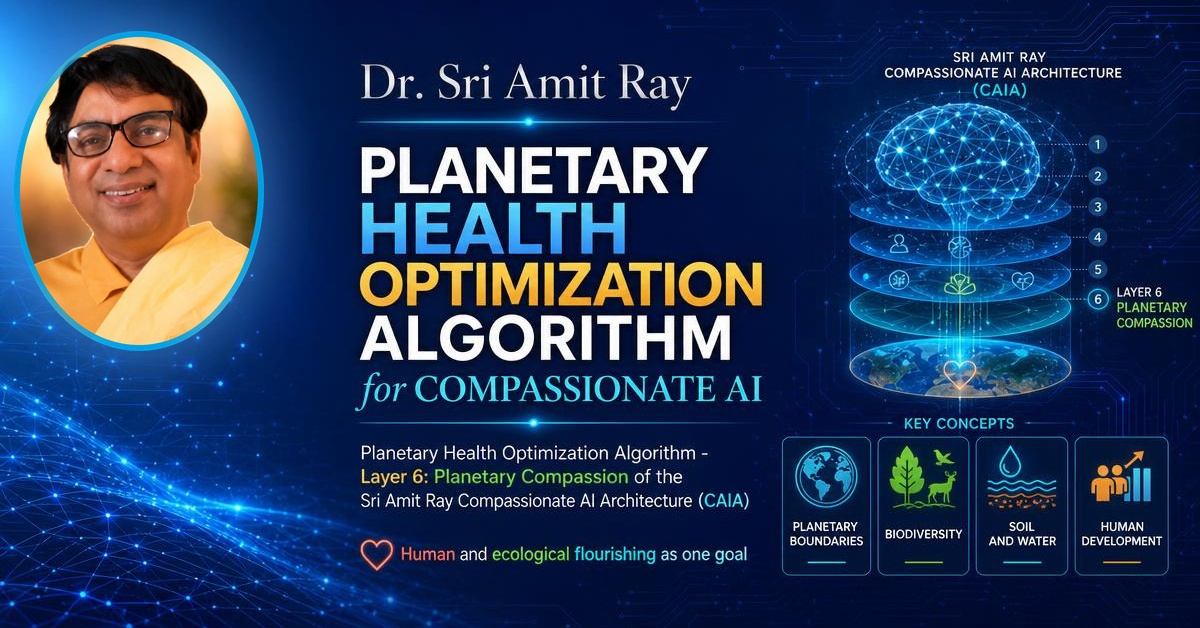
At its heart is a biophilic welfare function: human development plus soil health and biodiversity, minus the depletion of water. Any solution that would break a planetary limit is ruled out. The algorithm is part of Layer 6 (Planetary Compassion) of Sri Amit Ray’s Compassionate AI Architecture™ (CAIA™).
Key Takeaways
- Optimises human development and ecological health together as one objective.
- Rests on the nine planetary boundaries and Kate Raworth’s “doughnut” of social floor and ecological ceiling.
- Rejects any solution that breaches a planetary boundary.
- Contributes to the Planetary Score in the CAIA™ framework.
In Simple Words
In simple terms: the algorithm looks for plans that improve people’s lives while keeping soil, water and wildlife healthy, and it refuses any plan that would push the Earth past its safe limits. Human and ecological flourishing are pursued as a single goal.
Readiness level: Concept-to-simulation for decision-support; suited to policy and land or resource modelling.
Why This Algorithm Matters
The Planetary Health Optimization Algorithm, developed at the Sri Amit Ray Compassionate AI Lab, balances human development with ecological sustainability, putting into practice a vision of AI that serves the flourishing of the whole community of life, not people alone. Its foundation is the idea of planetary boundaries set out by Johan Rockström and colleagues: nine biophysical thresholds for a safe operating space for humanity — climate change, biodiversity loss, land-system change, freshwater use, biogeochemical flows, ocean acidification, ozone depletion, atmospheric aerosol loading, and novel entities such as chemical pollution. [3]
It also draws on Kate Raworth’s Doughnut Economics: humanity must live between a social foundation that no one should fall below and an ecological ceiling that we must not overshoot. For AI, that means respecting both limits at once — meeting everyone’s basic needs while staying inside the planet’s boundaries. A system that reaches its human-welfare targets by overshooting ecological limits is not performing well; it is borrowing from the future to pay for the present.
“Human flourishing and planetary health are not rivals but a single, shared horizon.”
— A guiding principle of the Sri Amit Ray Compassionate AI Lab
The Mathematics
The biophilic welfare function integrating human development with planetary health:
Subject to planetary boundary constraints:
Symbols Used
| Symbol | Meaning |
|---|---|
| \(W_{planetary}\) | combined human-ecological welfare |
| \(U_{human\_dev}\) | human development utility |
| Soil, Biodiversity, WaterDepletion | ecological terms |
| \(\tau_{carbon},\tau_{nitrogen}\) | planetary-boundary limits |
A Step-by-Step Example
A land-use plan gives \(U_{human\_dev}=0.7\), soil +0.2, biodiversity +0.3, water depletion 0.4, with \(\alpha=\beta=\gamma=1\): W = 0.7+0.2+0.3 − 0.4 = 0.8. But if its CO₂ output exceeds \(\tau_{carbon}\), the plan is rejected outright regardless of W — boundaries are constraints, not trade-offs.
How It Is Implemented
The reference implementation expresses the model as compassionate, auditable logic, written for clarity rather than raw performance so that ethical reviewers as well as engineers can follow every decision.
def optimize_planetary_health(industrial_policy, ecological_sensors):
    soil        = ecological_sensors.get_soil_index()
    biodiversity= ecological_sensors.get_biodiversity_index()
    water       = ecological_sensors.get_water_table()
    co2         = estimate_policy_emissions(industrial_policy)
    if co2 > CO2_CAP or water < CRITICAL_WATER_LEVEL:
        return apply_ecological_constraints(industrial_policy)
    return industrial_policy
Measuring It Reliably
Ground the ecological terms in Earth-system indicators and the planetary-boundaries framework (Rockström et al.), with data from remote sensing and environmental monitoring. Validate against measured ecological outcomes.
Where It Can Help
- Precision Agriculture: Adjusting fertilizer and irrigation to protect local watersheds and maintain soil health while maintaining productivity.
- Climate Adaptation Planning: AI spatial planning that optimizes human settlement and infrastructure for long-term climate resilience while minimizing ecosystem disruption.
- Industrial Metabolism Optimization: AI systems managing industrial processes to minimize waste, maximize resource efficiency, and support circular economy transitions.
Use Cases in Practice
Beyond the general applications above, the algorithm supports concrete, human-centred deployments across compassionate-AI domains:
🌍 Climate AI — Protecting Vulnerable Populations
Land- and water-use plans are optimised within planetary boundaries while protecting the communities most exposed to degradation.
🏙️ Smart Cities — Public Welfare Optimization
Urban growth is planned to advance human development without breaching carbon, water, or biodiversity limits.
🌊 Humanitarian AI — Disaster Response Prioritization
Resource and recovery decisions account for soil, water, and ecosystem health so relief does not erode future resilience.
Ethical Foundations
Ethics and empathy are the starting point of the Sri Amit Ray tradition, not an extra layer added at the end. This algorithm rests on three commitments: non-harm (ahimsa), openness about how its decisions are reached, and respect for privacy and human dignity. Like every one of the twenty-five Human-Centered Compassionate AI algorithms, it is meant to work under human oversight — supporting human moral judgement, never standing in for it. [1]
Known Limits and Cautions
- Combining human and ecological measures into one objective involves deep value judgements.
- Ecological data is patchy and uncertain across many regions.
- The boundary thresholds are still debated by scientists and will need updating.
Guarding Against Misuse
Any tool strong enough to protect people can also be misused to harm them, so these safeguards must accompany every deployment. The main risks of misuse for this algorithm, and how to guard against them, are:
- Weighting can be skewed to justify extraction — keep boundaries as hard constraints and weights transparent.
- Avoid using local optimisation to export harm elsewhere (leakage).
Alignment with AI Standards
To support real-world adoption, the algorithm maps onto recognised AI governance frameworks and standards:
| Framework | How this algorithm contributes |
|---|---|
| NIST AI RMF | MAP — broad societal and environmental impact. |
| EU AI Act | Aligns with sustainability expectations. |
| ISO 14001 / SDG framework | Environmental management and global goals. |
| Planetary Boundaries | Scientific constraint basis. |
Supporting the 17 UN Sustainable Development Goals
The Planetary Health Optimization Algorithm integrates human development with soil, biodiversity, and water within hard planetary-boundary constraints, treating human and ecological flourishing as a single horizon. This connects to the environmental SDGs, building on Sri Amit Ray’s AI for climate change and biodiversity, sustainable green AI computing, and the move from data-driven to compassionate AI.
The most directly relevant Sustainable Development Goals, and how this algorithm helps fulfil them, are:
- SDG 6 Clean Water and Sanitation. Penalising water depletion safeguards clean water and sustainable management.
- SDG 13 Climate Action. Carbon and nitrogen boundary constraints keep development within a safe climate envelope.
- SDG 14 Life Below Water. Biodiversity terms account for marine ecosystem health in optimisation.
- SDG 15 Life on Land. Soil-health and biodiversity objectives protect and restore life on land.
In this way the algorithm is not a stand-alone technical artefact but a concrete instrument for the global development agenda, translating compassion into measurable progress toward the 2030 Goals and beyond.
Where It Fits in CAIA™
Figure: This algorithm sits in Layer 6 · Planetary Compassion (highlighted) of the Compassionate AI Architecture™ (CAIA™).
CAIA-SVG-START
CAIA-SVG-END
This algorithm is one of twenty-five building blocks of Sri Amit Ray’s Compassionate AI Architecture™ (CAIA™). CAIA works like a seven-layer, human-centred operating system: before any AI decision can be deployed, it has to pass through each layer of compassion in turn.
It operates in Layer 6: Planetary Compassion Layer, whose purpose is to protect civilization and Earth. The layer answers a single guiding question — Does it protect the planet? — and emits the Planetary Score, one of the seven inputs to the Compassionate AI Index, \( \text{CAI}=\sum_k w_k S_k \). It integrates human development with ecological limits, keeping the planetary layer within safe planetary boundaries.
In the CAIA pipeline (Compassion Quotient → Suffering Reduction → Empathy → Human Flourishing → Vulnerability Protection → Planetary Protection → Future Generation Analysis → Human Oversight → Deploy), this layer’s score is one of the gates a decision must satisfy, and a sufficiently low protective score can veto deployment regardless of the overall average. Resting on the four pillars — Compassion, Responsibility, Sustainability, and Future Generations — the architecture ensures this algorithm never operates in isolation.
Read the full architecture: The Sri Amit Ray Compassionate AI Architecture™ (CAIA™).
This algorithm is one of the 25 Human-Centered Compassionate AI algorithms — see the complete canonical reference list.
How to Cite
Ray, Sri Amit. “Planetary Health Optimization Algorithm for Compassionate AI.” Compassionate AI, Sri Amit Ray Compassionate AI Lab, 2026, https://sriamitray.com/research/planetary-health-optimization-algorithm-compassionate-ai/.
References
- Ray, Amit. “Artificial Intelligence for Climate Change, Biodiversity and Earth System Models.” Compassionate AI, vol. 1, no. 1, 2022, pp. 54–56, amitray.com.
- Ray, Amit. “The 12 Sri Amit Ray Compassionate AI Principles | Ethical AI Framework.” Compassionate AI, vol. 2, no. 4, 2026, pp. 12–14, amitray.com.
- Rockström, Johan, et al. “Planetary Boundaries: Exploring the Safe Operating Space for Humanity.” Ecology and Society, vol. 14, no. 2, 2009, art. 32, ecologyandsociety.org.
- Raworth, Kate. Doughnut Economics: Seven Ways to Think Like a 21st-Century Economist. Chelsea Green Publishing, 2017.
- Sen, Amartya. Development as Freedom. Alfred A. Knopf, 1999.
- Ray, Amit. Human-Centered Compassionate AI: Sri Amit Ray’s 25 Algorithms for Protecting Humanity and Future Generations. Compassionate AI Lab, 2026. ISBN 978-8169641050.
- Ray, Amit. Compassionate Artificial Intelligence: Frameworks and Algorithms. Compassionate AI Lab, 2018. ISBN 978-9382123460.
- Ray, Amit. Compassionate Superintelligence AI 5.0: AI with Blockchain, BMI, Drone, IoT, and Biometric Technologies. Compassionate AI Lab, 2018. ISBN 978-9382123446.
Further Reading from the Compassionate AI Lab
- Ray, Amit. “Build Your Own Agentic AI Healthcare MCP Server: A Complete Guide to AI-Powered Healthcare Agents.” Compassionate AI, 3.8 (2026): 60-62. https://amitray.com/agentic-ai-healthcare-mcp-server/
- Ray, Amit. “Medical AI Drones for Disaster Management: Intelligent Unmanned Health-Care Systems.” Compassionate AI, 3.8 (2026): 57-59. https://amitray.com/medical-ai-drones-for-disaster-management/
- Ray, Amit. “Compassionate Medical AI Drones as Intelligent Unmanned Health-Care Systems: A Human-Centered AI Architecture for Suffering Reduction and Human Flourishing.” Compassionate AI, 3.8 (2026): 57-59. https://amitray.com/medical-ai-drones-human-centered-ai-healthcare/
- Ray, Amit. “The Sri Amit Ray Compassion Quotient (CQ) Algorithm for Compassionate AI.” Compassionate AI, 2.6 (2026): 81-83. https://amitray.com/compassion-quotient-cq-algorithm-compassionate-ai/
- Ray, Amit. “Collective Human Flourishing Optimization AI Algorithm (CHFOA): A Compassion-Centered Multi-Stakeholder AI Optimization Framework.” Compassionate AI, 2.6 (2026): 90-92. https://amitray.com/collective-human-flourishing-optimization-algorithm-chfoa/
- Ray, Amit. “Human Flourishing Optimization Algorithm (HFOA) for Compassionate AI Architecture.” Compassionate AI, 2.6 (2026): 81-83. https://amitray.com/human-flourishing-optimization-algorithm-hfoa-compassionate-ai/
- Ray, Amit. “The Sri Amit Ray Compassionate AI Architecture (CAIA): A Seven-Layer Framework for Human-Centered Artificial Intelligence.” Compassionate AI, 2.6 (2026): 81-83. https://amitray.com/compassionate-ai-architecture/
- Ray, Amit. “Human-Centered Compassionate AI: The 25 Algorithms for Protecting Humanity and Future Generations.” Compassionate AI, 2.6 (2026): 30-32. https://amitray.com/human-centered-compassionate-ai-the-25-algorithms/
- Ray, Amit. “AI Consciousness and Self-Aware Robots: Sri Amit Ray’s Framework for Compassionate Intelligence.” Compassionate AI, 2.5 (2026): 57-59. https://amitray.com/ai-consciousness-self-aware-robots/
- Ray, Amit. “The 12 Sri Amit Ray Compassionate AI Principles | Ethical AI Framework.” Compassionate AI, 2.4 (2026): 12-14. https://amitray.com/the-12-compassionate-ai-principles-for-humanity-and-future-generations/
- Ray, Amit. “The Compassionate AI Lab Declaration on AI Safety, Suffering Reduction, and the Protection of Humanity.” Compassionate AI, 4.12 (2025): 72-74. https://amitray.com/compassionate-ai-declaration-protection-of-humanity/
- Ray, Amit. “Compassionate AI for Forward Deployed Engineers (FDEs) in SaaS Companies.” Compassionate AI, 4.11 (2025): 15-17. https://amitray.com/compassionate-ai-for-forward-deployed-engineers-fdes-in-saas-companies/
- Ray, Amit. “Microbial AI, Bioleaching and Digital Twins for Manufacturing the 17 Rare Earth Elements.” Compassionate AI, 4.10 (2025): 42-44. https://amitray.com/microbial-ai-bioleaching-and-digital-twins-for-manufacturing-the-17-rare-earth-elements/
- Ray, Amit. “AI-Driven Rare Earth Element Magnet Design: Detailed Methodologies.” Compassionate AI, 4.10 (2025): 27-29. https://amitray.com/ai-driven-rare-earth-elements-magnet-design-methodologies/
- Ray, Amit. “AI Agents and Robots in Peacekeeping Force and Social Care: Compassionate AI Technologies.” Compassionate AI, 3.9 (2025): 75-77. https://amitray.com/ai-agents-robots-peacekeeping-force-social-care-compassionate-ai/
- Ray, Amit. “Ray Mother–Infant Inter-brain Synchrony Algorithm for Deep Compassionate AI.” Compassionate AI, 3.9 (2025): 60-62. https://amitray.com/ray-mother-infant-inter-brain-synchrony-algorithm-deep-compassionate-ai/
- Ray, Amit. “Pain Recognition and Prediction AI Algorithm (PRPA) for Compassionate AI.” Compassionate AI, 3.9 (2025): 60-62. https://amitray.com/pain-recognition-and-prediction-algorithm-prpa-for-compassionate-ai/
- Ray, Amit. “Modeling Consciousness in Compassionate AI: Transformer Models and EEG Data Verification.” Compassionate AI, 3.9 (2025): 27-29. https://amitray.com/modeling-consciousness-in-compassionate-ai-transformer-models/
- Ray, Amit. “The 7 Pillars of Compassionate AI Democracy.” Compassionate AI, 3.9 (2024): 84-86. https://amitray.com/the-7-pillars-of-compassionate-ai-democracy/
- Ray, Amit. “Compassionate AI-Driven Democracy: Power and Challenges.” Compassionate AI, 3.9 (2024): 48-50. https://amitray.com/compassionate-ai-driven-democracy-power-and-challenges/
- Ray, Amit. “The 10 Ethical AI Indexes for LLM Data Training and Responsible AI.” Compassionate AI, 3.8 (2023): 35-39. https://amitray.com/the-10-ethical-ai-indexes-for-responsible-ai/
- Ray, Amit. “Ethical Responsibilities in Large Language AI Models: GPT-3, GPT-4, PaLM 2, LLaMA, Chinchilla, Gopher, and BLOOM.” Compassionate AI, 3.7 (2023): 21-23. https://amitray.com/ethical-responsibility-in-large-language-ai-models/
- Ray, Amit. “Calling for a Compassionate AI Movement: Towards Compassionate Artificial Intelligence.” Compassionate AI, 2.6 (2023): 75-77. https://amitray.com/calling-for-a-compassionate-ai-movement/
- Ray, Amit. “From Data-Driven AI to Compassionate AI: Safeguarding Humanity and Empowering Future Generations.” Compassionate AI, 2.6 (2023): 51-53. https://amitray.com/from-data-driven-ai-to-compassionate-ai-safeguarding-humanity-and-empowering-future-generations/
- Ray, Amit. “Artificial intelligence for Climate Change, Biodiversity and Earth System Models.” Compassionate AI, 1.1 (2022): 54-56. https://amitray.com/artificial-intelligence-for-climate-change-and-earth-system-models/
- Ray, Amit. “Artificial Intelligence for Balance Control and Fall Detection of Elderly People.” Compassionate AI, 4.10 (2018): 39-41. https://amitray.com/artificial-intelligence-for-balance-control-and-fall-detection-system-of-elderly-people/
- Ray, Amit. “Artificial Intelligence to Combat Antibiotic Resistant Bacteria.” Compassionate AI, 2.6 (2018): 3-5. https://amitray.com/artificial-intelligence-for-antibiotic-resistant-bacteria/
- Ray, Amit. “Navigation System for Blind People Using Artificial Intelligence.” Compassionate AI, 2.5 (2018): 42-44. https://amitray.com/artificial-intelligence-for-assisting-blind-people/
- Ray, Amit. “Brain-Computer Interface and Compassionate Artificial Intelligence.” Compassionate AI, 2.5 (2018): 3-5. https://amitray.com/brain-computer-interface-compassionate-ai/