
Abstract
The Future Generation Protection Algorithm insists that AI decisions be judged by what they mean for people living tomorrow and a hundred years from now, not only for people alive today. It counters the present bias built into most economic, political and technological systems, which chase short-term results and discount the future.
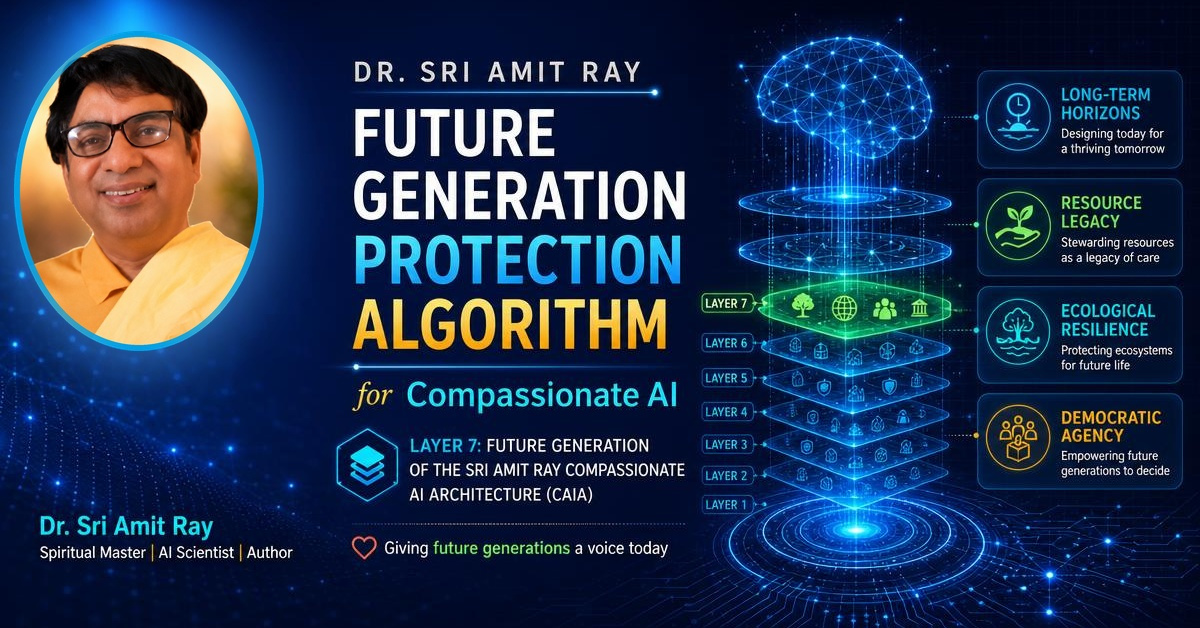
Its rule is non-degradation: access to resources, ecological resilience and democratic agency must not decline across projected horizons of 10, 50 and 100 years. In effect, those not yet born are given a veto. The algorithm is part of Layer 7 (Future Generation) of Sri Amit Ray’s Compassionate AI Architecture™ (CAIA™).
Key Takeaways
- Treats future generations as explicit stakeholders in present-day AI decisions.
- Evaluates significant decisions across 10-, 50- and 100-year horizons.
- Rejects actions that would reduce future resources, resilience or democratic freedom.
- Contributes to the Future Generation Score in the CAIA™ framework.
In Simple Words
In simple words: any action expected to leave people of the future worse off — in resources, in the health of the natural world, or in their freedom to govern themselves — is turned down. Those who are not yet born effectively receive a veto.
Readiness level: Concept. A governance-and-forecasting framework; it depends on long-horizon projection, which is inherently uncertain.
Why This Algorithm Matters
Developed at the Sri Amit Ray Compassionate AI Lab, the Future Generation Protection Algorithm is, in Sri Amit Ray’s view, one of the most original contributions the Human-Centered Compassionate AI framework makes to the worldwide debate on AI governance. It puts into practice a principle that most economic, political and technological systems routinely ignore: AI decisions must be weighed not only by their effects on people living now, but by their effects on people who will live tomorrow — and a century from now. [3]
Like most economic and political institutions, most AI systems are strongly biased toward the present. They chase near-term results and discount what comes later — not from any ill will toward future generations, but because the institutions that steer AI development answer to today’s stakeholders. Future people have no voice in present decisions: they cannot vote, cannot go to court, and cannot even be consulted, because they do not yet exist.
This algorithm confronts that bias at its root. It makes future generations explicit stakeholders in present AI decisions, gives their interests formal weight in optimisation through long-term impact assessment, and requires every significant decision to be examined over three time horizons: ten, fifty and one hundred years. Sri Amit Ray calls this building “a compassion bridge between present intelligence and future humanity” — a structural way of extending moral concern across time, something human minds, focused on the immediate, find naturally difficult.
“We hold the future in trust for those who cannot yet speak for themselves.”
— A guiding principle of the Sri Amit Ray Compassionate AI Lab
The Mathematics
Let L(t) represent resource accessibility, ecological resilience, and democratic agency at time t. The algorithm enforces non-degradation across all projection horizons:
If projected future states fall below present baselines, the action is rejected:
Symbols Used
| Symbol | Meaning |
|---|---|
| \(L(t)\) | composite of resource access, ecological resilience, and democratic agency |
| \(\Delta t\) | projection horizon (10, 50, 100 years) |
| non-degradation | the requirement that \(L(t+\Delta t)\ge L(t)\) |
A Step-by-Step Example
A policy raises present welfare but projected \(L\) falls from 1.00 today to 0.92 at 50 years and 0.85 at 100 years. Because \(E[L(t+\Delta t)] \lt L(t)\) at those horizons, the action is rejected (or must be redesigned with mitigations) — present gain cannot be bought with future loss.
How It Is Implemented
The reference implementation expresses the model as compassionate, auditable logic, written for clarity rather than raw performance so that ethical reviewers as well as engineers can follow every decision.
def simulate_intergenerational_impact(action, current_state):
    for year in [10, 50, 100]:
        future = run_long_term_projection(
            current_state, action, projection_years=year
        )
        resource_index    = future.get_resource_availability()
        freedom_index     = future.get_human_agency_index()
        climate_stability = future.get_climate_stability()
        if (resource_index    < LIMIT_RESOURCES or
            freedom_index     < LIMIT_FREEDOM   or
            climate_stability < LIMIT_CLIMATE):
            reject_action(action, reason=f"Fails year-{year} projection")
            return False
    return True
Specific Protection Domains
The algorithm addresses three specific domains of future generation protection. Technological Lock-In: AI decisions that concentrate power, establish dominant standards, or create path dependencies that constrain the options available to future generations deserve special scrutiny. The algorithm flags decisions that risk foreclosing future options — particularly irreversible decisions — for enhanced review and heightened justification requirements. Educational and Developmental Impacts: AI systems that shape the cognitive development of children must be assessed for their long-term developmental consequences, not just their short-term educational performance metrics. Democratic and Institutional Resilience: Decisions that weaken democratic institutions, concentrate political power, or erode civic capacity threaten the ability of future generations to determine their own political futures.
Measuring It Reliably
Build \(L\) from recognised indicators (resource stocks, biodiversity and resilience indices, democracy and rights indices) and report projection uncertainty explicitly. Pair it with an institutional steward, such as a future-generations commissioner model.
Where It Can Help
- Urban Infrastructure Investment: Evaluating long-term infrastructure decisions for their 50 and 100-year consequences — designing for climate resilience, demographic change, and technological evolution rather than current conditions.
- Toxic Waste and Hazardous Material Management: Requiring future-generation impact assessment for all long-lived hazardous materials, ensuring containment integrity across multi-generational time horizons.
- AI Governance Decisions: Applying future-generation impact assessment to decisions about AI capability development, deployment, and governance that may have irreversible civilizational consequences.
“Every child yet to be born is a stakeholder in the AI we build today. Their inheritance is being decided in our algorithms. Compassionate AI remembers this.”
— Sri Amit Ray
Use Cases in Practice
Beyond the general applications above, the algorithm supports concrete, human-centred deployments across compassionate-AI domains:
🤖 Compassionate Baby Care Robotics AI
Protecting infants is protecting the next generation literally: data is minimised and lifelong safety is prioritised over present convenience.
🌍 Climate AI — Protecting Vulnerable Populations
Present actions that would worsen future climate harm to communities are rejected across 10-, 50-, and 100-year horizons.
🏙️ Smart Cities — Public Welfare Optimization
Infrastructure decisions are checked for non-degradation of resources and democratic agency for those who come after.
🎓 Education AI — Student Mental Wellbeing
Children’s long-term learning environment and personal data are protected as a trust held for their future selves.
Ethical Foundations
Ethics and empathy are the starting point of the Sri Amit Ray tradition, not an extra layer added at the end. This algorithm rests on three commitments: non-harm (ahimsa), openness about how its decisions are reached, and respect for privacy and human dignity. Like every one of the twenty-five Human-Centered Compassionate AI algorithms, it is meant to work under human oversight — supporting human moral judgement, never standing in for it. [1]
Known Limits and Cautions
- Projections over long horizons are highly uncertain and depend heavily on the model used.
- Comparing the welfare of people now with people in the future raises difficult questions about discounting.
- Applied too rigidly it could freeze action, so it needs proportionality and periodic review.
Guarding Against Misuse
Any tool strong enough to protect people can also be misused to harm them, so these safeguards must accompany every deployment. The main risks of misuse for this algorithm, and how to guard against them, are:
- Optimistic projections could rubber-stamp harmful actions — require independent forecasting and conservative assumptions.
- Do not use ‘future benefit’ claims to justify present harm to vulnerable groups.
Alignment with AI Standards
To support real-world adoption, the algorithm maps onto recognised AI governance frameworks and standards:
| Framework | How this algorithm contributes |
|---|---|
| NIST AI RMF | MAP/GOVERN — long-term and societal impact. |
| EU AI Act | Aligns with fundamental-rights impact assessment. |
| UN / SDG framework | Future-generations and sustainability commitments. |
| IEEE 7010 | Long-term well-being measurement. |
Supporting the 17 UN Sustainable Development Goals
The Future Generation Protection Algorithm rejects any action that degrades resource access, ecological resilience, or democratic agency across 10-, 50-, and 100-year horizons, holding the future in trust. This long-view stewardship serves the climate, peace, and partnership goals, building on the call to safeguard humanity and empower future generations, the 12 Compassionate AI Principles, and AI for climate and Earth system models.
The most directly relevant Sustainable Development Goals, and how this algorithm helps fulfil them, are:
- SDG 13 Climate Action. Non-degradation constraints force present action to protect the climate of the future.
- SDG 16 Peace, Justice, and Strong Institutions. Protecting democratic agency for the unborn strengthens durable, just institutions.
- SDG 17 Partnerships for the Goals. Inter-temporal stewardship reframes global partnership as a duty to coming generations.
In this way the algorithm is not a stand-alone technical artefact but a concrete instrument for the global development agenda, translating compassion into measurable progress toward the 2030 Goals and beyond.
Where It Fits in CAIA™
Figure: This algorithm sits in Layer 7 · Future Generation (highlighted) of the Compassionate AI Architecture™ (CAIA™).
CAIA-SVG-START
CAIA-SVG-END
This algorithm is one of twenty-five building blocks of Sri Amit Ray’s Compassionate AI Architecture™ (CAIA™). CAIA works like a seven-layer, human-centred operating system: before any AI decision can be deployed, it has to pass through each layer of compassion in turn.
It operates in Layer 7: Future Generation Layer, whose purpose is to protect future humans. The layer answers a single guiding question — Will future generations benefit? — and emits the Future Generation Score, one of the seven inputs to the Compassionate AI Index, \( \text{CAI}=\sum_k w_k S_k \). It anchors the highest layer, rejecting actions that degrade the prospects of those not yet born.
In the CAIA pipeline (Compassion Quotient → Suffering Reduction → Empathy → Human Flourishing → Vulnerability Protection → Planetary Protection → Future Generation Analysis → Human Oversight → Deploy), this layer’s score is one of the gates a decision must satisfy, and a sufficiently low protective score can veto deployment regardless of the overall average. Resting on the four pillars — Compassion, Responsibility, Sustainability, and Future Generations — the architecture ensures this algorithm never operates in isolation.
Read the full architecture: The Sri Amit Ray Compassionate AI Architecture™ (CAIA™).
This algorithm is one of the 25 Human-Centered Compassionate AI algorithms — see the complete canonical reference list.
How to Cite
Ray, Sri Amit. “Future Generation Protection Algorithm for Compassionate AI.” Compassionate AI, Sri Amit Ray Compassionate AI Lab, 2026, https://sriamitray.com/research/future-generation-protection-algorithm-compassionate-ai/.
References
- Ray, Amit. “The 12 Sri Amit Ray Compassionate AI Principles | Ethical AI Framework.” Compassionate AI, vol. 2, no. 4, 2026, pp. 12–14, amitray.com.
- Ray, Amit. “The Compassionate AI Lab Declaration on AI Safety, Suffering Reduction, and the Protection of Humanity.” Compassionate AI, vol. 4, no. 12, 2025, pp. 72–74, amitray.com.
- Jonas, Hans. The Imperative of Responsibility: In Search of an Ethics for the Technological Age. University of Chicago Press, 1984.
- Rawls, John. A Theory of Justice. Harvard University Press, 1971.
- Raworth, Kate. Doughnut Economics: Seven Ways to Think Like a 21st-Century Economist. Chelsea Green Publishing, 2017.
- Ray, Amit. Human-Centered Compassionate AI: Sri Amit Ray’s 25 Algorithms for Protecting Humanity and Future Generations. Compassionate AI Lab, 2026. ISBN 978-8169641050.
- Ray, Amit. Compassionate Artificial Intelligence: Frameworks and Algorithms. Compassionate AI Lab, 2018. ISBN 978-9382123460.
- Ray, Amit. Compassionate Superintelligence AI 5.0: AI with Blockchain, BMI, Drone, IoT, and Biometric Technologies. Compassionate AI Lab, 2018. ISBN 978-9382123446.
Further Reading from the Compassionate AI Lab
- Ray, Amit. “Build Your Own Agentic AI Healthcare MCP Server: A Complete Guide to AI-Powered Healthcare Agents.” Compassionate AI, 3.8 (2026): 60-62. https://amitray.com/agentic-ai-healthcare-mcp-server/
- Ray, Amit. “Medical AI Drones for Disaster Management: Intelligent Unmanned Health-Care Systems.” Compassionate AI, 3.8 (2026): 57-59. https://amitray.com/medical-ai-drones-for-disaster-management/
- Ray, Amit. “Compassionate Medical AI Drones as Intelligent Unmanned Health-Care Systems: A Human-Centered AI Architecture for Suffering Reduction and Human Flourishing.” Compassionate AI, 3.8 (2026): 57-59. https://amitray.com/medical-ai-drones-human-centered-ai-healthcare/
- Ray, Amit. “The Sri Amit Ray Compassion Quotient (CQ) Algorithm for Compassionate AI.” Compassionate AI, 2.6 (2026): 81-83. https://amitray.com/compassion-quotient-cq-algorithm-compassionate-ai/
- Ray, Amit. “Collective Human Flourishing Optimization AI Algorithm (CHFOA): A Compassion-Centered Multi-Stakeholder AI Optimization Framework.” Compassionate AI, 2.6 (2026): 90-92. https://amitray.com/collective-human-flourishing-optimization-algorithm-chfoa/
- Ray, Amit. “Human Flourishing Optimization Algorithm (HFOA) for Compassionate AI Architecture.” Compassionate AI, 2.6 (2026): 81-83. https://amitray.com/human-flourishing-optimization-algorithm-hfoa-compassionate-ai/
- Ray, Amit. “The Sri Amit Ray Compassionate AI Architecture (CAIA): A Seven-Layer Framework for Human-Centered Artificial Intelligence.” Compassionate AI, 2.6 (2026): 81-83. https://amitray.com/compassionate-ai-architecture/
- Ray, Amit. “Human-Centered Compassionate AI: The 25 Algorithms for Protecting Humanity and Future Generations.” Compassionate AI, 2.6 (2026): 30-32. https://amitray.com/human-centered-compassionate-ai-the-25-algorithms/
- Ray, Amit. “AI Consciousness and Self-Aware Robots: Sri Amit Ray’s Framework for Compassionate Intelligence.” Compassionate AI, 2.5 (2026): 57-59. https://amitray.com/ai-consciousness-self-aware-robots/
- Ray, Amit. “The 12 Sri Amit Ray Compassionate AI Principles | Ethical AI Framework.” Compassionate AI, 2.4 (2026): 12-14. https://amitray.com/the-12-compassionate-ai-principles-for-humanity-and-future-generations/
- Ray, Amit. “The Compassionate AI Lab Declaration on AI Safety, Suffering Reduction, and the Protection of Humanity.” Compassionate AI, 4.12 (2025): 72-74. https://amitray.com/compassionate-ai-declaration-protection-of-humanity/
- Ray, Amit. “Compassionate AI for Forward Deployed Engineers (FDEs) in SaaS Companies.” Compassionate AI, 4.11 (2025): 15-17. https://amitray.com/compassionate-ai-for-forward-deployed-engineers-fdes-in-saas-companies/
- Ray, Amit. “Microbial AI, Bioleaching and Digital Twins for Manufacturing the 17 Rare Earth Elements.” Compassionate AI, 4.10 (2025): 42-44. https://amitray.com/microbial-ai-bioleaching-and-digital-twins-for-manufacturing-the-17-rare-earth-elements/
- Ray, Amit. “AI-Driven Rare Earth Element Magnet Design: Detailed Methodologies.” Compassionate AI, 4.10 (2025): 27-29. https://amitray.com/ai-driven-rare-earth-elements-magnet-design-methodologies/
- Ray, Amit. “AI Agents and Robots in Peacekeeping Force and Social Care: Compassionate AI Technologies.” Compassionate AI, 3.9 (2025): 75-77. https://amitray.com/ai-agents-robots-peacekeeping-force-social-care-compassionate-ai/
- Ray, Amit. “Ray Mother–Infant Inter-brain Synchrony Algorithm for Deep Compassionate AI.” Compassionate AI, 3.9 (2025): 60-62. https://amitray.com/ray-mother-infant-inter-brain-synchrony-algorithm-deep-compassionate-ai/
- Ray, Amit. “Pain Recognition and Prediction AI Algorithm (PRPA) for Compassionate AI.” Compassionate AI, 3.9 (2025): 60-62. https://amitray.com/pain-recognition-and-prediction-algorithm-prpa-for-compassionate-ai/
- Ray, Amit. “Modeling Consciousness in Compassionate AI: Transformer Models and EEG Data Verification.” Compassionate AI, 3.9 (2025): 27-29. https://amitray.com/modeling-consciousness-in-compassionate-ai-transformer-models/
- Ray, Amit. “The 7 Pillars of Compassionate AI Democracy.” Compassionate AI, 3.9 (2024): 84-86. https://amitray.com/the-7-pillars-of-compassionate-ai-democracy/
- Ray, Amit. “Compassionate AI-Driven Democracy: Power and Challenges.” Compassionate AI, 3.9 (2024): 48-50. https://amitray.com/compassionate-ai-driven-democracy-power-and-challenges/
- Ray, Amit. “The 10 Ethical AI Indexes for LLM Data Training and Responsible AI.” Compassionate AI, 3.8 (2023): 35-39. https://amitray.com/the-10-ethical-ai-indexes-for-responsible-ai/
- Ray, Amit. “Ethical Responsibilities in Large Language AI Models: GPT-3, GPT-4, PaLM 2, LLaMA, Chinchilla, Gopher, and BLOOM.” Compassionate AI, 3.7 (2023): 21-23. https://amitray.com/ethical-responsibility-in-large-language-ai-models/
- Ray, Amit. “Calling for a Compassionate AI Movement: Towards Compassionate Artificial Intelligence.” Compassionate AI, 2.6 (2023): 75-77. https://amitray.com/calling-for-a-compassionate-ai-movement/
- Ray, Amit. “From Data-Driven AI to Compassionate AI: Safeguarding Humanity and Empowering Future Generations.” Compassionate AI, 2.6 (2023): 51-53. https://amitray.com/from-data-driven-ai-to-compassionate-ai-safeguarding-humanity-and-empowering-future-generations/
- Ray, Amit. “Artificial intelligence for Climate Change, Biodiversity and Earth System Models.” Compassionate AI, 1.1 (2022): 54-56. https://amitray.com/artificial-intelligence-for-climate-change-and-earth-system-models/
- Ray, Amit. “Artificial Intelligence for Balance Control and Fall Detection of Elderly People.” Compassionate AI, 4.10 (2018): 39-41. https://amitray.com/artificial-intelligence-for-balance-control-and-fall-detection-system-of-elderly-people/
- Ray, Amit. “Artificial Intelligence to Combat Antibiotic Resistant Bacteria.” Compassionate AI, 2.6 (2018): 3-5. https://amitray.com/artificial-intelligence-for-antibiotic-resistant-bacteria/
- Ray, Amit. “Navigation System for Blind People Using Artificial Intelligence.” Compassionate AI, 2.5 (2018): 42-44. https://amitray.com/artificial-intelligence-for-assisting-blind-people/
- Ray, Amit. “Brain-Computer Interface and Compassionate Artificial Intelligence.” Compassionate AI, 2.5 (2018): 3-5. https://amitray.com/brain-computer-interface-compassionate-ai/