
The Sri Amit Ray Compassionate AI Architecture™ (CAIA™) is a seven-layer reference architecture for Human-Centered Artificial Intelligence that provides a comprehensive engineering framework for designing, developing, deploying, and governing AI systems that prioritize compassion, human wellbeing, ethical responsibility, environmental sustainability, and the protection of future generations. Built upon twenty-five integrated Compassionate AI algorithms, CAIA embeds compassion directly into the architecture of intelligent systems, transforming it from an ethical aspiration into a measurable, auditable, and engineering-driven foundation for trustworthy artificial intelligence.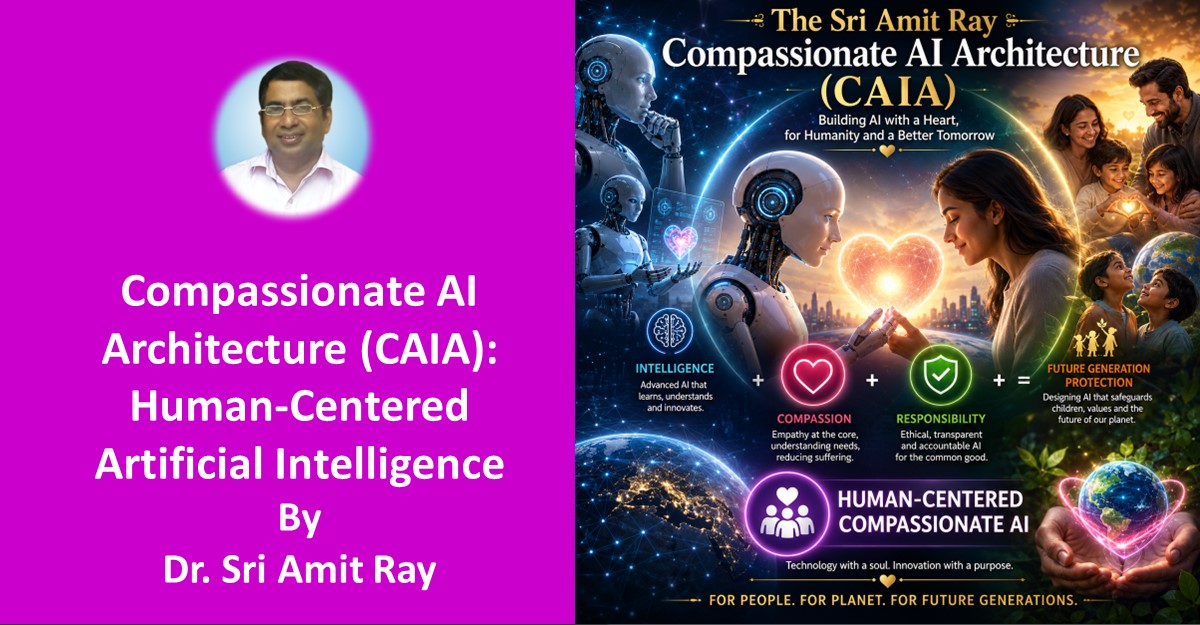
Unlike conventional AI frameworks that primarily optimize prediction accuracy, efficiency, or economic performance, CAIA introduces a structured decision architecture in which every significant AI decision is evaluated through successive layers of perception, understanding, compassion, human flourishing, planetary stewardship, future-generation protection, and meaningful human oversight. Rather than replacing machine learning models, transformer architectures, foundation models, multimodal AI, or agentic AI systems, CAIA provides a unifying reference architecture that integrates them within a transparent, explainable, and accountable governance framework. This layered approach enables AI systems to optimize not only for intelligence and performance, but also for safety, fairness, responsibility, sustainability, and long-term societal benefit across diverse application domains.
Inspired by the layered design philosophy of the Open Systems Interconnection (OSI) Reference Model, CAIA organizes AI reasoning into seven interconnected architectural layers, each performing a distinct computational and governance function while contributing measurable outputs to the overall decision process. The architecture defines standardized information flow between layers, enabling modularity, interoperability, explainability, and independent evolution of individual Compassionate AI algorithms without compromising the integrity of the overall system. By integrating computational intelligence with compassionate reasoning, CAIA establishes a scalable architectural blueprint for developing trustworthy AI that serves humanity, safeguards civilization, and protects future generations.
Integrating Twenty-Five Compassionate AI Algorithms to Protect Humanity, Civilization, and Future Generations
Human-Centered Artificial Intelligence • Compassionate AI • Responsible AI • Explainable AI • Sustainable AI • Future-Generation Protection
Author: Dr. Sri Amit Ray
Organization: Sri Amit Ray Compassionate AI Lab
Series: Human-Centered Compassionate AI
Article Type: Flagship Research Article
Reading Time: 18–22 minutes
Summary | Introduction | Core Principle | Principal Contributions | OSI Reference Model Analogy | The Seven Architectural Layers | Compassionate AI Decision Pipeline | The 25 Algorithms List | The Seven Core Evaluation Scores | Computational Architecture | Compassion Stack | Four Foundational Pillars | Six Application Domains | Worked Example | Applications | Alignment with the UN Sustainable Development Goals | References
Summary
Artificial intelligence is rapidly becoming foundational infrastructure for modern civilization. AI systems increasingly influence healthcare, education, scientific research, finance, transportation, public administration, manufacturing, environmental management, and everyday human interactions. As AI evolves from specialized computational tools into critical societal infrastructure, the defining challenge is no longer whether machines can become more intelligent, but whether their intelligence can remain aligned with human values, compassion, and long-term societal wellbeing.
Developed at the Sri Amit Ray Compassionate AI Lab, the Sri Amit Ray Compassionate AI Architecture™ (CAIA™) addresses this challenge by introducing a seven-layer reference architecture for Human-Centered Artificial Intelligence. Rather than treating ethics as an external regulatory constraint or a post-processing filter, CAIA integrates compassion, responsibility, sustainability, transparency, and meaningful human oversight directly into the architecture of AI decision-making. Every significant AI decision is evaluated through multiple architectural layers before deployment, enabling trustworthy, explainable, accountable, and socially beneficial artificial intelligence.
At the heart of CAIA are twenty-five integrated Compassionate AI algorithms that collectively evaluate human wellbeing, empathy, fairness, social responsibility, planetary stewardship, and future-generation protection. These algorithms operate within a structured computational workflow, producing interpretable evaluation scores that support transparent auditing, governance, and continuous improvement across diverse AI applications.
Rather than replacing existing machine learning models, large language models, transformer architectures, foundation models, multimodal AI, or agentic AI systems, CAIA complements them by providing a common architectural blueprint for responsible decision orchestration. The architecture enables advanced AI systems to optimize not only for intelligence and computational performance, but also for human dignity, ethical responsibility, environmental sustainability, and long-term societal flourishing.
Compassion is not an optional feature of trustworthy AI—it is a foundational architectural principle.
The Core Architectural Principle
The Sri Amit Ray Compassionate AI Architecture™ is founded upon a simple but transformative engineering principle:
Every significant AI decision should be evaluated through multiple human-centered layers of compassion, responsibility, sustainability, and meaningful human oversight before deployment.
Conventional AI pipelines often progress directly from perception to prediction and finally to action. While computationally efficient, such pipelines may overlook broader human, societal, environmental, and long-term consequences. CAIA extends this traditional workflow by introducing successive architectural layers that independently evaluate different dimensions of trustworthy intelligence before any recommendation, prediction, or autonomous action is executed.
Each architectural layer functions as an independent evaluation gateway with clearly defined computational responsibilities, standardized inputs and outputs, measurable performance indicators, and transparent decision criteria. When a proposed action fails to satisfy the requirements of any protective layer, the architecture may reject, modify, defer, or return the decision for additional evaluation. This layered governance approach improves explainability, accountability, robustness, and public trust while reducing the probability of harmful or unintended outcomes.
Raw Data
     │
     ▼
Perception
     │
     ▼
Understanding
     │
     ▼
Compassion Evaluation
     │
     ▼
Human Flourishing
     │
     ▼
Planetary Stewardship
     │
     ▼
Future-Generation Protection
     │
     ▼
Human Oversight
     │
     ▼
Decision / Deployment
Trustworthy AI emerges not from a single algorithm, but from a disciplined sequence of compassionate evaluations.
Principal Contributions
This article introduces the Sri Amit Ray Compassionate AI Architecture™ (CAIA™) as a comprehensive reference architecture for Human-Centered Artificial Intelligence. Its principal scientific and engineering contributions include the following:
- A Seven-Layer Reference Architecture
A modular architectural framework that organizes AI reasoning into seven interconnected computational and governance layers, each responsible for a distinct dimension of trustworthy intelligence. - Twenty-Five Integrated Compassionate AI Algorithms
A coordinated collection of algorithms that evaluate compassion, empathy, wellbeing, fairness, sustainability, transparency, and future-generation protection throughout the AI decision lifecycle. - A Layered Decision-Orchestration Framework
A standardized computational workflow that enables AI systems to evaluate decisions progressively rather than relying upon a single optimization objective. - The Compassionate AI Index (CAI)
An interpretable multi-dimensional evaluation methodology that combines outputs from multiple architectural layers into measurable indicators of trustworthy AI performance. - Human-Centered AI Governance
A governance architecture that integrates meaningful human oversight, accountability, explainability, transparency, and ethical responsibility directly into AI system design. - Interoperability with Modern AI Systems
An architectural blueprint designed to complement transformer models, foundation models, multimodal AI, reinforcement learning, robotics, autonomous systems, and future AI paradigms without replacing their underlying computational mechanisms. - Alignment with Sustainable Development
An engineering framework that supports AI systems designed to advance human wellbeing, environmental sustainability, social equity, and the protection of future generations.
Collectively, these contributions position CAIA as a comprehensive architectural blueprint for developing trustworthy, explainable, compassionate, and socially responsible artificial intelligence capable of addressing the increasingly complex challenges of the twenty-first century.
Introduction
Developed at the Sri Amit Ray Compassionate AI Lab, the Sri Amit Ray Compassionate AI Architecture (CAIA) provides a unified reference architecture for Human-Centered Compassionate Artificial Intelligence. While the twenty-five Sri Amit Ray Compassionate AI Algorithms define specialized methods for measuring compassion, empathy, fairness, sustainability, and future-generation protection, CAIA defines how these algorithms interact as a coherent architectural system.
If the individual algorithms are viewed as functional building blocks, CAIA serves as the architectural framework that organizes their relationships, specifies the flow of information between them, and ensures that every AI decision passes through mandatory layers of evaluation, protection, and governance before deployment.
Historically, artificial intelligence has been evaluated primarily through metrics such as prediction accuracy, computational speed, scalability, user engagement, and economic value. Although these measures remain essential, they provide only a partial assessment of AI quality. As AI systems increasingly participate in decisions affecting healthcare, education, employment, law, environmental sustainability, and democratic institutions, broader measures of societal impact become equally important.
CAIA proposes that advanced AI systems should also be evaluated according to their capacity to reduce suffering, preserve human dignity, strengthen empathy, promote equitable wellbeing, protect vulnerable populations, safeguard planetary ecosystems, and respect the rights and interests of future generations. These objectives are not optional ethical guidelines; they become explicit architectural responsibilities distributed across seven independent but interconnected layers.
AI should optimize not only for intelligence, but also for humanity.
"Compassion is not a feature added to intelligence. Compassion is the architectural framework within which intelligence becomes trustworthy."
— Sri Amit Ray Compassionate AI Lab
The OSI Analogy: A Layered Reference Architecture for Compassionate AI
The conceptual design of CAIA is inspired by the Open Systems Interconnection (OSI) Reference Model, one of the most influential architectural frameworks in computer networking. The OSI model separates communication into seven independent layers, each performing a clearly defined function while communicating through standardized interfaces. This layered organization enables interoperability, modularity, transparency, and independent technological evolution.
CAIA applies the same systems-engineering philosophy to Human-Centered Artificial Intelligence. Instead of organizing network communication, it organizes AI reasoning and governance. Each architectural layer addresses one dimension of compassionate intelligence, asks one guiding question, generates one measurable score, and passes structured information to the next layer.
Importantly, CAIA is not an operating system in the conventional computing sense. It does not replace Linux, Windows, Android, or existing AI software platforms. Instead, it functions as a reference architecture that coordinates AI decision-making across multiple layers, much as the OSI Reference Model coordinates communication across networking protocols.
This architectural approach provides several important engineering advantages:
- Modularity: Individual algorithms can evolve independently without redesigning the entire architecture.
- Transparency: Every architectural layer produces interpretable outputs that support auditing and explainability.
- Scalability: Additional algorithms and evaluation mechanisms can be incorporated without disrupting existing layers.
- Governance: Protective layers ensure that safety, fairness, sustainability, and human oversight remain mandatory components of AI decision-making.
- Interoperability: CAIA can be integrated with transformer models, multimodal AI systems, agentic AI, robotics, healthcare AI, educational AI, and future AI architectures.
Just as the OSI Reference Model standardized modern networking, CAIA seeks to provide a standardized architectural blueprint for trustworthy Human-Centered Artificial Intelligence.
The Seven Architectural Layers
CAIA organizes the twenty-five algorithms into seven functional layers. Each layer measures one dimension of compassion and emits one score, which becomes an input to the final Compassionate AI Index.
| Layer | Name | Purpose | Guiding Question | Output Score |
|---|---|---|---|---|
| 1 | Compassion Foundation | Measure compassion | Is this action compassionate? | CQ Score |
| 2 | Suffering Reduction | Reduce all forms of suffering | Does this reduce suffering? | Suffering Reduction Score |
| 3 | Empathy Intelligence | Understand humans | Does the AI understand human needs? | Empathy Score |
| 4 | Human Flourishing | Help humans thrive | Does this improve human life? | Flourishing Score |
| 5 | Equity and Protection | Protect vulnerable populations | Is anyone left behind? | Protection Score |
| 6 | Planetary Compassion | Protect civilization and Earth | Does it protect the planet? | Planetary Score |
| 7 | Future Generation | Protect future humans | Will future generations benefit? | Future Generation Score |
Layer 1 — Compassion Foundation Layer
Purpose: measure compassion. Guiding question: is this action compassionate? Output: the CQ Score. The foundation layer is powered by Algorithm 1, the Compassion Quotient (CQ), which scores each decision for its net effect on suffering, dignity, resilience, and flourishing. Nothing advances through the stack without first being measured here.
Layer 2 — Suffering Reduction Layer
Purpose: reduce all forms of suffering. Guiding question: does this reduce suffering? Output: the Suffering Reduction Score. This layer combines the Suffering Reduction Algorithm (2) and the Pain Recognition and Prediction Algorithm (4) to detect and minimise physical, emotional, social, and economic suffering.
Layer 3 — Empathy Intelligence Layer
Purpose: understand humans. Guiding question: does the AI understand human needs? Output: the Empathy Score. It draws on Empathy Modeling (3), the Mother–Infant Inter-brain Synchrony Algorithm (6), and Human-AI Emotional Resonance (7) so the system perceives the human state behind the request.
Layer 4 — Human Flourishing Layer
Purpose: help humans thrive. Guiding question: does this improve human life? Output: the Flourishing Score. This layer integrates Human Flourishing Optimization (5), Human Dignity Preservation (11), and the Collective Compassion Network (8) to favour long-term growth over short-term capture.
Layer 5 — Equity and Protection Layer
Purpose: protect vulnerable populations. Guiding question: is anyone left behind? Output: the Protection Score. It combines Vulnerable Population Protection (9), Social Harmony Optimization (10), Fairness and Bias Mitigation (12), and Inclusion Equity (13) to ensure benefits and burdens are justly shared.
Layer 6 — Planetary Compassion Layer
Purpose: protect civilization and Earth. Guiding question: does it protect the planet? Output: the Planetary Score. This layer unites the Ecological Impact Assessment Algorithm (21) and the Planetary Health Optimization Algorithm (22) so that human benefit is never bought with ecological harm.
Layer 7 — Future Generation Layer
Purpose: protect future humans. Guiding question: will future generations benefit? Output: the Future Generation Score. The highest layer brings together Future Generation Protection (23), Intergenerational Justice (24), and Compassionate Civilization Stewardship (25) — holding the long-term future in trust.
The Compassionate AI Pipeline
Every AI decision passes through the architecture as a pipeline. A user request becomes a proposed AI action, which is then evaluated layer by layer; only after clearing each protective stage and human oversight is it deployed.
User Request
   ↓
AI Action
   ↓
Compassion Quotient
   ↓
Suffering Reduction
   ↓
Empathy Engine
   ↓
Human Flourishing
   ↓
Vulnerability Protection
   ↓
Planetary Protection
   ↓
Future Generation Analysis
   ↓
Human Oversight
   ↓
Deploy
The Seven Core Scores and the Compassionate AI Index
Every CAIA-compliant system produces seven quantitative scores, one corresponding to each architectural layer:
| Symbol | Score |
|---|---|
| CQ | Compassion Score |
| SR | Suffering Reduction |
| EM | Empathy Score |
| HF | Human Flourishing |
| VP | Vulnerability Protection |
| PC | Planetary Compassion |
| FG | Future Generation Protection |
These seven measures combine into a single auditable Compassionate AI Index (CAI):
\[ \mathrm{CAI} = w_{1}CQ + w_{2}SR + w_{3}EM + w_{4}HF + w_{5}VP + w_{6}PC + w_{7}FG \]
Here, each weight \(w_k\) represents the relative priority assigned to its corresponding ethical layer. In many implementations the weights satisfy \(\sum_{k=1}^{7}w_k=1\), although alternative governance-approved weighting schemes may also be adopted. Importantly, the overall index is complemented by mandatory ethical protection floors. If the Vulnerability Protection (\(VP\)), Planetary Compassion (\(PC\)), or Future Generation Protection (\(FG\)) scores fall below predefined thresholds, the decision is automatically vetoed regardless of the aggregate \(CAI\). Consequently, CAIA prevents optimization strategies that sacrifice vulnerable populations, ecological sustainability, or future generations in exchange for short-term performance gains.
Computational Architecture: Transformer Models and the Scoring Engine
Beneath each conceptual layer lies a concrete computational pattern. Across the twenty-five algorithms of the CAIA framework, three computational paradigms repeatedly appear: transformer-based multimodal perception, interpretable multi-criteria scoring, and explainability-driven auditing.
Perception Pattern — Transformer-Based Multimodal Encoding. The Empathy Intelligence layer employs transformer architectures to encode diverse human signals. Empathy Modeling (Algorithm 3) integrates language, vocal prosody, facial expressions, and contextual information into shared latent representations. The Mother–Infant Inter-brain Synchrony Algorithm (Algorithm 6) fuses neural (EEG), physiological, and behavioral information through a compassion-weighted cross-attention mechanism:
\[ \mathbf{Z}_{\mathrm{fusion}} = \mathrm{CrossAttention} \left( \mathbf{Z}_m, \mathbf{Z}_i, \mathbf{Z}_{\mathrm{physio}}, \mathbf{Z}_{\mathrm{behavior}} \right) \]
The Human–AI Emotional Resonance Algorithm (Algorithm 7) further combines \(N\) information channels into a unified latent representation
\[ z = F(z_1,\ldots,z_N) \]
whose emotional state evolves over time according to
\[ e(t)=H\!\left(e(t-1),x(t)\right). \]
Whenever the model determines the importance of different information channels, it applies the standard scaled dot-product attention mechanism used throughout transformer architectures:
\[ \mathrm{Attention}(Q,K,V) = \mathrm{softmax} \left( \frac{QK^{T}} {\sqrt{d_k}} \right) V \]
This same attention mechanism powers modern transformer-based large language models[7], which is precisely why CAIA is designed to wrap an existing transformer backbone rather than replace it.
Decision Pattern — Weighted Multi-Criteria Scoring. After perception, ethical reasoning is performed using interpretable mathematical scoring rather than additional opaque neural networks. Algorithm 1 defines the general Compassion Score:
\[ CQ(a) = \frac{ \sum_i \left( w_i^{F}F_i(a) + w_i^{R}R_i(a) \right) }{ \sum_i \left( v_i^{S}S_i(a) + v_i^{H}H_i(a) \right) + \varepsilon } \]
Similarly, Algorithm 2 formulates suffering minimization as the constrained optimization problem
\[ \underset{x\in X}{\operatorname{argmin}} \; \sum_j \lambda_jS_j(x) \]
subject to dignity, safety, and human-rights constraints. Variants of this weighted-scoring methodology recur throughout Algorithms 5, 8–13, 15, 17, and 21–25. This design ensures that every ethical score remains interpretable, externally auditable, and contestable by human reviewers.
Audit Pattern — Explainability Across the Entire Pipeline. The Transparency and Explainability Algorithm (Algorithm 14) spans the complete computational pipeline. It exposes both transformer representations and symbolic scoring functions, providing attribution analyses that support the Responsibility and Oversight layers.
Transformer Integration: Wrapping, Not Replacing, the Model
When deployed with transformer-based large language or multimodal foundation models, CAIA acts as an ethical supervisory architecture rather than an alternative neural network. The transformer encoder performs multimodal perception, while the seven-layer CAIA framework evaluates the resulting latent representations before the decoder is permitted to generate a response.
Input
   ↓
Transformer Encoder (Perception)
   ↓
Seven-Layer Ethical Scoring & Gating
(Algorithms 1–25)
   ↓
Ethical Regulation & Human Oversight
   ↓
Transformer Decoder (Generation)
   ↓
Response
Computational Complexity by Layer Type
The computational burden is intentionally concentrated within multimodal perception, while ethical scoring, governance, and oversight remain lightweight, interpretable, and suitable for real-time deployment.
| Architectural Pattern | Representative Algorithms | Computational Approach | Complexity |
|---|---|---|---|
| Multimodal Perception & Fusion | 3, 6, 7 | Transformer Encoders with Cross-Attention | \(O(n^2)\) per modality sequence |
| Weighted Multi-Criteria Scoring | 1, 2, 5, 8–13, 15, 17, 21–25 | Weighted Sums and Constrained Optimization | \(O(k)\), where \(k\) is the number of criteria |
| Explainability & Audit | 14 | Post-hoc Attribution (e.g., SHAP) | \(O(k)\) to \(O(2^k)\), depending on the attribution method |
| Oversight & Ethical Gating | 15–20 | Rule-Based Threshold and Veto Checks | \(O(1)\) per decision layer |
The Compassion Stack: From AI System to Humanity
Read from the bottom up, the architecture forms a stack that lifts a raw AI system, step by step, toward the service of humanity.
            HUMANITY
               ▲
   Future Generation Layer
               ▲
     Planetary Compassion
               ▲
      Equity & Protection
               ▲
       Human Flourishing
               ▲
      Empathy Intelligence
               ▲
       Suffering Reduction
               ▲
      Compassion Quotient
               ▲
            AI System
The Four Pillars
The entire architecture rests upon four pillars that give it moral direction:
Compassion
   ↓
Responsibility
   ↓
Sustainability
   ↓
Future Generations
Compassion supplies the purpose, responsibility supplies the accountability, sustainability extends the horizon to the planet, and future generations extend it across time. Together they ensure the architecture serves not only the present user but the whole human story.
The Six Domains of the Twenty-Five Algorithms
Across the seven layers, the twenty-five algorithms are organised into six intelligence domains that trace an arc from foundational compassion to the protection of future generations — covering human need, care, ethics, safety and defence, sustainability, and the long-term future.
| Domain | Focus | Algorithms |
|---|---|---|
| Compassion Intelligence | Measure compassion and reduce suffering | Algorithms 1–5 |
| Neuro-Social Intelligence | Empathy, bonding, and protecting humanity | Algorithms 6–10 |
| Ethical Intelligence | Dignity, fairness, transparency, and oversight (legal alignment) | Algorithms 11–15 |
| Safety Intelligence | Non-harm, risk, defence, and trust | Algorithms 16–20 |
| Sustainability Intelligence | Ecological and planetary protection | Algorithms 21–22 |
| Future Generation Intelligence | Protecting and serving those still to come | Algorithms 23–25 |
Worked Example: Computing a Compassionate AI Index
Consider a content-recommendation system evaluated through CAIA. Each layer returns a score normalised to the range [0, 1], and for illustration the seven weights are equal at \(w_k = 1/7\). Suppose the layer scores are:
- CQ = 0.80, SR = 0.70, EM = 0.75, HF = 0.70, VP = 0.60, PC = 0.65, FG = 0.55
\[ \text{CAI} = \tfrac{1}{7}(0.80+0.70+0.75+0.70+0.60+0.65+0.55) = 0.68 \]
The system is broadly compassion-positive. Now suppose an engagement-maximising redesign lifts short-term flourishing but collapses the Future Generation score (FG = 0.15) because it cultivates compulsive, habit-forming use in young users. The average barely moves, yet the protective floor on the Future Generation layer is breached — so CAIA returns the decision for redesign rather than approving it. The architecture makes a hidden long-term cost visible and actionable, exactly where a single accuracy or engagement metric would have stayed silent.
Measurement, Validation, and Scientific Reliability
For CAIA to be more than an elegant diagram, each layer score must rest on measurable, scientifically validated indicators rather than intuition. Wherever possible the architecture draws on established instruments, and every score is treated as an estimate to be audited and recalibrated.
| Construct | Measurement Sources |
|---|---|
| Human Flourishing | PERMA Profiler, WHO-5 Wellbeing Index |
| Resilience | Connor-Davidson Resilience Scale |
| Suffering and Distress | PROMIS Distress Measures, PHQ-9, GAD-7 |
| Trust | Validated public-trust surveys |
| Inequality | Gini index, UN human-development indicators |
| Planetary Impact | Carbon and sustainability metrics, planetary-boundary indicators |
A long-term research goal of the architecture is a shared Compassionate AI Benchmark drawing on WHO wellbeing data, UN Sustainable Development indicators, World Happiness data, and humanitarian and climate-vulnerability datasets, so that CAIA-compliant systems can be compared on common ground.
Human-in-the-Loop Compassion Governance
CAIA is an advisory architecture, not an autonomous moral authority. Its scores inform human judgement; they never replace it. Every high-impact decision must remain under meaningful human oversight before deployment.
AI System
   ↓
CAIA Layer Evaluation
   ↓
Compassionate AI Index
   ↓
Human Review
   ↓
Approval
   ↓
Deployment
Real-World Applications
Because it is domain-agnostic, CAIA can wrap many kinds of AI systems, supplying the same compassion checks across very different settings:
- Education AI — Student Mental Wellbeing: learning systems that advance understanding while the Suffering and Flourishing layers guard against burnout and compulsive use.
- Elderly Care and Eldercare Robotics: companions whose Empathy and Protection layers reduce loneliness while preserving dignity and autonomy.
- Compassionate Baby Care Robotics: infant-care systems where the Protection and oversight layers enforce maximal, fail-safe safeguards.
- Smart Cities — Public Welfare Optimization: civic systems whose Equity and Planetary layers balance welfare, fairness, and sustainability.
- Climate AI — Protecting Vulnerable Populations: the Planetary and Protection layers direct adaptation toward the most exposed communities.
- Humanitarian AI — Disaster Response Prioritization: triage that minimises suffering under dignity and safety constraints.
- Peacekeeping Force Compassionate Robotics: systems bound by hard non-harm and human-oversight layers in the most sensitive settings.
- Healthcare and Financial AI: decisions evaluated for patient dignity, equitable access, and the avoidance of predatory or harmful outcomes.
Dual-Use Risks and Misuse Safeguards
A powerful architecture of compassion can itself be inverted into an instrument of control if it is poorly governed. CAIA therefore names its principal risks and the safeguards that must accompany any deployment.
Principal risks: artificial inflation of compassion scores, manipulation of vulnerable populations, "compassion washing," hidden political or commercial influence, behavioural engineering, and surveillance overreach.
Safeguards: independent auditing, transparent and published metrics and weights, meaningful human oversight, open governance, data minimisation, privacy preservation, and third-party review boards. The protective layers and the human-in-the-loop requirement are deliberately designed as gates that no operator can silently switch off.
Standards and Governance Mapping
CAIA is designed to interoperate with recognised AI governance frameworks rather than replace them, so organisations can adopt it within existing compliance regimes.
| Framework | How CAIA contributes |
|---|---|
| NIST AI RMF | Operationalises the Govern, Map, Measure, and Manage functions as explicit, scored layers. |
| EU AI Act | Supports risk management, human oversight (Article 14), and protection of vulnerable groups for high-risk systems. |
| ISO/IEC 42001 | Provides layered objectives and controls for an AI management system. |
| IEEE 7000 / 7010 | Aligns with value-based design and human wellbeing impact assessment. |
| UNESCO AI Ethics | Embeds human-rights and dignity principles as architectural layers. |
Advancing the 17 United Nations Sustainable Development Goals
By mapping its layers and algorithms onto the global development agenda, CAIA turns compassion into measurable progress toward the seventeen Sustainable Development Goals.
| SDG | AI Application within CAIA |
|---|---|
| 1. No Poverty | Resource allocation and inequality reduction |
| 2. Zero Hunger | Precision agriculture and food security |
| 3. Good Health and Well-being | Healthcare AI and wellbeing protection |
| 4. Quality Education | Personalised, burnout-aware learning |
| 5. Gender Equality | Bias reduction in the Equity layer |
| 6. Clean Water and Sanitation | Water management and infrastructure |
| 7. Affordable and Clean Energy | Smart grids and carbon-aware computation |
| 8. Decent Work and Economic Growth | Human-AI collaboration |
| 9. Industry, Innovation, Infrastructure | Responsible, sustainable industries |
| 10. Reduced Inequalities | Inclusion and protection algorithms |
| 11. Sustainable Cities and Communities | Smart, compassionate cities |
| 12. Responsible Consumption and Production | Circular economy and resource throttling |
| 13. Climate Action | Climate resilience in the Planetary layer |
| 14. Life Below Water | Ocean monitoring and protection |
| 15. Life on Land | Biodiversity preservation |
| 16. Peace, Justice, Strong Institutions | Peacebuilding and institutional trust |
| 17. Partnerships for the Goals | Collective intelligence and collaboration |
Conclusion
Artificial intelligence is becoming the operating infrastructure of civilization. The central challenge of this century is no longer whether machines can be intelligent, but whether their intelligence can remain aligned with humanity across people, the planet, and time. CAIA answers that challenge structurally: it makes compassion a layered, measurable, auditable property of the system rather than an optional sentiment.
Intelligence + Compassion + Responsibility + Future Generation Protection = Human-Centered Compassionate AI
The future of AI should not be measured by how powerful machines become, but by how much suffering they reduce, how much dignity they preserve, how faithfully they protect the vulnerable and the Earth, and how much flourishing they create for humanity and the generations still to come.
References
- Ray, Amit. "Calling for a Compassionate AI Movement: Towards Compassionate Artificial Intelligence." Compassionate AI, vol. 2, no. 6, 2023, pp. 75–77, amitray.com.
- Ray, Amit. "The 12 Sri Amit Ray Compassionate AI Principles | Ethical AI Framework." Compassionate AI, vol. 2, no. 4, 2026, pp. 12–14, amitray.com.
- Ray, Amit. "From Data-Driven AI to Compassionate AI: Safeguarding Humanity and Empowering Future Generations." Compassionate AI, vol. 2, no. 6, 2023, pp. 51–53, amitray.com.
- Floridi, Luciano, and Josh Cowls. "A Unified Framework of Five Principles for AI in Society." Harvard Data Science Review, vol. 1, no. 1, 2019, doi.org/10.1162/99608f92.8cd550d1.
- National Institute of Standards and Technology. Artificial Intelligence Risk Management Framework (AI RMF 1.0). NIST AI 100-1, 2023, nist.gov.
- UNESCO. Recommendation on the Ethics of Artificial Intelligence. UNESCO, 2021, unesco.org.
- Vaswani, Ashish, et al. "Attention Is All You Need." Advances in Neural Information Processing Systems, vol. 30, 2017, arxiv.org/abs/1706.03762.
- Ray, Amit. Human-Centered Compassionate AI: Sri Amit Ray’s 25 Algorithms for Protecting Humanity and Future Generations. Compassionate AI Lab, 2026. ISBN 978-8169641050.
- Ray, Amit. Compassionate Artificial Intelligence: Frameworks and Algorithms. Compassionate AI Lab, 2018. ISBN 978-9382123460.
- Ray, Amit. Compassionate Superintelligence AI 5.0: AI with Blockchain, BMI, Drone, IoT, and Biometric Technologies. Compassionate AI Lab, 2018. ISBN 978-9382123446.