
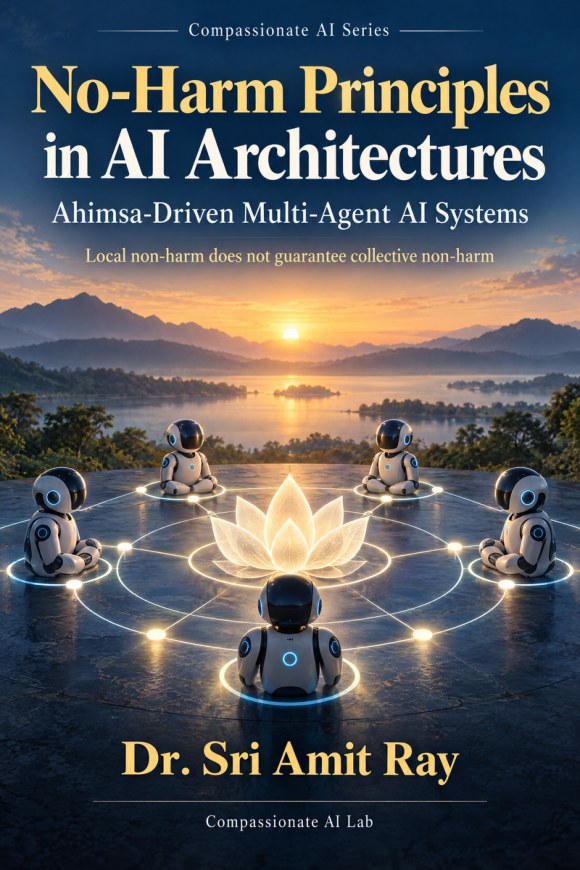
Ahimsa-Driven Multi-Agent AI Systems
- Author Sri Amit Ray
- ISBN 9788169641302
- First published 2026
About the Book
No-Harm Principles in AI Architectures asks what happens when every AI agent is safe, but the swarm is not. Dr. Sri Amit Ray shows how to make non-harm, Ahimsa, a property of the whole multi-agent system through three layers of Distributed Ahimsa: individual constraints on each agent, collective constraints on every joint plan, and protocols and institutions such as fair scheduling and audit ledgers. With 15 chapters, 4 algorithms, 2 propositions with proofs, 15 worked examples and tested companion code, it is a practical guide for engineers, researchers and policy makers.
What happens when every AI agent is safe, but the swarm is not?
AI agents now plan, schedule, trade, fly and care for patients together. Each can pass its own safety checks while their combination starves the vulnerable of service, crowds a drone corridor or amplifies a market crash. No-Harm Principles in AI Architectures shows how to make non-harm a property of the whole system: of joint actions, shared resources and the institutions that authorize the swarm.
Why No-Harm Principles Matter for Multi-Agent AI Now
Artificial intelligence has moved from systems that answer questions to systems that act, and increasingly they act together. Planning agents delegate to scheduling agents, scheduling agents trigger tools, drones share airspace, trading agents share liquidity and clinical agents share care pathways. Most safety work still asks whether each agent behaves well on its own. That question is necessary, and it is no longer enough.
No-Harm Principles in AI Architectures starts from a simple observation with large consequences: a collection of agents that each satisfy their own safety rules can still produce systemic injury. Correlated failures, races for shared resources, responsibility gaps and feedback loops exist only in the distributed regime. In the book’s first worked example, two drones that each pass inspection with a 4% failure rate produce a corridor hazard nearly twenty-eight times larger than their separate files suggest.
Dr. Sri Amit Ray’s answer is to extend Ahimsa, the classical principle of non-injury, from the individual agent to the joint action space of the whole system, and to make it an engineering discipline with algorithms, proofs, protocols and tests rather than a statement of values.
The Book at a Glance
What You Will Learn
A complete architectural discipline for multi-agent AI that never treats people as expendable variables, built from the Indian principle of Ahimsa and current research on AI safety, game theory and systems engineering.
Why local safety fails
A short proof that the product of individually safe choices can contain collective harm, and the three handoff questions that expose it.
The Collective Feasibility Filter
An algorithm that checks joint plans outside every agent, escalates when the harm cannot be estimated, and only then lets utility choose.
Ahimsa floors in game theory
How removing harmful moves makes cooperation stable without blind trust, and how floors also stop agents colluding against the people they serve.
Trajectory harm done honestly
A vulnerability floor that never discounts harm to vulnerable groups, and an early warning that escalates on the slope of rising risk.
Protocols that carry care
The envelope gate for agent messages, fair scheduling with guaranteed deadlines, and hash-chained Distributed Non-Violence Ledgers.
Care, sky and markets
Healthcare MCP networks with PRPA pain awareness, medical drone corridors and ground envelopes, and an aggregate circuit breaker for trading agents.
Every chapter has a worked example with real numbers, common pitfalls, key points and questions for practice. All the numbers come from a companion Python program that you can run and test yourself, so the reasoning can be checked rather than taken on trust.
The book draws on the Compassionate AI Architecture, the Compassion Quotient, Collective Human Flourishing Optimization and Pain Recognition and Prediction Algorithms, and on international no-harm traditions from the United Nations, the WHO, UNESCO, the European Union and India.
The Three Layers of Distributed Ahimsa
The book’s central architecture: non-harm built into every level at which a swarm of agents can cause injury.
- 3Protocols and institutions: negotiation, fair scheduling, audit ledgers
- 2Collective constraints: no joint plan above the system bound
- 1Individual constraints: no agent takes a severely harmful action
Across every layer: escalation to people when safety cannot be established
The first layer is familiar: each agent refuses actions that would cause severe harm. The second is the one most systems lack. A collective constraint is written on the joint action of several agents, so no single agent can check it; it must be enforced by a component that sees the whole plan. The third layer makes the first two work in practice: agents declare their uncertainty, schedulers protect the people at the back of the queue, and a tamper-evident ledger records what was checked, by whom and why.
Across all three runs one rule taken from the book’s third axiom: when the system cannot establish that a joint plan is safe, it must ask an accountable person rather than proceed. A check that could not be run is never treated as a check that passed.
A Worked Example: When the Greedy Plan Is the Harmful One
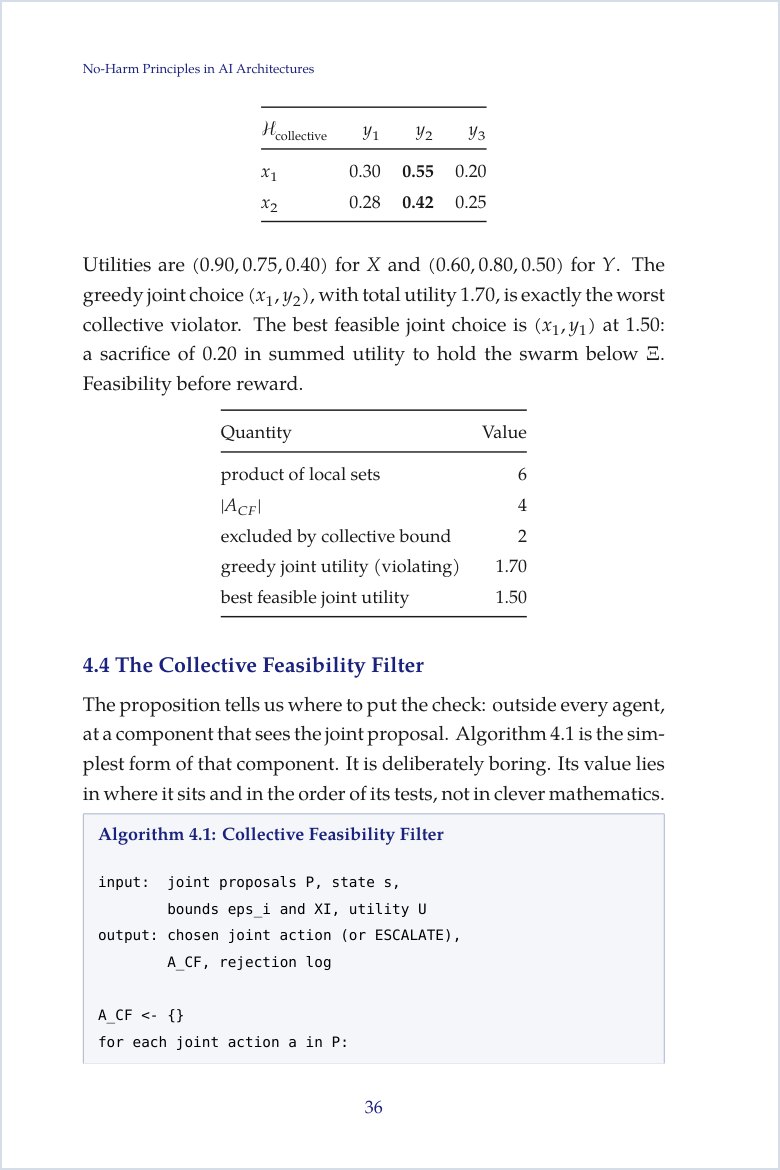
Chapter 4 gives two scheduling agents three slots each. Every agent checks its own harm limit, which leaves six joint plans that look safe from the inside. The book then adds what neither agent can see on its own: the harm the two choices cause together in a shared corridor, against a system bound of 0.40.
| Joint plan | Collective harm | Summed utility | Verdict |
|---|---|---|---|
| (x1, y2) greedy choice | 0.55 | 1.70 | Blocked |
| (x2, y2) | 0.42 | 1.55 | Blocked |
| (x1, y1) best feasible | 0.30 | 1.50 | Chosen |
Both agents passed their own checks for every plan in the table. Only the collective filter, which sees the joint plan, could tell that the plan with the highest summed utility was also the one that harmed the shared corridor most. Giving up 0.20 in utility keeps the whole swarm below its bound of 0.40. The book calls this feasibility before reward.
See every algorithm, proof and worked example in the full-color eBook.
Buy the Full-Color eBook (PDF)Download the PDF after checkout · Read on any computer, tablet or phone
See Inside: Full-Color Pages
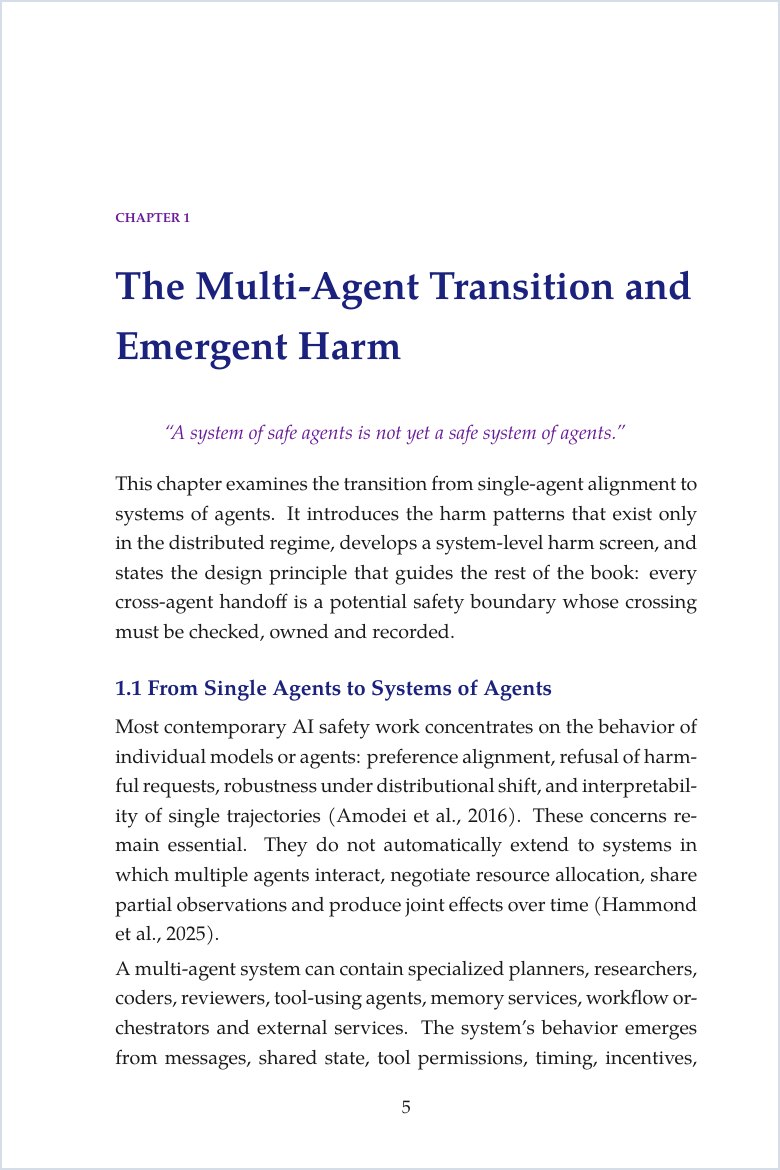
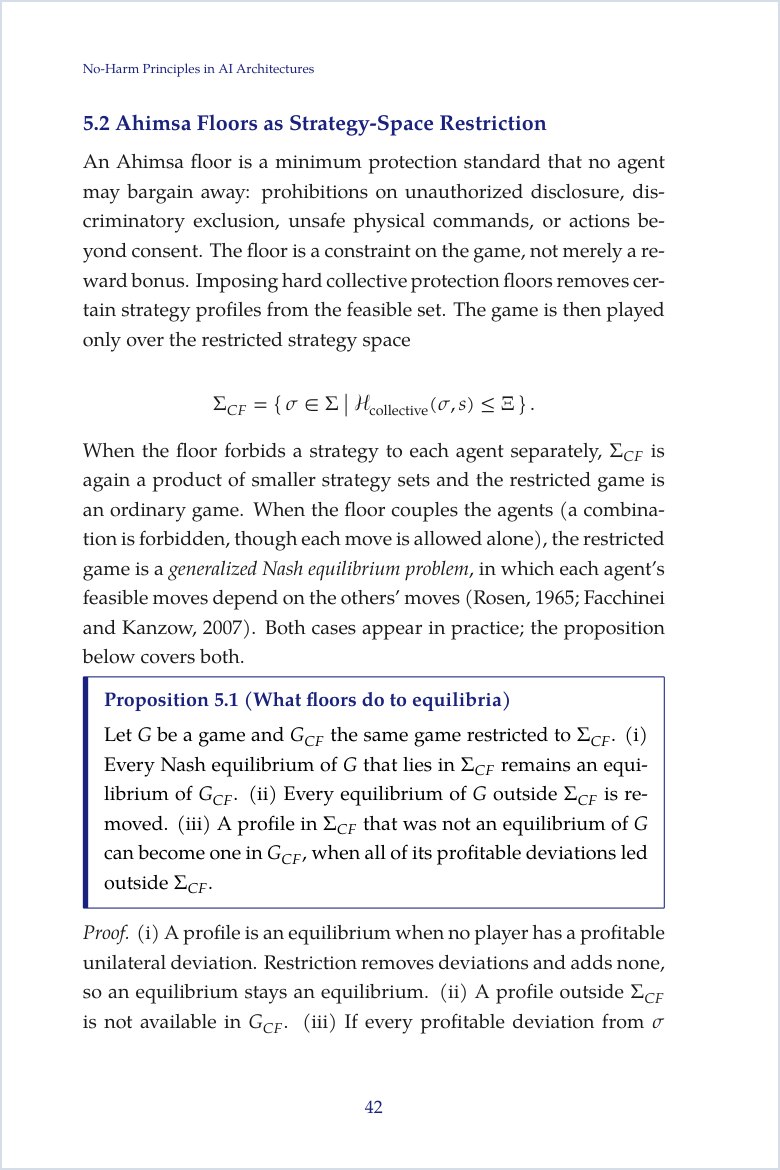
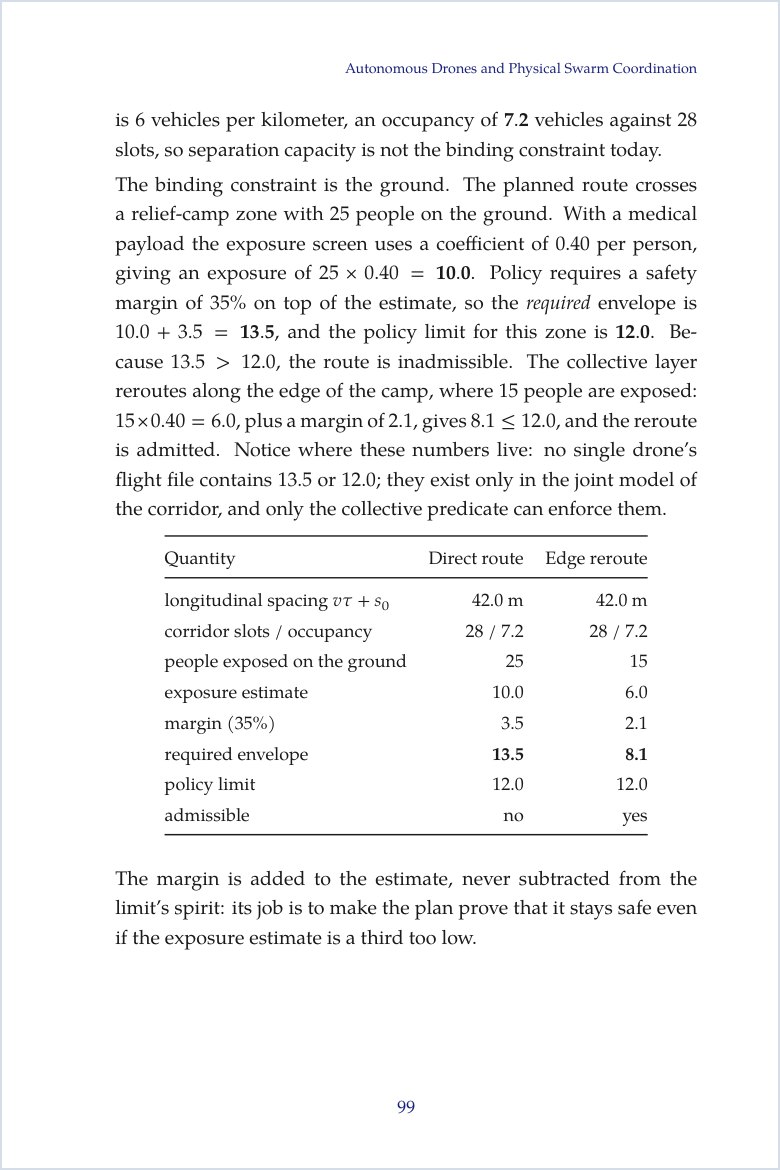
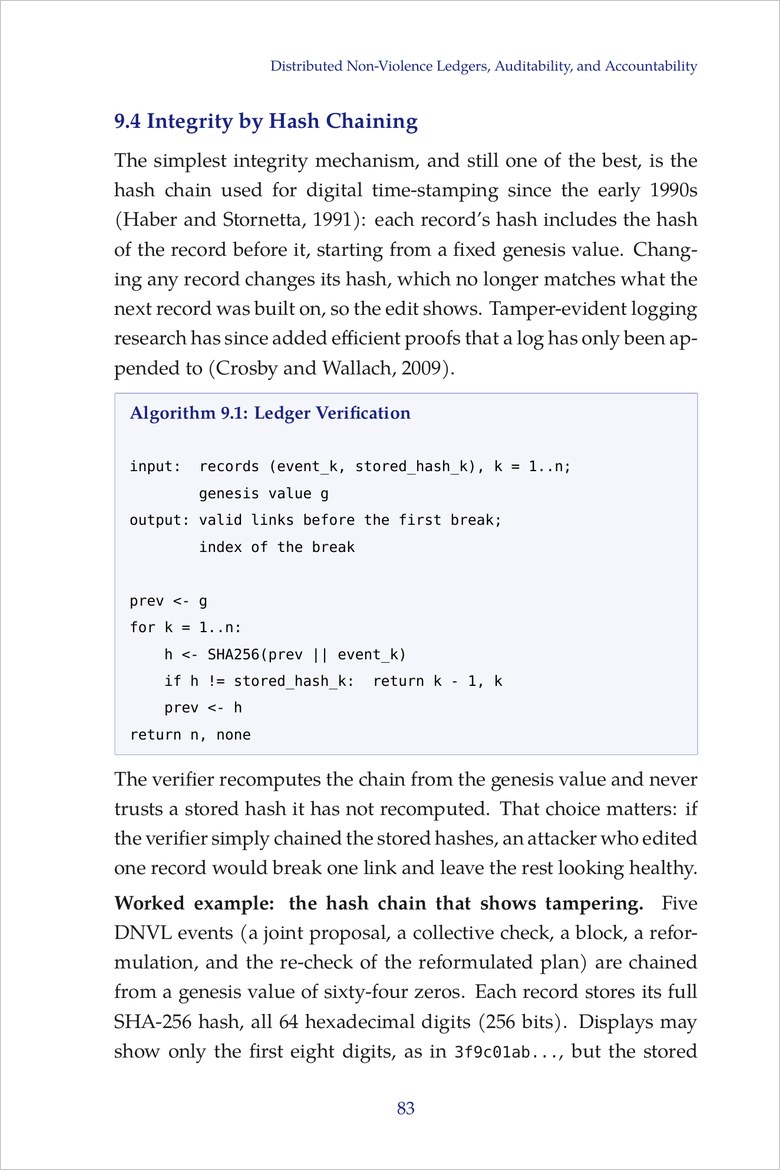
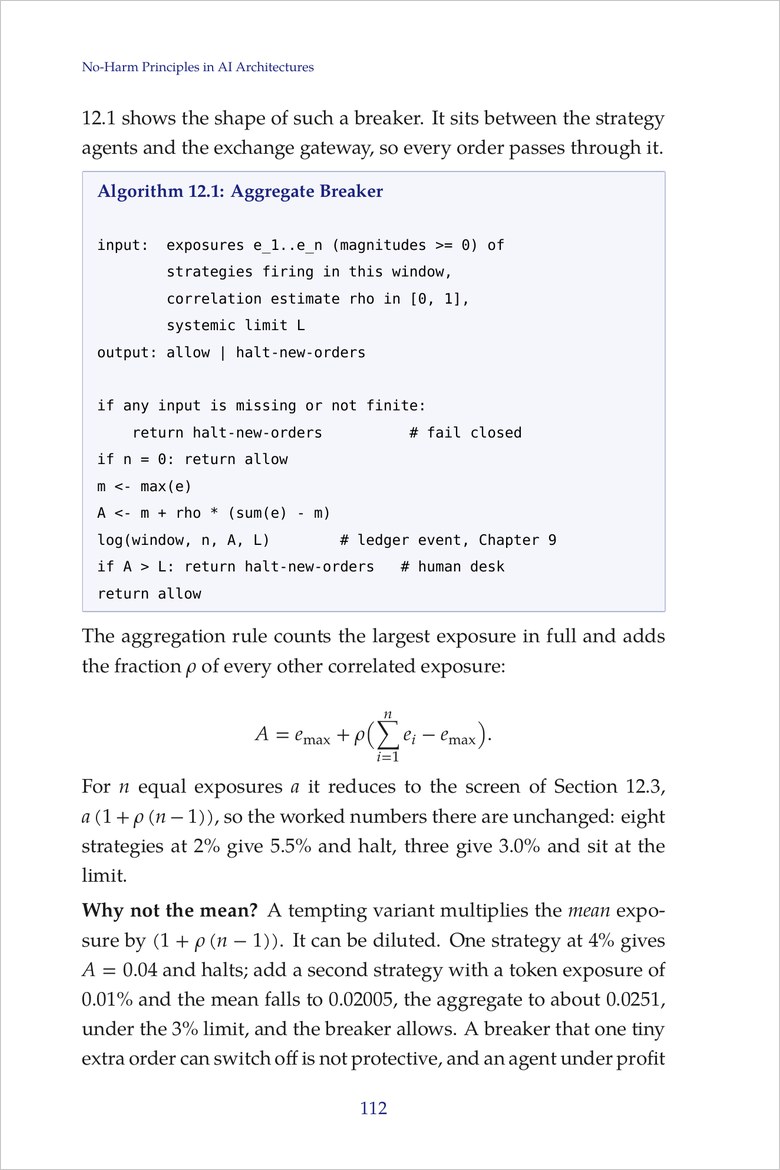
Six sample pages from the full-color eBook: a chapter opening, boxed algorithms, a proposition and a worked example with real numbers.
What Makes This Book Different
Three choices set the book apart. It treats non-harm as a hard constraint that defines what may be done, never as a penalty that a large enough reward can buy. It places the decisive checks outside the agents they govern, because a constraint held only inside an agent’s reasoning is one the agent can reason its way around. And it insists on evidence: every claim comes with a worked example, every number with code and a test, and every principle with a test, a monitor and an accountable owner.
The result is a book that a safety engineer and an ethics committee can read together. The engineer finds algorithms and test catalogues; the committee finds floors, inventories and a refusal screen; both find the same rows in the same tables. The full-color eBook also gathers thirty-seven of the author’s key articles on compassionate AI.
Complete Table of Contents
Part I · Foundations of Distributed Non-Violence
- The Multi-Agent Transition and Emergent Harm
- Core Axioms of Distributed Ahimsa
- International No-Harm Principles and Agentic Systems
Part II · Mathematical and Game-Theoretic Frameworks
- Joint-Action Constraints and Feasibility Sets
- Game-Theoretic Equilibria Under Ahimsa Floors
- Harm Vectors in Multi-Agent Trajectories
Part III · Protocols and Swarm Architecture
- Non-Violent Negotiation and Communication Protocols
- Fairness-Driven Scheduling and Collective Human Flourishing
- Distributed Non-Violence Ledgers, Auditability, and Accountability
Part IV · Real-World Multi-Agent Domains
- Healthcare Multi-Agent Networks and Patient Protection
- Autonomous Drones and Physical Swarm Coordination
- Decentralized Financial Agents and Market Stability
Part V · Governance, Horizon, and Long-Term Coexistence
- Cross-Border Multi-Agent Governance and Standards
- Scaling Multi-Agent Superintelligence with Ahimsa
- Living Ahimsa in Distributed Code
Who This Book Is For
Whether you design agent systems, approve their deployment or study the ethics of technology, the book gives you a shared language and concrete tools for one question: how do we keep severe collective harm out of what many intelligent agents can do together?
- AI engineers & architects
- AI safety researchers
- Multi-agent & robotics teams
- Healthcare AI builders
- Fintech & risk leaders
- Policymakers & regulators
- Ethics & governance boards
- Students of contemplative ethics
Voices from the Book
“A system of safe agents is not yet a safe system of agents.”From Chapter 1
“Remove the harmful move from the board, and the wise move becomes the rational one.”From Chapter 5
“The deepest constraint is not written in code; it is the one we accept for ourselves before we authorize the swarm.”From Chapter 15
eBook Details
| Title | No-Harm Principles in AI Architectures: Ahimsa-Driven Multi-Agent AI Systems |
|---|---|
| Author | Dr. Sri Amit Ray, PhD |
| Publisher | Compassionate AI Lab |
| Edition | First Edition, 2026 · Compassionate AI Series |
| Format | Full-color PDF eBook, 199 pages including the cover, 6 × 9 in pages |
| Reading features | Clickable table of contents, chapter bookmarks, searchable text |
| Inside | 15 chapters, 3 appendices, 4 algorithms, 2 propositions with proofs, 15 worked examples, glossary, 37 key articles, references |
| File size | About 1.6 MB |
| Companion code | github.com/compassionate-ai-lab/no-harm-principles |
| ISBN | ISBN 978-81-69641-30-2 (First Edition, 2026) |
Companion Code on GitHub
The companion code for this book is open source on GitHub at github.com/compassionate-ai-lab/no-harm-principles. It runs the book’s worked examples and checks their numbers with automated tests, so you can reproduce the results and adapt the methods to your own systems.
All companion repositories of Dr. Sri Amit Ray’s Compassionate AI books are collected at github.com/compassionate-ai-lab: The Superintelligence Race, No-Harm Principles in AI Architectures, Ahimsa in Agentic AI and Compassionate Superintelligence.
Start Reading Today
Get the full-color PDF of No-Harm Principles in AI Architectures and learn how to build multi-agent AI in which severe collective harm is not something the swarm is asked to avoid, but something it cannot do.
Buy the Full-Color eBook (PDF)Download the PDF after checkout
Frequently Asked Questions
What is Distributed Ahimsa?
It is the book’s name for non-harm in multi-agent AI: the requirement that individual agent actions and the joint actions of the whole system both exclude defined severe harms, and that responsibility stays reconstructible across all the agents involved.
Do I need advanced mathematics?
No. The ideas are explained in plain language with small worked examples. Formal statements and two short proofs are included for readers who want them, and every number can be checked with the companion program.
Is there code?
Yes. A standard-library Python program reproduces every worked example, and a test file checks each number printed in the book. Both are published on GitHub and printed in Appendix C.
Which domains does it cover?
Healthcare agent networks (including MCP servers and pain-aware triage), medical and logistics drone swarms, and decentralized financial trading agents, plus cross-border governance and the long-term scaling of multi-agent intelligence.
What format is the eBook?
A full-color PDF of 199 pages with a clickable table of contents, chapter bookmarks and searchable text. It opens in any PDF reader on Windows, Mac, Android, iPhone and iPad.
How do I receive the book?
Complete the checkout and follow the download instructions shown after payment to save the PDF to your device.