
Abstract
The Social Harmony Optimization Algorithm puts the well-being of society as a whole at the centre of AI systems that operate at scale. It responds to one of the clearest harms of today’s digital platforms: recommendation engines tuned for engagement that end up magnifying division, tribalism and conflict.
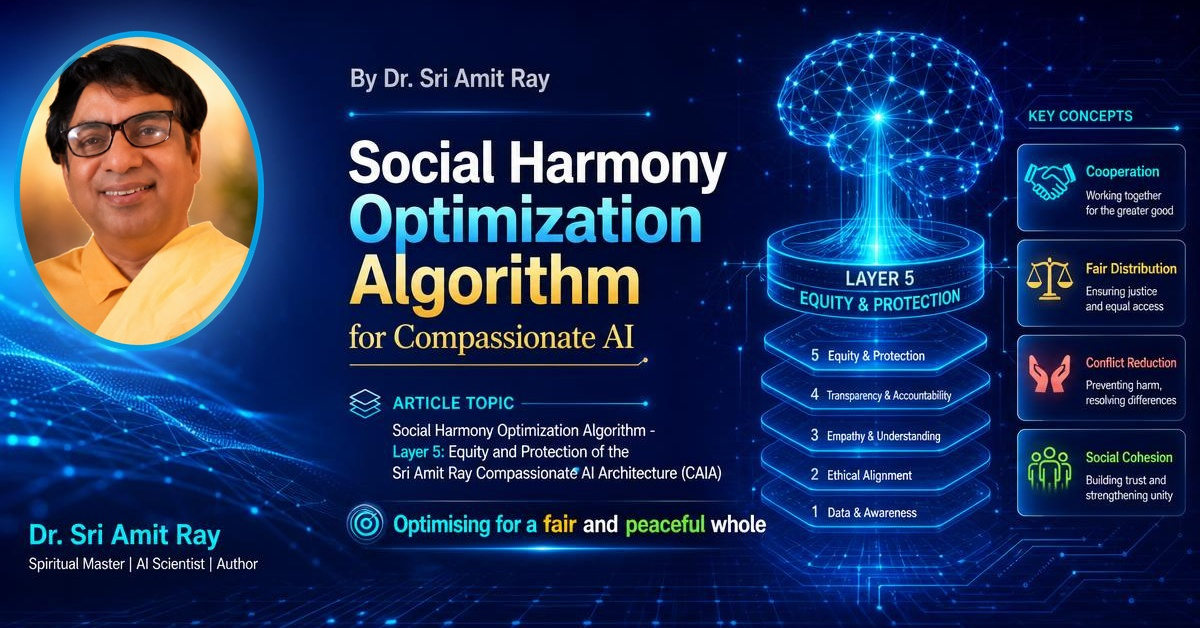
The algorithm defines social harmony as total benefit minus two penalties — one for inequality, measured with a Gini term, and one for conflict between groups. An outcome that lifts the average while widening the gap or heightening tension therefore scores badly. The algorithm is part of Layer 5 (Equity and Protection) of Sri Amit Ray’s Compassionate AI Architecture™ (CAIA™).
Key Takeaways
- Makes social cohesion an explicit optimisation goal, alongside individual benefit.
- Penalises both inequality (Gini) and pairwise conflict.
- Detects polarisation early and responds by surfacing bridging voices and common ground.
- Contributes to the Protection Score in the CAIA™ framework.
In Simple Words
In short: the algorithm balances how much good a decision does against how unequal and divisive it is. A plan that grows the pie but splits the community will lose to one that keeps people fair and at peace. The aim is a just, cohesive whole — not simply a larger total.
Readiness level: Concept-to-simulation. Suitable for policy modelling; live allocation use requires participatory weight-setting and oversight.
Why This Algorithm Matters
The Social Harmony Optimization Algorithm was developed at the Sri Amit Ray Compassionate AI Lab to promote cooperation, reduce conflict, build trust and strengthen social cohesion. It does so by making the collective health of society a primary objective for AI systems that work at social scale, directly confronting a well-documented modern harm: the way engagement-optimised recommendation systems amplify division, tribalism and conflict. [2]
Research on platform dynamics explains how this happens. Posts that provoke moral outrage hold attention better than posts that invite reflection. Content that flatters a group’s existing beliefs outperforms content that adds nuance. Material that demonises outsiders draws stronger reactions than material that humanises them. A system that maximises engagement with no regard for social harmony will discover and exploit these patterns — not out of malice, but simply by following the gradient of its metrics.
This algorithm adds a counterweight: measures of social cohesion built directly into the objective, alongside individual engagement. When it detects signs of polarisation — sharper ideological sorting, fewer interactions across groups, rising emotional heat in public conversation — it responds by promoting bridging content, highlighting shared ground, removing the built-in advantage of outrage, and giving more space to constructive voices.
“Harmony is not the absence of difference but the just balance of many voices.”
— A guiding principle of the Sri Amit Ray Compassionate AI Lab
The Mathematics
Social harmony H_social is modeled as the balance of aggregate utility, equity, and conflict reduction:
Symbols Used
| Symbol | Meaning |
|---|---|
| \(U_i\) | utility or benefit to member i |
| \(Gini(\cdot)\) | inequality of the utility distribution |
| \(\lambda\) | weight penalising inequality |
| \(\beta\) | weight penalising inter-group conflict |
A Step-by-Step Example
Option A gives utilities summing to 10 with Gini 0.1 and conflict 0.05; option B sums to 12 but Gini 0.4 and conflict 0.2. With \(\lambda=5,\beta=5\): H_A = 10 − 0.5 − 0.25 = 9.25; H_B = 12 − 2.0 − 1.0 = 9.0. The fairer option A wins despite lower raw utility.
How It Is Implemented
The reference implementation expresses the model as compassionate, auditable logic, written for clarity rather than raw performance so that ethical reviewers as well as engineers can follow every decision.
def optimize_social_harmony(resources, stakeholders):
    allocations = generate_all_possible_allocations(resources, stakeholders)
    best_alloc  = None
    max_harmony = -float('inf')
    for alloc in allocations:
        utilities = [calculate_utility(s, alloc) for s in stakeholders]
        gini      = calculate_gini_coefficient(utilities)
        conflict  = calculate_total_conflict(alloc, stakeholders)
        harmony   = sum(utilities) - LAMBDA * gini - BETA * conflict
        if harmony > max_harmony:
            max_harmony = harmony
            best_alloc  = alloc
    return best_alloc
Bridging versus Bonding Social Capital
The Social Harmony Optimization Algorithm draws on the sociological distinction between bonding social capital — the strong ties within homogeneous groups — and bridging social capital — the weaker but crucially important ties between diverse groups. Healthy societies require both: bonding capital provides the trust and solidarity that makes communities resilient; bridging capital provides the cross-group connections and shared understandings that make societies cohesive.
Engagement-optimized AI systems systematically maximize bonding capital while eroding bridging capital — because in-group content is more engaging than cross-group content, and tribal solidarity is a more reliable engagement trigger than civic solidarity. The Social Harmony Optimization Algorithm counters this dynamic by explicitly monitoring and optimizing for bridging capital alongside bonding capital — ensuring that AI systems contribute to social cohesion rather than social fragmentation.
Measuring It Reliably
Derive utilities from domain outcomes, inequality from standard Gini or Theil indices, and conflict from validated tension and grievance indicators. Set \(\lambda\) and \(\beta\) through participatory, transparent processes, not by the operator alone.
Where It Can Help
- Social Media Platform Design: Building bridging content amplification into recommendation systems, reducing the algorithmic advantage of outrage-generating content, and monitoring for coordinated inauthentic behavior that artificially amplifies social division.
- Urban Planning and Resource Allocation: Distributing public resources — parks, transit, services — to maximize social harmony across diverse communities rather than maximizing aggregate efficiency in ways that systematically benefit already-advantaged populations.
- Organizational Collaboration Tools: Tracking and incentivizing cross-functional cooperation and mutual support, building organizational cultures of compassionate collective intelligence.
PART IV
Human Dignity and Ethical Intelligence
Algorithms 11–15: Dignity · Fairness · Inclusion · Transparency · Oversight
Use Cases in Practice
Beyond the general applications above, the algorithm supports concrete, human-centred deployments across compassionate-AI domains:
🏙️ Smart Cities — Public Welfare Optimization
A city allocates services to maximise welfare while penalising inequality and inter-neighbourhood tension.
🕊️ Peacekeeping Force Compassionate Robotics AI
Patrol and resource decisions are tuned to reduce inter-group conflict, not merely maximise coverage.
🌊 Humanitarian AI — Disaster Response Prioritization
Aid is distributed to keep relief equitable across communities and avoid grievance-driven unrest.
🌍 Climate AI — Protecting Vulnerable Populations
Adaptation funds are balanced so benefits do not concentrate while exposed groups are left behind.
Ethical Foundations
Ethics and empathy are the starting point of the Sri Amit Ray tradition, not an extra layer added at the end. This algorithm rests on three commitments: non-harm (ahimsa), openness about how its decisions are reached, and respect for privacy and human dignity. Like every one of the twenty-five Human-Centered Compassionate AI algorithms, it is meant to work under human oversight — supporting human moral judgement, never standing in for it. [1]
Known Limits and Cautions
- Adding up welfare across many people rests on value choices that are open to debate.
- Conflict and benefit are hard to measure and easy to measure with bias.
- A poorly specified harmony goal could silence legitimate and necessary dissent.
Guarding Against Misuse
Any tool strong enough to protect people can also be misused to harm them, so these safeguards must accompany every deployment. The main risks of misuse for this algorithm, and how to guard against them, are:
- It could be tuned to enforce conformity or silence minorities under the banner of harmony — protect dissent explicitly and keep weights public.
- Avoid individual-level scoring; operate on aggregate allocations.
Alignment with AI Standards
To support real-world adoption, the algorithm maps onto recognised AI governance frameworks and standards:
| Framework | How this algorithm contributes |
|---|---|
| NIST AI RMF | MAP — assesses societal-level impacts. |
| EU AI Act | Guards against social-scoring and discriminatory allocation. |
| ISO/IEC 42001 | Impact assessment and stakeholder engagement. |
| IEEE 7010 | Societal well-being measurement. |
Supporting the 17 UN Sustainable Development Goals
The Social Harmony Optimization Algorithm balances aggregate welfare against inequality and conflict, encoding a just distribution rather than raw efficiency. This directly serves the SDGs on equality and peaceful institutions, extending the Compassionate AI movement and the 10 Ethical AI Indexes to questions of collective coexistence, guided by the 12 Compassionate AI Principles.
The most directly relevant Sustainable Development Goals, and how this algorithm helps fulfil them, are:
- SDG 10 Reduced Inequalities. Penalising the Gini term in the objective explicitly drives allocations toward reduced inequality.
- SDG 11 Sustainable Cities and Communities. Conflict-reduction terms help cities and communities remain cohesive and safe.
- SDG 16 Peace, Justice, and Strong Institutions. Balancing many voices fairly strengthens peaceful, representative institutions.
In this way the algorithm is not a stand-alone technical artefact but a concrete instrument for the global development agenda, translating compassion into measurable progress toward the 2030 Goals and beyond.
Where It Fits in CAIA™
Figure: This algorithm sits in Layer 5 · Equity & Protection (highlighted) of the Compassionate AI Architecture™ (CAIA™).
CAIA-SVG-START
CAIA-SVG-END
This algorithm is one of twenty-five building blocks of Sri Amit Ray’s Compassionate AI Architecture™ (CAIA™). CAIA works like a seven-layer, human-centred operating system: before any AI decision can be deployed, it has to pass through each layer of compassion in turn.
It operates in Layer 5: Equity and Protection Layer, whose purpose is to protect vulnerable populations. The layer answers a single guiding question — Is anyone left behind? — and emits the Protection Score, one of the seven inputs to the Compassionate AI Index, \( \text{CAI}=\sum_k w_k S_k \). It ensures the protection layer balances aggregate welfare against inequality and conflict, protecting the social fabric as well as individuals.
In the CAIA pipeline (Compassion Quotient → Suffering Reduction → Empathy → Human Flourishing → Vulnerability Protection → Planetary Protection → Future Generation Analysis → Human Oversight → Deploy), this layer’s score is one of the gates a decision must satisfy, and a sufficiently low protective score can veto deployment regardless of the overall average. Resting on the four pillars — Compassion, Responsibility, Sustainability, and Future Generations — the architecture ensures this algorithm never operates in isolation.
Read the full architecture: The Sri Amit Ray Compassionate AI Architecture™ (CAIA™).
This algorithm is one of the 25 Human-Centered Compassionate AI algorithms — see the complete canonical reference list.
How to Cite
Ray, Sri Amit. “Social Harmony Optimization Algorithm for Compassionate AI.” Compassionate AI, Sri Amit Ray Compassionate AI Lab, 2026, https://sriamitray.com/research/social-harmony-optimization-algorithm-compassionate-ai/.
References
- Ray, Amit. “AI Agents and Robots in Peacekeeping Force and Social Care: Compassionate AI Technologies.” Compassionate AI, vol. 3, no. 9, 2025, pp. 75–77, amitray.com.
- Ray, Amit. “Compassionate AI-Driven Democracy: Power and Challenges.” Compassionate AI, vol. 3, no. 9, 2024, pp. 48–50, amitray.com.
- Rawls, John. A Theory of Justice. Harvard University Press, 1971.
- Christakis, Nicholas A., and James H. Fowler. Connected: The Surprising Power of Our Social Networks and How They Shape Our Lives. Little, Brown, 2009.
- Granovetter, Mark S. “The Strength of Weak Ties.” American Journal of Sociology, vol. 78, no. 6, 1973, pp. 1360–1380, doi.org/10.1086/225469.
- Ray, Amit. Human-Centered Compassionate AI: Sri Amit Ray’s 25 Algorithms for Protecting Humanity and Future Generations. Compassionate AI Lab, 2026. ISBN 978-8169641050.
- Ray, Amit. Compassionate Artificial Intelligence: Frameworks and Algorithms. Compassionate AI Lab, 2018. ISBN 978-9382123460.
- Ray, Amit. Compassionate Superintelligence AI 5.0: AI with Blockchain, BMI, Drone, IoT, and Biometric Technologies. Compassionate AI Lab, 2018. ISBN 978-9382123446.
Further Reading from the Compassionate AI Lab
- Ray, Amit. “Build Your Own Agentic AI Healthcare MCP Server: A Complete Guide to AI-Powered Healthcare Agents.” Compassionate AI, 3.8 (2026): 60-62. https://amitray.com/agentic-ai-healthcare-mcp-server/
- Ray, Amit. “Medical AI Drones for Disaster Management: Intelligent Unmanned Health-Care Systems.” Compassionate AI, 3.8 (2026): 57-59. https://amitray.com/medical-ai-drones-for-disaster-management/
- Ray, Amit. “Compassionate Medical AI Drones as Intelligent Unmanned Health-Care Systems: A Human-Centered AI Architecture for Suffering Reduction and Human Flourishing.” Compassionate AI, 3.8 (2026): 57-59. https://amitray.com/medical-ai-drones-human-centered-ai-healthcare/
- Ray, Amit. “The Sri Amit Ray Compassion Quotient (CQ) Algorithm for Compassionate AI.” Compassionate AI, 2.6 (2026): 81-83. https://amitray.com/compassion-quotient-cq-algorithm-compassionate-ai/
- Ray, Amit. “Collective Human Flourishing Optimization AI Algorithm (CHFOA): A Compassion-Centered Multi-Stakeholder AI Optimization Framework.” Compassionate AI, 2.6 (2026): 90-92. https://amitray.com/collective-human-flourishing-optimization-algorithm-chfoa/
- Ray, Amit. “Human Flourishing Optimization Algorithm (HFOA) for Compassionate AI Architecture.” Compassionate AI, 2.6 (2026): 81-83. https://amitray.com/human-flourishing-optimization-algorithm-hfoa-compassionate-ai/
- Ray, Amit. “The Sri Amit Ray Compassionate AI Architecture (CAIA): A Seven-Layer Framework for Human-Centered Artificial Intelligence.” Compassionate AI, 2.6 (2026): 81-83. https://amitray.com/compassionate-ai-architecture/
- Ray, Amit. “Human-Centered Compassionate AI: The 25 Algorithms for Protecting Humanity and Future Generations.” Compassionate AI, 2.6 (2026): 30-32. https://amitray.com/human-centered-compassionate-ai-the-25-algorithms/
- Ray, Amit. “AI Consciousness and Self-Aware Robots: Sri Amit Ray’s Framework for Compassionate Intelligence.” Compassionate AI, 2.5 (2026): 57-59. https://amitray.com/ai-consciousness-self-aware-robots/
- Ray, Amit. “The 12 Sri Amit Ray Compassionate AI Principles | Ethical AI Framework.” Compassionate AI, 2.4 (2026): 12-14. https://amitray.com/the-12-compassionate-ai-principles-for-humanity-and-future-generations/
- Ray, Amit. “The Compassionate AI Lab Declaration on AI Safety, Suffering Reduction, and the Protection of Humanity.” Compassionate AI, 4.12 (2025): 72-74. https://amitray.com/compassionate-ai-declaration-protection-of-humanity/
- Ray, Amit. “Compassionate AI for Forward Deployed Engineers (FDEs) in SaaS Companies.” Compassionate AI, 4.11 (2025): 15-17. https://amitray.com/compassionate-ai-for-forward-deployed-engineers-fdes-in-saas-companies/
- Ray, Amit. “Microbial AI, Bioleaching and Digital Twins for Manufacturing the 17 Rare Earth Elements.” Compassionate AI, 4.10 (2025): 42-44. https://amitray.com/microbial-ai-bioleaching-and-digital-twins-for-manufacturing-the-17-rare-earth-elements/
- Ray, Amit. “AI-Driven Rare Earth Element Magnet Design: Detailed Methodologies.” Compassionate AI, 4.10 (2025): 27-29. https://amitray.com/ai-driven-rare-earth-elements-magnet-design-methodologies/
- Ray, Amit. “AI Agents and Robots in Peacekeeping Force and Social Care: Compassionate AI Technologies.” Compassionate AI, 3.9 (2025): 75-77. https://amitray.com/ai-agents-robots-peacekeeping-force-social-care-compassionate-ai/
- Ray, Amit. “Ray Mother–Infant Inter-brain Synchrony Algorithm for Deep Compassionate AI.” Compassionate AI, 3.9 (2025): 60-62. https://amitray.com/ray-mother-infant-inter-brain-synchrony-algorithm-deep-compassionate-ai/
- Ray, Amit. “Pain Recognition and Prediction AI Algorithm (PRPA) for Compassionate AI.” Compassionate AI, 3.9 (2025): 60-62. https://amitray.com/pain-recognition-and-prediction-algorithm-prpa-for-compassionate-ai/
- Ray, Amit. “Modeling Consciousness in Compassionate AI: Transformer Models and EEG Data Verification.” Compassionate AI, 3.9 (2025): 27-29. https://amitray.com/modeling-consciousness-in-compassionate-ai-transformer-models/
- Ray, Amit. “The 7 Pillars of Compassionate AI Democracy.” Compassionate AI, 3.9 (2024): 84-86. https://amitray.com/the-7-pillars-of-compassionate-ai-democracy/
- Ray, Amit. “Compassionate AI-Driven Democracy: Power and Challenges.” Compassionate AI, 3.9 (2024): 48-50. https://amitray.com/compassionate-ai-driven-democracy-power-and-challenges/
- Ray, Amit. “The 10 Ethical AI Indexes for LLM Data Training and Responsible AI.” Compassionate AI, 3.8 (2023): 35-39. https://amitray.com/the-10-ethical-ai-indexes-for-responsible-ai/
- Ray, Amit. “Ethical Responsibilities in Large Language AI Models: GPT-3, GPT-4, PaLM 2, LLaMA, Chinchilla, Gopher, and BLOOM.” Compassionate AI, 3.7 (2023): 21-23. https://amitray.com/ethical-responsibility-in-large-language-ai-models/
- Ray, Amit. “Calling for a Compassionate AI Movement: Towards Compassionate Artificial Intelligence.” Compassionate AI, 2.6 (2023): 75-77. https://amitray.com/calling-for-a-compassionate-ai-movement/
- Ray, Amit. “From Data-Driven AI to Compassionate AI: Safeguarding Humanity and Empowering Future Generations.” Compassionate AI, 2.6 (2023): 51-53. https://amitray.com/from-data-driven-ai-to-compassionate-ai-safeguarding-humanity-and-empowering-future-generations/
- Ray, Amit. “Artificial intelligence for Climate Change, Biodiversity and Earth System Models.” Compassionate AI, 1.1 (2022): 54-56. https://amitray.com/artificial-intelligence-for-climate-change-and-earth-system-models/
- Ray, Amit. “Artificial Intelligence for Balance Control and Fall Detection of Elderly People.” Compassionate AI, 4.10 (2018): 39-41. https://amitray.com/artificial-intelligence-for-balance-control-and-fall-detection-system-of-elderly-people/
- Ray, Amit. “Artificial Intelligence to Combat Antibiotic Resistant Bacteria.” Compassionate AI, 2.6 (2018): 3-5. https://amitray.com/artificial-intelligence-for-antibiotic-resistant-bacteria/
- Ray, Amit. “Navigation System for Blind People Using Artificial Intelligence.” Compassionate AI, 2.5 (2018): 42-44. https://amitray.com/artificial-intelligence-for-assisting-blind-people/
- Ray, Amit. “Brain-Computer Interface and Compassionate Artificial Intelligence.” Compassionate AI, 2.5 (2018): 3-5. https://amitray.com/brain-computer-interface-compassionate-ai/