
Abstract
The Ecological Impact Assessment Algorithm weighs the environmental effects of AI decisions and gives nature a real seat at the table whenever AI acts at scale. It extends the circle of moral concern in AI ethics beyond immediate users to the living systems that all human life relies on.
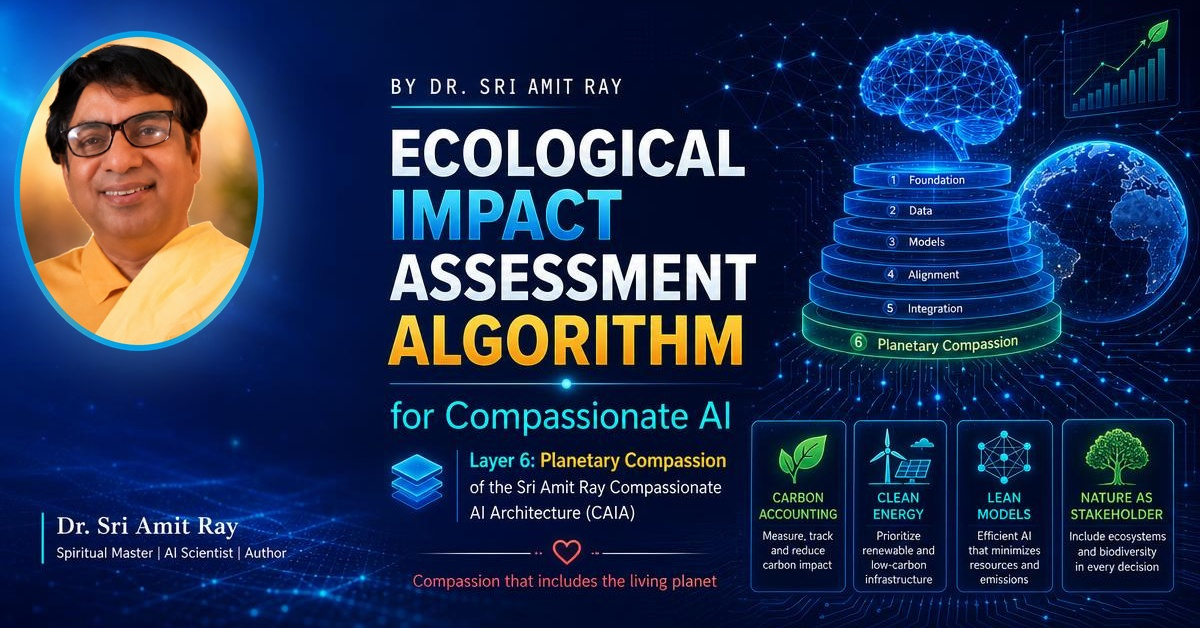
It also counts the carbon cost of computation itself — power draw, running time, data-centre efficiency (PUE) and the carbon intensity of the electricity grid — and guides workloads toward cleaner energy and more efficient models. The algorithm is part of Layer 6 (Planetary Compassion) of Sri Amit Ray’s Compassionate AI Architecture™ (CAIA™).
Key Takeaways
- Makes the environment an explicit stakeholder in AI optimisation.
- Calculates the carbon cost of AI computation from power, time, PUE and grid intensity.
- Supports carbon-aware scheduling and smaller, more efficient models.
- Contributes to the Planetary Score in the CAIA™ framework.
In Simple Words
In plain words: the algorithm adds up the carbon that running the AI produces and nudges the work toward cleaner electricity and lighter models. Compassion that leaves out the planet is only half complete.
Readiness level: Field-ready. Carbon accounting and carbon-aware scheduling are practical today.
Why This Algorithm Matters
Developed at the Sri Amit Ray Compassionate AI Lab, the Ecological Impact Assessment Algorithm evaluates the environmental consequences of AI decisions and treats nature as a genuine stakeholder in every significant AI action. This marks a basic widening of moral concern in AI ethics — from the people who use AI directly to the wider web of life on which every human depends. [1]
AI poses an ecological challenge in two ways. First, AI systems have a large and growing footprint of their own. Training a single large language model has been estimated to emit roughly as much carbon dioxide as five cars over their whole lifetimes, and answering billions of requests every day adds a great deal more. As capability and scale increase, these costs will keep rising unless they are actively managed, and the energy AI needs will increasingly compete with other demands — including the shift away from fossil fuels.
Second, AI now makes or shapes many decisions with direct environmental effects: managing energy, extracting resources, farming, routing transport, planning land use and running industry. Each can either cut environmental harm or multiply it. A farming system tuned only for yield, ignoring soil health, water use and biodiversity, may win short-term output at the cost of lasting ecological damage. This algorithm writes such ecological side-effects into the optimisation itself, making nature’s interests visible in the calculation instead of treating the environment as a free resource.
“Compassion that ignores the Earth is incomplete; intelligence must count its own footprint.”
— A guiding principle of the Sri Amit Ray Compassionate AI Lab
The Mathematics
The carbon cost E_carbon of a computation task:
Where P(τ) = hardware power draw (kW), t(τ) = time (hours), PUE = Power Usage Effectiveness, CI = Carbon Intensity (gCO₂/kWh).
Symbols Used
| Symbol | Meaning |
|---|---|
| \(E_{carbon}\) | carbon emissions of a computation |
| \(P(\tau)\) | hardware power draw |
| \(t(\tau)\) | run time |
| PUE | data-centre power-usage effectiveness |
| CI | grid carbon intensity (gCO₂/kWh) |
A Step-by-Step Example
A training run draws P=0.4 kW for t=100 h with PUE=1.5 on a grid at CI=400 gCO₂/kWh. \(E_{carbon}\) = 0.4·100·1.5·400 = 24,000 g ≈ 24 kg CO₂. Scheduling the same job on a 100 gCO₂/kWh grid cuts it to 6 kg — a 75% reduction for the same result.
How It Is Implemented
The reference implementation expresses the model as compassionate, auditable logic, written for clarity rather than raw performance so that ethical reviewers as well as engineers can follow every decision.
def schedule_computational_task(task_details, datacenters):
    best_dc    = None
    min_carbon = float('inf')
    for dc in datacenters:
        pue              = dc.get_pue()
        ci               = dc.get_current_carbon_intensity()
        estimated_power  = estimate_power_draw(task_details, dc.hardware)
        carbon_footprint = estimated_power * task_details.duration * pue * ci
        if carbon_footprint < min_carbon:
            min_carbon = carbon_footprint
            best_dc    = dc
    if min_carbon > MAX_CARBON_BUDGET:
        defer_task(task_details, wait_for_renewable_grid=True)
        return None
    return best_dc
Biodiversity and Ecosystem Services
One of the most ecologically significant dimensions of the algorithm is its treatment of biodiversity and ecosystem services — the vast range of life-sustaining functions performed by healthy ecosystems: air and water purification, climate regulation, pollination, soil formation, flood control, and carbon sequestration. These services have been systematically undervalued in conventional economic analysis, producing patterns of ecological destruction that impose massive long-term costs while appearing economically rational in the short term.
The algorithm incorporates biodiversity impact metrics and ecosystem service valuations into its assessments, ensuring that AI decisions affecting biodiversity or ecosystem services bear the full cost of these impacts in the analysis — making invisible ecological costs visible rather than treating nature as a free input to human economic activity.
Measuring It Reliably
Use measured power and real-time grid carbon intensity rather than averages (building on Strubell et al. and green-AI practice). Report emissions per model and per inference, and verify against provider data.
Where It Can Help
- Large-Scale AI Training: Automatically scheduling compute-intensive training runs to clean-energy datacenters and renewable energy surplus windows.
- Supply Chain Optimization: Incorporating deforestation impact, carbon intensity, and biodiversity metrics into AI supply chain decisions.
- Agricultural AI: Monitoring and optimizing for soil health, water table levels, and local biodiversity alongside yield metrics.
Use Cases in Practice
Beyond the general applications above, the algorithm supports concrete, human-centred deployments across compassionate-AI domains:
🌍 Climate AI — Protecting Vulnerable Populations
Carbon-aware scheduling shifts heavy AI workloads to low-carbon hours and grids, cutting the emissions that drive climate harm to vulnerable communities.
🏙️ Smart Cities — Public Welfare Optimization
City AI services report and minimise their per-inference carbon footprint.
🤖 Compassionate Eldercare Robotics AI
Care-robot fleets are measured and optimised for energy use so compassion does not carry a hidden carbon cost.
🌊 Humanitarian AI — Disaster Response Prioritization
Field deployments favour lean, low-energy models suited to constrained, off-grid settings.
Ethical Foundations
Ethics and empathy are the starting point of the Sri Amit Ray tradition, not an extra layer added at the end. This algorithm rests on three commitments: non-harm (ahimsa), openness about how its decisions are reached, and respect for privacy and human dignity. Like every one of the twenty-five Human-Centered Compassionate AI algorithms, it is meant to work under human oversight — supporting human moral judgement, never standing in for it. [1]
Known Limits and Cautions
- Manufacturing (embodied) and water costs are often left out and should be included too.
- The quality of grid carbon-intensity data varies from region to region.
- Efficiency gains can be cancelled out by rebound effects, as cheaper computing leads to more use.
Guarding Against Misuse
Any tool strong enough to protect people can also be misused to harm them, so these safeguards must accompany every deployment. The main risks of misuse for this algorithm, and how to guard against them, are:
- Selective boundaries enable greenwashing — fix a transparent accounting scope and seek third-party verification.
- Do not offset on paper while real emissions keep rising.
Alignment with AI Standards
To support real-world adoption, the algorithm maps onto recognised AI governance frameworks and standards:
| Framework | How this algorithm contributes |
|---|---|
| NIST AI RMF | MEASURE — environmental impact as a system characteristic. |
| EU AI Act | Supports energy and resource reporting expectations for large models. |
| ISO/IEC 42001 / ISO 14001 | Environmental objectives in management systems. |
| GHG Protocol | Carbon-accounting alignment. |
Supporting the 17 UN Sustainable Development Goals
The Ecological Impact Assessment Algorithm accounts for the carbon cost of computation itself, ensuring that compassion does not ignore the Earth. Measuring and reducing AI’s footprint serves the energy and climate goals, building on AI Brick Computing for sustainable green AI and Sri Amit Ray’s work on AI for climate change and Earth system models, in line with the 12 Compassionate AI Principles.
The most directly relevant Sustainable Development Goals, and how this algorithm helps fulfil them, are:
- SDG 7 Affordable and Clean Energy. Carbon-aware scheduling shifts computation toward clean, affordable energy.
- SDG 12 Responsible Consumption and Production. Quantifying compute cost drives responsible, efficient production and consumption of AI.
- SDG 13 Climate Action. Minimising emissions per task makes AI itself an instrument of climate action.
In this way the algorithm is not a stand-alone technical artefact but a concrete instrument for the global development agenda, translating compassion into measurable progress toward the 2030 Goals and beyond.
Where It Fits in CAIA™
Figure: This algorithm sits in Layer 6 · Planetary Compassion (highlighted) of the Compassionate AI Architecture™ (CAIA™).
CAIA-SVG-START
CAIA-SVG-END
This algorithm is one of twenty-five building blocks of Sri Amit Ray’s Compassionate AI Architecture™ (CAIA™). CAIA works like a seven-layer, human-centred operating system: before any AI decision can be deployed, it has to pass through each layer of compassion in turn.
It operates in Layer 6: Planetary Compassion Layer, whose purpose is to protect civilization and Earth. The layer answers a single guiding question — Does it protect the planet? — and emits the Planetary Score, one of the seven inputs to the Compassionate AI Index, \( \text{CAI}=\sum_k w_k S_k \). It gives the planetary layer its measurement of the AI’s own environmental footprint, steering computation toward clean energy.
In the CAIA pipeline (Compassion Quotient → Suffering Reduction → Empathy → Human Flourishing → Vulnerability Protection → Planetary Protection → Future Generation Analysis → Human Oversight → Deploy), this layer’s score is one of the gates a decision must satisfy, and a sufficiently low protective score can veto deployment regardless of the overall average. Resting on the four pillars — Compassion, Responsibility, Sustainability, and Future Generations — the architecture ensures this algorithm never operates in isolation.
Read the full architecture: The Sri Amit Ray Compassionate AI Architecture™ (CAIA™).
This algorithm is one of the 25 Human-Centered Compassionate AI algorithms — see the complete canonical reference list.
How to Cite
Ray, Sri Amit. “Ecological Impact Assessment Algorithm for Compassionate AI.” Compassionate AI, Sri Amit Ray Compassionate AI Lab, 2026, https://sriamitray.com/research/ecological-impact-assessment-algorithm-compassionate-ai/.
References
- Ray, Amit. “Artificial Intelligence for Climate Change, Biodiversity and Earth System Models.” Compassionate AI, vol. 1, no. 1, 2022, pp. 54–56, amitray.com.
- Ray, Amit. “Calling for a Compassionate AI Movement: Towards Compassionate Artificial Intelligence.” Compassionate AI, vol. 2, no. 6, 2023, pp. 75–77, amitray.com.
- Rockström, Johan, et al. “Planetary Boundaries: Exploring the Safe Operating Space for Humanity.” Ecology and Society, vol. 14, no. 2, 2009, art. 32, ecologyandsociety.org.
- Raworth, Kate. Doughnut Economics: Seven Ways to Think Like a 21st-Century Economist. Chelsea Green Publishing, 2017.
- Strubell, Emma, et al. “Energy and Policy Considerations for Deep Learning in NLP.” Proceedings of the 57th Annual Meeting of the Association for Computational Linguistics, 2019, aclanthology.org/P19-1355.
- Ray, Amit. Human-Centered Compassionate AI: Sri Amit Ray’s 25 Algorithms for Protecting Humanity and Future Generations. Compassionate AI Lab, 2026. ISBN 978-8169641050.
- Ray, Amit. Compassionate Artificial Intelligence: Frameworks and Algorithms. Compassionate AI Lab, 2018. ISBN 978-9382123460.
- Ray, Amit. Compassionate Superintelligence AI 5.0: AI with Blockchain, BMI, Drone, IoT, and Biometric Technologies. Compassionate AI Lab, 2018. ISBN 978-9382123446.
Further Reading from the Compassionate AI Lab
- Ray, Amit. “Build Your Own Agentic AI Healthcare MCP Server: A Complete Guide to AI-Powered Healthcare Agents.” Compassionate AI, 3.8 (2026): 60-62. https://amitray.com/agentic-ai-healthcare-mcp-server/
- Ray, Amit. “Medical AI Drones for Disaster Management: Intelligent Unmanned Health-Care Systems.” Compassionate AI, 3.8 (2026): 57-59. https://amitray.com/medical-ai-drones-for-disaster-management/
- Ray, Amit. “Compassionate Medical AI Drones as Intelligent Unmanned Health-Care Systems: A Human-Centered AI Architecture for Suffering Reduction and Human Flourishing.” Compassionate AI, 3.8 (2026): 57-59. https://amitray.com/medical-ai-drones-human-centered-ai-healthcare/
- Ray, Amit. “The Sri Amit Ray Compassion Quotient (CQ) Algorithm for Compassionate AI.” Compassionate AI, 2.6 (2026): 81-83. https://amitray.com/compassion-quotient-cq-algorithm-compassionate-ai/
- Ray, Amit. “Collective Human Flourishing Optimization AI Algorithm (CHFOA): A Compassion-Centered Multi-Stakeholder AI Optimization Framework.” Compassionate AI, 2.6 (2026): 90-92. https://amitray.com/collective-human-flourishing-optimization-algorithm-chfoa/
- Ray, Amit. “Human Flourishing Optimization Algorithm (HFOA) for Compassionate AI Architecture.” Compassionate AI, 2.6 (2026): 81-83. https://amitray.com/human-flourishing-optimization-algorithm-hfoa-compassionate-ai/
- Ray, Amit. “The Sri Amit Ray Compassionate AI Architecture (CAIA): A Seven-Layer Framework for Human-Centered Artificial Intelligence.” Compassionate AI, 2.6 (2026): 81-83. https://amitray.com/compassionate-ai-architecture/
- Ray, Amit. “Human-Centered Compassionate AI: The 25 Algorithms for Protecting Humanity and Future Generations.” Compassionate AI, 2.6 (2026): 30-32. https://amitray.com/human-centered-compassionate-ai-the-25-algorithms/
- Ray, Amit. “AI Consciousness and Self-Aware Robots: Sri Amit Ray’s Framework for Compassionate Intelligence.” Compassionate AI, 2.5 (2026): 57-59. https://amitray.com/ai-consciousness-self-aware-robots/
- Ray, Amit. “The 12 Sri Amit Ray Compassionate AI Principles | Ethical AI Framework.” Compassionate AI, 2.4 (2026): 12-14. https://amitray.com/the-12-compassionate-ai-principles-for-humanity-and-future-generations/
- Ray, Amit. “The Compassionate AI Lab Declaration on AI Safety, Suffering Reduction, and the Protection of Humanity.” Compassionate AI, 4.12 (2025): 72-74. https://amitray.com/compassionate-ai-declaration-protection-of-humanity/
- Ray, Amit. “Compassionate AI for Forward Deployed Engineers (FDEs) in SaaS Companies.” Compassionate AI, 4.11 (2025): 15-17. https://amitray.com/compassionate-ai-for-forward-deployed-engineers-fdes-in-saas-companies/
- Ray, Amit. “Microbial AI, Bioleaching and Digital Twins for Manufacturing the 17 Rare Earth Elements.” Compassionate AI, 4.10 (2025): 42-44. https://amitray.com/microbial-ai-bioleaching-and-digital-twins-for-manufacturing-the-17-rare-earth-elements/
- Ray, Amit. “AI-Driven Rare Earth Element Magnet Design: Detailed Methodologies.” Compassionate AI, 4.10 (2025): 27-29. https://amitray.com/ai-driven-rare-earth-elements-magnet-design-methodologies/
- Ray, Amit. “AI Agents and Robots in Peacekeeping Force and Social Care: Compassionate AI Technologies.” Compassionate AI, 3.9 (2025): 75-77. https://amitray.com/ai-agents-robots-peacekeeping-force-social-care-compassionate-ai/
- Ray, Amit. “Ray Mother–Infant Inter-brain Synchrony Algorithm for Deep Compassionate AI.” Compassionate AI, 3.9 (2025): 60-62. https://amitray.com/ray-mother-infant-inter-brain-synchrony-algorithm-deep-compassionate-ai/
- Ray, Amit. “Pain Recognition and Prediction AI Algorithm (PRPA) for Compassionate AI.” Compassionate AI, 3.9 (2025): 60-62. https://amitray.com/pain-recognition-and-prediction-algorithm-prpa-for-compassionate-ai/
- Ray, Amit. “Modeling Consciousness in Compassionate AI: Transformer Models and EEG Data Verification.” Compassionate AI, 3.9 (2025): 27-29. https://amitray.com/modeling-consciousness-in-compassionate-ai-transformer-models/
- Ray, Amit. “The 7 Pillars of Compassionate AI Democracy.” Compassionate AI, 3.9 (2024): 84-86. https://amitray.com/the-7-pillars-of-compassionate-ai-democracy/
- Ray, Amit. “Compassionate AI-Driven Democracy: Power and Challenges.” Compassionate AI, 3.9 (2024): 48-50. https://amitray.com/compassionate-ai-driven-democracy-power-and-challenges/
- Ray, Amit. “The 10 Ethical AI Indexes for LLM Data Training and Responsible AI.” Compassionate AI, 3.8 (2023): 35-39. https://amitray.com/the-10-ethical-ai-indexes-for-responsible-ai/
- Ray, Amit. “Ethical Responsibilities in Large Language AI Models: GPT-3, GPT-4, PaLM 2, LLaMA, Chinchilla, Gopher, and BLOOM.” Compassionate AI, 3.7 (2023): 21-23. https://amitray.com/ethical-responsibility-in-large-language-ai-models/
- Ray, Amit. “Calling for a Compassionate AI Movement: Towards Compassionate Artificial Intelligence.” Compassionate AI, 2.6 (2023): 75-77. https://amitray.com/calling-for-a-compassionate-ai-movement/
- Ray, Amit. “From Data-Driven AI to Compassionate AI: Safeguarding Humanity and Empowering Future Generations.” Compassionate AI, 2.6 (2023): 51-53. https://amitray.com/from-data-driven-ai-to-compassionate-ai-safeguarding-humanity-and-empowering-future-generations/
- Ray, Amit. “Artificial intelligence for Climate Change, Biodiversity and Earth System Models.” Compassionate AI, 1.1 (2022): 54-56. https://amitray.com/artificial-intelligence-for-climate-change-and-earth-system-models/
- Ray, Amit. “Artificial Intelligence for Balance Control and Fall Detection of Elderly People.” Compassionate AI, 4.10 (2018): 39-41. https://amitray.com/artificial-intelligence-for-balance-control-and-fall-detection-system-of-elderly-people/
- Ray, Amit. “Artificial Intelligence to Combat Antibiotic Resistant Bacteria.” Compassionate AI, 2.6 (2018): 3-5. https://amitray.com/artificial-intelligence-for-antibiotic-resistant-bacteria/
- Ray, Amit. “Navigation System for Blind People Using Artificial Intelligence.” Compassionate AI, 2.5 (2018): 42-44. https://amitray.com/artificial-intelligence-for-assisting-blind-people/
- Ray, Amit. “Brain-Computer Interface and Compassionate Artificial Intelligence.” Compassionate AI, 2.5 (2018): 3-5. https://amitray.com/brain-computer-interface-compassionate-ai/