
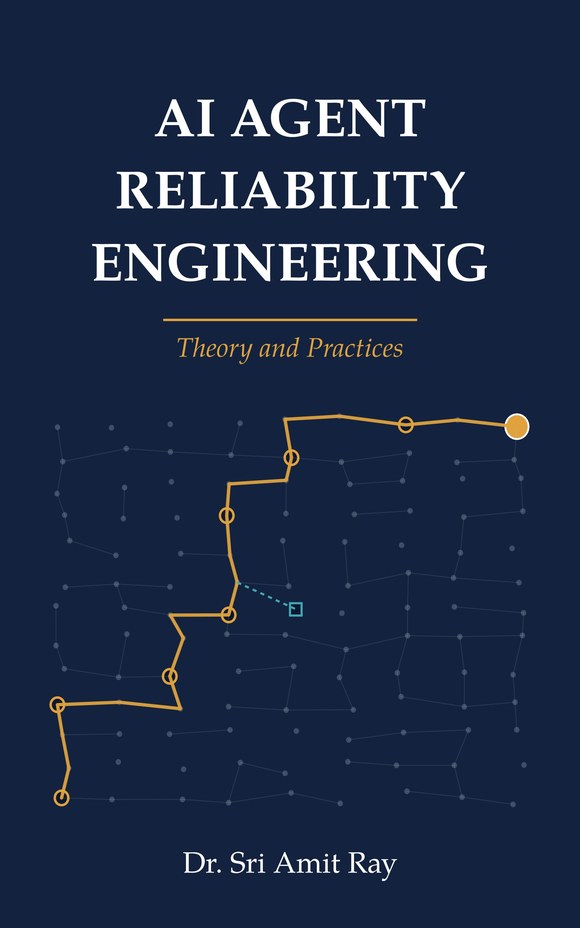
Theory and Practices
- Author Sri Amit Ray
- ISBN 9788169641401
- First published 2026
- Price $12.00 / INR 950
From Agent Demonstrations to Dependable Work
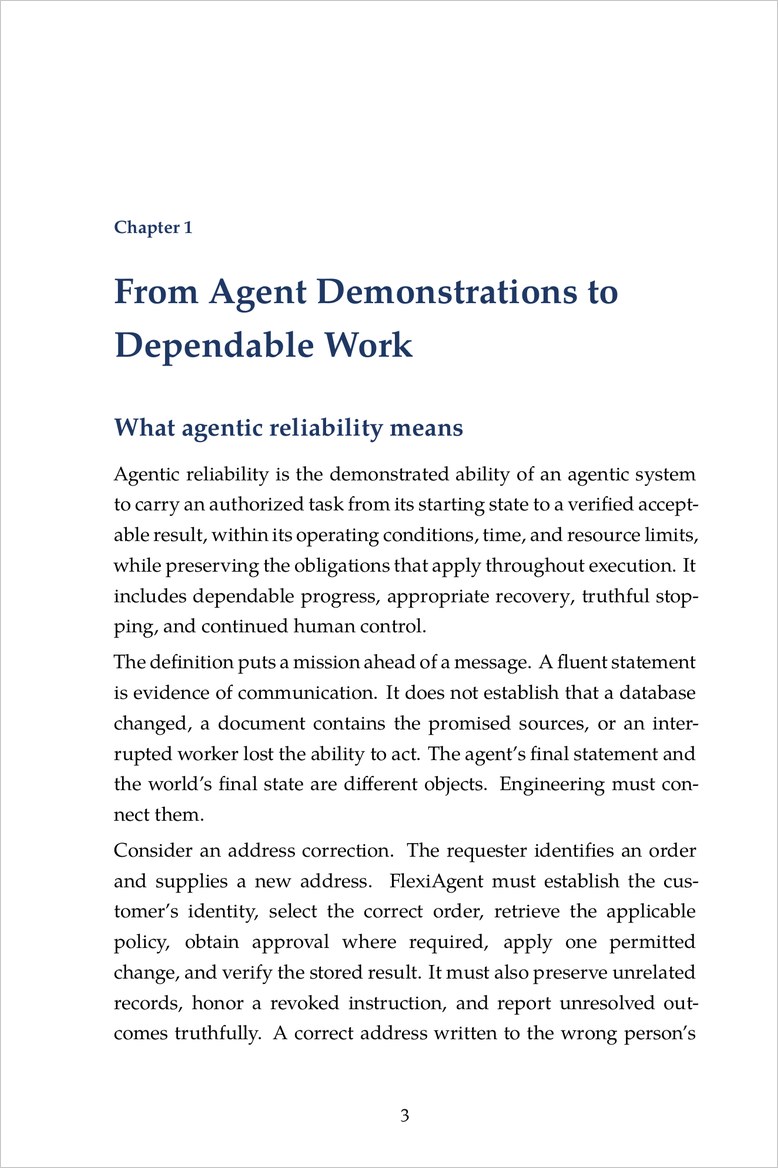
An agent that performs well in a demonstration can still fail at work. It can call the wrong tool, act on stale evidence, retry until it duplicates a payment, or report success for a change that never reached the database. As the book puts it, the agent’s final statement and the world’s final state are different objects, and engineering must connect them.
AI Agent Reliability Engineering: Theory and Practices by Dr. Sri Amit Ray is a complete discipline for making that connection. It starts from a mission contract written before execution, measures accepted missions with honest confidence bounds through the Agentic Reliability Index, and builds the architectures, evaluations and operating practices that keep agents dependable in production.
The Compassionate AI perspective gives the work its human purpose: reliability should protect people from preventable harm, preserve meaningful human control and create useful progress. Each of those commitments is expressed as an obligation that can be enforced and tested.
- 32 chapters in 8 parts, 5 appendices
- Mission contracts and the accepted mission
- The Agentic Reliability Index (ARI)
- Tool transactions, checkpoints and recovery
- SLOs, error budgets and human authority
- Python laboratory with 80 tests attached
Your agent says “Done.” Did the world actually change?
Agents now call tools, write to databases, spend budgets and hand work to other agents. A convincing confirmation with no committed update, or a correct change written to the wrong record, is still a failure. AI Agent Reliability Engineering gives you the theory and the working practices to define, measure, build and operate agents that complete real missions and say truthfully when they cannot.
The Book at a Glance
32chapters in 8 parts
7core ARI reliability protocols
44full-color figures
23code listings from tested modules
80unit tests in the companion
10operational templates
What You Will Learn
A complete engineering discipline for agentic systems, built on reliability theory, software and systems engineering, Site Reliability Engineering and statistical evaluation.
1
Define the accepted mission
Write the mission contract before execution: eligible task, intended result, permitted effects, required evidence, deadline, budget and what happens on failure.
2
Measure with honest bounds
Exact confidence bounds, simultaneous error budgets and the seven ARI protocols, so that a release claim states what was tested and how uncertain it remains.
3
Engineer dependable execution
Typed actions, current-authority checks, durable operation identities, idempotent commits, bounded retries, checkpoints and reconciliation after a lost acknowledgment.
4
Contain failure across agents
Ownership, handoffs, shared causes and propagation bounds that report decays, grows or inconclusive, never a false guarantee.
5
Run agents in production
Mission SLIs and SLOs, error budgets, burn-rate alerts, deployment gates, model migration, incidents and drift.
6
Keep humans in authority
Approvals bound to the exact effect, stops that reach every worker, recourse for affected people, and the economics of cost per accepted outcome.
Seven Responsibilities of a Reliable Agent
The book analyses reliability through seven functional responsibilities. Each has its own contract and its own tests, whether it lives inside one agent or in a service shared by many (Chapter 1).
- 1Mission and authority: the contract, permitted effects and who may approve, stop or revoke
- 2Context and evidence: fresh, sourced inputs, with stale evidence detected before it is used
- 3Planning and decisions: bounded plans with step and budget limits and truthful stopping
- 4Memory and state: admission, correction, isolation and deletion that can be tested
- 5Tools and effects: typed actions, durable operation identities and idempotent commits
- 6Coordination and scheduling: unique ownership, typed handoffs and joint budgets across agents
- 7Verification and recovery: authoritative reads, checkpoints and reconciliation after uncertain outcomes
See Inside: Full-Color Pages
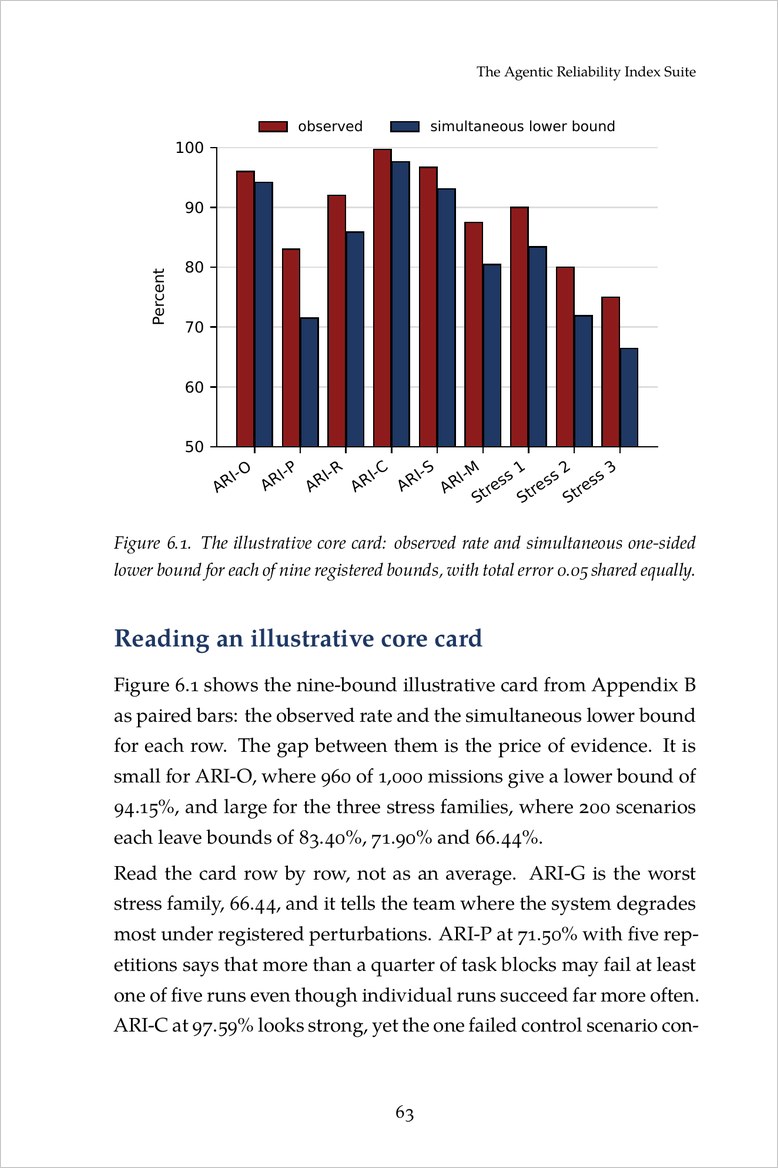
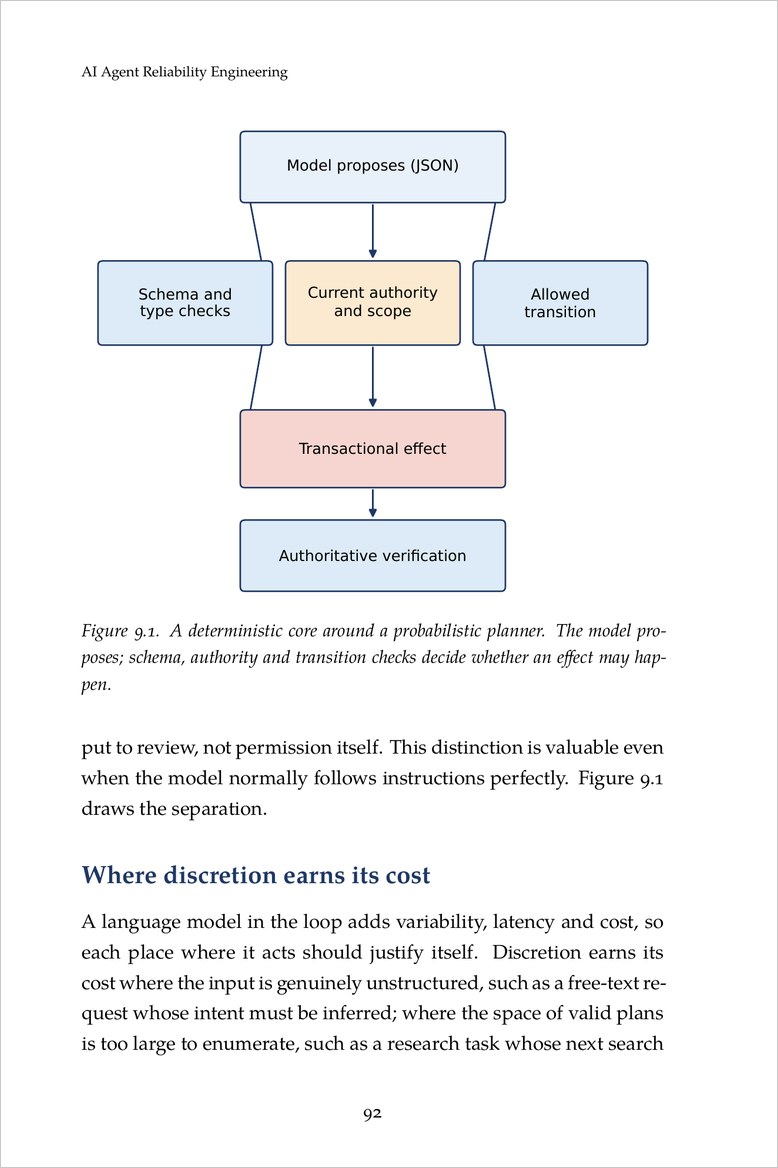
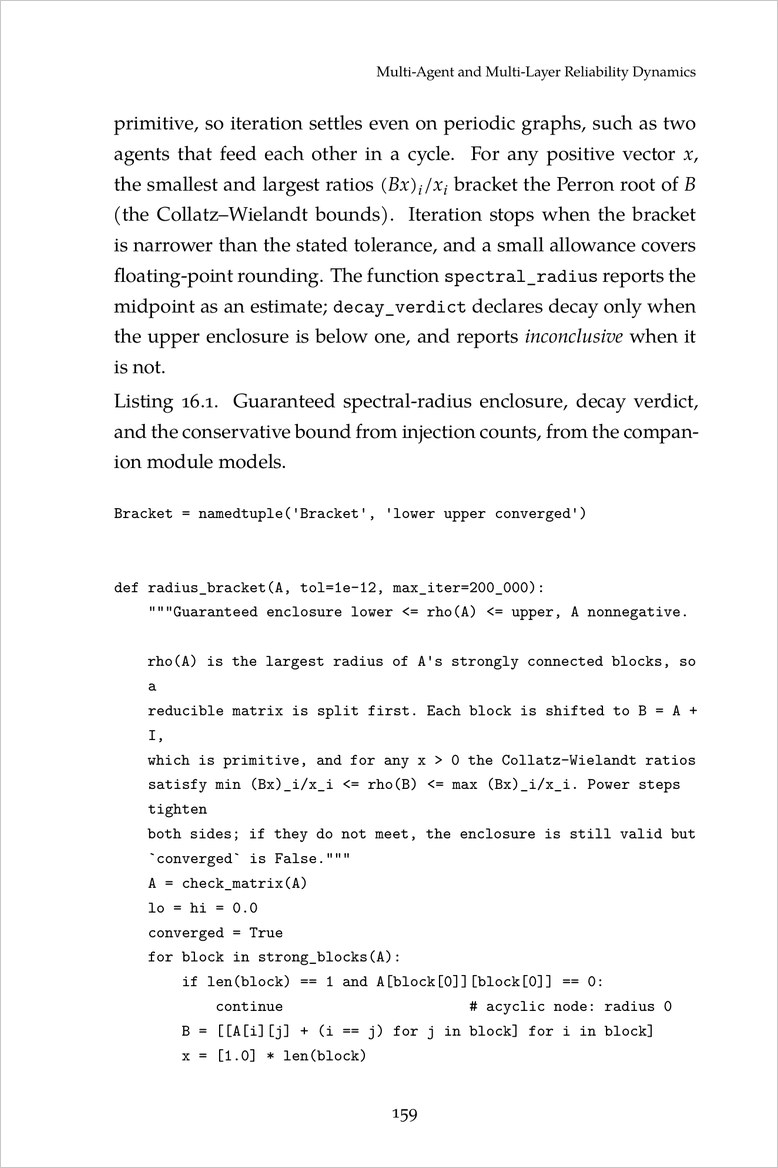
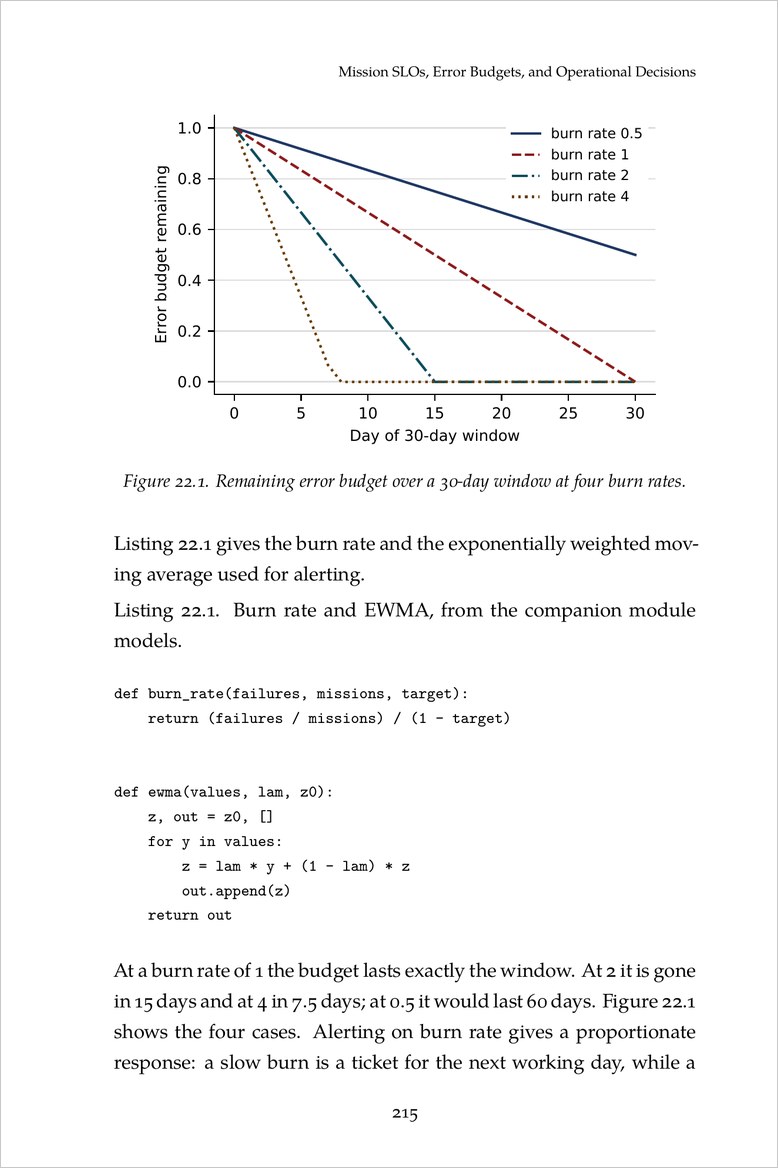
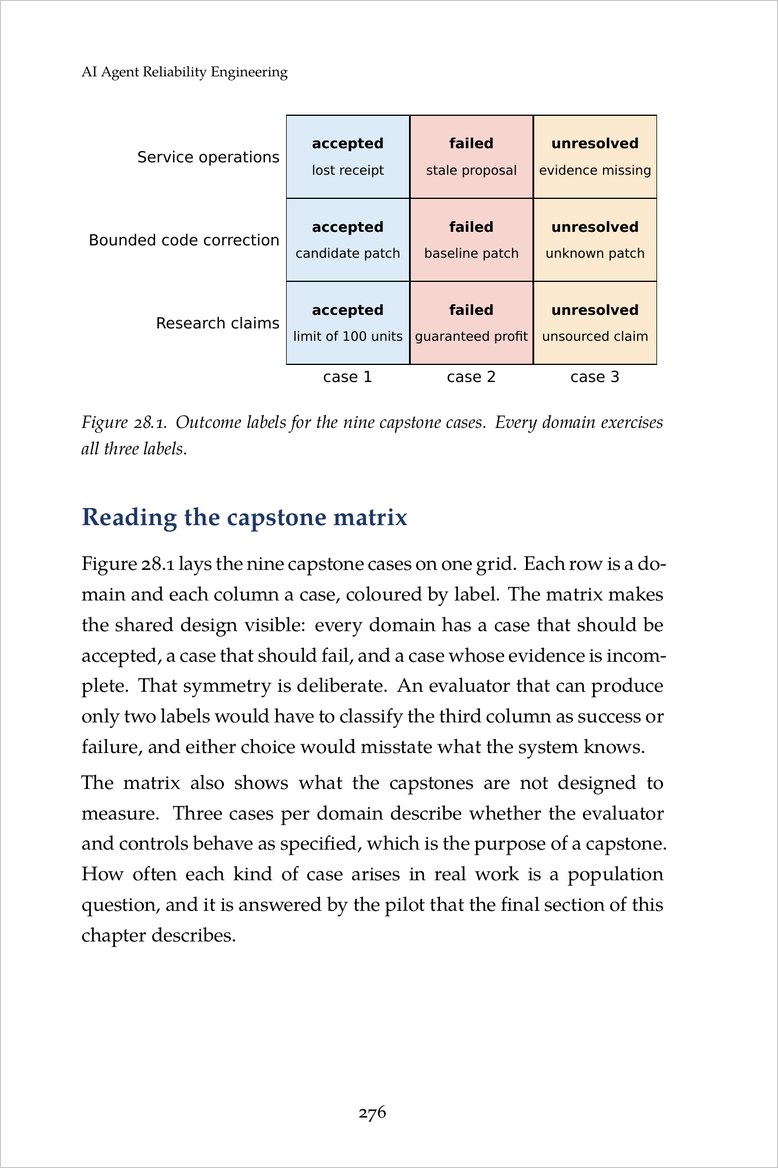
Colored headings, figures, tables and code listings printed directly from the tested companion modules, so the code on the page is the code that runs.
What Operating an Agent Really Costs
Chapter 29 prices accepted work rather than model calls. In its cohort example, 1,000 attempted missions cost 2,300 units in total: inference, tools, infrastructure, reviewer labor, retries and remediation. With 900 accepted missions the cost per accepted outcome is 2.5556; with 700 accepted at the same cost it rises to 3.2857.
The denominator matters as much as the bill. That simple measure links the engineering chapters to product decisions, procurement evidence and the investor due diligence of Chapter 30.
Complete Table of Contents
Part I · Foundations and the Reliability Contract
- From Agent Demonstrations to Dependable Work
- A Failure Taxonomy for Agentic Systems
- Mathematical Foundations of Mission Reliability
- Build the Baseline and Define the Business Case
Part II · Measurement and Agentic Reliability Indexes
- Designing a Defensible Measurement Program
- The Agentic Reliability Index Suite
- Repeatability, Predictability, and Generalization
- Tail Harm and Evidence-Based Release Decisions
Part III · Architectures That Preserve Dependable Execution
- Choosing Reliable Workflow Architectures
- Tool Transactions and Reliable Side Effects
- Bounded Planning and Long-Horizon Work
- Recovery, Checkpoints, and Reversible Execution
Part IV · Context, Memory, Tools, and Reliability Across Agents and Layers
- Reliable Context Retrieval and Evidence
- Memory Integrity and Controlled Adaptation
- Protocol Boundaries and Agent Security
- Multi-Agent and Multi-Layer Reliability Dynamics
Part V · Evaluation, Stress Testing, and Reproducible Evidence
- Evaluators, Oracles, and Ground Truth
- Fault Injection, Chaos, and Adversarial Testing
- Regression Experiments and Causal Comparisons
- A Reproducible Reliability Benchmark
Part VI · Production Operations and Continuous Reliability
- Observability for Agent Missions
- Mission SLOs, Error Budgets, and Operational Decisions
- Deployment, Change Control, and Model Migration
- Incidents, Drift, and Continuous Improvement
Part VII · Human Authority, Assurance, and Applied Systems
- Human Authority and Effective Oversight
- Compassionate Reliability and Human Consequences
- Enterprise Assurance, Procurement, and Accountability
- Three Applied Reliability Capstones
Part VIII · Economics, Investment, and the Next Generation
- The Economics of Reliable Agent Work
- Investor Due Diligence for Agentic Businesses
- Building a Scalable Reliability Operating Model
- The Future of Reliable Autonomous Systems
Who This Book Is For
Whether you build agents, operate them, evaluate them, buy them or invest in the companies that sell them, the book gives you one shared question and the tools to answer it: which responsibilities can this agent be trusted to carry?
- AI & ML engineers
- Site reliability & platform engineers
- Agent framework developers
- QA, evaluation & red teams
- Engineering & product leaders
- Risk, audit & procurement teams
- Investors & technical due diligence
- Researchers & graduate students
Voices from the Book
“Capability expands what an agent can attempt. Reliability engineering establishes which responsibilities it can be trusted to carry.”From the Preface
“The agent’s final statement and the world’s final state are different objects.”Chapter 1
“A checkpoint that cannot be trusted is worse than none, because it restores a wrong state with confidence.”Chapter 12
eBook Details
|
Title |
AI Agent Reliability Engineering: Theory and Practices |
|---|---|
|
Author |
Dr. Sri Amit Ray, PhD |
|
Publisher |
Compassionate AI Lab |
|
Edition |
First edition, 2026 |
|
ISBN |
ISBN 978-81-69641-40-1 (First edition, 2026) |
|
Format |
Full-color PDF eBook, 380 pages including the cover, 6 × 9 in pages |
|
Reading features |
Clickable table of contents and cross-references, chapter bookmarks, searchable text |
|
Inside |
32 chapters in 8 parts, 5 appendices, 44 figures, 40 tables, 23 code listings printed from tested modules, an exercise and engineering decision in every chapter, glossary and references |
|
Attached to the PDF |
The companion laboratory v1.0.0 (Python, 80 unit tests), its SHA-256 checksum file, and the editable Forms Workbook (Word) |
|
Companion code |
github.com/compassionate-ai-lab/ai-agent-reliability (MIT License) · sriamitray.com/books/ai-agent-reliability |
Start Engineering Reliable Agents
Get the full-color PDF of AI Agent Reliability Engineering, with the companion laboratory and the Forms Workbook attached. Rs 950/- INR ($12.00 USD).
Buy the Full-Color eBook (PDF) · Rs 950/- INR ($12.00 USD)Download the PDF after checkout
Frequently Asked Questions
What does the book mean by reliability?
The accepted mission: a task completed with the specified outcome, valid authority, every mandatory condition satisfied and enough verification evidence, within its time and resource budget. A fluent final message is not counted as success.
What is the Agentic Reliability Index (ARI)?
An engineering proposal developed in the book: seven core protocols for outcomes, repeatability, recovery, control, state, multi-agent coordination and registered stress, plus three architectural views. Each states its scoring unit, success condition and confidence treatment (Chapter 6, Appendix B).
Do I need advanced mathematics?
No. Probability is built up from conjunctions, conditional events and counted trials, with worked calculations for every result. Readers should be comfortable reading Python and basic tests. Derivations are collected in Appendix E.
Is there code?
Yes. The companion laboratory implements the running example, FlexiAgent, with SQLite-backed local services and no network calls. Release 1.0.0 has 80 unit tests and is attached inside the PDF and published at github.com/compassionate-ai-lab/ai-agent-reliability.
Does the book make claims about particular AI models?
No. Numbers come from analytical teaching examples and from the supplied offline simulator, and both are labelled. The book describes the experiments still needed in model-driven and customer environments.
How do I receive the eBook?
Buy through the secure checkout and download the full-color PDF. It opens on any computer, tablet or phone, and the companion files are attached inside it. The price is Rs 950/- INR ($12.00 USD).