
Abstract
The Transparency and Explainability Algorithm supplies honest, understandable reasons for AI decisions. Such explanations underpin trust, accountability, democratic control of technology, people’s rights when machines decide about them, and any oversight worth the name. Without them, AI drifts toward a “black box society”, where life-shaping decisions can be neither understood nor challenged.
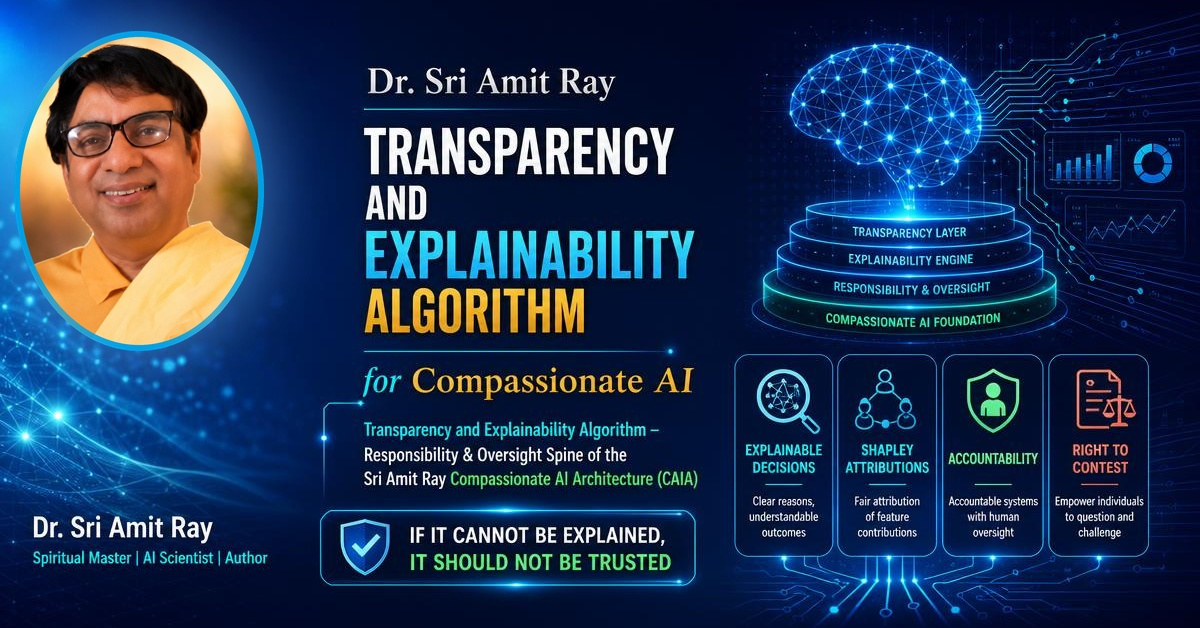
The algorithm fits local explanation models based on Shapley additive feature attributions, so that every individual decision can be traced back to the factors that most influenced it. It forms part of the Responsibility and Oversight spine of Sri Amit Ray’s Compassionate AI Architecture™ (CAIA™).
Key Takeaways
- Gives each AI decision a reason that is faithful to the model and readable by people.
- Uses Shapley-value (SHAP) attributions to show which factors mattered and how much.
- Supports the right to understand and contest automated decisions in health, hiring and justice.
- Belongs to the Responsibility and Oversight spine that runs through all seven CAIA™ layers.
In Simple Words
In simple words: for every decision the AI makes, this algorithm produces a truthful explanation a person can read, so the decision can be understood and, if needed, challenged. A decision that cannot be explained has not earned our trust.
Readiness level: Field-ready (it builds on SHAP and interpretability research), with the caveat that explanations must be faithful, not merely plausible.
Why This Algorithm Matters
At the Sri Amit Ray Compassionate AI Lab, transparency comes first: without it there can be no trust, no accountability and no real oversight. The Transparency and Explainability Algorithm produces explanations of AI decisions that people can understand — something essential for democratic governance of AI, for individual rights wherever decisions are automated, and for human oversight that actually works. Without transparency, AI becomes what Frank Pasquale called a “black box society”: decisions that shape people’s lives made by systems that nobody — users, regulators or even developers — can fully understand or explain. [4]
Today’s deep learning models make this genuinely hard. A network with billions of parameters reaches its answers through layer upon layer of matrix operations and nonlinear functions. The answers can be accurate, yet the process offers no natural, human-readable account of why a given input led to a given output. That opacity is more than a technical nuisance; it is a structural obstacle to accountability and justice.
Where the stakes are high, an unexplainable decision is unacceptable. If a medical system advises against a treatment, patient and doctor deserve to know why. If a hiring system rejects an applicant, that person deserves to know which factors counted against them — and, ideally, what they could change. If a justice system rates someone as high-risk, that person and their lawyer must be able to challenge the specific grounds of that rating.
“A decision that cannot be explained cannot be trusted, and cannot be just.”
— A guiding principle of the Sri Amit Ray Compassionate AI Lab
The Mathematics
We calculate the local explanation model g using Shapley additive feature attributions:
Where φᵢ is the Shapley value of feature i, calculated as the marginal contribution over all subset coalitions.
Symbols Used
| Symbol | Meaning |
|---|---|
| \(f(x)\) | the model’s prediction for input x |
| \(\phi_i\) | Shapley contribution of feature i |
| \(\phi_0\) | base value (average prediction) |
| \(g(z’)\) | local additive explanation approximating f |
A Step-by-Step Example
A loan model declines an application. Feature attributions give \(\phi_0=0.5\) (base approval), with debt-to-income \(\phi=-0.25\) and short credit history \(\phi=-0.15\) driving the decline. The applicant receives a specific, contestable reason — not a black-box ‘no’.
How It Is Implemented
The reference implementation expresses the model as compassionate, auditable logic, written for clarity rather than raw performance so that ethical reviewers as well as engineers can follow every decision.
def generate_decision_explanation(model, input_vector, feature_names):
    shap_values     = shapley_engine.compute_values(model, input_vector)
    sorted_features = sorted(
        zip(feature_names, shap_values),
        key=lambda x: abs(x[1]), reverse=True
    )
    explanation_steps = []
    for name, val in sorted_features[:3]:
        direction = "increased" if val > 0 else "decreased"
        explanation_steps.append(
            f"'{name}' {direction} the score by {abs(val):.2f}."
        )
    return "Decision based on: " + "; ".join(explanation_steps)
Levels of Explainability
The algorithm provides explainability at multiple levels calibrated to different audiences and purposes. Technical explainability provides model-level explanations — Shapley values, attention maps, counterfactual analyses — for developers, auditors, and regulators. Decision-level explainability provides plain-language accounts of the specific factors driving a specific decision — ‘your application was not selected primarily because of X, Y, and Z’ — for the individuals affected. Systemic explainability provides aggregate reporting on overall system behavior — ‘across the 10,000 decisions made last quarter, the most influential features were…’ — for regulators, civil society, and public accountability. Counterfactual explainability answers the actionable question: ‘What would need to be different for the outcome to change?’ — providing genuinely useful guidance rather than merely post-hoc justification.
Measuring It Reliably
Assess explanations for faithfulness (do they reflect the model’s actual computation?) and for human comprehension (can the intended audience act on them?), drawing on Doshi-Velez and Kim. Test with real users, not just developers.
Where It Can Help
- Medical Diagnosis Support: Helping physicians understand exactly which imaging features or biomarkers drove an AI recommendation — enabling informed clinical judgment rather than blind acceptance or rejection.
- Credit and Financial Decisions: Providing applicants with specific, actionable feedback on the factors driving adverse credit decisions, supporting both individual redress and systemic fairness monitoring.
- Legal and Administrative AI: Ensuring every consequential automated decision in government services, immigration, benefits administration, and justice is accompanied by a human-interpretable explanation that supports the right to meaningful challenge.
Use Cases in Practice
Beyond the general applications above, the algorithm supports concrete, human-centred deployments across compassionate-AI domains:
🏙️ Smart Cities — Public Welfare Optimization
Citizens denied a benefit receive a specific, contestable explanation of the decision rather than a black-box refusal.
🌊 Humanitarian AI — Disaster Response Prioritization
Communities are shown why triage prioritised certain areas, building trust in the response.
🎓 Education AI — Student Mental Wellbeing
Students and parents get clear reasons behind assessments and support recommendations.
🤖 Compassionate Eldercare Robotics AI
Families and clinicians can see why a care robot raised an alert or chose an action.
Ethical Foundations
Ethics and empathy are the starting point of the Sri Amit Ray tradition, not an extra layer added at the end. This algorithm rests on three commitments: non-harm (ahimsa), openness about how its decisions are reached, and respect for privacy and human dignity. Like every one of the twenty-five Human-Centered Compassionate AI algorithms, it is meant to work under human oversight — supporting human moral judgement, never standing in for it. [1]
Known Limits and Cautions
- Explanations produced after the fact can sound convincing while not reflecting how the model really works.
- Making explanations simple enough for users can cost accuracy.
- Explanations can be engineered to appear fair while concealing the real reason for a decision.
Guarding Against Misuse
Any tool strong enough to protect people can also be misused to harm them, so these safeguards must accompany every deployment. The main risks of misuse for this algorithm, and how to guard against them, are:
- Explanations can be cherry-picked to launder biased decisions — require faithfulness testing and independent audit.
- Do not expose explanation internals in ways that let bad actors game high-stakes systems.
Alignment with AI Standards
To support real-world adoption, the algorithm maps onto recognised AI governance frameworks and standards:
| Framework | How this algorithm contributes |
|---|---|
| NIST AI RMF | MEASURE — explainability and interpretability characteristic. |
| EU AI Act | Transparency and explanation-adjacent duties for high-risk AI. |
| ISO/IEC 42001 | Transparency controls in the AIMS. |
| IEEE 7001 | Transparency of autonomous systems standard. |
Supporting the 17 UN Sustainable Development Goals
The Transparency and Explainability Algorithm produces faithful, human-readable explanations for AI decisions, because a decision that cannot be explained cannot be trusted or contested. Explainability is the backbone of accountable institutions and trustworthy infrastructure, a theme of the 10 Ethical AI Indexes, the ethical responsibilities of large language models, and the Compassionate AI movement.
The most directly relevant Sustainable Development Goals, and how this algorithm helps fulfil them, are:
- SDG 16 Peace, Justice, and Strong Institutions. Contestable explanations let citizens challenge automated decisions, strengthening justice and due process.
- SDG 9 Industry, Innovation, and Infrastructure. Explainable systems are auditable and maintainable, supporting resilient digital infrastructure.
In this way the algorithm is not a stand-alone technical artefact but a concrete instrument for the global development agenda, translating compassion into measurable progress toward the 2030 Goals and beyond.
Where It Fits in CAIA™
Figure: This algorithm works on the cross-cutting Responsibility & Oversight spine that audits every layer of the Compassionate AI Architecture™ (CAIA™).
CAIA-SVG-START
CAIA-SVG-END
This algorithm is one of twenty-five building blocks of Sri Amit Ray’s Compassionate AI Architecture™ (CAIA™). CAIA works like a seven-layer, human-centred operating system: before any AI decision can be deployed, it has to pass through each layer of compassion in turn.
It does not occupy a single compassion layer. Instead it functions as a cross-cutting mechanism of the architecture’s Responsibility pillar, operating across all seven layers and at the Human Oversight gate of the pipeline. It makes every layer’s score inspectable and contestable, which is what allows CAIA to be audited rather than merely trusted.
Because CAIA requires that every layer’s score remain auditable, contestable, and safe, governance algorithms like this one are what allow the architecture to be trusted rather than merely asserted. A decision that fails here can be halted no matter how well it scores on any individual compassion layer. The architecture rests on four pillars — Compassion, Responsibility, Sustainability, and Future Generations — and this algorithm is central to the second.
Read the full architecture: The Sri Amit Ray Compassionate AI Architecture™ (CAIA™).
This algorithm is one of the 25 Human-Centered Compassionate AI algorithms — see the complete canonical reference list.
How to Cite
Ray, Sri Amit. “Transparency and Explainability Algorithm for Compassionate AI.” Compassionate AI, Sri Amit Ray Compassionate AI Lab, 2026, https://sriamitray.com/research/transparency-and-explainability-algorithm-compassionate-ai/.
References
- Ray, Amit. “The 10 Ethical AI Indexes for LLM Data Training and Responsible AI.” Compassionate AI, vol. 3, no. 8, 2023, pp. 35–39, amitray.com.
- Ray, Amit. “Ethical Responsibilities in Large Language AI Models.” Compassionate AI, vol. 3, no. 7, 2023, pp. 21–23, amitray.com.
- Doshi-Velez, Finale, and Been Kim. “Towards a Rigorous Science of Interpretable Machine Learning.” arXiv, 2017, arxiv.org/abs/1702.08608.
- Pasquale, Frank. The Black Box Society: The Secret Algorithms That Control Money and Information. Harvard University Press, 2015.
- Floridi, Luciano, and Josh Cowls. “A Unified Framework of Five Principles for AI in Society.” Harvard Data Science Review, vol. 1, no. 1, 2019, doi.org/10.1162/99608f92.8cd550d1.
- Ray, Amit. Human-Centered Compassionate AI: Sri Amit Ray’s 25 Algorithms for Protecting Humanity and Future Generations. Compassionate AI Lab, 2026. ISBN 978-8169641050.
- Ray, Amit. Compassionate Artificial Intelligence: Frameworks and Algorithms. Compassionate AI Lab, 2018. ISBN 978-9382123460.
- Ray, Amit. Compassionate Superintelligence AI 5.0: AI with Blockchain, BMI, Drone, IoT, and Biometric Technologies. Compassionate AI Lab, 2018. ISBN 978-9382123446.
Further Reading from the Compassionate AI Lab
- Ray, Amit. “Build Your Own Agentic AI Healthcare MCP Server: A Complete Guide to AI-Powered Healthcare Agents.” Compassionate AI, 3.8 (2026): 60-62. https://amitray.com/agentic-ai-healthcare-mcp-server/
- Ray, Amit. “Medical AI Drones for Disaster Management: Intelligent Unmanned Health-Care Systems.” Compassionate AI, 3.8 (2026): 57-59. https://amitray.com/medical-ai-drones-for-disaster-management/
- Ray, Amit. “Compassionate Medical AI Drones as Intelligent Unmanned Health-Care Systems: A Human-Centered AI Architecture for Suffering Reduction and Human Flourishing.” Compassionate AI, 3.8 (2026): 57-59. https://amitray.com/medical-ai-drones-human-centered-ai-healthcare/
- Ray, Amit. “The Sri Amit Ray Compassion Quotient (CQ) Algorithm for Compassionate AI.” Compassionate AI, 2.6 (2026): 81-83. https://amitray.com/compassion-quotient-cq-algorithm-compassionate-ai/
- Ray, Amit. “Collective Human Flourishing Optimization AI Algorithm (CHFOA): A Compassion-Centered Multi-Stakeholder AI Optimization Framework.” Compassionate AI, 2.6 (2026): 90-92. https://amitray.com/collective-human-flourishing-optimization-algorithm-chfoa/
- Ray, Amit. “Human Flourishing Optimization Algorithm (HFOA) for Compassionate AI Architecture.” Compassionate AI, 2.6 (2026): 81-83. https://amitray.com/human-flourishing-optimization-algorithm-hfoa-compassionate-ai/
- Ray, Amit. “The Sri Amit Ray Compassionate AI Architecture (CAIA): A Seven-Layer Framework for Human-Centered Artificial Intelligence.” Compassionate AI, 2.6 (2026): 81-83. https://amitray.com/compassionate-ai-architecture/
- Ray, Amit. “Human-Centered Compassionate AI: The 25 Algorithms for Protecting Humanity and Future Generations.” Compassionate AI, 2.6 (2026): 30-32. https://amitray.com/human-centered-compassionate-ai-the-25-algorithms/
- Ray, Amit. “AI Consciousness and Self-Aware Robots: Sri Amit Ray’s Framework for Compassionate Intelligence.” Compassionate AI, 2.5 (2026): 57-59. https://amitray.com/ai-consciousness-self-aware-robots/
- Ray, Amit. “The 12 Sri Amit Ray Compassionate AI Principles | Ethical AI Framework.” Compassionate AI, 2.4 (2026): 12-14. https://amitray.com/the-12-compassionate-ai-principles-for-humanity-and-future-generations/
- Ray, Amit. “The Compassionate AI Lab Declaration on AI Safety, Suffering Reduction, and the Protection of Humanity.” Compassionate AI, 4.12 (2025): 72-74. https://amitray.com/compassionate-ai-declaration-protection-of-humanity/
- Ray, Amit. “Compassionate AI for Forward Deployed Engineers (FDEs) in SaaS Companies.” Compassionate AI, 4.11 (2025): 15-17. https://amitray.com/compassionate-ai-for-forward-deployed-engineers-fdes-in-saas-companies/
- Ray, Amit. “Microbial AI, Bioleaching and Digital Twins for Manufacturing the 17 Rare Earth Elements.” Compassionate AI, 4.10 (2025): 42-44. https://amitray.com/microbial-ai-bioleaching-and-digital-twins-for-manufacturing-the-17-rare-earth-elements/
- Ray, Amit. “AI-Driven Rare Earth Element Magnet Design: Detailed Methodologies.” Compassionate AI, 4.10 (2025): 27-29. https://amitray.com/ai-driven-rare-earth-elements-magnet-design-methodologies/
- Ray, Amit. “AI Agents and Robots in Peacekeeping Force and Social Care: Compassionate AI Technologies.” Compassionate AI, 3.9 (2025): 75-77. https://amitray.com/ai-agents-robots-peacekeeping-force-social-care-compassionate-ai/
- Ray, Amit. “Ray Mother–Infant Inter-brain Synchrony Algorithm for Deep Compassionate AI.” Compassionate AI, 3.9 (2025): 60-62. https://amitray.com/ray-mother-infant-inter-brain-synchrony-algorithm-deep-compassionate-ai/
- Ray, Amit. “Pain Recognition and Prediction AI Algorithm (PRPA) for Compassionate AI.” Compassionate AI, 3.9 (2025): 60-62. https://amitray.com/pain-recognition-and-prediction-algorithm-prpa-for-compassionate-ai/
- Ray, Amit. “Modeling Consciousness in Compassionate AI: Transformer Models and EEG Data Verification.” Compassionate AI, 3.9 (2025): 27-29. https://amitray.com/modeling-consciousness-in-compassionate-ai-transformer-models/
- Ray, Amit. “The 7 Pillars of Compassionate AI Democracy.” Compassionate AI, 3.9 (2024): 84-86. https://amitray.com/the-7-pillars-of-compassionate-ai-democracy/
- Ray, Amit. “Compassionate AI-Driven Democracy: Power and Challenges.” Compassionate AI, 3.9 (2024): 48-50. https://amitray.com/compassionate-ai-driven-democracy-power-and-challenges/
- Ray, Amit. “The 10 Ethical AI Indexes for LLM Data Training and Responsible AI.” Compassionate AI, 3.8 (2023): 35-39. https://amitray.com/the-10-ethical-ai-indexes-for-responsible-ai/
- Ray, Amit. “Ethical Responsibilities in Large Language AI Models: GPT-3, GPT-4, PaLM 2, LLaMA, Chinchilla, Gopher, and BLOOM.” Compassionate AI, 3.7 (2023): 21-23. https://amitray.com/ethical-responsibility-in-large-language-ai-models/
- Ray, Amit. “Calling for a Compassionate AI Movement: Towards Compassionate Artificial Intelligence.” Compassionate AI, 2.6 (2023): 75-77. https://amitray.com/calling-for-a-compassionate-ai-movement/
- Ray, Amit. “From Data-Driven AI to Compassionate AI: Safeguarding Humanity and Empowering Future Generations.” Compassionate AI, 2.6 (2023): 51-53. https://amitray.com/from-data-driven-ai-to-compassionate-ai-safeguarding-humanity-and-empowering-future-generations/
- Ray, Amit. “Artificial intelligence for Climate Change, Biodiversity and Earth System Models.” Compassionate AI, 1.1 (2022): 54-56. https://amitray.com/artificial-intelligence-for-climate-change-and-earth-system-models/
- Ray, Amit. “Artificial Intelligence for Balance Control and Fall Detection of Elderly People.” Compassionate AI, 4.10 (2018): 39-41. https://amitray.com/artificial-intelligence-for-balance-control-and-fall-detection-system-of-elderly-people/
- Ray, Amit. “Artificial Intelligence to Combat Antibiotic Resistant Bacteria.” Compassionate AI, 2.6 (2018): 3-5. https://amitray.com/artificial-intelligence-for-antibiotic-resistant-bacteria/
- Ray, Amit. “Navigation System for Blind People Using Artificial Intelligence.” Compassionate AI, 2.5 (2018): 42-44. https://amitray.com/artificial-intelligence-for-assisting-blind-people/
- Ray, Amit. “Brain-Computer Interface and Compassionate Artificial Intelligence.” Compassionate AI, 2.5 (2018): 3-5. https://amitray.com/brain-computer-interface-compassionate-ai/