
Abstract
Unmanned aerial vehicles (UAVs), commonly called drones, are increasingly being investigated and deployed for health-care logistics, emergency response, diagnostics, connectivity, and last-mile delivery. Recent evidence indicates that drones can improve timeliness and access for selected lightweight, time-critical medical payloads in infrastructure-constrained settings, although performance depends on workflow integration, cold-chain requirements, regulation, geography, weather, payload, and the availability of alternative transport. At the same time, health-care artificial intelligence is moving from static prediction systems toward agentic systems capable of perception, reasoning, tool use, memory, planning, and multi-agent collaboration. These two technological trajectories have largely developed in parallel.
This article proposes a foundational synthesis: the Intelligent Unmanned Health-Care System (IUHS) in which a medical drone is not treated merely as an autonomous aircraft or delivery vehicle, but as a physical, connected component of a human-centered health-care intelligence architecture. Within this model, the drone provides mobility, sensing, communication, and logistics capabilities; AI agents provide perception, reasoning, prioritization, planning, coordination, and verification; health-care professionals retain appropriate clinical authority; and human institutions retain governance responsibility.
The article further proposes the Compassionate Medical Drone Architecture (CMDA) as a domain-specific reference architecture built around the Sri Amit Ray Compassionate AI Architecture (CAIA), Human Flourishing Optimization Algorithm (HFOA), Collective Human Flourishing Optimization Algorithm (CHFOA), Care Compassion Quotient (Care-CQ), vulnerability-aware optimization, and human-in-the-loop governance. CAIA is used as a conceptual seven-layer human-centered governance stack; HFOA supplies a constraint-first, multi-objective optimization mechanism; CHFOA extends the perspective toward collective flourishing and cross-community fairness; and Care-CQ provides a proposed vulnerability-aware measurement layer. These frameworks are treated here as research architectures requiring domain-specific validation, not as clinically validated autonomous decision systems.
The central proposition is that a compassionate medical drone should optimize health-care outcomes rather than drone utilization. The objective is therefore not simply the fastest delivery or lowest logistics cost. It is the safest feasible intervention that can contribute to reducing avoidable suffering, protecting dignity and vulnerable populations, improving equitable access, strengthening resilience, and supporting human flourishing. The article establishes terminology, architecture, computational principles, governance requirements, research questions, evaluation criteria, and a roadmap for subsequent application papers on disaster management, peacekeeping and humanitarian operations, medical logistics, agentic drone fleets, telemedicine, vulnerability-aware care, and AI governance.
Keywords: Medical AI Drone, Compassionate Medical Drones; Intelligent Unmanned Health-Care Systems; IUHS; Compassionate AI; CAIA; HFOA; CHFOA; Care-CQ; medical UAV; health-care logistics; AI agents; human-in-the-loop; vulnerability-aware optimization; suffering reduction; human flourishing.
Cite as: Ray, Amit. “Compassionate Medical AI Drones as Intelligent Unmanned Health-Care Systems: A Human-Centered AI Architecture for Suffering Reduction and Human Flourishing.” Compassionate AI 3.8 (19 August 2026): 57-59, Compassionate AI Lab.
1. Introduction: From Drone Delivery to Intelligent Health-Care Infrastructure
Health-care access is partly a problem of clinical knowledge and partly a problem of physical reach. A medicine can be clinically appropriate but practically useless if it cannot reach the patient. A diagnostic specimen can be correctly collected but lose value if transportation delays make timely analysis impossible. A remote health worker can have the necessary expertise but remain unable to consult a specialist when terrestrial communications fail. In geographically difficult, infrastructure-constrained, or emergency settings, the transport and communication layer of health care can become a determinant of clinical outcomes.
Drones offer one response to this problem. UNICEF reports that uncrewed aircraft systems have been used since 2016 to transport vaccines, medicines, diagnostic samples, blood products, and other health commodities to hard-to-access areas, including mountainous and island settings. UNICEF also identifies connectivity and aerial imaging as additional humanitarian applications.
The recent evidence base is increasingly substantial. A 2026 systematic review of 54 studies found that UAV-enabled delivery can improve timeliness and last-mile access for selected time-critical, lightweight medical payloads in infrastructure-constrained settings, while emphasizing integration into routine workflows and validation of cold-chain handling. (Singh et al.) A 2026 scoping review of 21 real-world medical-supply case studies reported a median delivery time of 45 minutes by drone compared with 305 minutes using conventional transport, while also noting the need for stronger standardized economic evidence. (Rodríguez et al.)
These findings establish a credible technological and operational foundation. They do not, however, imply that drones should replace conventional transport, health workers, ambulances, or clinical decision-makers. Nor do they establish that autonomous drone systems can independently determine what constitutes good health care.
The next research question is therefore architectural:
This article proposes that question as the foundation of a new research domain: Compassionate Medical Drones as Intelligent Unmanned Health-Care Systems.
2. Why a New Concept Is Needed
The phrase “medical drone” usually describes an aircraft carrying or sensing something medically relevant. That description is useful but incomplete. It emphasizes the physical platform while obscuring the decision system surrounding it.
Similarly, “drone delivery” frames the problem as transportation:
A health-care system requires a richer process:
The distinction is important because a medical intervention is not valuable merely because a package arrived. The relevant question is whether the intervention improved access to appropriate care and reduced avoidable harm under the constraints of the situation.
The proposed term Intelligent Unmanned Health-Care System (IUHS) therefore refers to a sociotechnical system in which unmanned physical platforms participate in health-care delivery while remaining connected to clinical, logistical, informational, and governance systems.
Proposed definition — Intelligent Unmanned Health-Care System (IUHS): A sociotechnical health-care system in which unmanned physical platforms, AI agents, medical logistics, communication infrastructure, human professionals, and governance mechanisms are integrated to extend health-care access, coordination, monitoring, or delivery while preserving appropriate human authority, safety, accountability, and patient rights.
This definition deliberately makes the word system central. The drone is a component, not the whole architecture.
3. What Is a Compassionate Medical Drone?
A Compassionate Medical Drone (CMD) is proposed here as a medical UAV whose mission planning and operation are explicitly evaluated according to human-centered criteria such as safety, suffering reduction, dignity, vulnerability, equity, human flourishing, environmental impact, and accountability.
Compassion in this context does not mean that a machine possesses human feelings. The HFOA manuscript explicitly distinguishes Compassionate AI from anthropomorphic behavior: compassion is represented through explicit treatment of suffering, vulnerability, dignity, agency, and long-term human consequences rather than through an assumption that AI has subjective emotion (Ray, Human Flourishing Optimization).
Accordingly:
Compassionate Medical Drone = Medical UAV + Human-Centered Decision Architecture + Accountable Governance
This distinction is foundational. A drone that speaks politely while allocating scarce medicines unfairly would not be compassionate. A system that does not express emotion but systematically protects vulnerable patients, prevents avoidable suffering, preserves dignity, and remains accountable could be more appropriately described as compassionate in the architectural sense proposed here.
4. The Current Evidence: What Drones Can and Cannot Yet Establish
The evidence supports several practical capabilities, but each should be bounded by the evidence.
| Capability | Current Evidence / Rationale | Research Boundary |
|---|---|---|
| Last-mile delivery | Evidence supports improved timeliness and access for selected lightweight, time-critical payloads. | Not every payload or geography benefits; workflow and regulatory integration matter. |
| Blood and diagnostic transport | Real-world humanitarian deployments include blood products and diagnostic samples. | Cold chain, payload integrity, chain of custody, and clinical workflow require validation. |
| Vaccine transport | UNICEF documents vaccine transport and cold-chain applications. | Temperature control and product-specific requirements remain mission-critical. |
| Connectivity | Humanitarian drone programs investigate connectivity for hard-to-reach communities. | Connectivity does not itself establish clinical usefulness. |
| Aerial imaging | Emergency programs use UAV imaging for preparedness and response. | Privacy, proportionality, data governance, and interpretation must be controlled. |
| Autonomous health-care decision-making | AI-agent research is rapidly advancing in perception, reasoning, tools, memory, and multi-agent collaboration. | Clinical autonomy remains a high-risk research area requiring validation, safety, governance, and human oversight. |
UNICEF’s operational experience is particularly relevant because it treats drones as one element of an existing health supply chain rather than as a replacement for the entire system. (UNICEF, “Drones to Reach the Last Mile”; UNICEF, “Drones”)
The 2026 drone literature similarly emphasizes that the value of UAVs depends on operational context. A review of emergency-drone research covering 136 studies categorized the field into communication support, delivery, and reconnaissance and assessment, while calling for effective planning and integration of smart technologies. (Akpunar and Akpinar)
5. The Emergence of Agentic AI in Health Care
The second technological foundation of IUHS is the emergence of agentic AI.
Zhao et al. describe health-care AI agents across assisted diagnosis, clinical decision support, medical report generation, patient-facing systems, health-care management, and medical education. Their review identifies embodied systems, expanded evaluation, safety and controllability, ethical governance, user trust, and changing health-care roles as important future directions (Zhao et al.).
Xu et al.’s 2026 survey synthesizes more than 200 studies and organizes health-care agents around three pillars: multimodal perception; agent capabilities including tool use, reasoning, memory, and multi-agent collaboration; and an application ecosystem involving clinicians, patients, researchers, and administrators (Xu et al.).
Srinivasu et al. examine agent coordination, task management, communication workflows, agent ranking, and agentic architectures involving 6G and federated learning (Srinivasu et al.).
These developments provide a conceptual bridge to medical drones. The drone can become the embodied execution layer of an agentic health-care system: it can move, sense, communicate, carry, return, and verify. But the existence of an embodied platform does not eliminate the need for clinical and institutional governance.
↓
Perception · Reasoning · Planning · Tool Use · Memory · Coordination
↓
Unmanned Physical Platform
↓
Mobility · Sensing · Delivery · Communication · Verification
6. Why Compassionate AI Belongs in the Architecture
The central limitation of conventional optimization is not computational weakness. It is objective selection.
A logistics system may optimize:
- minimum travel time;
- minimum distance;
- minimum energy;
- maximum fleet utilization;
- minimum cost;
- maximum number of deliveries.
These are legitimate engineering objectives. But none is equivalent to human well-being.
An optimization can therefore be technically excellent while producing an ethically poor outcome. A system might serve the largest number of people while repeatedly neglecting a small isolated population. It might minimize average delivery time while exposing a highly vulnerable patient to a clinically unacceptable delay. It might maximize fleet efficiency while collecting unnecessary personal data.
The Sri Amit Ray Compassionate AI framework begins from the proposition that AI should consider human well-being, dignity, safety, vulnerable populations, planetary responsibility, and future generations rather than treating task performance as the complete objective (Ray, Human-Centered Compassionate AI).
CAIA describes a seven-layer reference architecture in which compassion, suffering reduction, empathy, human flourishing, equity and protection, planetary compassion, and future-generation protection are evaluated before human oversight and deployment. The source architecture explicitly presents CAIA as a reference architecture rather than a replacement for underlying machine-learning or foundation-model architectures (Ray, “Sri Amit Ray Compassionate AI Architecture”).
7. CAIA as the Human-Centered Governance Spine
CAIA is particularly suitable as the governance spine for IUHS because it is designed to wrap existing AI systems rather than replace them.
The seven layers are:
| Layer | CAIA Layer | IUHS Interpretation | Core Question |
|---|---|---|---|
| 1 | Compassion Foundation | Compassionate assessment of the proposed medical mission | Is this action compassionate? |
| 2 | Suffering Reduction | Expected reduction in avoidable pain, delay, harm, deprivation, or distress | Does this reduce suffering? |
| 3 | Empathy Intelligence | Understanding patient, caregiver, clinician, and community needs | Does the system understand the human situation? |
| 4 | Human Flourishing | Longer-term health, autonomy, dignity, capability, and resilience | Does this improve human life? |
| 5 | Equity and Protection | Vulnerability-aware access and protection from disproportionate harm | Who might be left behind? |
| 6 | Planetary Compassion | Environmental and ecological consequences of the system | Does the intervention protect rather than unnecessarily damage ecological systems? |
| 7 | Future Generation | Long-term institutional, ecological, and intergenerational consequences | Will future generations benefit? |
The source CAIA architecture associates the seven layers with twenty-five specialized algorithms, including Compassion Quotient, Suffering Reduction, Empathy Modeling, Pain Recognition and Prediction, Human Flourishing Optimization, Vulnerable Population Protection, Fairness and Bias Mitigation, Human Oversight Assurance, Ahimsa/Non-Harm, Risk Anticipation, Harm Prevention, Transparency and Explainability, ecological assessment, planetary health, and future-generation protection (Ray, “Sri Amit Ray Compassionate AI Architecture”).
8. The Proposed Compassionate Medical Drone Architecture (CMDA)
This article proposes the Compassionate Medical Drone Architecture (CMDA) as a domain-specific instantiation of CAIA for intelligent unmanned health-care systems. CMDA is not presented as an established international standard. It is a research architecture proposed for subsequent simulation, implementation, and validation.
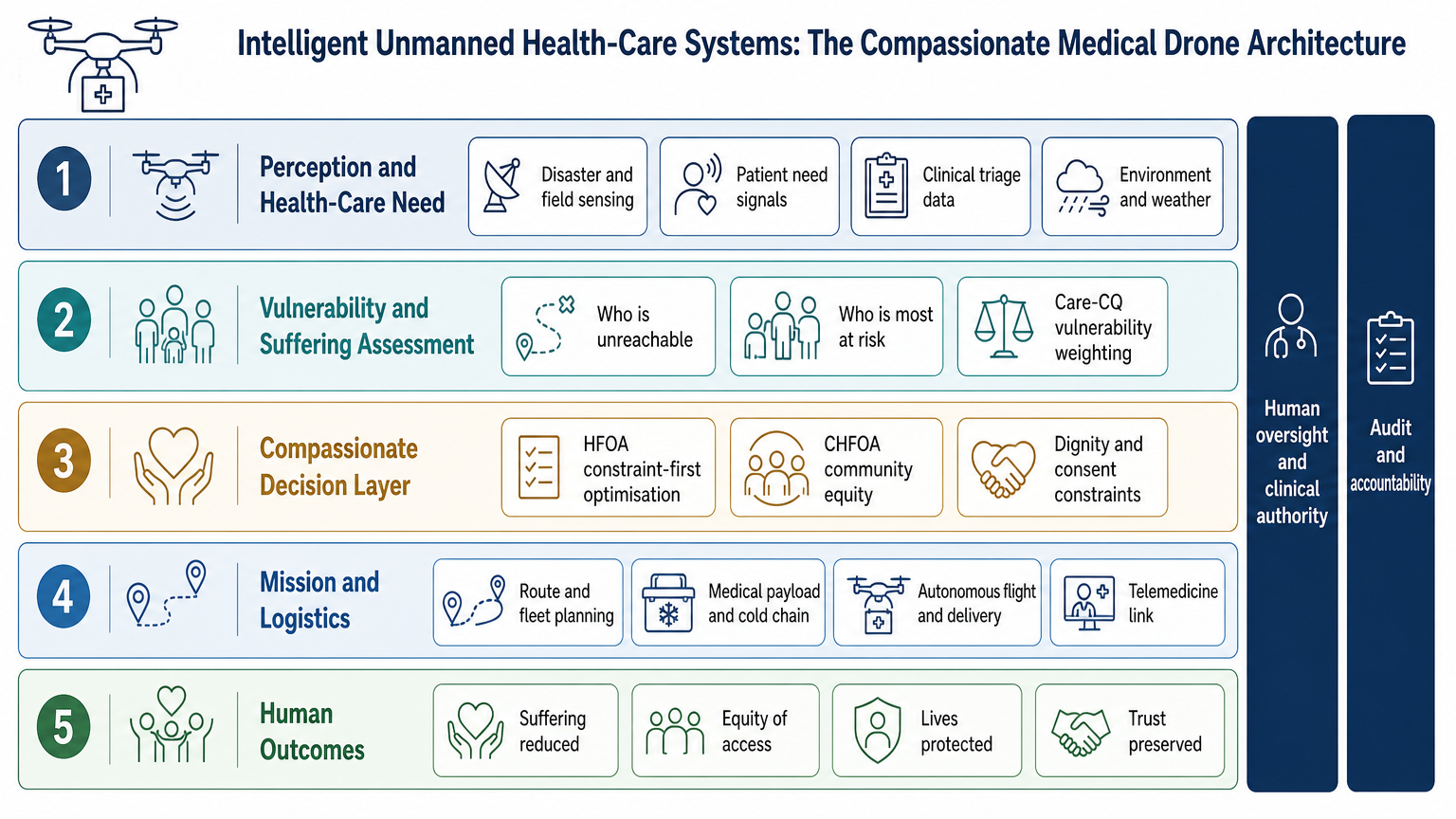 Figure 1. Intelligent Unmanned Health-Care System (IUHS) foundational architecture.
Source: Sri Amit Ray Compassionate AI Lab; conceptual figure for this research article.
                         HUMAN FLOURISHING
                               ▲
                               │
                 ┌───────────────────────────┐
                 │  CAIA HUMAN-CENTERED GATE │
                 │ Compassion · Suffering    │
                 │ Flourishing · Equity      │
                 │ Planet · Future · Oversight│
                 └─────────────┬─────────────┘
                               │
                 ┌─────────────▼─────────────┐
                 │   COMPASSIONATE DECISION  │
                 │ HFOA / CHFOA / Care-CQ    │
                 │ Vulnerability-aware       │
                 │ Multi-objective planning   │
                 └─────────────┬─────────────┘
                               │
          ┌────────────────────▼────────────────────┐
          │          AI AGENT ORCHESTRATION         │
          │ Needs · Medical · Logistics · Safety   │
          │ Route · Fleet · Communication · Audit  │
          └────────────────────┬────────────────────┘
                               │
          ┌────────────────────▼────────────────────┐
          │        INTELLIGENT DRONE FLEET          │
          │ Sense · Navigate · Carry · Communicate │
          │ Return · Verify · Adapt                 │
          └────────────────────┬────────────────────┘
                               │
          ┌────────────────────▼────────────────────┐
          │       HEALTH-CARE ECOSYSTEM             │
          │ Hospitals · Clinics · Labs · Pharmacies│
          │ Ambulances · Warehouses · Field Teams   │
          └─────────────────────────────────────────┘
Conceptual schematic: Proposed Compassionate Medical Drone Architecture (CMDA). The drone fleet is embedded within an AI-agent and health-care ecosystem and governed by a human-centered Compassionate AI layer.
The architecture has five conceptual zones:
- Health-care ecosystem: the actual clinical and logistical environment.
- Intelligent drone fleet: the physical unmanned mobility and sensing layer.
- AI-agent orchestration: perception, reasoning, planning, coordination, and verification.
- Compassionate decision layer: HFOA, CHFOA, Care-CQ, and vulnerability-aware decision mechanisms.
- CAIA governance layer: human-centered evaluation, safeguards, and human oversight.
9. Intelligent Unmanned Health-Care System: Functional Layers
To make the architecture implementable, the IUHS can be decomposed into functional layers.
| IUHS Layer | Primary Function | Example Components |
|---|---|---|
| Health Context Layer | Represent the medical and operational context | Hospitals, clinics, requests, inventories, patient-care pathways |
| Perception Layer | Collect and interpret authorized information | Maps, weather, sensors, imagery, requests, inventory data |
| Agent Layer | Reason, plan, coordinate, and use tools | LLMs, multimodal models, specialized agents, planning tools |
| Compassion Layer | Evaluate human-centered impact | CAIA, CQ, suffering reduction, HFOA, Care-CQ |
| Optimization Layer | Compare feasible interventions | Multi-objective optimization, Pareto analysis, vulnerability weighting |
| Mobility Layer | Execute physical missions | UAVs, navigation, payload systems, fleet management |
| Clinical Interface Layer | Connect with professionals | Clinicians, pharmacists, nurses, emergency coordinators |
| Governance Layer | Authorize, monitor, audit, and improve | Human oversight, logs, privacy, safety gates, incident response |
This architecture allows the same health-care intelligence to choose among multiple modes of intervention. The system should be able to conclude that a drone is not the appropriate solution.
10. AI-Agent Architecture for IUHS
The foundational system can employ specialized agents rather than one undifferentiated autonomous model.
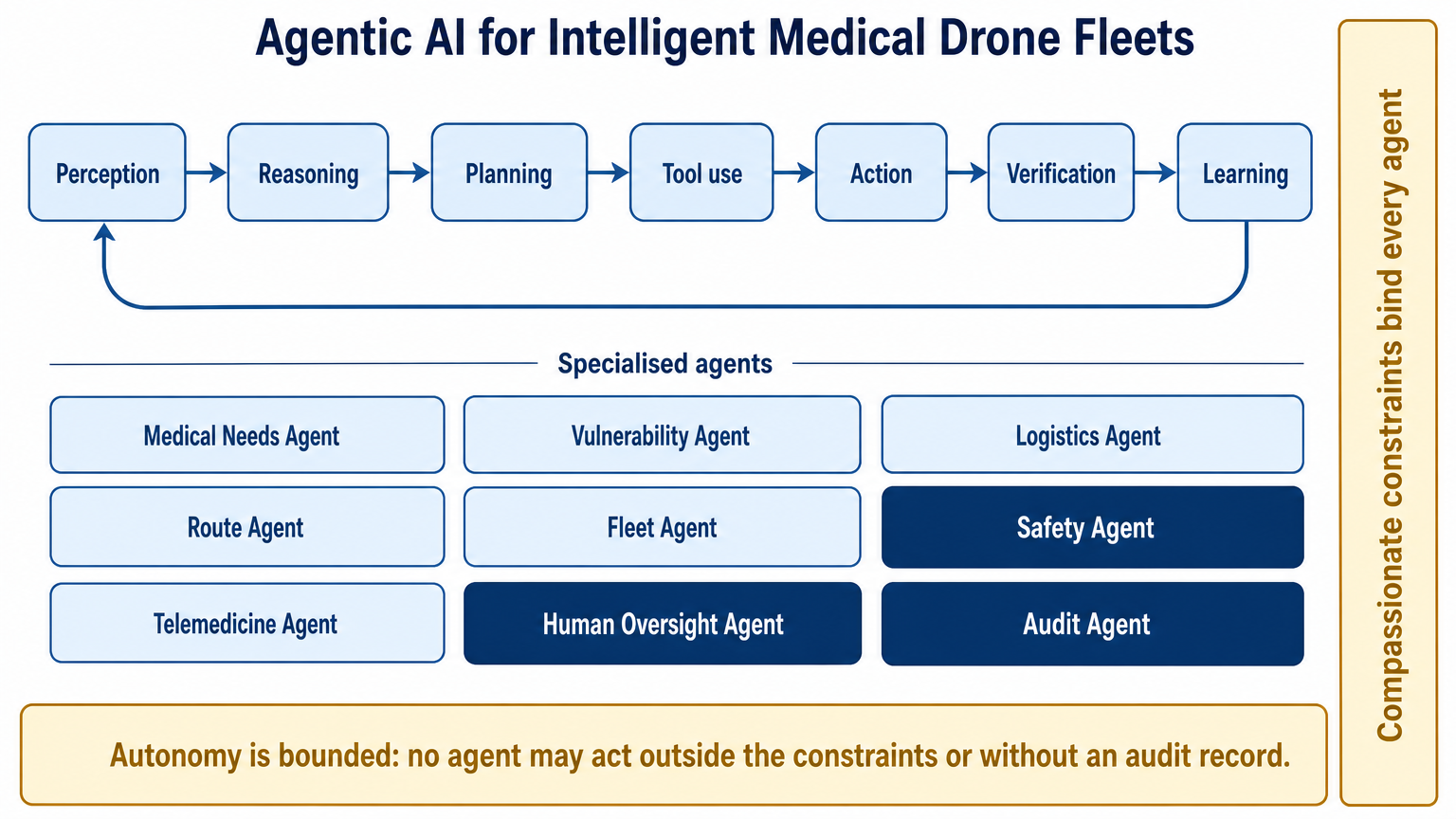 Figure 2. Agentic AI architecture for an intelligent medical-drone fleet.
Source: Sri Amit Ray Compassionate AI Lab; conceptual figure for this research article.
| Agent | Role | Human Boundary |
|---|---|---|
| Health Needs Agent | Aggregates validated health-care requests and identifies gaps. | Does not independently diagnose patients. |
| Medical Logistics Agent | Matches supplies, destinations, inventory, and transport modes. | Works within approved medical logistics policies. |
| Vulnerability Agent | Represents declared vulnerability information and access barriers. | Does not infer sensitive attributes unnecessarily. |
| Compassion Agent | Evaluates suffering reduction, dignity, equity, and human-centered effects. | Provides auditable recommendations rather than moral authority. |
| Route Agent | Plans and replans feasible routes. | Cannot override safety or airspace constraints. |
| Fleet Agent | Coordinates multiple drones. | Operates within fleet safety rules and human authorization. |
| Communication Agent | Supports authorized telemedicine or connectivity workflows. | Applies privacy and data-minimization requirements. |
| Safety Agent | Checks mission constraints, uncertainty, and failure conditions. | Can veto or escalate a mission. |
| Audit Agent | Records inputs, recommendations, approvals, actions, and outcomes. | Cannot alter governance records without authorized procedure. |
This design follows the direction of current health-care agent research while adding an embodied and humanitarian layer. Xu et al. emphasize perception, tool use, reasoning, memory, and multi-agent collaboration as core agent capabilities; Srinivasu et al. likewise examine agent coordination, task management, and communication workflows (Xu et al.; Srinivasu et al.).
11. HFOA: Constraint-First Human Flourishing Optimization
The most important computational contribution from the uploaded HFOA manuscript is its distinction between what an AI system may optimize and what it must not violate.
HFOA models human flourishing as a multi-objective optimization problem while placing selected human-centered requirements in a separate feasibility layer. Candidate decisions that violate specified constraints are excluded before flourishing optimization. Feasible candidates are then evaluated using multiple objectives and Pareto reasoning, with vulnerability-aware selection preventing aggregate performance from obscuring severe disadvantage (Ray, Human Flourishing Optimization).
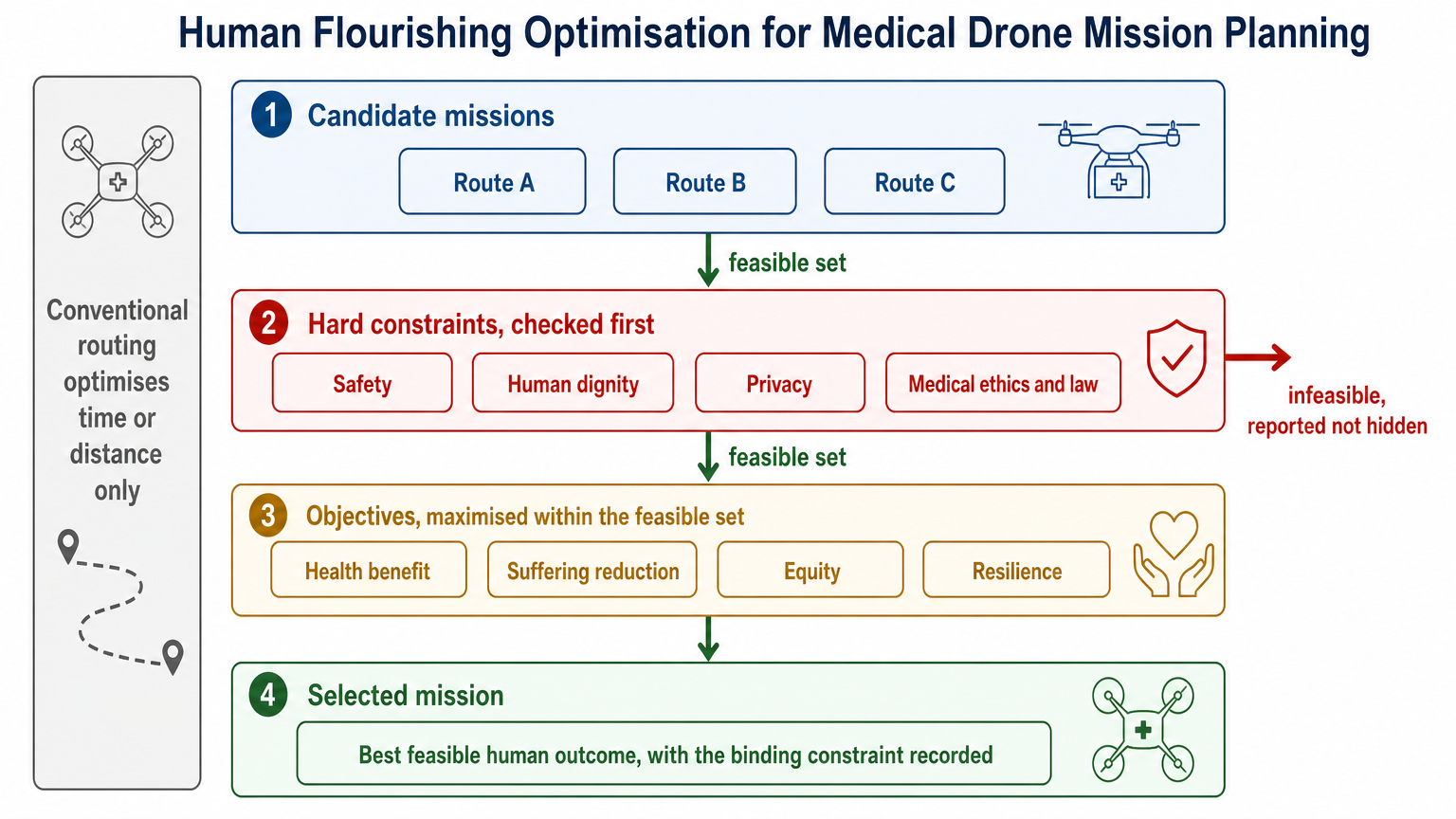 Figure 3. HFOA-based compassionate mission planning.
Source: Sri Amit Ray Compassionate AI Lab; conceptual figure for this research article.
For a medical drone mission, let x denote a candidate intervention. The conceptual HFO formulation is:
where XCF is the compassionately feasible decision space and F(x) is a multidimensional flourishing vector.
The uploaded HFOA manuscript identifies eight configurable flourishing objectives: well-being, autonomy, dignity, equity, capability, social flourishing, future-generational flourishing, and suffering reduction (Ray, Human Flourishing Optimization).
The hard-constraint vector includes non-harm, dignity, autonomy, safety, rights/non-discrimination, and vulnerable-population protection. The manuscript explicitly defines a non-compensation principle: a violation of a hard constraint cannot be offset by a high aggregate benefit elsewhere (Ray, Human Flourishing Optimization).
This is particularly relevant to medical drones. A route that saves ten minutes but violates an essential safety requirement should not win because its average utility is higher.
12. Vulnerability-Aware Optimization
Vulnerability is central to compassionate health-care allocation because average outcomes can conceal severe disadvantage.
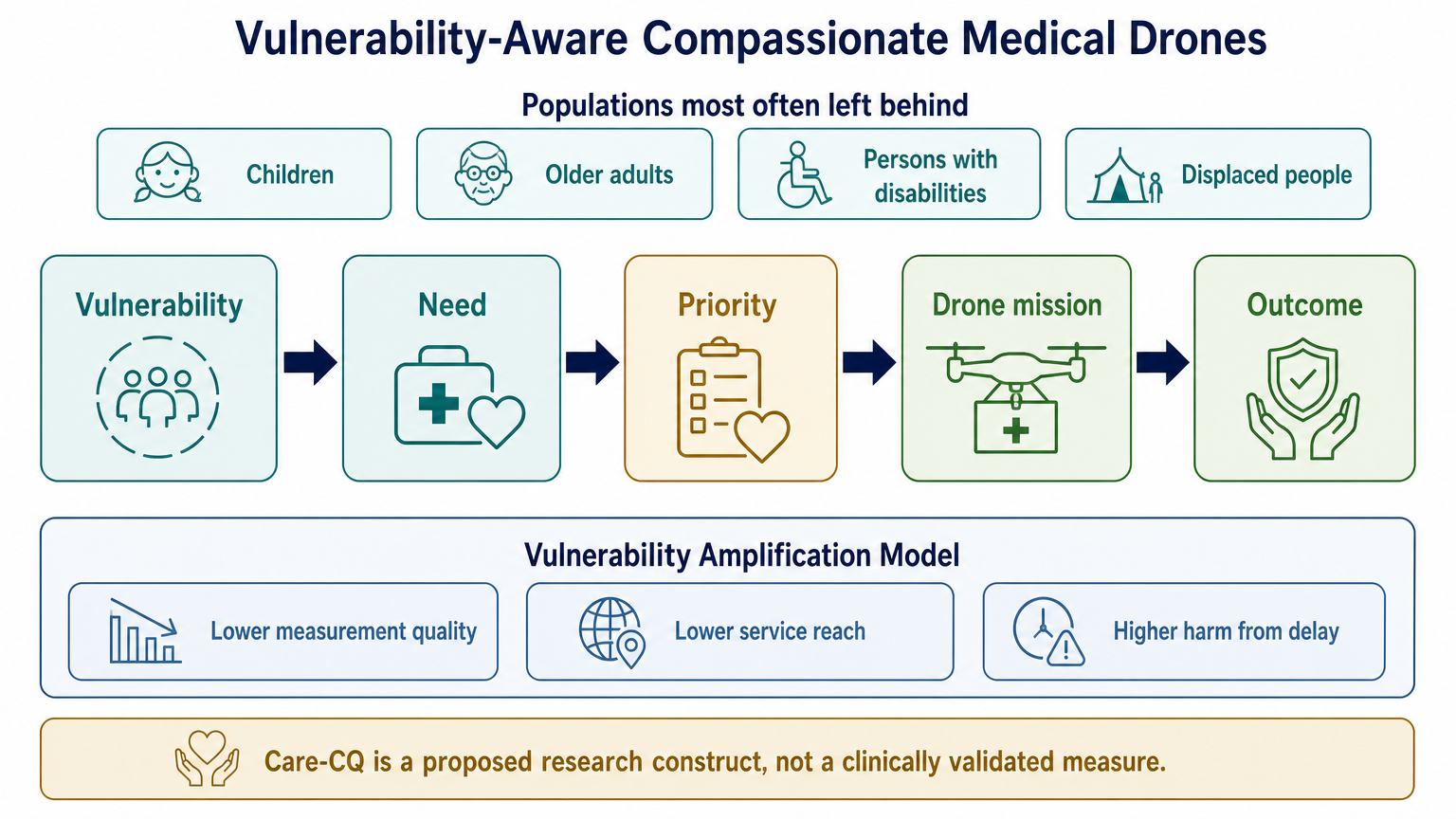 Figure 6. Vulnerability-aware access for populations left behind.
Source: Sri Amit Ray Compassionate AI Lab; conceptual figure for this research article.
The HFOA manuscript proposes vulnerability-weighted outcomes and allows vulnerability protection to function either as a hard constraint or as a hierarchical selection criterion depending on the policy context (Ray, Human Flourishing Optimization).
A conceptual vulnerability-weighted benefit can be written as:
where vi represents a declared vulnerability coefficient and Δi(x) represents normalized outcome improvement.
For IUHS, vulnerability may reflect barriers such as geographic isolation, inability to access conventional transport, critical medical need, dependence on time-sensitive supplies, or other contextually justified factors. It should not be inferred from sensitive personal characteristics merely because a model can infer them.
13. CHFOA: From the Individual Patient to the Health-Care Community
HFOA provides an individual or contextual optimization foundation. Health-care systems, however, are collective systems. A drone fleet can serve one community while reducing access elsewhere. A warehouse can be emptied for one emergency while creating a later shortage. A hospital can receive rapid supplies while a remote clinic remains systematically underserved.
CHFOA extends the Compassionate AI perspective toward collective human flourishing, ecological sustainability, and cross-community fairness. The uploaded framework defines ten flourishing dimensions: physical well-being, psychological well-being, social connection, agency and self-determination, fairness and justice, knowledge and capability, cultural integrity, ecological sustainability, democratic participation, and spiritual/existential meaning (Ray, Artificial Intelligence Ethics).
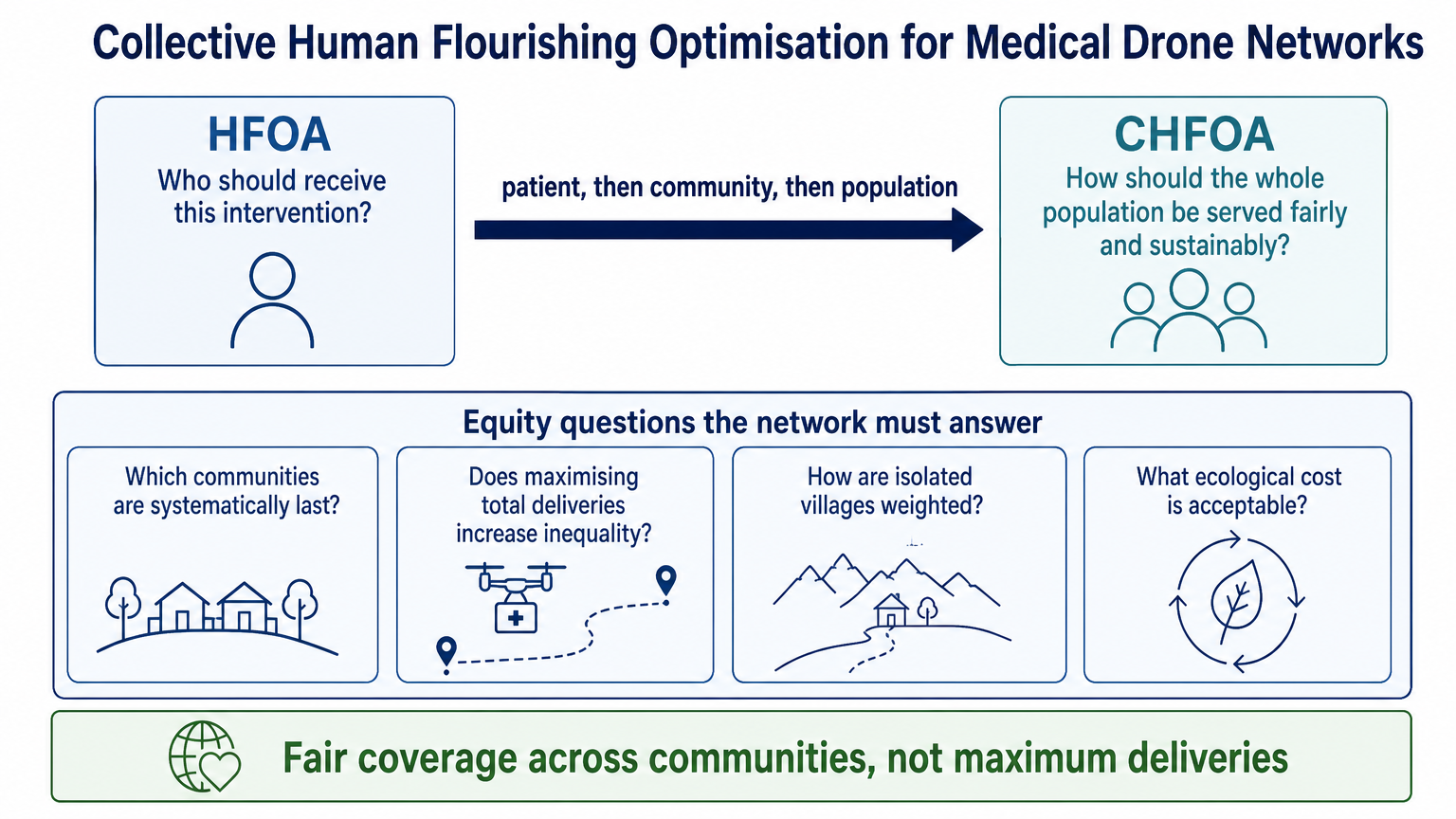 Figure 4. CHFOA and collective flourishing across a medical-drone network.
Source: Sri Amit Ray Compassionate AI Lab; conceptual figure for this research article.
For IUHS, not all ten dimensions will have equal operational relevance in every mission. The architecture should therefore declare which dimensions are active, how they are measured, and what thresholds apply rather than pretending that one universal formula automatically captures human flourishing.
The CHFOA governance protocol is also useful as a systems-level process:
- Stakeholder mapping: identify affected patients, communities, health workers, institutions, and other stakeholders.
- Multi-dimensional value assessment: evaluate candidate interventions across relevant flourishing dimensions.
- Temporal extension: consider short-, medium-, and long-term consequences.
- Cross-community fairness arbitration: address conflicts between communities and populations.
- Autonomy-preserving governance: preserve human authority over value-laden decisions.
- Continuous learning and adaptation: incorporate outcomes and affected-community feedback.
This makes CHFOA particularly relevant to fleet-level planning and health-system resilience rather than only individual mission selection.
14. Care-CQ: Measuring Compassionate Impact
The Care Compassion Quotient (Care-CQ) is presented in the uploaded framework as a vulnerability-weighted, multidimensional metric system for measuring the compassionate impact of AI decisions. Its dimensions include suffering reduction, equity of access, safety, empathy quality, transparency, accountability, privacy protection, and dignity preservation (Ray, Artificial Intelligence Ethics).
The framework specifies a vulnerability amplification factor and a hard safety threshold:
subject to Msafety(a,i) ≥ safety threshold
For medical drones, this formulation is useful as a conceptual measurement layer because it separates compassionate impact from simple delivery performance. A mission can be fast and still have poor privacy, poor equity, or poor dignity performance.
However, Care-CQ should not be described as a clinically validated universal instrument. Its parameters, indicators, weights, vulnerability model, thresholds, and reliability must be validated for each domain before operational use.
15. The Compassionate Medical Drone Decision Pipeline
HEALTH-CARE REQUEST
        │
        ▼
VALIDATE NEED & DATA
        │
        ▼
SITUATIONAL PERCEPTION
        │
        ▼
MEDICAL NEEDS ASSESSMENT
        │
        ▼
VULNERABILITY ASSESSMENT
        │
        ▼
GENERATE CANDIDATE INTERVENTIONS
        │
        ├── Drone
        ├── Ambulance
        ├── Ground Transport
        ├── Boat / Other Mode
        ├── Telemedicine
        └── Combined Intervention
        │
        ▼
CAIA HUMAN-CENTERED EVALUATION
        │
        ▼
HFOA / CHFOA OPTIMIZATION
        │
        ▼
CARE-CQ / EQUITY / SAFETY CHECK
        │
        ▼
HUMAN AUTHORIZATION
        │
        ▼
MISSION EXECUTION
        │
        ▼
DELIVERY / CONNECTION / SERVICE
        │
        ▼
OUTCOME VERIFICATION
        │
        ▼
AUDIT + LEARNING
Conceptual schematic: Proposed end-to-end IUHS decision pipeline. The drone is selected only after alternative interventions and human-centered constraints are considered.
16. Human-in-the-Loop Is an Architectural Requirement
Human oversight is not an optional administrative step. It is part of the architecture.
The CAIA source explicitly describes its scores as informing human judgment rather than replacing it, with high-impact decisions remaining subject to meaningful human oversight (Ray, “Sri Amit Ray Compassionate AI Architecture”). The HFOA manuscript similarly places final contextual selection after feasibility and Pareto analysis so that value judgments remain visible and authorized rather than silently embedded in the optimizer (Ray, Human Flourishing Optimization).
For IUHS, three levels of human involvement can be distinguished:
| Level | Human Role | Example |
|---|---|---|
| Human-in-the-loop | Human approval required before action. | High-impact medical mission or ambiguous patient-priority decision. |
| Human-on-the-loop | System operates within predefined boundaries while humans monitor and can intervene. | Routine pre-authorized logistics missions. |
| Human-in-command | Human institution retains strategic and ethical authority. | Mission policy, safety thresholds, governance rules, fleet authorization. |
Recent health-care AI literature reinforces the need for this approach. Zhao et al. emphasize safety, controllability, ethical governance, user trust, and evolving professional roles. Hou et al.’s systematic review of 19 qualitative studies identifies technical reliability, algorithmic bias, accountability, data security, workflow integration, patient-care quality, and technological dependency among major concerns raised by health-care professionals (Zhao et al.; Hou et al.).
17. Health-Care Logistics: The Drone Must Be One Mode Among Many
A foundational IUHS should never assume that the drone is automatically the optimal transport mode.
Instead, the system should compare:
- drone delivery;
- ground vehicle;
- ambulance;
- boat or other specialized transport;
- mobile health team;
- telemedicine;
- local stock redistribution;
- combined interventions.
This prevents a common technological bias: optimizing the technology simply because the technology is available.
The 2026 medical-drone systematic review emphasizes that operational benefit depends on payload characteristics, infrastructure constraints, workflow integration, and cold-chain validation. (Singh et al.)
not
IUHS Objective = Maximize Drone Missions
18. Medical Payloads and the Last Mile
The most mature application area remains transport of relatively small, time-sensitive or difficult-to-access medical payloads.
Potential categories include:
| Payload | Potential IUHS Value | Critical Control |
|---|---|---|
| Medicines | Rapid replenishment of remote facilities | Prescription/authorization and chain of custody |
| Vaccines | Last-mile immunization support | Temperature and cold-chain integrity |
| Blood products | Potential reduction of transport delay | Temperature, packaging, traceability, clinical acceptance |
| Diagnostic samples | Faster laboratory turnaround | Specimen integrity and chain of custody |
| Emergency kits | Rapid response to isolated facilities | Inventory and mission prioritization |
| Small medical devices | Support for remote teams | Device-specific handling requirements |
UNICEF documents these categories across its humanitarian drone work and emphasizes transport efficiency, supply-chain management, emergency response, diagnostic kits, and temperature-sensitive materials. (UNICEF, “Drones to Reach the Last Mile”; UNICEF, “Drones”)
19. The Communication and Telemedicine Dimension
An IUHS should not be limited to physical delivery. Communication can itself be a health-care intervention.
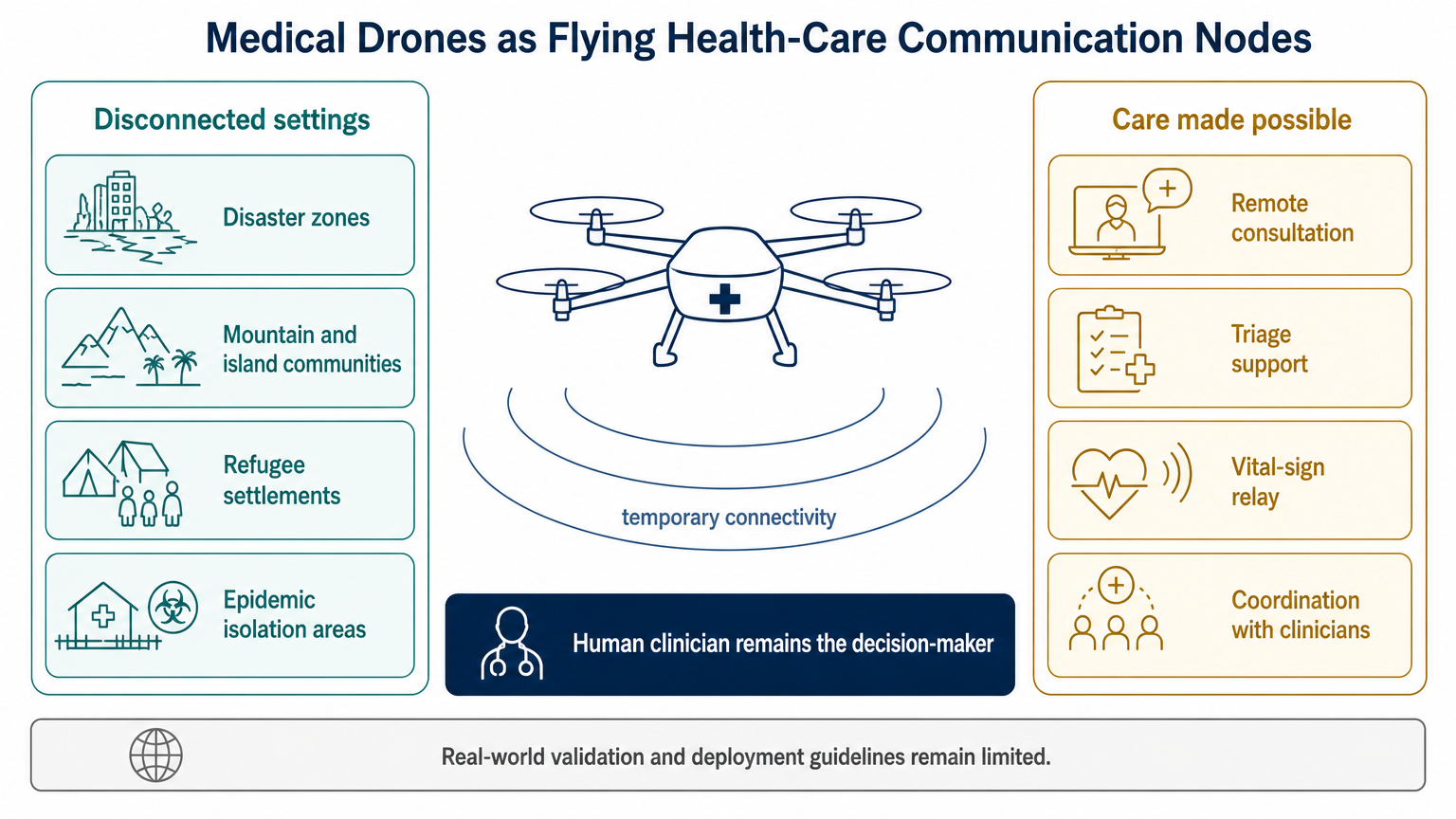 Figure 5. The medical drone as a flying telemedicine and connectivity node.
Source: Sri Amit Ray Compassionate AI Lab; conceptual figure for this research article.
A connected drone platform may potentially support:
- field-to-hospital communication;
- remote specialist consultation;
- transmission of authorized diagnostic information;
- temporary connectivity in infrastructure-constrained environments;
- coordination among mobile health teams;
- emergency communication when terrestrial systems fail.
UNICEF explicitly identifies improved connectivity in hard-to-reach communities as one area of its drone program. (UNICEF, “Drones”)
However, connectivity also increases the importance of privacy, cybersecurity, authentication, and data minimization. The more connected the drone becomes, the more important it is to treat it as part of the health-information infrastructure rather than merely as an aircraft.
20. Safety: A Medical Drone Is a Physical AI System
Software failures in an ordinary information system may cause informational harm. A medical drone can add physical consequences.
Potential failure modes include:
- navigation error;
- weather deterioration;
- battery depletion;
- communication loss;
- sensor malfunction;
- payload failure;
- destination closure;
- incorrect health request;
- AI prioritization error;
- cybersecurity compromise;
- collision or airspace conflict.
Therefore, IUHS safety must operate at multiple levels:
WHO guidance emphasizes that AI for health must place ethics and human rights at the center of design, deployment, and use, while holding stakeholders accountable to health workers and affected communities. (World Health Organization, “Ethics and Governance”)
21. Failure-With-Care
A compassionate system is not one that assumes it will never fail. It is one designed to minimize harm when failure occurs.
If a mission becomes impossible, the system should not simply terminate. It should search for a safe alternative:
Possible alternatives include:
- rerouting;
- transferring the mission to another drone;
- switching to ground transport;
- redirecting to another health facility;
- requesting a field team;
- initiating telemedicine support;
- returning the payload safely.
This concept should become a major research topic in later articles in the series.
22. Privacy, Data Minimization, and Human Dignity
A medical drone may collect location data, imagery, health information, environmental information, and operational metadata. A system designed to care for people must not quietly transform care into pervasive surveillance.
Hou et al. identify privacy, data security, accountability, technical reliability, workflow integration, and patient-care quality among the ethical issues emerging from AI in health care (Hou et al.).
The IUHS architecture should therefore implement:
- purpose limitation;
- data minimization;
- role-based access;
- encryption;
- secure authentication;
- retention limits;
- audit logs;
- privacy-preserving analytics where appropriate;
- clear responsibility for data governance.
Human dignity should be treated as more than a legal compliance variable. In the HFOA framework, dignity is one of the protections that should not simply be traded away for higher aggregate utility (Ray, Human Flourishing Optimization).
23. Environmental and Intergenerational Responsibility
Drones are often presented as environmentally beneficial because they can reduce some ground transport. That conclusion should not be generalized without life-cycle assessment.
Environmental impact may depend on:
- vehicle energy source;
- battery production;
- flight frequency;
- payload efficiency;
- maintenance;
- replacement cycles;
- alternative transport emissions;
- infrastructure requirements.
CAIA includes planetary compassion and future-generation protection as explicit layers, while CHFOA includes ecological sustainability and intergenerational considerations among its broader flourishing dimensions (Ray, “Sri Amit Ray Compassionate AI Architecture”; Ray, Artificial Intelligence Ethics).
This gives the foundational IUHS architecture a longer time horizon:
24. The Compassionate Medical Drone Index: A Proposed Research Construct
To evaluate the system beyond flight performance, this article proposes a preliminary Compassionate Medical Drone Index (CMDI). CMDI is a research construct, not a validated clinical or regulatory instrument.
| Dimension | Possible Measure |
|---|---|
| Medical Benefit | Change in clinically relevant access or outcome. |
| Suffering Reduction | Reduction in avoidable delay, pain, deprivation, or distress. |
| Responsiveness | Time from validated request to effective intervention. |
| Equity | Distribution of benefits across relevant populations. |
| Vulnerability Protection | Outcome for declared high-vulnerability groups. |
| Safety | Mission and clinical safety performance. |
| Dignity | Protection of autonomy, privacy, and respectful treatment. |
| Resilience | Performance under infrastructure and communication disruption. |
| Environmental Impact | Life-cycle or mission-level ecological impact. |
| Accountability | Completeness and reconstructability of decision records. |
The CMDI should eventually be validated through empirical studies rather than assumed to be meaningful because its dimensions appear intuitively desirable.
25. A Formal Research Model
The foundational architecture can be summarized as a constrained multi-objective decision problem.
Let:
- x = candidate health-care intervention;
- F(x) = flourishing and health-impact objectives;
- H(x) = human-centered constraints;
- V(x) = vulnerability-aware outcome;
- C(x) = compassionate-impact metrics;
- S(x) = operational and clinical safety.
The proposed decision structure is:
2. Optimization: Pareto-maximize F(x) over the feasible set
3. Vulnerability: protect V(x) through constraint or hierarchical selection
4. Compassion: evaluate C(x) and suffering reduction
5. Human selection: authorized human or institutional decision
6. Audit: record constraints, objectives, evidence, action, and outcome
This structure follows the uploaded HFOA formulation rather than inventing a new optimizer. The HFOA manuscript emphasizes that its novelty lies in problem formulation, the feasibility architecture, vulnerability-aware selection, and human-authorized final decision rather than in claiming a universally superior search operator (Ray, Human Flourishing Optimization).
26. A Reference Computational Stack
┌───────────────────────────────────────────────────────┐
│ HUMAN / INSTITUTIONAL GOVERNANCE                       │
│ Clinical authority · ethics · policy · accountability │
└───────────────────────────▲───────────────────────────┘
                            │
┌───────────────────────────┴───────────────────────────┐
│ CAIA GOVERNANCE SPINE                                  │
│ CQ · SR · EM · HF · VP · Planet · Future · Oversight │
└───────────────────────────▲───────────────────────────┘
                            │
┌───────────────────────────┴───────────────────────────┐
│ COMPASSIONATE OPTIMIZATION                             │
│ HFOA · CHFOA · Care-CQ · vulnerability-aware rules    │
└───────────────────────────▲───────────────────────────┘
                            │
┌───────────────────────────┴───────────────────────────┐
│ AGENT ORCHESTRATION                                    │
│ perception · reasoning · memory · tools · planning     │
│ multi-agent collaboration · verification               │
└───────────────────────────▲───────────────────────────┘
                            │
┌───────────────────────────┴───────────────────────────┐
│ EMBODIED MEDICAL DRONE LAYER                           │
│ sensing · navigation · payload · communication        │
│ fleet coordination · return · mission verification    │
└───────────────────────────▲───────────────────────────┘
                            │
┌───────────────────────────┴───────────────────────────┐
│ HEALTH-CARE & LOGISTICS ECOSYSTEM                      │
│ hospitals · clinics · labs · pharmacies · warehouses  │
│ ambulances · field teams · patients · communities      │
└───────────────────────────────────────────────────────┘
Conceptual schematic: Proposed reference computational stack for Intelligent Unmanned Health-Care Systems.
27. What Makes IUHS Different from Autonomous Drones?
| Autonomous Drone Concept | Intelligent Unmanned Health-Care System |
|---|---|
| Focuses on aircraft autonomy. | Focuses on health-care system outcomes. |
| Optimizes flight or mission parameters. | Optimizes appropriate care delivery. |
| May treat a request as the complete objective. | Evaluates the legitimacy and human consequences of the request. |
| Can operate as a standalone platform. | Must integrate with clinical and logistical systems. |
| Success = mission completed. | Success = intended health-care benefit achieved safely. |
| Human oversight may be external. | Human oversight is architectural. |
| Ethics may be an external compliance layer. | Compassion and human-centered constraints are integrated into decision architecture. |
28. Research Questions for the IUHS Program
The foundational architecture generates a sequence of research questions for the broader article series.
- Can an IUHS improve health-care access in infrastructure-constrained settings compared with conventional transport?
- Under what payload, geography, weather, and demand conditions are medical drones genuinely beneficial?
- Can agentic AI improve coordination without increasing unsafe automation?
- Can HFOA reduce harmful trade-offs between speed, efficiency, equity, and human protection?
- Can vulnerability-aware optimization reduce systematic neglect of hard-to-reach populations?
- Can CHFOA support fair allocation across multiple communities and institutions?
- Can Care-CQ be operationalized with reliable domain-specific indicators?
- What human-oversight architecture produces the best balance between responsiveness and accountability?
- How should medical-drone systems behave under communication loss or mission failure?
- How should privacy and dignity be protected when drones combine physical sensing with medical data?
- Can digital twins provide reliable pre-deployment evaluation of compassionate drone policies?
- What evidence is required before any component of an IUHS can move from research autonomy to operational autonomy?
29. Validation Roadmap
The proposed architecture should proceed through staged validation.
29.1 Conceptual Validation
Formalize terminology, architecture, assumptions, constraints, stakeholder roles, and measurable constructs.
29.2 Simulation
Construct synthetic medical-logistics environments with hospitals, clinics, warehouses, demand nodes, drone fleets, ground transport, weather, and vulnerability profiles.
29.3 Algorithmic Benchmarking
Compare conventional shortest-path or utility optimization with HFOA-based and vulnerability-aware approaches. The comparison should include failure cases and trade-offs, not only favorable results.
29.4 Human-in-the-Loop Testing
Evaluate clinicians, logisticians, drone operators, and emergency coordinators interacting with the agent system.
29.5 Safety and Robustness Testing
Test communication loss, sensor failure, route closure, adverse weather, battery constraints, incorrect requests, adversarial inputs, and AI uncertainty.
29.6 Field Validation
Only after appropriate technical, clinical, regulatory, and ethical validation should real-world pilot studies be undertaken.
30. Evaluation Must Include Negative Results
The scientific credibility of Compassionate AI will depend on measuring not only where the architecture helps but also where it fails.
The uploaded HFOA study is instructive because it reports favorable and unfavorable findings rather than treating the framework as automatically superior. The manuscript reports that conventional NSGA-II can match HFOA on feasibility when resources are abundant and can achieve larger hypervolume in that setting; it also reports that HFOA does not produce the best worst-off individual outcome in every regime. These limitations are part of the empirical record and should remain visible in subsequent IUHS research (Ray, Human Flourishing Optimization).
Likewise, a future medical-drone benchmark should report:
- cases where drones are slower than conventional transport;
- cases where drones are more expensive;
- cases where autonomous recommendations are wrong;
- cases where vulnerability weighting produces an undesirable outcome;
- cases where human intervention improves the result;
- cases where the safest decision is not to use a drone.
31. Ethical and Governance Foundations
IUHS sits at the intersection of several governance domains: medical ethics, AI governance, aviation safety, data protection, cybersecurity, health-care regulation, and humanitarian operations.
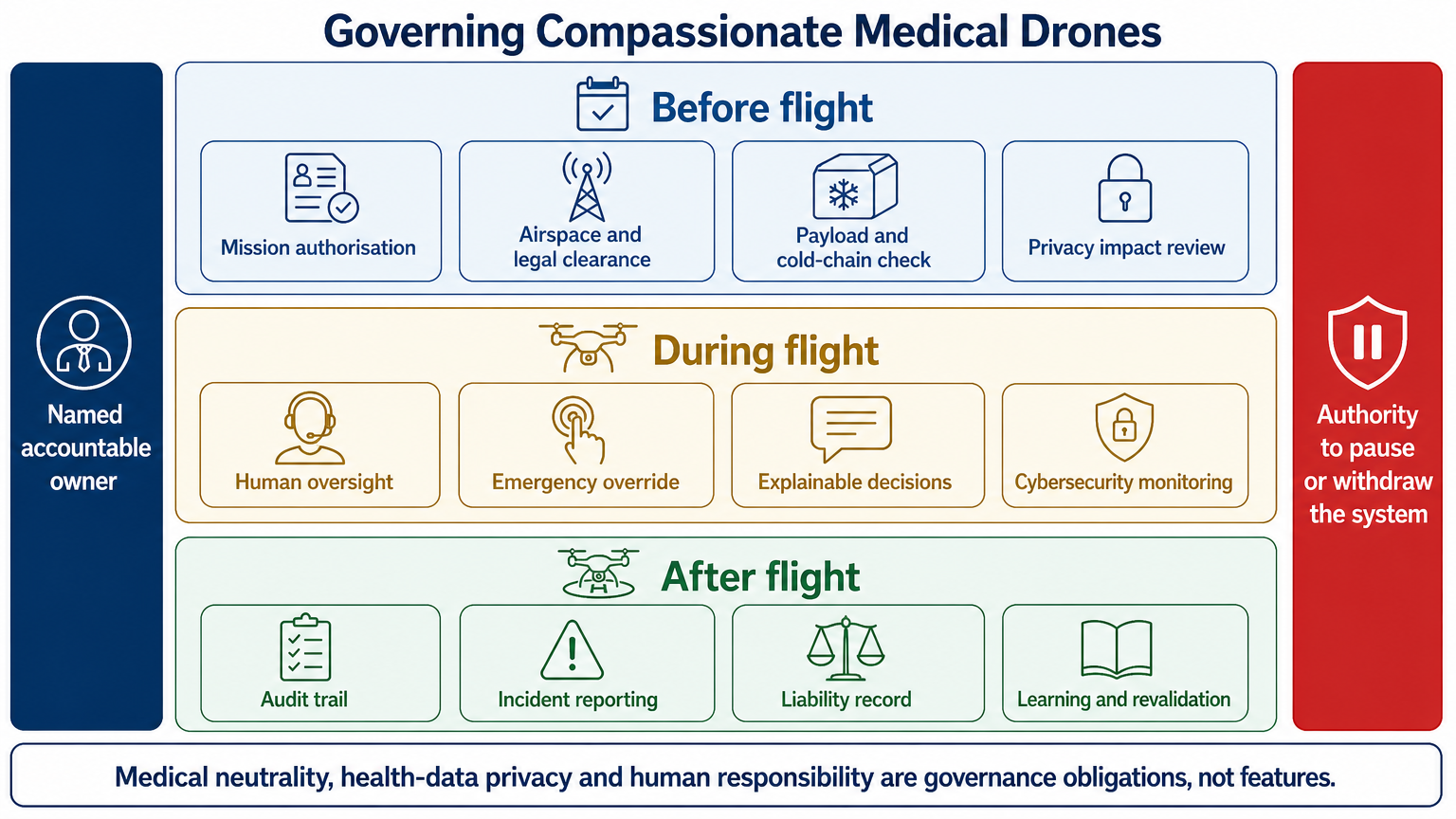 Figure 7. Governance, safety, and human oversight for autonomous medical drones.
Source: Sri Amit Ray Compassionate AI Lab; conceptual figure for this research article.
WHO’s guidance on AI ethics and governance emphasizes human rights, human autonomy, public well-being, transparency, accountability, inclusiveness, and sustainability as central considerations for AI in health. (World Health Organization, “Ethics and Governance”) WHO also provides guidance for medical teams operating in armed conflicts and other insecure environments, illustrating the additional operational requirements that arise when health care is delivered under insecurity. (World Health Organization, “Guidance Document”)
The CAIA source explicitly positions its architecture as interoperable with established governance frameworks rather than a replacement for them, including NIST AI RMF, the EU AI Act, ISO/IEC 42001, IEEE value-based design, and UNESCO AI ethics (Ray, “Sri Amit Ray Compassionate AI Architecture”).
Therefore, CMDA should be treated as a domain architecture within a wider governance ecosystem, not as an alternative legal or regulatory system.
32. The Role of the Community
A human-centered system cannot be designed only around engineers and institutions.
Communities affected by an IUHS should have a role in determining:
- what constitutes acceptable service;
- which populations are considered vulnerable in context;
- what information should be collected;
- how privacy is protected;
- which interventions are culturally acceptable;
- how complaints and appeals work;
- how system performance is judged.
This is consistent with the CHFOA protocol’s emphasis on stakeholder mapping, cross-community fairness, autonomy-preserving governance, and continuous feedback (Ray, Artificial Intelligence Ethics).
33. From Compassionate AI to Compassionate Infrastructure
The most important conceptual shift proposed by this article is from compassionate AI behavior to compassionate infrastructure.
A chatbot may be designed to respond compassionately. An IUHS must make compassionate decisions at multiple physical and institutional layers.
↓
Compassionate Decision
↓
Compassionate Logistics
↓
Compassionate Physical Action
↓
Compassionate Outcome Verification
↓
Human Flourishing
This is a more demanding standard. The system cannot claim compassion merely because the AI model was trained on compassionate language. Compassion must be reflected in resource allocation, safety constraints, vulnerability protection, privacy, human oversight, and measurable outcomes.
34. Relationship to the Broader Compassionate AI Research Program
The foundational IUHS architecture is designed to support a coherent sequence of subsequent studies.
| Research Paper | Primary Contribution |
|---|---|
| Compassionate Medical Drones for Disaster Management | Disaster health response and resilience. |
| Compassionate Medical Drones for Peacekeeping and Humanitarian Operations | Civilian care, humanitarian access, and medical protection. |
| Compassionate Medical Drone Logistics | Last-mile health-care supply chains. |
| Agentic AI for Medical Drone Fleets | Multi-agent orchestration and embodied health-care AI. |
| HFOA for Medical Drone Mission Planning | Constraint-first human flourishing optimization. |
| CHFOA for Medical Drone Networks | Collective and cross-community optimization. |
| Care-CQ for Intelligent Unmanned Health Care | Vulnerability-aware compassionate measurement. |
| Medical Drones as Health-Care Communication Nodes | Telemedicine and resilient connectivity. |
| Vulnerability-Aware Medical Drone Systems | Equitable care for hard-to-reach populations. |
| Governance of Compassionate Medical Drones | Safety, privacy, accountability, and human oversight. |
This separation is intentional. The foundational paper establishes the architecture; subsequent papers should test individual components or application domains rather than repeatedly restating the entire framework.
35. Limitations of the Present Architecture
This article is a foundational conceptual and architectural contribution. It does not establish clinical efficacy, regulatory approval, or universal superiority of drones over conventional health-care logistics.
Several limitations require explicit acknowledgment.
- Evidence heterogeneity: medical-drone studies differ substantially in geography, payload, operational model, and comparator.
- Limited clinical outcome evidence: faster transport does not automatically translate into improved patient outcomes.
- AI-agent uncertainty: current agentic health-care systems remain under active evaluation, particularly regarding reliability, safety, governance, and real-world deployment.
- Normative assumptions: vulnerability, dignity, flourishing, and compassion require explicit contextual definitions.
- Measurement validity: CMDI and domain-specific Care-CQ measures proposed here require empirical validation.
- Human oversight: the appropriate boundary between autonomy and human intervention remains application dependent.
- Regulation: aviation, health-care, privacy, cybersecurity, and medical-device requirements vary by jurisdiction.
These limitations are not weaknesses to conceal. They define the research agenda.
36. A Foundational Set of Design Principles
Principle 1 — Health-Care Purpose First
The system should optimize meaningful health-care outcomes, not technology utilization.
Principle 2 — Safety Before Optimization
Non-negotiable safety requirements should act as feasibility gates rather than ordinary trade-off variables.
Principle 3 — Reduce Avoidable Suffering
Where safe and clinically appropriate, the system should prioritize interventions capable of reducing avoidable suffering and harmful delay.
Principle 4 — Protect the Vulnerable
Aggregate performance must not hide severe disadvantage among vulnerable populations.
Principle 5 — Preserve Human Dignity and Agency
People affected by the system remain rights-bearing participants, not merely optimization variables.
Principle 6 — Keep Humans Accountable
AI agents can recommend, coordinate, and execute bounded tasks, but responsibility must remain identifiable.
Principle 7 — Integrate, Do Not Isolate
Drones should operate as one component of health-care logistics rather than as isolated technological systems.
Principle 8 — Design for Failure
Safe fallback and mission-abort behavior should be part of the architecture from the beginning.
Principle 9 — Protect Privacy
Medical and location data should be collected, processed, retained, and shared only for justified purposes.
Principle 10 — Consider Planet and Future Generations
Short-term health benefits should not be achieved through avoidable long-term ecological or intergenerational harm.
37. Conclusion: From Intelligent Machines to Compassionate Health-Care Systems
Medical drones have moved beyond science fiction into real health-care logistics. UNICEF and other humanitarian organizations have documented applications involving vaccines, medicines, blood products, diagnostic samples, emergency supplies, connectivity, and aerial imaging. Recent systematic and scoping reviews provide growing evidence that drones can improve timeliness and last-mile access in selected settings, while also identifying the importance of workflow integration, cold-chain validation, regulation, cost analysis, and operational context. (UNICEF, “Drones to Reach the Last Mile”; Singh et al.; Rodríguez et al.)
At the same time, AI agents are moving from static prediction toward systems capable of perception, reasoning, planning, tool use, memory, and multi-agent collaboration. Recent health-care reviews emphasize the promise of these capabilities while highlighting safety, controllability, governance, privacy, reliability, and human-professional roles as major unresolved questions (Hou et al.; Zhao et al.; Srinivasu et al.; Xu et al.).
The convergence of these technologies creates a new possibility: the Intelligent Unmanned Health-Care System.
In this architecture, the drone is no longer merely an aircraft carrying a package. It becomes an embodied component of a health-care network. AI agents provide perception, reasoning, planning, coordination, and verification. Medical professionals provide clinical judgment. Health-care institutions provide context and operational authority. Human governance provides accountability. Compassionate AI provides the normative and computational orientation toward suffering reduction, human dignity, vulnerability protection, equity, sustainability, and human flourishing.
Within this architecture, CAIA provides the human-centered governance spine; HFOA provides a constraint-first optimization framework; CHFOA extends the optimization problem toward collective flourishing and cross-community fairness; and Care-CQ offers a proposed vulnerability-aware measurement mechanism. Together, they provide a conceptual bridge between compassionate ethics and intelligent physical health-care infrastructure.
The foundational proposition of this research program is simple:
Do not optimize the drone. Optimize the care.
The purpose of an intelligent medical drone should therefore not be defined by flight speed, payload capacity, or fleet utilization alone. Its ultimate value should be judged by whether it safely extends appropriate care, reduces avoidable suffering, protects vulnerable people, preserves dignity, improves equitable access, strengthens health-system resilience, and contributes to human flourishing.
That is the transition from a medical drone to a Compassionate Medical Drone; from autonomous aviation to an Intelligent Unmanned Health-Care System; and from technological capability to human-centered compassionate infrastructure.
The architecture proposed here is intentionally foundational. It is not the final validated system. It is a research blueprint from which rigorous application-specific studies can proceed—through simulation, benchmarking, human-in-the-loop evaluation, safety testing, clinical validation, community participation, and eventually carefully governed real-world deployment.
The next generation of medical drones should not merely travel farther or fly faster. They should become components of health-care systems that understand context, respect human agency, protect the vulnerable, learn responsibly, and remain accountable to the people they are designed to serve.
References
- Hou, Jiayu, Xuan Cheng, Jiayu Liao, Zhiqiao Zhang, and Weihong Wang. “Ethical Concerns of AI in Healthcare: A Systematic Review of Qualitative Studies.” Nursing Ethics, vol. 33, no. 2, 2026, pp. 428–449. doi:10.1177/09697330251385024.
- Akpunar, Özge Şatir, and Şener Akpinar. “Drones in Emergencies: A Review of Recent Developments and Future Directions.” Computers & Industrial Engineering, vol. 216, 2026, article 112003. doi.org/10.1016/j.cie.2026.112003
- Singh, Tejinder, Yerasani Sinjana, and Anuj Pal Kapoor. “Aerial Innovations in Healthcare: A Systematic Review of Drone-Based Logistics and Regulatory Barriers.” Sustainable Futures, vol. 11, 2026, article 101758. doi.org/10.1016/j.sftr.2026.101758
- Ray, Amit. Artificial Intelligence Ethics: The 37 Principles of Compassionate and Responsible AI. Inner Light Publishers, 2025.
- Ray, Amit. Human-Centered Compassionate AI: Sri Amit Ray’s 25 Algorithms for Protecting Humanity and Future Generations. Compassionate AI Lab, 2026. ISBN 978-8169641050.
- Ray, Amit. Compassionate Artificial Intelligence: Frameworks and Algorithms. Compassionate AI Lab, 2018.
- Ray, Amit. Compassionate Superintelligence AI 5.0: AI with Blockchain, BMI, Drone, IoT, and Biometric Technologies. Compassionate AI Lab, 2018.
- Ray, Amit. “Calling for a Compassionate AI Movement: Towards Compassionate Artificial Intelligence.” Compassionate AI, 2023. amitray.com.
- Ray, Amit. “The 12 Sri Amit Ray Compassionate AI Principles | Ethical AI Framework.” Compassionate AI, 2026. amitray.com.
- Ray, Amit. “From Data-Driven AI to Compassionate AI: Safeguarding Humanity and Empowering Future Generations.” Compassionate AI, 2023. amitray.com.
- Ray, Amit. “Sri Amit Ray Compassionate AI Architecture (CAIA).” Compassionate AI, 2026. amitray.com.
- Ray, Amit. “Human Flourishing Optimization Algorithm (HFOA) for Compassionate AI.” Compassionate AI, 2026. amitray.com.
- Ray, Amit. “Pain Recognition and Prediction Algorithm (PRPA) for Compassionate AI.” Compassionate AI, 2026. amitray.com.
- Rodríguez, Sebastián, Catalina León-Prieto, and María Fernanda Rodríguez-Jaime. “Use of Drones for the Delivery of Medical Supplies: A Scoping Review of Case Studies.” Case Studies on Transport Policy, vol. 24, 2026, article 101833. doi:10.1016/j.cstp.2026.101833.
- Srinivasu, Parvathaneni Naga, Gorli L. Aruna Kumari, Shakeel Ahmed, and Abdulaziz Alhumam. “Exploring Agentic AI in Healthcare: A Study on Its Working Mechanism.” Frontiers in Medicine, vol. 12, 2026, article 1753443. doi:10.3389/fmed.2025.1753443.
- UNICEF. “Drones to Reach the Last Mile.” UNICEF Supply Division, 2026. unicef.org.
- UNICEF. “Drones.” UNICEF Office of Innovation, 2026. unicef.org.
- UNICEF. Unmanned Aircraft Systems: Product Profiles and Guidance. UNICEF Supply Division, 2019. unicef.org.
- World Health Organization. Ethics and Governance of Artificial Intelligence for Health. WHO, 2021. who.int.
- World Health Organization. A Guidance Document for Medical Teams Responding to Health Emergencies in Armed Conflicts and Other Insecure Environments. WHO, 2021. who.int.
- Xu, Gelei, Xueyang Li, Yixiong Chen, Yuying Duan, Shuqing Wu, Haoxinran Yu, Ching-Hao Chiu, Juntong Ni, Ningzhi Tang, Toby Jia-Jun Li, Alan Yuille, Wei Jin, and Yiyu Shi. “A Comprehensive Survey of AI Agents in Healthcare.” Journal of Biomedical Informatics, vol. 179, 2026, article 105045. doi:10.1016/j.jbi.2026.105045.
- Zhao, Lina, Shengrui Liu, Tangsiwei Xin, et al. “AI Agent in Healthcare: Applications, Evaluations, and Future Directions.” npj Artificial Intelligence, vol. 2, 2026, article 31. doi:10.1038/s44387-026-00076-4.