
Abstract
The Compassionate Civilization Stewardship Algorithm crowns the series of 25 Human-Centered Compassionate AI algorithms and coordinates them all. It brings together planetary sustainability, the safety of future generations, social harmony and the twenty-four algorithms before it in a large-scale simulation framework devoted to preserving and advancing human civilisation and the living world over the long term.
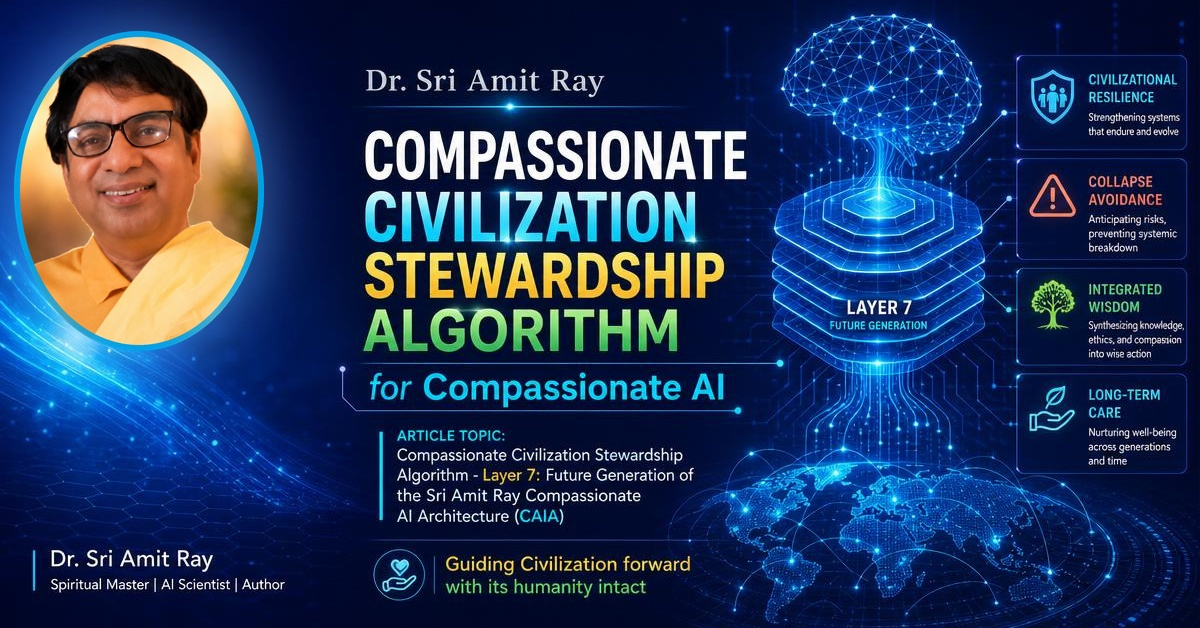
The stewardship model selects policies that keep civilisation as far as possible from the “basins of attraction” that lead to collapse, across long time horizons, so that society can last with its humanity intact. It sits in Layer 7 (Future Generation) of Sri Amit Ray’s Compassionate AI Architecture™ (CAIA™) as the capstone that integrates all twenty-five algorithms.
Key Takeaways
- Integrates all twenty-four preceding CAIA™ algorithms into one civilisation-scale framework.
- Steers long-horizon policy away from collapse attractor basins.
- Asks of every major AI decision whether it strengthens the foundations of civilisation.
- Completes Layer 7 and contributes to the Future Generation Score.
In Simple Words
In everyday terms: this final algorithm guides decisions made at the scale of whole societies away from paths that end in collapse, helping civilisation endure without losing its humanity. It is the layer that holds the other twenty-four together.
Readiness level: Concept and research vision. A direction for civilisation-scale decision-support, not a deployable component.
Why This Algorithm Matters
Developed at the Sri Amit Ray Compassionate AI Lab, the Compassionate Civilization Stewardship Algorithm is the master coordinator of the whole Human-Centered Compassionate AI framework. It draws planetary sustainability, intergenerational safety, social harmony and all twenty-four earlier algorithms into one macro-simulation framework that guides AI toward the long-term preservation and progress of human civilisation and of the living world that supports it. [1]
Stewardship of civilisation means caring for, and building on, everything humanity has accumulated — knowledge, institutions, arts, sciences, relationships and values — while protecting the ecosystems that sustain it, and handing both on to future generations in at least as good a state as we found them. Of every significant AI decision, the algorithm asks: Does this serve the long-term flourishing of civilisation? Does it strengthen or weaken the institutions, relationships, knowledge and values that civilisation rests on?
“The final task of a compassionate intelligence is to help a civilization endure with its humanity intact.”
— A guiding principle of the Sri Amit Ray Compassionate AI Lab
The Mathematics
The stewardship model steers civilization away from collapse attractor basins:
Where B_collapse is the set of civilizational collapse conditions and u is the policy guidance vector. The discount rate \(\rho\) is kept very small (or zero), so that distant generations are not discounted away — in keeping with the Intergenerational Justice Algorithm.
Symbols Used
| Symbol | Meaning |
|---|---|
| \(s(t)\) | civilisational state over time |
| \(B_{collapse}\) | the set of collapse conditions to avoid |
| \(\rho\) | discount rate over the long horizon |
| \(u\) | policy-guidance vector |
A Step-by-Step Example
Among policy trajectories, the algorithm prefers the one that maximises discounted distance from collapse conditions \(B_{collapse}\) (for example ecological tipping points or institutional breakdown). A path with high near-term output that drifts toward a tipping point scores worse than a steadier path that stays far from the basin.
How It Is Implemented
The reference implementation expresses the model as compassionate, auditable logic, written for clarity rather than raw performance so that ethical reviewers as well as engineers can follow every decision.
def run_stewardship_optimizer(global_indicators):
    climate_risk   = assess_climate_feedback_loops(global_indicators)
    ai_runaway     = assess_alignment_drift(global_indicators)
    conflict_risk  = assess_geopolitical_tensions(global_indicators)
    if (climate_risk  > SAFE_BOUND or
        ai_runaway    > SAFE_BOUND or
        conflict_risk > SAFE_BOUND):
        initiate_global_coordination_protocols()
        restrict_existential_vectors()
        return "Emergency containment protocol activated"
    return "Civilizational metrics stable"
Three Civilizational Dimensions
The algorithm operates across three dimensions of civilizational health. Knowledge and Cultural Heritage: AI systems must respect and support cultural diversity, contribute to the commons of human knowledge rather than enclosing it in proprietary systems, and enhance rather than displace human creativity. The algorithm monitors for AI-driven cultural homogenization, knowledge enclosure, and the attrition of minority languages and cultural practices that represent irreplaceable human heritage.
Democratic Institutions and Peace: AI development must actively support democratic governance — transparency enabling informed public deliberation, accountability mechanisms preventing monopoly concentration of AI power, and international cooperation frameworks preventing AI from becoming a weapon in geopolitical competition that destabilizes global peace. The algorithm flags AI developments that pose risks to democratic governance or that create conditions for authoritarian control at civilizational scale.
Long-Term Civilizational Thinking: The algorithm introduces civilizational time horizons into AI governance — the practice of evaluating AI decisions not only on quarterly or annual timescales but on the scale of generations and centuries. Decisions about the governance of AI will shape the conditions of human life for generations to come. Making these decisions well requires thinking in civilizational terms — asking not just ‘what optimizes this quarter’s metrics?’ but ‘what kind of civilization are we building?’
Measuring It Reliably
Define collapse conditions from resilience science and historical case studies, use ensembles of models, and treat outputs as scenario guidance reviewed by humans — never as automated mandates.
Where It Can Help
- Global AI Monitoring Networks: Coordinating planetary safety monitoring to detect existential risk indicators — climate feedback loop acceleration, alignment drift in frontier AI systems, geopolitical tension escalation — before they exceed safe operating boundaries.
- International AI Governance: Providing computational and analytical foundations for international compassionate AI agreements — giving technical substance to the governance commitments of the Compassionate AI Declaration.
- Civilizational Risk Early Warning: Detecting and flagging AI developments that pose risks of irreversible civilizational harm — including runaway automated weapons systems, dangerous biotechnology applications, and AI capability developments that outpace governance frameworks.
“The civilization we are building with AI will be judged not by its intelligence, but by its compassion. Not by what it can do, but by what it chooses to do — and what it chooses never to do.”
— Sri Amit Ray
PART VIII
Future Development of Compassionate AI
Compassionate AGI · The CIQ Benchmark · Global Governance · Human-AI Co-Evolution
Use Cases in Practice
Beyond the general applications above, the algorithm supports concrete, human-centred deployments across compassionate-AI domains:
🕊️ Peacekeeping Force Compassionate Robotics AI
Regional dynamics are steered away from conflict and collapse basins over long horizons.
🏙️ Smart Cities — Public Welfare Optimization
City-scale systems are kept resilient and far from collapse conditions.
🌍 Climate AI — Protecting Vulnerable Populations
Policy guidance avoids ecological tipping points that would threaten whole populations.
🌊 Humanitarian AI — Disaster Response Prioritization
Large-scale coordination keeps societies stable through compounding shocks.
Ethical Foundations
Ethics and empathy are the starting point of the Sri Amit Ray tradition, not an extra layer added at the end. This algorithm rests on three commitments: non-harm (ahimsa), openness about how its decisions are reached, and respect for privacy and human dignity. Like every one of the twenty-five Human-Centered Compassionate AI algorithms, it is meant to work under human oversight — supporting human moral judgement, never standing in for it. [1]
Known Limits and Cautions
- Modelling at the scale of civilisation is speculative and full of value judgements.
- How to define “collapse”, and what discount rate to use, are both contested.
- Treated as an authority rather than an aid, it could invite technocratic overreach.
Guarding Against Misuse
Any tool strong enough to protect people can also be misused to harm them, so these safeguards must accompany every deployment. The main risks of misuse for this algorithm, and how to guard against them, are:
- Civilisation-steering framing could justify authoritarian control ‘for our own good’ — it must remain advisory, transparent, pluralistic, and under democratic oversight.
- Never let a single model or actor claim to optimise civilisation unilaterally.
Alignment with AI Standards
To support real-world adoption, the algorithm maps onto recognised AI governance frameworks and standards:
| Framework | How this algorithm contributes |
|---|---|
| NIST AI RMF | GOVERN — highest-level accountability and societal impact. |
| EU AI Act | Fundamental-rights and democratic-safeguard alignment. |
| UN / SDG framework | Global governance and partnership. |
| IEEE 7000 | Value-based, democratically accountable design. |
Supporting the 17 UN Sustainable Development Goals
The Compassionate Civilization Stewardship Algorithm steers civilization away from collapse attractor basins over long horizons, the culminating task of a compassionate intelligence: to help a civilization endure with its humanity intact. This integrative goal touches the institutional and partnership SDGs, expressing the spirit of the Compassionate AI movement, the 12 Compassionate AI Principles, and the move from data-driven to compassionate AI.
The most directly relevant Sustainable Development Goals, and how this algorithm helps fulfil them, are:
- SDG 11 Sustainable Cities and Communities. Steering away from collapse helps sustain liveable, resilient human settlements.
- SDG 16 Peace, Justice, and Strong Institutions. Long-horizon stewardship preserves peaceful, stable, and just institutions.
- SDG 17 Partnerships for the Goals. A civilizational view requires and reinforces global partnership for shared survival.
In this way the algorithm is not a stand-alone technical artefact but a concrete instrument for the global development agenda, translating compassion into measurable progress toward the 2030 Goals and beyond.
Where It Fits in CAIA™
Figure: This algorithm sits in Layer 7 · Future Generation (highlighted) of the Compassionate AI Architecture™ (CAIA™).
CAIA-SVG-START
CAIA-SVG-END
This algorithm is one of twenty-five building blocks of Sri Amit Ray’s Compassionate AI Architecture™ (CAIA™). CAIA works like a seven-layer, human-centred operating system: before any AI decision can be deployed, it has to pass through each layer of compassion in turn.
It operates in Layer 7: Future Generation Layer, whose purpose is to protect future humans. The layer answers a single guiding question — Will future generations benefit? — and emits the Future Generation Score, one of the seven inputs to the Compassionate AI Index, \( \text{CAI}=\sum_k w_k S_k \). As the capstone of the future-generation layer, it steers civilisation-scale decisions away from collapse.
In the CAIA pipeline (Compassion Quotient → Suffering Reduction → Empathy → Human Flourishing → Vulnerability Protection → Planetary Protection → Future Generation Analysis → Human Oversight → Deploy), this layer’s score is one of the gates a decision must satisfy, and a sufficiently low protective score can veto deployment regardless of the overall average. Resting on the four pillars — Compassion, Responsibility, Sustainability, and Future Generations — the architecture ensures this algorithm never operates in isolation.
Read the full architecture: The Sri Amit Ray Compassionate AI Architecture™ (CAIA™).
This algorithm is one of the 25 Human-Centered Compassionate AI algorithms — see the complete canonical reference list.
How to Cite
Ray, Sri Amit. “Compassionate Civilization Stewardship Algorithm for Compassionate AI.” Compassionate AI, Sri Amit Ray Compassionate AI Lab, 2026, https://sriamitray.com/research/compassionate-civilization-stewardship-algorithm-compassionate-ai/.
References
- Ray, Amit. “The Compassionate AI Lab Declaration on AI Safety, Suffering Reduction, and the Protection of Humanity.” Compassionate AI, vol. 4, no. 12, 2025, pp. 72–74, amitray.com.
- Ray, Amit. “Calling for a Compassionate AI Movement: Towards Compassionate Artificial Intelligence.” Compassionate AI, vol. 2, no. 6, 2023, pp. 75–77, amitray.com.
- Vallor, Shannon. Technology and the Virtues: A Philosophical Guide to a Future Worth Wanting. Oxford University Press, 2016.
- Jonas, Hans. The Imperative of Responsibility: In Search of an Ethics for the Technological Age. University of Chicago Press, 1984.
- Raworth, Kate. Doughnut Economics: Seven Ways to Think Like a 21st-Century Economist. Chelsea Green Publishing, 2017.
- Ray, Amit. Human-Centered Compassionate AI: Sri Amit Ray’s 25 Algorithms for Protecting Humanity and Future Generations. Compassionate AI Lab, 2026. ISBN 978-8169641050.
- Ray, Amit. Compassionate Artificial Intelligence: Frameworks and Algorithms. Compassionate AI Lab, 2018. ISBN 978-9382123460.
- Ray, Amit. Compassionate Superintelligence AI 5.0: AI with Blockchain, BMI, Drone, IoT, and Biometric Technologies. Compassionate AI Lab, 2018. ISBN 978-9382123446.
Further Reading from the Compassionate AI Lab
- Ray, Amit. “Build Your Own Agentic AI Healthcare MCP Server: A Complete Guide to AI-Powered Healthcare Agents.” Compassionate AI, 3.8 (2026): 60-62. https://amitray.com/agentic-ai-healthcare-mcp-server/
- Ray, Amit. “Medical AI Drones for Disaster Management: Intelligent Unmanned Health-Care Systems.” Compassionate AI, 3.8 (2026): 57-59. https://amitray.com/medical-ai-drones-for-disaster-management/
- Ray, Amit. “Compassionate Medical AI Drones as Intelligent Unmanned Health-Care Systems: A Human-Centered AI Architecture for Suffering Reduction and Human Flourishing.” Compassionate AI, 3.8 (2026): 57-59. https://amitray.com/medical-ai-drones-human-centered-ai-healthcare/
- Ray, Amit. “The Sri Amit Ray Compassion Quotient (CQ) Algorithm for Compassionate AI.” Compassionate AI, 2.6 (2026): 81-83. https://amitray.com/compassion-quotient-cq-algorithm-compassionate-ai/
- Ray, Amit. “Collective Human Flourishing Optimization AI Algorithm (CHFOA): A Compassion-Centered Multi-Stakeholder AI Optimization Framework.” Compassionate AI, 2.6 (2026): 90-92. https://amitray.com/collective-human-flourishing-optimization-algorithm-chfoa/
- Ray, Amit. “Human Flourishing Optimization Algorithm (HFOA) for Compassionate AI Architecture.” Compassionate AI, 2.6 (2026): 81-83. https://amitray.com/human-flourishing-optimization-algorithm-hfoa-compassionate-ai/
- Ray, Amit. “The Sri Amit Ray Compassionate AI Architecture (CAIA): A Seven-Layer Framework for Human-Centered Artificial Intelligence.” Compassionate AI, 2.6 (2026): 81-83. https://amitray.com/compassionate-ai-architecture/
- Ray, Amit. “Human-Centered Compassionate AI: The 25 Algorithms for Protecting Humanity and Future Generations.” Compassionate AI, 2.6 (2026): 30-32. https://amitray.com/human-centered-compassionate-ai-the-25-algorithms/
- Ray, Amit. “AI Consciousness and Self-Aware Robots: Sri Amit Ray’s Framework for Compassionate Intelligence.” Compassionate AI, 2.5 (2026): 57-59. https://amitray.com/ai-consciousness-self-aware-robots/
- Ray, Amit. “The 12 Sri Amit Ray Compassionate AI Principles | Ethical AI Framework.” Compassionate AI, 2.4 (2026): 12-14. https://amitray.com/the-12-compassionate-ai-principles-for-humanity-and-future-generations/
- Ray, Amit. “The Compassionate AI Lab Declaration on AI Safety, Suffering Reduction, and the Protection of Humanity.” Compassionate AI, 4.12 (2025): 72-74. https://amitray.com/compassionate-ai-declaration-protection-of-humanity/
- Ray, Amit. “Compassionate AI for Forward Deployed Engineers (FDEs) in SaaS Companies.” Compassionate AI, 4.11 (2025): 15-17. https://amitray.com/compassionate-ai-for-forward-deployed-engineers-fdes-in-saas-companies/
- Ray, Amit. “Microbial AI, Bioleaching and Digital Twins for Manufacturing the 17 Rare Earth Elements.” Compassionate AI, 4.10 (2025): 42-44. https://amitray.com/microbial-ai-bioleaching-and-digital-twins-for-manufacturing-the-17-rare-earth-elements/
- Ray, Amit. “AI-Driven Rare Earth Element Magnet Design: Detailed Methodologies.” Compassionate AI, 4.10 (2025): 27-29. https://amitray.com/ai-driven-rare-earth-elements-magnet-design-methodologies/
- Ray, Amit. “AI Agents and Robots in Peacekeeping Force and Social Care: Compassionate AI Technologies.” Compassionate AI, 3.9 (2025): 75-77. https://amitray.com/ai-agents-robots-peacekeeping-force-social-care-compassionate-ai/
- Ray, Amit. “Ray Mother–Infant Inter-brain Synchrony Algorithm for Deep Compassionate AI.” Compassionate AI, 3.9 (2025): 60-62. https://amitray.com/ray-mother-infant-inter-brain-synchrony-algorithm-deep-compassionate-ai/
- Ray, Amit. “Pain Recognition and Prediction AI Algorithm (PRPA) for Compassionate AI.” Compassionate AI, 3.9 (2025): 60-62. https://amitray.com/pain-recognition-and-prediction-algorithm-prpa-for-compassionate-ai/
- Ray, Amit. “Modeling Consciousness in Compassionate AI: Transformer Models and EEG Data Verification.” Compassionate AI, 3.9 (2025): 27-29. https://amitray.com/modeling-consciousness-in-compassionate-ai-transformer-models/
- Ray, Amit. “The 7 Pillars of Compassionate AI Democracy.” Compassionate AI, 3.9 (2024): 84-86. https://amitray.com/the-7-pillars-of-compassionate-ai-democracy/
- Ray, Amit. “Compassionate AI-Driven Democracy: Power and Challenges.” Compassionate AI, 3.9 (2024): 48-50. https://amitray.com/compassionate-ai-driven-democracy-power-and-challenges/
- Ray, Amit. “The 10 Ethical AI Indexes for LLM Data Training and Responsible AI.” Compassionate AI, 3.8 (2023): 35-39. https://amitray.com/the-10-ethical-ai-indexes-for-responsible-ai/
- Ray, Amit. “Ethical Responsibilities in Large Language AI Models: GPT-3, GPT-4, PaLM 2, LLaMA, Chinchilla, Gopher, and BLOOM.” Compassionate AI, 3.7 (2023): 21-23. https://amitray.com/ethical-responsibility-in-large-language-ai-models/
- Ray, Amit. “Calling for a Compassionate AI Movement: Towards Compassionate Artificial Intelligence.” Compassionate AI, 2.6 (2023): 75-77. https://amitray.com/calling-for-a-compassionate-ai-movement/
- Ray, Amit. “From Data-Driven AI to Compassionate AI: Safeguarding Humanity and Empowering Future Generations.” Compassionate AI, 2.6 (2023): 51-53. https://amitray.com/from-data-driven-ai-to-compassionate-ai-safeguarding-humanity-and-empowering-future-generations/
- Ray, Amit. “Artificial intelligence for Climate Change, Biodiversity and Earth System Models.” Compassionate AI, 1.1 (2022): 54-56. https://amitray.com/artificial-intelligence-for-climate-change-and-earth-system-models/
- Ray, Amit. “Artificial Intelligence for Balance Control and Fall Detection of Elderly People.” Compassionate AI, 4.10 (2018): 39-41. https://amitray.com/artificial-intelligence-for-balance-control-and-fall-detection-system-of-elderly-people/
- Ray, Amit. “Artificial Intelligence to Combat Antibiotic Resistant Bacteria.” Compassionate AI, 2.6 (2018): 3-5. https://amitray.com/artificial-intelligence-for-antibiotic-resistant-bacteria/
- Ray, Amit. “Navigation System for Blind People Using Artificial Intelligence.” Compassionate AI, 2.5 (2018): 42-44. https://amitray.com/artificial-intelligence-for-assisting-blind-people/
- Ray, Amit. “Brain-Computer Interface and Compassionate Artificial Intelligence.” Compassionate AI, 2.5 (2018): 3-5. https://amitray.com/brain-computer-interface-compassionate-ai/