
Abstract
The Trustworthiness Verification Algorithm audits an AI system’s performance continuously and structurally. It keeps a living trust index that decides how much independence the system is given, and it calls for review whenever signs of trustworthiness decline. Trust has to be earned through steady, verifiable conduct — and it can be withdrawn.
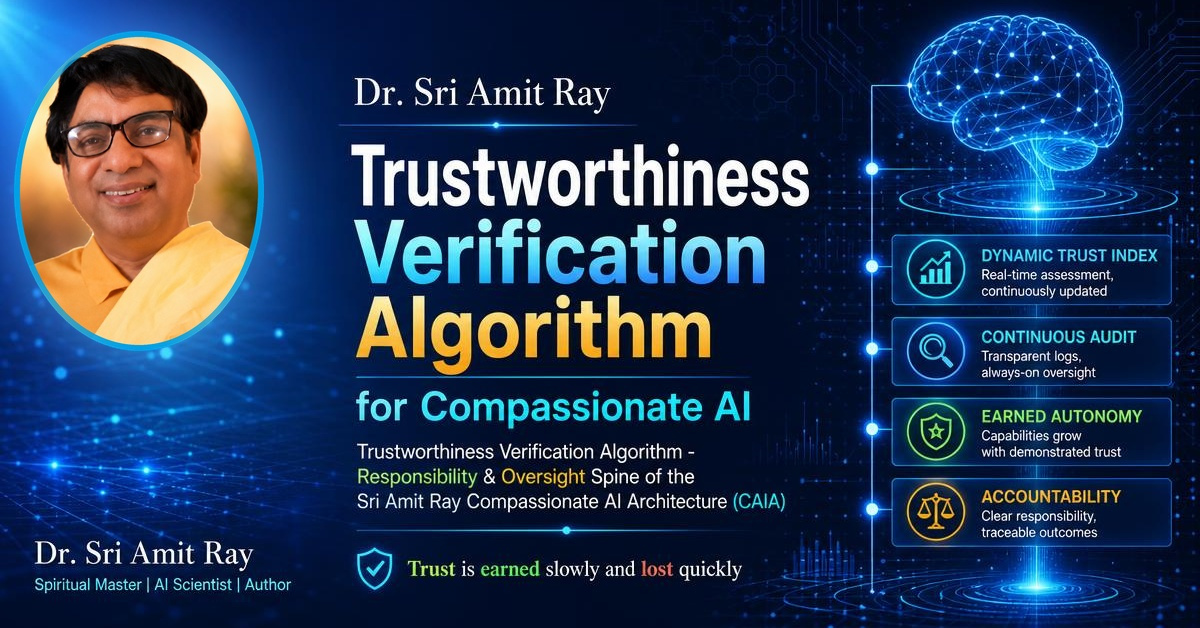
The trust score falls exponentially with each safety violation and climbs back only through proven accuracy and fairness, putting the system on probation until it has shown it can be relied on again. The algorithm is part of the Responsibility and Oversight spine of Sri Amit Ray’s Compassionate AI Architecture™ (CAIA™).
Key Takeaways
- Links an AI system’s autonomy directly to a live, measurable trust index.
- Trust drops exponentially after violations and recovers only through demonstrated performance.
- Automatically triggers human review and probation when trust falls.
- Belongs to the Responsibility and Oversight spine of CAIA™.
In Simple Words
Put simply: an AI system earns more freedom slowly, by showing it is accurate and fair, and loses it quickly after any safety lapse — going on “probation” until it proves itself again. Trust is something it must keep earning, never something it is given for good.
Readiness level: Concept-to-pilot as a runtime governance layer over deployed models.
Why This Algorithm Matters
The Trustworthiness Verification Algorithm was developed at the Sri Amit Ray Compassionate AI Lab to audit AI performance continuously and structurally. It keeps a dynamic trust index that determines what the system may do on its own and sets off review procedures whenever indicators of trustworthiness drop. It puts into practice a simple principle: trust in AI must be earned through consistent, verifiable performance on everything that matters to the people who depend on it — and trust once earned can be lost when performance slips. [1]
“Trust is earned slowly through demonstrated care, and lost quickly through a single harm.”
— A guiding principle of the Sri Amit Ray Compassionate AI Lab
The Mathematics
The trust score T(t) decays exponentially with safety violations and recovers with demonstrated accuracy and fairness:
When T(t) < θ_trust, the system is placed on probation — autonomous privileges are reduced until trust is restored through demonstrated safe, fair, and accurate operation.
Symbols Used
| Symbol | Meaning |
|---|---|
| \(T(t)\) | trust score over time |
| \(N_{violations}\) | count of safety violations |
| \(\lambda_v\) | decay rate per violation |
| \(\theta_{trust}\) | probation threshold |
A Step-by-Step Example
A system at \(T(0)=0.9\) records 3 violations with \(\lambda_v=0.3\), decaying trust to \(0.9\,e^{-0.9}\) ≈ 0.37, plus accuracy and fairness credit of 0.1, giving T ≈ 0.47. Below \(\theta_{trust}=0.6\) it is placed on probation: autonomous privileges are reduced and human approval is required until trust recovers.
How It Is Implemented
The reference implementation expresses the model as compassionate, auditable logic, written for clarity rather than raw performance so that ethical reviewers as well as engineers can follow every decision.
def update_trustworthiness_index(system_log, current_trust):
    violations = system_log.count_safety_violations_in_period()
    accuracy   = system_log.get_accuracy_metric()
    fairness   = system_log.get_fairness_metric()
    decay      = math.exp(-LAMBDA_V * violations)
    new_trust  = current_trust * decay + MU * accuracy + ETA * fairness
    if new_trust < THETA_TRUST:
        revoke_autonomous_privileges(
            reason="Trust index below threshold."
        )
    return new_trust
Public Trust Reporting
The algorithm supports public transparency through regular public trust reports — accessible, honest accounts of AI system performance, failures, and improvements. These reports must go beyond promotional communications to provide genuine accounting: what went wrong, what was done about it, what residual risks exist, and what monitoring mechanisms are in place. Communities that receive honest, informative reports about AI system performance develop more appropriate and productive trust relationships with those systems than communities that receive only promotional communications. The algorithm standardizes the content and format of these reports to enable meaningful comparison across systems and over time.
Measuring It Reliably
Log violations against an agreed taxonomy, verify accuracy and fairness on held-out data, and validate that probation events correspond to real reliability drops. Make the trust ledger auditable.
Where It Can Help
- Clinical AI Systems: Dynamic privilege management for medical AI — observer-only status when safety anomalies are detected, with gradual privilege restoration as safe performance is re-established.
- Financial AI: Trade volume restrictions when risk-adjusted performance metrics fall below regulatory thresholds.
- Public Sector AI: Mandatory public trust reporting and independent audit triggers when trustworthiness indices fall below agreed standards.
PART VI
Planetary Sustainability Intelligence
Algorithms 21–22 + Ecological Stewardship: Making Nature a Stakeholder
Use Cases in Practice
Beyond the general applications above, the algorithm supports concrete, human-centred deployments across compassionate-AI domains:
🤖 Compassionate Eldercare Robotics AI
A care robot that records safety violations is placed on probation, with reduced autonomy until it demonstrates safe operation again.
🏙️ Smart Cities — Public Welfare Optimization
Public-facing AI services are continuously trust-verified and lose autonomy after incidents.
🌊 Humanitarian AI — Disaster Response Prioritization
Aid-allocation systems must keep earning trust through demonstrated accuracy and fairness.
🤖 Compassionate Baby Care Robotics AI
A baby-care robot’s privileges are gated by a verifiable, auditable trust ledger.
Ethical Foundations
Ethics and empathy are the starting point of the Sri Amit Ray tradition, not an extra layer added at the end. This algorithm rests on three commitments: non-harm (ahimsa), openness about how its decisions are reached, and respect for privacy and human dignity. Like every one of the twenty-five Human-Centered Compassionate AI algorithms, it is meant to work under human oversight — supporting human moral judgement, never standing in for it. [1]
Known Limits and Cautions
- Deciding what counts as a “violation”, and detecting it, is difficult and open to dispute.
- A system might learn to polish the measured accuracy and fairness terms while hiding other harms.
- The recovery rules must make sure serious harms cannot be cheaply “bought back”.
Guarding Against Misuse
Any tool strong enough to protect people can also be misused to harm them, so these safeguards must accompany every deployment. The main risks of misuse for this algorithm, and how to guard against them, are:
- Trust scores could be inflated for marketing — require third-party verification of the ledger.
- Do not use the score to evade accountability for incidents that have already harmed people.
Alignment with AI Standards
To support real-world adoption, the algorithm maps onto recognised AI governance frameworks and standards:
| Framework | How this algorithm contributes |
|---|---|
| NIST AI RMF | All four functions — operationalises continuous trustworthiness. |
| EU AI Act | Post-market monitoring and incident-reporting duties. |
| ISO/IEC 42001 | Performance monitoring and continual improvement. |
| IEEE 7000 | Accountability by design. |
Supporting the 17 UN Sustainable Development Goals
The Trustworthiness Verification Algorithm tracks a trust score that decays with safety violations and recovers only through demonstrated accuracy and fairness, placing unreliable systems on probation. Verifiable trust underpins resilient institutions and partnership, themes of the 10 Ethical AI Indexes, the work on building trustworthy AI agents, and the 12 Compassionate AI Principles.
The most directly relevant Sustainable Development Goals, and how this algorithm helps fulfil them, are:
- SDG 9 Industry, Innovation, and Infrastructure. Continuous trust verification keeps deployed AI infrastructure dependable over time.
- SDG 16 Peace, Justice, and Strong Institutions. Probation for unsafe systems enforces institutional accountability.
- SDG 17 Partnerships for the Goals. Shared trust metrics enable confident collaboration across organisations and sectors.
In this way the algorithm is not a stand-alone technical artefact but a concrete instrument for the global development agenda, translating compassion into measurable progress toward the 2030 Goals and beyond.
Where It Fits in CAIA™
Figure: This algorithm works on the cross-cutting Responsibility & Oversight spine that audits every layer of the Compassionate AI Architecture™ (CAIA™).
CAIA-SVG-START
CAIA-SVG-END
This algorithm is one of twenty-five building blocks of Sri Amit Ray’s Compassionate AI Architecture™ (CAIA™). CAIA works like a seven-layer, human-centred operating system: before any AI decision can be deployed, it has to pass through each layer of compassion in turn.
It does not occupy a single compassion layer. Instead it functions as a cross-cutting mechanism of the architecture’s Responsibility pillar, operating across all seven layers and at the Human Oversight gate of the pipeline. It continuously audits the entire stack, decaying autonomy after violations so that trust in any layer must be earned and re-earned.
Because CAIA requires that every layer’s score remain auditable, contestable, and safe, governance algorithms like this one are what allow the architecture to be trusted rather than merely asserted. A decision that fails here can be halted no matter how well it scores on any individual compassion layer. The architecture rests on four pillars — Compassion, Responsibility, Sustainability, and Future Generations — and this algorithm is central to the second.
Read the full architecture: The Sri Amit Ray Compassionate AI Architecture™ (CAIA™).
This algorithm is one of the 25 Human-Centered Compassionate AI algorithms — see the complete canonical reference list.
How to Cite
Ray, Sri Amit. “Trustworthiness Verification Algorithm for Compassionate AI.” Compassionate AI, Sri Amit Ray Compassionate AI Lab, 2026, https://sriamitray.com/research/trustworthiness-verification-algorithm-compassionate-ai/.
References
- Ray, Amit. “The Compassionate AI Lab Declaration on AI Safety, Suffering Reduction, and the Protection of Humanity.” Compassionate AI, vol. 4, no. 12, 2025, pp. 72–74, amitray.com.
- Ray, Amit. “The 10 Ethical AI Indexes for LLM Data Training and Responsible AI.” Compassionate AI, vol. 3, no. 8, 2023, pp. 35–39, amitray.com.
- National Institute of Standards and Technology. Artificial Intelligence Risk Management Framework (AI RMF 1.0). NIST AI 100-1, 2023, nist.gov.
- Floridi, Luciano, and Josh Cowls. “A Unified Framework of Five Principles for AI in Society.” Harvard Data Science Review, vol. 1, no. 1, 2019, doi.org/10.1162/99608f92.8cd550d1.
- Jobin, Anna, et al. “The Global Landscape of AI Ethics Guidelines.” Nature Machine Intelligence, vol. 1, no. 9, 2019, pp. 389–399, doi.org/10.1038/s42256-019-0088-2.
- Ray, Amit. Human-Centered Compassionate AI: Sri Amit Ray’s 25 Algorithms for Protecting Humanity and Future Generations. Compassionate AI Lab, 2026. ISBN 978-8169641050.
- Ray, Amit. Compassionate Artificial Intelligence: Frameworks and Algorithms. Compassionate AI Lab, 2018. ISBN 978-9382123460.
- Ray, Amit. Compassionate Superintelligence AI 5.0: AI with Blockchain, BMI, Drone, IoT, and Biometric Technologies. Compassionate AI Lab, 2018. ISBN 978-9382123446.
Further Reading from the Compassionate AI Lab
- Ray, Amit. “Build Your Own Agentic AI Healthcare MCP Server: A Complete Guide to AI-Powered Healthcare Agents.” Compassionate AI, 3.8 (2026): 60-62. https://amitray.com/agentic-ai-healthcare-mcp-server/
- Ray, Amit. “Medical AI Drones for Disaster Management: Intelligent Unmanned Health-Care Systems.” Compassionate AI, 3.8 (2026): 57-59. https://amitray.com/medical-ai-drones-for-disaster-management/
- Ray, Amit. “Compassionate Medical AI Drones as Intelligent Unmanned Health-Care Systems: A Human-Centered AI Architecture for Suffering Reduction and Human Flourishing.” Compassionate AI, 3.8 (2026): 57-59. https://amitray.com/medical-ai-drones-human-centered-ai-healthcare/
- Ray, Amit. “The Sri Amit Ray Compassion Quotient (CQ) Algorithm for Compassionate AI.” Compassionate AI, 2.6 (2026): 81-83. https://amitray.com/compassion-quotient-cq-algorithm-compassionate-ai/
- Ray, Amit. “Collective Human Flourishing Optimization AI Algorithm (CHFOA): A Compassion-Centered Multi-Stakeholder AI Optimization Framework.” Compassionate AI, 2.6 (2026): 90-92. https://amitray.com/collective-human-flourishing-optimization-algorithm-chfoa/
- Ray, Amit. “Human Flourishing Optimization Algorithm (HFOA) for Compassionate AI Architecture.” Compassionate AI, 2.6 (2026): 81-83. https://amitray.com/human-flourishing-optimization-algorithm-hfoa-compassionate-ai/
- Ray, Amit. “The Sri Amit Ray Compassionate AI Architecture (CAIA): A Seven-Layer Framework for Human-Centered Artificial Intelligence.” Compassionate AI, 2.6 (2026): 81-83. https://amitray.com/compassionate-ai-architecture/
- Ray, Amit. “Human-Centered Compassionate AI: The 25 Algorithms for Protecting Humanity and Future Generations.” Compassionate AI, 2.6 (2026): 30-32. https://amitray.com/human-centered-compassionate-ai-the-25-algorithms/
- Ray, Amit. “AI Consciousness and Self-Aware Robots: Sri Amit Ray’s Framework for Compassionate Intelligence.” Compassionate AI, 2.5 (2026): 57-59. https://amitray.com/ai-consciousness-self-aware-robots/
- Ray, Amit. “The 12 Sri Amit Ray Compassionate AI Principles | Ethical AI Framework.” Compassionate AI, 2.4 (2026): 12-14. https://amitray.com/the-12-compassionate-ai-principles-for-humanity-and-future-generations/
- Ray, Amit. “The Compassionate AI Lab Declaration on AI Safety, Suffering Reduction, and the Protection of Humanity.” Compassionate AI, 4.12 (2025): 72-74. https://amitray.com/compassionate-ai-declaration-protection-of-humanity/
- Ray, Amit. “Compassionate AI for Forward Deployed Engineers (FDEs) in SaaS Companies.” Compassionate AI, 4.11 (2025): 15-17. https://amitray.com/compassionate-ai-for-forward-deployed-engineers-fdes-in-saas-companies/
- Ray, Amit. “Microbial AI, Bioleaching and Digital Twins for Manufacturing the 17 Rare Earth Elements.” Compassionate AI, 4.10 (2025): 42-44. https://amitray.com/microbial-ai-bioleaching-and-digital-twins-for-manufacturing-the-17-rare-earth-elements/
- Ray, Amit. “AI-Driven Rare Earth Element Magnet Design: Detailed Methodologies.” Compassionate AI, 4.10 (2025): 27-29. https://amitray.com/ai-driven-rare-earth-elements-magnet-design-methodologies/
- Ray, Amit. “AI Agents and Robots in Peacekeeping Force and Social Care: Compassionate AI Technologies.” Compassionate AI, 3.9 (2025): 75-77. https://amitray.com/ai-agents-robots-peacekeeping-force-social-care-compassionate-ai/
- Ray, Amit. “Ray Mother–Infant Inter-brain Synchrony Algorithm for Deep Compassionate AI.” Compassionate AI, 3.9 (2025): 60-62. https://amitray.com/ray-mother-infant-inter-brain-synchrony-algorithm-deep-compassionate-ai/
- Ray, Amit. “Pain Recognition and Prediction AI Algorithm (PRPA) for Compassionate AI.” Compassionate AI, 3.9 (2025): 60-62. https://amitray.com/pain-recognition-and-prediction-algorithm-prpa-for-compassionate-ai/
- Ray, Amit. “Modeling Consciousness in Compassionate AI: Transformer Models and EEG Data Verification.” Compassionate AI, 3.9 (2025): 27-29. https://amitray.com/modeling-consciousness-in-compassionate-ai-transformer-models/
- Ray, Amit. “The 7 Pillars of Compassionate AI Democracy.” Compassionate AI, 3.9 (2024): 84-86. https://amitray.com/the-7-pillars-of-compassionate-ai-democracy/
- Ray, Amit. “Compassionate AI-Driven Democracy: Power and Challenges.” Compassionate AI, 3.9 (2024): 48-50. https://amitray.com/compassionate-ai-driven-democracy-power-and-challenges/
- Ray, Amit. “The 10 Ethical AI Indexes for LLM Data Training and Responsible AI.” Compassionate AI, 3.8 (2023): 35-39. https://amitray.com/the-10-ethical-ai-indexes-for-responsible-ai/
- Ray, Amit. “Ethical Responsibilities in Large Language AI Models: GPT-3, GPT-4, PaLM 2, LLaMA, Chinchilla, Gopher, and BLOOM.” Compassionate AI, 3.7 (2023): 21-23. https://amitray.com/ethical-responsibility-in-large-language-ai-models/
- Ray, Amit. “Calling for a Compassionate AI Movement: Towards Compassionate Artificial Intelligence.” Compassionate AI, 2.6 (2023): 75-77. https://amitray.com/calling-for-a-compassionate-ai-movement/
- Ray, Amit. “From Data-Driven AI to Compassionate AI: Safeguarding Humanity and Empowering Future Generations.” Compassionate AI, 2.6 (2023): 51-53. https://amitray.com/from-data-driven-ai-to-compassionate-ai-safeguarding-humanity-and-empowering-future-generations/
- Ray, Amit. “Artificial intelligence for Climate Change, Biodiversity and Earth System Models.” Compassionate AI, 1.1 (2022): 54-56. https://amitray.com/artificial-intelligence-for-climate-change-and-earth-system-models/
- Ray, Amit. “Artificial Intelligence for Balance Control and Fall Detection of Elderly People.” Compassionate AI, 4.10 (2018): 39-41. https://amitray.com/artificial-intelligence-for-balance-control-and-fall-detection-system-of-elderly-people/
- Ray, Amit. “Artificial Intelligence to Combat Antibiotic Resistant Bacteria.” Compassionate AI, 2.6 (2018): 3-5. https://amitray.com/artificial-intelligence-for-antibiotic-resistant-bacteria/
- Ray, Amit. “Navigation System for Blind People Using Artificial Intelligence.” Compassionate AI, 2.5 (2018): 42-44. https://amitray.com/artificial-intelligence-for-assisting-blind-people/
- Ray, Amit. “Brain-Computer Interface and Compassionate Artificial Intelligence.” Compassionate AI, 2.5 (2018): 3-5. https://amitray.com/brain-computer-interface-compassionate-ai/