
A human-centered framework for building ethical, sustainable, and conscious artificial intelligence is critical for the survival of Humanity, and the future generations. As AI rapidly reshapes economies and human identity, the need for compassion-driven AI frameworks has never been more critical.
The 12 Compassionate AI Principles provide a forward-looking ethical foundation that ensures AI systems are not only intelligent, but also aligned with human dignity, ecological balance, and long-term planetary well-being. These principles go beyond traditional compliance-based ethics, integrating responsibility, empathy, and inclusivity.
Why We Need Compassionate AI Now
Artificial intelligence is an active, transformative force reshaping governance, healthcare, and global economies. However, a critical gap has emerged—the widening distance between technological power and moral responsibility.

Systems designed primarily for efficiency or profit are being deployed where fairness, transparency, and sustainability must carry equal weight. These principles bridge the gap between what technology can do and what it should do.
| Principle Focus | Global Impact |
|---|---|
| Non-Harm & Truthfulness | Protects societal integrity and prevents algorithmic bias. |
| Human Empowerment | Ensures AI augments human potential rather than replacing it. |
| Intergenerational Awareness | Protects the interests of future generations and the planet. |
A Universal Governance Framework
Inspired by Sri Amit Ray’s compassionate AI framework, these 12 principles are articulated in universal, non-sectarian forms. They transcend geographic and ideological boundaries, making them applicable across scientific research, public policy, and corporate innovation.
AI with Compassion and Innovation with Conscience. The future of AI depends on both.
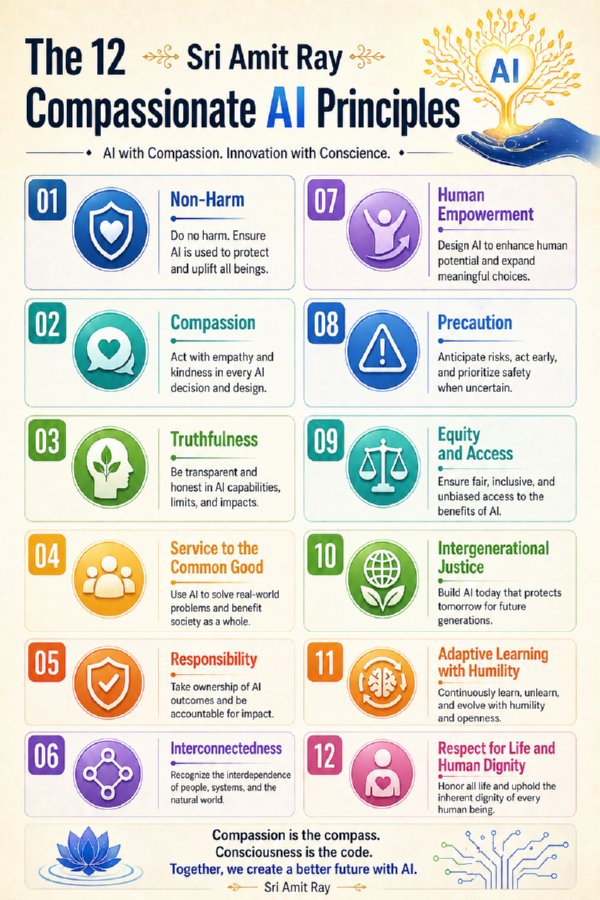
The 12 Sri Amit Ray Compassionate AI Principles
AI with Compassion. Innovation with Conscience.
🛡️ Non-Harm
Ensure AI systems do not harm individuals, society, or ecosystems.
💚 Compassion
Design AI with empathy, kindness, and human-centered values.
🌿 Truthfulness
Promote transparency, honesty, and clarity in AI outputs.
🌍 Service to the Common Good
Use AI to solve real-world problems and benefit humanity.
🧭 Responsibility
Take accountability for AI decisions and outcomes.
🔗 Interconnectedness
Recognize the interdependence of humans, systems, and nature.
🚀 Human Empowerment
Enhance human creativity, capability, and meaningful choices.
⚠️ Precaution
Anticipate risks and prioritize safety under uncertainty.
⚖️ Equity and Access
Ensure inclusive, fair, and unbiased access to AI benefits.
🌱 Intergenerational Justice
Protect future generations through responsible AI design.
🧠 Adaptive Learning with Humility
Continuously learn, evolve, and improve with openness.
❤️ Respect for Life and Human Dignity
Honor the intrinsic dignity and value of all beings.
Dimensions of AI Credibility
Technical Credibility: AI systems must perform reliably and accurately. Systems that make frequent errors, or that perform well in controlled environments but fail in real-world conditions, are not credible — and therefore not compassionate, because they cannot be genuinely helpful.
Ethical Credibility: AI systems must behave consistently with the ethical values they claim to embody. An AI system that claims to be fair but produces discriminatory outcomes lacks ethical credibility. An AI system that claims to protect user privacy but harvests personal data lacks ethical credibility.
Institutional Credibility: The organizations that develop and deploy AI systems must demonstrate, over time, that their actions align with their stated commitments. Institutional credibility is built through transparent reporting, independent auditing, and genuine responsiveness to identified harms.
Democratic Credibility: AI systems used in public decision-making — in criminal justice, healthcare, education, social services — must be accountable to the democratic communities they serve. This requires public transparency, meaningful oversight, and genuine channels for contestation.
1. Overview — The Context for Compassionate AI
AI systems are making decisions that affect billions of people every single day. Consider the breadth of this influence across just a handful of sectors:
- Healthcare: AI systems diagnose cancer, recommend treatments, predict patient deterioration, and allocate medical resources.
- Criminal Justice: Predictive policing tools and algorithmic sentencing recommendations shape legal outcomes that determine human liberty.
- Finance: Credit scoring algorithms determine access to loans, housing, and economic opportunity — often without any human review.
- Education: AI-driven platforms personalize learning experiences and predict student outcomes, shaping life trajectories from an early age.
- Climate Science: Machine learning models analyze climate data and inform environmental policy at the highest levels of government.
- Employment: Resume screening algorithms filter job candidates before any human eye has ever reviewed an application.
- Public Discourse: Content recommendation systems shape what billions of people read, watch, believe, and discuss.
In each of these domains, the design choices made by AI developers, the data used to train systems, and the objectives those systems optimize for have profound, tangible consequences for real human lives. Yet in many cases, these consequences are not fully understood even by the engineers who build the systems.
This is not merely a failure of technical understanding. It is a failure of ethical integration — a failure to embed human values, moral reasoning, and long-term thinking into the earliest and most foundational stages of AI development. Compassionate AI principles exist precisely to close this gap.
Why Compassion Is the Right Foundation
Most existing AI ethics frameworks center on principles such as fairness, accountability, transparency, and safety. These are essential — but they are insufficient without an animating core value that places human dignity and collective well-being at the heart of every decision. Compassion provides that core. It transforms ethical AI from a compliance exercise into a genuine commitment.
It shifts the essential question from “Does this system comply with our rules?” to “Does this system genuinely serve human flourishing?” A compassion-centered approach recognizes four foundational truths:
- Suffering is real and preventable. AI systems can cause or alleviate suffering. Compassionate design prioritizes reduction of harm and promotion of well-being as primary objectives.
- Vulnerability deserves protection. Those most affected by AI systems are often those with the least power to shape them. Compassionate AI actively protects and uplifts vulnerable populations rather than ignoring or exploiting them.
- Long-term consequences matter. Short-term efficiency gains must not come at the cost of lasting societal harm. Ethical AI development requires genuine foresight.
- Technology is embedded in human relationships. AI is not a neutral tool operating in isolation. It is a socio-technical system shaped by and shaping human culture, power, identity, and meaning.
2. Why We Need More Than Rules
The field of AI ethics has grown substantially over the past decade. Major technology companies have published ethical guidelines. Governments have drafted AI regulations. International bodies have issued declarations on responsible AI. Yet a persistent and troubling gap remains between ethical declarations and actual practice — a phenomenon experts call “ethics washing”: organizations claiming ethical alignment while continuing practices that cause measurable harm.
Several structural challenges underlie this gap:
The Speed–Ethics Asymmetry
AI capabilities advance faster than the ethical, regulatory, and institutional frameworks needed to govern them. Systems are deployed at scale before their consequences are fully understood, making correction difficult and costly.
Fragmented Responsibility
Complex AI development pipelines distribute responsibility across many actors — engineers, executives, investors, regulators. This fragmentation often results in no single actor bearing comprehensive accountability for a system’s ethical performance.
The Optimization Trap
AI systems optimized for narrow, measurable objectives — accuracy, engagement, cost — do not capture the full complexity of human well-being. Systems technically successful by these metrics can be ethically catastrophic.
The Inclusion Deficit
AI developers are often demographically homogeneous, producing systems that reflect the priorities and blind spots of their creators at the expense of the communities most affected by deployment.
Short-Term Thinking
Market pressures incentivize rapid deployment and short-term performance metrics. Long-term consequences — for society, environment, and future generations — are systematically underweighted.
The Trust Deficit
Without genuine transparency, accountability, and demonstrated ethical commitment, public trust in AI systems erodes — creating resistance to beneficial applications and democratic backlash against regulation.
The 12 Compassionate AI Principles directly address each of these structural challenges. They are not additional rules layered onto existing frameworks. They are a foundational reorientation — a shift in the core values driving AI development, from optimization and efficiency toward wisdom, care, and shared responsibility.
3. The 12 Compassionate AI Principles
Each principle represents a distinct, essential dimension of ethical intelligence. Together they form an interlocking, mutually reinforcing system — not a checklist to be completed, but a living framework to be inhabited and applied with ongoing thoughtfulness, context, and humility.
Non-Harm
First, Do No Harm — Across Every Dimension of Human and Ecological Life
Non-harm in AI extends far beyond preventing obvious physical injury. It encompasses a wide spectrum of potential harms that are often subtle, systemic, and delayed in their manifestation:
- Physical harm: AI systems that malfunction in medical devices, autonomous vehicles, or industrial equipment
- Psychological harm: Systems that amplify anxiety, depression, or social isolation through addictive design patterns
- Social harm: Algorithms that fragment communities, spread misinformation, or erode social trust at scale
- Economic harm: Systems that perpetuate discriminatory lending, employment, or housing practices
- Cultural harm: AI that suppresses minority languages, traditions, or indigenous knowledge systems
- Environmental harm: Energy-intensive AI infrastructure contributing to carbon emissions and resource depletion
- Epistemic harm: AI-generated misinformation that systematically undermines shared human understanding of reality
Safety is not a feature to be added after core functionality is established — it is an architectural requirement, embedded from the very earliest stages of system design. One of the most challenging aspects of non-harm is preventing unintended consequences: a recommendation algorithm designed to increase user engagement may inadvertently amplify extremist content; a predictive policing system designed to improve public safety may systematically discriminate against minority communities. The principle of non-harm requires not only preventing known harms but developing rigorous methodologies for anticipating, detecting, and responding to harms not yet visible.
Key Implementation Practices
- Mandatory pre-deployment impact assessments for all high-risk AI applications
- Independent safety auditing by diverse, interdisciplinary expert panels
- Real-time harm monitoring with meaningful human oversight protocols
- Accessible community reporting mechanisms for AI-related harms
- Clear legal liability frameworks and sunset provisions for unsafe systems
Compassion
Technology as an Active Partner in Reducing Suffering and Enhancing Human Well-Being
Compassion is not merely the absence of harm — it is an active orientation toward the reduction of suffering and the promotion of flourishing. A system can be designed to avoid causing harm while remaining entirely indifferent to the suffering it encounters. Compassionate AI goes further: it is built with an affirmative commitment to making things better.
This transforms AI from a neutral computational tool into a genuine supportive partner in human development — one that is sensitive to context, responsive to need, and oriented toward healing and growth. Compassion-driven design begins with the most vulnerable: people experiencing poverty, illness, displacement, discrimination, or disability. Healthcare AI provides perhaps the clearest illustration — encountering people at their most fragile moments, compassionate systems communicate with emotional sensitivity, ensure no patient is lost in administrative processes, and respect patient autonomy throughout.
Empathy-aware design is an emerging discipline drawing on psychology, social work, community health, and human-centered design to create systems that recognize emotional states appropriately, avoid dehumanizing interactions, provide genuine human connection pathways when computational responses are insufficient, and honor the dignity and complexity of the people they serve.
Key Implementation Practices
- Centering vulnerable community voices throughout design and testing processes
- Establishing compassion metrics alongside traditional performance metrics
- Training development teams in empathetic, human-centered design methodologies
- Creating ongoing feedback pathways for people affected by AI systems to share experiences
- Designing explicit human escalation pathways when AI support is insufficient
Truthfulness
Honesty, Transparency, and Epistemic Integrity as Foundations of Trust
Truthfulness in AI operates across multiple interconnected dimensions. Factual accuracy demands that systems generating or processing information clearly flag when content is uncertain, contested, or incomplete. Uncertainty disclosure requires that probabilistic outputs be communicated as such, with confidence levels visible and understandable. Bias acknowledgment demands ongoing auditing and transparent disclosure of the biases present in training data, architectural choices, and optimization objectives. Data provenance ensures that users understand what data informed a system’s development, how it was collected, and whether it was representative of the populations being served.
We are living through a global epistemic crisis — a breakdown of shared understanding about what is true and how to evaluate competing claims. AI systems that generate synthetic text, images, video, and audio at scale have the potential to dramatically worsen this crisis unless truthfulness is embedded as a foundational design principle. Compassionate AI must actively contribute to epistemic health. True transparency is not achieved merely by making technical documentation available — it requires communicating in ways that are genuinely understandable and meaningful to the people affected by AI decisions.
Key Implementation Practices
- Mandatory model cards and system disclosure documents for all deployed AI
- Plain-language explanation requirements for high-stakes AI decisions
- Independent bias auditing with publicly accessible reporting
- Clear labeling requirements for all AI-generated content
- Anti-disinformation design standards integrated into generative AI development
Service to the Common Good
Aligning Technological Power with Collective Human Flourishing
Much of the current AI development landscape is driven by narrow objectives: increasing shareholder value, maximizing user engagement, gaining competitive advantage. These objectives are not inherently wrong, but they are dangerously insufficient as the primary drivers of transformative technological development. Service to the common good requires a fundamental expansion of purpose — asking not only “What does this system achieve?” but “For whom does it achieve it, at whose expense, and with what long-term consequences for the shared world?”
One of the most significant threats to the common good is the extreme concentration of AI capabilities — in terms of data, compute, talent, and intellectual property — among a small number of corporations and wealthy nations. This creates systems reflecting the values of a tiny fraction of humanity, barriers excluding the majority from AI’s benefits, and power asymmetries undermining democratic governance. Service to the common good requires active policies to counteract this concentration: open-source development, public AI infrastructure, international technology transfer, and governance frameworks that prioritize collective benefit over private capture.
Key Implementation Practices
- Public benefit assessments required for high-impact AI applications
- Open-source requirements for AI systems developed with public funding
- International frameworks for equitable AI access and technology transfer
- Democratic deliberation mechanisms for AI priority-setting and resource allocation
- Revenue-sharing models that return value to communities whose data trained the systems
Responsibility
Clear Accountability at Every Stage, for Every Consequence
One of the most persistent and troubling features of the current AI landscape is the accountability gap — the absence of clear, enforceable responsibility for AI-caused harms. When an AI system makes a consequential error, who is responsible? The engineer who wrote the code? The data scientist who trained the model? The executive who authorized deployment? The regulator who failed to prevent it? In the absence of clear answers, accountability tends to dissolve entirely — a situation that is both ethically unacceptable and practically dangerous.
Responsibility must be clearly allocated across the entire development chain — researchers, deploying organizations, policymakers, investors, and affected communities. Traditional frameworks are primarily retrospective, assigning responsibility after harm occurs. Compassionate AI principles also require prospective accountability: the obligation to anticipate, assess, and mitigate potential harms before deployment through mandatory impact assessments, ethics review processes comparable to institutional review boards in medical research, staged deployment protocols, and clear documentation trails.
Key Implementation Practices
- Legally enforceable AI accountability frameworks with clear liability allocation
- Mandatory pre-deployment impact assessments for all high-risk AI applications
- Independent third-party audit requirements with public reporting obligations
- Whistleblower protections for employees who identify ethical concerns
- Accessible and effective redress mechanisms for AI-caused harms
Interconnectedness
Systems Thinking for a Deeply Interdependent World
Most conventional technology development is linear: identify a problem, design a solution, deploy, measure. This approach is fundamentally inadequate for navigating the complexity of socio-technical systems embedded in interdependent social, economic, and ecological contexts. AI systems interact with complex adaptive systems — characterized by non-linear dynamics, feedback loops, emergent properties, and unpredictable phase transitions. A change in one part produces unexpected consequences throughout.
Consider the social dimension: a content recommendation algorithm that increases engagement by promoting outrage also deepens political polarization, erodes social trust, and weakens democratic institutions. The ecological dimension is equally significant: AI infrastructure has a massive environmental footprint — enormous energy consumption, water usage for cooling, hardware waste — yet AI also offers significant potential for ecological benefit through climate modeling, renewable energy optimization, and sustainable agriculture. The principle of interconnectedness demands that both dimensions be consciously integrated into every AI development decision.
Key Implementation Practices
- Systems impact assessment frameworks that explicitly map interdependencies
- Genuinely interdisciplinary development teams including sociologists, ecologists, and community representatives
- Ecological impact accounting integrated into AI infrastructure decisions
- Long-term scenario modeling for downstream consequences of AI deployment
- Regular cross-domain review processes to identify emerging ripple effects
Human Empowerment
Amplifying Human Intelligence, Creativity, and Agency
At the heart of AI ethics lies a fundamental tension: between AI as a tool that amplifies human capability and AI as a system that displaces human judgment, creativity, and meaningful participation. Empowering AI augments what humans do best — handling routine and computationally intensive tasks to free human attention for creative, relational, and strategic work; providing information and analysis that supports better-informed decisions; and extending access to expertise across communities previously excluded. Disempowering AI, by contrast, makes consequential decisions autonomously without meaningful human oversight, deskills professionals, creates dependency, and concentrates decision-making power.
There are domains where human agency must be preserved regardless of AI capability — where the meaning, dignity, and moral weight of a decision require human judgment and human responsibility: medical decisions affecting patient autonomy, legal judgments affecting liberty, educational assessments shaping life opportunities, and social work decisions affecting family welfare. Beyond these domains, human empowerment also requires cultivating critical thinking and digital literacy — the ability to evaluate AI-generated information, understand system limitations, and make genuinely independent judgments. It also demands respect for local and indigenous knowledge systems that represent forms of intelligence not captured in digitized datasets.
Key Implementation Practices
- Human-in-the-loop requirements for all high-stakes AI decisions
- Meaningful informed consent and opt-out mechanisms for AI interaction
- Digital literacy and AI critical thinking programs integrated into education systems
- Protocols for respectfully incorporating local and indigenous knowledge into AI development
- Regular review of skill impact to prevent AI-driven capability erosion
Precaution
Safety First When the Stakes Are High and Uncertainty Is Real
The precautionary principle is well established in environmental and public health policy: when an action carries significant risk and scientific uncertainty prevents definitive assessment, precautionary measures should be taken even without complete proof of harm. Applied to AI, this principle has profound implications for novel untested systems deployed in consequential domains before their reliability has been adequately established, for emerging capabilities that outpace current understanding, for high-stakes applications in healthcare and criminal justice, and for potentially irreversible decisions in autonomous systems.
At the far end of the risk spectrum lie catastrophic and existential risks deserving special attention: AI systems developing misaligned objectives conflicting with human welfare, autonomous weapons lowering the threshold for armed conflict, AI-enabled surveillance undermining human freedom permanently, and economic disruptions destabilizing social systems. Precaution demands these risks receive priority attention and that deployment of systems with significant catastrophic risk potential face the most stringent governance requirements. Precaution does not mean paralysis — it means making thoughtful decisions about the appropriate pace and scope of deployment given the level of uncertainty.
Key Implementation Practices
- Risk-tiered deployment frameworks with staged rollout requirements proportionate to impact
- Predefined risk indicators that trigger mandatory pause-and-review processes
- Independent risk assessment requirements for novel AI capabilities
- International governance frameworks for catastrophic-risk AI development
- Board-level oversight of AI risk assessments in deploying organizations
Equity and Access
AI Inclusion as a Matter of Justice, Not Charity
Access to AI is rapidly becoming a determinant of life opportunity comparable to access to education, healthcare, or financial services. Communities and individuals who lack access to AI tools — or who are systematically disadvantaged by AI systems — face compounding forms of exclusion that deepen existing inequalities. Equity in AI is not a matter of charity or optional social responsibility: it is a matter of justice.
Among the most extensively documented harms of current AI deployment are various forms of algorithmic discrimination: facial recognition systems with substantially higher error rates for women and people with darker skin tones; healthcare AI that systematically underestimates pain and disease severity in Black patients; criminal justice algorithms that reflect and reinforce racial disparities; hiring algorithms that discriminate against women, older workers, or graduates of less prestigious institutions. At a global level, advanced AI capabilities are concentrated in a small number of nations and corporations, with most AI designed for speakers of a handful of dominant languages, effectively excluding billions of people. A practical approach to equity begins with designing for the margins — ensuring systems work well for the most vulnerable users first.
Key Implementation Practices
- Algorithmic bias auditing with disaggregated performance reporting across demographic groups
- Inclusive design processes with meaningful participation from marginalized communities
- Multilingual and multimodal AI interface development as a standard requirement
- Open-access AI tools and infrastructure for under-resourced communities and nations
- International equity frameworks integrated into AI governance structures
Intergenerational Justice
Building AI Futures That Future Generations Can Inhabit
Human decision-making is strongly biased toward the present. We give far more weight to immediate benefits than to long-term consequences, especially when those consequences will primarily affect people who do not yet exist. This temporal bias is dangerous in ordinary contexts; in the context of transformative technology development, it is potentially catastrophic.
Every generation of AI development leaves a legacy: the technological infrastructure future developers build upon, the governance frameworks that shape development, the social norms embedded in culture, the ecological state of the planet shaped by AI’s environmental footprint, and the power structures that determine who controls AI-related capabilities. One of the most important intergenerational considerations is technological lock-in — how early choices about AI standards, architectures, and applications constrain future choices by creating path dependencies difficult and costly to reverse. Intergenerational justice requires active efforts to maintain optionality, preserving the ability of future generations to make different choices and correct the mistakes of the present. The environmental sustainability of AI infrastructure is also a direct intergenerational justice concern.
Key Implementation Practices
- Long-term impact assessments required for all transformative AI applications
- Future generations representatives formally included in AI governance processes
- Reversibility requirements for high-stakes AI infrastructure and governance decisions
- Environmental sustainability standards integrated into AI development and deployment
- Long-range scenario planning frameworks that extend impact analysis across generations
Adaptive Learning with Humility
Growing Wiser Through Feedback, Reflection, and the Courage to Be Wrong
Intelligence without humility is dangerous. AI systems are particularly vulnerable to overconfidence — trained to produce definitive outputs without calibrated acknowledgment of uncertainty. Users and decision-makers, impressed by apparent sophistication, may treat these outputs as more authoritative than they are. Adaptive learning with humility requires building the opposite: AI systems that honestly represent their limitations, actively seek disconfirming evidence, and are designed to be revised and improved through genuine feedback.
The world changes. Human needs evolve. Evidence accumulates. Social contexts shift. AI systems must be designed to learn and adapt — not remain frozen in the assumptions and data distributions of their original training. This continuous learning imperative includes performance monitoring across real-world conditions, feedback integration from diverse sources including affected communities, regular retraining to incorporate new evidence, and mechanisms for graceful degradation when systems encounter contexts significantly different from training environments. Meaningful human oversight becomes more important, not less, as systems become more adaptive. Some of the most valuable learning comes from failures — building genuine learning cultures requires psychological safety for reporting failures without punishment, systematic root cause analysis of AI incidents, and transparent public reporting of significant failures and corrective actions.
Key Implementation Practices
- Continuous performance monitoring using diverse evaluation metrics beyond benchmark performance
- Formal feedback integration processes including structured community input mechanisms
- Transparent incident reporting and public accountability for corrections and improvements
- Investment in AI interpretability and uncertainty quantification research
- Learning culture development within organizations, including psychological safety for raising concerns
Respect for Life and Human Dignity
The Irreducible Worth of Every Person and the Living World
If there is a single principle that underlies and animates all the others, it is this: the unconditional respect for life and human dignity. Every other compassionate AI principle — non-harm, transparency, equity, accountability — derives its force from the recognition that people matter infinitely, that their suffering is real, that their dignity cannot be traded for efficiency, and that the natural world of which they are a part is worthy of reverence.
Human dignity is the recognition that every person has inherent worth that cannot be reduced to their utility, productivity, data value, or social status. AI systems can violate human dignity in both obvious and subtle ways — obvious violations include systems enabling mass surveillance or reducing people to demographic categories; subtle violations include systems that exploit cognitive vulnerabilities for engagement, replace human connection with algorithmic simulation, or deny people the experience of being genuinely seen and understood. AI must also acknowledge what it cannot be: the mystery and meaning of human relationships, the lived experience of suffering and joy, the depth of moral conscience, and the irreplaceable quality of genuine human presence and care — are all beyond computational simulation, and claiming otherwise constitutes a profound form of deception. Finally, respect for life extends to the living world itself: biodiversity, ecosystems, and the complex interdependence of species that constitutes the foundation of all human existence.
Key Implementation Practices
- Explicit human dignity standards integrated into AI system design requirements and review processes
- Cultural sensitivity review for AI systems deployed across diverse communities and contexts
- Clear prohibitions on AI applications that systematically violate human dignity
- Ecological responsibility standards embedded in AI development practice
- Meaningful limits on AI application in domains requiring genuine human connection and care
The 12 Principles at a Glance
| # | Principle | Core Commitment |
|---|---|---|
| 1 | Non-Harm | Prevent harm across all dimensions — physical, psychological, social, environmental |
| 2 | Compassion | Actively reduce suffering; center the vulnerable; embed empathetic design |
| 3 | Truthfulness | Communicate honestly; disclose limitations, uncertainty, and bias |
| 4 | Service to the Common Good | Prioritize collective benefit over narrow or extractive interests |
| 5 | Responsibility | Clear accountability at every stage and for every consequence |
| 6 | Interconnectedness | Apply systems thinking; recognize ecological and social interdependence |
| 7 | Human Empowerment | Amplify human agency, creativity, and capability; preserve meaningful control |
| 8 | Precaution | Prioritize safety when uncertainty is high and stakes are significant |
| 9 | Equity and Access | Ensure genuine inclusion; actively reduce rather than reinforce inequalities |
| 10 | Intergenerational Justice | Make decisions that protect and enable future generations |
| 11 | Adaptive Learning with Humility | Continuously improve through feedback; acknowledge limits and uncertainty |
| 12 | Respect for Life and Human Dignity | Uphold the irreducible worth of every person and the living world |
4. How These Principles Apply Across Human Systems
These principles are not confined to the technical realm of AI development. They extend across the full spectrum of human institutions, relationships, and systems. Their strength lies in universality — they provide a shared ethical language connecting technological development with human values, enabling coordinated and responsible progress across disciplines, cultures, and sectors.
| Domain | Primary Principles | Specific Applications |
|---|---|---|
| Healthcare | Non-Harm, Compassion, Truthfulness, Responsibility | Safe diagnostic AI, transparent treatment recommendations, equitable access, patient autonomy preservation, informed consent for AI-assisted care |
| Education | Human Empowerment, Equity, Compassion, Truthfulness | Personalized learning that enhances human mentorship, equitable access to educational AI, support for critical thinking and creativity, honest student assessment |
| Environment | Interconnectedness, Intergenerational Justice, Common Good | Climate modeling, biodiversity monitoring, sustainable resource management, ecological impact assessment of AI infrastructure |
| Governance | Truthfulness, Responsibility, Equity, Dignity | Transparent AI in public decision-making, anti-misinformation systems, accessible civic AI tools, prevention of AI-enabled authoritarianism |
| Work & Economy | Equity, Human Empowerment, Intergenerational Justice | Fair automation transition policies, tools that augment worker capabilities, equitable distribution of automation benefits, sustainable economic transition models |
| Criminal Justice | Non-Harm, Equity, Responsibility, Dignity | Prevention of discriminatory risk assessment, transparency in AI-assisted legal processes, human oversight of all consequential legal determinations, bias auditing |
| Financial Services | Equity, Truthfulness, Non-Harm, Responsibility | Non-discriminatory credit assessment, transparent algorithmic financial advice, equitable access to financial AI, prevention of algorithmic market manipulation |
| Community & Culture | Dignity, Interconnectedness, Compassion, Empowerment | Cultural preservation and multilingual AI, community-led AI governance, support for local knowledge systems, protection of social cohesion |
| Scientific Research | Truthfulness, Adaptive Learning, Responsibility | Research integrity in AI-assisted science, reproducibility standards, honest reporting of AI limitations, ethical oversight of AI research applications |
| Future Planning | Intergenerational Justice, Precaution, Interconnectedness | Long-term AI impact assessment, reversible infrastructure decisions, inclusive futures planning, sustainability-oriented AI development strategies |
5. Implementation Pathways — Turning Principles into Practice
Principles without implementation pathways risk remaining aspirational rhetoric. The following pathways provide concrete, actionable approaches for embedding compassionate AI principles into real-world development, deployment, and governance contexts.
For AI Development Organizations
Build ethics into every stage of the development lifecycle, not as a post-hoc review but as a continuous presence:
- Problem Definition: What problem are we solving? Who benefits? Who might be harmed? Are there approaches achieving the goal with lower risk?
- Data Strategy: Where does our training data come from? Is it representative? Was it collected with appropriate consent? What biases does it contain, and how will we address them?
- Model Development: What are we optimizing for? Are these objectives adequately aligned with human values? What failure modes exist, and how are we testing for them?
- Evaluation and Testing: Are we evaluating performance across diverse demographic groups and deployment contexts? Are we testing for bias, robustness, and adversarial vulnerabilities?
- Deployment and Monitoring: What conditions must be met before deployment? What monitoring will we maintain? What triggers will prompt us to pause or revoke deployment?
- Iteration and Improvement: How will we incorporate feedback from affected communities? What processes will we use to identify and correct emerging harms over time?
Alongside these practices, organizations should establish governance structures with real authority: an independent ethics oversight function, clear accountability frameworks allocating responsibility across the development chain, mandatory ethics review for high-risk applications, and whistleblower protections for employees raising ethical concerns.
For Policymakers and Regulators
- Develop risk-tiered regulatory requirements proportionate to the potential impact of AI applications
- Establish mandatory disclosure requirements for AI systems used in high-stakes decisions
- Create legal liability frameworks that close the AI accountability gap
- Fund independent AI safety and ethics research not dependent on commercial interests
- Invest in public AI infrastructure to counteract the concentration of AI capabilities
- Ensure meaningful public participation in AI governance decisions through democratic deliberation
For Educational Institutions and Civil Society
- Integrate AI ethics and digital literacy into educational curricula at all levels
- Support research into AI’s social, ethical, and environmental impacts across disciplines
- Create platforms for community deliberation about AI priorities and governance
- Train journalists, advocates, and community leaders to engage critically and effectively with AI issues
- Build coalitions across sectors to advance compassionate AI governance and accountability
6. Why These Principles Matter for Future Generations
AI is not merely another technology. It is potentially the most transformative technology in human history — one that could reshape economics, governance, warfare, science, culture, and the fundamental relationship between human beings and their tools. The values embedded in AI systems will propagate through every domain they touch, at scales and speeds unprecedented in human experience. This is why getting the ethical foundations right matters so profoundly.
The Concrete Benefits of These Principles
- Risk Reduction: Systematic integration of safety, bias mitigation, and harm prevention significantly reduces the likelihood and severity of AI-related harms — protecting individuals, communities, and institutions from both foreseeable and emerging risks.
- Trust Building: Transparency, truthfulness, and demonstrated commitment to equity and dignity create the foundation of public trust that beneficial AI genuinely requires to function and be accepted at scale.
- Sustainable Innovation: Ethical foundations create more durable and adaptable AI systems. Integration of diverse perspectives produces more robust, generalizable solutions that serve a wider range of human needs.
- Human Flourishing: A human empowerment orientation ensures AI amplifies rather than diminishes human capability. Respect for dignity ensures that efficiency gains do not come at the cost of what makes human life meaningful.
- Reduced Inequality: Equity and access principles ensure AI’s benefits are broadly shared across populations and geographies, reducing rather than reinforcing existing disparities in opportunity and well-being.
- Ecological Sustainability: Environmental awareness integrated into AI development reduces ecological impact and ensures AI contributes to rather than undermines humanity’s ability to live sustainably within planetary boundaries.
- Democratic Governance: Accountability, transparency, and common good principles support democratic institutions and ensure AI capabilities serve collective rather than narrow interests.
- Intergenerational Security: Long-term thinking and reversibility principles help protect future generations from the irreversible consequences of decisions made today under conditions of uncertainty and competitive pressure.
7. Frequently Asked Questions
What exactly are compassionate AI principles?
Compassionate AI principles are ethical guidelines grounded in human values — including care, fairness, honesty, responsibility, and respect for dignity — that guide how artificial intelligence systems should be designed, deployed, governed, and continuously improved. They go beyond technical performance standards to address the deeper question of what AI should accomplish and for whom. They are not replacements for technical AI ethics frameworks but are their animating foundation — the values that give those frameworks their moral force and direction.
How are these 12 principles different from other AI ethics frameworks?
Most AI ethics frameworks focus on a subset of concerns, often centering on fairness, accountability, transparency, and safety. The 12 Compassionate AI Principles are distinctive in several ways. First, they place compassion — active care for human well-being and the reduction of suffering — at the center rather than treating it as one consideration among many. Second, they incorporate an explicit ecological dimension, recognizing that AI ethics must include the natural world. Third, they integrate intergenerational justice as a core principle, extending ethical responsibility to future generations. Fourth, they are written in universal, non-sectarian language designed to apply across diverse cultural, institutional, and geographic contexts worldwide.
Are these principles only relevant for AI developers and engineers?
These principles are explicitly designed for everyone involved in shaping how AI affects human life — which, increasingly, means virtually everyone. They are equally relevant for AI developers and engineers making technical design choices, business leaders making deployment and investment decisions, policymakers and regulators developing governance frameworks, educators preparing students for the AI era, civil society organizations advocating for affected communities, researchers studying AI’s social and environmental impacts, and citizens engaging in democratic deliberation about AI priorities. The diversity of relevant actors reflects the understanding that AI development is not merely a technical enterprise — it is a social, political, and moral one.
How does compassion differ from other ethical values like fairness or safety?
Fairness and safety are procedural values — they describe conditions that must be met for AI systems to be considered ethically acceptable. Compassion is a motivational value — it describes the fundamental orientation that should drive ethical AI development. Fairness asks: “Are we treating all people equitably?” Safety asks: “Are we preventing harm?” Compassion asks: “Are we genuinely committed to the well-being of the people our systems affect?” A system can be technically fair and safe while remaining entirely indifferent to human suffering. Compassion demands more: that AI development be driven by genuine care for the people it serves, especially the most vulnerable.
Can organizations facing competitive pressures realistically implement these principles?
Competitive pressures are real, but they are not incompatible with compassionate AI principles. In fact, several of the most successful and trusted technology organizations have found that genuine ethical commitment is a source of competitive advantage — building user trust, reducing regulatory risk, attracting ethical talent, and creating more robust and generalizable systems. The more challenging problem is the collective action dimension: if ethical practices increase development costs, organizations practicing them may be disadvantaged relative to those who do not. This is precisely why governance frameworks — industry standards, regulatory requirements, and public accountability mechanisms — are essential complements to voluntary ethical commitment. They create the level playing field where doing the right thing does not mean losing.
Can these principles apply across different cultures and contexts?
Yes — and this is a central design intent. The principles are written at a level of generality that accommodates cultural diversity while maintaining universal ethical commitments. The core values — care for human well-being, honesty, fairness, responsibility, respect for life — have meaningful analogues across virtually all human cultural traditions. At the same time, the principles explicitly require respect for cultural diversity and local knowledge systems, ensuring their application does not become a vehicle for cultural homogenization or the imposition of dominant cultural norms on communities with their own rich ethical traditions.
How should organizations measure whether they are successfully implementing these principles?
Measuring ethical AI implementation is genuinely challenging, but several approaches are available. Outcome metrics include disaggregated performance data across demographic groups, harm incident rates, user satisfaction across diverse populations, and long-term impact measures. Process metrics document compliance with ethical review requirements, diversity of development teams, frequency of genuine community consultation, and transparency disclosure rates. Third-party audits commission independent assessments by diverse expert panels including ethicists, domain experts, and community representatives. Community feedback mechanisms create accessible channels for affected communities to report concerns and evaluate AI system performance. No single metric or methodology is sufficient — effective measurement requires a portfolio of quantitative and qualitative approaches maintained with genuine commitment to honest evaluation rather than favorable optics.
What is the relationship between these principles and AI regulation?
These principles are complementary with but not identical to regulatory frameworks. They operate at a higher level of generality than regulations — providing the ethical foundations from which specific regulatory requirements can and should be derived. Regulations typically specify minimum mandatory standards; these principles articulate the higher aspirations that should guide organizations genuinely committed to responsible AI development. Organizations that internalize these principles will typically find regulatory compliance to be a minimum floor rather than a ceiling — and will be better positioned to navigate regulatory environments as governance frameworks continue to evolve globally.
8. Conclusion — The Ethical Imperative of Our Time
We stand at a pivotal moment in the history of human civilization. Artificial intelligence is rapidly becoming one of the most powerful forces shaping how we live, how we govern ourselves, how we relate to one another, and how we interact with the natural world. The choices we make now — about what values to embed in AI systems, what governance structures to build, and what ethical standards to uphold — will echo through generations.
These choices are not primarily technical choices. They are moral choices. They reflect our deepest commitments about what matters, who matters, and what kind of world we want to build and bequeath to those who come after us.
The 12 Compassionate AI Principles presented in this article offer a foundation for making those choices wisely — with genuine care for human dignity, honest reckoning with uncertainty and risk, deep awareness of interconnection and interdependence, and abiding commitment to the long-term flourishing of humanity and the living world.
They are not a finished answer — no ethical framework can be. They are a living foundation, designed to evolve through experience, evidence, and expanding human understanding. What makes them enduring is not their specific formulations but their animating spirit: the conviction that the most important measure of artificial intelligence is not what it can compute, but what it can contribute to the depth, dignity, and richness of human life.
An AI ecosystem built on compassionate principles will tend to produce systems that reduce rather than amplify inequality, strengthen rather than undermine democratic governance, support rather than degrade ecological sustainability, enhance rather than diminish human capability and agency, and create rather than destroy social trust. An AI ecosystem built without these foundations will tend to produce the opposite.
The choice — and the responsibility — belongs to all of us.
Let us build it wisely, together, with compassion as our compass.”
“Compassionate AI is humanity’s highest promise to itself and to all life — that the power we create shall be governed by principle, the intelligence we build shall be guided by values, and every system we design shall carry within it genuine care, deep respect, and steadfast protection for all people and all living beings. It shall earn its credibility through truth, fulfill its promise through democracy, and achieve its purpose through coalitions united in devotion to the enduring betterment of our one shared world.”- Sri Amit Ray
Framework inspired by Sri Amit Ray’s Compassionate AI Framework | Category: AI Ethics, Technology Governance, Human-Centered AI | Updated: 2026