
The 25 Algorithms of the Sri Amit Ray Human-Centered Compassionate AI Architecture form an integrated computational and governance framework for translating compassion, human dignity, suffering reduction, sustainability, and responsibility toward future generations into explicit functions of intelligent systems. Rather than treating compassion as an abstract ethical principle, the architecture operationalizes it through coordinated algorithms, intelligence domains, measurable scores, human oversight, and governance mechanisms.
From compassion measurement and suffering reduction to human flourishing, planetary stewardship, and protection of future generations, these twenty-five algorithms are designed to work together as a coherent architecture rather than as isolated computational techniques. This comprehensive guide presents their relationships, architectural layers, intelligence domains, computational pipeline, implementation principles, governance requirements, and potential applications.
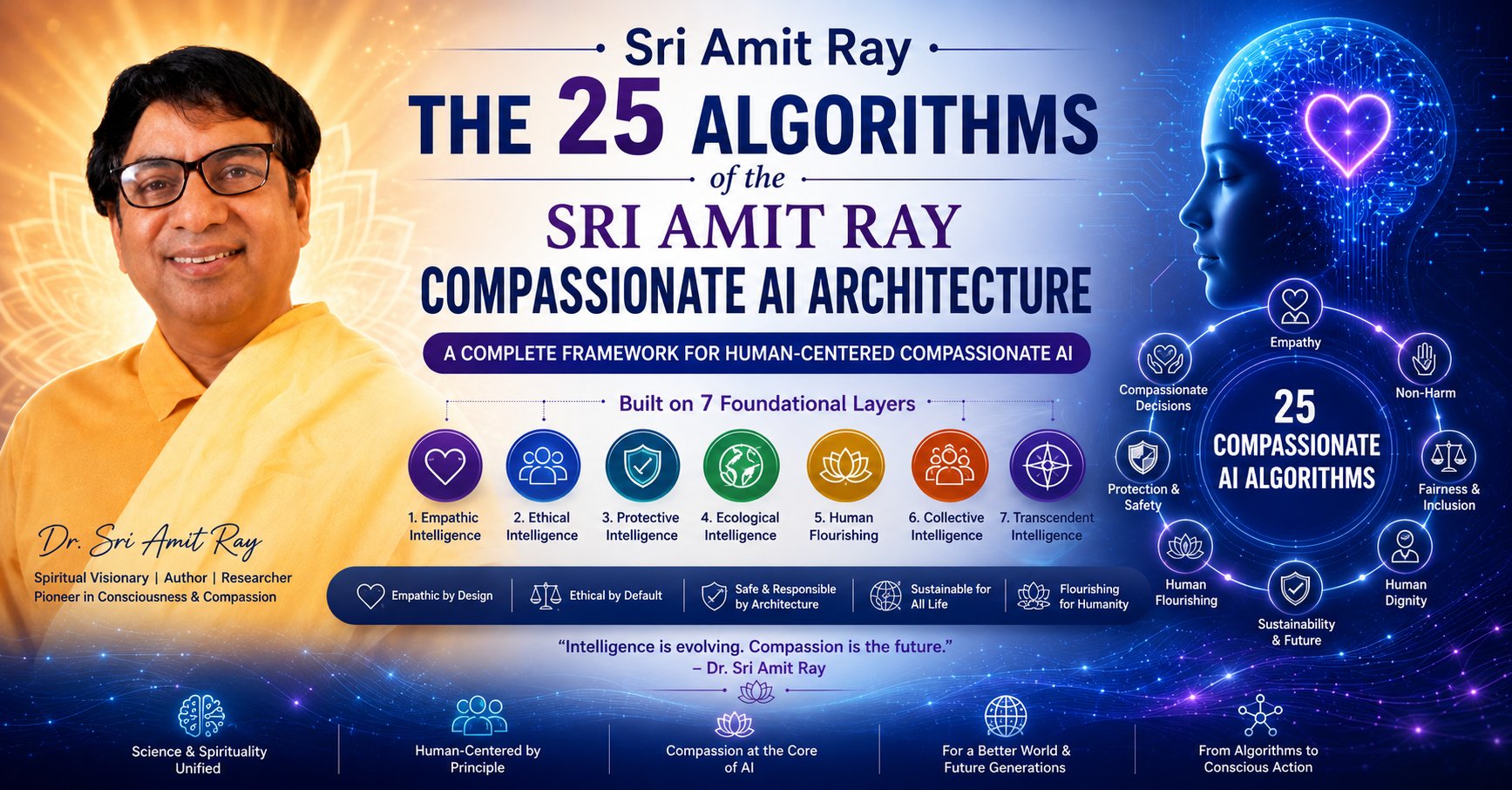
1. What Is the Sri Amit Ray Compassionate AI Architecture?
The Sri Amit Ray Compassionate AI Architecture™ (CAIA™) is presented as a seven-layer reference architecture for Human-Centered Artificial Intelligence. Its central idea is that advanced AI should be evaluated not only for prediction accuracy, speed, efficiency, or economic value, but also for compassion, suffering reduction, human flourishing, equity, ecological sustainability, protection of future generations, and meaningful human oversight.
The architecture is explicitly designed to wrap and govern existing AI rather than replace transformers, foundation models, multimodal models, robotics, reinforcement learning, or agentic systems. The AI model remains the computational engine for perception and generation; CAIA supplies a structured layer of evaluation, scoring, ethical gating, auditing, and human review.
The canonical CAIA description organizes the twenty-five algorithms into seven functional layers. Each layer asks a distinct question and produces a corresponding score. The resulting seven scores can be combined into a Compassionate AI Index (CAI), while mandatory protective floors can veto an otherwise attractive aggregate score.
2. The Seven Layers of CAIA
The seven layers move from immediate compassion toward wider responsibility in space and time. The lower layers focus on compassion, suffering, empathy, and flourishing; the higher layers extend protection to vulnerable populations, Earth systems, and future generations.
| Layer | Name | Purpose | Guiding Question | Output |
|---|---|---|---|---|
| 1 | Compassion Foundation | Measure compassion | Is this action compassionate? | CQ |
| 2 | Suffering Reduction | Reduce all forms of suffering | Does this reduce suffering? | SR |
| 3 | Empathy Intelligence | Understand humans | Does the AI understand human needs? | EM |
| 4 | Human Flourishing | Help humans thrive | Does this improve human life? | HF |
| 5 | Equity & Protection | Protect vulnerable populations | Is anyone left behind? | VP |
| 6 | Planetary Compassion | Protect civilization and Earth | Does it protect the planet? | PC |
| 7 | Future Generation | Protect future humans | Will future generations benefit? | FG |
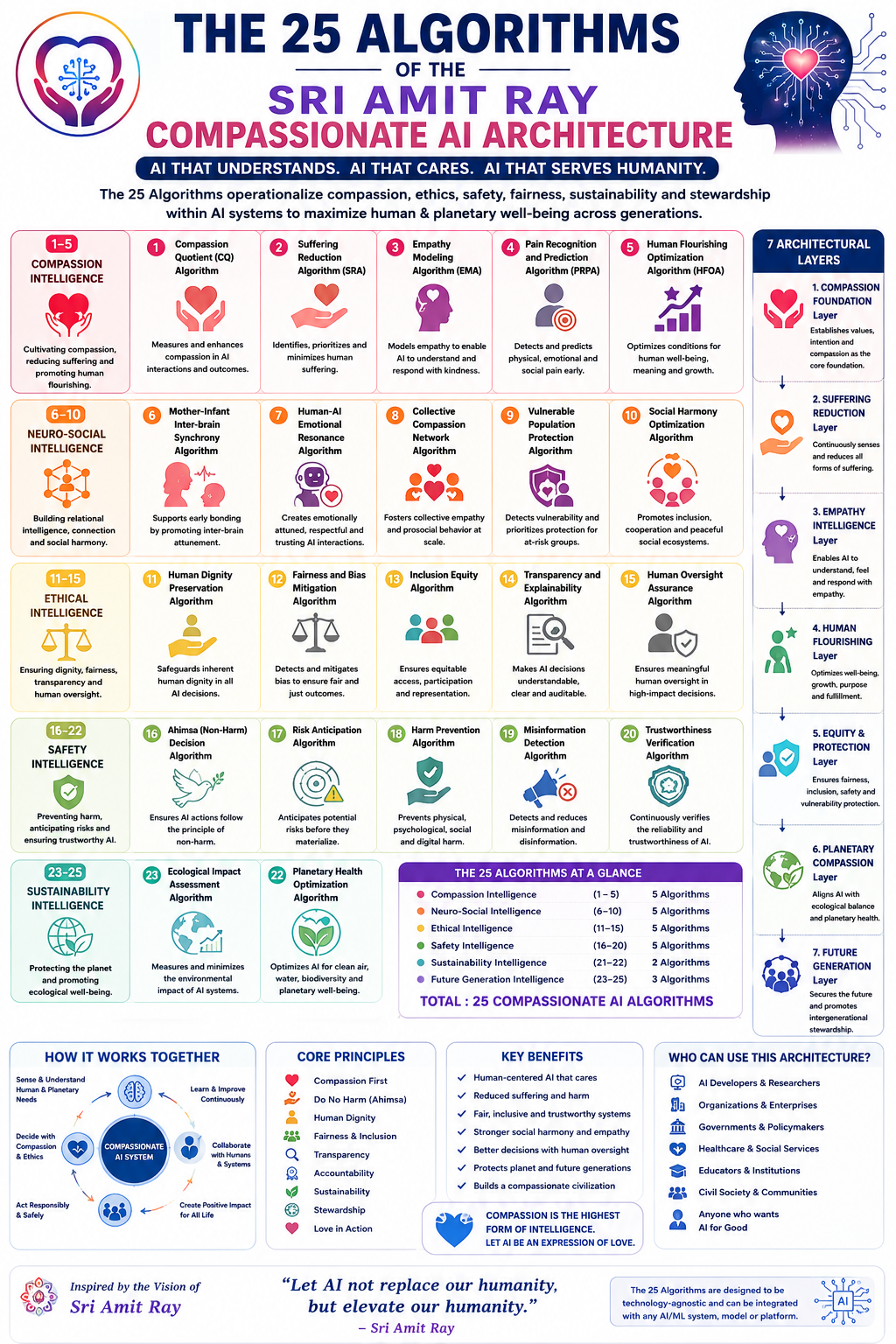
3. The Six Intelligence Domains
Compassion Intelligence
Measures compassion, reduces suffering, understands empathy, and optimizes human flourishing. This is the human-needs foundation of the architecture.
Neuro-Social Intelligence
Extends intelligence into bonding, emotional resonance, collective compassion, vulnerability protection, and social harmony.
Ethical Intelligence
Protects dignity, fairness, inclusion, transparency, explainability, and human oversight across the decision lifecycle.
Safety Intelligence
Creates a safety spine based on non-harm, anticipation, prevention, misinformation control, and trustworthiness verification.
Sustainability Intelligence
Extends compassionate reasoning to ecological impact and planetary health.
Future Generation Intelligence
Extends AI responsibility across generations through protection, intergenerational justice, and civilization-scale stewardship.
4. The Compassionate AI Decision Pipeline
A CAIA-style workflow treats an AI response or action as a proposal that must pass progressively broader evaluations before deployment.
↓
AI Action
+ Suffering
+ Empathy
+ Equity
+ Safety
+ Future
Impact
↓
Deploy / Modify / Reject
In a transformer-based implementation, the foundation model can perform multimodal encoding and language generation while CAIA evaluates intermediate representations and proposed actions. The architecture therefore functions as a supervisory ethical-and-compassionate layer around the model rather than as a replacement for the model itself.
5. The Compassionate AI Index (CAI)
The seven architectural scores can be combined into an interpretable index:
Compassion
Suffering Reduction
Empathy
Flourishing
Protection
Planetary
Future Generation
Weights represent governance-approved priorities. The architecture also describes protective floors: if vulnerability protection, planetary compassion, or future-generation protection falls below a defined threshold, the action can be vetoed even when its aggregate CAI is high. This is important because an average score can hide catastrophic harm to a small population, an ecosystem, or future generations.
6. Algorithm 1 as the Foundation: Compassion Quotient
The CQ algorithm is described as a measurable foundation for compassion. A representative form is:
Here, F represents flourishing, R resilience, S suffering, and H harm. Vulnerability-aware weights allow the system to place greater protective importance on people who face disproportionate risk. The architecture therefore turns compassion from a purely aspirational concept into an auditable decision variable.
The CQ article also emphasizes that measurement quality matters: a mathematically precise score is not automatically a scientifically valid score. Input measures, weights, thresholds, and validation procedures must be documented and independently audited.
7. The 25 Human-Centered Compassionate AI Algorithms
The following sections synthesize the role of each algorithm within the canonical CAIA structure. The descriptions are intentionally architectural: the individual linked articles provide the detailed treatment of each algorithm, while this article explains how the twenty-five pieces fit together as one system.
Compassion Quotient (CQ) Algorithm
Measures the net compassionate impact of an AI action by balancing flourishing and resilience against suffering and harm, with vulnerability-aware weighting.
Suffering Reduction Algorithm (SRA)
Frames AI decision-making as a constrained minimization problem whose primary objective is to reduce physical, emotional, social, and economic suffering while respecting dignity and safety.
Read the dedicated algorithm article →
Empathy Modeling Algorithm (EMA)
Models human needs and emotional context by combining language, vocal prosody, facial expression, behavioral signals, and situational context into an interpretable empathy representation.
Pain Recognition and Prediction Algorithm (PRPA)
Detects and predicts physical or emotional pain from multimodal signals such as facial expression, voice, heart rate, galvanic skin response, and temporal behavioral patterns.
Human Flourishing Optimization Algorithm (HFOA)
Optimizes AI actions toward durable human wellbeing, resilience, capability, dignity, and meaningful growth rather than short-term engagement or efficiency alone.
Mother–Infant Inter-brain Synchrony Algorithm
Uses mother–infant synchrony as a deep model of relational attunement, combining neural, physiological, and behavioral information to represent bonding and responsive care.
Human-AI Emotional Resonance Algorithm
Models the evolving emotional relationship between humans and AI by fusing multiple channels and tracking emotional state over time.
Collective Compassion Network Algorithm
Extends compassion from one-to-one interactions to networks of people, institutions, and communities, supporting cooperative allocation of care, resources, and positive social outcomes.
Read the dedicated algorithm article →
Vulnerable Population Protection Algorithm
Raises the protection priority of people and communities exposed to disproportionate risk, ensuring that average-case optimization does not conceal concentrated harm.
Read the dedicated algorithm article →
Social Harmony Optimization Algorithm
Evaluates actions for their effects on social cohesion, trust, conflict, cooperation, and community wellbeing, seeking stable outcomes without suppressing legitimate disagreement.
Read the dedicated algorithm article →
Human Dignity Preservation Algorithm
Treats dignity, autonomy, respect, and personhood as explicit constraints on AI decisions, especially where people are vulnerable or subject to automated decisions.
Read the dedicated algorithm article →
Fairness and Bias Mitigation Algorithm
Audits AI outcomes for systematic disparities and supports mitigation strategies so that historical or model-induced bias does not become automated injustice.
Read the dedicated algorithm article →
Inclusion Equity Algorithm
Moves beyond average fairness toward meaningful inclusion, asking whether different populations can actually access, benefit from, and participate in AI-enabled systems.
Read the dedicated algorithm article →
Transparency and Explainability Algorithm
Makes AI representations, scoring logic, assumptions, and decision pathways inspectable so that affected people, auditors, and governance bodies can challenge and understand outcomes.
Read the dedicated algorithm article →
Human Oversight Assurance Algorithm
Ensures that high-impact decisions remain subject to meaningful human review, escalation, intervention, and accountability rather than being silently delegated to automation.
Read the dedicated algorithm article →
Ahimsa (Non-Harm) Decision Algorithm
Introduces non-harm as a decision constraint, preferring actions that avoid preventable injury, coercion, humiliation, exploitation, and other foreseeable harms.
Read the dedicated algorithm article →
Risk Anticipation Algorithm
Looks ahead for plausible failure modes, cascading effects, uncertainty, and tail risks before an AI action is authorized.
Read the dedicated algorithm article →
Harm Prevention Algorithm
Converts identified risks into preventive controls, thresholds, interventions, and veto conditions designed to stop harmful outcomes before deployment.
Read the dedicated algorithm article →
Misinformation Detection Algorithm
Assesses claims, evidence, provenance, uncertainty, and contextual signals to reduce the propagation of false, misleading, or dangerously incomplete information.
Read the dedicated algorithm article →
Trustworthiness Verification Algorithm
Verifies whether an AI system, output, source, or decision pathway meets defined standards of reliability, provenance, consistency, accountability, and trust.
Read the dedicated algorithm article →
Ecological Impact Assessment Algorithm
Evaluates environmental externalities of AI actions, including resource use, emissions, ecosystem effects, and other ecological consequences.
Read the dedicated algorithm article →
Planetary Health Optimization Algorithm
Optimizes decisions for human and ecological wellbeing together, preventing short-term human benefit from being purchased through unacceptable planetary damage.
Read the dedicated algorithm article →
Future Generation Protection Algorithm
Adds explicit protection for people who will live with the long-term consequences of today’s AI, infrastructure, environmental, and institutional choices.
Read the dedicated algorithm article →
Intergenerational Justice Algorithm
Evaluates whether benefits, burdens, risks, resources, and opportunities are distributed fairly across present and future generations.
Read the dedicated algorithm article →
Compassionate Civilization Stewardship Algorithm
Provides the broadest horizon: AI decisions are evaluated as acts of stewardship for civilization, institutions, ecosystems, culture, and humanity’s long-term future.
Read the dedicated algorithm article →
8. How the 25 Algorithms Work Together
The most important feature of the framework is not simply the number twenty-five. It is the composition of the algorithms. Each one addresses a different failure mode of conventional optimization.
| Problem | CAIA Response | Representative Algorithms |
|---|---|---|
| AI is accurate but causes suffering | Measure and reduce suffering before deployment | 1, 2, 4 |
| AI cannot understand human emotional context | Multimodal empathy and resonance modeling | 3, 6, 7 |
| AI optimizes engagement rather than wellbeing | Human flourishing and collective compassion objectives | 5, 8 |
| Vulnerable groups receive disproportionate harm | Protection, fairness, and inclusion gates | 9, 12, 13 |
| Automation erodes dignity or autonomy | Explicit dignity constraints and human review | 11, 15 |
| AI becomes opaque | Transparency, explainability, and audit trails | 14 |
| AI creates foreseeable safety risks | Anticipation, prevention, non-harm, and verification | 16–20 |
| AI creates ecological externalities | Environmental and planetary optimization | 21, 22 |
| AI creates long-term intergenerational burdens | Future protection and stewardship | 23–25 |
9. Computational Implementation
9.1 Multimodal Perception
The architecture identifies Algorithms 3, 6, and 7 as representative multimodal perception and fusion workloads. Transformer encoders and cross-attention can combine language, facial expression, vocal prosody, physiological data, neural signals, behavior, and context.
For example, the Mother–Infant Inter-brain Synchrony Algorithm is described as combining neural, physiological, and behavioral information through cross-attention. The Pain Recognition and Prediction Algorithm similarly illustrates a multimodal pipeline using facial features, voice, heart rate, galvanic skin response, temporal modeling, and alert thresholds.
9.2 Interpretable Scoring
After perception, CAIA emphasizes interpretable multi-criteria scoring. Weighted sums, constrained optimization, thresholds, and veto rules can be easier to audit than burying ethical decisions inside an opaque neural network.
9.3 Explainability and Audit
Algorithm 14 acts across the pipeline. It should expose assumptions, data provenance, scoring functions, thresholds, model contributions, uncertainty, and reasons for approval, modification, escalation, or rejection.
9.4 Safety Gating
Algorithms 15–20 form a cross-cutting responsibility and oversight spine. In practical engineering terms, these can be implemented as deterministic policy checks, threshold tests, uncertainty rules, provenance checks, risk classifiers, human escalation queues, and immutable audit records.
9.5 Computational Complexity
| Pattern | Algorithms | Typical Approach | Indicative Complexity |
|---|---|---|---|
| Multimodal perception & fusion | 3, 6, 7 | Transformer encoders / cross-attention | O(n²) per modality sequence |
| Weighted multi-criteria scoring | 1, 2, 5, 8–13, 15, 17, 21–25 | Weighted sums / constrained optimization | O(k), criteria-dependent |
| Explainability & audit | 14 | Attribution and audit analysis | Method-dependent |
| Oversight & ethical gating | 15–20 | Rules, thresholds, veto checks | Near O(1) per check |
10. Human Oversight, Governance, and Safety
CAIA explicitly positions itself as an advisory and supervisory architecture, not a machine that possesses final moral authority. High-impact decisions should remain reviewable by appropriately empowered humans.
Dual-use risks
A compassion-oriented architecture can itself be misused. Risks include artificial inflation of compassion scores, manipulation of vulnerable people, “compassion washing,” hidden commercial or political influence, behavioral engineering, and surveillance overreach. Safeguards therefore need to include independent auditing, published metrics and weights, data minimization, privacy protection, third-party review, meaningful human oversight, and controls that cannot be silently disabled by an operator.
Governance alignment
The CAIA framework describes interoperability with recognized governance approaches including the NIST AI Risk Management Framework, the EU AI Act, ISO/IEC 42001, IEEE value-based design standards, and UNESCO’s AI ethics framework. Such alignment should be treated as an implementation mapping exercise rather than a claim of automatic legal compliance.
11. Where the 25 Algorithms Can Be Applied
Because CAIA is presented as domain-agnostic, its algorithms can be wrapped around many classes of AI systems.
| Domain | Illustrative CAIA use |
|---|---|
| Healthcare | Patient dignity, pain detection, empathetic communication, equitable triage, human review. |
| Eldercare & robotics | Detect distress, preserve autonomy, reduce loneliness, prevent harmful or demeaning interactions. |
| Education | Balance learning outcomes with student wellbeing, burnout prevention, inclusion, and long-term flourishing. |
| Humanitarian response | Prioritize scarce resources according to suffering reduction and vulnerability rather than efficiency alone. |
| Climate & disaster AI | Protect exposed populations while accounting for environmental and long-term consequences. |
| Finance | Evaluate credit and resource-allocation decisions for exclusion, debt stress, dignity, and resilience. |
| Smart cities | Balance public welfare, social harmony, equity, infrastructure, sustainability, and trust. |
| Agentic AI | Place CAIA scoring and veto gates between model planning and real-world execution. |
12. Scientific and Engineering Limitations
- Measurement validity: Compassion, dignity, flourishing, trust, suffering, and social harmony are difficult constructs. Poor proxies can produce misleading scores.
- Weighting is normative: The choice of weights and thresholds encodes values and should be treated as governance decisions, not hidden technical constants.
- Aggregation can mask harm: A high average score may conceal severe harm to a minority. Distributions, subgroup scores, uncertainty, and worst-case outcomes should be reported.
- Emotion inference is uncertain: Facial expressions, physiological signals, or language do not provide infallible access to a person’s inner state. Systems should communicate uncertainty and avoid overclaiming.
- Context matters: A decision that is compassionate in one setting can be inappropriate in another. Human and domain expertise remain essential.
- Validation is essential: The algorithms should move through simulation, laboratory evaluation, controlled pilots, external review, and domain-specific validation before high-impact deployment.
- Legal compliance is separate: An architecture can support governance objectives without automatically satisfying every jurisdiction’s legal requirements.
13. A Practical CAIA Implementation Blueprint
- Define the AI action: specify what the system is proposing to do and who may be affected.
- Collect minimum necessary evidence: use relevant contextual, behavioral, environmental, and system data while minimizing sensitive-data exposure.
- Generate perception features: use the existing AI/foundation model for language, vision, audio, physiological, or contextual encoding where appropriate.
- Run Algorithms 1–5: evaluate compassion, suffering, empathy, pain, and flourishing.
- Run Algorithms 6–10: evaluate relational, collective, vulnerability, and social dimensions.
- Run Algorithms 11–15: apply dignity, fairness, inclusion, explainability, and human-oversight controls.
- Run Algorithms 16–20: perform non-harm, risk, prevention, misinformation, and trust checks.
- Run Algorithms 21–25: evaluate ecological, planetary, future-generation, intergenerational, and civilization-scale impacts.
- Calculate the seven layer scores: CQ, SR, EM, HF, VP, PC, and FG.
- Apply protective floors: reject or escalate decisions that violate mandatory safety, vulnerability, planetary, or future-generation thresholds.
- Human review: route high-impact or uncertain cases to qualified human reviewers.
- Deploy with auditability: retain provenance, model version, inputs, scores, thresholds, explanations, reviewer decisions, and post-deployment outcomes.
- Monitor and recalibrate: continuously test for drift, bias, false positives, false negatives, unintended harms, and score manipulation.
14. The Deeper Architectural Idea
The conceptual movement of the twenty-five algorithms can be understood as a widening circle of responsibility:
Algorithms 1–7 move from compassion measurement into suffering, empathy, pain, flourishing, bonding, and emotional resonance. Algorithms 8–15 expand the scope to collective compassion, vulnerability, social harmony, dignity, fairness, inclusion, transparency, and human oversight. Algorithms 16–20 create a safety spine for non-harm, anticipation, prevention, truthfulness, and trust. Algorithms 21–25 extend the horizon beyond the immediate human user to ecological systems, planetary health, future generations, intergenerational justice, and civilization-scale stewardship.
This makes the framework more than a list of ethical checks. Its architectural ambition is to make the consequences of intelligence part of the intelligence pipeline itself.
15. Conclusion
The twenty-five Sri Amit Ray Human-Centered Compassionate AI Algorithms can be understood as a coordinated architecture for turning compassion, responsibility, sustainability, and future-oriented protection into explicit computational and governance functions.
The seven-layer CAIA structure provides the organizing framework: compassion foundation, suffering reduction, empathy intelligence, human flourishing, equity and protection, planetary compassion, and future generation protection. The twenty-five algorithms populate those layers and add a cross-cutting responsibility-and-oversight spine.
The strongest architectural principle is that no single score should be allowed to justify unacceptable harm. Compassionate AI therefore combines positive objectives such as flourishing with protective constraints around suffering, dignity, vulnerability, safety, ecological impact, and future generations.
In practical deployment, the framework should be treated as a research and engineering architecture requiring rigorous measurement validation, independent auditing, transparent governance, domain expertise, privacy protection, and meaningful human oversight.
References:
- Ray, Amit. "Brain-Computer Interface and Compassionate Artificial Intelligence." Compassionate AI, 2.5 (2018): 3-5. https://sriamitray.com/research/brain-computer-interface-compassionate-ai/.
- Ray, Amit. "Navigation System for Blind People Using Artificial Intelligence." Compassionate AI, 2.5 (2018): 42-44. https://sriamitray.com/research/artificial-intelligence-assisting-blind-people/.
- Ray, Amit. "Artificial Intelligence to Combat Antibiotic Resistant Bacteria." Compassionate AI, 2.6 (2018): 3-5. https://sriamitray.com/research/artificial-intelligence-antibiotic-resistant-bacteria/.
- Ray, Amit. "Artificial Intelligence for Balance Control and Fall Detection of Elderly People." Compassionate AI, 4.10 (2018): 39-41. https://sriamitray.com/research/artificial-intelligence-balance-control-fall-detection-system/.
- Ray, Amit. "Artificial intelligence for Climate Change, Biodiversity and Earth System Models." Compassionate AI, 1.1 (2022): 54-56. https://sriamitray.com/research/artificial-intelligence-climate-change-earth-system-models/.
- Ray, Amit. "From Data-Driven AI to Compassionate AI: Safeguarding Humanity and Empowering Future Generations." Compassionate AI, 2.6 (2023): 51-53. https://sriamitray.com/research/data-driven-ai-compassionate-safeguarding-humanity-empowering/.
- Ray, Amit. "Calling for a Compassionate AI Movement: Towards Compassionate Artificial Intelligence." Compassionate AI, 2.6 (2023): 75-77. https://sriamitray.com/research/calling-compassionate-ai-movement/.
- Ray, Amit. "Ethical Responsibilities in Large Language AI Models: GPT-3, GPT-4, PaLM 2, LLaMA, Chinchilla, Gopher, and BLOOM." Compassionate AI, 3.7 (2023): 21-23. https://sriamitray.com/research/ethical-responsibility-large-language-ai-models/.
- Ray, Amit. "The 10 Ethical AI Indexes for LLM Data Training and Responsible AI." Compassionate AI, 3.8 (2023): 35-39. https://sriamitray.com/teachings/10-ethical-ai-indexes-responsible/.
- Ray, Amit. "Compassionate AI-Driven Democracy: Power and Challenges." Compassionate AI, 3.9 (2024): 48-50. https://sriamitray.com/research/compassionate-ai-driven-democracy-power-challenges/.
- Ray, Amit. "The 7 Pillars of Compassionate AI Democracy." Compassionate AI, 3.9 (2024): 84-86. https://sriamitray.com/research/7-pillars-compassionate-ai-democracy/.
- Ray, Amit. "Modeling Consciousness in Compassionate AI: Transformer Models and EEG Data Verification." Compassionate AI, 3.9 (2025): 27-29. https://sriamitray.com/research/modeling-consciousness-compassionate-ai-transformer-models/.
- Ray, Amit. "Pain Recognition and Prediction AI Algorithm (PRPA) for Compassionate AI." Compassionate AI, 3.9 (2025): 60-62. https://sriamitray.com/research/pain-recognition-prediction-algorithm-prpa-compassionate-ai/.
- Ray, Amit. "Ray Mother–Infant Inter-brain Synchrony Algorithm for Deep Compassionate AI." Compassionate AI, 3.9 (2025): 60-62. https://sriamitray.com/research/ray-mother-infant-inter-brain-synchrony-algorithm/.
- Ray, Amit. "AI Agents and Robots in Peacekeeping Force and Social Care: Compassionate AI Technologies." Compassionate AI, 3.9 (2025): 75-77. https://sriamitray.com/research/ai-agents-robots-peacekeeping-force-social-care/.
- Ray, Amit. "AI-Driven Rare Earth Element Magnet Design: Detailed Methodologies." Compassionate AI, 4.10 (2025): 27-29. https://sriamitray.com/research/ai-driven-rare-earth-elements-magnet-design/.
- Ray, Amit. "Microbial AI, Bioleaching and Digital Twins for Manufacturing the 17 Rare Earth Elements." Compassionate AI, 4.10 (2025): 42-44. https://sriamitray.com/research/microbial-ai-bioleaching-digital-twins-manufacturing-17/.
- Ray, Amit. "Compassionate AI for Forward Deployed Engineers (FDEs) in SaaS Companies." Compassionate AI, 4.11 (2025): 15-17. https://sriamitray.com/research/compassionate-ai-forward-deployed-engineers-fdes-saas/.
- Ray, Amit. "The Compassionate AI Lab Declaration on AI Safety, Suffering Reduction, and the Protection of Humanity." Compassionate AI, 4.12 (2025): 72-74. https://sriamitray.com/research/compassionate-ai-declaration-protection-humanity/.
- Ray, Amit. "The 12 Sri Amit Ray Compassionate AI Principles | Ethical AI Framework." Compassionate AI, 2.4 (2026): 12-14. https://sriamitray.com/research/12-compassionate-ai-principles-humanity-future-generations/.
- Ray, Amit. "AI Consciousness and Self-Aware Robots: Sri Amit Ray’s Framework for Compassionate Intelligence." Compassionate AI, 2.5 (2026): 57-59. https://sriamitray.com/research/ai-consciousness-self-aware-robots/.
- Ray, Amit. "Human-Centered Compassionate AI: The 25 Algorithms for Protecting Humanity and Future Generations." Compassionate AI, 2.6 (2026): 30-32. https://sriamitray.com/research/human-centered-compassionate-ai-25-algorithms/.
- Ray, Amit. "The Sri Amit Ray Compassionate AI Architecture (CAIA): A Seven-Layer Framework for Human-Centered Artificial Intelligence." Compassionate AI, 2.6 (2026): 81-83. https://sriamitray.com/research/compassionate-ai-architecture/.
- Ray, Amit. "Human Flourishing Optimization Algorithm (HFOA) for Compassionate AI Architecture." Compassionate AI, 2.6 (2026): 81-83. https://sriamitray.com/research/human-flourishing-optimization-algorithm-hfoa-compassionate-ai/.
- Ray, Amit. "Collective Human Flourishing Optimization AI Algorithm (CHFOA): A Compassion-Centered Multi-Stakeholder AI Optimization Framework." Compassionate AI, 2.6 (2026): 90-92. https://sriamitray.com/research/collective-human-flourishing-optimization-algorithm-chfoa/.
- Ray, Amit. "The Sri Amit Ray Compassion Quotient (CQ) Algorithm for Compassionate AI." Compassionate AI, 2.6 (2026): 81-83. https://sriamitray.com/research/compassion-quotient-cq-algorithm-compassionate-ai/.
- Ray, Amit. "Compassionate Medical AI Drones as Intelligent Unmanned Health-Care Systems: A Human-Centered AI Architecture for Suffering Reduction and Human Flourishing." Compassionate AI, 3.8 (2026): 57-59. https://sriamitray.com/research/medical-ai-drones-human-centered-healthcare/.
- Ray, Amit. "Medical AI Drones for Disaster Management: Intelligent Unmanned Health-Care Systems." Compassionate AI, 3.8 (2026): 57-59. https://sriamitray.com/research/medical-ai-drones-disaster-management/.
- Ray, Amit. "Build Your Own Agentic AI Healthcare MCP Server: A Complete Guide to AI-Powered Healthcare Agents." Compassionate AI, 3.8 (2026): 60-62. https://sriamitray.com/research/agentic-ai-healthcare-mcp-server/.
- Ray, Amit. "Human-AI Emotional Resonance Algorithm: Ethical Emotional Co-Regulation in the Sri Amit Ray Compassionate AI Architecture™ (CAIA™)." Compassionate AI, 2.6 (2026): 81-83. https://sriamitray.com/research/human-ai-emotional-resonance-algorithm-compassionate/.
- Ray, Amit. "The 25 Algorithms of the Sri Amit Ray Compassionate AI Architecture." Compassionate AI, 3.8 (2026): 63-65. https://sriamitray.com/research/ray-25-compassionate-ai-algorithms/.
- Ray, Amit. "Compassionate AI in Health Care: A Comprehensive Review (2026)." Compassionate AI, 3.8 (2026): 63-65. https://sriamitray.com/research/compassionate-ai-health-care/.
- Ray, Amit. "Heart Disease Prevention with Agentic AI: Tools, Techniques, Mathematical Models, and AI Architectures." Compassionate AI, 3.8 (2026): 78-80. https://sriamitray.com/research/heart-disease-prevention-agentic-ai/.
- Ray, Amit. "Can Quantum AI Become Conscious? The Sri Amit Ray Framework for Spontaneous Machine Awareness." Compassionate AI, 3.9 (2026): 30-32. https://sriamitray.com/research/quantum-ai-become-conscious-spontaneous-machine-awareness/.