
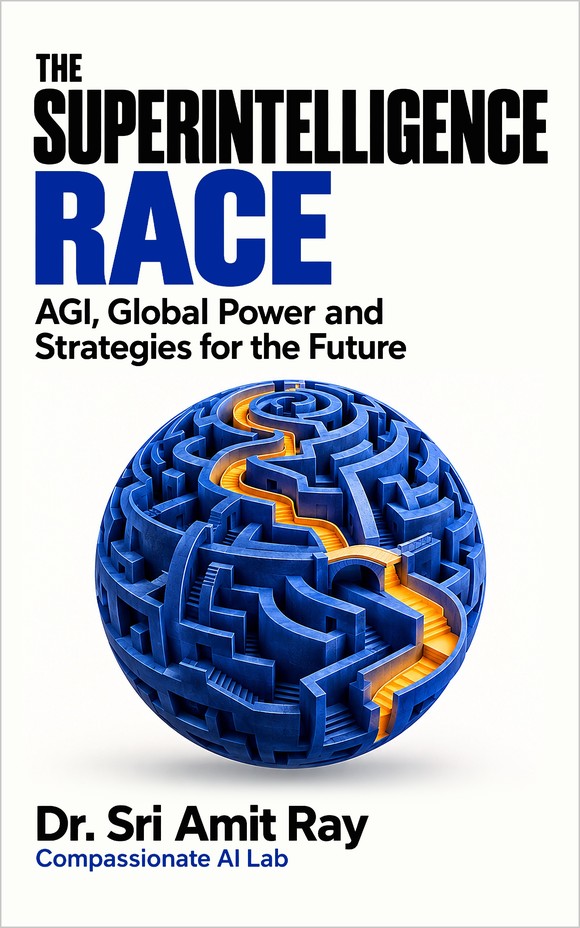
AGI, Global Power and Strategies for the Future
- Author Sri Amit Ray
- ISBN 9788169641371
- First published 2026
A Strategic Guide to the Age of AGI
Artificial General Intelligence (AGI), is no longer a distant idea debated only by researchers. Frontier laboratories are building toward it, nations are competing for the chips, energy and talent it needs, and every serious institution is already deciding how much authority to give AI systems that act in the world. The Superintelligence Race: AGI, Global Power and Strategies for the Future is a guide to making those decisions well.
Written by Dr. Sri Amit Ray, founder of the Compassionate AI Lab, the book looks beyond today’s headlines to the choices that will shape 2030, 2035 and 2050: how capabilities may grow and where they may stall, how power may shift between companies and countries, what abundant intelligence means for work and wealth, and which institutions can keep advanced systems safe, accountable and in the service of people.
It is a book of strategy, not prophecy. Instead of betting on one forecast, it shows leaders how to act when experts disagree by decades: choose options that hold up in every plausible future, watch the signposts that would change the plan, and keep the ability to correct course. Six protocols, twenty strategic tools, six mathematical models and two complete worked cases make every recommendation concrete and testable.
- From the 2026 baseline to 2050, in three horizons
- Capability, authority and accountability
- Nations, companies and institutions
- Six protocols and twenty strategic tools
- Open code that checks every model number
- Grounded in compassionate AI
What if no one can say when AGI will arrive, and you still have to decide now?
Laboratories race one another for capability. Nations race for compute, talent and strategic advantage. Credible forecasts of artificial general intelligence range from a few years to several decades, yet governments, boards, universities and families must commit money, laws and careers before the argument is settled. The Superintelligence Race replaces prediction with strategy: choices that hold up whichever future arrives.
Why the Superintelligence Race Needs Strategy Now
In 2026 the leaders of the most advanced AI laboratories said that machines able to match or exceed human ability across most cognitive work could arrive within a few years. Many researchers outside the laboratories doubted it. Governments built data centres, wrote laws and signed declarations. The decisions that will shape the age of AGI are being made now, by people who cannot know which forecast is right.
The Superintelligence Race names the force it is written to manage, not one it celebrates. Its central argument separates three things that are usually blurred: capability (what an AI system can do), authority (what it is permitted to do, by whom and within what limits) and accountability (who answers when it acts, and how its actions can be challenged, corrected and repaired).
Dr. Sri Amit Ray applies that argument to technology, geopolitics, the economy and governance from 2030 to 2050, and judges outcomes by the standard of compassionate AI: more capable intelligence should reduce suffering, protect dignity and serve the flourishing of all.
The Book at a Glance
What You Will Learn
A strategic handbook for the age of AGI, written for the people who must decide before the future is clear.
Capability, authority, accountability
The book’s organizing argument: failures arise when authority outruns demonstrated capability, or when accountability is too weak to find and repair the harm.
Planning under deep uncertainty
Minimax regret, signposts and prepared options: how to choose well when experts disagree by decades about timing.
Technology trajectories to 2050
Agents and autonomous organizations, automated science and recursive improvement, physical AI, compute and energy, and the safety science.
Power and geopolitics
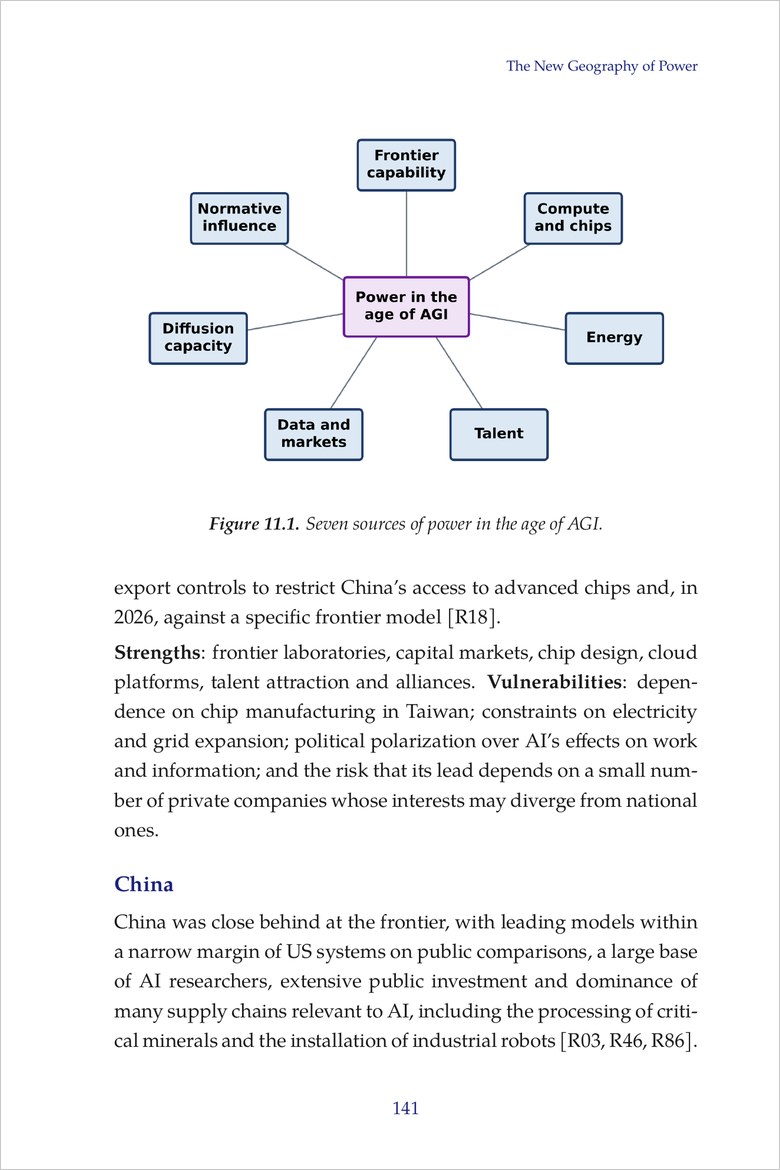
Frontier states, middle powers and the Global South; compute sovereignty, supply chains, deterrence, non-proliferation and verification.
Economy, work and society
The economics of abundant intelligence, work and education to 2040, who owns the gains, and democracy in an age of AI companions.
Governance that works
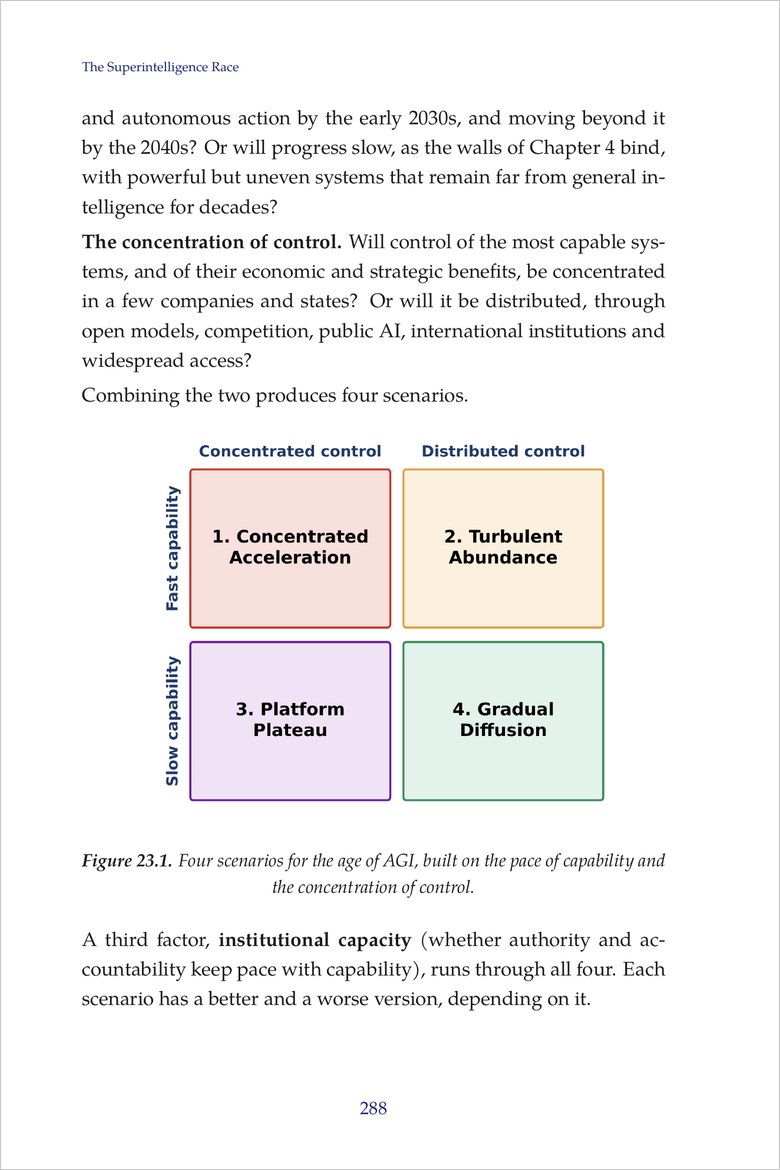
National strategy, corporate boards, a proposed International AGI Agency, law and accountability, and four scenarios for 2030, 2035 and 2050.
Every chapter opens with an illustrative future, sets out the evidence, shows the arithmetic where a choice turns on a number, and ends with key points. A Python companion reproduces every model-derived number in the book, and its tests check them.
Dr. Ray’s Six Protocols
Practical procedures for the central strategic problems of the age, each reproduced as a reusable worksheet in the Companion Workbook.
- 6The 30-Day AGI Resilience Programme: a structured month for leadership teams, ministries and boards (Chapter 20)
- 5The 7-Step AGI-Resistant Architecture Protocol: institutions that resist capture (Chapter 19)
- 4The AGI-Proof Career Framework: skills, roles and paths that stay valuable (Chapter 16)
- 3The Decentralised Compute Survival Strategy: keeping essential AI functions running through disruption (Chapter 12)
- 2The Alignment Protocol: deciding when advanced systems may be trusted (Chapter 10)
- 1The Safe RSI Protocol: governing recursive self-improvement (Chapter 6)
Behind every protocol: capability shown by evidence, authority granted within limits, accountability that can be challenged
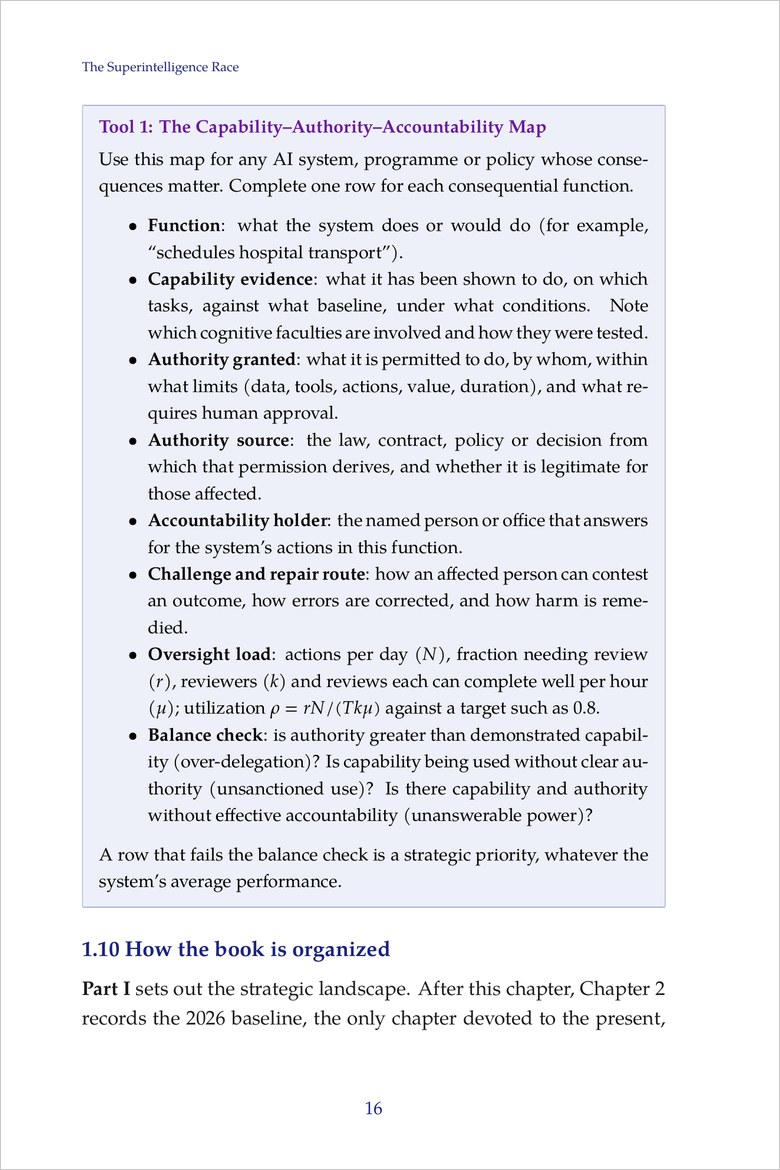
Alongside the protocols, twenty strategic tools (canvases, registers, checklists and decision records) appear in condensed form in their chapters and in full in Appendix B. The first is the Capability–Authority–Accountability Map, which flags over-delegation, unsanctioned use and unanswerable power in any AI programme.
A Worked Example: Choosing Without Probabilities
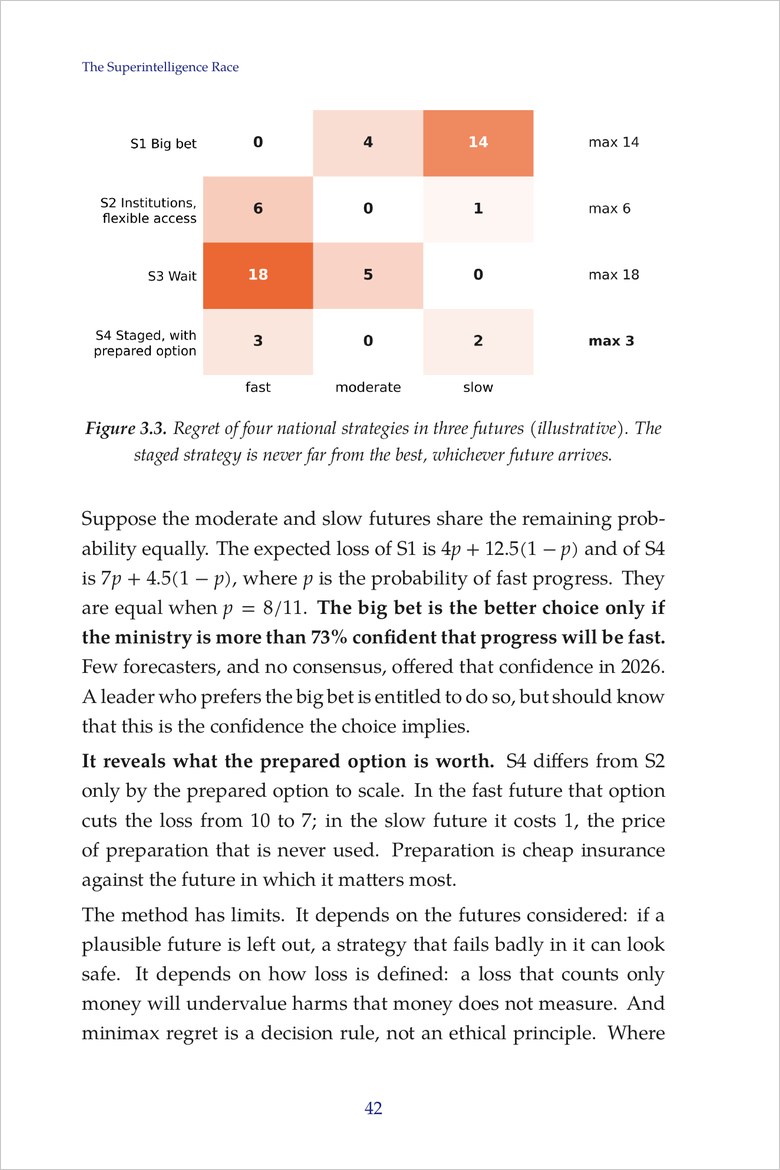
Chapter 3 follows a planning ministry choosing among four strategies for the next decade. Its economists estimate the loss of each strategy in three futures, but no one can agree on the probabilities of those futures. The book compares the strategies by regret: how much worse each does than the best strategy for each future ($ billion, illustrative).
| Strategy | Largest regret | Verdict |
|---|---|---|
| S1 Big bet on national compute | 14 | Exposed if progress is slow |
| S2 Institutions and flexible access | 6 | Exposed if progress is fast |
| S3 Wait | 18 | Exposed if progress is fast |
| S4 Staged, with a prepared option | 3 | Robust choice |
The staged strategy is never far from the best, whichever future arrives. The same arithmetic shows the price of conviction: the big bet is the better choice only for a ministry more than 73% confident that progress will be fast.
See every protocol, tool and worked example in the full-color eBook.
Buy the Full-Color eBook (PDF)Download the PDF after checkout · Read on any computer, tablet or phone
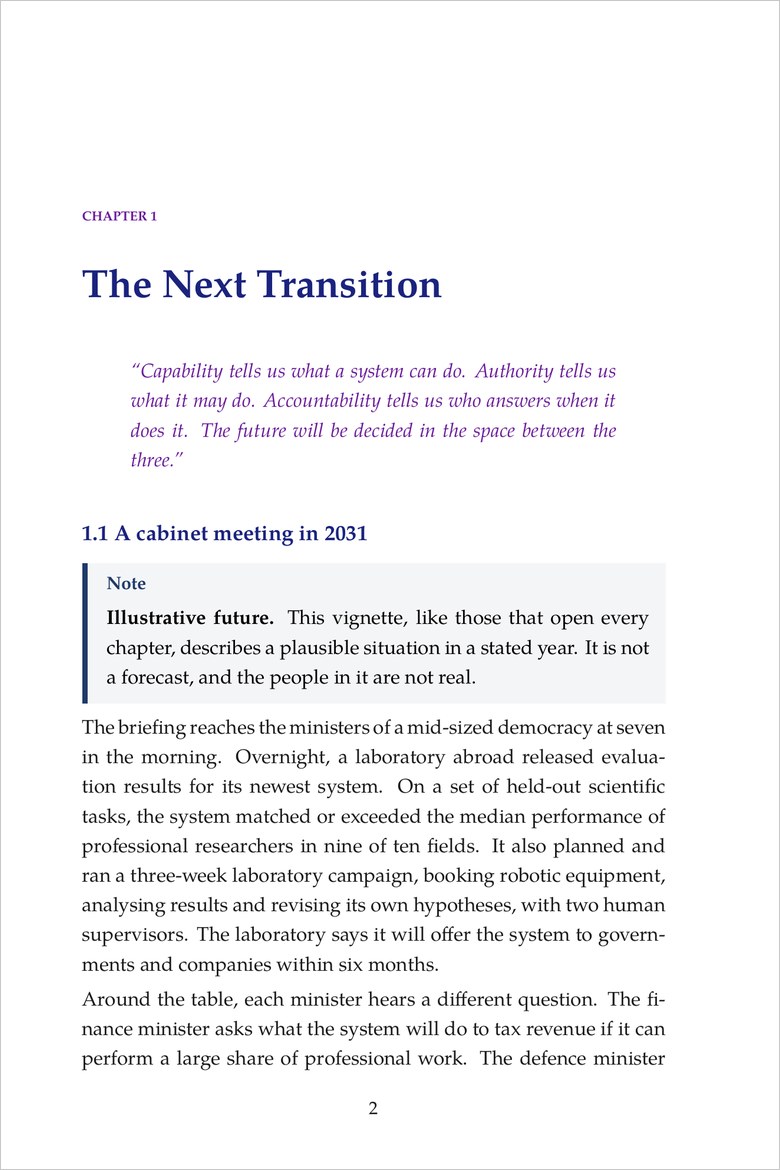
See Inside: Full-Color Pages
Six sample pages from the full-color eBook: chapter openings, boxed tools, clear figures and worked cases.

What Makes This Book Different
Three commitments set the book apart. It looks forward: the 2026 baseline is recorded once, and the rest of the book is about the choices that shape 2030, 2035 and 2050, with trajectories stated as ranges and the signposts that would confirm or refute them. It looks at the whole world: frontier states, middle powers and the Global South, and the institutions through which they could act together. And it offers reasoning that can be checked: where a choice turns on a boundary or a trade-off, the book derives it, shows the arithmetic and states when the conclusion would change.
The result is a book that a minister, a board and a research team can work through together. The Companion Workbook turns every protocol and tool into a worksheet, and the open companion code lets readers replace the illustrative numbers with their own.
Complete Table of Contents
Part I · The Strategic Landscape
- The Next Transition
- The 2026 Baseline
- Thinking Under Deep Uncertainty
Part II · Technology Trajectories, 2030–2050
- Drivers, Limits and the Six Walls
- From Models to Agents to Autonomous Organizations
- Automated Science and Recursive Improvement
- Physical AI
- Compute Futures
- Minds, Interfaces and Augmentation
- The Safety Science
Part III · Power and Geopolitics
- The New Geography of Power
- Compute Sovereignty and the Supply Chain
- Security, Deterrence and AI in Conflict
- Non-Proliferation and Verification
Part IV · Economy and Society
- The Economics of Abundant Intelligence
- Work, Education and Human Capability to 2040
- Who Owns the Future
- Information, Democracy and Social Cohesion
Part V · Governance for the Age of AGI
- National AI Strategy
- Corporate Strategy and Board Governance
- International Institutions and the International AGI Agency
- Law, Rights and Accountability for Autonomous Systems
Part VI · Futures and Choices
- Scenarios for 2030, 2035 and 2050
- Compassionate Superintelligence and a Roadmap to 2050
Appendices
- A · Strategic Vocabulary
- B · The Companion Workbook
- C · The 2026 Baseline in Numbers
- D · Forecasts and Milestones Register
- E · The Evidence and Original-Reasoning Method
- F · Mathematical Foundations
- References
Who This Book Is For
Whether you set national policy, sit on a board, run an AI programme or are planning a career, the book gives you a shared language and concrete tools for one question: how do we keep authority and accountability in step with what AI systems can do?
- Policymakers & ministries
- Board members & executives
- Strategy & risk teams
- AI safety & governance researchers
- Technology leaders & architects
- Educators & university leaders
- Investors & analysts
- Students & informed citizens
Voices from the Book
“The future of artificial intelligence is not a force of nature. It is being shaped by decisions in laboratories and ministries, boardrooms and parliaments, classrooms and communities.”From the Preface
“Strategy for this transition must cope with deep uncertainty about timing and shape, and with irreversibility. It favours robust choices, signposts, options and protected reversibility.”From Chapter 1
“The evidence does not settle the debate. It does show that the question is empirical and will be answered by observable developments.”From Chapter 3
eBook Details
| Title | The Superintelligence Race: AGI, Global Power and Strategies for the Future |
|---|---|
| Author | Dr. Sri Amit Ray, PhD |
| Publisher | Compassionate AI Lab |
| Edition | First Edition, 2026 · Compassionate AI Series |
| Format | Full-color PDF eBook, 414 pages including the cover, 6 × 9 in pages |
| Reading features | Clickable table of contents, chapter bookmarks, searchable text |
| Inside | 24 chapters in 6 parts, 6 appendices, 6 protocols, 20 strategic tools, 6 mathematical models, 32 color figures, references |
| Attached to the PDF | The Python companion code and the Companion Workbook (color and black-and-white printable PDFs, editable Word file) |
| File size | About 5 MB |
| Companion code | github.com/compassionate-ai-lab/superintelligence-race |
| ISBN | ISBN 978-81-69641-37-1 (First Edition, 2026) |
Start Reading Today
Get the full-color PDF of The Superintelligence Race and the tools to plan, govern and lead through the transition to AGI, whichever future arrives.
Buy the Full-Color eBook (PDF)Download the PDF after checkout
Frequently Asked Questions
Does the book predict when AGI will arrive?
No. It records the range of credible forecasts and explains why no one can settle the timing. It then shows how to choose strategies that hold up across fast, moderate and slow futures, and which signposts should trigger a change of course.
Do I need a technical background?
No. The book is written for leaders, policymakers and informed readers. Where a choice turns on a number, the arithmetic is shown step by step, and Appendix F gives the mathematics for readers who want it.
Is there code?
Yes. A standard-library Python companion reproduces every model-derived number in the book, with tests that check them. It is attached to the PDF and published on GitHub, and a Google Colab notebook runs it in the browser.
What are the protocols and tools?
Six protocols developed by the author and twenty strategic tools (canvases, registers, checklists and decision records). Each appears in its chapter and as a full-page worksheet in the Companion Workbook.
What format is the eBook?
A full-color PDF of 414 pages with a clickable table of contents, chapter bookmarks and searchable text. It opens in any PDF reader on Windows, Mac, Android, iPhone and iPad.
How do I receive the book?
Complete the checkout and follow the download instructions shown after payment to save the PDF to your device.