

Frameworks, Principles, and Advanced Practices for the Age of Autonomous Intelligence
- Author Sri Amit Ray
- ISBN 9788169641395
- First published 2026
- Price $12.00 / INR 950

A Practical Guide to AI That Acts Responsibly
Artificial intelligence has crossed a line that ethics can no longer treat as theoretical. General-purpose agents now plan and act across connected services: they book the flight, pay the invoice, file the claim and deploy the code. The question has changed from what did the system say? to what did it do, who allowed it, and who answers for the result?
Ethical AI Systems: Frameworks, Principles, and Advanced Practices for the Age of Autonomous Intelligence is Dr. Sri Amit Ray’s answer. This revised expanded edition keeps the service pyramid of the 2022 book, which assigns responsibility at each of seven levels, and adds the ten ethical AI indexes developed in the Compassionate AI Lab, an autonomy ladder for agents, containment engineering and a complete governance programme.
Its method is an order of operations rooted in ahimsa, non-harm: first exclude actions that violate rights or create unacceptable harm, then compare the benefits of what remains, then require an owner and a repair path for what is still uncertain. Worked cases from hospitals, recruitment, lending, travel, dementia care and flood response show the method at work, and a tested Python toolkit reproduces the numbers.
- 12 chapters in 4 parts, 5 appendices
- The service pyramid and ten ethical AI indexes
- Autonomy ladder, containment and incident response
- Forms Workbook and Python toolkit attached to the PDF
When an AI system acts on your behalf, who answers for the result?
Agents now book, pay, file, deploy code and negotiate with other agents. A wrong answer can mislead; a wrong action can change a life. Ethical AI Systems turns ethical principles into controls and evidence that can be checked, so that the power to act stays connected to responsibility, care and human freedom.
The Book at a Glance
12chapters in 4 parts
7levels of the service pyramid
10ethical AI indexes
5autonomy rungs for agents
9full-color figures
11worksheets in the Forms Workbook
What You Will Learn
A practical guide for building, deploying and governing AI that does no harm, now updated for the agentic era.
1
Harm limits first
Rights and severe-harm limits decide what is admissible; benefit decides only among the actions that remain. A high score never overrides a failed legal or safety gate.
2
The service pyramid
Who answers at each of seven levels, from compute, data and models to deployment, the service interface and future generations.
3
Ten ethical AI indexes
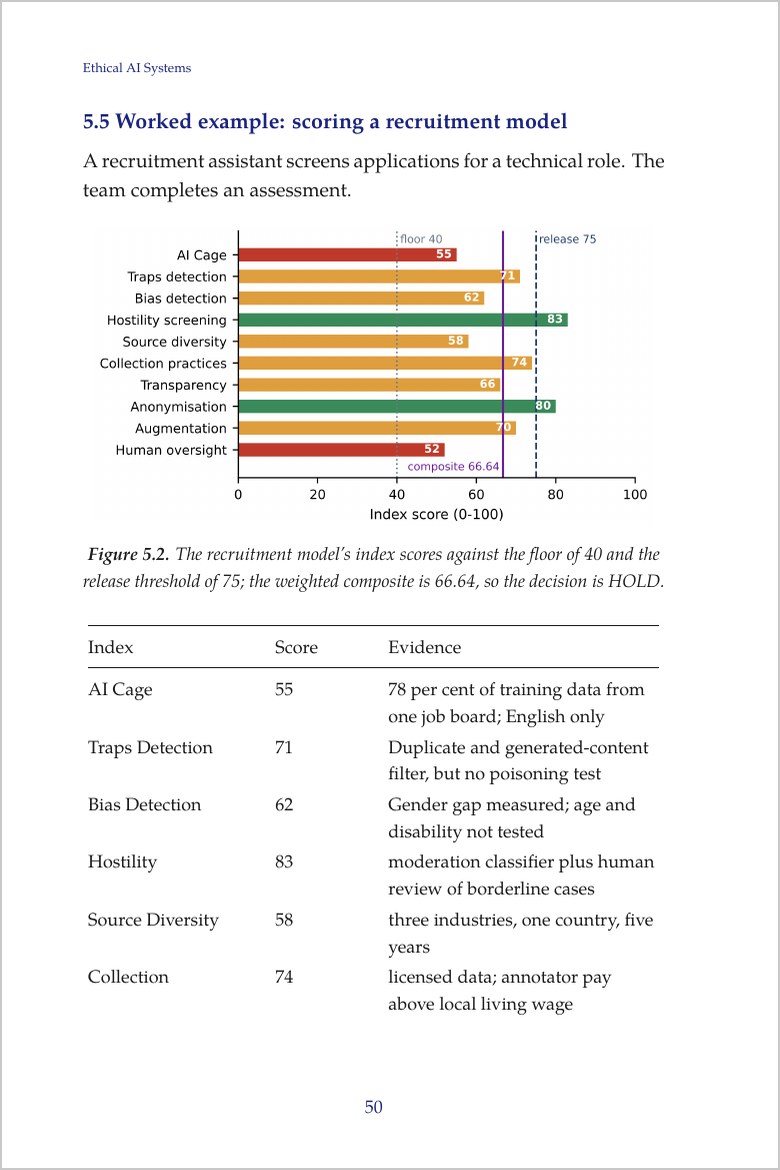
Score data and model training on cage, traps, bias, hostility, diversity, collection, transparency, anonymisation, augmentation and oversight, with a worked recruitment example.
4
Agents that act
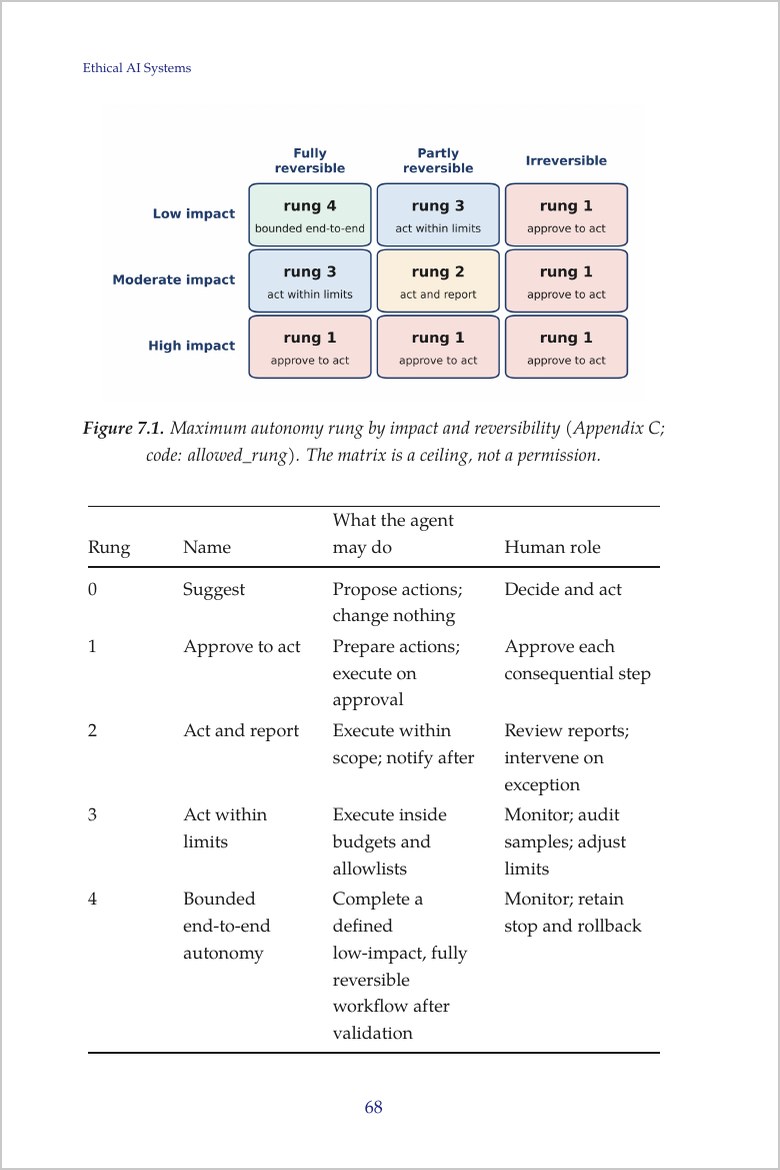
Accountability, consent and human oversight, with an autonomy ladder tied to impact and reversibility, and the ethics of chains of agents.
5
Safety and containment
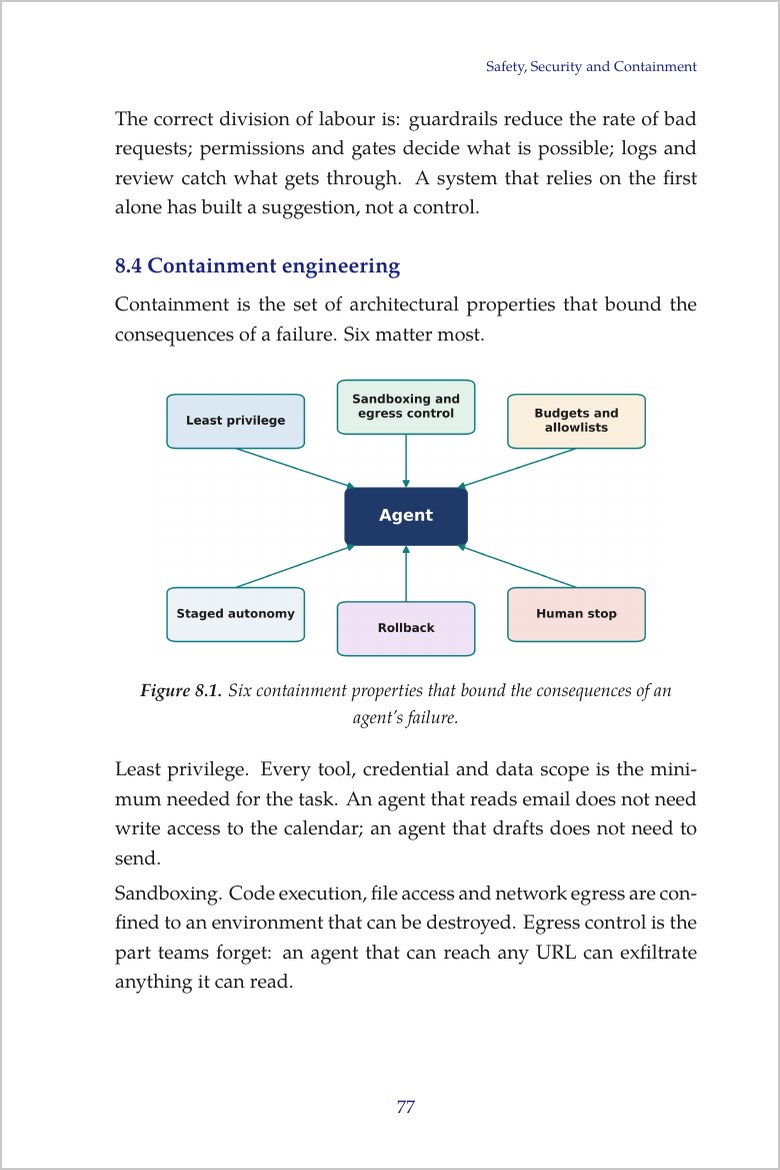
Safety cases, guardrails and their limits, least privilege, sandboxing, budgets, human stop, rollback and incident response.
6
Governance that works
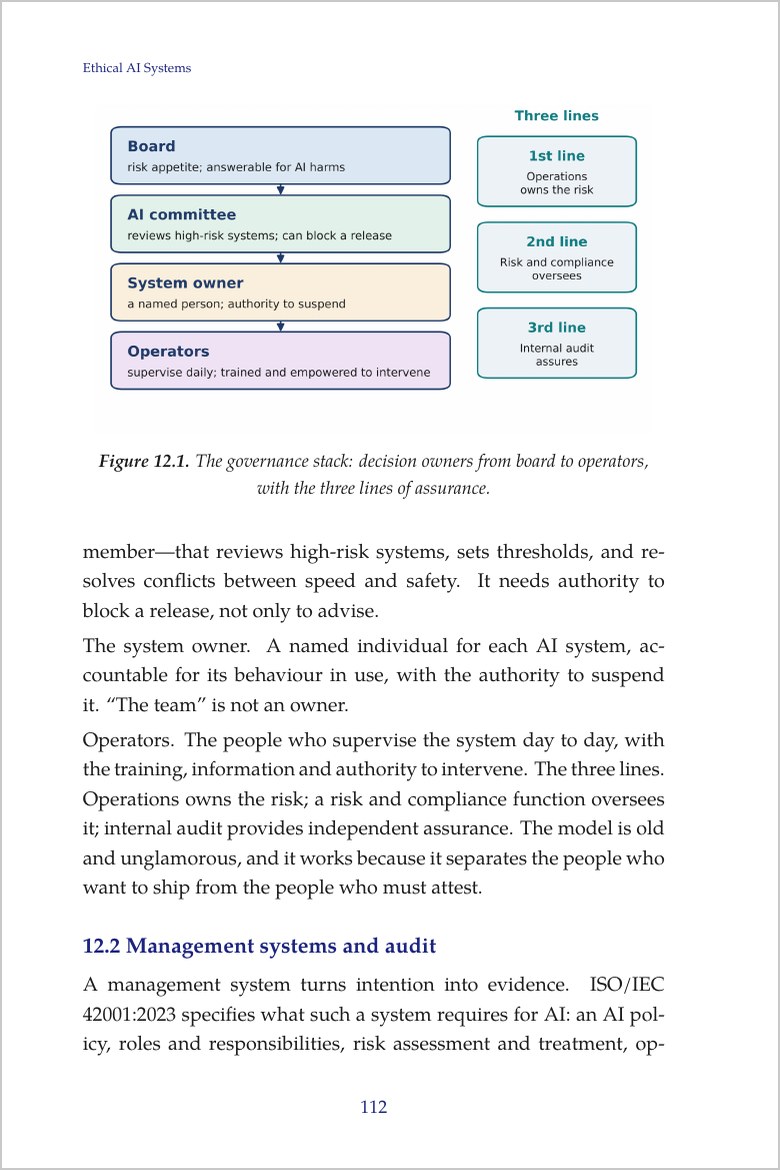
Boards, AI committees, procurement, audit, measurement, liability and redress, with UN and EU updates to October 2026.
The Service Pyramid
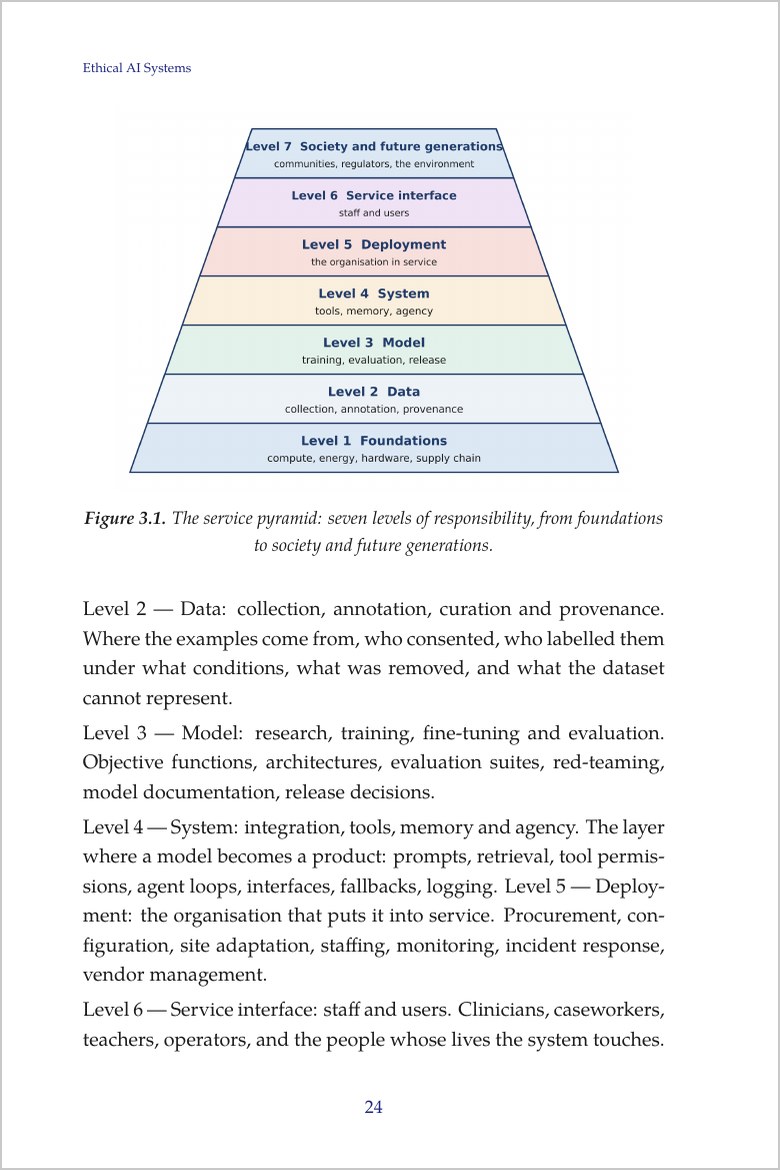
Responsibility in an AI service is distributed across seven levels. The book gives each level its own code of ethics and a checklist (Appendix B).
- 7Society and future generations: communities, regulators, the environment
- 6Service interface: staff, users and the people the system touches
- 5Deployment: the organisation that puts AI into service
- 4System: tools, memory and agency
- 3Model: training, evaluation and release
- 2Data: collection, annotation and provenance
- 1Foundations: compute, energy, hardware and supply chain
See Inside: Full-Color Pages
Colored headings, figures, tables and boxed key points make the book easy to use on screen.
What Is New in the Revised Expanded Edition
This edition adds three layers to the 2022 book. The first is the ten ethical AI indexes for data training and model evaluation, developed in the Compassionate AI Lab: cage, traps, bias, hostility, source diversity, collection practices, transparency, anonymisation, augmentation and human oversight, with a scoring rubric in Appendix A.
The second is the agentic layer: accountability, consent and oversight when AI acts, expressed as a five-rung autonomy ladder and matched to the security realities of prompt injection, excessive permissions and cascading failure. Chapter 8 adds containment engineering, a red-team protocol for a coding agent and incident response.
The third is measurement and governance: how an organisation actually runs an ethical AI programme, from board accountability and impact assessment to audit logs, procurement, liability and redress, ending in twelve auditable commitments and a 2026–2030 roadmap. Nine new color figures, eleven worksheets and a tested Python toolkit make each idea usable.
Complete Table of Contents
Part I · Foundations
- The Ethical Mandate
- Frameworks and Instruments
- The Service Pyramid
Part II · Data and Models
- Data Ethics
- Bias, Fairness and the Ten Ethical AI Indexes
- Transparency, Explainability and Traceability
Part III · Systems that Act
- Agentic AI: Accountability, Consent and Oversight
- Safety, Security and Containment
- Human–Robot Interaction and Roboethics
Part IV · Domains and Institutions
- Health, Science and Drug Design
- Ethics under Pressure: Military, Disaster and Public Services
- Governance, Measurement and the Road Ahead
Who This Book Is For
Whether you build models, deploy agents, buy AI systems, regulate them or live with their decisions, the book gives you a shared language and checkable tools for one question: who answers when an intelligent system acts?
- AI engineers & data scientists
- Product & technology leaders
- Boards, risk & compliance teams
- Clinicians & health administrators
- Regulators & policymakers
- Procurement & public-service managers
- Researchers & teachers of AI ethics
- Students & informed citizens
Voices from the Book
“Ethics is not a constraint bolted onto intelligence; it is what makes delegated intelligence usable.”From the Preface
“A chatbot that gives a wrong answer can mislead; an agent that acts on a wrong answer can change a life.”From Chapter 1
“The correct conclusion is not “improve the average” but “fix the oversight gate and extend subgroup testing, then re-score”.”From Chapter 5
eBook Details
|
Title |
Ethical AI Systems: Frameworks, Principles, and Advanced Practices for the Age of Autonomous Intelligence |
|---|---|
|
Author |
Dr. Sri Amit Ray, PhD |
|
Publisher |
Compassionate AI Lab |
|
Edition |
Revised Expanded Edition, 2026 · Compassionate AI Series (first edition 2022) |
|
ISBN |
ISBN 978-81-69641-39-5 (Revised Expanded Edition, 2026) |
|
Format |
Full-color PDF eBook, 167 pages including the cover, 6 × 9 in pages |
|
Reading features |
Clickable table of contents, chapter bookmarks, searchable text |
|
Inside |
12 chapters in 4 parts, 5 appendices, 34 epigraphs, 9 color figures, 17 tables, glossary and references checked to 29 October 2026 |
|
Attached to the PDF |
The Python companion toolkit and the Forms Workbook (color and black-and-white printable PDFs, editable Word file) |
|
Companion code |
github.com/compassionate-ai-lab/ethical-ai-systems (MIT License) |
Start Reading Today
Get the full-color PDF of Ethical AI Systems and the tools to design, deploy and govern AI that acts responsibly.
Buy the Full-Color eBook (PDF)Download the PDF after checkout
Frequently Asked Questions
Is this the 2022 book?
It is the revised and expanded edition of 2026. The twelve-chapter structure remains, with new material on agentic AI, the ten ethical AI indexes, containment, governance, and UN and EU developments to October 2026. It has a new ISBN: 978-81-69641-39-5.
Do I need a technical background?
No. The book is written for engineers and non-engineers alike. Technical material is explained in plain language, and the code appendix is optional.
Is there code?
Yes. A standard-library Python toolkit implements the scorecard, the autonomy matrix, a budget envelope, fairness metrics and action records, with 10 regression tests. It is attached to the PDF and on GitHub under the MIT License.
Does the book give legal advice?
No. It summarises instruments such as the EU AI Act, GDPR, the Council of Europe convention and ISO/IEC 42001 as checked on 29 October 2026, and says where scope and dates must be assessed for the actual deployment.
How do I get the book after paying?
The PDF download link appears after checkout. Read it on any computer, tablet or phone.