
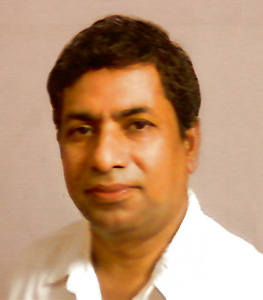
 Sri Amit Ray is a spiritual master and scientist. He is the pioneer of the 114 Chakras system, Compassionate Artificial Intelligence, and Quantum Attention Function theory. His work brings spiritual inquiry into conversation with science and technology, exploring consciousness, human flourishing, and the compassionate use of knowledge. His teachings, mantras, books, and research share a common purpose: to deepen awareness and bring that understanding into the service of life.
At the heart of his work is his direct realization of the Infinite. Years of silence, sustained awareness, and deep meditation in the Himalayas shaped his inward inquiry into the nature of being, culminating in the recognition that the witnessing awareness and the whole of existence are one. His teachings and explorations flow from this realization as a river flows from its source, bringing the depth of inner contemplation to the questions and responsibilities of human life.
Amid the movement of worldly activity, Sri Amit Ray remains rooted in the stillness of pure being. Peace, nonviolence, and compassion find expression in the way he meets others, responds to suffering, and puts knowledge to use. His life and work unite contemplation with action, inviting an awakening that finds its fullest expression in service to the whole of life.
“When you touch the celestial in your heart, you will realize that the beauty of your soul is so pure, so vast and so devastating that you have no option but to merge with it. You have no option but to feel the rhythm of the universe in the rhythm of your heart.” – Sri Amit Ray
The call within
He was born on 12 August 1960 in India. The inner life began early. From the age of eight he showed a heightened awareness and a pull toward silence, and he learnt meditation from the wandering monks and ascetics who passed by the family’s village farmhouse. The child was often found sitting in deep absorption under a peepal tree in the forest near his home. The years from eight to fourteen were rich with experiences he could not then name, and he has said that from childhood he felt guided by a divine force.
The tree and the forest were his first teachers. Long before the Himalaya, the stillness he found under that peepal tree set the pattern of his life: to sit, to listen, and to let what is real disclose itself.
Two worlds
Outwardly he followed the path of a scientist. He was a meritorious student, took his engineering degree at Shibpur and his M.Tech and PhD at the Indian Institute of Technology, Kharagpur, in 1993, in artificial intelligence. He worked as a scientist, earned patents, and led large projects in several countries. Inwardly the search never stopped. It is characteristic of him that he did not treat the two as rivals: the same demand for exactness that made the scientist would later make the mystic.
In 1996, while he was working in a corporate job in London, the first deep realization came at Thornton Heath. A series of uncommon mystical experiences followed. The life of achievement went on, but its centre had moved.
In 2002, at the height of his career and to the astonishment of friends and colleagues, he left a high-profile position in the United States and went to the Himalaya, to give himself wholly to the search for the ultimate truth. What the world calls success he set down without regret, as a traveller sets down what he no longer needs.
The years of silence
With his wife and spiritual companion Banani Ray he settled in a cottage in a high Himalayan village. What followed was not study but surrender: years of meditation, silence and fasting, with almost no contact with the outside world. He took up the practices of the Hindu and Buddhist traditions with a scientist’s honesty, testing each in his own experience and keeping clear of dogma and ritual. From 2004 to 2010 he kept long silence on Varunavat Mountain above Uttarkashi. He has often remained absorbed in meditation in the dense forests, the caves and the snow-covered heights of the Himalaya.
Silence of this kind is not the absence of speech. It is the mind coming to rest in its own ground, and in that rest things are seen which the active mind passes over. The uninterrupted watching of breath, heartbeat and the finest vibrations of awareness opened what books only describe. Layers of luminous fields within the body became perceptible, not as ideas but as living structures that answered to attention and to stillness. This was the first unfolding of the energy body.
Forest, herbs and river
For a man in silence the forest is not scenery. The trees, the mountain herbs, the river and the changing light were his company through those years, and his teaching carries their mark. He speaks of the living world as a collaboration: “The Sun collaborates with soil to bring flowers on the earth.” He asks his students to be like the lotus and to be grateful to the mud, the water, the air and the light. He teaches that to care for a single tree with love is itself greatness.
The herbs belong to the same vision. In his teaching the healing plants are not chemistry alone; they stand in relation to the chakras and to the vital energy of the body. From this understanding came his later teaching on Sanjivani Vidya, on the eleven key healing herbs and the eleven immunity chakras, and the study of the 84 healing herbs of Ayurveda. The body, the plant and the cosmos are seen as one field, each answering the other.
The body as a receiver of the cosmos
One of the central realizations of the first Himalayan years was that human vitality moves with the rhythms of the cosmos. He observed the cycles of the body, the emotions and the intellect alongside deeper oscillations tied to the moon, the sun, the planets and the galaxy. The human being showed itself not as a separate biological unit but as a celestial receiver, set within larger fields and tuned to them.
In prolonged meditation there were also meetings with the intelligences that the old traditions call Devas, Siddhas and luminous beings. He understood these not as outside entities but as modes of consciousness, each a frequency of awareness able to work across several subtle layers at once.
The revelation of 2005
In 2005 the silence ripened into revelation. In deep meditation the 114 chakras opened to his sight: their names, their places in the body and beyond it, and their functions. He saw the limits of the traditional seven chakras, which describe mainly the vertical axis, and he saw the wider geometry in which the 114 chakras and the 72,000 nadis form one web. Each chakra appeared as a gateway joining the nervous system, the subtle energies and cosmic intelligence.
The same year, in nirvikalpa samadhi on the banks of the Ganga in the Himalaya, the Vaikuntha chakras were revealed to him, the centres of a state in which fear and decay fall away. He also came to the Mandala Chakra, a centre beyond the subtle body where the awakening of the individual opens into universal consciousness.
With the vision came its path. He uncovered the nine phases of awakening the 114 chakras, a sequence that unfolds like the petals of a lotus and shows how the inner centres answer to the universe at large. His deeper realization of cosmic God-consciousness took place at Uttarkashi and at Gomukh, the source of the Ganga.
He describes the heart of it simply: “When you unlock the mysteries of the 114 chakras, you will truly realize that you are not the body and not even the mind.”
The higher layers
Between 2005 and 2010 the structure of the higher planes became clear to him. He saw the bridge between the nine Vyuhas, the layers of embodied consciousness, and the fourteen Lokas of Vedic cosmology, from Bhuloka to Satyaloka. The chakras were the means of passage: interfaces through which awareness reaches subtler and subtler dimensions of existence. This is the ground of his teaching on Kaya Vyuha Yoga, which joins the 114 chakras of the body to the fourteen higher worlds and to the solar and galactic rhythms, and of his course on spiritual visions and the fourteen higher worlds.
These years gave him a complete account of the human being as many layers at once: body, breath, mind, subtle energy and cosmic awareness, each with its own order and all of them one. In this account consciousness is not produced by matter. Matter is an ordered expression of consciousness. The whole is set out in The Sri Amit Ray Tradition.
Compassion, the fruit of realization
He did not stay on the mountain. The realization itself turned him back toward the world. One who has seen that all life is a single consciousness cannot be indifferent to any part of it. Another’s pain is no longer another’s. In his teaching enlightenment without compassion is incomplete, and compassion is not a rule he adopted. It is what remained when the sense of separation was gone.
“Suddenly you realize that you are the mother of the Universe, eager to protect, transform and care every soul of the world.”
Sri Amit Ray
From 2010 he began to share what he had found, at first with a small group of students, many of them scientists and researchers from the United States, Europe and India. He gave the inner findings a language that science could meet, drawing on neuroscience, physics and systems biology. From 2016 the work became global: teaching, research, and the application of the principles of consciousness to health, ethics and technology. His teaching on peace and nonviolence, his care for the girl child, for trees and for small daily acts of kindness, all come from the same root.
Human-centred compassionate AI: machines that reduce pain
For a master who has seen the root of suffering, the coming of intelligent machines poses one question before all others: will they add to human pain or relieve it? His answer is the work he calls human-centred compassionate AI. Its measure of success is not power or profit but the reduction of suffering, with the greatest weight given to the most vulnerable.
The seed was there in 1993, during his PhD at IIT Kharagpur on AI-based diagnostic systems, when he first asked how compassion could enter the working of an intelligent system. After the Himalayan years the question returned with the full force of realization behind it. The work is carried on at the Compassionate AI Lab, and it runs in two directions.
Systems that recognise and reduce pain. AI that can perceive distress and respond to it: the Pain Recognition and Prediction Algorithm, deep compassion algorithms for care-giving and for people who are physically or mentally challenged, navigation for the blind, fall detection for the elderly, brain-computer interfaces for those who cannot move or speak, and the mother-infant synchrony algorithm, which takes the bond of mother and child as the model of care.
A framework that keeps AI human-centred. The Compassionate AI Architecture, a seven-layer design for building and governing AI in the service of human well-being, with its 25 Human-Centered Compassionate AI algorithms, beginning with the Compassion Quotient, a single auditable score of the net compassionate effect of an AI decision; and the Compassionate AI Lab Declaration on AI safety, suffering reduction and the protection of humanity.
| 1993 | PhD in artificial intelligence at IIT Kharagpur; first exploration of compassion as a principle for AI. |
|---|---|
| 2018 | Deep Compassion algorithms and frameworks; the books Compassionate Artificial Intelligence and Compassionate Superintelligence AI 5.0; aids for blind, elderly and disabled people. |
| 2020 | Quantum Attention Function theory for quantum machine learning. |
| 2023 | Calling for a Compassionate AI Movement. |
| 2024 | The seven pillars of Compassionate AI Democracy. |
| 2025 | Pain recognition and prediction; mother-infant synchrony; the Declaration on AI safety and suffering reduction. |
| 2026 | The Compassionate AI Architecture and the 25 Human-Centered Compassionate AI algorithms. |
“The coming era of Artificial Intelligence will not be the era of war, but be the era of deep compassion, non-violence and love.”
Sri Amit Ray
His sadhana and teaching
His own practice and what he teaches are the same path. It has six streams, and each is a way into the one realization.
Om
The first sound and the simplest door. For him Om is not a syllable to repeat but the whole cosmos heard as one vibration: “It is the entire cosmos, whatever we can see, touch, hear and feel.” Chanting opens the inner being petal by petal. Om chanting and meditation
The 114 chakras
The map of the human being that opened to him in 2005: 114 centres across many axes of the body and beyond it, each a gateway between nerve, subtle energy and cosmic intelligence. The Ray 114 Chakra System
The 72,000 nadis
The channels through which life and awareness move. Where the chakras are the gateways, the nadis are the rivers that join them; to purify and awaken them is to make the whole body transparent to consciousness. The Ray 72000 Nadi System
Sri Vidya
The path of the Divine Mother and of the Sri Chakra, kept in the Samayachara Suddha Vidya way: inward, without outer ritual excess, holding power, compassion and responsibility in balance. Sri Vidya Sadhana
Sri Rudram
The ancient Vedic hymn used as living sadhana. Sound, breath and one-pointed awareness dissolve fear and the hardness of the ego, and steady the higher states of consciousness. Sri Rudram Sadhana
Higher consciousness
The ascent through the layers of being to the fourteen higher worlds and beyond, where the awakening of the individual opens into the universal. This is the summit to which the other five lead. Kaya Vyuha Yoga
The master as teacher
He has fully experienced the higher consciousness and is at home both in the ancient meditation literature and in current research. As a teacher he is compassionate, caring and quick: brief, provocative and profound, going to the core and spending nothing on inessentials. His short sayings are known for moving a listener from philosophical argument into the plain purity of awareness.
He asks no one to believe. He gives a map and a practice, and asks the student to verify each step in his or her own experience. His teaching crosses the lines of religion, country, culture, caste and class, and it always points to one thing: realizing and awakening the divinity within and around us. He does not ask his students to leave the world. He asks them to live in it from the centre.
“Center of your heart is the center of the Universe. Go to that center and radiate positive vibration for the well-being of the humanity.”
“To realize truth, you must cross all boundaries of all religions and all prophets.”
Sri Amit Ray
The path is taught in his courses on Om, the 114 chakras, the 72,000 nadis, Sri Vidya and Sri Rudram.
The books
His books are the written form of the same path. Some are records of what was seen in silence, some are manuals of practice, and some carry the realization into the questions of the age: peace, compassion and the future of intelligent machines. Several were written with Banani Ray.
On the chakras and the nadis. The Secrets of 114 Chakras (2005) is the first account of the revelation. It was followed by Kundalini Energy and the 114 Chakras (2010), The Science of the 114 Chakras in Human Body (2015), 72000 Nadis and 114 Chakras in Human Body for Healing and Meditation (2019) and Ray 114 Chakra System: Names, Locations and Functions (2020), the guidebook to the full map.
On Om, meditation and yoga. OM Chanting and Meditation and OM Sutra: The Pathway to Enlightenment (2010, with Banani Ray) give the practice of the primal sound. Meditation: Insights and Inspirations, Mindfulness: Living in the Moment, Living in the Breath, Yoga and Vipassana: An Integrated Lifestyle, Beautify your Breath, Beautify your Life, Enlightenment Step by Step and Awakening Inner Guru (with Banani Ray) set out the inner work in plain steps. Many of his best-known sayings come from these pages.
On peace and compassion. Nonviolence: The Transforming Power, Walking the Path of Compassion, World Peace: The Voice of a Mountain Bird (with Banani Ray) and Peace on the Earth: A Nuclear Weapons Free World speak for a world without violence.
On compassionate AI and quantum computing. Compassionate Artificial Intelligence: Frameworks and Algorithms (2018) founded the field as he teaches it. With it stand Compassionate Superintelligence AI 5.0, Value Driven Artificial Intelligence, Quantum Computing Algorithms for Artificial Intelligence and Quantum Attention Function Theory (2020).
All books and eBooks | Author page on Amazon
Chronology
| 1960 | Born 12 August, India. |
|---|---|
| Age 8 to 14 | Meditation learnt from wandering monks; early inner experiences under the peepal tree. |
| 1993 | PhD, Indian Institute of Technology, Kharagpur. Thesis: Enhancement of the Capabilities of Artificial Intelligence Based Diagnostic Systems. |
| 1996 | First deep realization, Thornton Heath, London. |
| 2002 | Leaves his career in the USA for the Himalaya. |
| 2002 to 2005 | Himalayan solitude: silence, fasting, the first unfolding of the energy body. |
| 2004 to 2010 | Long silence on Varunavat Mountain, Uttarkashi; realization of cosmic God-consciousness at Uttarkashi and Gomukh. |
| 2005 | Revelation of the 114 chakras, the Vaikuntha chakras and the Mandala Chakra; the nine phases of awakening. |
| 2005 to 2010 | The nine Vyuhas and the fourteen higher Lokas. |
| 2010 to 2015 | Begins teaching; the inner findings expressed in the language of science. |
| 2016 to present | Global teaching, research, and human-centred compassionate AI. |
Education: BE, Indian Institute of Engineering Science and Technology, Shibpur (University of Calcutta); M.Tech and PhD, Indian Institute of Technology, Kharagpur. He is the founding president of IISCIM, dedicated to relieving suffering through yoga, meditation, Ayurveda, a clean environment, research and social welfare. He is also the founder of the CompassionateAI Foundation for Global Peace.