
Abstract
Disasters create a fundamental health-care paradox: medical need can increase rapidly while the physical infrastructure required to deliver care becomes inaccessible. Roads and bridges may be damaged, hospitals may be overloaded, communications may fail, electricity may be disrupted, and geographically isolated populations may experience prolonged shortages of medicines, blood products, diagnostic services, and emergency supplies. Unmanned aerial vehicles (UAVs), commonly called drones, offer a rapidly deployable layer of mobility capable of crossing many of these physical barriers. Yet a medical drone should not be conceptualized merely as an aircraft carrying a package. It can become a component of an intelligent, human-centered health-care system that senses, assesses, prioritizes, coordinates, delivers, communicates, verifies, and learns.
This article proposes Compassionate Medical AI Drones as Intelligent Unmanned Health-Care Systems (IUHS) within a disaster-management architecture. The framework integrates recent research on emergency drones and health-care AI agents with the Sri Amit Ray Compassionate AI framework, including the Compassionate AI Architecture (CAIA), Human Flourishing Optimization Algorithm (HFOA), Collective Human Flourishing Optimization Algorithm (CHFOA), Care Compassion Quotient (Care-CQ), and Pain Recognition and Prediction Algorithm (PRPA). These Sri Amit Ray frameworks are presented as conceptual and research-oriented components requiring empirical validation, not as clinically validated algorithms.
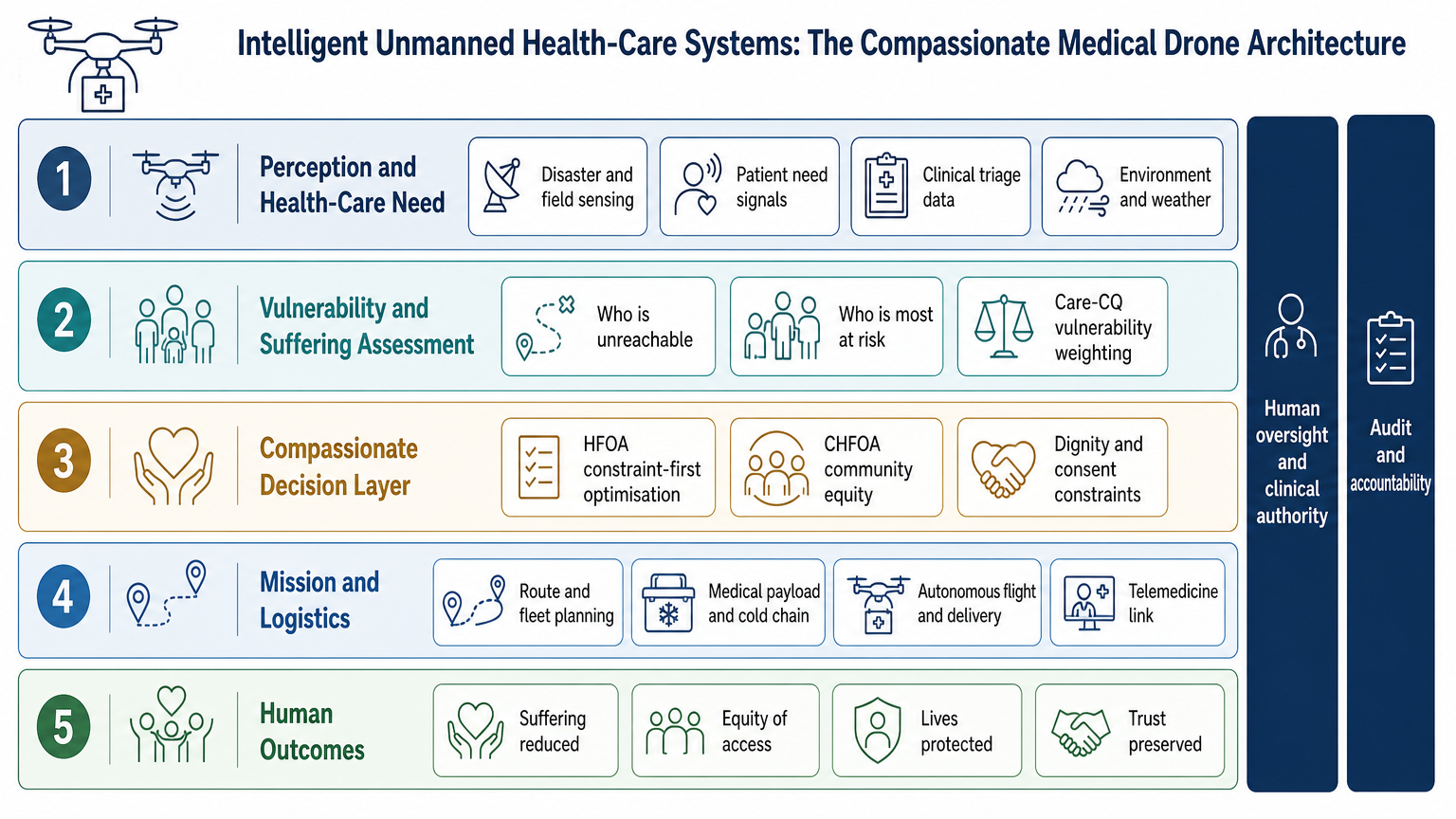
The proposed architecture moves beyond fastest-delivery optimization. It treats safety, human dignity, vulnerability, equity, privacy, accountability, suffering reduction, and human flourishing as explicit design considerations. The resulting system is a human-AI partnership in which AI agents provide perception, reasoning, coordination, and adaptive logistics; drones provide mobility and reach; health professionals retain appropriate clinical authority; and humanitarian institutions retain governance responsibility. The article proposes a nine-layer Compassionate Disaster Health Drone Architecture, a vulnerability-aware decision model, a Compassionate Disaster Drone Index, a digital-twin research pathway, and a validation agenda for simulation and real-world evaluation.
Keywords: compassionate medical drones; intelligent unmanned health-care systems; disaster management; disaster response; humanitarian AI; AI agents; UAV; medical logistics; telemedicine; HFOA; CHFOA; Care-CQ; suffering reduction; human flourishing.
Cite as: Ray, Amit. “Medical AI Drones for Disaster Management: Intelligent Unmanned Health-Care Systems.” Compassionate AI 3.8 (19 August 2026): 57-59, Compassionate AI Lab, https://sriamitray.com/medical-ai-drones-for-disaster-management/.
1. Introduction: Disaster as a Health-Care Network Failure
A major disaster is not only a destructive physical event. It is also a disruption of the network through which health care reaches people. Roads can become impassable, bridges can collapse, airports can close, hospitals can exceed capacity, communication systems can fail, cold-chain infrastructure can be interrupted, and health workers can themselves become affected members of the disaster population.
The resulting problem can be expressed simply:
This asymmetry is especially dangerous when delays affect time-sensitive medicines, blood products, diagnostic samples, emergency equipment, or access to clinical advice. Recent evidence supports a significant role for drones in this environment. A 2026 scoping review of 21 real-world medical-supply cases across five continents found a median delivery time of 45 minutes by drone compared with 305 minutes using conventional transportation (Rodríguez, León-Prieto, and Rodríguez-Jaime). The same review found that gains were particularly substantial in geographically constrained settings.
A separate 2026 review of 136 studies on drones in emergency management organizes the field into three major operational domains: communication support, delivery, and reconnaissance and assessment (Akpunar and Akpinar). This taxonomy is particularly useful for disaster health because it shows that the drone can participate in more than supply transportation.
The central thesis of this article is therefore not that every disaster should be solved by drones. Rather, it is that medical drones can become an intelligent extension of the emergency health-care network when integrated with human decision-makers, medical logistics, AI agents, communications, and accountable governance.
2. From Medical Drone to Intelligent Unmanned Health-Care System
A conventional drone logistics model can be represented as:
An Intelligent Unmanned Health-Care System requires a substantially richer loop:
This distinction matters because disasters are dynamic. A route can become unsafe after a mission is planned. A clinic can become overloaded. A population can move. Weather can change. A new medical emergency can emerge. A communications node can fail. The system therefore needs adaptive intelligence rather than a fixed transportation plan.
Recent health-care AI research provides a useful conceptual foundation. Zhao et al. describe AI agents across assisted diagnosis, clinical decision support, report generation, patient-facing applications, health-care management, and education, while emphasizing embodied systems, safety, controllability, ethical governance, user trust, and changing health-care roles as important future directions. Xu et al. review more than 200 studies and organize health-care agents around multimodal perception, agent capabilities such as reasoning, tool use, memory and multi-agent collaboration, and an application ecosystem involving clinicians, patients, researchers, and administrators.
For disaster medicine, the drone can be understood as an embodied execution platform within such an agentic ecosystem.
3. The Evidence Base for Emergency Medical Drones
The evidence base should be interpreted carefully. Drones are not universally faster, cheaper, safer, or clinically superior. Their value depends on geography, payload, weather, airspace, infrastructure, regulatory conditions, fleet availability, and the alternative transportation network.
Nevertheless, the current literature shows a credible operational signal. Rodríguez, León-Prieto, and Rodríguez-Jaime’s 2026 scoping review included 21 case studies from 2018–2025 and reported a median delivery time of 45 minutes by drone versus 305 minutes by conventional transport. Akpunar and Akpinar’s 2026 review of 136 emergency-drone studies shows a broader research ecosystem encompassing delivery, reconnaissance, and communication support.
These findings support a research position in which drones are treated as one component of a larger disaster-response system rather than as a standalone technology.
4. Disaster Management Requires More Than Delivery
Disaster management spans preparedness, mitigation, response, continuity, and recovery. Consequently, an intelligent medical-drone system should support several functions.
| Function | Potential Role of Intelligent Medical Drones |
|---|---|
| Reconnaissance | Rapid aerial assessment of damaged infrastructure and accessibility. |
| Medical logistics | Transport of medicines, blood products, diagnostic specimens, vaccines, and emergency supplies where authorized and operationally appropriate. |
| Communication | Potential temporary communication or connectivity support where infrastructure is disrupted. |
| Health situational awareness | Integration of authorized observations and health-system status into a common operational picture. |
| Telemedicine support | Potential relay between field teams and remote clinicians. |
| Verification | Confirmation that a delivery or communication mission succeeded. |
| Resilience | Alternative transport when conventional routes are unavailable. |
UNICEF’s documented drone work includes health commodities such as vaccines, medicines, blood products and diagnostic samples, as well as humanitarian applications involving aerial imaging and connectivity. These examples illustrate why the drone should be understood as a multi-function emergency infrastructure component rather than simply a courier.
5. Compassionate AI as the Decision Philosophy
Compassion in an AI system should not be reduced to a conversational tone or an emotionally expressive interface. In a disaster-health context, compassion can be operationalized as a disciplined concern for the reduction of avoidable suffering while protecting safety, dignity, agency, privacy, equity, and human well-being.
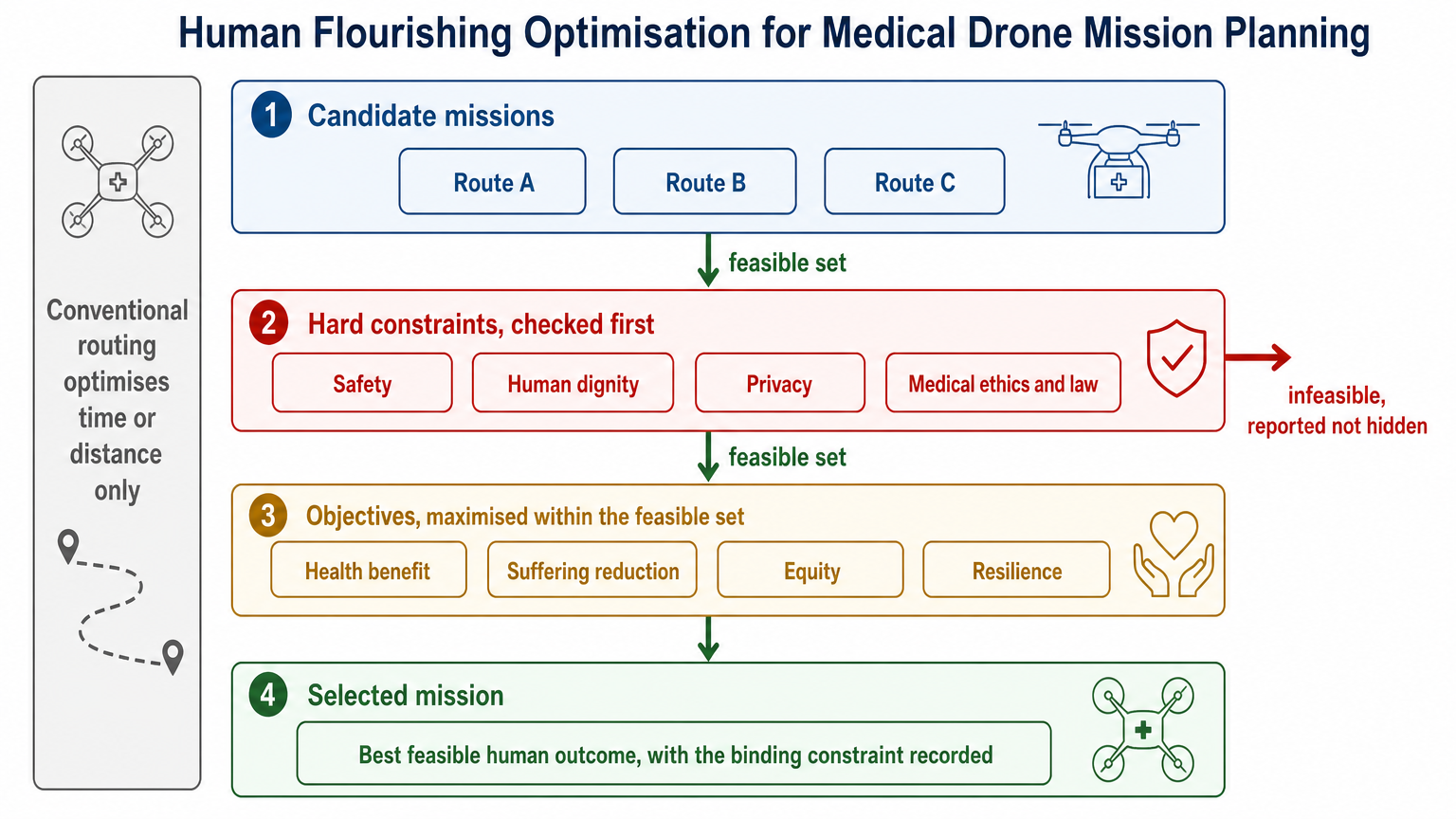
The uploaded Sri Amit Ray framework makes a related distinction between what an AI system should optimize and what it must never sacrifice. The HFOA manuscript describes a constraint-first architecture in which candidate decisions first pass a human-centered feasibility gate addressing non-harm, dignity, autonomy, safety, privacy and fundamental rights, and protection of vulnerable populations. Feasible alternatives can then be evaluated across multiple flourishing dimensions, with Pareto optimization used to preserve trade-offs rather than prematurely collapsing heterogeneous human values into one scalar score (Ray, Human Flourishing Optimization).
The CHFOA and Care-CQ materials extend this logic from individual optimization to collective well-being, ecological sustainability, cross-community fairness, and vulnerability-aware measurement. Care-CQ is described as a vulnerability-weighted metric system, with a vulnerability-amplification factor intended to prevent harms to fragile populations from disappearing inside aggregate averages (Ray, Responsible AI Systems).
6. The Compassionate Disaster Health Drone Architecture
This article proposes a nine-layer architecture called the Compassionate Disaster Health Drone Architecture (CDHDA). It adapts the human-centered logic of CAIA, HFOA, CHFOA and Care-CQ to an emergency medical-drone environment.
Layer 1 — Disaster Perception
The system integrates authorized information from drones, maps, weather services, infrastructure status, emergency alerts, hospitals, clinics, shelters, and other operational sources. The purpose is situational awareness, not unrestricted surveillance.
Layer 2 — Health-Care Intelligence
This layer transforms operational information into health-care requirements: medicine shortages, blood requirements, diagnostic transport, emergency equipment, vaccination needs, trauma supplies, and continuity-of-care requirements.
Layer 3 — Vulnerability and Suffering Assessment
The system estimates where delay or inaccessibility may impose particularly serious consequences. Vulnerability may include age, disability, pregnancy, critical illness, isolation, lack of transport, and loss of local health infrastructure. The PRPA concept can be investigated here as a research component for recognizing and predicting pain or suffering, but it should not be presented as a clinically validated autonomous diagnostic mechanism (Ray, “Pain Recognition and Prediction AI Algorithm”).
Layer 4 — Compassionate Prioritization
Candidate missions are evaluated using urgency, vulnerability, expected health benefit, accessibility, equity, feasibility, and safety. This is where HFOA’s constraint-first logic is particularly relevant: a mission that violates a hard safety or human-rights constraint should not become acceptable merely because it scores well on speed or aggregate utility.
Layer 5 — Medical Logistics Intelligence
The system matches demand to available supplies and transport capacity across hospitals, warehouses, blood banks, laboratories, pharmacies, mobile clinics, ambulances, humanitarian organizations, and drone bases. The drone is therefore one mode inside a multimodal medical logistics network.
Layer 6 — Autonomous Flight and Delivery
This layer performs route planning, navigation, obstacle avoidance, payload monitoring, weather adaptation, authorized drop-off or landing procedures, and contingency management. Dynamic replanning is essential because disaster conditions can change after mission authorization.
Layer 7 — Communication and Telemedicine
Where technically and legally appropriate, drones can support communication or connectivity in areas affected by infrastructure disruption. This can potentially link field health workers, patients, mobile clinics, hospitals, and coordination centers. The role should be designed around minimum necessary data collection and secure communications.
Layer 8 — Human Oversight and Clinical Authority
AI recommendations and autonomous execution should remain subject to defined human-oversight rules. Clinical decisions with significant patient-safety implications should remain within appropriate professional authority. The recent health-care agent literature emphasizes safety, controllability, governance, trust, and real-world integration as unresolved requirements (Zhao et al.; Xu et al.).
Layer 9 — Accountability, Audit, and Learning
Every consequential mission should generate an auditable record: why the mission was initiated, which data were considered, what alternatives were evaluated, what the AI recommended, who authorized it, what action occurred, and whether the intended outcome was achieved.
7. AI Agents in the Disaster Medical-Drone Ecosystem
A single general-purpose AI should not be expected to perform every emergency function. A multi-agent architecture can separate responsibilities and make system behavior more inspectable.
| Agent | Primary Responsibility |
|---|---|
| Disaster Perception Agent | Processes authorized imagery, maps, weather, and infrastructure observations. |
| Medical Needs Agent | Aggregates validated requests and health-system requirements. |
| Vulnerability Agent | Identifies potentially high-risk populations and locations. |
| Logistics Agent | Matches supplies and requests across transport modes. |
| Route Agent | Computes and dynamically updates safe routes. |
| Fleet Agent | Coordinates multiple drones and mission priorities. |
| Communication Agent | Manages authorized communication and telemedicine support. |
| Safety Agent | Checks hard constraints, uncertainty, airspace, payload, and mission risk. |
| Human-Oversight Agent | Escalates defined decisions to authorized human operators or clinicians. |
| Audit Agent | Maintains decision provenance and post-mission records. |
Srinivasu et al. describe agent coordination, task management, agent ranking, communication workflows, and federated-learning/6G directions for health-care agentic systems. Their work is not evidence that such an architecture is already clinically operational; rather, it provides relevant technical concepts for investigating coordinated agents in future disaster-health systems.
8. HFOA: From Fastest Route to Best Feasible Human Outcome
Conventional drone logistics frequently emphasizes time, distance, energy, cost, or fleet utilization. These are important engineering objectives but insufficient as a complete disaster-health objective.
HFOA provides a useful conceptual extension. Its manuscript separates hard human-centered constraints from positive flourishing objectives and uses multi-objective/Pareto reasoning to preserve legitimate trade-offs (Ray, Human Flourishing Optimization).
For disaster medical drones, the decision sequence can therefore be represented as:
Possible objectives include:
- expected health benefit;
- suffering reduction;
- response time;
- equitable access;
- continuity of care;
- resource efficiency;
- community resilience;
- environmental impact.
The crucial point is that a safety violation should not be compensated for by an efficiency gain.
9. CHFOA and Collective Disaster Health
Disasters affect communities, not only individual patients. A decision that benefits one location can unintentionally worsen access elsewhere. CHFOA is designed around collective human well-being, ecological sustainability, and cross-community fairness rather than a single proxy objective (Ray, Responsible AI Systems).
The CHFOA materials describe ten dimensions of flourishing, including physical well-being, psychological well-being, social connection, and other dimensions of human and collective thriving. Importantly for health-care AI, physical safety is treated as a foundational constraint rather than an ordinary variable that can be traded against efficiency (Ray, Responsible AI Systems).
This is directly relevant to disaster drone allocation. A fleet should not repeatedly serve highly visible or easily connected communities while inaccessible populations remain underserved simply because aggregate delivery efficiency improves.
10. Care-CQ and Vulnerability-Aware Disaster Response
Care-CQ provides a potential measurement layer for compassionate disaster AI. The uploaded framework describes vulnerability amplification through a factor of the form (1 + αv(i)), where vulnerability is used to increase the weight assigned to affected individuals or communities so that severe impacts on fragile populations are not averaged away (Ray, Responsible AI Systems).
In a disaster context, the mechanism could be investigated as a way of asking whether a resource-allocation model is systematically overlooking high-vulnerability communities.
However, the parameters must be empirically calibrated. Vulnerability should not be guessed from crude demographic proxies, and the system should not infer sensitive personal characteristics unnecessarily. Any operational version would require domain-specific governance, validated data, fairness analysis, and human review.
11. Medical Drones for Different Disaster Types
11.1 Earthquakes
Earthquakes can simultaneously damage roads, hospitals, communication systems, and utilities. Drones can potentially support rapid reconnaissance, medical delivery, diagnostic logistics, and communications while ground routes are being restored.
11.2 Floods and Cyclones
Flooding can make roads unusable while communities remain geographically reachable by air. Medical drones may therefore have particular value for medicines, diagnostic specimens, emergency kits, and communication support in isolated areas.
11.3 Wildfires and Extreme Heat
Drones can contribute reconnaissance, environmental sensing, communications, and supply support for isolated response teams, subject to aviation and safety constraints.
11.4 Epidemic and Infectious-Disease Emergencies
Drone transport can potentially reduce dependence on disrupted road networks for diagnostic samples and medical commodities. Such systems require strict biosafety, chain-of-custody, and regulatory controls.
11.5 Mountain and Remote-Area Disasters
Mountainous terrain and sparse infrastructure can produce long ground-travel times even without complete infrastructure collapse. Drones can potentially provide a rapid aerial logistics layer.
12. The Drone as a Mobile Health-Care Node
The more ambitious concept is to transform the drone from a transport platform into a mobile health-care node.
A future platform could combine, depending on mission requirements and regulatory approval:
- medical payloads;
- communication equipment;
- environmental sensors;
- imaging;
- diagnostic-support equipment;
- secure connectivity;
- edge AI;
- telemedicine interfaces.
This does not mean that the drone itself becomes a hospital or physician. It means that the platform becomes an intelligent physical interface connecting damaged environments with the broader health-care system.
13. Communication and Telemedicine
Health-care access is not only a material logistics problem. A community can possess medicines and still lack access to professional medical knowledge.
Communication-capable drones could potentially serve as temporary relays where terrestrial infrastructure is unavailable. In a carefully governed system, a field worker might communicate with a remote clinician, transmit authorized diagnostic information, or request a higher-level intervention.
Such capabilities raise privacy and cybersecurity requirements. Hou et al.’s systematic review of qualitative health-care AI research identifies algorithmic bias, privacy, data security, technical reliability, and ambiguous accountability among major ethical concerns. These concerns become more serious when AI, medical data, autonomous mobility, and disaster operations are combined.
14. Compassion Is Not the Same as Speed
The strongest temptation in emergency drone design is to equate compassion with rapid delivery. Speed matters, but speed alone is not compassion.
Consider two possible missions. Mission A can deliver a low-urgency supply in eight minutes. Mission B can deliver a time-sensitive medicine to an isolated, high-vulnerability population in twenty minutes. A pure speed objective may favor A. A human-centered health objective may favor B.
Compassionate Optimization = Best Safe Human-Centered Outcome Under Constraints
This is the principal conceptual bridge between drone operations research and Compassionate AI.
15. Ethical Risks
15.1 Algorithmic Bias
AI systems may underestimate needs in populations poorly represented in their data. Equity must therefore be evaluated explicitly rather than assumed.
15.2 Privacy and Aerial Surveillance
Aerial imagery can capture homes, individuals, medical facilities, and other sensitive information. Data collection should be proportionate to the emergency purpose.
15.3 Automation Bias
Under pressure, human responders may over-trust an AI recommendation. Interfaces should expose uncertainty and make escalation pathways clear.
15.4 Clinical Overreach
A logistics or perception system should not silently become an autonomous clinical authority. Clinical decisions require appropriate professional governance.
15.5 Accountability
When a decision involves several agents, an operator, a drone, a hospital, and an emergency organization, responsibility can become diffuse. Auditability must therefore be designed from the beginning.
15.6 Cybersecurity
Medical drones combine physical mobility, communications, software, and potentially sensitive health information. Cybersecurity failures can become physical safety failures.
16. Uncertainty as a First-Class Variable
A compassionate system should explicitly represent uncertainty rather than presenting uncertain predictions as facts.
For example:
| Situation | Recommended Governance Pattern |
|---|---|
| High urgency + high confidence + safe route | Rapid authorized dispatch. |
| High urgency + low confidence | Rapid human verification or additional sensing. |
| Low urgency + high uncertainty | Gather additional information before committing scarce resources. |
| Safety constraint violated | Reject or redesign mission regardless of efficiency score. |
This constraint-first approach is consistent with the HFOA manuscript’s separation of non-compensable protections from positive optimization objectives (Ray, Human Flourishing Optimization).
17. Failure-With-Care
Disaster systems must be designed around failure because failure is not an exceptional condition in a disaster.
- battery depletion;
- communication loss;
- GPS degradation;
- unexpected weather;
- payload malfunction;
- airspace conflict;
- cyberattack;
- destination closure;
- AI perception or reasoning error.
A compassionate architecture asks not only how to prevent failure, but also what should happen after failure:
Possible responses include transfer to another drone, rerouting to another health facility, switching to ground transport, requesting human intervention, or establishing an alternative communication pathway.
18. Multi-Drone and Multi-Agent Coordination
A large disaster may require a fleet. Different drones can specialize in reconnaissance, medical delivery, communications, diagnostic transport, and environmental monitoring.
The fleet becomes a multi-agent system in which the central problem is not merely navigation but coordination under scarcity.
Relevant research questions include:
- How should missions be allocated across heterogeneous drones?
- How should vulnerability affect fleet scheduling?
- How should one drone’s failure alter the global plan?
- How should human operators override a fleet-level AI decision?
- How should privacy and data minimization be enforced across agents?
Srinivasu et al. and Xu et al. provide relevant foundations for studying agent coordination, tool use, reasoning, memory, and multi-agent collaboration, although their work does not itself establish the clinical validity of a compassionate drone fleet.
19. Digital Twins for Disaster Health
A disaster-health digital twin could represent roads, bridges, hospitals, shelters, medical inventories, weather, population movement, communication nodes, and drone positions.
The 2026 emergency-drone review identifies digital twins and other smart technologies as important directions for future emergency operations research (Akpunar and Akpinar).
For Compassionate AI, the digital twin could also allow researchers to test whether an allocation policy reduces or amplifies inequity before deployment.
20. Edge AI and Resilient Intelligence
Disasters may disrupt cloud connectivity. A resilient architecture should therefore allow selected functions to operate at the edge:
- navigation;
- obstacle avoidance;
- basic perception;
- mission safety checks;
- local anomaly detection.
More computationally intensive reasoning can be delegated when connectivity permits.
Agentic health-care research increasingly emphasizes integrated perception, reasoning, tools, memory, and coordination. Disaster systems add another requirement: graceful degradation when communication infrastructure fails (Xu et al.; Srinivasu et al.).
21. The Compassionate Disaster Drone Index
This article proposes the Compassionate Disaster Drone Index (CDDI) as a research construct for evaluating the humanitarian performance of medical-drone missions.
| Dimension | Research Question |
|---|---|
| Health Benefit | Did the intervention produce meaningful health benefit? |
| Suffering Reduction | Did it reduce avoidable delay, pain, distress, or deterioration? |
| Responsiveness | How rapidly did the system respond? |
| Equity | Were underserved populations appropriately considered? |
| Accessibility | Did the system reach locations inaccessible to conventional transport? |
| Safety | Was the mission completed within acceptable safety limits? |
| Dignity | Were affected people treated as rights-bearing participants rather than data objects? |
| Privacy | Was data collection proportionate and protected? |
| Resilience | Did the system remain useful under disruption? |
| Accountability | Can the decision and outcome be reconstructed? |
The CDDI is proposed in this article as a research framework. It is not a clinically validated or internationally standardized index.
22. A Disaster Health Decision Model
The integrated decision model can be expressed as:
subject to Safety + Dignity + Autonomy + Privacy + Legal + Operational Constraints
This formulation deliberately separates constraints from optimization. A mission should not become permissible simply because it produces a high aggregate score.
The approach also supports Pareto reasoning: several missions may be non-dominated because they represent legitimate trade-offs among response time, health benefit, equity, energy, and resilience. The final choice can then be made through declared governance rules rather than an opaque single score.
23. Human-Centered Governance
Hou et al.’s 2026 systematic review found that health-care professionals identify technical reliability, algorithmic bias, privacy, data security, and accountability as important ethical concerns. Zhao et al. similarly identify safety, controllability, ethical governance, user trust, and evolving professional roles as important directions for health-care agents.
These findings reinforce a core principle of this article: autonomy should be bounded by governance.
A mature disaster-health drone system should define in advance:
- which decisions can be automated;
- which decisions require an operator;
- which decisions require a clinician;
- which decisions require institutional authorization;
- which conditions automatically terminate or reroute a mission.
24. Seven Principles for Compassionate Disaster Medical Drones
Principle 1 — Preserve Life and Physical Safety
Human health and physical safety should be foundational constraints.
Principle 2 — Reduce Avoidable Suffering
Where safe alternatives exist, the system should favor interventions likely to reduce preventable delay and distress.
Principle 3 — Reach the Unreachable
The system should recognize the humanitarian value of extending care to communities that conventional infrastructure cannot adequately serve.
Principle 4 — Protect Dignity and Agency
Affected people should not be reduced to algorithmic observations. Human agency and appropriate consent should be respected wherever circumstances permit.
Principle 5 — Promote Equity
Allocation systems should actively test for systematic neglect of vulnerable populations.
Principle 6 — Preserve Human Responsibility
Autonomous execution must not erase accountable human authority.
Principle 7 — Learn Without Repeating Harm
Post-mission learning should improve future operations while protecting privacy and avoiding harmful feedback loops.
These principles are consistent with the uploaded Sri Amit Ray Compassionate AI principles and the broader CAIA/CHFOA/Care-CQ direction (Ray, “12 Sri Amit Ray Compassionate AI Principles”; Ray, “Compassionate AI Lab Declaration”).
25. Complete Disaster-Response Workflow
DETECT — Identify disaster signals and emerging health threats.
ASSESS — Map damage, accessibility, population movement and health-system capacity.
PRIORITIZE — Evaluate urgency, vulnerability, suffering reduction, equity and feasibility.
PLAN — Select drone, ground, ambulance, telemedicine or combined intervention.
AUTHORIZE — Apply human and safety governance gates.
EXECUTE — Deploy the mission.
VERIFY — Confirm delivery, connection or intended health-care outcome.
LEARN — Update models, policies and training data under governance controls.
26. Research and Validation Roadmap
The proposed architecture should be treated as a research program rather than a claim of completed deployment.
26.1 Simulation
Construct earthquake, flood, cyclone, wildfire, epidemic, and remote-terrain scenarios and compare conventional and drone-supported logistics.
26.2 Digital-Twin Experiments
Model roads, hospitals, shelters, medical inventory, weather, drone fleets, and population movement to test alternative allocation policies before physical deployment.
26.3 Human-in-the-Loop Trials
Evaluate interaction among emergency physicians, logisticians, drone operators, humanitarian coordinators, and AI agents.
26.4 Fairness and Vulnerability Testing
Measure whether the system systematically under-serves isolated, low-resource, disabled, elderly, or otherwise vulnerable populations.
26.5 Failure Testing
Test battery loss, communication failure, GPS disruption, adverse weather, payload failure, cyberattack, route closure, and incorrect AI recommendations.
26.6 Outcome Evaluation
Measure health and humanitarian outcomes rather than only flight performance.
27. Proposed Benchmark Study
| Architecture | Description |
|---|---|
| Baseline Logistics | Conventional ground transportation. |
| Drone Logistics | Drone-assisted delivery without advanced AI optimization. |
| AI Drone Logistics | AI-optimized drone logistics focused on operational objectives. |
| Compassionate AI Drone System | AI-assisted drone system incorporating safety constraints, vulnerability, equity, suffering reduction, human flourishing, and human oversight. |
Key outcomes should include response time, delivery success, health outcomes, resource utilization, equity, suffering reduction, safety, human workload, privacy, and resilience.
28. Why This Framework Matters
The significance of the proposed framework is not that it predicts a future in which drones replace health-care workers. It proposes a different division of labor.
Humanitarian responders → social and operational context
AI agents → perception, reasoning and coordination
Drones → mobility, reach and sensing
Institutions → governance, accountability and resources
Such a division is more realistic than full autonomy. It also aligns with the emerging health-care agent literature, which identifies substantial promise but emphasizes the remaining requirements of reliability, privacy, governance, evaluation, and real-world integration (Zhao et al.; Xu et al.).
29. Conclusion
Disasters expose a critical weakness in conventional health-care delivery: the moment medical need becomes greatest can be the moment when transportation, communication, and clinical infrastructure become least accessible.
Medical drones provide a powerful additional layer of reach. Current evidence indicates substantial reductions in medical-supply delivery time in many real-world settings, while emergency-drone research increasingly addresses delivery, reconnaissance, communication, operations research, and smart technologies.
But the next research frontier should not be defined simply as more autonomous drones. It should be defined as more intelligent, more accountable, and more compassionate unmanned health-care systems.
The framework proposed here combines medical drones with AI agents, disaster intelligence, medical logistics, communication, edge computing, digital twins, and human oversight. The Sri Amit Ray Compassionate AI framework contributes a complementary normative and computational direction: HFOA places human-centered constraints before optimization; CHFOA expands the objective toward collective flourishing, equity, and sustainability; Care-CQ introduces vulnerability-aware measurement; and PRPA offers a conceptual route for research on pain and suffering recognition.
The resulting principle is straightforward:
This transforms the drone from a logistics machine into a potential intelligent component of a human-centered disaster health-care network.
The future compassionate medical drone should therefore not replace the physician, nurse, emergency worker, humanitarian coordinator, or community. It should extend their reach—crossing damaged terrain, carrying critical supplies, supporting communications, gathering situational information, and helping coordinate care when ordinary systems are overwhelmed.
Compassionate Medical Drones as Intelligent Unmanned Health-Care Systems for Disaster Management thus represents a research direction in which artificial intelligence, autonomous mobility, emergency medicine, humanitarian logistics, and Compassionate AI converge around a common purpose: protecting human life, reducing avoidable suffering, strengthening equitable access to care, and supporting human flourishing during the most difficult conditions.
References
- Akpunar, Özge Şatir, and Şener Akpinar. “Drones in Emergencies: A Review of Recent Developments and Future Directions.” Computers & Industrial Engineering, vol. 216, 2026, article 112003. doi:10.1016/j.cie.2026.112003.
- Hou, Jiayu, Xuan Cheng, Jiayu Liao, Zhiqiao Zhang, and Weihong Wang. “Ethical Concerns of AI in Healthcare: A Systematic Review of Qualitative Studies.” Nursing Ethics, vol. 33, no. 2, 2026, pp. 428–449. doi:10.1177/09697330251385024.
- Ray, Amit. “The 12 Sri Amit Ray Compassionate AI Principles | Ethical AI Framework.” Compassionate AI, vol. 2, no. 4, 2026, pp. 12–14. amitray.com.
- Ray, Amit. “AI Agents and Robots in Peacekeeping Force and Social Care: Compassionate AI Technologies.” Compassionate AI, vol. 3, no. 9, 2025, pp. 75–77. amitray.com.
- Ray, Amit. “The Compassionate AI Lab Declaration on AI Safety, Suffering Reduction, and the Protection of Humanity.” Compassionate AI, vol. 4, no. 12, 2025, pp. 72–74. amitray.com.
- Ray, Amit. “The Sri Amit Ray Compassionate AI Architecture (CAIA): A Seven-Layer Framework for Human-Centered Artificial Intelligence.” Compassionate AI, vol. 2, no. 6, 2026, pp. 81–83. amitray.com.
- Ray, Amit. “Human Flourishing Optimization Algorithm (HFOA) for Compassionate AI Architecture.” Compassionate AI, vol. 2, no. 6, 2026, pp. 81–83. amitray.com.
- Ray, Amit. Ethical AI Systems: Frameworks, Principles, and Advanced Practices. Inner Light Publishers, 2024.
- Ray, Amit. “Pain Recognition and Prediction AI Algorithm (PRPA) for Compassionate AI.” Compassionate AI, vol. 3, no. 9, 2025, pp. 60–62. amitray.com.
- Ray, Amit. “Collective Human Flourishing Optimization Algorithm (CHFOA) and Care-CQ.” Ethical AI Systems: Frameworks, Principles, and Advanced Practices. Inner Light Publishers, 2024.
- Rodríguez, Sebastián, Catalina León-Prieto, and María Fernanda Rodríguez-Jaime. “Use of Drones for the Delivery of Medical Supplies: A Scoping Review of Case Studies.” Case Studies on Transport Policy, vol. 24, 2026, article 101833. doi:10.1016/j.cstp.2026.101833.
- Srinivasu, Parvathaneni Naga, Gorli L. Aruna Kumari, Shakeel Ahmed, and Abdulaziz Alhumam. “Exploring Agentic AI in Healthcare: A Study on Its Working Mechanism.” Frontiers in Medicine, vol. 12, 2026, article 1753443. doi:10.3389/fmed.2025.1753443.
- UNICEF. “Drones.” UNICEF Office of Innovation, 2026. unicef.org/innovation/drones.
- UNICEF. “Drones to Reach the Last Mile.” UNICEF Supply Division, 2026.
- World Health Organization. Emergency Health Kits. World Health Organization, 2026.
- Xu, Gelei, Xueyang Li, Yixiong Chen, Yuying Duan, Shuqing Wu, Haoxinran Yu, Ching-Hao Chiu, Juntong Ni, Ningzhi Tang, Toby Jia-Jun Li, Alan Yuille, Wei Jin, and Yiyu Shi. “A Comprehensive Survey of AI Agents in Healthcare.” Journal of Biomedical Informatics, vol. 179, 2026, article 105045. doi:10.1016/j.jbi.2026.105045.
- Zhao, Lina, Shengrui Liu, Tangsiwei Xin, et al. “AI Agent in Healthcare: Applications, Evaluations, and Future Directions.” npj Artificial Intelligence, vol. 2, 2026, article 31. doi:10.1038/s44387-026-00076-4.