
Abstract
The Intergenerational Justice Algorithm gives practical shape to the principle that no generation may use up humanity’s natural, cultural and institutional inheritance at the expense of those who come after. It takes aim at the time-based injustice of discounting, which quietly values future lives below present ones.
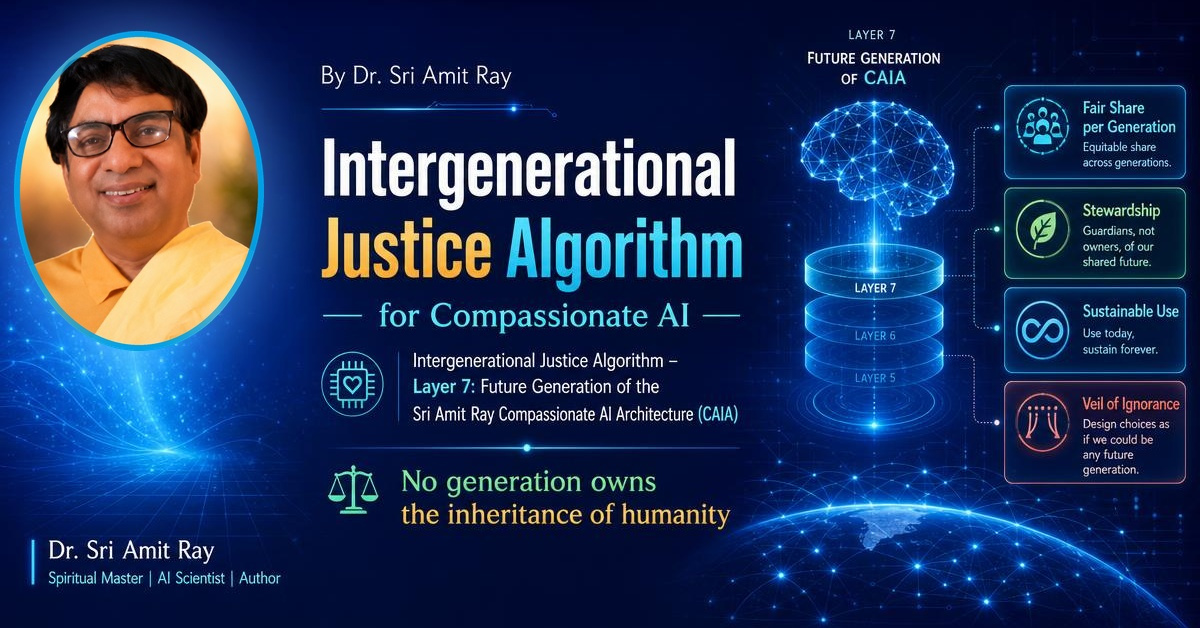
Inspired by Rawls’s veil of ignorance, the algorithm calculates a fair extraction quota for each generation from the total resources available and the expected lifespan of civilisation, and it slows any consumption that goes beyond that quota. The algorithm is part of Layer 7 (Future Generation) of Sri Amit Ray’s Compassionate AI Architecture™ (CAIA™).
Key Takeaways
- Treats each generation as a steward, not an owner, of shared resources.
- Derives a fair per-generation quota from total stocks and civilisation’s expected lifespan.
- Uses near-zero discount rates for decisions with civilisational consequences.
- Contributes to the Future Generation Score in the CAIA™ framework.
In Simple Words
Put simply: the algorithm works out a fair portion of finite resources for each generation and holds back consumption that would take more. It is long-term rationing by design, so that those who follow inherit a living world.
Readiness level: Concept. Useful as a policy-modelling lens; the inputs (civilisation lifespan, total stocks) are estimates.
Why This Algorithm Matters
The Intergenerational Justice Algorithm, created at the Sri Amit Ray Compassionate AI Lab, puts into practice the moral principle that no generation may consume the whole of humanity’s natural, cultural and institutional inheritance at the cost of generations still to come. It confronts the injustice across time built into much of today’s AI optimisation: the routine discounting of future consequences, which in effect treats future human lives as worth less than present ones. [1]
In A Theory of Justice, John Rawls argued that just principles are those rational people would choose from behind a “veil of ignorance”, without knowing which generation they would be born into. From that position, people would protect future generations against the consumption and risk-taking of those who came earlier. They would choose sustainability limits, duties of fairness between generations, and institutions that stop any single generation from enjoying benefits by passing the costs on to its successors.
With conventional economic discount rates of 3–7% a year, the entire future of humanity — every life to be lived on Earth over the next ten thousand years — is worth almost nothing today. That arithmetic consistently justifies present consumption at the expense of the distant future, however catastrophic the long-term results. For decisions with civilisational stakes, the Intergenerational Justice Algorithm rejects this approach: it applies near-zero discount rates to long-horizon impacts and gives future generations full moral weight as stakeholders.
“Each generation is a steward, not an owner, of what it inherits.”
— A guiding principle of the Sri Amit Ray Compassionate AI Lab
The Mathematics
The fair extraction quota based on estimated civilization lifetime:
The algorithm enforces fair-share consumption constraints:
where \(s\) is the compassionate sharing factor.
Symbols Used
| Symbol | Meaning |
|---|---|
| \(Q_{fair}\) | fair per-generation resource quota |
| total resources | estimated available stock |
| lifespan / generation time | number of future generations to share with |
| throttling factor | compassionate-sharing reduction applied when over quota |
A Step-by-Step Example
With an estimated sustainable stock supporting 100 generations of use, \(Q_{fair}\) = total/100 per generation. If current consumption \(C_{now}\) is three times \(Q_{fair}\), the algorithm enforces throttling toward \(Q_{fair}\) (scaled by a sharing factor), signalling strong over-extraction and the need for renewal or substitution.
How It Is Implemented
The reference implementation expresses the model as compassionate, auditable logic, written for clarity rather than raw performance so that ethical reviewers as well as engineers can follow every decision.
def check_intergenerational_justice(current_extraction_rate, total_reserves):
    generations_remaining = ESTIMATED_CIVILIZATION_LIFESPAN / GENERATION_DURATION
    fair_rate             = total_reserves / generations_remaining
    if current_extraction_rate > fair_rate:
        restricted_rate = fair_rate * COMPASSIONATE_SHARING_FACTOR
        enforce_resource_throttling(rate=restricted_rate)
        return False
    return True
Measuring It Reliably
Use ranges and scenarios for lifespan and stock estimates rather than single numbers, and validate against established sustainable-yield and footprint accounting. Report sensitivity to assumptions.
Where It Can Help
- Fossil Fuel and Mining Governance: AI-governed resource extraction quotas calibrated to multi-generational fair share calculations, replacing short-term profit maximization with intergenerational equity constraints.
- Aquifer and Water Resource Management: Capping extraction to match natural replenishment cycles, ensuring that future generations inherit functioning water systems rather than depleted aquifers.
- AI Compute and Energy Allocation: Ensuring that AI infrastructure growth does not permanently consume renewable energy capacity needed by future generations for decarbonization.
Use Cases in Practice
Beyond the general applications above, the algorithm supports concrete, human-centred deployments across compassionate-AI domains:
🌍 Climate AI — Protecting Vulnerable Populations
Resource consumption is throttled toward a fair per-generation share so present use does not rob future people.
🏙️ Smart Cities — Public Welfare Optimization
Municipal resource use is held within a sustainable per-generation quota.
🌊 Humanitarian AI — Disaster Response Prioritization
Long-term recovery is planned so it does not borrow ecological capacity from future generations.
Ethical Foundations
Ethics and empathy are the starting point of the Sri Amit Ray tradition, not an extra layer added at the end. This algorithm rests on three commitments: non-harm (ahimsa), openness about how its decisions are reached, and respect for privacy and human dignity. Like every one of the twenty-five Human-Centered Compassionate AI algorithms, it is meant to work under human oversight — supporting human moral judgement, never standing in for it. [1]
Known Limits and Cautions
- The lifespan of civilisation and the size of “total resources” are very uncertain estimates.
- New technologies can substitute for resources and change the effective stocks over time.
- Equal sharing between generations is only one of several reasonable fairness rules.
Guarding Against Misuse
Any tool strong enough to protect people can also be misused to harm them, so these safeguards must accompany every deployment. The main risks of misuse for this algorithm, and how to guard against them, are:
- Quota framing could justify austerity that falls hardest on the poor — couple it with equity (Algorithm 13) so throttling is fair within a generation too.
- Do not weaponise scarcity narratives for control; keep assumptions public.
Alignment with AI Standards
To support real-world adoption, the algorithm maps onto recognised AI governance frameworks and standards:
| Framework | How this algorithm contributes |
|---|---|
| NIST AI RMF | GOVERN — long-term resource and societal stewardship. |
| EU AI Act | Aligns with sustainability objectives. |
| SDG 12 / Doughnut Economics | Responsible consumption within limits. |
| ISO 14001 | Environmental stewardship. |
Supporting the 17 UN Sustainable Development Goals
The Intergenerational Justice Algorithm derives a fair per-generation resource quota from estimated civilization lifetime and throttles over-consumption, treating each generation as a steward rather than an owner. This directly serves the consumption and equality goals, extending the call to move from data-driven to compassionate AI, the work on AI for climate and Earth system models, and the 12 Compassionate AI Principles.
The most directly relevant Sustainable Development Goals, and how this algorithm helps fulfil them, are:
- SDG 10 Reduced Inequalities. Fair-share quotas reduce inequality between present and future generations.
- SDG 12 Responsible Consumption and Production. Resource throttling enforces responsible, sustainable consumption and production.
- SDG 13 Climate Action. Limiting extraction to a sustainable share protects the long-term climate.
In this way the algorithm is not a stand-alone technical artefact but a concrete instrument for the global development agenda, translating compassion into measurable progress toward the 2030 Goals and beyond.
Where It Fits in CAIA™
Figure: This algorithm sits in Layer 7 · Future Generation (highlighted) of the Compassionate AI Architecture™ (CAIA™).
CAIA-SVG-START
CAIA-SVG-END
This algorithm is one of twenty-five building blocks of Sri Amit Ray’s Compassionate AI Architecture™ (CAIA™). CAIA works like a seven-layer, human-centred operating system: before any AI decision can be deployed, it has to pass through each layer of compassion in turn.
It operates in Layer 7: Future Generation Layer, whose purpose is to protect future humans. The layer answers a single guiding question — Will future generations benefit? — and emits the Future Generation Score, one of the seven inputs to the Compassionate AI Index, \( \text{CAI}=\sum_k w_k S_k \). It enforces fair sharing of finite resources across generations within the future-generation layer.
In the CAIA pipeline (Compassion Quotient → Suffering Reduction → Empathy → Human Flourishing → Vulnerability Protection → Planetary Protection → Future Generation Analysis → Human Oversight → Deploy), this layer’s score is one of the gates a decision must satisfy, and a sufficiently low protective score can veto deployment regardless of the overall average. Resting on the four pillars — Compassion, Responsibility, Sustainability, and Future Generations — the architecture ensures this algorithm never operates in isolation.
Read the full architecture: The Sri Amit Ray Compassionate AI Architecture™ (CAIA™).
This algorithm is one of the 25 Human-Centered Compassionate AI algorithms — see the complete canonical reference list.
How to Cite
Ray, Sri Amit. “Intergenerational Justice Algorithm for Compassionate AI.” Compassionate AI, Sri Amit Ray Compassionate AI Lab, 2026, https://sriamitray.com/research/intergenerational-justice-algorithm-compassionate-ai/.
References
- Ray, Amit. “The 12 Sri Amit Ray Compassionate AI Principles | Ethical AI Framework.” Compassionate AI, vol. 2, no. 4, 2026, pp. 12–14, amitray.com.
- Ray, Amit. “The 7 Pillars of Compassionate AI Democracy.” Compassionate AI, vol. 3, no. 9, 2024, pp. 84–86, amitray.com.
- Rawls, John. A Theory of Justice. Harvard University Press, 1971.
- Jonas, Hans. The Imperative of Responsibility: In Search of an Ethics for the Technological Age. University of Chicago Press, 1984.
- Burke, Edmund. Reflections on the Revolution in France. 1790. Penguin Classics, 1986.
- Ray, Amit. Human-Centered Compassionate AI: Sri Amit Ray’s 25 Algorithms for Protecting Humanity and Future Generations. Compassionate AI Lab, 2026. ISBN 978-8169641050.
- Ray, Amit. Compassionate Artificial Intelligence: Frameworks and Algorithms. Compassionate AI Lab, 2018. ISBN 978-9382123460.
- Ray, Amit. Compassionate Superintelligence AI 5.0: AI with Blockchain, BMI, Drone, IoT, and Biometric Technologies. Compassionate AI Lab, 2018. ISBN 978-9382123446.
Further Reading from the Compassionate AI Lab
- Ray, Amit. “Build Your Own Agentic AI Healthcare MCP Server: A Complete Guide to AI-Powered Healthcare Agents.” Compassionate AI, 3.8 (2026): 60-62. https://amitray.com/agentic-ai-healthcare-mcp-server/
- Ray, Amit. “Medical AI Drones for Disaster Management: Intelligent Unmanned Health-Care Systems.” Compassionate AI, 3.8 (2026): 57-59. https://amitray.com/medical-ai-drones-for-disaster-management/
- Ray, Amit. “Compassionate Medical AI Drones as Intelligent Unmanned Health-Care Systems: A Human-Centered AI Architecture for Suffering Reduction and Human Flourishing.” Compassionate AI, 3.8 (2026): 57-59. https://amitray.com/medical-ai-drones-human-centered-ai-healthcare/
- Ray, Amit. “The Sri Amit Ray Compassion Quotient (CQ) Algorithm for Compassionate AI.” Compassionate AI, 2.6 (2026): 81-83. https://amitray.com/compassion-quotient-cq-algorithm-compassionate-ai/
- Ray, Amit. “Collective Human Flourishing Optimization AI Algorithm (CHFOA): A Compassion-Centered Multi-Stakeholder AI Optimization Framework.” Compassionate AI, 2.6 (2026): 90-92. https://amitray.com/collective-human-flourishing-optimization-algorithm-chfoa/
- Ray, Amit. “Human Flourishing Optimization Algorithm (HFOA) for Compassionate AI Architecture.” Compassionate AI, 2.6 (2026): 81-83. https://amitray.com/human-flourishing-optimization-algorithm-hfoa-compassionate-ai/
- Ray, Amit. “The Sri Amit Ray Compassionate AI Architecture (CAIA): A Seven-Layer Framework for Human-Centered Artificial Intelligence.” Compassionate AI, 2.6 (2026): 81-83. https://amitray.com/compassionate-ai-architecture/
- Ray, Amit. “Human-Centered Compassionate AI: The 25 Algorithms for Protecting Humanity and Future Generations.” Compassionate AI, 2.6 (2026): 30-32. https://amitray.com/human-centered-compassionate-ai-the-25-algorithms/
- Ray, Amit. “AI Consciousness and Self-Aware Robots: Sri Amit Ray’s Framework for Compassionate Intelligence.” Compassionate AI, 2.5 (2026): 57-59. https://amitray.com/ai-consciousness-self-aware-robots/
- Ray, Amit. “The 12 Sri Amit Ray Compassionate AI Principles | Ethical AI Framework.” Compassionate AI, 2.4 (2026): 12-14. https://amitray.com/the-12-compassionate-ai-principles-for-humanity-and-future-generations/
- Ray, Amit. “The Compassionate AI Lab Declaration on AI Safety, Suffering Reduction, and the Protection of Humanity.” Compassionate AI, 4.12 (2025): 72-74. https://amitray.com/compassionate-ai-declaration-protection-of-humanity/
- Ray, Amit. “Compassionate AI for Forward Deployed Engineers (FDEs) in SaaS Companies.” Compassionate AI, 4.11 (2025): 15-17. https://amitray.com/compassionate-ai-for-forward-deployed-engineers-fdes-in-saas-companies/
- Ray, Amit. “Microbial AI, Bioleaching and Digital Twins for Manufacturing the 17 Rare Earth Elements.” Compassionate AI, 4.10 (2025): 42-44. https://amitray.com/microbial-ai-bioleaching-and-digital-twins-for-manufacturing-the-17-rare-earth-elements/
- Ray, Amit. “AI-Driven Rare Earth Element Magnet Design: Detailed Methodologies.” Compassionate AI, 4.10 (2025): 27-29. https://amitray.com/ai-driven-rare-earth-elements-magnet-design-methodologies/
- Ray, Amit. “AI Agents and Robots in Peacekeeping Force and Social Care: Compassionate AI Technologies.” Compassionate AI, 3.9 (2025): 75-77. https://amitray.com/ai-agents-robots-peacekeeping-force-social-care-compassionate-ai/
- Ray, Amit. “Ray Mother–Infant Inter-brain Synchrony Algorithm for Deep Compassionate AI.” Compassionate AI, 3.9 (2025): 60-62. https://amitray.com/ray-mother-infant-inter-brain-synchrony-algorithm-deep-compassionate-ai/
- Ray, Amit. “Pain Recognition and Prediction AI Algorithm (PRPA) for Compassionate AI.” Compassionate AI, 3.9 (2025): 60-62. https://amitray.com/pain-recognition-and-prediction-algorithm-prpa-for-compassionate-ai/
- Ray, Amit. “Modeling Consciousness in Compassionate AI: Transformer Models and EEG Data Verification.” Compassionate AI, 3.9 (2025): 27-29. https://amitray.com/modeling-consciousness-in-compassionate-ai-transformer-models/
- Ray, Amit. “The 7 Pillars of Compassionate AI Democracy.” Compassionate AI, 3.9 (2024): 84-86. https://amitray.com/the-7-pillars-of-compassionate-ai-democracy/
- Ray, Amit. “Compassionate AI-Driven Democracy: Power and Challenges.” Compassionate AI, 3.9 (2024): 48-50. https://amitray.com/compassionate-ai-driven-democracy-power-and-challenges/
- Ray, Amit. “The 10 Ethical AI Indexes for LLM Data Training and Responsible AI.” Compassionate AI, 3.8 (2023): 35-39. https://amitray.com/the-10-ethical-ai-indexes-for-responsible-ai/
- Ray, Amit. “Ethical Responsibilities in Large Language AI Models: GPT-3, GPT-4, PaLM 2, LLaMA, Chinchilla, Gopher, and BLOOM.” Compassionate AI, 3.7 (2023): 21-23. https://amitray.com/ethical-responsibility-in-large-language-ai-models/
- Ray, Amit. “Calling for a Compassionate AI Movement: Towards Compassionate Artificial Intelligence.” Compassionate AI, 2.6 (2023): 75-77. https://amitray.com/calling-for-a-compassionate-ai-movement/
- Ray, Amit. “From Data-Driven AI to Compassionate AI: Safeguarding Humanity and Empowering Future Generations.” Compassionate AI, 2.6 (2023): 51-53. https://amitray.com/from-data-driven-ai-to-compassionate-ai-safeguarding-humanity-and-empowering-future-generations/
- Ray, Amit. “Artificial intelligence for Climate Change, Biodiversity and Earth System Models.” Compassionate AI, 1.1 (2022): 54-56. https://amitray.com/artificial-intelligence-for-climate-change-and-earth-system-models/
- Ray, Amit. “Artificial Intelligence for Balance Control and Fall Detection of Elderly People.” Compassionate AI, 4.10 (2018): 39-41. https://amitray.com/artificial-intelligence-for-balance-control-and-fall-detection-system-of-elderly-people/
- Ray, Amit. “Artificial Intelligence to Combat Antibiotic Resistant Bacteria.” Compassionate AI, 2.6 (2018): 3-5. https://amitray.com/artificial-intelligence-for-antibiotic-resistant-bacteria/
- Ray, Amit. “Navigation System for Blind People Using Artificial Intelligence.” Compassionate AI, 2.5 (2018): 42-44. https://amitray.com/artificial-intelligence-for-assisting-blind-people/
- Ray, Amit. “Brain-Computer Interface and Compassionate Artificial Intelligence.” Compassionate AI, 2.5 (2018): 3-5. https://amitray.com/brain-computer-interface-compassionate-ai/