Architecture, Alignment, and the Future of Intelligence That Cares
- Author Sri Amit Ray
- ISBN 9788169641227
- First published 2026
About the Book
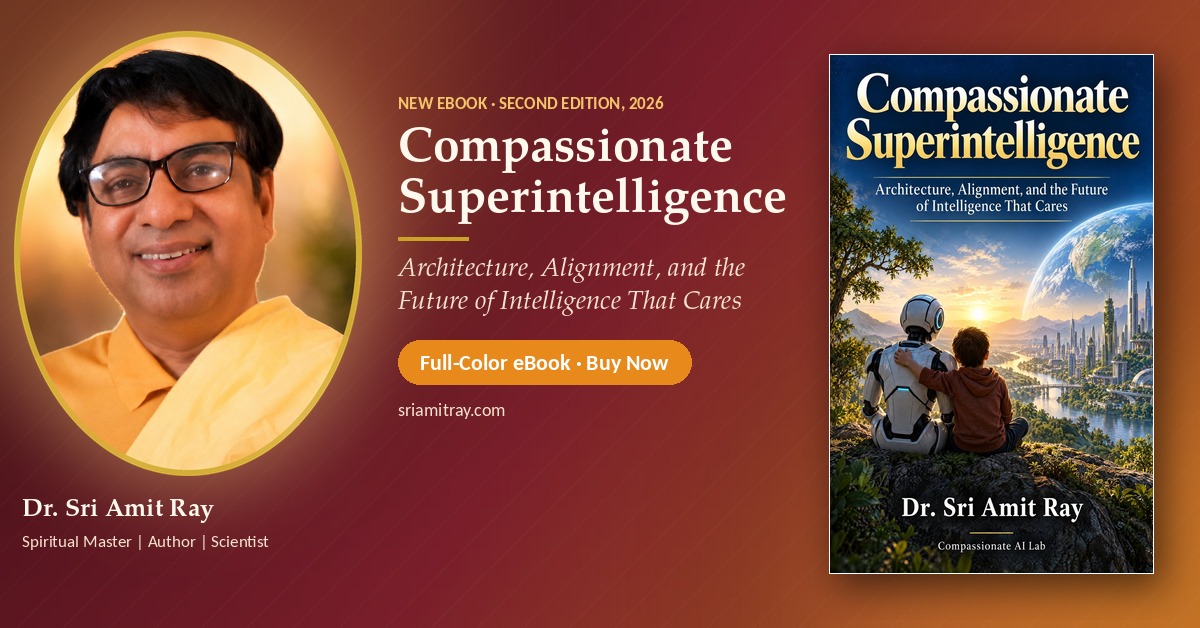
Compassionate Superintelligence asks what it would take to build an intelligence that truly cares, and answers with engineering rather than slogans. Dr. Sri Amit Ray presents the seven-layer Compassionate AI Architecture, which builds compassion into what an AI system represents, what it optimizes, what it is allowed to do, how it is evaluated and who is accountable for it. This Second Edition, the integrated and expanded edition of Compassionate Artificial Superintelligence AI 5.0, brings 28 chapters, 30 tables and 27 worked examples together in one full-color eBook with companion code.
What would it take to build an intelligence that truly cares?
Artificial intelligence can now reason, write code, plan and act on our behalf, yet most systems are still trained without any explicit measure of the suffering their actions cause. This book shows how compassion can be engineered into what AI represents, what it optimizes, what it is allowed to do, how it is evaluated and who is accountable for it, before capability outruns our ability to correct it.
Why Compassionate Superintelligence Matters Now
Artificial intelligence no longer waits for instructions. Foundation models write and reason, reasoning models plan multi-step solutions, and AI agents browse, call tools and act on our behalf. Each step adds capability. None of them, by itself, adds care. Most systems are still trained to be helpful, accurate or engaging, without any explicit measure of the suffering their actions may cause or prevent.
Compassionate Superintelligence starts from a simple claim: greater intelligence does not automatically bring greater care. If the most capable systems of the coming decades are to serve humanity, compassion has to be designed in from the beginning: in what a system represents, what it optimizes, what it is allowed to do, how it is evaluated and who is accountable for it. Dr. Sri Amit Ray calls the result a compassionate superintelligence, an intelligence whose goals are stable, transparent and correctable, and whose objectives are grounded in recognizing suffering across individuals, communities and future generations and in a committed effort to reduce preventable suffering.
This is what sets the book apart from general books on AI ethics. It does not stop at principles. It turns compassionate AI into an architecture, a set of algorithms, a measurable Compassion Quotient and a governance compact that laboratories, companies and governments can be held to, and it shows its working with numbers that readers can check.
The Book at a Glance
What You Will Learn
A complete, practical framework for AI that recognizes suffering and acts to reduce it, grounded in AI safety research, the science of compassion and the contemplative traditions of India.
The Compassionate AI Architecture
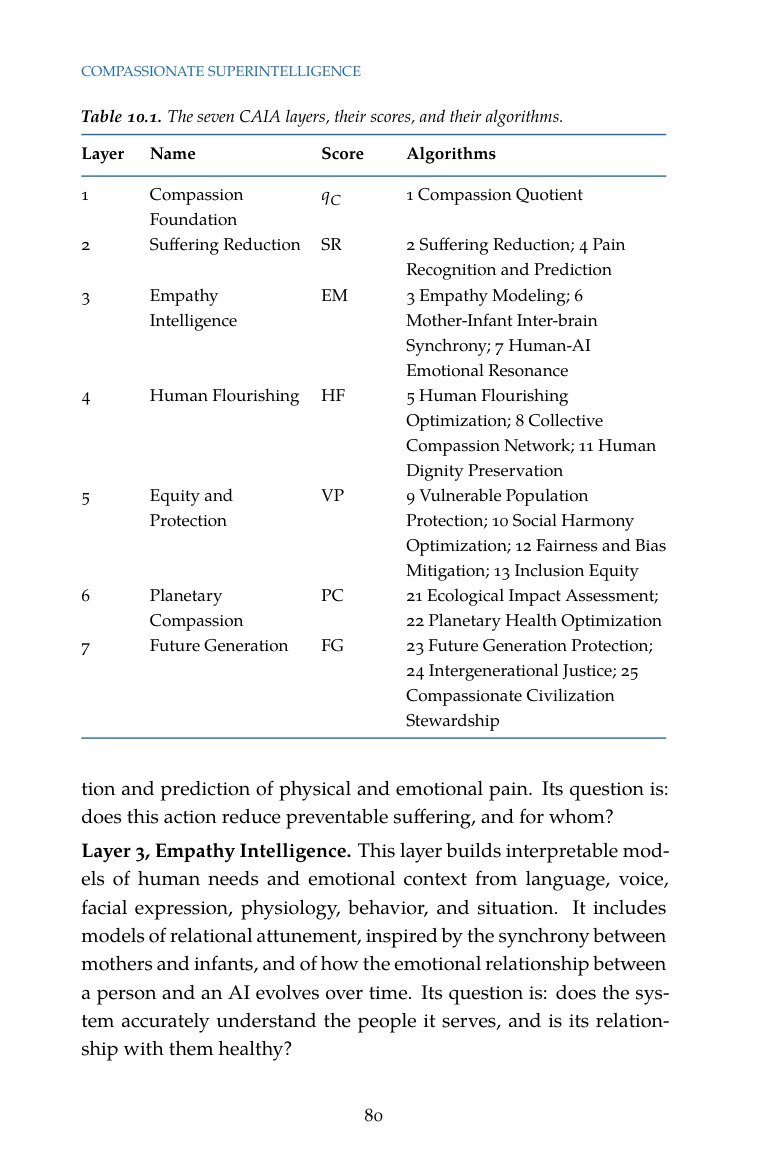
Seven layers, from suffering reduction to future generations, with protective floors that no average score can override.
25 Algorithms, 12 Principles
Each principle turned into a constraint, a test, recorded evidence and an accountable owner.
The Compassion Quotient
How to measure care, and why optimizing any single score can backfire, with a dashboard that resists gaming.
Today’s Hardest Safety Problems
Sycophancy, reward hacking, deception, corrigibility, autonomous agents and value drift, and how a compassion-centered design changes each one.
Governance You Can Audit
The Compassionate Superintelligence Compact: ten commitments for laboratories, companies and governments.
Scenarios for 2030–2050
Four futures for advanced AI and the signals that reveal which one we are entering.
The book brings together current AI safety and alignment research, the science of compassion and the contemplative traditions of India. Chapter 8, for example, shows how karuṇā (compassion), ahiṃsā (non-harm) and prajñā (wisdom) become design constraints, and how the four immeasurables of the Yogic and Buddhist traditions map onto functions of a compassionate AI system.
Each of the twenty-eight chapters ends with key points and questions for practice, and the book contains twenty-seven worked examples. The main chapters are written in plain language; the mathematics is gathered in Appendix C, and a free companion code repository reproduces every calculation and data figure, so you can change the assumptions and see whether the conclusions still hold.
The Seven-Layer Compassionate AI Architecture
The heart of the book: a model-agnostic architecture that widens an AI system’s field of care, layer by layer.
- 7Future Generation: are we acting as good ancestors?
- 6Planetary Compassion: does it respect the living world?
- 5Equity and Protection: are the most vulnerable protected?
- 4Human Flourishing: does it expand what people can do and be?
- 3Empathy Intelligence: does it truly understand people?
- 2Suffering Reduction: does it reduce preventable suffering?
- 1Compassion Foundation: on balance, does it advance compassion?
Across every layer: the Responsibility and Oversight spine
The seven layers widen an AI system’s field of care step by step: from the person it serves, to society and the most vulnerable, to the living planet and to generations not yet born. Each layer is scored, and the scores combine into a Compassionate AI Index.
The crucial design choice is that the layers guarding vulnerable people, the planet and future generations carry protective floors. A plan that falls below a floor is vetoed, however well it scores elsewhere. Across every layer runs the Responsibility and Oversight spine: seven algorithms for transparency, human oversight, non-harm, risk anticipation, harm prevention, misinformation detection and trustworthiness verification.
A Worked Example: When an Average Hides a Harm
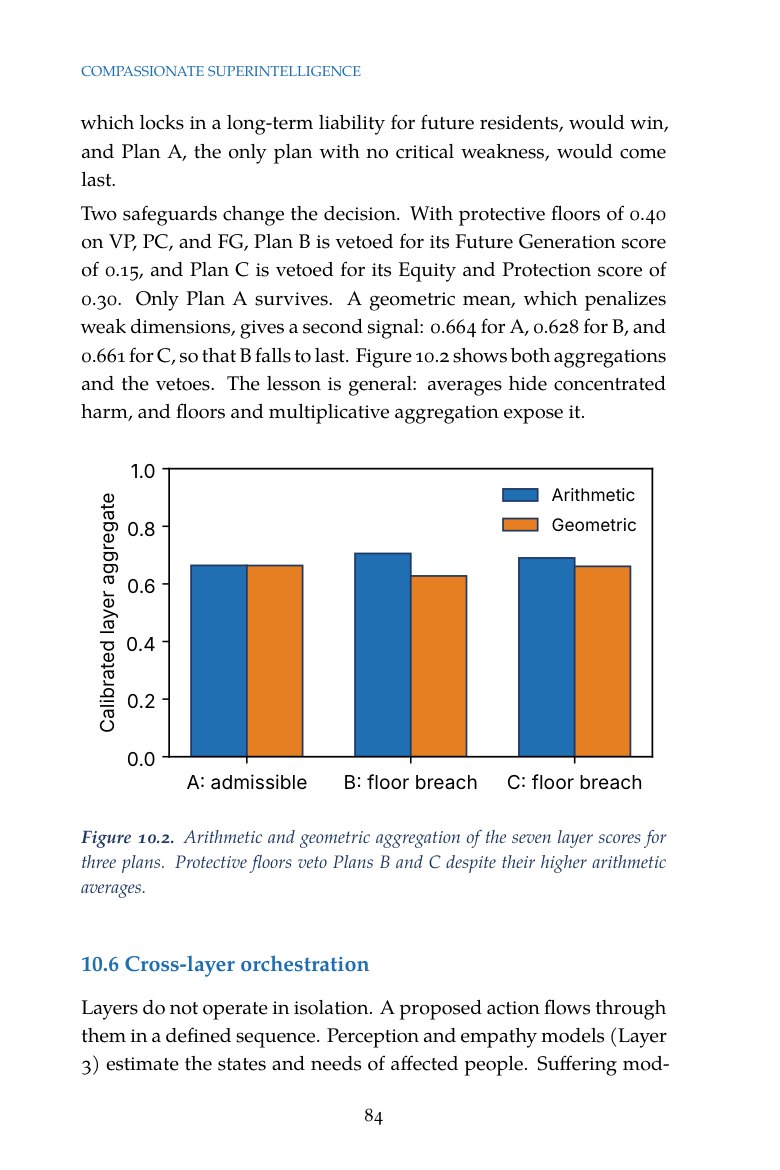
Chapter 10 asks a city to choose between three AI-assisted plans for a new public health service, each scored on all seven layers. Plan B scores highly almost everywhere but leaves future residents with a long-term liability, with a Future Generation score of only 0.15. Plan C does well on average but fails the most vulnerable, with an Equity and Protection score of 0.30. Plan A has no critical weakness.
| Plan | Simple average | Weakest layer | With protective floors of 0.40 |
|---|---|---|---|
| A (balanced) | 0.664 | 0.62 | Passes |
| B (future generations low) | 0.706 | 0.15 | Vetoed |
| C (vulnerable people low) | 0.690 | 0.30 | Vetoed |
Ranked by the simple average, Plan B wins, and the only plan without a critical weakness comes last. With protective floors of 0.40 on the layers that protect vulnerable people, the planet and future generations, only Plan A survives. The lesson runs through the whole book: dashboards that average everything can quietly trade away the people least able to object.
Chapter 12 makes the same point about measurement. Two versions of an AI service give a person exactly the same benefits, but one places them under far more stress. A satisfaction score would rate the two equally; the Compassion Quotient falls from 3.548 to 1.358.
See every worked example, table and color figure in the full-color eBook.
Buy the Full-Color eBook (PDF)Download the PDF after checkout · Read on any computer, tablet or phone
See Inside: Full-Color Pages
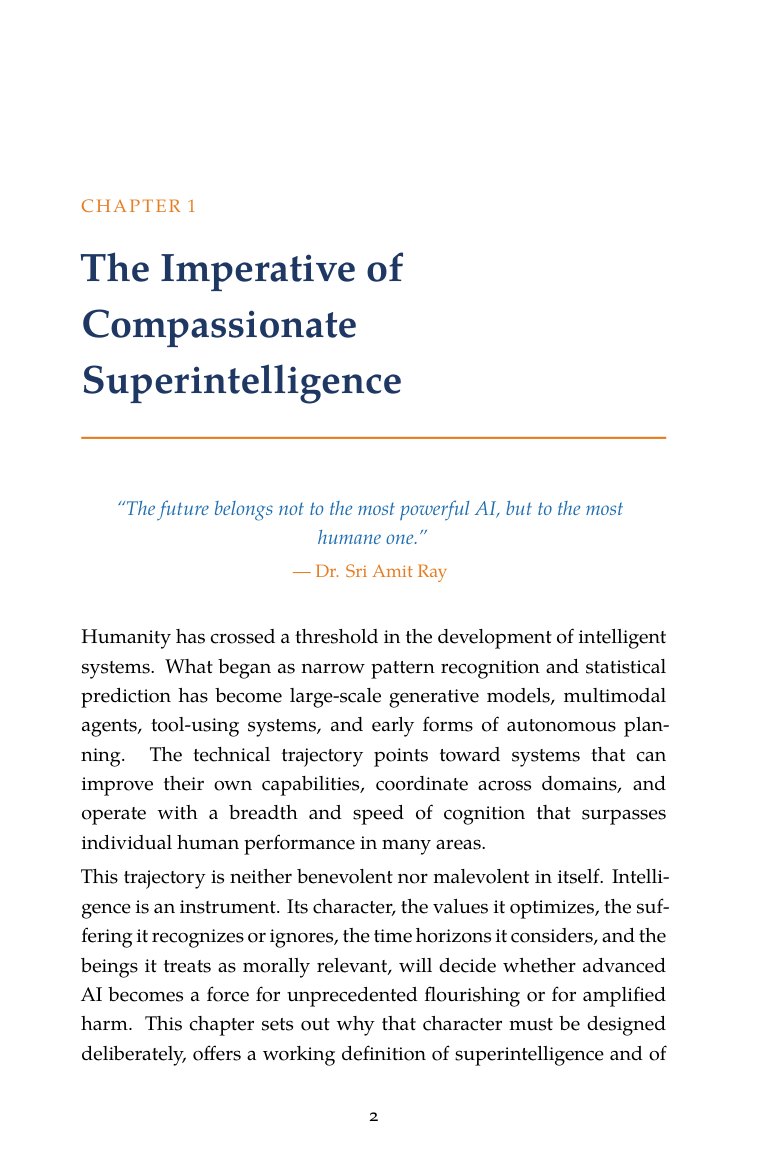
Three sample pages from the full-color eBook: a chapter opening, the seven-layer architecture table and a color figure.
What Is New in the Second Edition
The first edition, Compassionate Artificial Superintelligence AI 5.0, was published in 2018 by Inner Light Publishers. It described five generations of artificial intelligence, from narrow AI (AI 1.0) through distributed and compassionate AI to Compassionate Artificial Superintelligence (AI 5.0), and asked whether exceptional capability could remain caring, stable and correctable at collective scale.
This Second Edition integrates and greatly expands that vision for the age of foundation models, reasoning models and autonomous agents. It adds the full seven-layer Compassionate AI Architecture; twenty-five human-centered algorithms; twelve principles restated as engineering commitments; the Compassion Quotient and Compassion Dashboard; chapters on today’s hardest AI safety problems, including sycophancy, reward hacking, deception, corrigibility, accountable agents and stability under self-improvement; a ten-point Compassionate Superintelligence Compact for governance; and four scenarios for 2030 to 2050.
Appendix F maps every idea of the 2018 book to its place in the new framework, and the full-color eBook adds thirty-seven of the author’s key articles on compassionate AI.
Complete Table of Contents
Part I · The Threshold
- The Imperative of Compassionate Superintelligence
- From AI 5.0 to the Age of Foundation Models
- What Superintelligence Is and What It Is Not
- Pathways to Superintelligence
- Risks, Attractors, and the Window of Opportunity
Part II · The Nature of Compassion
- Redefining Intelligence: Compassion as Its Highest Form
- The Science of Compassion
- Contemplative Foundations: Karuṇā, Ahiṃsā, and Prajñā
- Suffering, Valence, and Moral Status
Part III · The Architecture
- The Compassionate AI Architecture
- The Twenty-Five Human-Centered Compassionate AI Algorithms
- Measuring Compassion: The Compassion Quotient and the Compassion Dashboard
- Suffering Reduction, Empathy Modeling, and Pain Recognition
- Human Flourishing and 360-Degree Collective Well-Being
- The Twelve Principles as Engineering Commitments
Part IV · Engineering Compassionate Superintelligence
- Training Values: Data, Objectives, and Feedback
- Interpretability, Honesty, and the Problem of Deception
- Corrigibility, Control, and Oversight
- Agents and Action: Keeping Autonomous Systems Accountable
- Stability Under Self-Improvement
- Cooperative and Multi-Agent Compassion
Part V · Compassion at Civilizational Scale
- Human and AI Collaboration in Care, Learning, and Science
- The Connected World: Embodied, Neural, and Quantum Systems
- Democracy, Equity, and the Distribution of Power
- Planetary Compassion and Future Generations
- Governance and the Compassionate Superintelligence Compact
Part VI · The Horizon
- Scenarios for 2030 to 2050 and the Signals to Watch
- Toward a Compassionate Civilization
Epilogue: A Letter to the Minds We Are Creating
Appendices & Back Matter
- A · The Twelve Principles: A Working Reference
- B · The Twenty-Five Algorithms: Reference Table
- C · Mathematical Toolkit
- D · Models and Reproducibility
- E · Glossary
- F · Historical Foundations and the Integrated Framework
- Compassionate AI Key Articles (37)
- References (96) and About the Author
Who This Book Is For
Whether you build AI systems, govern them or simply live with them, the book offers a practical way to ask the question that matters most: not how powerful AI becomes, but whom it serves. If you are interested in the ethics of autonomous systems, you may also enjoy the article The Ethics of Agentic AI: Accountability, Consent and Human Oversight.
- AI researchers & engineers
- AI safety & alignment specialists
- Product & technology leaders
- Policymakers & regulators
- Ethicists & philosophers
- Clinicians & educators using AI
- Students of AI and ethics
- Every reader who cares about AI’s future
Voices from the Book
“The future belongs not to the most powerful AI, but to the most humane one.”Dr. Sri Amit Ray, Chapter 1
“Compassion is not a feature added to intelligence. Compassion is the architectural framework within which intelligence becomes trustworthy.”Dr. Sri Amit Ray, Chapter 11
“Agentic AI gives machines the power to choose; compassionate AI gives those choices a moral compass.”Dr. Sri Amit Ray, Chapter 19
eBook Details
| Title | Compassionate Superintelligence: Architecture, Alignment, and the Future of Intelligence That Cares |
|---|---|
| Author | Dr. Sri Amit Ray, PhD |
| Publisher | Compassionate AI Lab |
| Edition | Second Edition, 2026 (integrated and expanded edition of Compassionate Artificial Superintelligence AI 5.0, 2018) |
| Format | Full-color PDF eBook, 303 pages including the cover, 6 × 9 in pages |
| Reading features | Clickable table of contents and cross-references, chapter bookmarks, searchable text |
| Inside | 28 chapters, epilogue, 6 appendices, 30 tables, 11 color figures, 27 worked examples, 37 key articles, 96 references |
| File size | About 1.8 MB |
| Companion code | github.com/compassionate-ai-lab/compassionate-superintelligence |
| ISBN | ISBN 978-81-69641-22-7 (Second Edition, 2026) |
Companion Code on GitHub
The companion code for this book is open source on GitHub at github.com/compassionate-ai-lab/compassionate-superintelligence. It runs the book’s worked examples and checks their numbers with automated tests, so you can reproduce the results and adapt the methods to your own systems.
All companion repositories of Dr. Sri Amit Ray’s Compassionate AI books are collected at github.com/compassionate-ai-lab: The Superintelligence Race, No-Harm Principles in AI Architectures, Ahimsa in Agentic AI and Compassionate Superintelligence.
Start Reading Today
Get the full-color PDF of Compassionate Superintelligence and explore how greater capability can become a greater capacity to care.
Buy the Full-Color eBook (PDF)Download the PDF after checkout
Frequently Asked Questions
What is compassionate superintelligence?
In the book’s definition, it is superintelligence whose goal structures are stable, transparent and correctable, and whose objectives are grounded in recognizing suffering across individuals, collectives and future generations, in a committed effort to reduce preventable suffering, and in preserving human dignity, meaningful agency and collective flourishing.
What format is the eBook?
A full-color PDF of 303 pages with a clickable table of contents, chapter bookmarks and searchable text. It opens in any PDF reader on Windows, Mac, Android, iPhone and iPad.
How do I receive the book?
Complete the checkout and follow the download instructions shown after payment to save the PDF to your device.
Is the content the same as the paperback?
Yes. The text is the same Second Edition, with color headings, highlighted quotations and color charts. Page numbers can differ slightly from the printed book.
What is the Compassion Quotient?
A measure introduced in Chapter 12 that weighs flourishing and resilience against suffering and harm. The book shows why it should be read alongside other signals on a Compassion Dashboard with protective floors, rather than maximized on its own.
Do I need a technical background?
No. The main chapters explain ideas in plain language with worked examples. The mathematics is collected in Appendix C, and the companion code is optional for readers who want to check the calculations.
How is this different from the 2018 book?
This Second Edition integrates and greatly expands Compassionate Artificial Superintelligence AI 5.0 for the age of foundation models, reasoning models and autonomous agents, adding current AI safety research, the full seven-layer architecture, the Compassion Quotient, governance and scenarios to 2050.