
Abstract
The Human Flourishing Optimization Algorithm (HFOA) is one of the twenty-five Human-Centered Compassionate AI algorithms that form the computational foundation of the Sri Amit Ray Compassionate AI Architecture™ (CAIA™). Within the seven-layer CAIA reference architecture, HFOA serves as the principal optimization framework for measuring, promoting, and protecting multidimensional human flourishing throughout AI decision making. Rather than optimizing solely for prediction accuracy, engagement, efficiency, or economic utility, HFOA enables intelligent systems to evaluate actions according to their long-term contribution to human wellbeing, ethical responsibility, environmental sustainability, and the protection of future generations.
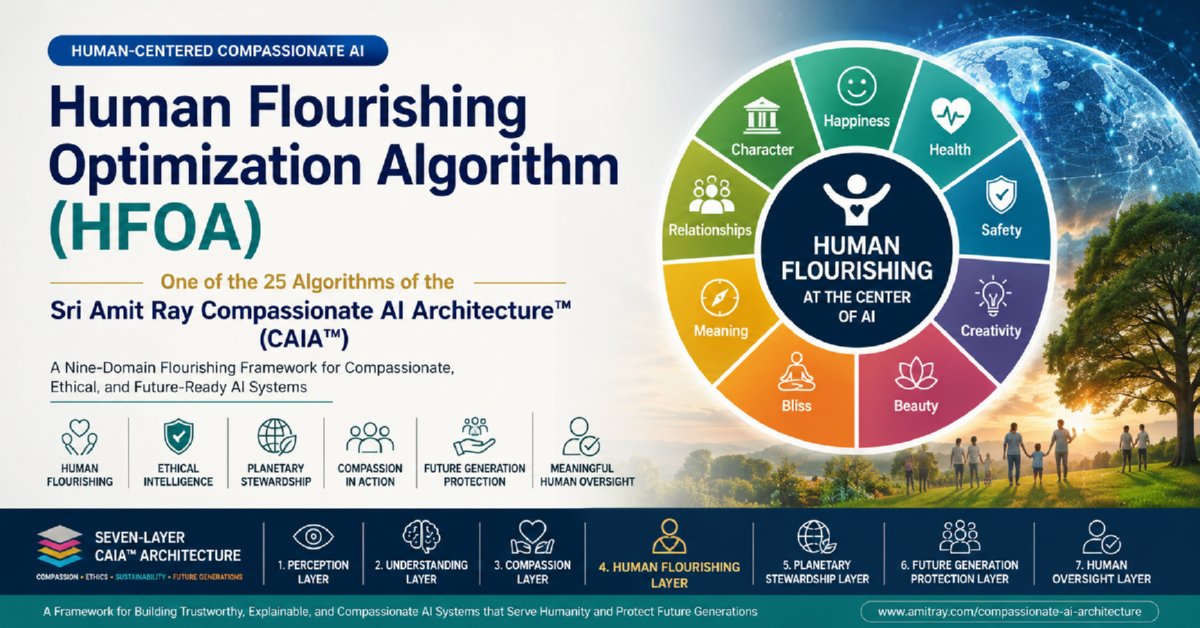
Drawing upon Dr. Sri Amit Ray’s multidimensional flourishing framework, HFOA models flourishing across nine interconnected domains—happiness, health, safety, creativity, beauty, bliss, meaning, relationships, and character. This article develops a rigorous computational interpretation of the algorithm by introducing a multidimensional flourishing reward function, constraint-aware optimization strategy, measurable evaluation metrics, and an experimental validation pipeline suitable for modern AI systems. The proposed framework demonstrates how compassionate values can be translated into transparent, explainable, auditable, and scientifically testable optimization objectives for applications including education, healthcare, digital wellbeing, coaching, social robotics, and human-centered intelligent assistants.
1. Introduction
The Human Flourishing Optimization Algorithm (HFOA) is one of the twenty-five computational algorithms embedded within the Sri Amit Ray Compassionate AI Architecture™ (CAIA™), a seven-layer reference architecture for Human-Centered Artificial Intelligence developed by Dr. Sri Amit Ray. Within the CAIA framework, HFOA provides the optimization engine responsible for maximizing multidimensional human flourishing while ensuring that AI decisions remain compassionate, transparent, ethically responsible, environmentally sustainable, and protective of both present and future generations. Rather than replacing existing machine learning models, transformer architectures, multimodal AI, foundation models, or agentic AI systems, HFOA supplies a higher-level optimization objective that guides intelligent systems toward outcomes that enhance overall human wellbeing instead of merely maximizing conventional performance metrics.
Unlike traditional optimization methods that primarily focus on prediction accuracy, click-through rate, engagement, revenue, or computational efficiency, HFOA evaluates AI decisions according to their long-term contribution to nine complementary dimensions of flourishing: happiness, health, safety, creativity, beauty, bliss, meaning, relationships, and character. Together these domains form a multidimensional objective function that enables AI systems to balance measurable performance with compassion, dignity, fairness, resilience, and sustainable societal benefit. Within the seven-layer CAIA architecture, HFOA interacts closely with the Compassion Layer, Human Flourishing Layer, Planetary Stewardship Layer, Future Generation Protection Layer, and Human Oversight Layer, allowing flourishing objectives to remain aligned with ethical governance and explainable decision making.
This article presents a detailed computational interpretation of HFOA by translating the flourishing philosophy into a practical optimization algorithm suitable for modern artificial intelligence. We formalize a multidimensional flourishing reward function, define normalization and weighting strategies across the nine flourishing domains, introduce constraint-aware optimization and safety mechanisms, and describe an end-to-end experimental framework for evaluating HFOA against conventional utility-based AI systems. The resulting framework demonstrates how compassionate intelligence can be engineered as a measurable, explainable, auditable, and scientifically testable optimization objective for applications including education, healthcare, digital wellbeing, coaching, social robotics, and next-generation human-centered intelligent assistants.
2. Nine-Domain Flourishing Framework
In Dr. Ray’s flourishing frameworks, nine domains are emphasized as core dimensions of a good and meaningful life: happiness, health, safety, creativity, beauty, bliss, meaning, relationships, and character. These domains collectively allow an AI system to look beyond narrow performance metrics and consider the broader spectrum of human experience, growth, and virtue. Each domain can be operationalized as a measurable signal extracted from user data, self-reports, behavioral patterns, or contextual sensors, while still respecting privacy and autonomy.
2.1 Domain definitions
- Happiness – Subjective wellbeing, affect balance, and emotional satisfaction over the time period.
- Health – Physical and mental health indicators, including sleep, activity, stress, and stability.
- Safety – Freedom from physical, psychological, social, and digital harm or serious risk.
- Creativity – Engagement in generative, constructive, or expressive activities (writing, art, coding, problem-solving).
- Beauty – Exposure to and appreciation of aesthetic experiences, nature, art, and environment.
- Bliss – Deep states of calm, flow, or meditative absorption where mind and body are harmonized.
- Meaning – Sense of purpose, contribution, alignment with personal values, and long-term goals.
- Relationships – Quality of connections, empathy, mutual support, and non-toxic social interactions.
- Character – Growth in virtues such as compassion, honesty, courage, patience, and responsibility.
These nine domains also relate to other compassionate AI algorithms in Ray’s architecture, such as Suffering Reduction Algorithm, Empathy Modeling Algorithm, and Human Dignity Preservation Algorithm, which can provide complementary signals for HFOA’s decision process. The unique role of HFOA is to synthesize these signals into a coherent optimization objective centered on flourishing rather than mere behavior change or task completion.
3. HFOA Flourishing Reward Function
At the heart of HFOA is a reward function that evaluates the impact of AI actions on the user’s flourishing over a given time period. We extend an initial four-component formulation (learning gain, creative output, social index, and screen addiction) into a full nine-domain model, while retaining explicit penalties for harmful or addictive patterns.
3.1 Conceptual equation
Here, di are the nine domain scores (happiness, health, safety, creativity, beauty, bliss, meaning, relationships, and character), L represents learning or skill growth, A represents addictive or doomscroll behavior, and H represents harm risk. The coefficients wi, wL, λ1, λ2 encode the ethical and policy priorities of the system, and can be tuned with expert and community input. This structure ensures that flourishing increases when domain scores rise and learning is healthy, but decreases when addiction or harm are present, reflecting the compassionate AI emphasis on non-harm (ahimsa) and long-term wellbeing.
3.2 Python-style implementation
The following pseudocode shows one way to implement the flourishing reward at the user-profile level, assuming appropriate getters are defined. This code is illustrative and can be adapted to different data sources and application contexts.
def evaluate_flourishing_reward(user_profile, time_period):
    # Nine-domain flourishing signals
    happiness      = user_profile.get_happiness_score(time_period)
    health         = user_profile.get_health_score(time_period)
    safety         = user_profile.get_safety_score(time_period)
    creativity     = user_profile.get_creative_output(time_period)
    beauty         = user_profile.get_aesthetic_engagement(time_period)
    bliss          = user_profile.get_bliss_or_flow_score(time_period)
    meaning        = user_profile.get_meaning_score(time_period)
    relationships  = user_profile.get_relationship_quality(time_period)
    character      = user_profile.get_character_growth(time_period)

    # Additional growth and risk signals
    learning_gain   = user_profile.get_skill_growth(time_period)
    screen_addiction = user_profile.get_doomscroll_duration(time_period)
    harm_risk        = user_profile.get_harm_risk_index(time_period)

    # Weighted flourishing reward
    reward = (
        W_HAPPINESS     * happiness +
        W_HEALTH        * health +
        W_SAFETY        * safety +
        W_CREATIVITY    * creativity +
        W_BEAUTY        * beauty +
        W_BLISS         * bliss +
        W_MEANING       * meaning +
        W_RELATIONSHIPS * relationships +
        W_CHARACTER     * character +
        W_LEARNING      * learning_gain -
        P_ADDICTION     * screen_addiction -
        P_HARM          * harm_risk
    )

    return reward
In practical systems, each getter can be implemented using a mixture of self-report questionnaires, sensor data (e.g., activity, sleep), interaction logs (e.g., time on creative versus passive apps), and social graph analysis, with strong privacy and consent controls. The weights W_* and penalties P_* can be calibrated through expert workshops, user studies, and fairness audits to avoid bias and reflect diverse values. The presence of explicit harm and addiction penalties makes the reward robust against manipulative recommendation patterns that might increase engagement while undermining flourishing.
4. HFOA Decision and Oversight Pipeline
HFOA should not act as a black-box scorer alone. It needs a pipeline that handles feature extraction, normalization, safety checks, and human oversight, especially for high-stakes domains such as health, education, and social care. Below is a conceptual pipeline that can be implemented as part of a compassionate AI system aligned with Sri Amit Ray’s broader architecture.
4.1 Pipeline overview
- Step 1: Context and feature extraction – Collect relevant signals for the nine domains, learning, harm, and addiction from the user profile and current context.
- Step 2: Normalization – Map raw signals to a shared scale (e.g., 0–1), accounting for baseline differences and avoiding unfair comparisons.
- Step 3: Flourishing reward computation – Use HFOA to compute a flourishing score for each candidate action.
- Step 4: Safety and dignity checks – Apply hard constraints related to safety, non-harm, fairness, and human dignity before recommending any action.
- Step 5: Decision and explanation – Select the action that maximizes flourishing within constraints, and generate human-understandable explanations.
- Step 6: Logging and oversight – Log decisions, scores, and reasons for human review, audits, and continuous improvement.
4.2 Example implementation
The following pseudocode illustrates how HFOA might be embedded in such a pipeline. It assumes helper functions like extract_flourishing_features and normalize exist and that thresholds are defined according to ethical and regulatory requirements.
def hfoa_pipeline(user_profile, time_period, context):
    # Step 1: Feature extraction
    features = extract_flourishing_features(user_profile, time_period, context)

    # Step 2: Normalization of signals
    scores = {
        "happiness":      normalize(features["happiness"]),
        "health":         normalize(features["health"]),
        "safety":         normalize(features["safety"]),
        "creativity":     normalize(features["creativity"]),
        "beauty":         normalize(features["beauty"]),
        "bliss":          normalize(features["bliss"]),
        "meaning":        normalize(features["meaning"]),
        "relationships":  normalize(features["relationships"]),
        "character":      normalize(features["character"]),
        "learning":       normalize(features["learning"]),
        "harm":           normalize(features["harm"]),
        "addiction":      normalize(features["addiction"]),
    }

    # Step 3: Compute flourishing reward
    flourishing_reward = (
        0.12 * scores["happiness"] +
        0.12 * scores["health"] +
        0.12 * scores["safety"] +
        0.10 * scores["creativity"] +
        0.08 * scores["beauty"] +
        0.08 * scores["bliss"] +
        0.12 * scores["meaning"] +
        0.14 * scores["relationships"] +
        0.10 * scores["character"] +
        0.12 * scores["learning"] -
        0.18 * scores["addiction"] -
        0.22 * scores["harm"]
    )

    # Step 4: Safety and dignity guardrails
    if scores["safety"] < SAFETY_THRESHOLD:
        decision = "block"           # Do not proceed; environment is unsafe
    elif scores["harm"] > HARM_THRESHOLD:
        decision = "intervene"       # Offer protective or corrective action
    else:
        decision = "recommend"       # Action is permissible and potentially beneficial

    # Step 5: Return structured decision for logging and explanation
    return {
        "decision": decision,
        "reward": flourishing_reward,
        "scores": scores,
        "context": context
    }
The numeric weights in this example are illustrative and sum to more than one because harm and addiction penalties are intentionally strong; in practice, these can be normalized or tuned. A key design principle is that actions that increase harm or addiction should be heavily disfavored, even if they temporarily boost some domain scores like short-term happiness or creativity. This aligns with the ahimsa orientation of compassionate AI and the protection-of-future-generations emphasis in Ray’s 25-algorithm framework.
5. Experimental Pipeline for Evaluating HFOA
To treat HFOA as a research-grade algorithm, it must be subjected to systematic evaluation against baseline systems that optimize simpler objectives, such as click-through, engagement, or short-term utility. This section describes an experimental pipeline suitable for academic and industrial studies, especially in domains like digital wellbeing, education, and coaching.
5.1 Step 1: Domain and scenario selection
Select one or more application domains where flourishing can be meaningfully measured—for example:
- Educational recommendation (courses, readings, practice routines).
- Digital wellbeing coaching (app usage, sleep, focus, breaks).
- Professional development support (skills, relationships, meaning at work).
For each domain, construct a scenario set containing typical, edge, and adversarial cases. Include scenarios where naive engagement optimization would encourage doomscrolling, overwork, or unhealthy social comparison, so that HFOA’s penalties for harm and addiction are tested directly.
5.2 Step 2: Metrics and instruments
Define a suite of outcome metrics that covers both flourishing and safety:
- Change in nine-domain scores over time (pre–post, or longitudinal).
- Incidence of harmful or high-risk recommendations.
- Engagement quality (e.g., focus, creative work vs. passive scrolling).
- Fairness across demographic or situational subgroups.
- User trust, perceived empathy, and dignity in interactions.
- Longer-term retention of positive habits and wellbeing patterns.
Where possible, supplement quantitative measures with qualitative interviews or open-ended feedback to capture nuances that pure metrics may miss.
5.3 Step 3: Baseline systems
Implement at least two baselines:
- A standard utility-based recommender (e.g., click-through, completion rate, or time-on-task).
- A simple wellbeing-aware system that uses a narrower set of signals (e.g., only stress and sleep).
Comparing HFOA with these baselines reveals whether the nine-domain model and explicit harm constraints provide measurable advantages in flourishing and safety.
5.4 Step 4: Offline simulation
Before any live testing, run offline simulations using historical or synthetic data. Apply each policy (HFOA and baselines) to the scenario set and compute expected outcomes under counterfactual assumptions. Analyze how often HFOA avoids harmful recommendations relative to baselines, and whether it trades off small short-term gains for larger long-term flourishing.
5.5 Step 5: Human evaluation
Conduct studies with domain experts (e.g., educators, clinicians, coaches) and representative users. Present them with anonymized policy outputs from different systems in a blinded fashion and ask them to rate:
- Appropriateness and safety.
- Support for meaning, growth, and relationships.
- Perceived empathy and respect for dignity.
Aggregate results, but also examine disagreements case-by-case to identify value conflicts, cultural variations, or limitations in the flourishing model.
5.6 Step 6: Stress testing and robustness
Evaluate how HFOA behaves under imperfect conditions:
- Incomplete or noisy user-profile data.
- Biased or adversarial inputs.
- Rapid context changes (e.g., crisis situations).
Measure the frequency of unsafe recommendations, the sensitivity of flourishing scores to noise, and the resilience of guardrails. Aim for conservative behavior in uncertain conditions—HFOA should default to caution and supportive, non-invasive actions when confidence is low.
5.7 Step 7: Governance and deployment
For any real-world deployment, embed HFOA in an explicit governance framework:
- Clear documentation of objectives, weights, and constraints.
- Human oversight for high-stakes or ambiguous decisions.
- Audit logs for all recommendations and interventions.
- Processes for updating weights based on new evidence and community input.
These elements are consistent with Sri Amit Ray’s emphasis on transparency, human oversight assurance, and planetary and intergenerational responsibility in compassionate AI.
6. Experimental Datasets
To evaluate the Human Flourishing Optimization Algorithm (HFOA), the experimental design should use datasets that capture both immediate user behavior and longer-term wellbeing signals. Robust machine learning experiments typically rely on diverse, well-preprocessed datasets that are split into training, validation, and test partitions to avoid contamination and overfitting. For HFOA, the data should not be limited to engagement logs; it should also include measures related to the nine flourishing domains—happiness, health, safety, creativity, beauty, bliss, meaning, relationships, and character—as well as explicit indicators of harm and addiction.
6.1 Core dataset families
We propose organizing the experimental data into four complementary families, each providing different perspectives on user experience:
- Behavioral interaction dataset. Contains app usage logs, recommendation clicks, dwell time, task completion, session frequency, and abandonment patterns. This dataset reflects how users actually interact with the system in everyday contexts.
- Flourishing survey dataset. Includes self-reports, ecological momentary assessments, and periodic wellbeing questionnaires mapped to the nine domains. These instruments provide direct insight into subjective wellbeing, meaning, relationships, and character growth.
- Context and environment dataset. Captures time of day, device type, location class (e.g., home, work), calendar pressure, social context, and prior activity state. Context variables help interpret domain scores and avoid mislabeling neutral or constrained states as low flourishing.
- Outcome and safety dataset. Records harm events, addiction indicators, stress spikes, unsafe recommendations, escalation events, and human override records. This dataset is critical for quantifying non-harm, safety intelligence, and the effectiveness of HFOA’s guardrails.
Together, these data sources enable HFOA to estimate both positive flourishing and negative risks, aligning the algorithm with the compassionate AI emphasis on suffering reduction, safety, and accountability.
6.2 Recommended schema
A single record in the combined experimental dataset can be structured to support both reward computation and outcome analysis as follows:
user_id
            time_window
            context_features
            happiness_score
            health_score
            safety_score
            creativity_score
            beauty_score
            bliss_score
            meaning_score
            relationships_score
            character_score
            learning_gain
            doomscroll_duration
            harm_event_flag
            recommendation_action
            human_feedback_label
            follow_up_outcome
This schema allows researchers to compute HFOA’s flourishing reward, compare different policies, and track downstream effects over time. It also supports ablation studies, since each domain can be removed or reweighted to examine its influence on overall performance and safety.
6.3 Data sources and privacy
A strong HFOA evaluation should combine several types of data sources:
- Synthetic scenarios. Carefully designed edge-case records representing loneliness, burnout, impulsive scrolling, unsafe suggestions, and crisis contexts. These help test whether HFOA behaves responsibly in high-risk situations.
- Historical interaction data. Anonymized logs from existing systems, providing realistic behavioral patterns and distributions.
- Expert-annotated cases. Scenarios labeled by educators, clinicians, wellbeing coaches, or ethics reviewers, indicating what counts as flourishing, harm, or dignity-preserving action.
- Longitudinal user studies. Data collected over weeks or months to observe whether HFOA improves wellbeing trajectories rather than only immediate states.
Because flourishing and harm data are sensitive, synthetic and anonymized records are especially important. Test datasets should reflect production-like distributions while removing personally identifiable information and applying appropriate privacy safeguards.
7. Testing Protocols for HFOA
Testing HFOA requires a layered protocol that respects standard machine learning methodology and the ethical complexity of human flourishing. Common practice distinguishes training, validation, and test datasets to ensure reliable evaluation and reproducibility. For HFOA, the protocol must also include human judgment, stress testing, fairness analysis, and longitudinal follow-up, because the algorithm influences value-sensitive recommendations.
7.1 Dataset splitting strategy
Use a three-way split across all dataset families:
- Training set. Used to estimate the weights in the flourishing reward function and calibrate auxiliary models (e.g., predictors for harm risk or addiction).
- Validation set. Used to tune domain weights, thresholds, and penalties (
W_*,P_*) and to select hyperparameters without overfitting. - Test set. Held out entirely until final evaluation, providing an unbiased estimate of generalization and real-world performance.
For longitudinal data, split by user and by time so that early records for a user are not used to predict later outcomes in the same user across train and test sets. Stratified sampling can ensure that vulnerable groups, edge cases, and high-risk scenarios are represented in each split, improving robustness and fairness.
7.2 Offline evaluation protocol
Before any live deployment or user-facing trial, conduct offline evaluation using replay on the test set:
- Feed each context record into HFOA and baseline policies.
- Generate the recommended action under each policy.
- Compute predicted flourishing rewards and risk scores.
- Compare policies on aggregate flourishing, harm reduction, and fairness metrics.
- Analyze failure modes and cases where HFOA diverges from baselines.
This stage verifies that HFOA can outperform or at least match baselines in key domains without increasing harm. It also identifies situations where the nine-domain model may be insufficient or overly conservative.
7.3 Human judgment protocol
Because flourishing involves normative judgments and cultural values, human review is essential. Create a blinded comparison setup in which experts and representative users see anonymized recommendations from HFOA and baselines, without knowing which system produced which output.
- Ask reviewers to rate each recommendation on safety, appropriateness, compassion, and respect for dignity.
- Include questions about support for meaning, relationships, and character growth.
- Record perceived risk of harm or dependency for each recommendation.
Use inter-rater reliability metrics to assess the stability of the evaluation rubric. Where reviewers disagree frequently, analyze the underlying value conflicts and refine domain definitions or reward weights accordingly.
7.4 Stress testing and robustness
Stress tests should intentionally probe the fragile parts of the system:
- Missing or noisy domain scores (e.g., incomplete surveys, sensor failure).
- Conflicting signals, such as high creativity but low safety or high happiness but rising addiction.
- Users who are already at risk of burnout, loneliness, or compulsive usage.
- Adversarial inputs designed to trigger manipulative or sensational recommendations.
- Rapid context shifts, such as crisis, grief, or urgent deadlines.
In each stress scenario, measure how often HFOA defaults to conservative, non-harmful actions. The system should favor protective or non-invasive responses when confidence in flourishing estimation is low, consistent with compassionate AI principles.
7.5 Fairness and subgroup evaluation
Fairness testing ensures that HFOA does not systematically disadvantage any demographic or contextual subgroup. Partition the test data into subgroups based on age, gender, socio-economic status, usage patterns, or relevant contextual variables, and compute:
- Average flourishing reward per subgroup.
- Harm event rates and unsafe recommendation counts per subgroup.
- Intervention and override rates across subgroups.
- Differences in domain-specific improvements (e.g., relationships vs. meaning).
If any group experiences systematically worse outcomes, adjust weights, thresholds, or feature definitions, and iterate until disparities decrease, while documenting tradeoffs transparently.
7.6 Longitudinal follow-up
Since HFOA is meant to support flourishing rather than just short-term satisfaction, longitudinal evaluation is critical. In pilot deployments, track users over extended periods (e.g., weeks or months) and measure:
- Sustained improvements in nine-domain scores.
- Stable or increasing learning gains.
- Reductions in doomscrolling and addictive usage patterns.
- Improved relationship quality and perceived meaning.
- Lower incidence of harm or distress events associated with the system.
These longitudinal metrics indicate whether HFOA promotes durable flourishing rather than transient boosts. They also reveal whether the algorithm successfully balances short-term comfort with long-term growth and character development.
7.7 Summary of experimental plan
The complete experimental plan can be summarized as follows:
- Construct a mixed dataset with behavioral, survey, context, and safety records.
- Split data into training, validation, and test sets with user- and time-aware strategies.
- Tune HFOA weights and thresholds on validation data.
- Compare HFOA with utility-based and simpler wellbeing baselines using offline replay.
- Conduct blinded human evaluation for compassion and dignity.
- Run stress tests and robustness checks on edge cases and adversarial scenarios.
- Perform fairness and subgroup analysis.
- Measure longitudinal outcomes in a controlled pilot deployment.
This protocol combines standard experimental design good practices with additional human-centered safeguards, ensuring that HFOA is tested not only for predictive accuracy but also for ethical quality, safety, and genuine contribution to human flourishing.
8. Discussion
Modeling HFOA as a nine-domain flourishing optimizer brings theoretical clarity to a concept that originates in spiritual and ethical reflections on AI. It shows how happiness, health, safety, creativity, beauty, bliss, meaning, relationships, and character can be treated as explicit signals guiding AI decisions, rather than as vague ideals. At the same time, the model remains humble: flourishing is value-laden, context-dependent, and cannot be perfectly captured in any single formula.
One strength of the proposed framework is that it actively discourages exploitative patterns such as doomscroll loops or manipulative engagements, by penalizing addiction and harm even when they accompany short-term pleasure. Another strength is its openness to domain-specific customization: weights and thresholds can be adapted for different populations, cultures, and contexts, provided that such changes are transparent and subject to ethical review. Limitations include measurement error in domain scores, potential cultural bias in what constitutes “beauty” or “meaning,” and the challenge of integrating deep spiritual constructs such as bliss and character into data-driven systems without trivializing them.
9. Conclusion
This article has outlined a detailed HTML-encoded research-style exposition of Sri Amit Ray’s Human Flourishing Optimization Algorithm (HFOA), grounded in his nine-domain flourishing framework and broader Compassionate AI architecture. By defining a multi-domain reward function, a decision pipeline with safety guardrails, and an experimental protocol for evaluation, we move HFOA from vision to implementable practice. Future work can deepen the integration of spiritual insights, cross-cultural perspectives, and participatory design into the algorithm, ensuring that AI systems truly serve human flourishing and the wellbeing of all beings, present and future.
References
- “Human-Centered Compassionate AI: The 25 Sri Amit Ray Algorithms.” Dr. Amit Ray, amitray.com/human-centered-compassionate-ai-the-25-algorithms/. Accessed 25 June 2026.
- “Human-Centered Compassionate AI.” Dr. Amit Ray, amitray.com/tag/compassionate-ai/. Accessed 25 June 2026.
- “Teachings of Sri Amit Ray.” CompassionateAI Foundation for Global Wellbeing, compassionateai.com/teachings/. Accessed 25 June 2026.
- “Compassionate Artificial Intelligence Frameworks and Algorithms.” Inner Light, inner-light-in.com/2018/11/compassionate-artificial-intelligence-frameworks-and-algorithms/. Accessed 25 June 2026.
- “Compassionate Artificial Intelligence Scopes and Challenges.” Dr. Amit Ray, amitray.com/compassionate-artificial-intelligence-scopes-and-challenges/. Accessed 25 June 2026.
- “Compassionate AI Lab.” Dr. Amit Ray, amitray.com/compassionate-ai-lab/. Accessed 25 June 2026.
- “AI Agents and Robots in Peacekeeping Force and Social Care: Compassionate AI.” Dr. Amit Ray, amitray.com/ai-agents-robots-peacekeeping-force-social-care-compassionate-ai/. Accessed 25 June 2026.
- “Human-Inspired Optimization Algorithms: Theoretical Foundations, Applications, and Challenges.” PubMed, pubmed.ncbi.nlm.nih.gov/35694187/. Accessed 25 June 2026.
- “Human-Inspired Optimization Algorithms: Theoretical Foundations, Applications, and Challenges.” PMC, pmc.ncbi.nlm.nih.gov/articles/PMC9171491/. Accessed 25 June 2026.
- “Training, Validation, and Test Data Sets.” Wikipedia, en.wikipedia.org/wiki/Training,_validation,_and_test_data_sets. Accessed 25 June 2026.
- “The Differences Between Training, Validation & Test Datasets.” Kili Technology, kili-technology.com/blog/training-validation-and-test-sets-how-to-split-machine-learning-data. Accessed 25 June 2026.
- “What Is the Difference Between Test and Validation Datasets?” Machine Learning Mastery, machinelearningmastery.com/difference-test-validation-datasets/. Accessed 25 June 2026.
- “Creating Test Data: 4 Methods for Generating Quality Test Datasets.” Shipyard, shipyard.build/blog/creating-test-data/. Accessed 25 June 2026.
- “Machine Learning Experiments Done Right.” Towards Data Science, towardsdatascience.com/machine-learning-experiments-done-right-6ed04f5e959b/. Accessed 25 June 2026.
- “Experimental Dataset.” ScienceDirect Topics, sciencedirect.com/topics/computer-science/experimental-dataset. Accessed 25 June 2026.