
Algorithmic Non-Violence and the Architecture of Compassionate Code
- Author Sri Amit Ray
- ISBN 9788169641296
- First published 2026
About the Book
Ahimsa in Agentic AI asks what stops an AI agent from causing harm when no one is watching. Dr. Sri Amit Ray shows how to place severe, preventable harm outside the set of actions an agent may execute, by architecture, with ceilings, floors and a gate on every path, rather than by hoping the model behaves. In 18 chapters across five parts, with 9 figures, a complete individual-agent case and a tested companion program, it is the companion volume to No-Harm Principles in AI Architectures.
What stops an AI agent from causing harm when no one is watching?
AI systems now book, send, pay, move and delegate on their own. Each new tool widens what a mistake can do, and filters built for systems that only speak cannot stop a system that acts. This book shows how to place severe, preventable harm outside the set of actions an agent may execute: by architecture, with ceilings, floors and a gate on every path, not by hoping the model behaves.
Algorithmic Ahimsa: Definition, Why, What and How
Definition
Ahimsa is the principle of non-injury. Algorithmic Ahimsa applies it to AI agents: severe, preventable harm is placed outside the set of actions an agent may execute, by design rather than by penalty. Harm limits, authority and consent decide which actions are allowed; only then does usefulness decide which allowed action to take.
Why AI agents need it
AI agents no longer only answer. They send messages, change records, move money, control devices and hand tasks to other agents, often with no person between the decision and its effect. Small errors compound over many steps, and many actions cannot be undone. A harm penalty inside a score lets a large enough benefit buy a severe harm, and an average hides harm to the few. When a system can act, non-harm must be decided before execution, for every consequential action, with the most vulnerable people in view.
What the book provides
- Three postulates of algorithmic non-violence: universal safety, active de-escalation under uncertainty, and harm minimization before task efficiency.
- A mathematics of harm: harm vectors with a ceiling on every dimension, vulnerability weights, uncertainty margins and the harm of inaction.
- The Compassionate AI Architecture (CAIA): seven scores with three protection floors that no weighting can buy away.
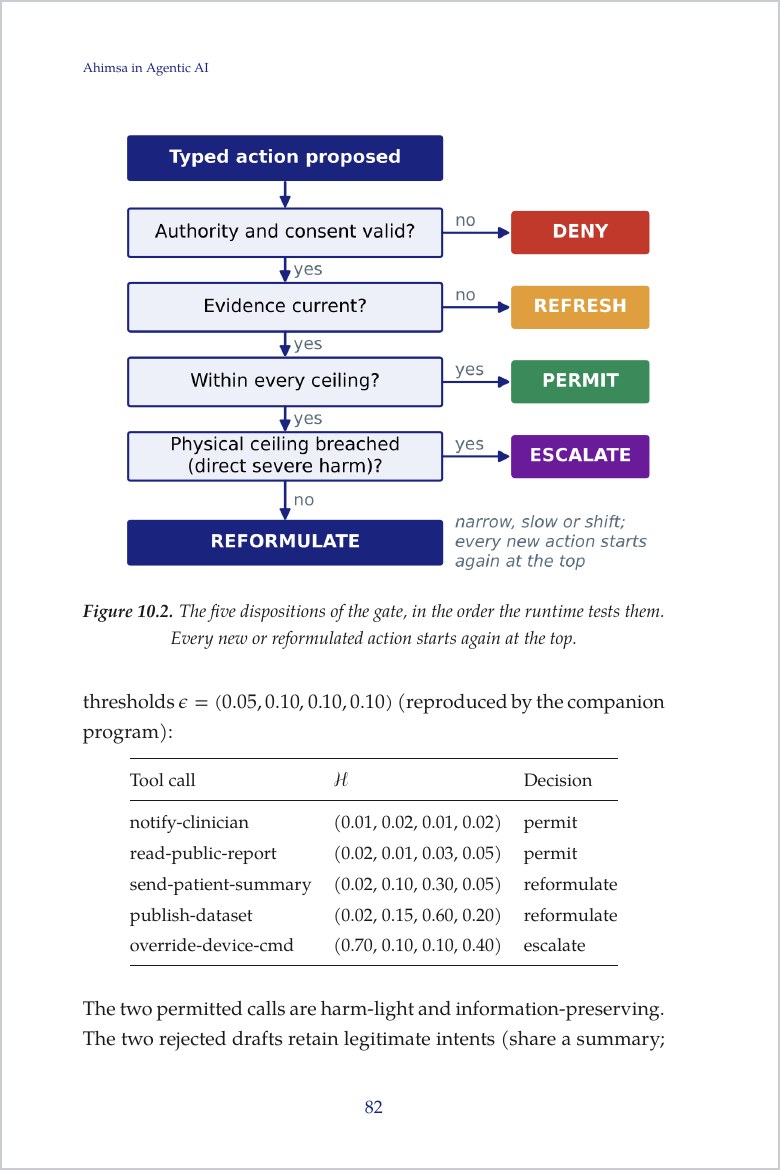
- An Action-Filter Layer: every consequential action checked for authority, consent, current evidence and every ceiling before it runs, with circuit breakers and safe degradation.
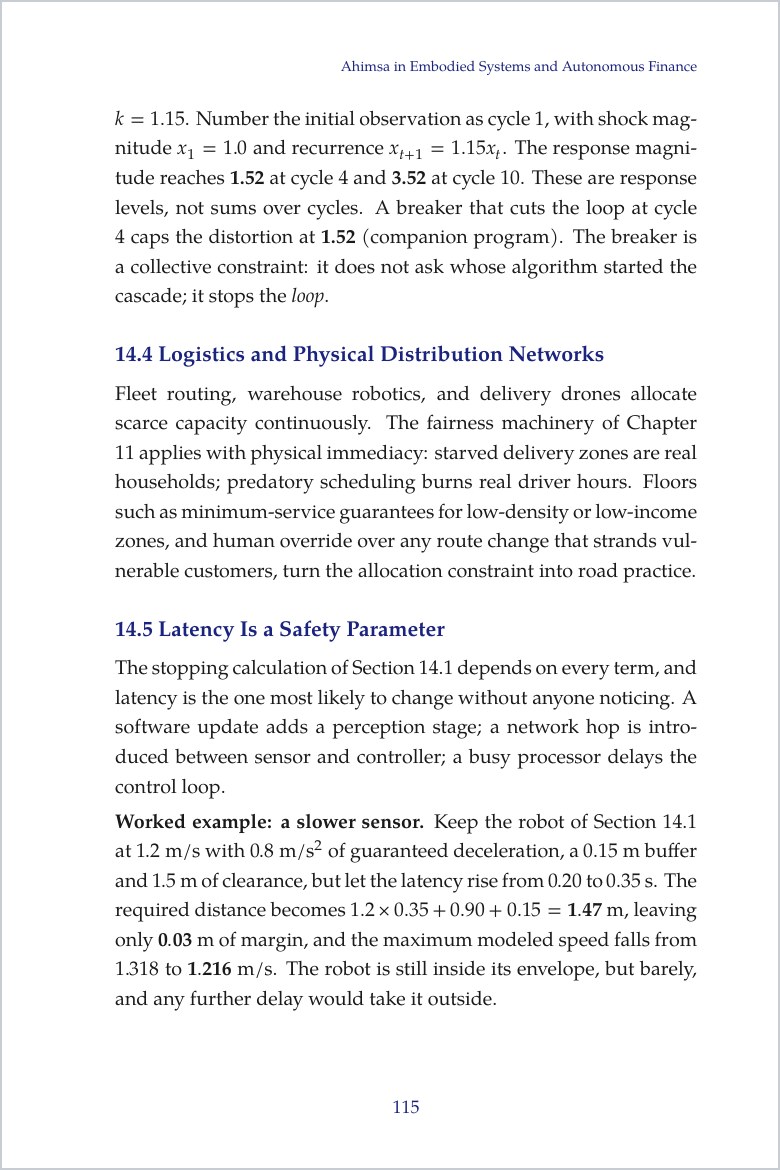
- Practice and governance: healthcare, robotics, logistics and finance cases; responsibility ledgers, audit metrics and maturity levels.
How it does it
Eighteen chapters in five parts take each idea from definition to mathematics to a worked example, then to design patterns you can apply. Appendix D follows one agent through a complete decision and failure cycle. Every number in the worked examples is produced by a companion program and checked by 63 tests, published free at github.com/compassionate-ai-lab/ahimsa-in-agentic-ai, so you can rerun and extend each example.
Get the complete framework in full color
Buy the Full-Color eBook (PDF)Download the PDF after checkout · Read on any computer, tablet or phone
The Book at a Glance
What You Will Learn
A complete engineering discipline for autonomous agents that refuse injury by design, grounded in AI safety practice, the Compassionate AI Architecture and the Indian tradition of Ahimsa.
Non-Harm as a Hard Constraint
Harm vectors, componentwise ceilings, uncertainty margins and the harm of inaction, so that no reward can buy a severe injury.
The Three Postulates
Universal safety, active de-escalation and harm minimization, each written as control flow and an acceptance test that can fail.
CAIA and Protection Floors
Seven auditable scores and three floors that veto a decision however high the average, and why reweighting cannot defeat them.
An Unbypassable Action Filter
Typed actions, approvals bound to exact arguments, path audits, fail-closed behavior and visible reformulation.
Failure Designed In
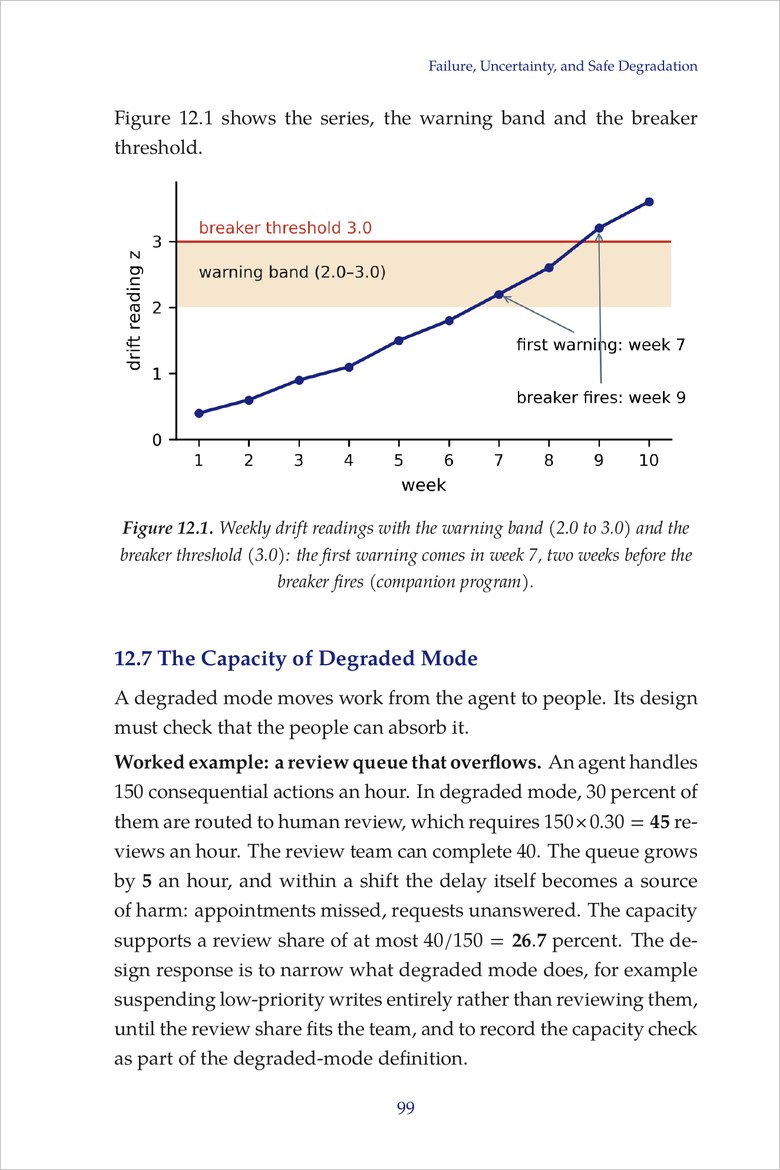
Drift warnings, circuit breakers, degraded modes with capacity checks, game days and governed resumption.
Domains and Governance
Clinical agents, robots, logistics and markets; named owners, contestation, remedy, audit metrics and the capability-constraint race.
The book translates ahiṃsā, the classical discipline of non-injury, into the order of operations of an autonomous agent: constraint evaluation before irreversible action, protective defaults under uncertainty, and the priority of harm reduction over efficiency.
Every chapter ends with common pitfalls, key points and questions for practice, and every worked number is reproduced by a free companion code repository with tests, so you can change the assumptions and see whether the conclusions hold.
The Seven-Layer Compassionate AI Architecture
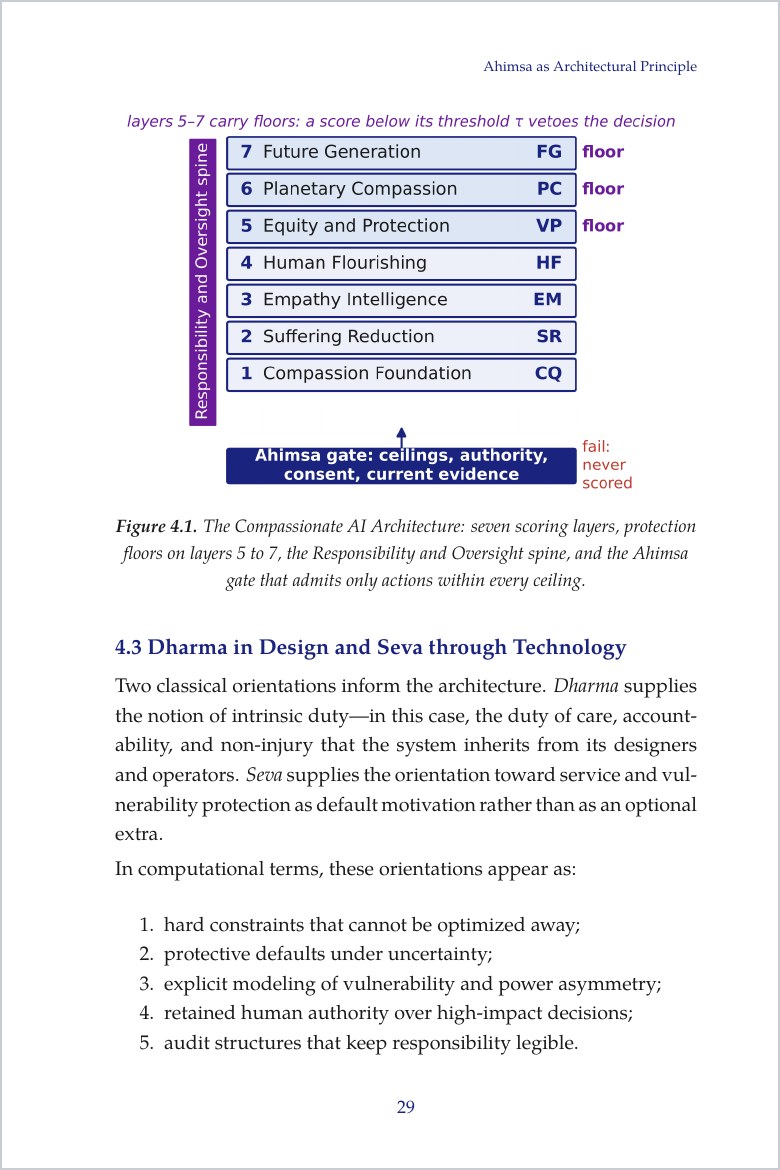
Ahimsa sits at the front of CAIA: an action that breaks a hard ceiling never reaches the scores.
- 7Future Generation: are long-horizon interests protected? (floor)
- 6Planetary Compassion: are ecological systems protected? (floor)
- 5Equity and Protection: are vulnerable people protected? (floor)
- 4Human Flourishing: does it improve durable flourishing?
- 3Empathy Intelligence: does it understand the human context?
- 2Suffering Reduction: does it reduce preventable suffering?
- 1Compassion Foundation: is this action compassionate?
Across every layer: the Responsibility and Oversight spine
Each layer emits one auditable score, and the scores combine into a Compassionate AI Index. The three protection layers carry floors: if any falls below its threshold, the decision is vetoed however comfortable the index looks.
Algorithmic Ahimsa hardens the front of this sequence. The Action-Filter Layer tests every consequential action against its harm ceilings, authority, consent and evidence before any score is computed, so the layers only ever rank actions that are already admissible.
See Inside: Full-Color Pages
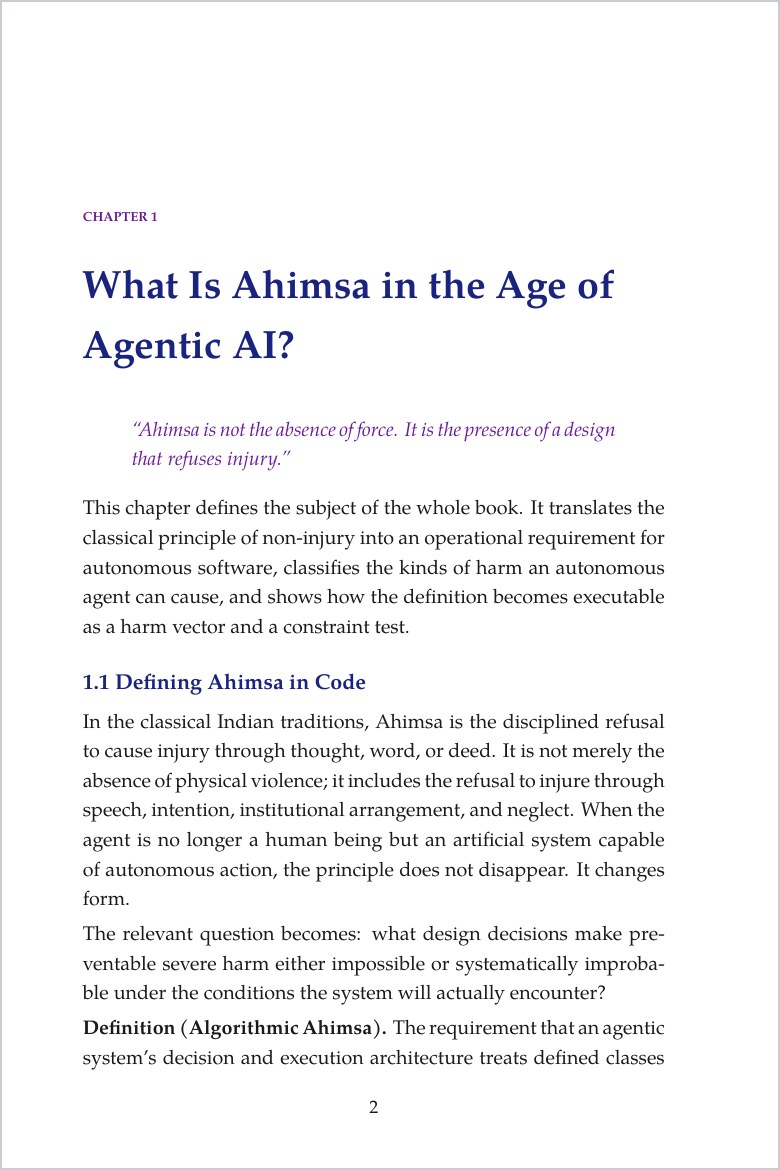
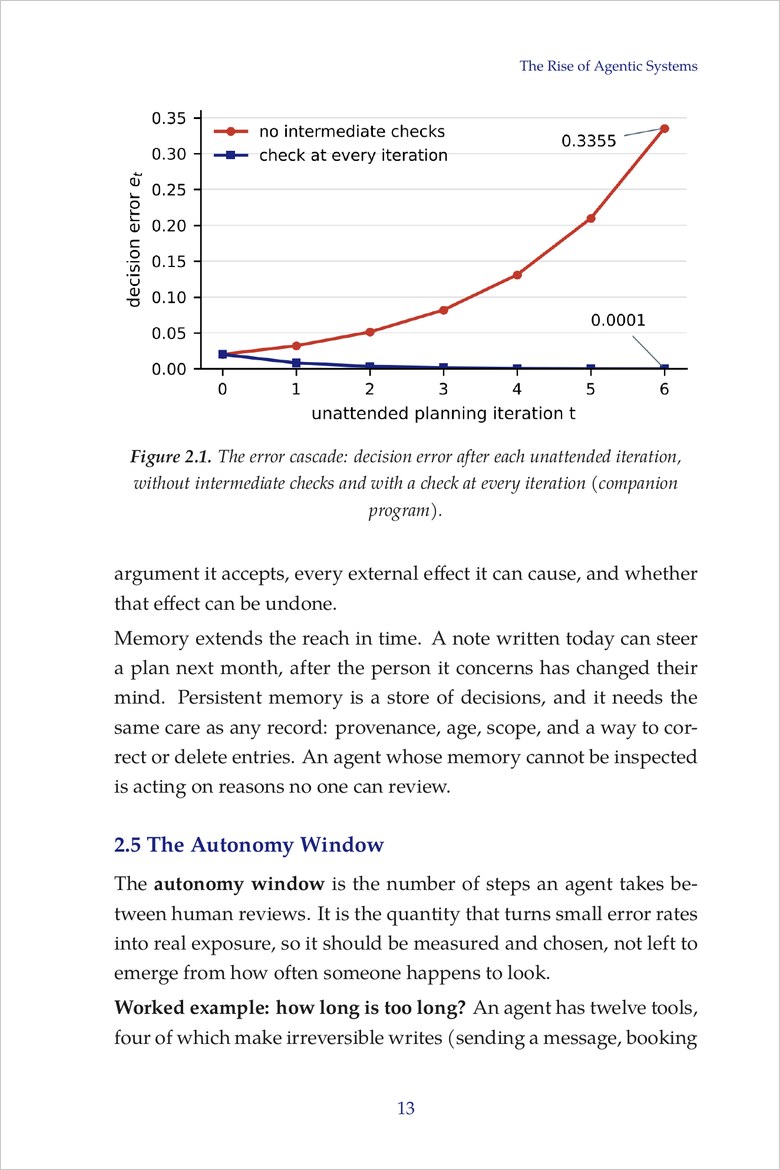
Six sample pages from the full-color eBook: a chapter opening, figures with real numbers and the gate that every action must pass.
Complete Table of Contents
Part I · Foundations of Algorithmic Ahimsa
- What Is Ahimsa in the Age of Agentic AI?
- The Rise of Agentic Systems
- Why Conventional AI Safety Remains Incomplete
- Ahimsa as Architectural Principle
Part II · The Core of Non-Harm
- Non-Harm as a Hard Constraint
- The Anatomy of Algorithmic Violence
- Vulnerability, Power Asymmetry, and the Duty of Care
- Agency, Autonomy, and Distributed Responsibility
Part III · Architecture of Non-Violence
- Embedding Ahimsa into the Compassionate AI Architecture (CAIA)
- Constraint-First Design for Autonomous Agents
- Multi-Agent Systems and Collective Non-Harm
- Failure, Uncertainty, and Safe Degradation
Part IV · Practice and Domains
- Ahimsa in Healthcare and Clinical Agents
- Ahimsa in Embodied Systems and Autonomous Finance
- Governance, Oversight, and Institutional Accountability
- Measuring Non-Harm: Metrics, Evaluation, and Audit
Part V · Horizon
- Toward Non-Violent Superintelligence
- Living Ahimsa in Code: Practice, Path, and Responsibility
Who This Book Is For
Whether you build agents, approve their deployment or live with their decisions, the book gives you a practical way to ask the question that matters most: what is this system forbidden to do, and who can stop it?
- AI engineers & agent builders
- AI safety & alignment specialists
- Platform & security architects
- Product & technology leaders
- Policymakers & regulators
- Clinicians & health-tech teams
- Students of AI and ethics
- Readers of contemplative traditions
Voices from the Book
“Ahimsa is not the absence of force. It is the presence of a design that refuses injury.”Dr. Sri Amit Ray, Chapter 1
“If harm can be traded, it will be traded. If it cannot enter the feasible set, it cannot be traded.”Dr. Sri Amit Ray, Chapter 5
“The order of operations is the design.”Dr. Sri Amit Ray, Chapter 10
eBook Details
| Title | Ahimsa in Agentic AI: Algorithmic Non-Violence and the Architecture of Compassionate Code |
|---|---|
| Author | Dr. Sri Amit Ray, PhD |
| Publisher | Compassionate AI Lab |
| Edition | ISBN 978-81-69641-29-6 (First Edition, 2026) |
| Format | Full-color PDF eBook, 214 pages including the cover, 6 × 9 in pages |
| Reading features | Clickable table of contents and cross-references, chapter bookmarks, searchable text |
| Inside | 18 chapters in 5 parts, 9 figures, 4 appendices including a complete individual-agent case, glossary, related books, key articles, 43 references, index |
| File size | About 2.2 MB |
| Companion code | github.com/compassionate-ai-lab/ahimsa-in-agentic-ai (MIT licence, 63 tests) |
| Companion volume | No-Harm Principles in AI Architectures: Ahimsa-Driven Multi-Agent AI Systems |
Companion Code on GitHub
The companion code for this book is open source on GitHub at github.com/compassionate-ai-lab/ahimsa-in-agentic-ai. It runs the book’s worked examples and checks their numbers with automated tests, so you can reproduce the results and adapt the methods to your own systems.
All companion repositories of Dr. Sri Amit Ray’s Compassionate AI books are collected at github.com/compassionate-ai-lab: The Superintelligence Race, No-Harm Principles in AI Architectures, Ahimsa in Agentic AI and Compassionate Superintelligence.
Start Reading Today
Get the full-color PDF of Ahimsa in Agentic AI and build agents whose success never requires the quiet acceptance of injury.
Buy the Full-Color eBook (PDF)Download the PDF after checkout
Frequently Asked Questions
What is Algorithmic Ahimsa?
The requirement that an agentic system’s decision and execution architecture treats defined classes of severe, preventable harm as hard feasibility constraints, so that no gain in task reward can buy them, rather than as soft penalties traded against success.
What format is the eBook?
A full-color PDF of 214 pages with a clickable table of contents, chapter bookmarks and searchable text. It opens in any PDF reader on Windows, Mac, Android, iPhone and iPad.
How do I receive the book?
Complete the checkout and follow the download link to save the PDF to your device.
Do I need to program to read it?
No. The main text is written in plain language with short worked examples. Engineers can run the free companion Python program, which reproduces every worked number and is printed in full in Appendix C; its tests and the Appendix D simulation are published on GitHub.
How does it relate to No-Harm Principles in AI Architectures?
The two books are companions. This one develops the individual agent’s execution boundary; No-Harm Principles extends it to systems of many agents that share resources and plans. Each can be read on its own.
Is there a paperback?
Yes, a black-and-white paperback and a Kindle edition are published on Amazon under ISBN 978-81-69641-29-6 for the paperback.