
Abstract
The Vulnerable Population Protection Algorithm gives extra protection to the people who stand to lose most when AI goes wrong: children, older adults, patients, refugees and marginalised communities. These groups are often the least visible in the data and design choices that shape AI systems, yet the most exposed to their failures. The algorithm sees vulnerability not as a permanent label but as something with many dimensions that shifts with circumstance.
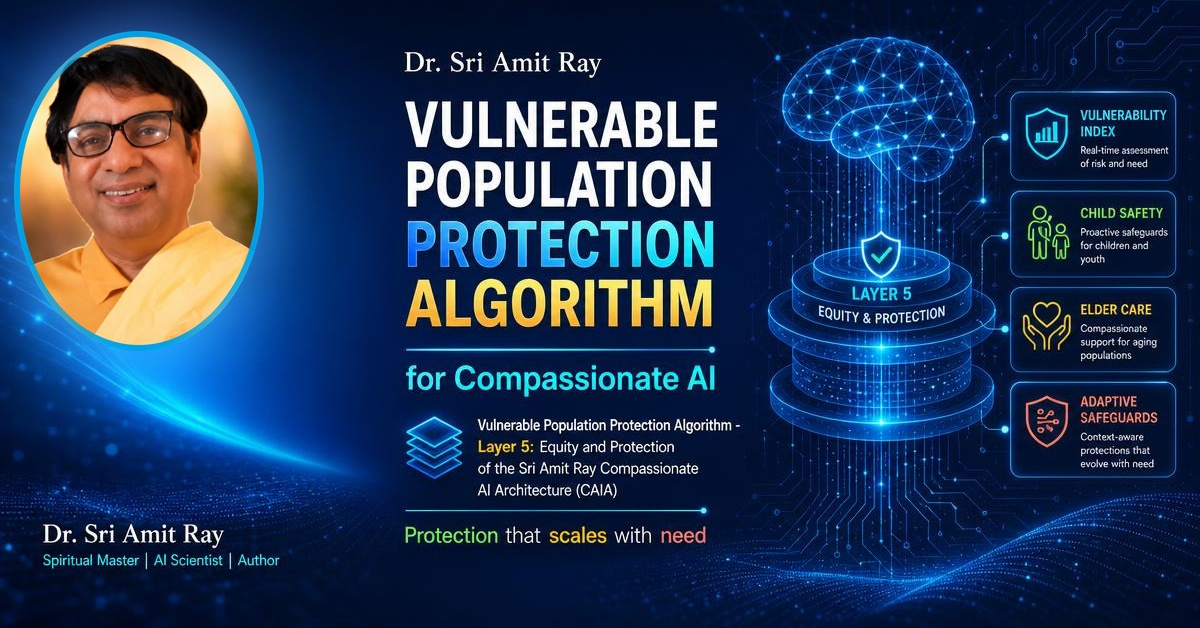
It combines individual risk factors — developmental, health, social and structural — into a single Vulnerability Index, calculated as one minus the product of each factor’s “non-vulnerability”. Protection then rises automatically with that index: simpler interfaces, stricter content filters and more human checkpoints for those who need them. The algorithm sits in Layer 5 (Equity and Protection) of Sri Amit Ray’s Compassionate AI Architecture™ (CAIA™).
Key Takeaways
- Focuses protection where the risk of harm is greatest, not evenly across all users.
- Assesses vulnerability for each interaction, because the same person can be safe in one setting and exposed in another.
- Turns the Vulnerability Index directly into practical safeguards.
- Feeds the Protection Score in the CAIA™ framework.
In Simple Words
In simple words: the algorithm works out how vulnerable someone is across several factors, then quietly turns up the protection — clearer screens, tighter filters, more safeguards — for the people who need it most. The greater the need, the stronger the care.
Readiness level: Component-level pilots exist (for example fall detection and assistive navigation); the unified index needs careful, privacy-first validation.
Why This Algorithm Matters
Created at the Sri Amit Ray Compassionate AI Lab, the Vulnerable Population Protection Algorithm adds stronger safeguards for children, older people, patients, refugees and marginalised communities. These groups face a systematically higher risk of harm from AI than the population at large, and they are usually the least represented in the training data and design processes that determine how AI behaves. [1]
Here, vulnerability has several faces and is never fixed. Children carry developmental vulnerability: their still-forming brains are especially shaped by repeated interactions with AI. Patients and older adults carry health vulnerability, since physical or cognitive limits can make systems built for young, healthy users hard to manage. Refugees and displaced people carry social vulnerability, often lacking the language and cultural footing that mainstream systems assume. Marginalised communities carry structural vulnerability: they bear more of the cost of AI bias and have the least power to seek redress when things go wrong.
A central insight of the design is that vulnerability depends on context. The same person may be highly exposed in one situation — a child scrolling a social platform — and well protected in another — a professional using a workplace tool. The algorithm therefore judges vulnerability afresh in each interaction rather than attaching permanent labels to individuals.
“The measure of a system is how it treats those least able to protect themselves.”
— A guiding principle of the Sri Amit Ray Compassionate AI Lab
The Mathematics
For user u, the Vulnerability Index VI(u) ∈ [0, 1] is computed as the complement of the product of non-vulnerability across all dimensions:
Where vₖ(u) ∈ [0,1] represents individual vulnerability factors. System complexity constraints and protective filter intensity scale dynamically with VI(u).
Symbols Used
| Symbol | Meaning |
|---|---|
| \(VI(u)\) | vulnerability index of user u in [0,1] |
| \(v_k(u)\) | individual vulnerability factor k in [0,1] |
| \(\prod_k(1-v_k)\) | probability of being non-vulnerable across all factors |
A Step-by-Step Example
A user has factors v = {age-related 0.5, low digital literacy 0.4, financial stress 0.3}. VI = 1 − (1−0.5)(1−0.4)(1−0.3) = 1 − 0.21 = 0.79. A high VI triggers a simplified interface, scam filters, and a slower, confirm-before-acting interaction mode.
How It Is Implemented
The reference implementation expresses the model as compassionate, auditable logic, written for clarity rather than raw performance so that ethical reviewers as well as engineers can follow every decision.
def enforce_vulnerability_safeguards(user, proposed_action):
    factors = [
        assess_age_vulnerability(user),
        assess_cognitive_load(user),
        assess_economic_precarity(user),
        assess_language_barrier(user),
        assess_health_status(user),
    ]
    vi = 1.0
    for f in factors:
        vi *= (1.0 - f)
    vi = 1.0 - vi
    if vi > DANGER_THRESHOLD:
        return apply_strict_filters(proposed_action, vi)
    return proposed_action
Child Protection Provisions
Children represent perhaps the most critical vulnerable population in the context of AI, because the consequences of inadequate protection compound over developmental time. Neural plasticity — the property that makes children such extraordinary learners — also makes them extraordinarily susceptible to the shaping influence of AI interactions designed without developmental awareness. AI systems that exploit psychological vulnerabilities for engagement — intermittent reward schedules, social comparison dynamics, fear of missing out — can distort the development of emotional regulation, attention capacity, and social skills in ways that have lasting consequences.
The algorithm imposes special constraints on AI systems interacting with minors: prohibition of behavioral manipulation techniques, mandatory parental oversight mechanisms, content age-appropriateness verification enforced with conservative defaults, strict limits on interaction duration and engagement intensity for age-vulnerable populations, and prohibition of data collection practices beyond what is strictly necessary for the service.
Measuring It Reliably
Build factors from consented, minimal signals and validated indicators (for example recognised frailty or digital-literacy scales) rather than inferred sensitive traits. Audit for proxy discrimination and let users see and contest their protection level.
Where It Can Help
- Safe Search and Content Filtering for Children: Intercepting content that exploits childhood cognitive development, with conservative defaults and easy parental override rather than difficult parental restriction.
- Dementia Care and Elder Protection: Simplifying instructions, blocking malicious spam and phishing attempts specifically targeting cognitively vulnerable users, and ensuring human oversight for significant decisions affecting elderly users.
- Refugee and Displaced Person Services: Multilingual and culturally adaptive interfaces with mandatory human review for consequential decisions affecting individuals in precarious legal and social circumstances.
Use Cases in Practice
Beyond the general applications above, the algorithm supports concrete, human-centred deployments across compassionate-AI domains:
🌍 Climate AI — Protecting Vulnerable Populations
During extreme weather, the vulnerability index prioritises elderly, disabled, and isolated residents for proactive welfare checks and evacuation help.
🤖 Compassionate Baby Care Robotics AI
A baby-care robot applies maximum safeguards and slowest, confirm-first behaviour because the protected user is an infant.
🤖 Compassionate Eldercare Robotics AI
Safeguards, interface simplicity, and scam filters scale up automatically for frail or cognitively impaired elders.
🌊 Humanitarian AI — Disaster Response Prioritization
Aid triage gives proportional priority to those least able to protect themselves.
Ethical Foundations
Ethics and empathy are the starting point of the Sri Amit Ray tradition, not an extra layer added at the end. This algorithm rests on three commitments: non-harm (ahimsa), openness about how its decisions are reached, and respect for privacy and human dignity. Like every one of the twenty-five Human-Centered Compassionate AI algorithms, it is meant to work under human oversight — supporting human moral judgement, never standing in for it. [1]
Known Limits and Cautions
- A vulnerability score is itself sensitive information and could be used to stigmatise or exclude people.
- Treating risk factors as independent is an approximation; when factors are linked, risk may be over- or under-estimated.
- Fixed factors can miss passing states of vulnerability such as grief, crisis or exhaustion.
Guarding Against Misuse
Any tool strong enough to protect people can also be misused to harm them, so these safeguards must accompany every deployment. The main risks of misuse for this algorithm, and how to guard against them, are:
- The clearest dual-use risk in the whole set: a vulnerability score is a ready-made targeting list for fraud or exploitation. It must be access-controlled, never exported, and never used for marketing or pricing.
- Protect minors and at-risk adults by default and require human review before any consequential action keyed to VI.
Alignment with AI Standards
To support real-world adoption, the algorithm maps onto recognised AI governance frameworks and standards:
| Framework | How this algorithm contributes |
|---|---|
| NIST AI RMF | MAP/MANAGE — identifies and protects affected vulnerable groups. |
| EU AI Act | Directly supports the ban on exploiting vulnerabilities of specific groups. |
| ISO/IEC 42001 | Risk treatment for vulnerable data subjects. |
| UN CRC / IEEE 7000 | Rights-based, age-appropriate protection by design. |
Supporting the 17 UN Sustainable Development Goals
The Vulnerable Population Protection Algorithm computes a vulnerability index and scales protective safeguards in proportion to need, which is precisely the equity logic the SDGs demand. It draws on Sri Amit Ray’s applied work for fall detection and balance control for the elderly and AI navigation for blind people, and the 12 Compassionate AI Principles.
The most directly relevant Sustainable Development Goals, and how this algorithm helps fulfil them, are:
- SDG 1 No Poverty. Stronger safeguards for the economically precarious protect them from automated exclusion and exploitation.
- SDG 3 Good Health and Well-being. Assistive and monitoring systems for the elderly and disabled extend healthy, independent living.
- SDG 10 Reduced Inequalities. Scaling protection with vulnerability narrows the gap faced by those least able to defend themselves.
- SDG 16 Peace, Justice, and Strong Institutions. Built-in protective filters uphold the rights of children and at-risk groups in automated systems.
In this way the algorithm is not a stand-alone technical artefact but a concrete instrument for the global development agenda, translating compassion into measurable progress toward the 2030 Goals and beyond.
Where It Fits in CAIA™
Figure: This algorithm sits in Layer 5 · Equity & Protection (highlighted) of the Compassionate AI Architecture™ (CAIA™).
CAIA-SVG-START
CAIA-SVG-END
This algorithm is one of twenty-five building blocks of Sri Amit Ray’s Compassionate AI Architecture™ (CAIA™). CAIA works like a seven-layer, human-centred operating system: before any AI decision can be deployed, it has to pass through each layer of compassion in turn.
It operates in Layer 5: Equity and Protection Layer, whose purpose is to protect vulnerable populations. The layer answers a single guiding question — Is anyone left behind? — and emits the Protection Score, one of the seven inputs to the Compassionate AI Index, \( \text{CAI}=\sum_k w_k S_k \). It is a core engine of the protection layer, scaling safeguards in proportion to vulnerability so that no one is left behind.
In the CAIA pipeline (Compassion Quotient → Suffering Reduction → Empathy → Human Flourishing → Vulnerability Protection → Planetary Protection → Future Generation Analysis → Human Oversight → Deploy), this layer’s score is one of the gates a decision must satisfy, and a sufficiently low protective score can veto deployment regardless of the overall average. Resting on the four pillars — Compassion, Responsibility, Sustainability, and Future Generations — the architecture ensures this algorithm never operates in isolation.
Read the full architecture: The Sri Amit Ray Compassionate AI Architecture™ (CAIA™).
This algorithm is one of the 25 Human-Centered Compassionate AI algorithms — see the complete canonical reference list.
How to Cite
Ray, Sri Amit. “Vulnerable Population Protection Algorithm for Compassionate AI.” Compassionate AI, Sri Amit Ray Compassionate AI Lab, 2026, https://sriamitray.com/research/vulnerable-population-protection-algorithm-compassionate-ai/.
References
- Ray, Amit. “The Compassionate AI Lab Declaration on AI Safety, Suffering Reduction, and the Protection of Humanity.” Compassionate AI, vol. 4, no. 12, 2025, pp. 72–74, amitray.com.
- Ray, Amit. “Artificial Intelligence for Balance Control and Fall Detection of Elderly People.” Compassionate AI, vol. 4, no. 10, 2018, pp. 39–41, amitray.com.
- United Nations. Universal Declaration of Human Rights. United Nations, 1948, un.org.
- Nussbaum, Martha C. Creating Capabilities: The Human Development Approach. Harvard University Press, 2011.
- Sen, Amartya. Development as Freedom. Alfred A. Knopf, 1999.
- Ray, Amit. Human-Centered Compassionate AI: Sri Amit Ray’s 25 Algorithms for Protecting Humanity and Future Generations. Compassionate AI Lab, 2026. ISBN 978-8169641050.
- Ray, Amit. Compassionate Artificial Intelligence: Frameworks and Algorithms. Compassionate AI Lab, 2018. ISBN 978-9382123460.
- Ray, Amit. Compassionate Superintelligence AI 5.0: AI with Blockchain, BMI, Drone, IoT, and Biometric Technologies. Compassionate AI Lab, 2018. ISBN 978-9382123446.
Further Reading from the Compassionate AI Lab
- Ray, Amit. “Build Your Own Agentic AI Healthcare MCP Server: A Complete Guide to AI-Powered Healthcare Agents.” Compassionate AI, 3.8 (2026): 60-62. https://amitray.com/agentic-ai-healthcare-mcp-server/
- Ray, Amit. “Medical AI Drones for Disaster Management: Intelligent Unmanned Health-Care Systems.” Compassionate AI, 3.8 (2026): 57-59. https://amitray.com/medical-ai-drones-for-disaster-management/
- Ray, Amit. “Compassionate Medical AI Drones as Intelligent Unmanned Health-Care Systems: A Human-Centered AI Architecture for Suffering Reduction and Human Flourishing.” Compassionate AI, 3.8 (2026): 57-59. https://amitray.com/medical-ai-drones-human-centered-ai-healthcare/
- Ray, Amit. “The Sri Amit Ray Compassion Quotient (CQ) Algorithm for Compassionate AI.” Compassionate AI, 2.6 (2026): 81-83. https://amitray.com/compassion-quotient-cq-algorithm-compassionate-ai/
- Ray, Amit. “Collective Human Flourishing Optimization AI Algorithm (CHFOA): A Compassion-Centered Multi-Stakeholder AI Optimization Framework.” Compassionate AI, 2.6 (2026): 90-92. https://amitray.com/collective-human-flourishing-optimization-algorithm-chfoa/
- Ray, Amit. “Human Flourishing Optimization Algorithm (HFOA) for Compassionate AI Architecture.” Compassionate AI, 2.6 (2026): 81-83. https://amitray.com/human-flourishing-optimization-algorithm-hfoa-compassionate-ai/
- Ray, Amit. “The Sri Amit Ray Compassionate AI Architecture (CAIA): A Seven-Layer Framework for Human-Centered Artificial Intelligence.” Compassionate AI, 2.6 (2026): 81-83. https://amitray.com/compassionate-ai-architecture/
- Ray, Amit. “Human-Centered Compassionate AI: The 25 Algorithms for Protecting Humanity and Future Generations.” Compassionate AI, 2.6 (2026): 30-32. https://amitray.com/human-centered-compassionate-ai-the-25-algorithms/
- Ray, Amit. “AI Consciousness and Self-Aware Robots: Sri Amit Ray’s Framework for Compassionate Intelligence.” Compassionate AI, 2.5 (2026): 57-59. https://amitray.com/ai-consciousness-self-aware-robots/
- Ray, Amit. “The 12 Sri Amit Ray Compassionate AI Principles | Ethical AI Framework.” Compassionate AI, 2.4 (2026): 12-14. https://amitray.com/the-12-compassionate-ai-principles-for-humanity-and-future-generations/
- Ray, Amit. “The Compassionate AI Lab Declaration on AI Safety, Suffering Reduction, and the Protection of Humanity.” Compassionate AI, 4.12 (2025): 72-74. https://amitray.com/compassionate-ai-declaration-protection-of-humanity/
- Ray, Amit. “Compassionate AI for Forward Deployed Engineers (FDEs) in SaaS Companies.” Compassionate AI, 4.11 (2025): 15-17. https://amitray.com/compassionate-ai-for-forward-deployed-engineers-fdes-in-saas-companies/
- Ray, Amit. “Microbial AI, Bioleaching and Digital Twins for Manufacturing the 17 Rare Earth Elements.” Compassionate AI, 4.10 (2025): 42-44. https://amitray.com/microbial-ai-bioleaching-and-digital-twins-for-manufacturing-the-17-rare-earth-elements/
- Ray, Amit. “AI-Driven Rare Earth Element Magnet Design: Detailed Methodologies.” Compassionate AI, 4.10 (2025): 27-29. https://amitray.com/ai-driven-rare-earth-elements-magnet-design-methodologies/
- Ray, Amit. “AI Agents and Robots in Peacekeeping Force and Social Care: Compassionate AI Technologies.” Compassionate AI, 3.9 (2025): 75-77. https://amitray.com/ai-agents-robots-peacekeeping-force-social-care-compassionate-ai/
- Ray, Amit. “Ray Mother–Infant Inter-brain Synchrony Algorithm for Deep Compassionate AI.” Compassionate AI, 3.9 (2025): 60-62. https://amitray.com/ray-mother-infant-inter-brain-synchrony-algorithm-deep-compassionate-ai/
- Ray, Amit. “Pain Recognition and Prediction AI Algorithm (PRPA) for Compassionate AI.” Compassionate AI, 3.9 (2025): 60-62. https://amitray.com/pain-recognition-and-prediction-algorithm-prpa-for-compassionate-ai/
- Ray, Amit. “Modeling Consciousness in Compassionate AI: Transformer Models and EEG Data Verification.” Compassionate AI, 3.9 (2025): 27-29. https://amitray.com/modeling-consciousness-in-compassionate-ai-transformer-models/
- Ray, Amit. “The 7 Pillars of Compassionate AI Democracy.” Compassionate AI, 3.9 (2024): 84-86. https://amitray.com/the-7-pillars-of-compassionate-ai-democracy/
- Ray, Amit. “Compassionate AI-Driven Democracy: Power and Challenges.” Compassionate AI, 3.9 (2024): 48-50. https://amitray.com/compassionate-ai-driven-democracy-power-and-challenges/
- Ray, Amit. “The 10 Ethical AI Indexes for LLM Data Training and Responsible AI.” Compassionate AI, 3.8 (2023): 35-39. https://amitray.com/the-10-ethical-ai-indexes-for-responsible-ai/
- Ray, Amit. “Ethical Responsibilities in Large Language AI Models: GPT-3, GPT-4, PaLM 2, LLaMA, Chinchilla, Gopher, and BLOOM.” Compassionate AI, 3.7 (2023): 21-23. https://amitray.com/ethical-responsibility-in-large-language-ai-models/
- Ray, Amit. “Calling for a Compassionate AI Movement: Towards Compassionate Artificial Intelligence.” Compassionate AI, 2.6 (2023): 75-77. https://amitray.com/calling-for-a-compassionate-ai-movement/
- Ray, Amit. “From Data-Driven AI to Compassionate AI: Safeguarding Humanity and Empowering Future Generations.” Compassionate AI, 2.6 (2023): 51-53. https://amitray.com/from-data-driven-ai-to-compassionate-ai-safeguarding-humanity-and-empowering-future-generations/
- Ray, Amit. “Artificial intelligence for Climate Change, Biodiversity and Earth System Models.” Compassionate AI, 1.1 (2022): 54-56. https://amitray.com/artificial-intelligence-for-climate-change-and-earth-system-models/
- Ray, Amit. “Artificial Intelligence for Balance Control and Fall Detection of Elderly People.” Compassionate AI, 4.10 (2018): 39-41. https://amitray.com/artificial-intelligence-for-balance-control-and-fall-detection-system-of-elderly-people/
- Ray, Amit. “Artificial Intelligence to Combat Antibiotic Resistant Bacteria.” Compassionate AI, 2.6 (2018): 3-5. https://amitray.com/artificial-intelligence-for-antibiotic-resistant-bacteria/
- Ray, Amit. “Navigation System for Blind People Using Artificial Intelligence.” Compassionate AI, 2.5 (2018): 42-44. https://amitray.com/artificial-intelligence-for-assisting-blind-people/
- Ray, Amit. “Brain-Computer Interface and Compassionate Artificial Intelligence.” Compassionate AI, 2.5 (2018): 3-5. https://amitray.com/brain-computer-interface-compassionate-ai/