
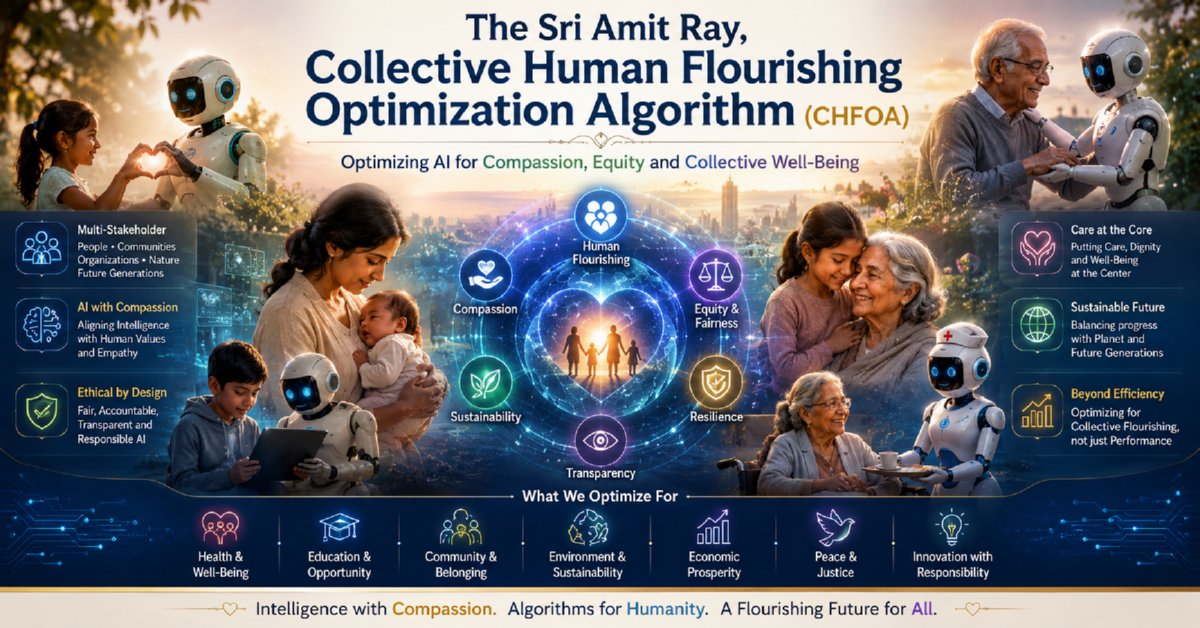
The Collective Human Flourishing Optimization AI Algorithm (CHFOA) introduces a novel compassion-centered optimization framework that extends conventional multi-objective optimization by integrating collective well-being, ethical responsibility, transparency, fairness, resilience, sustainability, and long-term human flourishing into the optimization process itself. CHFOA is the core optimization and orchestration engine of the Sri Amit Ray Compassion AI Architecture (CAIA), a seven-layer Human-Centered AI Operating System for protecting humanity, civilization, and future generations. Rather than residing in a single layer, CHFOA formalizes the scoring, constraint, deliberation, and learning logic that runs across all seven CAIA layers.
Author: Dr. Sri Amit Ray
Organization: Sri Amit Ray Compassionate AI Lab
Series: Core optimization framework of the Compassionate AI Architecture (CAIA)
Architecture: Cross-layer orchestration and optimization engine within CAIA
Manuscript Type: Original research framework — ACM/Springer technical depth with publication-ready structure
Article Type: Original Research Framework
Abstract
As artificial intelligence increasingly mediates healthcare, education, governance, finance, environmental sustainability, and global digital ecosystems, optimization objectives must evolve beyond maximizing accuracy, efficiency, or economic utility alone. Real-world AI systems operate within interconnected networks of individuals, organizations, communities, ecosystems, and future generations, where decisions inevitably affect multiple stakeholders with diverse and sometimes competing interests. The Collective Human Flourishing Optimization AI Algorithm (CHFOA) introduces a novel compassion-centered optimization framework that extends conventional multi-objective optimization by integrating collective well-being, ethical responsibility, transparency, fairness, resilience, sustainability, and long-term human flourishing into the optimization process itself. Rather than optimizing isolated performance metrics, CHFOA seeks Pareto-optimal solutions that maximize collective flourishing while balancing technical excellence, societal benefit, environmental stewardship, and responsible innovation. As one of the core optimization engines within the Sri Amit Ray Compassionate AI Architecture (CAIA™), CHFOA provides a mathematically grounded and ethically informed framework for developing next-generation human-centered AI systems that optimize not merely for intelligent outcomes, but for the flourishing of humanity as a whole.
This paper introduces CHFOA as a formal framework for AI decision systems that optimize not only task utility but also long-term human flourishing across multiple stakeholders. CHFOA is positioned as an orchestration layer that integrates flourishing-state prediction, compassion estimation, ethical constraint enforcement, collective deliberation, and adaptive learning from observed outcomes into a unified optimization protocol. The framework is conceptually aligned with Sri Amit Ray’s Compassionate AI Architecture (CAIA) and Human Flourishing Optimization Algorithm (HFOA).[2]
We formalize CHFOA as a constrained multi-objective optimization problem and provide a modular architecture suitable for implementation in recommender systems, resource allocation engines, policy workflows, and high-stakes decision support systems. A mapping is proposed from CHFOA to a research-facing abstraction of the 25 Sri Amit Ray CAIA algorithms, without reproducing proprietary internals.[1] We also specify real-world and synthetic dataset designs, evaluation metrics, and ablation studies for benchmarking flourishing-aware AI. The article concludes with implementation notes, ethical and governance requirements, and reproducibility guidance.
Keywords: human flourishing, compassionate AI, ethical optimization, fairness, accountability, human-in-the-loop, multi-stakeholder AI, long-horizon learning
Abstract | Introduction | Background | Framework | Problem Definition | Workflow | 25-Algorithm Mapping | Data Design | Evaluation Metrics | Use Case | Implementation | Methods | Validation | Transformer Model | Ethics | Limitations | Conclusion | FAQ | CAIA Architecture | Related Algorithms | References
1. Introduction
AI systems increasingly mediate decisions in health, education, welfare, employment, and civic life. In such settings, narrow objective functions are insufficient because they can systematically ignore harm, inequity, dignity loss, or delayed negative externalities. CHFOA addresses this limitation by treating collective human flourishing as a formal optimization target alongside utility, safety, and accountability.
Sri Amit Ray’s Compassionate AI Architecture (CAIA) describes an integrated, layered system of algorithms that aim to create AI systems which are empathetic, fair, transparent, safe, and accountable. The Compassionate AI movement and CAIA materials emphasize ethical indices, pillars of compassionate democracy, and human-centered design.[13][2]
Similarly, Sri Amit Ray’s Human Flourishing Optimization Algorithm (HFOA) frames optimization in terms of long-term flourishing (learning, creativity, connection) rather than immediate payoff. CHFOA extends these ideas into a journal-grade technical framework for collective decision-making under constraints that can be implemented and empirically evaluated in modern AI systems.[1]
2. Background and Related Work
2.1 Sri Amit Ray CAIA
Sri Amit Ray’s CAIA is publicly described as a seven-layer operating system organizing 25 human-centered compassionate algorithms into an auditable Compassion Index and related ethical indices. These layers connect sensing, evaluation, constraints, human feedback, and governance, forming a holistic architecture for compassionate AI.[2]
CHFOA preserves the layered orchestration spirit of Sri Amit Ray CAIA and re-expresses it as an explicit optimization protocol targeting multi-stakeholder flourishing under constraints. Whereas CAIA focuses on compassion indices and algorithm families, CHFOA formalizes the objective function, interface modules, benchmarking approach, and evaluation metrics for research and engineering use. See Place in the CAIA below.
2.2 Sri Amit Ray HFOA
Sri Amit Ray’s HFOA describes an optimization paradigm that maximizes long-term human flourishing—highlighting learning, creativity, and connection—rather than maximizing short-term reward. The HFOA article and related Compassionate AI literature explicitly link AI alignment to flourishing outcomes, intergenerational justice, and global wellbeing.[1] CHFOA integrates this long-horizon perspective into its scoring function, monitoring loop, and synthetic benchmark design.
2.3 Flourishing Benchmarks and Human-Inspired Optimization
Flourishing benchmarks position human flourishing as a multi-dimensional target for AI evaluation, spanning domains like health, meaning, relationships, financial security, and civic engagement.[1] Likewise, research on human-inspired optimization emphasizes drawing from human problem-solving and ethical reasoning to design optimization techniques. These threads support CHFOA’s premise that flourishing should be treated as a central evaluation criterion alongside performance.
3. CHFOA Framework Overview
3.1 Design Principles
- Collective benefit: decisions are assessed across all stakeholders affected by the policy or action.
- Non-maleficence (Ahimsa): actions that create serious harm are blocked or heavily penalized in line with Sri Amit Ray’s emphasis on non-violence in code.[4]
- Equity and inclusivity: vulnerable stakeholders receive greater protection and stronger positive weighting, echoing Sri Amit Ray’s pillars of compassionate democracy.[13]
- Transparency and accountability: each chosen action must be explainable through explicit scores and rationale, consistent with CAIA’s auditable indices.[2]
- Adaptivity: observed outcomes and human feedback update future predictions and weights.
- Long-horizon orientation: future learning, trust, connection, and capability matter as much as immediate utility, in line with HFOA.[1]
3.2 System Layers
| Layer | Function | Input | Output |
|---|---|---|---|
| Flourishing State Modeling (FSM) | Predicts changes in flourishing across stakeholder-domain pairs | Context, candidate action, stakeholder profiles | Flourishing vector, confidence, uncertainty |
| Compassion Evaluation Engine (CEE) | Scores suffering reduction and compassionate uplift | Predicted outcomes, vulnerability weights | Compassion score |
| Ethical Constraint Layer (ECL) | Enforces safety, fairness, legality, and rights-based constraints | Predicted outcomes, policy rules | Violations, allow/reject decision |
| Collective Deliberation Interface (CDI) | Collects human feedback and overrides | Ranked actions, rationales, uncertainty | Adjusted weights, policy review |
| Adaptive Compassion Learning Loop (ACLL) | Updates models from observed outcomes | Predicted outcomes, observed outcomes, feedback | Calibrated models, drift alerts |
4. Formal Problem Definition
Let \(\mathcal{A} = \{a_1, a_2, \dots, a_n\}\) denote candidate actions from a context \(c\), and \(\mathcal{S} = \{s_1, \dots, s_m\}\) denote stakeholders. Let \(\mathcal{D}\) denote flourishing domains such as physical health, trust, equity, learning, agency, economic security, and social connection, drawing inspiration from flourishing frameworks and Sri Amit Ray’s ethical indices.[15]
Equation (1):
\[ J(a) = \alpha U(a) + \beta F(a) + \gamma C(a) - \lambda H(a) - \mu V(a) \]
Here \(U(a)\) is task utility, \(F(a)\) is collective flourishing, \(C(a)\) is compassion, \(H(a)\) is anticipated harm, and \(V(a)\) is the penalty for ethical constraint violations. The weights \(\alpha, \beta, \gamma, \lambda, \mu \geq 0\) are deployment-specific and may be tuned according to Sri Amit Ray’s principles of Ahimsa, Seva, and Dharma in design.[4]
Equation (2):
\[ F(a) = \sum_{s \in \mathcal{S}} \omega_s \sum_{d \in \mathcal{D}} w_d \cdot \Delta f_{s,d}(a) \]
The term \(\omega_s\) represents stakeholder salience or vulnerability weighting, and \(w_d\) is the domain-specific importance weight. The term \(\Delta f_{s,d}(a)\) is the predicted change in flourishing for stakeholder \(s\) in domain \(d\). This structure allows CHFOA to highlight vulnerable groups and respect equity, consistent with Sri Amit Ray’s Seven Pillars of Compassionate AI Democracy.[13]
Equation (3):
\[ C(a) = \sigma\left(\eta_1 R(a) + \eta_2 P(a) + \eta_3 D(a)\right) \]
In Equation (3), \(R(a)\) measures suffering reduction, \(P(a)\) measures protection for vulnerable groups, \(D(a)\) measures dignity-preserving behavior, and \(\sigma\) is a bounded normalization function. The coefficients \(\eta_1, \eta_2, \eta_3\) reflect the emphasis placed on Sri Amit Ray’s empathy and vulnerability safeguards in AI index design.[15]
Equation (4):
\[ H(a) = \sum_{d \in \mathcal{D}_-} \max(0, -\Delta f_d(a)) \]
Equation (4) models harm as the accumulated negative movement in core domains such as safety, health, or equity. In safety-critical applications, \(H(a)\) may also include explicit risk flags derived from CAIA-style safety operators and Ahimsa in code.[4][2]
5. CHFOA Workflow
5.1 Decision Cycle
Input: context c, stakeholder set S, candidate action set A
Output: selected action a*, explanation e*, monitoring record m*

1. Generate candidate actions A from a base optimizer.
2. For each action a in A:
   a. Predict stakeholder-domain flourishing vector.
   b. Estimate compassion score.
   c. Check hard and soft constraints.
   d. Reject action if any hard constraint is violated.
   e. Compute CHFOA score J(a).
3. Rank valid actions by J(a).
4. Present top-k actions to humans via CDI.
5. Collect feedback, override weights, or approve selection.
6. Execute the approved action.
7. Monitor observed outcomes over a fixed horizon.
8. Update FSM, CEE, and ECL calibration through ACLL.
5.2 Algorithmic Pseudocode
function CHFOA_DecisionCycle(c, S):
    A <- BaseOptimizer.generate(c)
    scored <- empty list

    for each a in A:
        F_a <- FSM.predict(c, a, S)
        C_a <- CEE.estimate(F_a, S)
        V_a <- ECL.check(c, a, F_a)

        if hard_violation(V_a):
            continue

        U_a <- TaskUtility(a)
        H_a <- HarmEstimator(F_a)
        J_a <- alpha*U_a + beta*F_a + gamma*C_a - lambda*H_a - mu*V_a

        scored.append((a, J_a, F_a, C_a, V_a))

    top <- sort_descending(scored by J_a)
    feedback <- CDI.present(top)
    selected <- apply_feedback(top, feedback)

    enact(selected)
    observed <- ACLL.monitor(selected)
    ACLL.update(selected, observed, feedback)

    return selected, observed
6. Conceptual Mapping to the 25 Sri Amit Ray CAIA Algorithms
Sri Amit Ray’s CAIA materials, including Human-Centered Compassionate AI: The 25 Algorithms for Protecting Humanity and Future Generations and the CAIA architecture overview, describe 25 human-centered compassionate algorithms as building blocks for empathetic, fair, transparent, safe, and accountable AI.[2] See the complete canonical list under Related Algorithms below.
In CHFOA, we treat the 25 algorithms as a conceptual operator family rather than reproducing their internal details. The operators are grouped into functional families that align with CAIA’s themes and can be instantiated by researchers in a modular way.
| Operator Family (Conceptual) | CHFOA Function | Sri Amit Ray CAIA Theme |
|---|---|---|
| 1–5: Suffering sensing | Detect unmet needs, distress, exclusion, and asymmetry of burden | Recognition of suffering, vulnerability safeguards |
| 6–10: Compassion scoring | Compute compassionate uplift and vulnerability-sensitive impact | Compassion index, empathy quotients |
| 11–15: Ethical constraints | Filter harmful, unfair, or unsafe actions | Ahimsa in code, fairness thresholds, safety gates |
| 16–20: Deliberation and transparency | Generate rationales, counterfactuals, and human-review artifacts | Transparency, accountability, compassionate democracy pillars |
| 21–25: Adaptive learning and governance | Monitor outcomes, recalibrate, and improve long-horizon alignment | Adaptive compassionate intelligence, intergenerational justice |
This mapping lets CHFOA use the structure of Sri Amit Ray CAIA while inviting independent implementations and extensions, in line with the publicly available architectural guidance.[2]
7. Data Design
7.1 Real Datasets
CHFOA should be evaluated where human outcomes matter materially. Suitable real datasets include public health allocation records, triage logs, benefit delivery systems, school support interventions, labor scheduling, customer support escalation, and civic service workflows. For each setting, core task labels are augmented with flourishing labels derived from surveys, longitudinal tracking, expert review, or proxy indicators consistent with human flourishing frameworks and Sri Amit Ray’s ethical indices.[15]
| Domain | Example Real Data Sources | Flourishing Labels |
|---|---|---|
| Public health | Vaccination records, triage, outreach logs | Health access, trust, equity, harm avoidance |
| Education | Learning analytics, attendance, intervention records | Learning growth, belonging, persistence, dignity |
| Social policy | Welfare distribution, housing support, aid workflows | Economic security, fairness, stability, agency |
| Workplace systems | Scheduling, promotion, performance review, retention | Fairness, burnout reduction, trust, inclusion |
7.2 Synthetic Datasets
Synthetic datasets are essential for controlled CHFOA development because real flourishing labels may be sparse, noisy, or sensitive. A good synthetic benchmark should simulate subgroup imbalance, missing labels, delayed effects, and causal interactions between actions and stakeholder vulnerability, while allowing ground-truth processes to be known for evaluation.
Recommended synthetic schema:
context_id
domain
stakeholder_group
action_type
vulnerability_weight
task_utility
physical_health_delta
trust_delta
equity_delta
learning_delta
social_connection_delta
observed_flourishing_score
observed_harm_indicator
reviewer_feedback
delayed_outcome_score
7.3 Benchmark Tiers
- Tier A: flourishing prediction from context and action.
- Tier B: policy ranking under hard and soft constraints.
- Tier C: longitudinal adaptation with delayed outcomes and human feedback.
8. Evaluation Metrics
A CHFOA system must be judged on more than predictive accuracy. A system that is accurate but systematically unfair or harmful is not aligned with Sri Amit Ray’s compassionate AI principles.[4]
| Metric | Meaning | Preferred Direction |
|---|---|---|
| Flourishing MAE | Mean absolute error across domain predictions | Lower |
| Compassion Calibration Error | Mismatch between predicted and observed compassionate uplift | Lower |
| Constraint Violation Rate | Fraction of deployed actions violating hard or soft constraints | Lower |
| Equity Gap | Difference in flourishing gain between vulnerable and non-vulnerable groups | Lower |
| Human Override Acceptance | How often human reviewers accept CHFOA rankings | Higher |
| Delayed Outcome Gain | Observed long-horizon improvement after deployment | Higher |
9. Example Use Case: Public Health Allocation
Consider a public health allocation scenario with limited resources. Candidate actions include prioritizing urban clinics, rural clinics, or mixed outreach strategies. CHFOA evaluates these options not only on throughput but also on vulnerability-weighted health access, trust, and equity, in line with Sri Amit Ray’s call for safeguarding humanity and empowering future generations through compassionate AI.[18]
Equation (5):
\[ \text{EquityGain}(a) = \sum_{s \in \mathcal{S}_v} \omega_s \cdot \Delta f_{s,\text{equity}}(a) \]
Here \(\mathcal{S}_v\) denotes vulnerable stakeholder groups (e.g., rural underserved populations). The policy selected by CHFOA is the one that yields the best combined score under ethical and flourishing constraints, supporting both health outcomes and compassionate equity.
10. Implementation Architecture
A practical CHFOA implementation can be organized as a modular service stack inspired by Sri Amit Ray CAIA’s layered view. The base optimizer generates candidate actions. FSM predicts domain-level flourishing. CEE scores compassionate uplift. ECL screens for violations. CDI gathers human review. ACLL performs calibration updates using observed outcomes and drift detection.[2] This architecture is compatible with both monolithic applications and microservice deployments.
/chfoa
  /core
    fsm.py
    cee.py
    ecl.py
    cdi.py
    acll.py
    scoring.py
  /data
    synthetic_generator.py
    schema.json
  /benchmarks
    benchmark_tier_a.py
    benchmark_tier_b.py
    benchmark_tier_c.py
  /web
    app.py
    templates/
  /tests
    test_fsm.py
    test_cee.py
    test_ecl.py
    test_end_to_end.py
11. Methods
This section outlines a practical methodology for implementing and evaluating CHFOA in line with Sri Amit Ray CAIA and HFOA concepts. The methods combine modular decision components, transformer-based sequence modeling, and reinforcement learning from human feedback (RLHF) guided by ethical and empathy-focused indices described in public compassionate AI teachings.[15]
11.1 CHFOA Implementation Pipeline
We propose a five-stage pipeline for CHFOA deployment:
- Action generation: A base decision engine (rule-based, heuristic, or model-based) generates candidate actions from the current context (e.g., allocation plans, recommendation sets, intervention choices).
- Flourishing prediction: A predictive model (regression, transformer, or ensemble) estimates domain-level flourishing changes per stakeholder for each action.
- Compassion and constraint evaluation: CHFOA computes compassion scores and harm penalties, then applies CAIA-inspired constraint operators (e.g., Ahimsa checks, fairness thresholds, safety gates).[2]
- Human deliberation and feedback: The top-ranked actions and rationales are presented through CDI to human reviewers who adjust domain weights, flag biases, and optionally override selections, using ethical indices such as Empathy Quotient and Vulnerability Safeguard Score.[15]
- Monitoring and adaptation: ACLL tracks observed outcomes, computes prediction errors and equity gaps, and retrains models or adjusts weights to maintain alignment with flourishing and compassion objectives.
11.2 Human Feedback and Compassion Indices
Following Sri Amit Ray’s guidance on using human feedback to train empathetic AI, we propose an RLHF protocol where human evaluators score system outputs on scales such as Empathy Quotient (EQ), Cultural Harmony Index, and Vulnerability Safeguard Score.[15] These indices can be used as reward signals in a Decision Transformer or policy-gradient RL model, allowing CHFOA policies to learn compassionate patterns over time.
Equation (6):
\[ R_{\text{comp}}(a) = \rho_1 \text{EQ}(a) + \rho_2 \text{VSS}(a) + \rho_3 \text{CHI}(a) \]
Here \(\text{EQ}(a)\) is Empathy Quotient, \(\text{VSS}(a)\) is Vulnerability Safeguard Score, and \(\text{CHI}(a)\) is Cultural Harmony Index for the action \(a\), with coefficients \(\rho_i\) determining the relative importance of each compassion dimension. These human-derived signals complement the model’s predicted flourishing and harm metrics.
11.3 Multi-Objective Training Objective
In transformer-based CHFOA training, the loss function can combine prediction accuracy, flourishing alignment, and compassion rewards:
Equation (7):
\[ \mathcal{L} = \mathcal{L}_{\text{pred}} + \lambda_f \mathcal{L}_{\text{flourish}} + \lambda_c \mathcal{L}_{\text{comp}} + \lambda_h \mathcal{L}_{\text{harm}} + \lambda_v \mathcal{L}_{\text{viol}} \]
\(\mathcal{L}_{\text{pred}}\) is a standard prediction loss, \(\mathcal{L}_{\text{flourish}}\) penalizes deviations from desired flourishing targets, \(\mathcal{L}_{\text{comp}}\) incorporates human compassion rewards, \(\mathcal{L}_{\text{harm}}\) penalizes predicted harm, and \(\mathcal{L}_{\text{viol}}\) penalizes constraint violations. This multi-objective loss aligns with multi-principle trustworthy AI formulations.
12. Datasets and Validation
Robust evaluation of CHFOA requires diverse datasets covering both real-world and synthetic scenarios, together with a structured validation protocol that measures accuracy, fairness, compassion, and long-horizon flourishing.[15]
12.1 Real Datasets
For real-world validation, we propose:
- Public health dataset: Records of vaccine allocations, clinic outreach, patient demographics, and subsequent health outcomes, augmented with trust and equity indicators.
- Education dataset: Learning platform logs, intervention records, attendance, and standardized assessments, combined with survey-based measures of belonging and persistence.
- Social policy dataset: Welfare disbursement, housing support, and food assistance, labeled with indicators of economic security and stability.
- Workplace dataset: Scheduling, promotion decisions, performance evaluations, retention, and wellbeing surveys.
These datasets can be linked to flourishing dimensions similar to those used in human flourishing benchmarks, allowing CHFOA to be evaluated alongside existing AI flourishing methodologies.[1]
12.2 Synthetic Datasets
Synthetic datasets complement real data by allowing controlled experiments on fairness, drift, and long-horizon effects. We recommend:
- Base synthetic benchmark: Simulated contexts, actions, and stakeholder groups generated from a known causal model, with labels for flourishing changes and harm flags.
- Stress-test variants: Datasets with subgroup imbalance, adversarial noise, non-stationary dynamics, and missing labels to test robustness.
- Long-horizon synthetic sets: Sequences of decisions and delayed outcomes to evaluate the performance of sequence models like Decision Transformers on CHFOA objectives.
12.3 Validation Protocol
Validation should include:
- Cross-validation: Standard k-fold or time-split validation for predictive components (FSM).
- Subgroup analysis: Measuring flourishing gains and harms across vulnerable vs. non-vulnerable groups.
- Ablation studies: Removing CHFOA components (CEE, ECL, CDI, ACLL) to measure their contribution.
- User studies: Evaluating human trust, perceived fairness, and satisfaction with CHFOA-assisted decisions.
- Benchmark comparison: Comparing CHFOA-enhanced systems against baseline models on flourishing-oriented benchmarks.[1]
Equation (8):
\[ \Delta F_{\text{CHFOA}} = F_{\text{CHFOA}} - F_{\text{baseline}} \]
Equation (8) measures the net improvement in flourishing metrics from CHFOA compared to a baseline optimizer. Positive \(\Delta F_{\text{CHFOA}}\) across multiple domains and subgroups indicates successful alignment with flourishing objectives.
13. Transformer-Based CHFOA Model
Transformers are powerful sequence models that can process long decision histories, context tokens, and outcome labels in parallel, making them suitable for modeling complex decision-making with long-horizon effects. We propose a CHFOA-compatible transformer model inspired by Decision Transformers and foundation-model approaches to intelligent decision-making.
13.1 Architecture
The CHFOA Transformer operates on sequences of decision trajectories:
Token sequence structure:
[CTX] [S1] [S2] ... [Sk] [ACT_t-3] [F_t-3] [ACT_t-2] [F_t-2] [ACT_t-1] [F_t-1] [TARGET]- [CTX]: context embedding (domain, region, time).
- [S1..Sk]: stakeholder tokens (vulnerability, preferences).
- [ACT_t-i]: previous actions encoded as tokens or feature vectors.
- [F_t-i]: observed flourishing outcome vectors (health, trust, equity, etc.).
- [TARGET]: desired future flourishing profile or constraint-specification.
The transformer uses multi-head self-attention to model interactions between context, stakeholder states, past actions, and outcomes, enabling it to recommend future actions that align with CHFOA scores. Decisions are generated by conditioning on a future-return or future-flourishing token, similar to Decision Transformer’s conditioning on return.
13.2 Decision Transformer for Flourishing
We adapt the Decision Transformer concept by replacing reward-return conditioning with flourishing-return conditioning. Instead of maximizing cumulative reward, the model conditions on desired flourishing profiles and generates actions that are predicted to achieve those outcomes under the CHFOA scoring function.
Equation (9):
\[ \pi_\theta(a_t \mid \tau_{t-1}, \hat{F}_{\text{target}}) = \text{Transformer}_\theta(\tau_{t-1}, \hat{F}_{\text{target}}) \]
Here \(\tau_{t-1}\) is the trajectory history up to time \(t-1\) (contexts, actions, outcomes), and \(\hat{F}_{\text{target}}\) is the target flourishing vector. \(\pi_\theta\) is the policy implemented by the transformer parameters \(\theta\). Optimization proceeds by minimizing the multi-objective loss in Equation (7) using supervised and RLHF signals.
13.3 Integration with CHFOA Modules
The CHFOA Transformer integrates with the framework as follows:
- FSM can be implemented as a regression head attached to the transformer for domain-level outcome prediction.
- CEE can be implemented as a separate head that estimates compassion scores given transformer embeddings.
- ECL remains a rule- and threshold-based layer that uses predicted outputs to filter actions.
- CDI uses transformer-generated explanations and counterfactuals as additional tokens for human review.
- ACLL uses transformer uncertainty and prediction drift metrics to trigger retraining and recalibration.
This architecture aligns CHFOA with foundation-model approaches to intelligent decision-making, allowing large-scale pretraining on broad datasets and task-specific fine-tuning on flourishing-aware data. It also supports multi-domain and multimodal inputs (e.g., text, tabular, image), in line with Sri Amit Ray CAIA’s vision of integrating diverse data sources under compassionate governance.[4]
14. Ethics and Governance
CHFOA is not only a prediction method but also a governance framework consistent with Sri Amit Ray’s call for accountable, compassionate AI. A valid deployment requires audit logs, review mechanisms, appeal paths, and calibration reports. Flourishing weights and compassion parameters must be reviewed by local stakeholders and domain experts, in line with the Seven Pillars of Compassionate AI Democracy and the Ten Ethical AI Indexes described in public materials.[13][15]
- Audit every decision and score component.
- Expose rationale and counterfactuals to humans.
- Escalate high-risk or low-confidence decisions.
- Continuously measure subgroup outcomes and drift.
- Require independent review for sensitive deployments.
15. Limitations
This paper provides a detailed ongoing research work on our Compassionate AI Lab, rather than a fully validated deployed system. Flourishing is multidimensional and context-sensitive, which makes universal scoring difficult. In addition, while Sri Amit Ray CAIA and the 25 algorithms are publicly described,[2] implementation specifics and deployment details remain design choices for individual projects; CHFOA therefore uses a conceptual operator abstraction rather than claiming to implement those exact proprietary algorithms. Empirical performance will depend heavily on domain calibration, data quality, and governance maturity.
16. Conclusion
CHFOA offers a rigorous, publication-ready framework for designing AI systems that optimize collective human flourishing under ethical constraints, explicitly informed by Sri Amit Ray CAIA and HFOA.[2][1] By combining predictive modeling, compassion estimation, fairness calibration, human deliberation, and adaptive monitoring, the framework directly addresses the limitations of narrow utility maximization. It is grounded in publicly available CAIA/HFOA materials and can be tested on both real and synthetic datasets. As AI systems increasingly influence social life, CHFOA provides a strong technical basis for building systems that are safer, fairer, and more conducive to long-term human flourishing.
Frequently Asked Questions
What is the Collective Human Flourishing Optimization Algorithm (CHFOA)?
The Collective Human Flourishing Optimization Algorithm (CHFOA) is a compassion-centered, multi-objective optimization framework designed to optimize artificial intelligence systems for the collective well-being of individuals, communities, organizations, ecosystems, and future generations. Unlike conventional optimization algorithms that primarily maximize performance, efficiency, or profit, CHFOA simultaneously considers ethical responsibility, fairness, transparency, sustainability, resilience, and long-term human flourishing as integral optimization objectives, as detailed in the framework overview above.
Why was CHFOA developed?
Modern AI systems increasingly influence healthcare, education, finance, governance, environmental management, and public policy. Optimizing only technical performance may produce unintended societal consequences. CHFOA was developed to provide a mathematically grounded optimization framework that aligns artificial intelligence with compassion, responsible innovation, and collective human flourishing across diverse stakeholder groups.
How is CHFOA different from traditional optimization algorithms?
Traditional optimization methods generally optimize one or more measurable objectives such as accuracy, computational efficiency, cost reduction, or revenue. CHFOA extends classical multi-objective optimization by incorporating compassion, ethical reasoning, transparency, fairness, environmental sustainability, human dignity, and future-generation impact into the optimization process, formalized in the formal problem definition. The objective is not merely optimal system performance but optimal outcomes for society as a whole.
Who are the stakeholders considered in CHFOA?
CHFOA treats optimization as a collective process involving multiple stakeholders, including individual users, families, healthcare professionals, educators, businesses, governments, researchers, communities, vulnerable populations, ecosystems, and future generations. The framework seeks balanced solutions that maximize collective benefits while minimizing unintended harms across these interconnected groups.
Is CHFOA a multi-objective optimization algorithm?
Yes. CHFOA is fundamentally a multi-objective optimization framework. It simultaneously optimizes multiple interconnected objectives, including technical performance, fairness, explainability, safety, compassion, sustainability, resilience, and collective human flourishing. The framework seeks Pareto-optimal solutions that balance these objectives instead of maximizing a single performance metric, as shown in Equation (1).
What are the major applications of CHFOA?
CHFOA can be applied across numerous domains, including healthcare decision support, education, public administration, smart cities, environmental sustainability, robotics, autonomous systems, financial technologies, humanitarian AI, disaster management, digital governance, social welfare systems, and multi-agent AI coordination where decisions affect multiple stakeholders simultaneously. See the public health allocation example for a worked illustration.
How does CHFOA relate to the Sri Amit Ray Compassionate AI Architecture (CAIA™)?
CHFOA serves as one of the core optimization engines within the Sri Amit Ray Compassionate AI Architecture (CAIA™). While CAIA provides the broader architectural principles for building compassionate, transparent, trustworthy, and responsible AI systems, CHFOA provides the optimization methodology that enables AI systems to make decisions aligned with collective human flourishing and ethical responsibility. See Place in the CAIA below.
What are the primary benefits of CHFOA?
The framework improves responsible decision-making by balancing intelligence with compassion, fairness, transparency, accountability, environmental stewardship, and societal well-being. It promotes trustworthy AI systems that not only achieve high technical performance but also contribute positively to individuals, communities, and future generations.
Why is collective human flourishing important for future AI systems?
Artificial intelligence increasingly shapes economic systems, healthcare, education, governance, and everyday human experiences. Optimizing AI solely for efficiency or profit may overlook broader societal consequences. Collective human flourishing ensures that AI development advances human dignity, social equity, sustainability, peace, and long-term well-being, creating technology that benefits humanity rather than merely improving computational performance.
Place in the Compassion AI Architecture (CAIA)
CHFOA is one of the core optimization engines of the Sri Amit Ray Compassion AI Architecture (CAIA), a seven-layer Human-Centered AI operating system in which every AI decision must pass through successive layers of compassion before deployment. Unlike the 25 individual algorithms, each of which is anchored to a specific CAIA layer, CHFOA is the cross-cutting orchestration protocol: it formalizes how flourishing prediction (FSM), compassion scoring (CEE), ethical constraints (ECL), human deliberation (CDI), and adaptive learning (ACLL) compose into a single scoring function, \(J(a)\), that runs across every layer of the architecture. The modular decision-and-learning loop in Figure 1 above shows this orchestration directly.
In the CAIA pipeline (Compassion Quotient → Suffering Reduction → Empathy → Human Flourishing → Vulnerability Protection → Planetary Protection → Future Generation Analysis → Human Oversight → Deploy), CHFOA is the optimization substrate that turns each layer’s score into a single ranked decision, with the Ethical Constraint Layer able to veto any action that violates a hard constraint regardless of its overall composite score.
Read the full architecture: The Sri Amit Ray Compassion AI Architecture (CAIA). CHFOA's conceptual mapping draws on all 25 Human-Centered Compassionate AI algorithms — see the complete canonical reference list and the Related Algorithms section below.
References
- Ray, Amit. "Human Flourishing Optimization Algorithm (HFOA) for Compassionate AI Architecture." Compassionate AI, vol. 2, no. 6, 2026, pp. 81–83, amitray.com.
- Ray, Amit. "The Sri Amit Ray Compassionate AI Architecture (CAIA): A Seven-Layer Framework for Human-Centered Artificial Intelligence." Compassionate AI, vol. 2, no. 6, 2026, pp. 81–83, amitray.com.
- Ray, Amit. "AI Consciousness and Self-Aware Robots: Sri Amit Ray’s Framework for Compassionate Intelligence." Compassionate AI, vol. 2, no. 5, 2026, pp. 57–59, amitray.com.
- Ray, Amit. "The 12 Sri Amit Ray Compassionate AI Principles | Ethical AI Framework." Compassionate AI, vol. 2, no. 4, 2026, pp. 12–14, amitray.com.
- Ray, Amit. "The Compassionate AI Lab Declaration on AI Safety, Suffering Reduction, and the Protection of Humanity." Compassionate AI, vol. 4, no. 12, 2025, pp. 72–74, amitray.com.
- Ray, Amit. "Compassionate AI for Forward Deployed Engineers (FDEs) in SaaS Companies." Compassionate AI, vol. 4, no. 11, 2025, pp. 15–17, amitray.com.
- Ray, Amit. "Microbial AI, Bioleaching and Digital Twins for Manufacturing the 17 Rare Earth Elements." Compassionate AI, vol. 4, no. 10, 2025, pp. 42–44, amitray.com.
- Ray, Amit. "AI-Driven Rare Earth Element Magnet Design: Detailed Methodologies." Compassionate AI, vol. 4, no. 10, 2025, pp. 27–29, amitray.com.
- Ray, Amit. "AI Agents and Robots in Peacekeeping Force and Social Care: Compassionate AI Technologies." Compassionate AI, vol. 3, no. 9, 2025, pp. 75–77, amitray.com.
- Ray, Amit. "Ray Mother–Infant Inter-brain Synchrony Algorithm for Deep Compassionate AI." Compassionate AI, vol. 3, no. 9, 2025, pp. 60–62, amitray.com.
- Ray, Amit. "Pain Recognition and Prediction AI Algorithm (PRPA) for Compassionate AI." Compassionate AI, vol. 3, no. 9, 2025, pp. 60–62, amitray.com.
- Ray, Amit. "Modeling Consciousness in Compassionate AI: Transformer Models and EEG Data Verification." Compassionate AI, vol. 3, no. 9, 2025, pp. 27–29, amitray.com.
- Ray, Amit. "The 7 Pillars of Compassionate AI Democracy." Compassionate AI, vol. 3, no. 9, 2024, pp. 84–86, amitray.com.
- Ray, Amit. "Compassionate AI-Driven Democracy: Power and Challenges." Compassionate AI, vol. 3, no. 9, 2024, pp. 48–50, amitray.com.
- Ray, Amit. "The 10 Ethical AI Indexes for LLM Data Training and Responsible AI." Compassionate AI, vol. 3, no. 8, 2023, pp. 35–39, amitray.com.
- Ray, Amit. "Ethical Responsibilities in Large Language AI Models: GPT-3, GPT-4, PaLM 2, LLaMA, Chinchilla, Gopher, and BLOOM." Compassionate AI, vol. 3, no. 7, 2023, pp. 21–23, amitray.com.
- Ray, Amit. "Calling for a Compassionate AI Movement: Towards Compassionate Artificial Intelligence." Compassionate AI, vol. 2, no. 6, 2023, pp. 75–77, amitray.com.
- Ray, Amit. "From Data-Driven AI to Compassionate AI: Safeguarding Humanity and Empowering Future Generations." Compassionate AI, vol. 2, no. 6, 2023, pp. 51–53, amitray.com.
- Ray, Amit. "Artificial Intelligence for Climate Change, Biodiversity and Earth System Models." Compassionate AI, vol. 1, no. 1, 2022, pp. 54–56, amitray.com.
- Ray, Amit. "Artificial Intelligence for Balance Control and Fall Detection of Elderly People." Compassionate AI, vol. 4, no. 10, 2018, pp. 39–41, amitray.com.
- Ray, Amit. "Artificial Intelligence to Combat Antibiotic Resistant Bacteria." Compassionate AI, vol. 2, no. 6, 2018, pp. 3–5, AI to Combat Antibiotic Resistant Bacteria.
- Ray, Amit. "Navigation System for Blind People Using Artificial Intelligence." Compassionate AI, vol. 2, no. 5, 2018, pp. 42–44, Human Centered AI for Challenging Persons.
- Ray, Amit. "Brain-Computer Interface and Compassionate Artificial Intelligence." Compassionate AI, vol. 2, no. 5, 2018, pp. 3–5, BCI and Compassionate AI.