
Abstract
The Inclusion Equity Algorithm works to give everyone touched by AI a fair chance to take part and benefit — not only the groups that appear in training data or sit on design teams. It answers a pattern visible across the AI era: benefits gathering among connected, well-resourced populations while harms settle on marginalised communities.
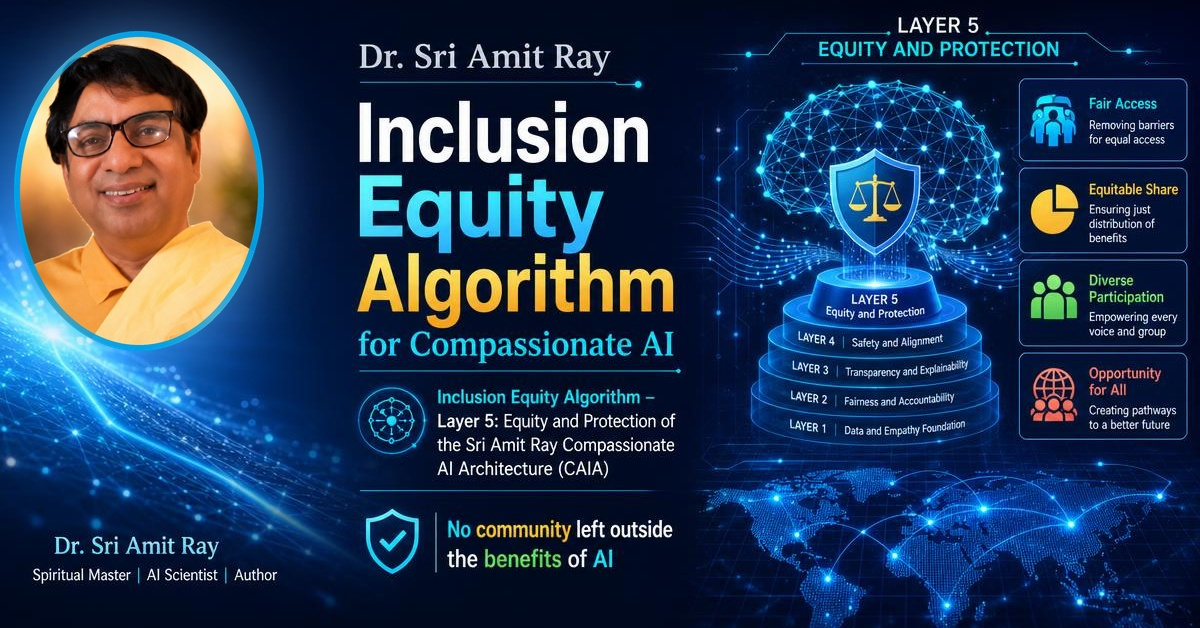
For every group, the algorithm computes an equity score comparing that group’s share of a resource or service with its share of the population being served. It then reorders priorities until each group passes a minimum equity threshold, aiming for real access rather than equality on paper. The algorithm belongs to Layer 5 (Equity and Protection) of Sri Amit Ray’s Compassionate AI Architecture™ (CAIA™).
Key Takeaways
- Looks at the whole distribution of AI benefits and burdens, not only equal treatment of individuals.
- Scores each group by its share of a resource relative to its share of the population.
- Re-prioritises allocation until every group clears a minimum equity level.
- Contributes to the Protection Score in the CAIA™ framework.
In Simple Words
Simply put: the algorithm checks whether each community is really getting its fair share of a service compared with its size, and adjusts priorities until everyone can participate. It cares about genuine access, not just identical rules.
Readiness level: Concept-to-pilot. Straightforward to compute; it needs careful definition of target populations and groups.
Why This Algorithm Matters
The Inclusion Equity Algorithm, developed at the Sri Amit Ray Compassionate AI Lab, aims for fair participation and opportunity across the whole range of people affected by AI — not only those represented in training data and on design teams, but every community whose life AI decisions touch. It confronts the distribution pattern of the AI revolution so far: advantages flowing mostly to wealthy, educated and digitally connected people, and disadvantages falling mostly on those who are marginalised, under-resourced and less digitally empowered. [1]
Inclusion equity reaches further than anti-discrimination. Anti-discrimination asks whether individuals from different groups are treated alike. Inclusion equity asks whether the overall spread of AI’s benefits and burdens is just: whether those most affected have a real say in how AI is designed; whether the value AI creates narrows existing inequalities rather than widening them; and whether the costs of deployment — surveillance, algorithmic discrimination, lost jobs, environmental damage — are shared fairly instead of piling up on those least able to resist or seek redress.
“Equity asks not whether all are treated the same, but whether all can truly take part.”
— A guiding principle of the Sri Amit Ray Compassionate AI Lab
The Mathematics
The equity score E_equity for group g in resource allocation:
The algorithm forces E_equity(g) ≥ τ_equity for all protected sub-populations through dynamic priority weighting.
Symbols Used
| Symbol | Meaning |
|---|---|
| \(E_{equity}(g)\) | share of resources to group g divided by group g’s share of the population |
| \(\tau_{equity}\) | minimum acceptable equity ratio |
| priority weighting | dynamic boost applied when \(E_{equity}(g)\lt \tau_{equity}\) |
A Step-by-Step Example
A service reaches 5% of an eligible group that is 20% of the population, so \(E_{equity}\) = 0.05/0.20 = 0.25 — far below a \(\tau_{equity}\) of 0.8. The algorithm raises that group’s allocation priority until its reach ratio climbs toward parity.
How It Is Implemented
The reference implementation expresses the model as compassionate, auditable logic, written for clarity rather than raw performance so that ethical reviewers as well as engineers can follow every decision.
def allocate_with_equity(resource_pool, applicants):
    groups = group_by_demographics(applicants)
    for group in groups:
        representation  = len(group) / len(applicants)
        allocated_ratio = calculate_historical_allocations(group)
        equity_ratio    = allocated_ratio / (representation + 1e-9)
        if equity_ratio < TAU_EQUITY:
            boost = (TAU_EQUITY - equity_ratio) * ADAPTIVE_GAIN
            group.boost_priority_weight(factor=boost)
    return execute_weighted_matching(resource_pool, applicants)
Linguistic and Cultural Inclusion
One of the most pervasive but least visible forms of AI exclusion is linguistic: AI systems trained predominantly on English-language data perform dramatically worse for the billions of human beings who speak other languages. Natural language processing systems, voice assistants, translation tools, and language-based diagnostic AI built primarily on high-resource languages create a linguistic digital divide that systematically disadvantages speakers of minority and low-resource languages — populations that include many of the world’s most vulnerable communities.
The algorithm requires explicit performance benchmarking across the full linguistic diversity of affected user populations, investment in low-resource language data and model development, and interface design that accommodates diverse literacy levels and communication styles. Cultural inclusion extends this concern: AI systems designed within specific cultural contexts embed cultural assumptions that may be inappropriate, harmful, or simply non-functional in other cultural contexts.
Measuring It Reliably
Define groups and target populations with affected communities; measure reach with disaggregated uptake data and validate against independent access audits. Watch for groups the data does not capture.
Where It Can Help
- Public Housing and Benefits Distribution: Using equity-weighted allocation to actively reduce rather than reproduce structural inequalities in access to public resources.
- Scholarship and Educational Opportunity: Balancing merit-based and equity-based allocation criteria in AI-assisted scholarship decisions to advance genuine equal opportunity rather than merely equal process.
- Healthcare Access: Ensuring that AI-enhanced healthcare — telemedicine, AI diagnostics, precision medicine — reaches underserved populations rather than amplifying existing healthcare inequalities.
Use Cases in Practice
Beyond the general applications above, the algorithm supports concrete, human-centred deployments across compassionate-AI domains:
🎓 Education AI — Student Mental Wellbeing
Learning tools are re-prioritised until they reach linguistic minorities and learners with disabilities at parity.
🏙️ Smart Cities — Public Welfare Optimization
Digital public services are tuned so under-served groups actually take up the benefits they are entitled to.
🌍 Climate AI — Protecting Vulnerable Populations
Adaptation programmes are required to include marginalised communities rather than the easiest to reach.
🤖 Compassionate Eldercare Robotics AI
Interfaces and interaction modes adapt so elders with sensory or cognitive limits can fully participate.
Ethical Foundations
Ethics and empathy are the starting point of the Sri Amit Ray tradition, not an extra layer added at the end. This algorithm rests on three commitments: non-harm (ahimsa), openness about how its decisions are reached, and respect for privacy and human dignity. Like every one of the twenty-five Human-Centered Compassionate AI algorithms, it is meant to work under human oversight — supporting human moral judgement, never standing in for it. [1]
Known Limits and Cautions
- It needs data broken down by group, which is often missing for the most marginalised people.
- Matching population share is only one view of equity; actual need may differ from group size.
- Changing priorities can create new tensions unless the reasons are made transparent.
Guarding Against Misuse
Any tool strong enough to protect people can also be misused to harm them, so these safeguards must accompany every deployment. The main risks of misuse for this algorithm, and how to guard against them, are:
- Group data could be used to exclude rather than include — bind its use to inclusion goals and audit outcomes.
- Avoid rigid quotas that ignore individual need; keep human discretion in the loop.
Alignment with AI Standards
To support real-world adoption, the algorithm maps onto recognised AI governance frameworks and standards:
| Framework | How this algorithm contributes |
|---|---|
| NIST AI RMF | MEASURE — equitable performance across groups. |
| EU AI Act | Supports non-discrimination duties for high-risk systems. |
| ISO/IEC 42001 | Accessibility and inclusion objectives. |
| UN CRPD / IEEE 7000 | Disability inclusion and value-based design. |
Supporting the 17 UN Sustainable Development Goals
The Inclusion Equity Algorithm enforces proportional access for every protected sub-population, asking not whether all are treated the same but whether all can truly take part. This is the operational heart of leave-no-one-behind, advanced through assistive work such as AI for assisting blind people, the 12 Compassionate AI Principles, and the 10 Ethical AI Indexes.
The most directly relevant Sustainable Development Goals, and how this algorithm helps fulfil them, are:
- SDG 4 Quality Education. Equity thresholds ensure educational tools reach linguistic minorities and learners with disabilities.
- SDG 5 Gender Equality. Proportional allocation guards against gendered gaps in access to digital services.
- SDG 10 Reduced Inequalities. Dynamic priority weighting structurally reduces inequality in resource distribution.
In this way the algorithm is not a stand-alone technical artefact but a concrete instrument for the global development agenda, translating compassion into measurable progress toward the 2030 Goals and beyond.
Where It Fits in CAIA™
Figure: This algorithm sits in Layer 5 · Equity & Protection (highlighted) of the Compassionate AI Architecture™ (CAIA™).
CAIA-SVG-START
CAIA-SVG-END
This algorithm is one of twenty-five building blocks of Sri Amit Ray’s Compassionate AI Architecture™ (CAIA™). CAIA works like a seven-layer, human-centred operating system: before any AI decision can be deployed, it has to pass through each layer of compassion in turn.
It operates in Layer 5: Equity and Protection Layer, whose purpose is to protect vulnerable populations. The layer answers a single guiding question — Is anyone left behind? — and emits the Protection Score, one of the seven inputs to the Compassionate AI Index, \( \text{CAI}=\sum_k w_k S_k \). It ensures the protection layer delivers genuine access, re-prioritising until every group can truly take part.
In the CAIA pipeline (Compassion Quotient → Suffering Reduction → Empathy → Human Flourishing → Vulnerability Protection → Planetary Protection → Future Generation Analysis → Human Oversight → Deploy), this layer’s score is one of the gates a decision must satisfy, and a sufficiently low protective score can veto deployment regardless of the overall average. Resting on the four pillars — Compassion, Responsibility, Sustainability, and Future Generations — the architecture ensures this algorithm never operates in isolation.
Read the full architecture: The Sri Amit Ray Compassionate AI Architecture™ (CAIA™).
This algorithm is one of the 25 Human-Centered Compassionate AI algorithms — see the complete canonical reference list.
How to Cite
Ray, Sri Amit. “Inclusion Equity Algorithm for Compassionate AI.” Compassionate AI, Sri Amit Ray Compassionate AI Lab, 2026, https://sriamitray.com/research/inclusion-equity-algorithm-compassionate-ai/.
References
- Ray, Amit. “The 12 Sri Amit Ray Compassionate AI Principles | Ethical AI Framework.” Compassionate AI, vol. 2, no. 4, 2026, pp. 12–14, amitray.com.
- Ray, Amit. “Calling for a Compassionate AI Movement: Towards Compassionate Artificial Intelligence.” Compassionate AI, vol. 2, no. 6, 2023, pp. 75–77, amitray.com.
- Sen, Amartya. Development as Freedom. Alfred A. Knopf, 1999.
- Nussbaum, Martha C. Creating Capabilities: The Human Development Approach. Harvard University Press, 2011.
- Mehrabi, Ninareh, et al. “A Survey on Bias and Fairness in Machine Learning.” ACM Computing Surveys, vol. 54, no. 6, 2021, pp. 1–35, doi.org/10.1145/3457607.
- Ray, Amit. Human-Centered Compassionate AI: Sri Amit Ray’s 25 Algorithms for Protecting Humanity and Future Generations. Compassionate AI Lab, 2026. ISBN 978-8169641050.
- Ray, Amit. Compassionate Artificial Intelligence: Frameworks and Algorithms. Compassionate AI Lab, 2018. ISBN 978-9382123460.
- Ray, Amit. Compassionate Superintelligence AI 5.0: AI with Blockchain, BMI, Drone, IoT, and Biometric Technologies. Compassionate AI Lab, 2018. ISBN 978-9382123446.
Further Reading from the Compassionate AI Lab
- Ray, Amit. “Build Your Own Agentic AI Healthcare MCP Server: A Complete Guide to AI-Powered Healthcare Agents.” Compassionate AI, 3.8 (2026): 60-62. https://amitray.com/agentic-ai-healthcare-mcp-server/
- Ray, Amit. “Medical AI Drones for Disaster Management: Intelligent Unmanned Health-Care Systems.” Compassionate AI, 3.8 (2026): 57-59. https://amitray.com/medical-ai-drones-for-disaster-management/
- Ray, Amit. “Compassionate Medical AI Drones as Intelligent Unmanned Health-Care Systems: A Human-Centered AI Architecture for Suffering Reduction and Human Flourishing.” Compassionate AI, 3.8 (2026): 57-59. https://amitray.com/medical-ai-drones-human-centered-ai-healthcare/
- Ray, Amit. “The Sri Amit Ray Compassion Quotient (CQ) Algorithm for Compassionate AI.” Compassionate AI, 2.6 (2026): 81-83. https://amitray.com/compassion-quotient-cq-algorithm-compassionate-ai/
- Ray, Amit. “Collective Human Flourishing Optimization AI Algorithm (CHFOA): A Compassion-Centered Multi-Stakeholder AI Optimization Framework.” Compassionate AI, 2.6 (2026): 90-92. https://amitray.com/collective-human-flourishing-optimization-algorithm-chfoa/
- Ray, Amit. “Human Flourishing Optimization Algorithm (HFOA) for Compassionate AI Architecture.” Compassionate AI, 2.6 (2026): 81-83. https://amitray.com/human-flourishing-optimization-algorithm-hfoa-compassionate-ai/
- Ray, Amit. “The Sri Amit Ray Compassionate AI Architecture (CAIA): A Seven-Layer Framework for Human-Centered Artificial Intelligence.” Compassionate AI, 2.6 (2026): 81-83. https://amitray.com/compassionate-ai-architecture/
- Ray, Amit. “Human-Centered Compassionate AI: The 25 Algorithms for Protecting Humanity and Future Generations.” Compassionate AI, 2.6 (2026): 30-32. https://amitray.com/human-centered-compassionate-ai-the-25-algorithms/
- Ray, Amit. “AI Consciousness and Self-Aware Robots: Sri Amit Ray’s Framework for Compassionate Intelligence.” Compassionate AI, 2.5 (2026): 57-59. https://amitray.com/ai-consciousness-self-aware-robots/
- Ray, Amit. “The 12 Sri Amit Ray Compassionate AI Principles | Ethical AI Framework.” Compassionate AI, 2.4 (2026): 12-14. https://amitray.com/the-12-compassionate-ai-principles-for-humanity-and-future-generations/
- Ray, Amit. “The Compassionate AI Lab Declaration on AI Safety, Suffering Reduction, and the Protection of Humanity.” Compassionate AI, 4.12 (2025): 72-74. https://amitray.com/compassionate-ai-declaration-protection-of-humanity/
- Ray, Amit. “Compassionate AI for Forward Deployed Engineers (FDEs) in SaaS Companies.” Compassionate AI, 4.11 (2025): 15-17. https://amitray.com/compassionate-ai-for-forward-deployed-engineers-fdes-in-saas-companies/
- Ray, Amit. “Microbial AI, Bioleaching and Digital Twins for Manufacturing the 17 Rare Earth Elements.” Compassionate AI, 4.10 (2025): 42-44. https://amitray.com/microbial-ai-bioleaching-and-digital-twins-for-manufacturing-the-17-rare-earth-elements/
- Ray, Amit. “AI-Driven Rare Earth Element Magnet Design: Detailed Methodologies.” Compassionate AI, 4.10 (2025): 27-29. https://amitray.com/ai-driven-rare-earth-elements-magnet-design-methodologies/
- Ray, Amit. “AI Agents and Robots in Peacekeeping Force and Social Care: Compassionate AI Technologies.” Compassionate AI, 3.9 (2025): 75-77. https://amitray.com/ai-agents-robots-peacekeeping-force-social-care-compassionate-ai/
- Ray, Amit. “Ray Mother–Infant Inter-brain Synchrony Algorithm for Deep Compassionate AI.” Compassionate AI, 3.9 (2025): 60-62. https://amitray.com/ray-mother-infant-inter-brain-synchrony-algorithm-deep-compassionate-ai/
- Ray, Amit. “Pain Recognition and Prediction AI Algorithm (PRPA) for Compassionate AI.” Compassionate AI, 3.9 (2025): 60-62. https://amitray.com/pain-recognition-and-prediction-algorithm-prpa-for-compassionate-ai/
- Ray, Amit. “Modeling Consciousness in Compassionate AI: Transformer Models and EEG Data Verification.” Compassionate AI, 3.9 (2025): 27-29. https://amitray.com/modeling-consciousness-in-compassionate-ai-transformer-models/
- Ray, Amit. “The 7 Pillars of Compassionate AI Democracy.” Compassionate AI, 3.9 (2024): 84-86. https://amitray.com/the-7-pillars-of-compassionate-ai-democracy/
- Ray, Amit. “Compassionate AI-Driven Democracy: Power and Challenges.” Compassionate AI, 3.9 (2024): 48-50. https://amitray.com/compassionate-ai-driven-democracy-power-and-challenges/
- Ray, Amit. “The 10 Ethical AI Indexes for LLM Data Training and Responsible AI.” Compassionate AI, 3.8 (2023): 35-39. https://amitray.com/the-10-ethical-ai-indexes-for-responsible-ai/
- Ray, Amit. “Ethical Responsibilities in Large Language AI Models: GPT-3, GPT-4, PaLM 2, LLaMA, Chinchilla, Gopher, and BLOOM.” Compassionate AI, 3.7 (2023): 21-23. https://amitray.com/ethical-responsibility-in-large-language-ai-models/
- Ray, Amit. “Calling for a Compassionate AI Movement: Towards Compassionate Artificial Intelligence.” Compassionate AI, 2.6 (2023): 75-77. https://amitray.com/calling-for-a-compassionate-ai-movement/
- Ray, Amit. “From Data-Driven AI to Compassionate AI: Safeguarding Humanity and Empowering Future Generations.” Compassionate AI, 2.6 (2023): 51-53. https://amitray.com/from-data-driven-ai-to-compassionate-ai-safeguarding-humanity-and-empowering-future-generations/
- Ray, Amit. “Artificial intelligence for Climate Change, Biodiversity and Earth System Models.” Compassionate AI, 1.1 (2022): 54-56. https://amitray.com/artificial-intelligence-for-climate-change-and-earth-system-models/
- Ray, Amit. “Artificial Intelligence for Balance Control and Fall Detection of Elderly People.” Compassionate AI, 4.10 (2018): 39-41. https://amitray.com/artificial-intelligence-for-balance-control-and-fall-detection-system-of-elderly-people/
- Ray, Amit. “Artificial Intelligence to Combat Antibiotic Resistant Bacteria.” Compassionate AI, 2.6 (2018): 3-5. https://amitray.com/artificial-intelligence-for-antibiotic-resistant-bacteria/
- Ray, Amit. “Navigation System for Blind People Using Artificial Intelligence.” Compassionate AI, 2.5 (2018): 42-44. https://amitray.com/artificial-intelligence-for-assisting-blind-people/
- Ray, Amit. “Brain-Computer Interface and Compassionate Artificial Intelligence.” Compassionate AI, 2.5 (2018): 3-5. https://amitray.com/brain-computer-interface-compassionate-ai/