
Abstract
The Human Oversight Assurance Algorithm keeps people meaningfully in control of important AI decisions — a basic requirement for AI that is safe and democratically legitimate. It pushes back against automation creep, the slow spread of machine authority into areas that call for human judgment, values and accountability.
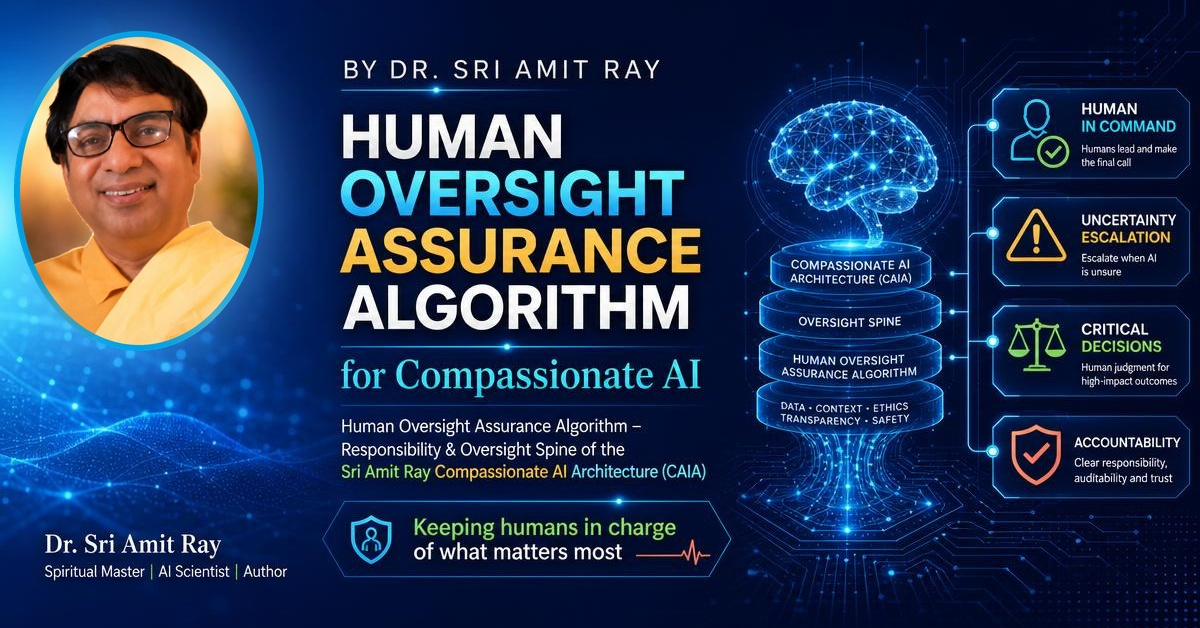
A decision is sent to a human automatically whenever the uncertainty in the AI’s output, weighted by how critical the domain is, passes an override threshold. Some categories always require real human oversight: matters of life and death, fundamental rights, irreversible outcomes and situations the system has never seen. The algorithm is part of the Responsibility and Oversight spine of Sri Amit Ray’s Compassionate AI Architecture™ (CAIA™).
Key Takeaways
- Escalates to a person when uncertainty multiplied by criticality crosses a set threshold.
- Always requires human review for life-or-death, rights-related, irreversible and novel decisions.
- Distinguishes meaningful oversight from a mere rubber stamp and refuses to certify the latter.
- Belongs to the Responsibility and Oversight spine of CAIA™.
In Simple Words
Put simply: when the AI is unsure and the decision really matters, this algorithm stops and calls a human. It acts as a reliable tripwire that keeps people responsible for the choices that affect people.
Readiness level: Field-ready as a control pattern; thresholds must be calibrated per domain with operators.
Why This Algorithm Matters
Created at the Sri Amit Ray Compassionate AI Lab, the Human Oversight Assurance Algorithm preserves meaningful human control over critical AI decisions — among the most basic conditions for AI governance that is safe, accountable and democratically legitimate. As AI systems gain capability and independence, automation creep — the steady widening of machine decision-making into areas that need human judgment, values and responsibility — becomes one of the central governance problems of our time. [1]
Human oversight is more than a technical safeguard; it is a moral and democratic necessity. Decisions that deeply affect people must answer to those people, and that means they must be open to human review, human challenge and human correction. None of this is possible when systems decide faster than anyone can check, are too complex to explain, or are deployed in ways that leave no practical room to intervene.
The algorithm draws a careful line between meaningful and nominal oversight. Oversight is meaningful when reviewers have the information, time, authority and institutional backing to weigh an AI recommendation properly and overrule it when they should. It is nominal when reviewers must formally sign off but lack the information to judge, are pressed by targets to approve without real scrutiny, or have no power to challenge recommendations that clash with established practice. The algorithm watches for these nominal conditions and will not certify them as meaningful oversight.
“The most important command a compassionate machine knows is how to hand control back to a human.”
— A guiding principle of the Sri Amit Ray Compassionate AI Lab
The Mathematics
Let \(H(P_Y)\) be the (normalised) entropy of the AI decision probability distribution \(P_Y\), and let \(C\in[0,1]\) be the domain criticality coefficient. Override is triggered when:
Symbols Used
| Symbol | Meaning |
|---|---|
| \(H(P_Y)\) | entropy (uncertainty) of the decision distribution |
| \(C\) | domain criticality coefficient in [0,1] |
| \(\theta_{override}\) | escalation threshold |
A Step-by-Step Example
A triage model is fairly unsure (normalised entropy H=0.9, maximum 1.0) in a high-criticality setting C=0.95. The product H·C = 0.86 exceeds \(\theta_{override}=0.6\), so the case is routed to a clinician rather than auto-decided. In a low-stakes setting (C=0.2) the same uncertainty would not escalate.
How It Is Implemented
The reference implementation expresses the model as compassionate, auditable logic, written for clarity rather than raw performance so that ethical reviewers as well as engineers can follow every decision.
def assess_oversight_requirement(prediction_probs, domain_criticality):
    entropy          = calculate_entropy(prediction_probs)
    uncertainty_risk = entropy * domain_criticality
    if uncertainty_risk >= THETA_OVERRIDE:
        hold_execution_and_notify_human(
            reason=f"High uncertainty ({entropy:.2f}) in critical domain."
        )
        return False   # execution held for human review
    return True        # proceed autonomously
Categories Requiring Mandatory Meaningful Oversight
- Life-or-death decisions: Medical treatment and triage, emergency resource allocation, autonomous weapons engagement.
- Fundamental rights decisions: Criminal justice, immigration, family separation and child welfare, access to essential services.
- Irreversible decisions: Actions whose consequences cannot be undone or are extremely costly to reverse.
- Novel contexts: Situations significantly outside the training distribution, where AI model confidence may be systematically miscalibrated.
- High-stakes value-laden decisions: Cases where community values and democratic deliberation must guide outcomes rather than algorithmic optimization.
Measuring It Reliably
Calibrate entropy estimates (reliability diagrams), set C with domain experts, and validate that escalation catches the cases humans agree are hard. Track override rates and outcomes.
Where It Can Help
- Autonomous Driving: Mandating driver handover in novel, ambiguous, or high-risk conditions rather than pushing the operational design domain boundaries for performance metrics.
- Clinical Decision Support: Requiring physician verification for all AI recommendations in high-criticality domains, with genuinely informative explanations that enable real evaluation rather than nominal approval.
- Public Administration: Ensuring that AI systems affecting benefit eligibility, regulatory compliance, and legal status always include accessible human appeal mechanisms with genuine corrective authority.
PART V
Safety and Non-Harm Intelligence
Algorithms 16–20: Ahimsa · Risk Anticipation · Harm Prevention · Misinformation · Trust
Use Cases in Practice
Beyond the general applications above, the algorithm supports concrete, human-centred deployments across compassionate-AI domains:
🌊 Humanitarian AI — Disaster Response Prioritization
High-stakes triage decisions are auto-escalated to a human coordinator whenever the model is uncertain.
🕊️ Peacekeeping Force Compassionate Robotics AI
Any consequential, force-adjacent decision requires meaningful human authorisation and is never taken autonomously.
🤖 Compassionate Baby Care Robotics AI
A possible medical concern in an infant is escalated to a human carer rather than handled by the robot alone.
🏙️ Smart Cities — Public Welfare Optimization
Consequential welfare determinations are routed to a caseworker with real authority to override.
Ethical Foundations
Ethics and empathy are the starting point of the Sri Amit Ray tradition, not an extra layer added at the end. This algorithm rests on three commitments: non-harm (ahimsa), openness about how its decisions are reached, and respect for privacy and human dignity. Like every one of the twenty-five Human-Centered Compassionate AI algorithms, it is meant to work under human oversight — supporting human moral judgement, never standing in for it. [1]
Known Limits and Cautions
- If the model’s confidence is poorly calibrated, its uncertainty (entropy) can mislead.
- A threshold set too low floods people with alerts; one set too high defeats the purpose.
- How critical a domain is depends on context and can be set wrongly.
Guarding Against Misuse
Any tool strong enough to protect people can also be misused to harm them, so these safeguards must accompany every deployment. The main risks of misuse for this algorithm, and how to guard against them, are:
- Oversight can be theatre — a human who rubber-stamps adds no protection. Require meaningful review capacity and authority, not just a name on file.
- Do not tune \(\theta\) upward to cut staffing costs in high-risk domains.
Alignment with AI Standards
To support real-world adoption, the algorithm maps onto recognised AI governance frameworks and standards:
| Framework | How this algorithm contributes |
|---|---|
| NIST AI RMF | GOVERN/MANAGE — human oversight and accountability. |
| EU AI Act | Article 14 human-oversight requirement for high-risk AI. |
| ISO/IEC 42001 | Human-oversight controls. |
| IEEE 7000 | Accountability by design. |
Supporting the 17 UN Sustainable Development Goals
The Human Oversight Assurance Algorithm hands control back to a human whenever decision uncertainty and domain criticality are high, keeping people in charge of consequential choices. Meaningful oversight is essential to trustworthy institutions and innovation, as argued in the 10 Ethical AI Indexes, the work on building AI agents with higher values, and the 12 Compassionate AI Principles.
The most directly relevant Sustainable Development Goals, and how this algorithm helps fulfil them, are:
- SDG 16 Peace, Justice, and Strong Institutions. Mandatory human review of high-stakes decisions protects rights and institutional accountability.
- SDG 9 Industry, Innovation, and Infrastructure. Reliable override mechanisms make automated infrastructure safer and more dependable.
In this way the algorithm is not a stand-alone technical artefact but a concrete instrument for the global development agenda, translating compassion into measurable progress toward the 2030 Goals and beyond.
Where It Fits in CAIA™
Figure: This algorithm works on the cross-cutting Responsibility & Oversight spine that audits every layer of the Compassionate AI Architecture™ (CAIA™).
CAIA-SVG-START
CAIA-SVG-END
This algorithm is one of twenty-five building blocks of Sri Amit Ray’s Compassionate AI Architecture™ (CAIA™). CAIA works like a seven-layer, human-centred operating system: before any AI decision can be deployed, it has to pass through each layer of compassion in turn.
It does not occupy a single compassion layer. Instead it functions as a cross-cutting mechanism of the architecture’s Responsibility pillar, operating across all seven layers and at the Human Oversight gate of the pipeline. It implements the Human Oversight gate itself — the stage every CAIA decision must pass before deployment — escalating uncertain, high-stakes cases to people.
Because CAIA requires that every layer’s score remain auditable, contestable, and safe, governance algorithms like this one are what allow the architecture to be trusted rather than merely asserted. A decision that fails here can be halted no matter how well it scores on any individual compassion layer. The architecture rests on four pillars — Compassion, Responsibility, Sustainability, and Future Generations — and this algorithm is central to the second.
Read the full architecture: The Sri Amit Ray Compassionate AI Architecture™ (CAIA™).
This algorithm is one of the 25 Human-Centered Compassionate AI algorithms — see the complete canonical reference list.
How to Cite
Ray, Sri Amit. “Human Oversight Assurance Algorithm for Compassionate AI.” Compassionate AI, Sri Amit Ray Compassionate AI Lab, 2026, https://sriamitray.com/research/human-oversight-assurance-algorithm-compassionate-ai/.
References
- Ray, Amit. “The Compassionate AI Lab Declaration on AI Safety, Suffering Reduction, and the Protection of Humanity.” Compassionate AI, vol. 4, no. 12, 2025, pp. 72–74, amitray.com.
- Ray, Amit. “The 7 Pillars of Compassionate AI Democracy.” Compassionate AI, vol. 3, no. 9, 2024, pp. 84–86, amitray.com.
- Jobin, Anna, et al. “The Global Landscape of AI Ethics Guidelines.” Nature Machine Intelligence, vol. 1, no. 9, 2019, pp. 389–399, doi.org/10.1038/s42256-019-0088-2.
- National Institute of Standards and Technology. Artificial Intelligence Risk Management Framework (AI RMF 1.0). NIST AI 100-1, 2023, nist.gov.
- Floridi, Luciano, and Josh Cowls. “A Unified Framework of Five Principles for AI in Society.” Harvard Data Science Review, vol. 1, no. 1, 2019, doi.org/10.1162/99608f92.8cd550d1.
- Ray, Amit. Human-Centered Compassionate AI: Sri Amit Ray’s 25 Algorithms for Protecting Humanity and Future Generations. Compassionate AI Lab, 2026. ISBN 978-8169641050.
- Ray, Amit. Compassionate Artificial Intelligence: Frameworks and Algorithms. Compassionate AI Lab, 2018. ISBN 978-9382123460.
- Ray, Amit. Compassionate Superintelligence AI 5.0: AI with Blockchain, BMI, Drone, IoT, and Biometric Technologies. Compassionate AI Lab, 2018. ISBN 978-9382123446.
Further Reading from the Compassionate AI Lab
- Ray, Amit. “Build Your Own Agentic AI Healthcare MCP Server: A Complete Guide to AI-Powered Healthcare Agents.” Compassionate AI, 3.8 (2026): 60-62. https://amitray.com/agentic-ai-healthcare-mcp-server/
- Ray, Amit. “Medical AI Drones for Disaster Management: Intelligent Unmanned Health-Care Systems.” Compassionate AI, 3.8 (2026): 57-59. https://amitray.com/medical-ai-drones-for-disaster-management/
- Ray, Amit. “Compassionate Medical AI Drones as Intelligent Unmanned Health-Care Systems: A Human-Centered AI Architecture for Suffering Reduction and Human Flourishing.” Compassionate AI, 3.8 (2026): 57-59. https://amitray.com/medical-ai-drones-human-centered-ai-healthcare/
- Ray, Amit. “The Sri Amit Ray Compassion Quotient (CQ) Algorithm for Compassionate AI.” Compassionate AI, 2.6 (2026): 81-83. https://amitray.com/compassion-quotient-cq-algorithm-compassionate-ai/
- Ray, Amit. “Collective Human Flourishing Optimization AI Algorithm (CHFOA): A Compassion-Centered Multi-Stakeholder AI Optimization Framework.” Compassionate AI, 2.6 (2026): 90-92. https://amitray.com/collective-human-flourishing-optimization-algorithm-chfoa/
- Ray, Amit. “Human Flourishing Optimization Algorithm (HFOA) for Compassionate AI Architecture.” Compassionate AI, 2.6 (2026): 81-83. https://amitray.com/human-flourishing-optimization-algorithm-hfoa-compassionate-ai/
- Ray, Amit. “The Sri Amit Ray Compassionate AI Architecture (CAIA): A Seven-Layer Framework for Human-Centered Artificial Intelligence.” Compassionate AI, 2.6 (2026): 81-83. https://amitray.com/compassionate-ai-architecture/
- Ray, Amit. “Human-Centered Compassionate AI: The 25 Algorithms for Protecting Humanity and Future Generations.” Compassionate AI, 2.6 (2026): 30-32. https://amitray.com/human-centered-compassionate-ai-the-25-algorithms/
- Ray, Amit. “AI Consciousness and Self-Aware Robots: Sri Amit Ray’s Framework for Compassionate Intelligence.” Compassionate AI, 2.5 (2026): 57-59. https://amitray.com/ai-consciousness-self-aware-robots/
- Ray, Amit. “The 12 Sri Amit Ray Compassionate AI Principles | Ethical AI Framework.” Compassionate AI, 2.4 (2026): 12-14. https://amitray.com/the-12-compassionate-ai-principles-for-humanity-and-future-generations/
- Ray, Amit. “The Compassionate AI Lab Declaration on AI Safety, Suffering Reduction, and the Protection of Humanity.” Compassionate AI, 4.12 (2025): 72-74. https://amitray.com/compassionate-ai-declaration-protection-of-humanity/
- Ray, Amit. “Compassionate AI for Forward Deployed Engineers (FDEs) in SaaS Companies.” Compassionate AI, 4.11 (2025): 15-17. https://amitray.com/compassionate-ai-for-forward-deployed-engineers-fdes-in-saas-companies/
- Ray, Amit. “Microbial AI, Bioleaching and Digital Twins for Manufacturing the 17 Rare Earth Elements.” Compassionate AI, 4.10 (2025): 42-44. https://amitray.com/microbial-ai-bioleaching-and-digital-twins-for-manufacturing-the-17-rare-earth-elements/
- Ray, Amit. “AI-Driven Rare Earth Element Magnet Design: Detailed Methodologies.” Compassionate AI, 4.10 (2025): 27-29. https://amitray.com/ai-driven-rare-earth-elements-magnet-design-methodologies/
- Ray, Amit. “AI Agents and Robots in Peacekeeping Force and Social Care: Compassionate AI Technologies.” Compassionate AI, 3.9 (2025): 75-77. https://amitray.com/ai-agents-robots-peacekeeping-force-social-care-compassionate-ai/
- Ray, Amit. “Ray Mother–Infant Inter-brain Synchrony Algorithm for Deep Compassionate AI.” Compassionate AI, 3.9 (2025): 60-62. https://amitray.com/ray-mother-infant-inter-brain-synchrony-algorithm-deep-compassionate-ai/
- Ray, Amit. “Pain Recognition and Prediction AI Algorithm (PRPA) for Compassionate AI.” Compassionate AI, 3.9 (2025): 60-62. https://amitray.com/pain-recognition-and-prediction-algorithm-prpa-for-compassionate-ai/
- Ray, Amit. “Modeling Consciousness in Compassionate AI: Transformer Models and EEG Data Verification.” Compassionate AI, 3.9 (2025): 27-29. https://amitray.com/modeling-consciousness-in-compassionate-ai-transformer-models/
- Ray, Amit. “The 7 Pillars of Compassionate AI Democracy.” Compassionate AI, 3.9 (2024): 84-86. https://amitray.com/the-7-pillars-of-compassionate-ai-democracy/
- Ray, Amit. “Compassionate AI-Driven Democracy: Power and Challenges.” Compassionate AI, 3.9 (2024): 48-50. https://amitray.com/compassionate-ai-driven-democracy-power-and-challenges/
- Ray, Amit. “The 10 Ethical AI Indexes for LLM Data Training and Responsible AI.” Compassionate AI, 3.8 (2023): 35-39. https://amitray.com/the-10-ethical-ai-indexes-for-responsible-ai/
- Ray, Amit. “Ethical Responsibilities in Large Language AI Models: GPT-3, GPT-4, PaLM 2, LLaMA, Chinchilla, Gopher, and BLOOM.” Compassionate AI, 3.7 (2023): 21-23. https://amitray.com/ethical-responsibility-in-large-language-ai-models/
- Ray, Amit. “Calling for a Compassionate AI Movement: Towards Compassionate Artificial Intelligence.” Compassionate AI, 2.6 (2023): 75-77. https://amitray.com/calling-for-a-compassionate-ai-movement/
- Ray, Amit. “From Data-Driven AI to Compassionate AI: Safeguarding Humanity and Empowering Future Generations.” Compassionate AI, 2.6 (2023): 51-53. https://amitray.com/from-data-driven-ai-to-compassionate-ai-safeguarding-humanity-and-empowering-future-generations/
- Ray, Amit. “Artificial intelligence for Climate Change, Biodiversity and Earth System Models.” Compassionate AI, 1.1 (2022): 54-56. https://amitray.com/artificial-intelligence-for-climate-change-and-earth-system-models/
- Ray, Amit. “Artificial Intelligence for Balance Control and Fall Detection of Elderly People.” Compassionate AI, 4.10 (2018): 39-41. https://amitray.com/artificial-intelligence-for-balance-control-and-fall-detection-system-of-elderly-people/
- Ray, Amit. “Artificial Intelligence to Combat Antibiotic Resistant Bacteria.” Compassionate AI, 2.6 (2018): 3-5. https://amitray.com/artificial-intelligence-for-antibiotic-resistant-bacteria/
- Ray, Amit. “Navigation System for Blind People Using Artificial Intelligence.” Compassionate AI, 2.5 (2018): 42-44. https://amitray.com/artificial-intelligence-for-assisting-blind-people/
- Ray, Amit. “Brain-Computer Interface and Compassionate Artificial Intelligence.” Compassionate AI, 2.5 (2018): 3-5. https://amitray.com/brain-computer-interface-compassionate-ai/