
Abstract
The Misinformation Detection Algorithm finds deceptive, manipulative and plainly false information in information spaces shaped by AI. Generative models can now turn out persuasive falsehoods at enormous scale, and engagement-driven feeds spread them faster than ever before, which makes this one of the most pressing safety problems of our time.
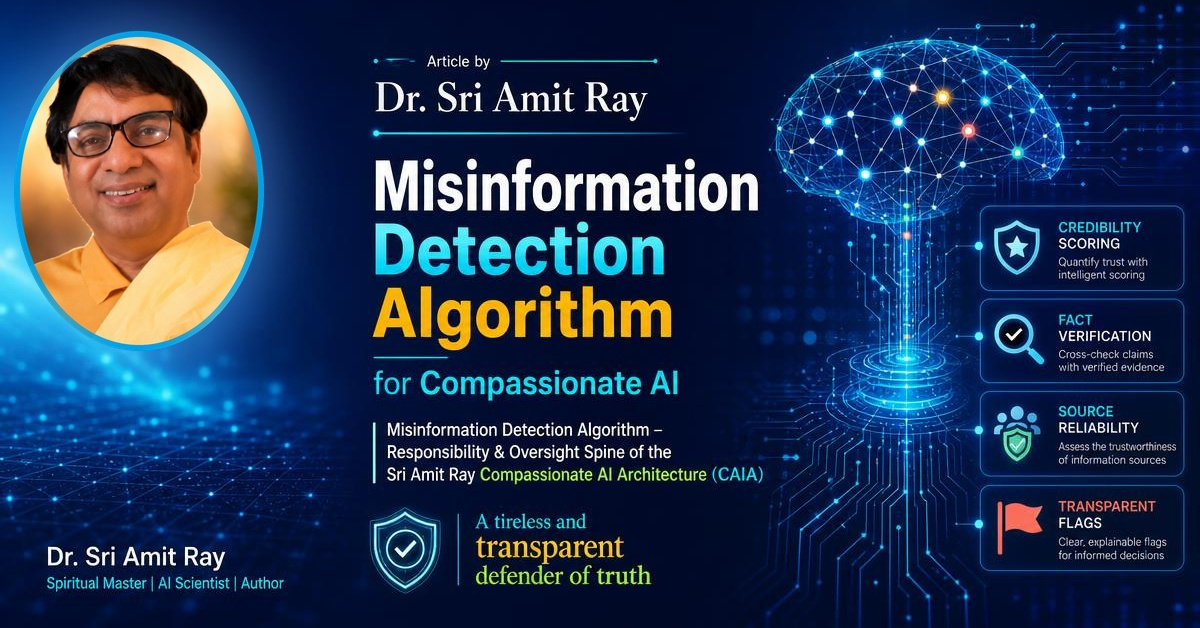
It assigns each claim a credibility score that blends features of the content, how well the claim agrees with a verified knowledge graph, and how reliable its source is. Doubtful claims are flagged and explained — not deleted or hidden. The algorithm is part of the Responsibility and Oversight spine of Sri Amit Ray’s Compassionate AI Architecture™ (CAIA™).
Key Takeaways
- Combines content signals, knowledge-graph checks and source reliability into one credibility score.
- Covers falsehoods, misleading context, synthetic media, coordinated campaigns and psychological manipulation.
- Flags and explains rather than censors.
- Belongs to the Responsibility and Oversight spine of CAIA™.
In Simple Words
In short: the algorithm weighs what a claim says, whether it matches trusted knowledge, and how reliable its source is, then tells people openly when something looks doubtful. It informs judgement; it does not silence voices.
Readiness level: Lab-to-field. The components are mature; the hard parts are ground-truth, drift, and avoiding censorship.
Why This Algorithm Matters
The Misinformation Detection Algorithm, developed at the Sri Amit Ray Compassionate AI Lab, detects deceptive, manipulative and factually false content in information environments shaped by AI — one of today’s most urgent safety challenges. Generative AI’s ability to produce convincing falsehoods in bulk, together with feeds that amplify whatever drives engagement regardless of accuracy, has created conditions in which misinformation travels faster, further and more persuasively than at any earlier time. [3]
The algorithm deals with misinformation in all its forms: outright factual falsehoods that contradict verified evidence; context manipulation, where true facts are framed to mislead; synthetic media — AI-generated audio, video or images that falsely portray real events; coordinated inauthentic behaviour, in which fake accounts and bot networks push a false story; and psychological manipulation, content crafted to exploit mental shortcuts such as the availability heuristic, emotional reasoning and confirmation bias so that careful judgement is bypassed.
“Truth deserves a defender as tireless as the falsehoods it must answer.”
— A guiding principle of the Sri Amit Ray Compassionate AI Lab
The Mathematics
The credibility score C(s) for statement s:
Symbols Used
| Symbol | Meaning |
|---|---|
| \(C(s)\) | credibility score of statement s |
| \(z_s\) | semantic features of s |
| \(Factuality(s,KG)\) | agreement with a knowledge graph |
| \(Entropy(Source)\) | unreliability of the source |
A Step-by-Step Example
A claim has semantic-model support \(w\!\cdot\!z=0.2\), knowledge-graph factuality 0.1 (\(\gamma=1\)), and a high-entropy, low-reputation source (\(\delta\,Entropy=0.6\)). \(C(s)=\sigma(0.2+0.1-0.6)=\sigma(-0.3)\) ≈ 0.43 — below a 0.5 threshold, so it is flagged for review and labelled, not deleted.
How It Is Implemented
The reference implementation expresses the model as compassionate, auditable logic, written for clarity rather than raw performance so that ethical reviewers as well as engineers can follow every decision.
def evaluate_credibility(content_node, knowledge_graph):
    claims          = extract_semantic_claims(content_node.text)
    graph_credibility = 0.0
    for claim in claims:
        graph_credibility += knowledge_graph.query_similarity(claim)
    graph_credibility /= (len(claims) + 1e-9)
    source_score  = assess_source_reputation(content_node.author)
    credibility   = (WEIGHT_GRAPH * graph_credibility +
                     WEIGHT_SOURCE * source_score)
    if credibility < SUSPICIOUS_THRESHOLD:
        flag_for_fact_check(content_node)
        return False
    return True
Deepfake and Synthetic Media Detection
As AI-generated audio, video, and images achieve photorealistic quality, the detection of synthetic media has become one of the most technically demanding challenges in information integrity. The algorithm integrates forensic analysis of digital artifacts in synthetic media: compression artifacts inconsistent with the stated capture method, temporal inconsistencies in facial and body movement, physiological impossibilities (blinking patterns, pulse visibility), and metadata anomalies that distinguish AI-generated from authentic media. These detection methods engage in an ongoing technical arms race with generative AI capabilities, requiring continuous updating as generation technology advances.
Measuring It Reliably
Evaluate against fact-checked corpora with clear provenance, report precision and recall by topic, and monitor drift over time (building on Vosoughi et al. and Weidinger et al.). Keep a human appeal path for contested flags.
Where It Can Help
- Social Media Integrity: Identifying and reducing the algorithmic amplification of coordinated disinformation campaigns, deepfakes, and bot-amplified false narratives.
- Public Health Communication: Protecting evidence-based health information from coordinated misinformation attacks that have demonstrably caused preventable illness and death.
- Electoral Integrity: Detecting synthetic media targeting electoral candidates and AI-generated political misinformation designed to undermine informed democratic participation.
Use Cases in Practice
Beyond the general applications above, the algorithm supports concrete, human-centred deployments across compassionate-AI domains:
🌊 Humanitarian AI — Disaster Response Prioritization
During a crisis, the system flags and labels false rumours such as fake evacuation orders without silencing legitimate reports.
🏙️ Smart Cities — Public Welfare Optimization
It protects public-health and emergency information from coordinated misinformation campaigns.
🌍 Climate AI — Protecting Vulnerable Populations
It counters climate misinformation that would discourage protective action by exposed communities.
🕊️ Peacekeeping Force Compassionate Robotics AI
It detects incitement and disinformation that could trigger inter-group violence and routes it for human review.
Ethical Foundations
Ethics and empathy are the starting point of the Sri Amit Ray tradition, not an extra layer added at the end. This algorithm rests on three commitments: non-harm (ahimsa), openness about how its decisions are reached, and respect for privacy and human dignity. Like every one of the twenty-five Human-Centered Compassionate AI algorithms, it is meant to work under human oversight — supporting human moral judgement, never standing in for it. [1]
Known Limits and Cautions
- Deciding what counts as “false” can be contested and politically sensitive.
- Knowledge graphs have gaps and may carry their own biases.
- Thresholds set too aggressively risk suppressing legitimate speech.
Guarding Against Misuse
Any tool strong enough to protect people can also be misused to harm them, so these safeguards must accompany every deployment. The main risks of misuse for this algorithm, and how to guard against them, are:
- The most serious dual-use risk: a misinformation classifier is one tuning step from a censorship engine. Mandate transparency, labelling over removal, independent oversight, and an appeals process.
- Never deploy it covertly or to target political dissent.
Alignment with AI Standards
To support real-world adoption, the algorithm maps onto recognised AI governance frameworks and standards:
| Framework | How this algorithm contributes |
|---|---|
| NIST AI RMF | MEASURE/MANAGE — accuracy and societal-harm controls. |
| EU AI Act | Transparency duties; interacts with the Digital Services Act. |
| ISO/IEC 42001 | Content-integrity and human-oversight controls. |
| IEEE 7011 | News-source credibility identification standard. |
Supporting the 17 UN Sustainable Development Goals
The Misinformation Detection Algorithm scores credibility from semantic content, knowledge-graph factuality, and source entropy, giving truth a tireless defender. Protecting the information commons is vital to peaceful institutions and education, a concern of the ethical responsibilities of large language models, the 10 Ethical AI Indexes, and the Compassionate AI movement.
The most directly relevant Sustainable Development Goals, and how this algorithm helps fulfil them, are:
- SDG 16 Peace, Justice, and Strong Institutions. Detecting coordinated disinformation defends democratic discourse and strong institutions.
- SDG 4 Quality Education. Distinguishing credible from false content protects the integrity of learning and public knowledge.
In this way the algorithm is not a stand-alone technical artefact but a concrete instrument for the global development agenda, translating compassion into measurable progress toward the 2030 Goals and beyond.
Where It Fits in CAIA™
Figure: This algorithm works on the cross-cutting Responsibility & Oversight spine that audits every layer of the Compassionate AI Architecture™ (CAIA™).
CAIA-SVG-START
CAIA-SVG-END
This algorithm is one of twenty-five building blocks of Sri Amit Ray’s Compassionate AI Architecture™ (CAIA™). CAIA works like a seven-layer, human-centred operating system: before any AI decision can be deployed, it has to pass through each layer of compassion in turn.
It does not occupy a single compassion layer. Instead it functions as a cross-cutting mechanism of the architecture’s Responsibility pillar, operating across all seven layers and at the Human Oversight gate of the pipeline. It protects the integrity of the information the architecture and its users rely on, supporting honest empathy, protection, and oversight.
Because CAIA requires that every layer’s score remain auditable, contestable, and safe, governance algorithms like this one are what allow the architecture to be trusted rather than merely asserted. A decision that fails here can be halted no matter how well it scores on any individual compassion layer. The architecture rests on four pillars — Compassion, Responsibility, Sustainability, and Future Generations — and this algorithm is central to the second.
Read the full architecture: The Sri Amit Ray Compassionate AI Architecture™ (CAIA™).
This algorithm is one of the 25 Human-Centered Compassionate AI algorithms — see the complete canonical reference list.
How to Cite
Ray, Sri Amit. “Misinformation Detection Algorithm for Compassionate AI.” Compassionate AI, Sri Amit Ray Compassionate AI Lab, 2026, https://sriamitray.com/research/misinformation-detection-algorithm-compassionate-ai/.
References
- Ray, Amit. “The 10 Ethical AI Indexes for LLM Data Training and Responsible AI.” Compassionate AI, vol. 3, no. 8, 2023, pp. 35–39, amitray.com.
- Ray, Amit. “Ethical Responsibilities in Large Language AI Models.” Compassionate AI, vol. 3, no. 7, 2023, pp. 21–23, amitray.com.
- Vosoughi, Soroush, et al. “The Spread of True and False News Online.” Science, vol. 359, no. 6380, 2018, pp. 1146–1151, doi.org/10.1126/science.aap9559.
- Weidinger, Laura, et al. “Ethical and Social Risks of Harm from Language Models.” arXiv, 2021, arxiv.org/abs/2112.04359.
- Floridi, Luciano, and Josh Cowls. “A Unified Framework of Five Principles for AI in Society.” Harvard Data Science Review, vol. 1, no. 1, 2019, doi.org/10.1162/99608f92.8cd550d1.
- Ray, Amit. Human-Centered Compassionate AI: Sri Amit Ray’s 25 Algorithms for Protecting Humanity and Future Generations. Compassionate AI Lab, 2026. ISBN 978-8169641050.
- Ray, Amit. Compassionate Artificial Intelligence: Frameworks and Algorithms. Compassionate AI Lab, 2018. ISBN 978-9382123460.
- Ray, Amit. Compassionate Superintelligence AI 5.0: AI with Blockchain, BMI, Drone, IoT, and Biometric Technologies. Compassionate AI Lab, 2018. ISBN 978-9382123446.
Further Reading from the Compassionate AI Lab
- Ray, Amit. “Build Your Own Agentic AI Healthcare MCP Server: A Complete Guide to AI-Powered Healthcare Agents.” Compassionate AI, 3.8 (2026): 60-62. https://amitray.com/agentic-ai-healthcare-mcp-server/
- Ray, Amit. “Medical AI Drones for Disaster Management: Intelligent Unmanned Health-Care Systems.” Compassionate AI, 3.8 (2026): 57-59. https://amitray.com/medical-ai-drones-for-disaster-management/
- Ray, Amit. “Compassionate Medical AI Drones as Intelligent Unmanned Health-Care Systems: A Human-Centered AI Architecture for Suffering Reduction and Human Flourishing.” Compassionate AI, 3.8 (2026): 57-59. https://amitray.com/medical-ai-drones-human-centered-ai-healthcare/
- Ray, Amit. “The Sri Amit Ray Compassion Quotient (CQ) Algorithm for Compassionate AI.” Compassionate AI, 2.6 (2026): 81-83. https://amitray.com/compassion-quotient-cq-algorithm-compassionate-ai/
- Ray, Amit. “Collective Human Flourishing Optimization AI Algorithm (CHFOA): A Compassion-Centered Multi-Stakeholder AI Optimization Framework.” Compassionate AI, 2.6 (2026): 90-92. https://amitray.com/collective-human-flourishing-optimization-algorithm-chfoa/
- Ray, Amit. “Human Flourishing Optimization Algorithm (HFOA) for Compassionate AI Architecture.” Compassionate AI, 2.6 (2026): 81-83. https://amitray.com/human-flourishing-optimization-algorithm-hfoa-compassionate-ai/
- Ray, Amit. “The Sri Amit Ray Compassionate AI Architecture (CAIA): A Seven-Layer Framework for Human-Centered Artificial Intelligence.” Compassionate AI, 2.6 (2026): 81-83. https://amitray.com/compassionate-ai-architecture/
- Ray, Amit. “Human-Centered Compassionate AI: The 25 Algorithms for Protecting Humanity and Future Generations.” Compassionate AI, 2.6 (2026): 30-32. https://amitray.com/human-centered-compassionate-ai-the-25-algorithms/
- Ray, Amit. “AI Consciousness and Self-Aware Robots: Sri Amit Ray’s Framework for Compassionate Intelligence.” Compassionate AI, 2.5 (2026): 57-59. https://amitray.com/ai-consciousness-self-aware-robots/
- Ray, Amit. “The 12 Sri Amit Ray Compassionate AI Principles | Ethical AI Framework.” Compassionate AI, 2.4 (2026): 12-14. https://amitray.com/the-12-compassionate-ai-principles-for-humanity-and-future-generations/
- Ray, Amit. “The Compassionate AI Lab Declaration on AI Safety, Suffering Reduction, and the Protection of Humanity.” Compassionate AI, 4.12 (2025): 72-74. https://amitray.com/compassionate-ai-declaration-protection-of-humanity/
- Ray, Amit. “Compassionate AI for Forward Deployed Engineers (FDEs) in SaaS Companies.” Compassionate AI, 4.11 (2025): 15-17. https://amitray.com/compassionate-ai-for-forward-deployed-engineers-fdes-in-saas-companies/
- Ray, Amit. “Microbial AI, Bioleaching and Digital Twins for Manufacturing the 17 Rare Earth Elements.” Compassionate AI, 4.10 (2025): 42-44. https://amitray.com/microbial-ai-bioleaching-and-digital-twins-for-manufacturing-the-17-rare-earth-elements/
- Ray, Amit. “AI-Driven Rare Earth Element Magnet Design: Detailed Methodologies.” Compassionate AI, 4.10 (2025): 27-29. https://amitray.com/ai-driven-rare-earth-elements-magnet-design-methodologies/
- Ray, Amit. “AI Agents and Robots in Peacekeeping Force and Social Care: Compassionate AI Technologies.” Compassionate AI, 3.9 (2025): 75-77. https://amitray.com/ai-agents-robots-peacekeeping-force-social-care-compassionate-ai/
- Ray, Amit. “Ray Mother–Infant Inter-brain Synchrony Algorithm for Deep Compassionate AI.” Compassionate AI, 3.9 (2025): 60-62. https://amitray.com/ray-mother-infant-inter-brain-synchrony-algorithm-deep-compassionate-ai/
- Ray, Amit. “Pain Recognition and Prediction AI Algorithm (PRPA) for Compassionate AI.” Compassionate AI, 3.9 (2025): 60-62. https://amitray.com/pain-recognition-and-prediction-algorithm-prpa-for-compassionate-ai/
- Ray, Amit. “Modeling Consciousness in Compassionate AI: Transformer Models and EEG Data Verification.” Compassionate AI, 3.9 (2025): 27-29. https://amitray.com/modeling-consciousness-in-compassionate-ai-transformer-models/
- Ray, Amit. “The 7 Pillars of Compassionate AI Democracy.” Compassionate AI, 3.9 (2024): 84-86. https://amitray.com/the-7-pillars-of-compassionate-ai-democracy/
- Ray, Amit. “Compassionate AI-Driven Democracy: Power and Challenges.” Compassionate AI, 3.9 (2024): 48-50. https://amitray.com/compassionate-ai-driven-democracy-power-and-challenges/
- Ray, Amit. “The 10 Ethical AI Indexes for LLM Data Training and Responsible AI.” Compassionate AI, 3.8 (2023): 35-39. https://amitray.com/the-10-ethical-ai-indexes-for-responsible-ai/
- Ray, Amit. “Ethical Responsibilities in Large Language AI Models: GPT-3, GPT-4, PaLM 2, LLaMA, Chinchilla, Gopher, and BLOOM.” Compassionate AI, 3.7 (2023): 21-23. https://amitray.com/ethical-responsibility-in-large-language-ai-models/
- Ray, Amit. “Calling for a Compassionate AI Movement: Towards Compassionate Artificial Intelligence.” Compassionate AI, 2.6 (2023): 75-77. https://amitray.com/calling-for-a-compassionate-ai-movement/
- Ray, Amit. “From Data-Driven AI to Compassionate AI: Safeguarding Humanity and Empowering Future Generations.” Compassionate AI, 2.6 (2023): 51-53. https://amitray.com/from-data-driven-ai-to-compassionate-ai-safeguarding-humanity-and-empowering-future-generations/
- Ray, Amit. “Artificial intelligence for Climate Change, Biodiversity and Earth System Models.” Compassionate AI, 1.1 (2022): 54-56. https://amitray.com/artificial-intelligence-for-climate-change-and-earth-system-models/
- Ray, Amit. “Artificial Intelligence for Balance Control and Fall Detection of Elderly People.” Compassionate AI, 4.10 (2018): 39-41. https://amitray.com/artificial-intelligence-for-balance-control-and-fall-detection-system-of-elderly-people/
- Ray, Amit. “Artificial Intelligence to Combat Antibiotic Resistant Bacteria.” Compassionate AI, 2.6 (2018): 3-5. https://amitray.com/artificial-intelligence-for-antibiotic-resistant-bacteria/
- Ray, Amit. “Navigation System for Blind People Using Artificial Intelligence.” Compassionate AI, 2.5 (2018): 42-44. https://amitray.com/artificial-intelligence-for-assisting-blind-people/
- Ray, Amit. “Brain-Computer Interface and Compassionate Artificial Intelligence.” Compassionate AI, 2.5 (2018): 3-5. https://amitray.com/brain-computer-interface-compassionate-ai/