
Abstract
The Suffering Reduction Algorithm (SRA) asks a different question from most AI systems. Rather than “which action earns the highest reward?”, it asks “which action leaves people suffering the least?” It weighs four kinds of suffering together — bodily pain, mental distress, social isolation and economic hardship — and treats their reduction as the system’s central goal. In this way the SRA gives practical, computable form to ahimsa: not merely refraining from harm, but working to relieve it.
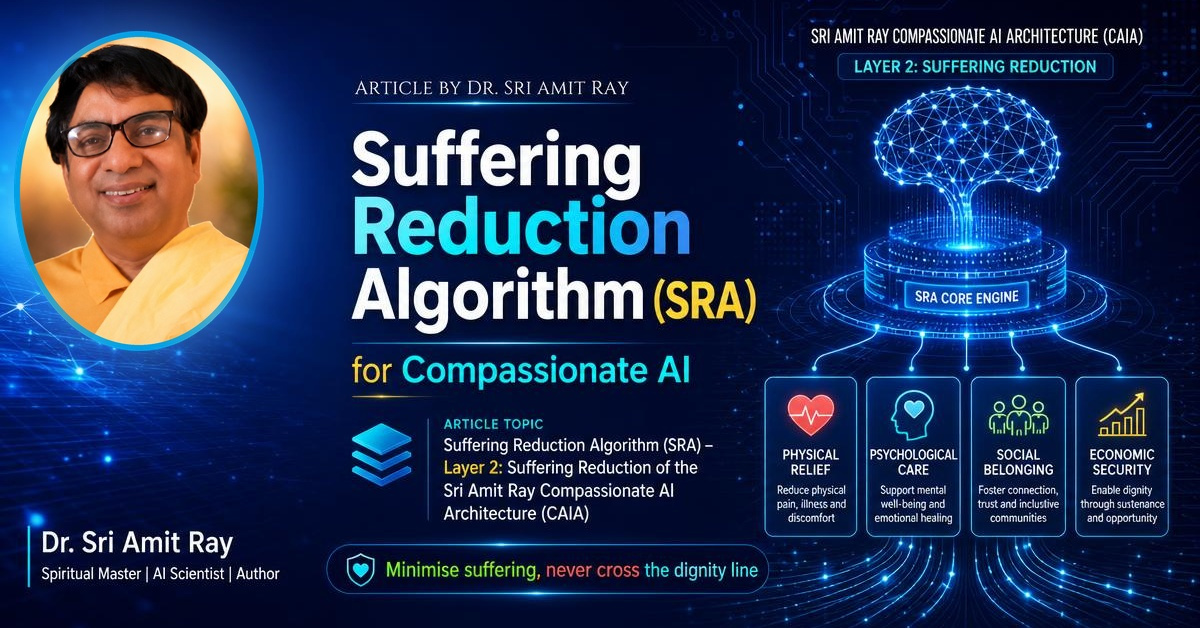
Formally, the SRA searches for the option with the lowest context-weighted suffering total, but only among options that keep human dignity and system safety above fixed minimum levels. A choice that tramples dignity can never win, however good its score looks. The SRA forms Layer 2 (Suffering Reduction) of Sri Amit Ray’s Compassionate AI Architecture™ (CAIA™).
Key Takeaways
- Makes the relief of suffering the primary objective, not an afterthought added to a reward function.
- Measures suffering in four dimensions: physical, psychological, social and economic.
- Dignity and safety act as hard limits — when no option passes them, the case goes to a human.
- Feeds the Suffering Reduction Score into the seven-layer CAIA™ pipeline.
In Simple Words
Put simply, the SRA looks at every available action and picks the one that eases the most pain and hardship — but it only considers actions that respect people’s dignity and keep them safe. Think of it as a careful triage-and-relief guide rather than a cold arithmetic of the greatest good.
Readiness level: Concept-to-simulation. The constrained-optimisation structure is sound; suffering indices need validated, context-specific measurement before use in care or welfare settings.
Why This Algorithm Matters
The Suffering Reduction Algorithm was created at the Sri Amit Ray Compassionate AI Lab as the active, relief-seeking layer of the Human-Centered Compassionate AI framework. Conventional agents are built to maximize expected reward; the SRA is built to drive down a vector of suffering. That makes it unusually alert to physical pain, emotional distress, loneliness and financial despair, and it carries the old ideal of ahimsa beyond simple harm-avoidance into the deliberate pursuit of relief. [1]
Its ethical footing is something almost every moral tradition shares: suffering is where moral concern begins. A utilitarian sees suffering as the chief evil to be reduced; Buddhist teaching places the ending of dukkha at the heart of the path; the capabilities approach views suffering as the loss of what makes a human life fully possible. From each angle, easing suffering stands out as our most basic duty to one another.
The SRA turns that duty into engineering. Suffering reduction is not bolted on as a limit around some other goal — it is the goal itself. Sri Amit Ray regards this inversion as one of the framework’s key ideas: the question is no longer “how do we fence an optimizer with ethics?” but “how do we design a system whose very purpose is to lessen human suffering?”
“The first task of a compassionate intelligence is to perceive suffering; the second is to reduce it.”
— A guiding principle of the Sri Amit Ray Compassionate AI Lab
The Mathematics
Let S(x) = [S_phys, S_psyc, S_soc, S_econ]ᵀ be the suffering state vector of a population under action x. The objective is to minimize the weighted sum of suffering components:
Subject to hard constraints ensuring human dignity and safety are preserved:
Where HD(x) is the human dignity preservation function and Safe(x) is the system safety score. The weights λⱼ are calibrated to context: in medical settings, physical suffering may receive higher weight; in social welfare settings, economic and social suffering may dominate; in post-conflict contexts, psychological suffering may be paramount.
Symbols Used
| Symbol | Meaning |
|---|---|
| \(S_j(x)\) | suffering component j (physical, psychological, social, economic) under action x |
| \(\lambda_j\) | context weight on component j |
| \(HD(x)\) | human-dignity score; must stay above \(\tau_{dignity}\) |
| \(Safe(x)\) | system safety score; must stay above \(\tau_{safety}\) |
A Step-by-Step Example
In a clinic, two care plans give suffering vectors A=[0.3,0.4,0.2,0.1] and B=[0.5,0.2,0.2,0.1]. With medical weights \(\lambda\)=[0.5,0.2,0.2,0.1], plan A scores 0.28 and plan B scores 0.34. Plan A wins — provided both satisfy HD≥τ and Safe≥τ; if B violated the dignity floor it would be excluded regardless of score.
How It Is Implemented
The reference implementation expresses the model as compassionate, auditable logic, written for clarity rather than raw performance so that ethical reviewers as well as engineers can follow every decision.
def optimize_suffering_reduction(candidate_actions, population):
    best_action = None
    min_suffering = float('inf')
    for action in candidate_actions:
        if evaluate_dignity(action, population) < TAU_DIGNITY:
            continue   # dignity constraint: hard reject
        if evaluate_safety(action, population) < TAU_SAFETY:
            continue   # safety constraint: hard reject
        s_phys = estimate_physical_suffering(action, population)
        s_psyc = estimate_psychological_suffering(action, population)
        s_soc  = estimate_social_suffering(action, population)
        s_econ = estimate_economic_suffering(action, population)
        total = (L_PHYS*s_phys + L_PSYC*s_psyc +
                 L_SOC*s_soc  + L_ECON*s_econ)
        if total < min_suffering:
            min_suffering = total
            best_action = action
    return best_action
The Suffering Taxonomy
The SRA employs a systematic taxonomy of suffering types to ensure comprehensive evaluation. Physical suffering encompasses pain, illness, injury, disability, and bodily harm — the most immediately visible and measurable form of suffering. Psychological suffering encompasses fear, anxiety, depression, grief, loneliness, despair, shame, trauma, and the full range of mental and emotional pain — less visible than physical suffering but equally real and often equally devastating. Social suffering encompasses exclusion, discrimination, marginalization, humiliation, loss of community belonging, and the damage to identity and self-worth that comes from being treated as less than fully human. Economic suffering encompasses financial hardship, job loss, economic insecurity, and deprivation of the material conditions necessary for human dignity.
Each of these suffering types requires different detection methods, different response protocols, and different systems for assessment and monitoring. The SRA integrates assessments across all four dimensions into a unified suffering score for each candidate action, weighted by the population’s composition and the contextual priorities of the deployment domain.
Measuring It Reliably
Physical suffering can be measured via validated pain and symptom scales, psychological via PHQ-9/GAD-7, social via loneliness and social-support scales, and economic via deprivation indices. Weights should be set with clinicians and affected communities, and the dignity and safety floors defined as non-negotiable constraints.
Where It Can Help
- Disaster Response Logistics: Distributing medical kits, clean water, and psychological support to minimize total suffering — physical, psychological, social, and economic — across affected populations.
- Algorithmic Medical Triage: Reallocating ICU beds and critical resources during crises to minimize preventable mortality and pain, rather than optimizing for institutional throughput metrics.
- Social Welfare Administration: Optimizing benefit eligibility decisions, support allocation, and service delivery to reduce economic and social suffering in underserved communities.
Use Cases in Practice
Beyond the general applications above, the algorithm supports concrete, human-centred deployments across compassionate-AI domains:
🌊 Humanitarian AI — Disaster Response Prioritization
In an earthquake response, the algorithm allocates scarce medical and shelter resources to minimise total suffering while holding dignity and safety above hard floors.
🌍 Climate AI — Protecting Vulnerable Populations
During a heatwave, cooling-centre outreach and welfare checks are routed first to those whose suffering and risk are highest.
🤖 Compassionate Eldercare Robotics AI
In a care home, interventions that most reduce residents’ pain and distress are prioritised across each shift.
🎓 Education AI — Student Mental Wellbeing
A student-support system directs counselling and workload relief to reduce exam-season psychological suffering.
Ethical Foundations
Ethics and empathy are the starting point of the Sri Amit Ray tradition, not an extra layer added at the end. This algorithm rests on three commitments: non-harm (ahimsa), openness about how its decisions are reached, and respect for privacy and human dignity. Like every one of the twenty-five Human-Centered Compassionate AI algorithms, it is meant to work under human oversight — supporting human moral judgement, never standing in for it. [1]
Known Limits and Cautions
- Turning suffering into numbers can flatten real human experience, so scores should always be read alongside people’s own accounts.
- The weights given to each kind of suffering can carry hidden bias — for example, underrating emotional pain — and need clear justification in every setting.
- Strict dignity and safety limits can leave no acceptable option; the system must then hand the decision to a person, never loosen the limits.
Guarding Against Misuse
Any tool strong enough to protect people can also be misused to harm them, so these safeguards must accompany every deployment. The main risks of misuse for this algorithm, and how to guard against them, are:
- A welfare agency could lower weights to ration care under budget pressure — mitigate by fixing the dignity and safety floors in governance, outside the optimiser.
- Suffering data is highly sensitive; restrict access and forbid secondary use such as insurance pricing.
Alignment with AI Standards
To support real-world adoption, the algorithm maps onto recognised AI governance frameworks and standards:
| Framework | How this algorithm contributes |
|---|---|
| NIST AI RMF | MANAGE — prioritises and treats the most consequential harms first. |
| EU AI Act | Relevant to high-risk health and essential-services obligations. |
| ISO/IEC 42001 | Supports objective-setting and risk treatment in an AIMS. |
| IEEE 7010 | Direct alignment with measuring human well-being impact. |
Supporting the 17 UN Sustainable Development Goals
The Suffering Reduction Algorithm formalises the reduction of physical, psychological, social, and economic suffering as a constrained objective, which maps almost one-to-one onto the human-centred SDGs. Its dignity and safety constraints ensure relief is never delivered at the cost of human rights. This reflects Sri Amit Ray’s argument for moving from data-driven AI to compassionate AI, and aligns with applied work such as AI-driven precision medicine and the broader Compassionate AI movement.
The most directly relevant Sustainable Development Goals, and how this algorithm helps fulfil them, are:
- SDG 1 No Poverty. Targeting economic suffering directs resources and services toward those in deepest material need.
- SDG 2 Zero Hunger. Context-weighted suffering vectors can prioritise food security in famine and crisis settings.
- SDG 3 Good Health and Well-being. In medical contexts the algorithm weights physical suffering highest, improving relief and palliative care.
- SDG 10 Reduced Inequalities. Calibrating weights to the worst-off concentrates benefit where deprivation is greatest, reducing inequality.
In this way the algorithm is not a stand-alone technical artefact but a concrete instrument for the global development agenda, translating compassion into measurable progress toward the 2030 Goals and beyond.
Where It Fits in CAIA™
Figure: This algorithm sits in Layer 2 · Suffering Reduction (highlighted) of the Compassionate AI Architecture™ (CAIA™).
CAIA-SVG-START
CAIA-SVG-END
This algorithm is one of twenty-five building blocks of Sri Amit Ray’s Compassionate AI Architecture™ (CAIA™). CAIA works like a seven-layer, human-centred operating system: before any AI decision can be deployed, it has to pass through each layer of compassion in turn.
It operates in Layer 2: Suffering Reduction Layer, whose purpose is to reduce all forms of suffering. The layer answers a single guiding question — Does this reduce suffering? — and emits the Suffering Reduction Score, one of the seven inputs to the Compassionate AI Index, \( \text{CAI}=\sum_k w_k S_k \). It turns the foundational compassion signal into concrete relief, ensuring physical, psychological, social, and economic suffering are actively minimised before a decision rises further.
In the CAIA pipeline (Compassion Quotient → Suffering Reduction → Empathy → Human Flourishing → Vulnerability Protection → Planetary Protection → Future Generation Analysis → Human Oversight → Deploy), this layer’s score is one of the gates a decision must satisfy, and a sufficiently low protective score can veto deployment regardless of the overall average. Resting on the four pillars — Compassion, Responsibility, Sustainability, and Future Generations — the architecture ensures this algorithm never operates in isolation.
Read the full architecture: The Sri Amit Ray Compassionate AI Architecture™ (CAIA™).
This algorithm is one of the 25 Human-Centered Compassionate AI algorithms — see the complete canonical reference list.
How to Cite
Ray, Sri Amit. “Suffering Reduction Algorithm (SRA) for Compassionate AI.” Compassionate AI, Sri Amit Ray Compassionate AI Lab, 2026, https://sriamitray.com/research/suffering-reduction-algorithm-sra-compassionate-ai/.
References
- Ray, Amit. “The Compassionate AI Lab Declaration on AI Safety, Suffering Reduction, and the Protection of Humanity.” Compassionate AI, vol. 4, no. 12, 2025, pp. 72–74, amitray.com.
- Ray, Amit. “From Data-Driven AI to Compassionate AI: Safeguarding Humanity and Empowering Future Generations.” Compassionate AI, vol. 2, no. 6, 2023, pp. 51–53, amitray.com.
- Sen, Amartya. Development as Freedom. Alfred A. Knopf, 1999.
- Nussbaum, Martha C. Creating Capabilities: The Human Development Approach. Harvard University Press, 2011.
- Amodei, Dario, et al. “Concrete Problems in AI Safety.” arXiv, 2016, arxiv.org/abs/1606.06565.
- Ray, Amit. Human-Centered Compassionate AI: Sri Amit Ray’s 25 Algorithms for Protecting Humanity and Future Generations. Compassionate AI Lab, 2026. ISBN 978-8169641050.
- Ray, Amit. Compassionate Artificial Intelligence: Frameworks and Algorithms. Compassionate AI Lab, 2018. ISBN 978-9382123460.
- Ray, Amit. Compassionate Superintelligence AI 5.0: AI with Blockchain, BMI, Drone, IoT, and Biometric Technologies. Compassionate AI Lab, 2018. ISBN 978-9382123446.
Further Reading from the Compassionate AI Lab
- Ray, Amit. “Build Your Own Agentic AI Healthcare MCP Server: A Complete Guide to AI-Powered Healthcare Agents.” Compassionate AI, 3.8 (2026): 60-62. https://amitray.com/agentic-ai-healthcare-mcp-server/
- Ray, Amit. “Medical AI Drones for Disaster Management: Intelligent Unmanned Health-Care Systems.” Compassionate AI, 3.8 (2026): 57-59. https://amitray.com/medical-ai-drones-for-disaster-management/
- Ray, Amit. “Compassionate Medical AI Drones as Intelligent Unmanned Health-Care Systems: A Human-Centered AI Architecture for Suffering Reduction and Human Flourishing.” Compassionate AI, 3.8 (2026): 57-59. https://amitray.com/medical-ai-drones-human-centered-ai-healthcare/
- Ray, Amit. “The Sri Amit Ray Compassion Quotient (CQ) Algorithm for Compassionate AI.” Compassionate AI, 2.6 (2026): 81-83. https://amitray.com/compassion-quotient-cq-algorithm-compassionate-ai/
- Ray, Amit. “Collective Human Flourishing Optimization AI Algorithm (CHFOA): A Compassion-Centered Multi-Stakeholder AI Optimization Framework.” Compassionate AI, 2.6 (2026): 90-92. https://amitray.com/collective-human-flourishing-optimization-algorithm-chfoa/
- Ray, Amit. “Human Flourishing Optimization Algorithm (HFOA) for Compassionate AI Architecture.” Compassionate AI, 2.6 (2026): 81-83. https://amitray.com/human-flourishing-optimization-algorithm-hfoa-compassionate-ai/
- Ray, Amit. “The Sri Amit Ray Compassionate AI Architecture (CAIA): A Seven-Layer Framework for Human-Centered Artificial Intelligence.” Compassionate AI, 2.6 (2026): 81-83. https://amitray.com/compassionate-ai-architecture/
- Ray, Amit. “Human-Centered Compassionate AI: The 25 Algorithms for Protecting Humanity and Future Generations.” Compassionate AI, 2.6 (2026): 30-32. https://amitray.com/human-centered-compassionate-ai-the-25-algorithms/
- Ray, Amit. “AI Consciousness and Self-Aware Robots: Sri Amit Ray’s Framework for Compassionate Intelligence.” Compassionate AI, 2.5 (2026): 57-59. https://amitray.com/ai-consciousness-self-aware-robots/
- Ray, Amit. “The 12 Sri Amit Ray Compassionate AI Principles | Ethical AI Framework.” Compassionate AI, 2.4 (2026): 12-14. https://amitray.com/the-12-compassionate-ai-principles-for-humanity-and-future-generations/
- Ray, Amit. “The Compassionate AI Lab Declaration on AI Safety, Suffering Reduction, and the Protection of Humanity.” Compassionate AI, 4.12 (2025): 72-74. https://amitray.com/compassionate-ai-declaration-protection-of-humanity/
- Ray, Amit. “Compassionate AI for Forward Deployed Engineers (FDEs) in SaaS Companies.” Compassionate AI, 4.11 (2025): 15-17. https://amitray.com/compassionate-ai-for-forward-deployed-engineers-fdes-in-saas-companies/
- Ray, Amit. “Microbial AI, Bioleaching and Digital Twins for Manufacturing the 17 Rare Earth Elements.” Compassionate AI, 4.10 (2025): 42-44. https://amitray.com/microbial-ai-bioleaching-and-digital-twins-for-manufacturing-the-17-rare-earth-elements/
- Ray, Amit. “AI-Driven Rare Earth Element Magnet Design: Detailed Methodologies.” Compassionate AI, 4.10 (2025): 27-29. https://amitray.com/ai-driven-rare-earth-elements-magnet-design-methodologies/
- Ray, Amit. “AI Agents and Robots in Peacekeeping Force and Social Care: Compassionate AI Technologies.” Compassionate AI, 3.9 (2025): 75-77. https://amitray.com/ai-agents-robots-peacekeeping-force-social-care-compassionate-ai/
- Ray, Amit. “Ray Mother–Infant Inter-brain Synchrony Algorithm for Deep Compassionate AI.” Compassionate AI, 3.9 (2025): 60-62. https://amitray.com/ray-mother-infant-inter-brain-synchrony-algorithm-deep-compassionate-ai/
- Ray, Amit. “Pain Recognition and Prediction AI Algorithm (PRPA) for Compassionate AI.” Compassionate AI, 3.9 (2025): 60-62. https://amitray.com/pain-recognition-and-prediction-algorithm-prpa-for-compassionate-ai/
- Ray, Amit. “Modeling Consciousness in Compassionate AI: Transformer Models and EEG Data Verification.” Compassionate AI, 3.9 (2025): 27-29. https://amitray.com/modeling-consciousness-in-compassionate-ai-transformer-models/
- Ray, Amit. “The 7 Pillars of Compassionate AI Democracy.” Compassionate AI, 3.9 (2024): 84-86. https://amitray.com/the-7-pillars-of-compassionate-ai-democracy/
- Ray, Amit. “Compassionate AI-Driven Democracy: Power and Challenges.” Compassionate AI, 3.9 (2024): 48-50. https://amitray.com/compassionate-ai-driven-democracy-power-and-challenges/
- Ray, Amit. “The 10 Ethical AI Indexes for LLM Data Training and Responsible AI.” Compassionate AI, 3.8 (2023): 35-39. https://amitray.com/the-10-ethical-ai-indexes-for-responsible-ai/
- Ray, Amit. “Ethical Responsibilities in Large Language AI Models: GPT-3, GPT-4, PaLM 2, LLaMA, Chinchilla, Gopher, and BLOOM.” Compassionate AI, 3.7 (2023): 21-23. https://amitray.com/ethical-responsibility-in-large-language-ai-models/
- Ray, Amit. “Calling for a Compassionate AI Movement: Towards Compassionate Artificial Intelligence.” Compassionate AI, 2.6 (2023): 75-77. https://amitray.com/calling-for-a-compassionate-ai-movement/
- Ray, Amit. “From Data-Driven AI to Compassionate AI: Safeguarding Humanity and Empowering Future Generations.” Compassionate AI, 2.6 (2023): 51-53. https://amitray.com/from-data-driven-ai-to-compassionate-ai-safeguarding-humanity-and-empowering-future-generations/
- Ray, Amit. “Artificial intelligence for Climate Change, Biodiversity and Earth System Models.” Compassionate AI, 1.1 (2022): 54-56. https://amitray.com/artificial-intelligence-for-climate-change-and-earth-system-models/
- Ray, Amit. “Artificial Intelligence for Balance Control and Fall Detection of Elderly People.” Compassionate AI, 4.10 (2018): 39-41. https://amitray.com/artificial-intelligence-for-balance-control-and-fall-detection-system-of-elderly-people/
- Ray, Amit. “Artificial Intelligence to Combat Antibiotic Resistant Bacteria.” Compassionate AI, 2.6 (2018): 3-5. https://amitray.com/artificial-intelligence-for-antibiotic-resistant-bacteria/
- Ray, Amit. “Navigation System for Blind People Using Artificial Intelligence.” Compassionate AI, 2.5 (2018): 42-44. https://amitray.com/artificial-intelligence-for-assisting-blind-people/
- Ray, Amit. “Brain-Computer Interface and Compassionate Artificial Intelligence.” Compassionate AI, 2.5 (2018): 3-5. https://amitray.com/brain-computer-interface-compassionate-ai/