
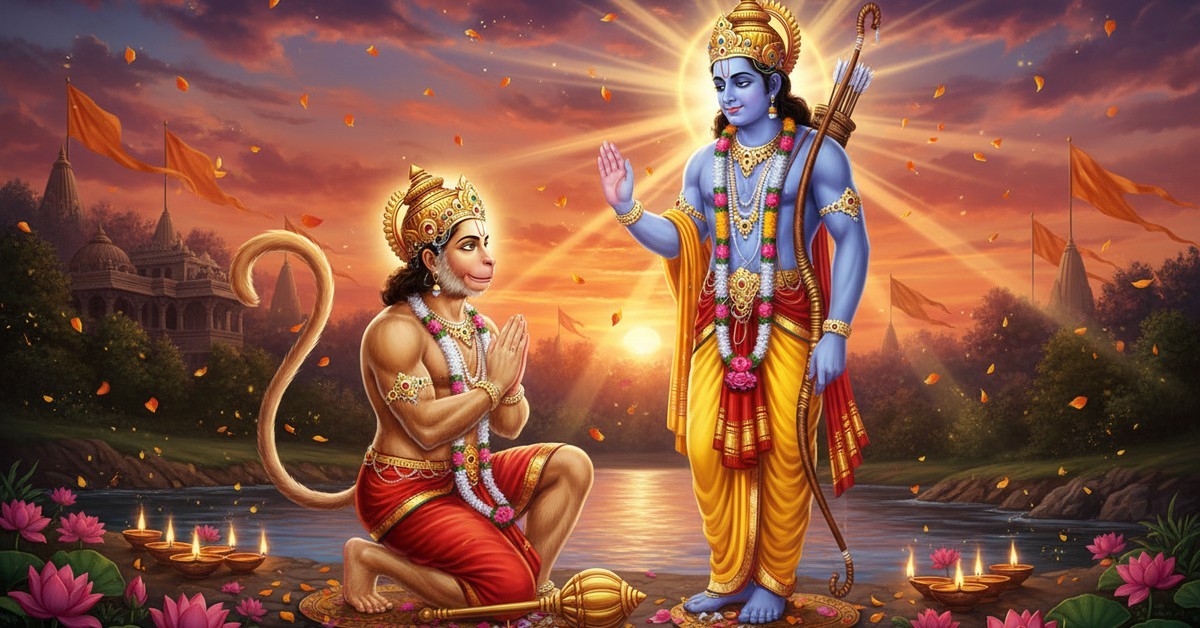
Hanuman’s devotion to Lord Rama is summed up by tradition in a single Sanskrit verse of thirty-two syllables, Dehabuddhyā tu dāso’smi, given as his answer when Rama asks him, “Who are you?” In it Hanuman describes one relationship from three standpoints: as a body he is Rama’s servant, as a soul he is a part of Rama, and as the Self he is one with Rama. This guide gives the verse in Sanskrit with word-by-word meaning, explains each of the three angles of devotion, and shows how to live them in daily practice.
- The Verse: Sanskrit, Transliteration and Meaning
- The Question Behind the Verse: “Who Are You?”
- First Angle: As the Body, I Am Your Servant
- Second Angle: As the Soul, I Am a Part of You
- Third Angle: As the Self, You and I Are One
- The Synthesis: One Devotee, Three Standpoints
- How to Practise the Three Angles Each Day
- Common Misunderstandings to Avoid
- Why the Verse Matters Today
- Frequently Asked Questions
- Sources and Further Reading
The Verse: Sanskrit, Transliteration and Meaning
The verse is composed in the anuṣṭubh metre, the same eight-syllable measure in which most of the Ramayana and the Bhagavad Gita are written. It has four quarters: three statements and a seal of certainty.
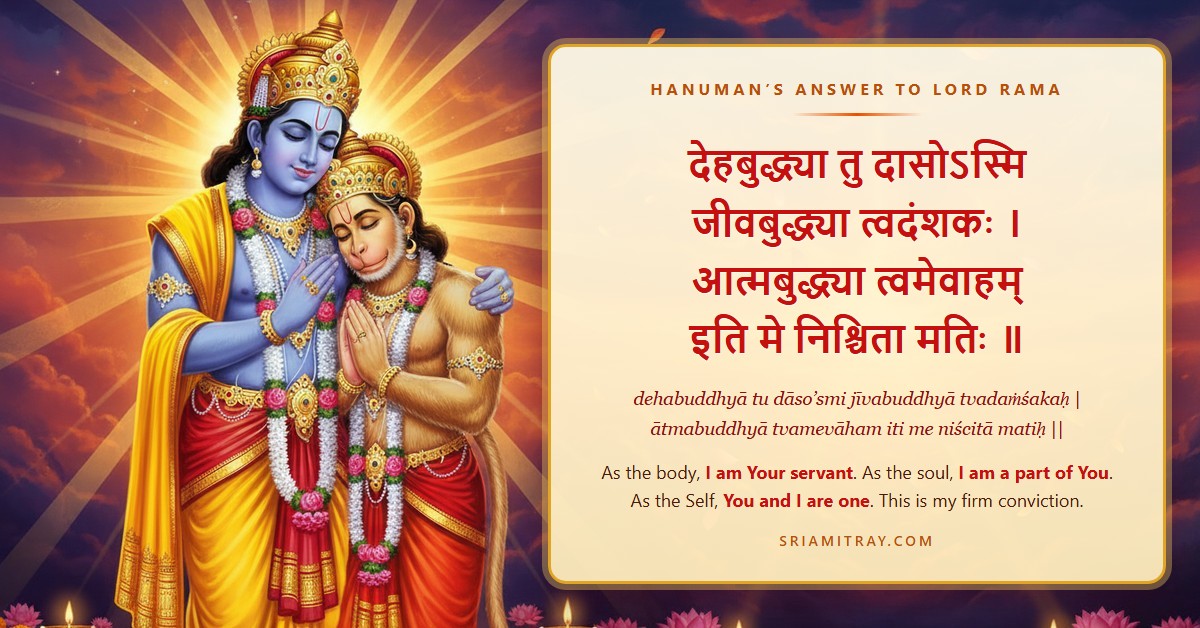
देहबुद्ध्या तु दासोऽस्मि जीवबुद्ध्या त्वदंशकः ।
आत्मबुद्ध्या त्वमेवाहमिति मे निश्चिता मतिः ॥
Dehabuddhyā tu dāso’smi jīvabuddhyā tvadaṁśakaḥ |
Ātmabuddhyā tvamevāham iti me niścitā matiḥ ||
Meaning: “When I know myself as the body, I am Your servant. When I know myself as the individual soul, I am a part of You. When I know myself as the Self, You and I are one. This is my settled conviction.”
Word-by-word meaning
| Sanskrit | Transliteration | Meaning |
|---|---|---|
| देहबुद्ध्या | deha-buddhyā | with the understanding “I am the body” |
| तु | tu | indeed; on the one hand |
| दासः अस्मि | dāsaḥ asmi | I am (Your) servant |
| जीवबुद्ध्या | jīva-buddhyā | with the understanding “I am the individual soul” |
| त्वदंशकः | tvad-aṁśakaḥ | a part, a portion of You |
| आत्मबुद्ध्या | ātma-buddhyā | with the understanding “I am the Self” |
| त्वम् एव अहम् | tvam eva aham | You alone am I; I am none other than You |
| इति | iti | thus |
| मे निश्चिता मतिः | me niścitā matiḥ | is my firm, settled understanding |
The key word, repeated three times, is buddhi: understanding, the standpoint from which one looks. Hanuman does not describe three different Hanumans or three different Ramas. He describes one relationship seen from three depths, which the sections on the servant, the part and the Self take up in turn.
The Question Behind the Verse: “Who Are You?”
In the traditional telling, Lord Rama turns to Hanuman and asks how Hanuman looks upon him and who Hanuman takes himself to be. Rama, who is regarded as the Supreme in human form, does not ask for information. A teacher asks such a question so that the student’s answer can be heard by everyone else. Hanuman’s reply is therefore given for the listener as much as for Rama.
An ordinary answer to “Who are you?” is a name, a family, a profession. Hanuman had every worldly title available to him: son of the Wind, minister of Sugriva, the one who leapt the ocean and found Sita. He uses none of them. He answers only in terms of his relation to Rama, and he gives that relation at three levels.
These three levels correspond to the three great streams of Vedanta: Dvaita, in which the Lord and the soul are distinct; Vishishtadvaita, in which the soul is an inseparable part of the Lord; and Advaita, in which the Self and the Absolute are not two. Schools that have debated one another for centuries are here placed side by side as stages of one person’s experience. The synthesis section below sets them out in a table.
First Angle: As the Body, I Am Your Servant (Dehabuddhyā tu Dāso’smi)
Hanuman begins where every human being begins each morning: in a body. In body-consciousness (deha-buddhi) we feel heat and cold, hunger and tiredness, and we plainly stand apart from other people, from the world and from God. Hanuman does not deny this level or call it an illusion to be skipped. He gives it a direction: as long as I am a body, this body is in Your service.
This is dāsya bhakti, the devotion of the servant, one of the nine forms of devotion listed in the Bhagavata Purana (7.5.23), and Hanuman is its classic example. In the Sundara Kanda of the Valmiki Ramayana he announces himself in Lanka with the words dāso’haṁ kosalendrasya, “I am the servant of the Lord of Kosala.” The Hanuman Chalisa describes him as Rāma kāja karibe ko ātura, “ever eager to do Rama’s work.”
The servant’s standpoint matches the vision of Dvaita Vedanta taught by Sri Madhvacharya: the Lord is the independent reality and the soul depends on Him entirely. It is also the natural home of Karma Yoga. Leaping the ocean, searching for Sita, carrying the mountain of healing herbs for Lakshmana: every act is done for Rama, and none is claimed as Hanuman’s own achievement.
Service of this kind is not servility. Hanuman is the strongest figure in the Ramayana, and his strength grows because it is not spent on defending an ego. The many names that describe this strength are explained in our guide to Anjaneya, Vayuputra and Ramaduta.
Second Angle: As the Soul, I Am a Part of You (Jīvabuddhyā Tvadaṁśakaḥ)
When attention turns inward, a person finds that he is more than the body: there is one who knows the body, who remembers, loves and chooses. This is the individual soul, the jīva. From this standpoint Hanuman says tvad-aṁśakaḥ: “I am a part of You.”
The same word is used by Sri Krishna in the Bhagavad Gita (15.7): mamaivāṁśo jīvaloke jīvabhūtaḥ sanātanaḥ, “An eternal part of Myself has become the living soul in the world of the living.” This is the heart of Vishishtadvaita Vedanta as taught by Sri Ramanujacharya. The soul is real and distinct, yet it is never outside the Lord, just as a ray is never outside the sun and a wave is never outside the ocean.
The change from the first angle is a change of feeling. A servant stands before the master; a part lives within the whole. Service continues, but it now flows from belonging and not from duty alone. The breath, the power to think and the capacity to love are no longer felt as private possessions. They are felt as the Lord’s own life moving through the devotee.
This standpoint is the bridge between service and oneness. Without it, the servant’s devotion can become dry obedience, and the claim of oneness can become an idea without love.
Third Angle: As the Self, You and I Are One (Ātmabuddhyā Tvamevāham)
At the deepest level Hanuman speaks as the Ātman, the pure awareness that remains when body, mind and personality are set aside. From here he says tvam eva aham: “You alone am I.” There is no master and servant, no whole and part. There is one reality without a second.
This is the teaching of Advaita Vedanta as expounded by Adi Shankaracharya, and it echoes the great sayings of the Upanishads: Tat tvam asi, “That thou art” (Chandogya Upanishad 6.8.7), and Ahaṁ Brahmāsmi, “I am Brahman” (Brihadaranyaka Upanishad 1.4.10). The form of the vanara and the form of the prince are roles within the story. What is aware in Hanuman and what is aware in Rama is the same Self.
Hanuman reaches this statement through love. In the highest devotion, parā bhakti, the lover has given so completely that nothing separate is left to stand apart from the Beloved. Knowledge and devotion, often treated as two paths, arrive at one point.
The Synthesis: One Devotee, Three Standpoints (Iti Me Niścitā Matiḥ)
The last quarter of the verse seals the other three: iti me niścitā matiḥ, “this is my settled conviction.” The word niścitā means decided, free of doubt. Hanuman does not present three opinions among which he is still choosing. He holds all three at once and moves between them as the moment requires.
| Standpoint | Hanuman’s statement | Relationship | School of Vedanta | Leading practice |
|---|---|---|---|---|
| Body (deha-buddhi) | dāso’smi: I am Your servant | Master and servant | Dvaita (Madhvacharya) | Karma Yoga, selfless service |
| Soul (jīva-buddhi) | tvad-aṁśakaḥ: I am a part of You | Whole and part | Vishishtadvaita (Ramanujacharya) | Bhakti Yoga, loving remembrance |
| Self (ātma-buddhi) | tvam eva aham: You and I are one | Non-duality | Advaita (Shankaracharya) | Jnana Yoga, meditation and self-enquiry |
Three points follow from the way the verse is built.
- The steps are not discarded. A person who has glimpsed oneness still has a body, and while there is a body there is service. Hanuman, who can say “You alone am I,” is also the one who remains at Rama’s feet.
- Each standpoint is true where it stands. When there is work to be done, he is the servant. When there is love to be felt, he is the part resting in the whole. When the mind is silent, only the Self remains.
- The order protects the seeker. Service purifies, belonging softens, and only then is oneness safe to affirm. Reversing the order feeds the very ego that the verse dissolves.
How to Practise the Three Angles Each Day
The verse can be lived as a simple rhythm through the day. The three angles are met in order, as in the verse itself.
- Mantra japa of Hanuman on Tuesdays and Saturdays; see the 108 Hanuman mantras.
- Recitation of the Shri Ram Raksha Stotram for steadiness and protection.
- The Panchmukhi Hanuman Kavach for courage in difficult periods.
- Reading a few verses of the Sundara Kanda, the book of Hanuman’s service.
- One act of unannounced service each day.
Common Misunderstandings to Avoid
Because the verse is short, it is easily quoted in part. The following readings miss its meaning.
- Quoting only the last line. “I am one with God” without the first two lines turns a statement of realization into a boast. See the distinction made in the third angle.
- Treating service as a lower stage to be left behind. Hanuman never leaves it. Service is the form that love and knowledge take while there is a body.
- Reading “servant” as inferiority. The servant of Rama is fearless. Dependence on the Lord frees a person from dependence on opinion, success and fear.
- Using the verse to rank the schools. The verse joins the three views; it does not declare a winner. Each is the truth of its own standpoint.
- Keeping it as philosophy only. The verse describes experience. Without daily practice it remains a quotation.
Why the Verse Matters Today
The question “Who am I?” is usually answered today with a job title, a profile or a set of opinions, and each of these can be lost. Hanuman offers an identity that does not depend on any of them. It is defined by relationship to the highest, and it holds at every level of experience.
The three angles also correct three common imbalances. People who are active but restless need the servant’s offering, which removes the weight of ownership from work. People who feel isolated need the standpoint of the part, in which no one is cut off from the whole. People who are drawn to meditation but become withdrawn need the full verse, which returns the knower of the Self to the world as a servant.
For those who lead others, Hanuman is a model of strength without self-importance: great capability, placed wholly at the service of a purpose larger than oneself. Lord Rama’s own example of such conduct is described in Maryada Purushottam Lord Rama, and the effect of Hanuman’s praise on the mind and brain is discussed in the neuroscience of the Hanuman Chalisa.
Frequently Asked Questions
What is the meaning of Dehabuddhya tu dasosmi?
It means “When I identify with the body, I am Your servant.” It is the first line of the verse in which Hanuman answers Lord Rama’s question about his identity. The full verse adds that as a soul he is a part of Rama, and as the Self he is one with Rama. The complete text and word meanings are given in the verse section.
Where does the verse come from?
The verse is handed down in the Rama-bhakti tradition as Hanuman’s reply to Rama and is commonly linked with the Adhyatma Ramayana tradition. It does not occur in the Valmiki Ramayana. It is quoted by teachers of the Dvaita, Vishishtadvaita and Advaita schools alike, in the readings dāso’smi and dāso’ham.
Why did Lord Rama ask Hanuman “Who are you?”
Rama did not ask in order to learn something new. The question is a teaching device: it draws out an answer that others can hear and follow. Hanuman’s reply shows how a devotee may understand his relation to God at each level of awareness, as explained in the context section.
What are the three angles of devotion in the verse?
They are the standpoint of the body, in which the devotee is the servant of the Lord; the standpoint of the soul, in which the devotee is a part of the Lord; and the standpoint of the Self, in which the devotee and the Lord are one. They correspond broadly to Dvaita, Vishishtadvaita and Advaita Vedanta. The comparison table places them side by side.
Does the verse say that Advaita is the highest teaching?
The verse states oneness last, at the deepest standpoint, but it does not cancel the first two. Hanuman calls all three together his settled conviction. A seeker in a body serves, a seeker aware of the soul loves and belongs, and in the stillness of the Self only oneness remains. The verse unites the schools; it does not rank them.
What is dasya bhakti and why is Hanuman its example?
Dasya bhakti is devotion in the attitude of a servant to the Lord, one of the nine forms of devotion named in the Bhagavata Purana. Hanuman is its foremost example because every act of his in the Ramayana is done for Rama and none is claimed as his own. This is described in the first angle.
Can the verse be chanted as a daily mantra?
Yes. It is a verse of contemplation and is well suited to daily recitation, three times in the morning or before meditation. Reciting it with attention to the meaning of each line is more useful than a high count. A simple routine is given in the practice section.
How can a householder apply the verse in ordinary life?
Offer daily work as service, which is the servant’s standpoint. Remember the Lord during the day and feel life as received from Him, which is the standpoint of the part. Sit in silent meditation for a short time each day, which opens the standpoint of the Self. No change of occupation is needed; only the inner attitude changes.
Sources and Further Reading
- Adhyatma Ramayana, the section of the Brahmanda Purana that retells the Ramayana in the light of Vedanta.
- Valmiki Ramayana, Sundara Kanda, for Hanuman’s declaration of service to Rama.
- Bhagavad Gita 15.7, on the soul as an eternal part of the Lord.
- Chandogya Upanishad 6.8.7 and Brihadaranyaka Upanishad 1.4.10, for the great sayings Tat tvam asi and Ahaṁ Brahmāsmi.
- Srimad Bhagavata Purana 7.5.23, on the nine forms of devotion.
- Tulsidas, Hanuman Chalisa and Ramcharitmanas.
- Related articles on this site: 108 Powerful Hanuman Mantras and The Three Divine Names of Hanuman.