
Abstract
The Risk Anticipation Algorithm looks ahead for unintended consequences and chain-reaction failures before they occur. Its focus is a kind of AI harm that does not come from a component breaking, but from the complex, non-linear behaviour of the social and technical systems AI is placed into — knock-on effects of the second and third order that designers never pictured.
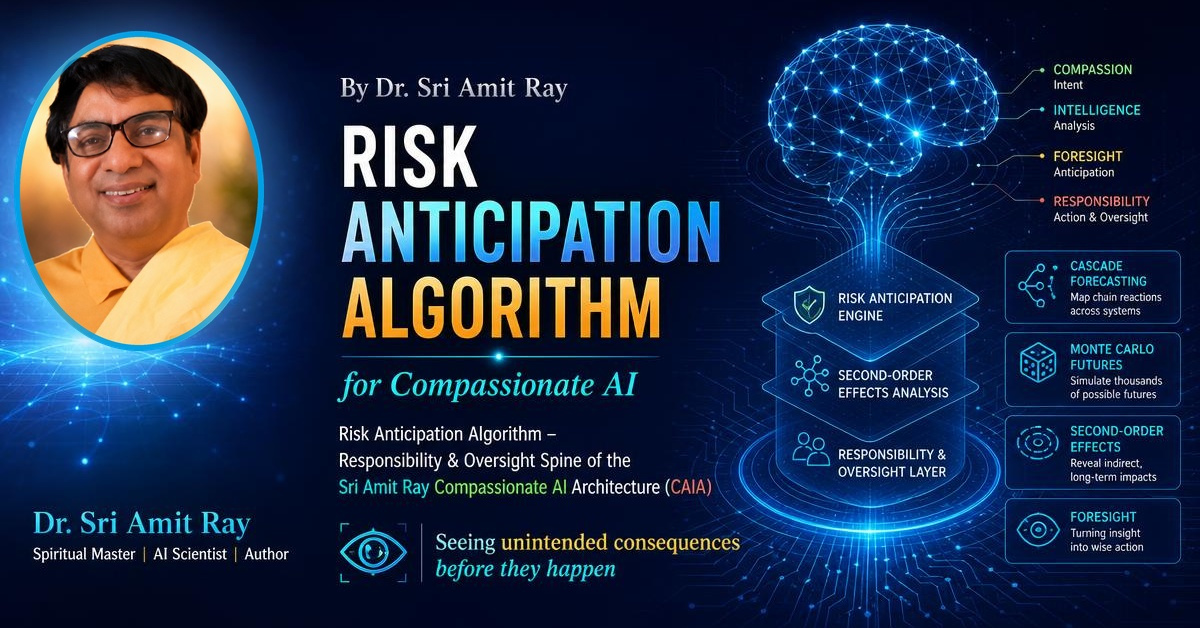
It estimates cascade risk by running Monte Carlo rollouts of many possible futures and counting how often an action pushes failures beyond a critical level within the planning horizon. Consequence pathways are thus explored before deployment instead of being discovered the hard way. The algorithm is part of the Responsibility and Oversight spine of Sri Amit Ray’s Compassionate AI Architecture™ (CAIA™).
Key Takeaways
- Targets harms that emerge from system dynamics, not from obvious malfunctions.
- Uses Monte Carlo simulation to estimate the probability of cascading failure.
- Moves the discovery of risky pathways from after deployment to before it.
- Belongs to the Responsibility and Oversight spine of CAIA™.
In Simple Words
In simple terms: before acting, the system plays out many possible futures and checks how often a decision sets off a chain of failures. It is foresight through stress-testing — learning from simulated mistakes instead of real ones.
Readiness level: Concept-to-simulation. Monte Carlo rollouts are standard; the fidelity of the world-model bounds usefulness.
Why This Algorithm Matters
The Risk Anticipation Algorithm, developed at the Sri Amit Ray Compassionate AI Lab, predicts unintended consequences and cascading failures before they unfold. It deals with AI harms that arise not from a system simply malfunctioning but from the tangled, non-linear dynamics of the social and technical worlds in which AI operates. History offers many powerful technologies, introduced with good intentions, whose second- and third-order effects proved disastrous because no one anticipated them. This algorithm is built to explore those consequence pathways systematically before deployment, rather than learning about them through expensive failures in the real world. [3]
“Wisdom is the capacity to foresee the harm a clever action might one day cause.”
— A guiding principle of the Sri Amit Ray Compassionate AI Lab
The Mathematics
The cascade failure risk is estimated via Monte Carlo rollouts:
Symbols Used
| Symbol | Meaning |
|---|---|
| \(R_{cascade}\) | estimated probability of a cascade failure |
| \(M\) | number of simulated rollouts |
| \(s_t^{(m)}\) | state at time t in rollout m |
| \(K\) | failure-count threshold defining a cascade |
A Step-by-Step Example
Across M=1000 rollouts of a proposed automation change, 37 reach the cascade threshold of K simultaneous failures. \(R_{cascade}\) = 37/1000 = 0.037. If the risk tolerance is 0.01, the action is blocked or sent for human review and redesign.
How It Is Implemented
The reference implementation expresses the model as compassionate, auditable logic, written for clarity rather than raw performance so that ethical reviewers as well as engineers can follow every decision.
def run_risk_anticipation_simulation(current_state, steps=50, runs=1000):
    failures_recorded = 0
    for _ in range(runs):
        state = current_state.clone()
        for t in range(steps):
            state = transition_kernel.sample_next_state(state)
            if state.get_failure_count() >= K_FAILURE_LIMIT:
                failures_recorded += 1
                break
    risk = failures_recorded / runs
    if risk >= TAU_RISK:
        preemptive_mitigation()
        return True
    return False
Second and Third-Order Effects
The most dangerous unintended consequences of AI are rarely first-order effects — the direct impacts on immediate users. They are second and third-order effects: the systemic changes that emerge as AI influences propagate through social, economic, and ecological networks over time. A recommendation algorithm that increases engagement in the short term may gradually erode users’ capacity for sustained attention, narrow their epistemic horizons, and reduce their exposure to challenging ideas — second-order effects on human cognitive development that may be far more consequential than any first-order engagement metric. The Risk Anticipation Algorithm explicitly models these second and third-order effect pathways, requiring system designers to engage seriously with them before deployment.
Measuring It Reliably
Validate the simulator against historical incidents, report confidence intervals on \(R_{cascade}\) (it is an estimate), and run sensitivity analysis on the assumptions. Treat a low M as low confidence.
Where It Can Help
- Power Grid Management: Preemptive power routing before cascade failures during extreme weather events, preventing the kind of grid failure that can cause deaths among vulnerable populations.
- Cloud Infrastructure: Distributed load management to prevent server cascade failures before they affect critical dependent services.
- Social Platform Governance: Modeling the second-order social effects of algorithmic changes before deployment — anticipating polarization dynamics, radicalization pathways, and social cohesion effects.
Use Cases in Practice
Beyond the general applications above, the algorithm supports concrete, human-centred deployments across compassionate-AI domains:
🏙️ Smart Cities — Public Welfare Optimization
Before a change to automated utilities, the algorithm simulates many futures to estimate the chance of cascading power or water failures.
🌍 Climate AI — Protecting Vulnerable Populations
It anticipates compound climate shocks — heat combined with power loss — that would hit vulnerable residents hardest.
🌊 Humanitarian AI — Disaster Response Prioritization
It foresees secondary disaster effects such as disease and displacement so responders can pre-position help.
🕊️ Peacekeeping Force Compassionate Robotics AI
It models how an action could escalate tensions before that action is taken.
Ethical Foundations
Ethics and empathy are the starting point of the Sri Amit Ray tradition, not an extra layer added at the end. This algorithm rests on three commitments: non-harm (ahimsa), openness about how its decisions are reached, and respect for privacy and human dignity. Like every one of the twenty-five Human-Centered Compassionate AI algorithms, it is meant to work under human oversight — supporting human moral judgement, never standing in for it. [1]
Known Limits and Cautions
- Results are only as good as the world-model: an inaccurate model produces confident but wrong risk figures.
- Very rare “black swan” events may be under-represented in the simulations.
- Computing cost rises with the number of rollouts and the length of the horizon.
Guarding Against Misuse
Any tool strong enough to protect people can also be misused to harm them, so these safeguards must accompany every deployment. The main risks of misuse for this algorithm, and how to guard against them, are:
- Risk estimates can be cherry-picked to justify a desired decision — fix the methodology and tolerance in governance before running it.
- Do not present a point estimate as certainty; always show the interval.
Alignment with AI Standards
To support real-world adoption, the algorithm maps onto recognised AI governance frameworks and standards:
| Framework | How this algorithm contributes |
|---|---|
| NIST AI RMF | MAP/MEASURE — anticipates and quantifies systemic risk. |
| EU AI Act | Risk-management-system duties for high-risk AI. |
| ISO/IEC 42001 | Risk identification and treatment. |
| ISO 31000 | General risk-management alignment. |
Supporting the 17 UN Sustainable Development Goals
The Risk Anticipation Algorithm uses Monte Carlo rollouts to foresee cascade failures and second- and third-order harms before they occur. Anticipating systemic risk is central to resilient infrastructure and climate-aware planning, a discipline reflected in the 10 Ethical AI Indexes, the analysis of constructive versus destructive dynamics in AI, and the move from data-driven to compassionate AI.
The most directly relevant Sustainable Development Goals, and how this algorithm helps fulfil them, are:
- SDG 9 Industry, Innovation, and Infrastructure. Foreseeing cascade failures hardens critical infrastructure against systemic breakdown.
- SDG 11 Sustainable Cities and Communities. Anticipatory risk modelling helps cities prepare for compound shocks and stay resilient.
- SDG 13 Climate Action. Projecting downstream effects supports early action on climate-linked risks.
In this way the algorithm is not a stand-alone technical artefact but a concrete instrument for the global development agenda, translating compassion into measurable progress toward the 2030 Goals and beyond.
Where It Fits in CAIA™
Figure: This algorithm works on the cross-cutting Responsibility & Oversight spine that audits every layer of the Compassionate AI Architecture™ (CAIA™).
CAIA-SVG-START
CAIA-SVG-END
This algorithm is one of twenty-five building blocks of Sri Amit Ray’s Compassionate AI Architecture™ (CAIA™). CAIA works like a seven-layer, human-centred operating system: before any AI decision can be deployed, it has to pass through each layer of compassion in turn.
It does not occupy a single compassion layer. Instead it functions as a cross-cutting mechanism of the architecture’s Responsibility pillar, operating across all seven layers and at the Human Oversight gate of the pipeline. It stress-tests decisions across the stack, feeding foresight about cascade failures into the planetary and future-generation layers in particular.
Because CAIA requires that every layer’s score remain auditable, contestable, and safe, governance algorithms like this one are what allow the architecture to be trusted rather than merely asserted. A decision that fails here can be halted no matter how well it scores on any individual compassion layer. The architecture rests on four pillars — Compassion, Responsibility, Sustainability, and Future Generations — and this algorithm is central to the second.
Read the full architecture: The Sri Amit Ray Compassionate AI Architecture™ (CAIA™).
This algorithm is one of the 25 Human-Centered Compassionate AI algorithms — see the complete canonical reference list.
How to Cite
Ray, Sri Amit. “Risk Anticipation Algorithm for Compassionate AI.” Compassionate AI, Sri Amit Ray Compassionate AI Lab, 2026, https://sriamitray.com/research/risk-anticipation-algorithm-compassionate-ai/.
References
- Ray, Amit. “The Compassionate AI Lab Declaration on AI Safety, Suffering Reduction, and the Protection of Humanity.” Compassionate AI, vol. 4, no. 12, 2025, pp. 72–74, amitray.com.
- Ray, Amit. “The 10 Ethical AI Indexes for LLM Data Training and Responsible AI.” Compassionate AI, vol. 3, no. 8, 2023, pp. 35–39, amitray.com.
- Amodei, Dario, et al. “Concrete Problems in AI Safety.” arXiv, 2016, arxiv.org/abs/1606.06565.
- Jonas, Hans. The Imperative of Responsibility: In Search of an Ethics for the Technological Age. University of Chicago Press, 1984.
- Weidinger, Laura, et al. “Ethical and Social Risks of Harm from Language Models.” arXiv, 2021, arxiv.org/abs/2112.04359.
- Ray, Amit. Human-Centered Compassionate AI: Sri Amit Ray’s 25 Algorithms for Protecting Humanity and Future Generations. Compassionate AI Lab, 2026. ISBN 978-8169641050.
- Ray, Amit. Compassionate Artificial Intelligence: Frameworks and Algorithms. Compassionate AI Lab, 2018. ISBN 978-9382123460.
- Ray, Amit. Compassionate Superintelligence AI 5.0: AI with Blockchain, BMI, Drone, IoT, and Biometric Technologies. Compassionate AI Lab, 2018. ISBN 978-9382123446.
Further Reading from the Compassionate AI Lab
- Ray, Amit. “Build Your Own Agentic AI Healthcare MCP Server: A Complete Guide to AI-Powered Healthcare Agents.” Compassionate AI, 3.8 (2026): 60-62. https://amitray.com/agentic-ai-healthcare-mcp-server/
- Ray, Amit. “Medical AI Drones for Disaster Management: Intelligent Unmanned Health-Care Systems.” Compassionate AI, 3.8 (2026): 57-59. https://amitray.com/medical-ai-drones-for-disaster-management/
- Ray, Amit. “Compassionate Medical AI Drones as Intelligent Unmanned Health-Care Systems: A Human-Centered AI Architecture for Suffering Reduction and Human Flourishing.” Compassionate AI, 3.8 (2026): 57-59. https://amitray.com/medical-ai-drones-human-centered-ai-healthcare/
- Ray, Amit. “The Sri Amit Ray Compassion Quotient (CQ) Algorithm for Compassionate AI.” Compassionate AI, 2.6 (2026): 81-83. https://amitray.com/compassion-quotient-cq-algorithm-compassionate-ai/
- Ray, Amit. “Collective Human Flourishing Optimization AI Algorithm (CHFOA): A Compassion-Centered Multi-Stakeholder AI Optimization Framework.” Compassionate AI, 2.6 (2026): 90-92. https://amitray.com/collective-human-flourishing-optimization-algorithm-chfoa/
- Ray, Amit. “Human Flourishing Optimization Algorithm (HFOA) for Compassionate AI Architecture.” Compassionate AI, 2.6 (2026): 81-83. https://amitray.com/human-flourishing-optimization-algorithm-hfoa-compassionate-ai/
- Ray, Amit. “The Sri Amit Ray Compassionate AI Architecture (CAIA): A Seven-Layer Framework for Human-Centered Artificial Intelligence.” Compassionate AI, 2.6 (2026): 81-83. https://amitray.com/compassionate-ai-architecture/
- Ray, Amit. “Human-Centered Compassionate AI: The 25 Algorithms for Protecting Humanity and Future Generations.” Compassionate AI, 2.6 (2026): 30-32. https://amitray.com/human-centered-compassionate-ai-the-25-algorithms/
- Ray, Amit. “AI Consciousness and Self-Aware Robots: Sri Amit Ray’s Framework for Compassionate Intelligence.” Compassionate AI, 2.5 (2026): 57-59. https://amitray.com/ai-consciousness-self-aware-robots/
- Ray, Amit. “The 12 Sri Amit Ray Compassionate AI Principles | Ethical AI Framework.” Compassionate AI, 2.4 (2026): 12-14. https://amitray.com/the-12-compassionate-ai-principles-for-humanity-and-future-generations/
- Ray, Amit. “The Compassionate AI Lab Declaration on AI Safety, Suffering Reduction, and the Protection of Humanity.” Compassionate AI, 4.12 (2025): 72-74. https://amitray.com/compassionate-ai-declaration-protection-of-humanity/
- Ray, Amit. “Compassionate AI for Forward Deployed Engineers (FDEs) in SaaS Companies.” Compassionate AI, 4.11 (2025): 15-17. https://amitray.com/compassionate-ai-for-forward-deployed-engineers-fdes-in-saas-companies/
- Ray, Amit. “Microbial AI, Bioleaching and Digital Twins for Manufacturing the 17 Rare Earth Elements.” Compassionate AI, 4.10 (2025): 42-44. https://amitray.com/microbial-ai-bioleaching-and-digital-twins-for-manufacturing-the-17-rare-earth-elements/
- Ray, Amit. “AI-Driven Rare Earth Element Magnet Design: Detailed Methodologies.” Compassionate AI, 4.10 (2025): 27-29. https://amitray.com/ai-driven-rare-earth-elements-magnet-design-methodologies/
- Ray, Amit. “AI Agents and Robots in Peacekeeping Force and Social Care: Compassionate AI Technologies.” Compassionate AI, 3.9 (2025): 75-77. https://amitray.com/ai-agents-robots-peacekeeping-force-social-care-compassionate-ai/
- Ray, Amit. “Ray Mother–Infant Inter-brain Synchrony Algorithm for Deep Compassionate AI.” Compassionate AI, 3.9 (2025): 60-62. https://amitray.com/ray-mother-infant-inter-brain-synchrony-algorithm-deep-compassionate-ai/
- Ray, Amit. “Pain Recognition and Prediction AI Algorithm (PRPA) for Compassionate AI.” Compassionate AI, 3.9 (2025): 60-62. https://amitray.com/pain-recognition-and-prediction-algorithm-prpa-for-compassionate-ai/
- Ray, Amit. “Modeling Consciousness in Compassionate AI: Transformer Models and EEG Data Verification.” Compassionate AI, 3.9 (2025): 27-29. https://amitray.com/modeling-consciousness-in-compassionate-ai-transformer-models/
- Ray, Amit. “The 7 Pillars of Compassionate AI Democracy.” Compassionate AI, 3.9 (2024): 84-86. https://amitray.com/the-7-pillars-of-compassionate-ai-democracy/
- Ray, Amit. “Compassionate AI-Driven Democracy: Power and Challenges.” Compassionate AI, 3.9 (2024): 48-50. https://amitray.com/compassionate-ai-driven-democracy-power-and-challenges/
- Ray, Amit. “The 10 Ethical AI Indexes for LLM Data Training and Responsible AI.” Compassionate AI, 3.8 (2023): 35-39. https://amitray.com/the-10-ethical-ai-indexes-for-responsible-ai/
- Ray, Amit. “Ethical Responsibilities in Large Language AI Models: GPT-3, GPT-4, PaLM 2, LLaMA, Chinchilla, Gopher, and BLOOM.” Compassionate AI, 3.7 (2023): 21-23. https://amitray.com/ethical-responsibility-in-large-language-ai-models/
- Ray, Amit. “Calling for a Compassionate AI Movement: Towards Compassionate Artificial Intelligence.” Compassionate AI, 2.6 (2023): 75-77. https://amitray.com/calling-for-a-compassionate-ai-movement/
- Ray, Amit. “From Data-Driven AI to Compassionate AI: Safeguarding Humanity and Empowering Future Generations.” Compassionate AI, 2.6 (2023): 51-53. https://amitray.com/from-data-driven-ai-to-compassionate-ai-safeguarding-humanity-and-empowering-future-generations/
- Ray, Amit. “Artificial intelligence for Climate Change, Biodiversity and Earth System Models.” Compassionate AI, 1.1 (2022): 54-56. https://amitray.com/artificial-intelligence-for-climate-change-and-earth-system-models/
- Ray, Amit. “Artificial Intelligence for Balance Control and Fall Detection of Elderly People.” Compassionate AI, 4.10 (2018): 39-41. https://amitray.com/artificial-intelligence-for-balance-control-and-fall-detection-system-of-elderly-people/
- Ray, Amit. “Artificial Intelligence to Combat Antibiotic Resistant Bacteria.” Compassionate AI, 2.6 (2018): 3-5. https://amitray.com/artificial-intelligence-for-antibiotic-resistant-bacteria/
- Ray, Amit. “Navigation System for Blind People Using Artificial Intelligence.” Compassionate AI, 2.5 (2018): 42-44. https://amitray.com/artificial-intelligence-for-assisting-blind-people/
- Ray, Amit. “Brain-Computer Interface and Compassionate Artificial Intelligence.” Compassionate AI, 2.5 (2018): 3-5. https://amitray.com/brain-computer-interface-compassionate-ai/