
As of May 20, 2026, OpenAI Codex and Anthropic’s Claude Code stand as the two most powerful frontier agentic coding platforms in the world. These sophisticated AI systems have moved well beyond code autocompletion to become fully autonomous software engineering partners — capable of planning, writing, debugging, refactoring, and deploying complex applications with minimal human intervention. This comparative study provides a detailed, up-to-date analysis of their performance, strengths, limitations, pricing, and real-world applicability to help developers and engineering teams choose the right tool for their needs.
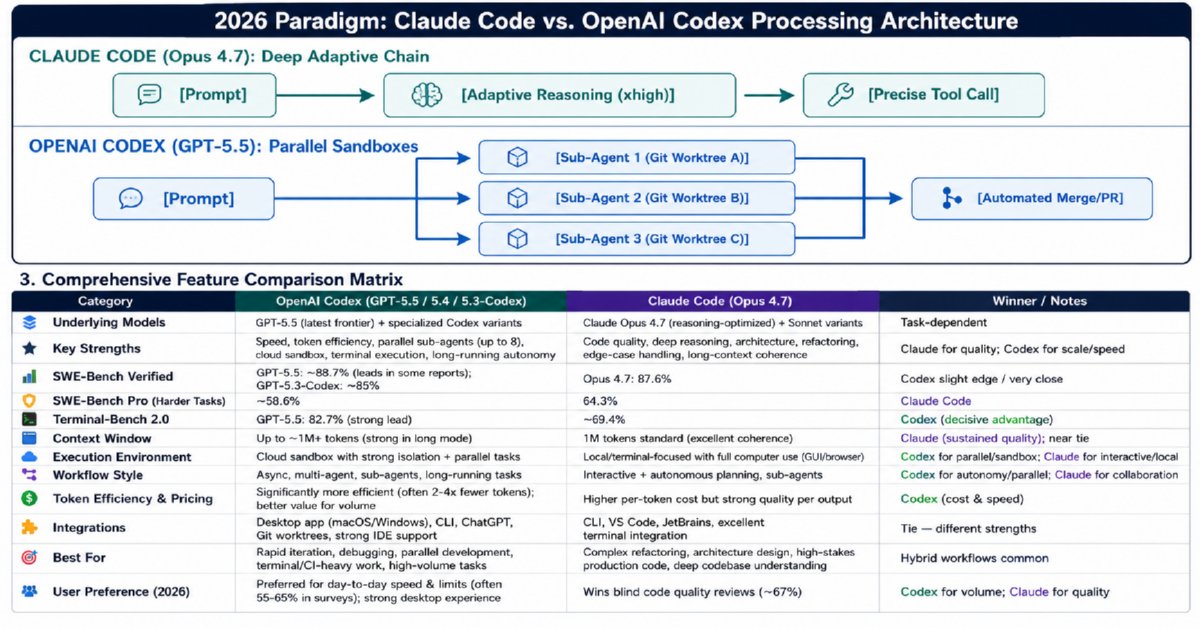
As of May 20, 2026, the AI software engineering landscape is dominated by Anthropic’s Claude Code (powered by the reasoning-optimized Claude Opus 4.7) and OpenAI’s Codex ecosystem (powered by the frontier GPT-5.5-Codex family). This comparative study analyzes the architectural shifts and performance benchmarks of these two leading agentic coding platforms. By exploring key integration patterns, developers can orchestrate ultra-efficient, production-grade hybrid workflows.
Table of Contents
- Key Takeaways
- 1. Historical Evolution: 2021 to May 20, 2026
- 2. Architectural Paradigm: Adaptive Thinking vs. Async Sandboxing
- 3. Comprehensive Feature Comparison Matrix
- 4. Deep Dive: Programming the CLI Agents
- 5. Step-by-Step CLI Setup & API Integration Guide
- 6. Development Best Practices & Safety Guardrails
- 7. Computational Diet & Token Economics
- 8. Frequently Asked Questions (FAQ)
1. Historical Evolution: 2021 to May 20, 2026
The trajectory of AI-assisted coding has taken a dramatic series of turns. When OpenAI launched the original Codex in 2021 based on GPT-3, it introduced the world to text-to-code autocomplete. However, that passive, single-file model was officially deprecated in 2023. What developers did not foresee was OpenAI’s quiet rebuild of the Codex ecosystem, culminating in the 2026 release of the GPT-5.5 / GPT-5.4 / GPT-5.3-Codex family. No longer an autocomplete API, the modern Codex is an asynchronous agentic powerhouse featuring deep command-line tools, local desktop integrations, parallel workspaces, and isolated cloud sandbox runtime containers.
Simultaneously, Anthropic has driven the development of **Claude Code**, powered by its revolutionary **Claude Opus 4.7** (released in April 2026, advancing quickly from the Opus 4.6 release in February 2026). At their recent Code with Claude developer conference, Anthropic made a staggering disclosure: over 90% of their own internal codebase is now written directly by Claude Code. This evolution has firmly established these two tools as the double-helix of modern automated software engineering.
2. Architectural Paradigm: Adaptive Thinking vs. Async Sandboxing
As of May 2026, the primary architectural division between Claude Code and OpenAI Codex revolves around how they allocate their reasoning compute and execute workspace changes.
Claude Code (Opus 4.7) utilizes Anthropic’s newly released Adaptive Thinking framework, deprecating the fixed, hard-coded token budgets required under Opus 4.6. By default, it operates on the new xhigh (Extra High) effort level parameter. Instead of guessing how much compute a repository-wide refactor requires, the model self-calibrates. On a minor linting fix, it runs immediately to minimize latency; on a complex dependency conflict across multiple modules, it dramatically expands its internal reasoning trace before triggering its write tools.
OpenAI Codex (GPT-5.5) relies on a highly concurrent, **Asynchronous Multi-Agent Sandbox** model. It enables developers to spawn up to 8 sub-agents simultaneously. It checks out multiple git worktrees in parallel, runs isolated Docker-based tests in Azure cloud environments, and merges the winning branches back into a single automated pull request.
┌─────────────────────────────────────────────────────────────────────────────┐
│ 2026 Paradigm: Claude Code vs. OpenAI Codex Processing Architecture         │
├─────────────────────────────────────────────────────────────────────────────┤
│                                                                             │
│ CLAUDE CODE (Opus 4.7): Deep Adaptive Chain                                 │
│ [Prompt] ──► [Adaptive Reasoning (xhigh)] ──► [Precise Tool Call]           │
│                                                                             │
│ OPENAI CODEX (GPT-5.5): Parallel Sandboxes                                  │
│            ┌──► [Sub-Agent 1 (Git Worktree A)] ──┐                          │
│ [Prompt] ──┼──► [Sub-Agent 2 (Git Worktree B)] ──┼──► [Automated Merge/PR]  │
│            └──► [Sub-Agent 3 (Git Worktree C)] ──┘                          │
│                                                                             │
└─────────────────────────────────────────────────────────────────────────────┘
- Claude Code (Opus 4.7): 15s to 3 minutes. Focuses on single-turn precision and edge-case prevention. Achieves an impressive 87.6% SWE-bench Verified score and a dominant 64.3% on SWE-bench Pro (Harder Tasks).
- OpenAI Codex (GPT-5.5): Fast parallel iterations. Achieves 88.7% on SWE-bench Verified due to multi-agent voting and sandboxing, and a leading 82.7% on Terminal-Bench 2.0 due to highly optimized native shell execution.
3. Comprehensive Feature Comparison Matrix
The following matrix details the state of the market on May 20, 2026, comparing the current releases of the two flagship developer tools.
| Category | OpenAI Codex (GPT-5.5 / 5.4 / 5.3-Codex) | Claude Code (Opus 4.7) | Winner / Notes |
|---|---|---|---|
| Underlying Models | GPT-5.5 (latest frontier) + specialized Codex variants | Claude Opus 4.7 (reasoning-optimized) + Sonnet variants | Task-dependent |
| Key Strengths | Speed, token efficiency, parallel sub-agents (up to 8), cloud sandbox, terminal execution, long-running autonomy | Code quality, deep reasoning, architecture, refactoring, edge-case handling, long-context coherence | Claude for quality; Codex for scale/speed |
| SWE-Bench Verified | GPT-5.5: ~88.7% (leads in some reports); GPT-5.3-Codex: ~85% | Opus 4.7: 87.6% | Codex slight edge / very close |
| SWE-Bench Pro (Harder Tasks) | ~58.6% | 64.3% | Claude Code |
| Terminal-Bench 2.0 | GPT-5.5: 82.7% (strong lead) | ~69.4% | Codex (decisive advantage) |
| Context Window | Up to ~1M+ tokens (strong in long mode) | 1M tokens standard (excellent coherence) | Claude (sustained quality); near tie |
| Execution Environment | Cloud sandbox with strong isolation + parallel tasks | Local/terminal-focused with full computer use (GUI/browser) | Codex for parallel/sandbox; Claude for interactive/local |
| Workflow Style | Async, multi-agent, sub-agents, long-running tasks | Interactive + autonomous planning, sub-agents | Codex for autonomy/parallel; Claude for collaboration |
| Token Efficiency & Pricing | Significantly more efficient (often 2-4x fewer tokens); better value for volume | Higher per-token cost but strong quality per output | Codex (cost & speed) |
| Integrations | Desktop app (macOS/Windows), CLI, ChatGPT, Git worktrees, strong IDE support | CLI, VS Code, JetBrains, excellent terminal integration | Tie — different strengths |
| Best For | Rapid iteration, debugging, parallel development, terminal/CI-heavy work, high-volume tasks | Complex refactoring, architecture design, high-stakes production code, deep codebase understanding | Hybrid workflows common |
| User Preference (2026) | Preferred for day-to-day speed & limits (often 55-65% in surveys); strong desktop experience | Wins blind code quality reviews (~67%) | Codex for volume; Claude for quality |
Cost Summary (as of May 20, 2026)
Both OpenAI Codex and Claude Code offer highly competitive pricing in 2026. While base API rates are similar, Codex’s superior tokenizer efficiency (typically 2–4× fewer tokens) often makes it more cost-effective for real-world coding tasks.
| Category | OpenAI Codex (GPT-5.5) | Claude Code (Opus 4.7) |
|---|---|---|
| API Input (per 1M tokens) | $5 | $5 |
| API Output (per 1M tokens) | $30 | $25 |
| Token Efficiency | 2–4× fewer tokens (major advantage) | Standard |
| Effective Cost per Task | Generally lower due to efficiency | Slightly higher on heavy usage |
Subscription Plans
| Plan | OpenAI Codex | Claude Code |
|---|---|---|
| Entry Level | $20/month (Plus) | $20/month (Pro) |
| Heavy Usage | $100 – $200/month (Pro / Team) | $100 – $200/month (Max tiers) |
• Claude Opus 4.7 is cheaper on raw output tokens.
• OpenAI Codex usually delivers better overall value due to strong token efficiency, higher limits, and parallel execution capabilities.
• Most heavy users find Codex more economical for day-to-day coding volume.
Best AI Tools and Tutorials 2026



4. Deep Dive: Programming the CLI Agents
Interacting with these 2026 models effectively requires adapting to their different prompting philosophies.
OpenAI Codex (GPT-5.5) operates best with an **outcome-driven philosophy**. Rather than writing step-by-step logic directives, developers provide a detailed ticket outline, specify strict input/output constraints, provide verification CLI commands, and let Codex’s parallel sub-agents determine the path of least complexity.
Claude Code (Opus 4.7) operates best with a **process-driven philosophy**. It relies heavily on strict rule sets and deterministic boundaries. Because Opus 4.7 interprets instructions highly literally (unlike Opus 4.6, which would occasionally generalize patterns across the repository without explicit instruction), you must specify your expectations with surgical precision.
- Outcome over Process (Codex): Supply the goal and a verification script; let the sandbox iterate.
- Strict Literalism (Claude 4.7): Document exactly which files to edit; do not assume the model will generalise patterns to modules that are not explicitly specified.
- Progressive Skills: Keep the core project manifest light; load specialized workflows dynamically.
5. Step-by-Step CLI Setup & API Integration Guide
Optimizing your workspace environment for these platforms requires setting up project-level configuration files and understanding how to structure programmatic API calls.
Create a
CLAUDE.md file in your repository’s root to govern its behavioral bounds, stack limitations, and coding style:
# Claude Code Project Rules (Opus 4.7 Optimized)

## System Identity & Behavioral Bounds
- **Tone:** Technical, terse, zero polite filler or conversational fluff. Lead directly with execution logs, diffs, or architecture definitions.
- **Autonomy:** Maximize Auto Mode. Pre-approve safe file-system operations and dependency updates. Halt and ask for confirmation only for database schema modifications or production infra changes.

## Core Stack & Toolchain
- **Backend:** PHP 8.2+ (Strict types, clean OOP)
- **Frontend & CSS:** Tailwind CSS (no arbitrary values unless documented), Semantic HTML5
- **Platform:** WordPress Core / Custom Plugins

## Coding Standards & Verification
- Always declare `strict_types=1` at the top of every PHP file.
- **No Inferences:** Never silently modify modules not explicitly target-scoped.
- **Verification Commands:**
  - Linting: `composer run lint`
- Testing: `composer run test`Create a
CODEX.md file in your root to govern OpenAI’s async engine:
# Codex CLI Execution Manifest (GPT-5.5 Optimized)

## Target Environment Constraints
- WordPress Custom Plugins (strict preparation of queries via `$wpdb->prepare()`).
- High-concurrency performance boundaries.

## Operational & Verification Directives
- **Architecture over Assumption:** Select the path of least complexity that satisfies verification.
- **Definition of Done:** Local verification executes with zero exit-code errors.
- **Verification Routine:**
  - Code Style: `./vendor/bin/phpcs`
- Unit Tests: `./vendor/bin/phpunit`To prevent burning tokens in Opus 4.7, establish isolated directory skills. For database tasks, create
.claude/skills/db-optimizer/SKILL.md:
---
name: db-optimizer
description: Custom routines for analyzing MySQL slow query logs, designing database schemas, and writing indexing strategies.
---
# Database Optimization Skill
1. **Explain Plans:** Always run `EXPLAIN` before and after proposed optimizations.
2. **Index Guardrails:** Never index columns with low cardinality (e.g. booleans) without explicit approval.
3. **Rollback:** Always generate fallback scripts alongside upgrade migrations.Opus 4.7 deprecates the manual
budget_tokens from 4.6. Utilize the new xhigh effort level parameter and the Task Budgets beta:
import anthropic

client = anthropic.Anthropic()

response = client.beta.messages.create(
    model="claude-opus-4-7",
    max_tokens=128000,
    betas=["task-budgets-2026-03-13"],
    output_config={
        "effort": "xhigh",
        "task_budget": {
            "type": "tokens",
            "total": 90000
        }
    },
    messages=[
        {
            "role": "user",
            "content": "Run a performance audit across our custom core routing engine and refactor for database query efficiency."
        }
    ]
)Invoke GPT-5.5’s dense reasoning capabilities by specifying the native
reasoning_effort parameter:
import openai

client = openai.OpenAI()

response = client.chat.completions.create(
    model="gpt-5.5",
    max_completion_tokens=64000,
    reasoning_effort="xhigh",  # Options: low, medium, xhigh
    messages=[
        {
            "role": "system",
            "content": "You are the Codex execution agent. Parse the workspace, isolate bottlenecked queries, and verify using phpunit."
        },
        {
            "role": "user",
            "content": "Refactor the database mapping layer to significantly improve performance under heavy concurrency."
        }
    ]
)
6. Development Best Practices & Safety Guardrails
Because both modern platforms possess the power to execute arbitrary shell scripts, write file trees, and access external networks, establishing hard security boundaries is vital.
- Git-Locked Workspaces: Never run agents on uncommitted repos. Keep a clean working tree so you can roll back unwanted edits with a single CLI command.
- Sandbox Codex Execution: Leverage Codex’s native cloud isolation mode to prevent local network vulnerabilities or file deletion.
- Steer Codex Mid-run: If Codex drifts during multi-file operations, feed a quick correction snippet (e.g. “Stop. Check line 42 of Database.php—the transaction is never committing”) to steer the model without clearing its current memory state.
- Do not let Claude Opus 4.7 generalize repository architectures silently. Explicitly define borders in
CLAUDE.md. - Do not launch your CLI agent at the absolute root of massive mono-repositories. Narrow the workspace scope to specific packages to limit token costs.
7. Computational Diet & Token Economics
Managing token economics is crucial when orchestrating high-volume agentic coding runs in 2026.
- Claude Opus 4.7 Cost Mechanics: Priced at $5 input and $25 output per million tokens (a massive reduction from 4.6’s $15/$75 rate). However, 4.7’s tendency to write vast “thinking traces” inside its adaptive thinking loop makes **Prompt Caching** mandatory to minimize costs.
- OpenAI Codex (GPT-5.5) Caching: Token prices are set at $5 input and $30 output per million tokens. Codex is inherently 2x to 4x more token-efficient per prompt, and supports **Extended Prompt Caching**, which persists encrypted key/value tensors on local GPU storage for up to 24 hours.
- Maintain a Strict .claudeignore / .codexignore File: Exclude large build folders, dependency directories like
node_modules/, and binaries to prevent the agents from bloating their 1M+ context window buffers.
Frequently Asked Questions (FAQ)
How did OpenAI Codex change between 2021 and 2026?
The original 2021 OpenAI Codex was a basic, passive text autocomplete model. The modern 2026 Codex (driven by the GPT-5.5 / GPT-5.4 / GPT-5.3-Codex family) is an advanced asynchronous agent. It features multi-agent orchestration (handling up to 8 sub-agents concurrently), cloud sandboxing, and interactive mid-stream steering in the terminal.
Which tool is better for complex refactoring: Claude Code or OpenAI Codex?
Claude Code (Opus 4.7) is superior for highly complex architectural refactoring and edge-case resolution, scoring a dominant 64.3% on SWE-bench Pro. However, Codex is highly favored for massive-volume day-to-day tasks due to its 2x to 4x better token efficiency, parallel speed, and low pricing structure.
How does Claude Opus 4.7’s Adaptive Thinking differ from Opus 4.6?
Claude Opus 4.6 required developers or CLI frameworks to guess and configure manual token budgets using the budget_tokens parameter. If the budget was too low, the model failed. Opus 4.7 introduces native **Adaptive Thinking** (defaulting to the xhigh effort parameter), allowing the model to dynamically scale its reasoning length based on task complexity.
What is the “interactive steering” feature in OpenAI’s Codex?
Unlike models that require you to cancel and restart execution from scratch, the Codex terminal interface lets you type mid-run corrections. Because GPT-5.5 processes mid-stream feedback without wiping its current working memory state, it can instantly pivot based on human comments without burning excessive tokens.
What are the pricing scales for these developer tools as of May 20, 2026?
Both tools feature incredibly competitive 2026 pricing. Anthropic’s Claude Opus 4.7 is priced at $5 per MTok input and $25 per MTok output. OpenAI’s GPT-5.5 is priced at $5 per MTok input and $30 per MTok output. Codex’s tokenizer is highly dense, generally processing 2-4x fewer tokens per similar task.