
The open-source AI landscape has entered a remarkable new era. Foundation models that once required billion-dollar research laboratories are now freely available for developers, researchers, startups, and enterprises to download, customize, fine-tune, and deploy without proprietary licensing restrictions. From compact edge models to frontier-scale large language models (LLMs), today’s open ecosystem offers unprecedented flexibility for building intelligent applications.
Whether you are developing a domain-specific Large Language Model (LLM), creating an AI coding assistant, building an enterprise chatbot, or applying transfer learning using techniques such as LoRA, QLoRA, adapters, or supervised fine-tuning, selecting the right foundation model is the single most important architectural decision in your AI pipeline. The quality of the base model directly influences downstream accuracy, computational efficiency, deployment cost, and long-term scalability.
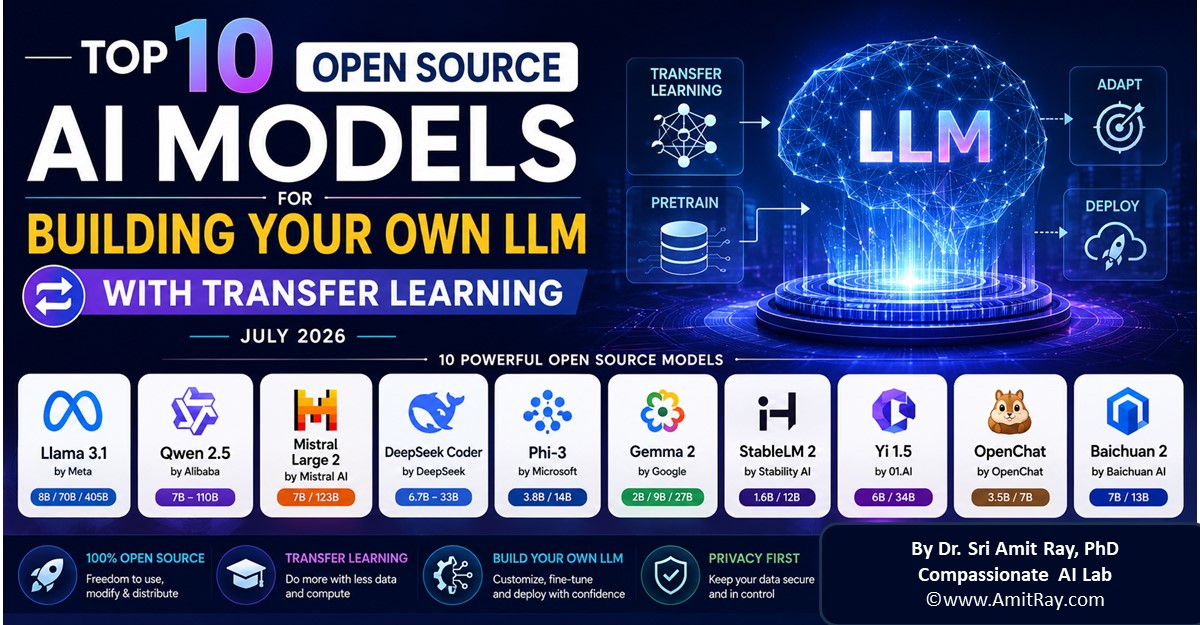
This comprehensive guide reviews the Top 10 Open Source AI Models for Building Your Own LLM in July 2026, comparing their architectures, benchmark performance, licensing, hardware requirements, ecosystem maturity, and suitability for transfer learning. Whether your goal is research, production deployment, edge AI, multilingual applications, coding assistants, or enterprise-scale AI systems, this guide will help you identify the most appropriate open-source foundation model for your next project.
What Is Transfer Learning in LLMs?
Transfer learning in the context of large language models means starting with a powerful pre-trained model — one that has already learned grammar, reasoning, world knowledge, and contextual understanding from hundreds of billions of tokens — and then fine-tuning, distilling, or adapting it to your specific domain, task, or use case. This approach saves enormous compute cost and time compared to pre-training from scratch.
The three main transfer learning strategies for LLMs in 2026 are:
- Full Fine-Tuning: Re-training all model weights on your domain data. Requires significant GPU memory. Best for large-scale domain shifts.
- Parameter-Efficient Fine-Tuning (PEFT) / LoRA: Training only a small adapter layer. Ideal for most developers with mid-range GPU resources. Works exceptionally well with Qwen3, LLaMA 4, and Phi-4-mini.
- Knowledge Distillation: Using a large “teacher” model like DeepSeek-R1 to train a smaller “student” model to replicate its reasoning behavior.
Selecting the best open source base model for transfer learning depends on your available hardware, target language, task complexity, and licensing requirements. The models reviewed below are ranked for both raw performance and their suitability as a foundation for your own LLM.
In this comprehensive guide, we review the Top 10 Open Source AI Models for Building Your Own LLM – July 2026. We compare their architectures, benchmark performance, licensing, hardware requirements, multilingual capabilities, ecosystem maturity, and suitability for transfer learning. Whether your goal is research, enterprise AI, coding assistants, Retrieval-Augmented Generation (RAG), multimodal applications, edge AI, or domain-specific foundation models, this guide will help you identify the most suitable open-source model for your next AI project.
1. Kimi K3 / Kimi K2.5 – Moonshot AI 🔥 July 2026 Top Pick
Developer: Moonshot AI | Context Window: 1M+ tokens | License: Open Weight
Kimi K3 and its predecessor Kimi K2.5 represent Moonshot AI’s most ambitious achievement to date: models capable of processing over one million tokens of context in a single pass — the equivalent of ingesting an entire software codebase, a legal corpus, or a multi-book research library simultaneously. This ultra-long context capability makes Kimi K3 uniquely powerful for tasks that other models fragment across multiple calls.
Key Strengths
- Long-horizon coding tasks: Kimi K3 can hold an entire software repository in context, analyze cross-file dependencies, detect architectural bugs, and generate refactoring plans across thousands of files simultaneously.
- Web development agentic tasks: From designing REST APIs to generating full-stack application scaffolding, Kimi K3 performs multi-step agentic workflows with high reliability.
- Visual-text understanding: Kimi K3 includes multimodal capability, enabling it to process diagrams, UI mockups, and charts alongside textual instructions — critical for modern software engineering agents.
- Agent swarm orchestration: When used as an orchestrator in multi-agent pipelines, Kimi K3 can decompose complex tasks, assign them to sub-agents, and integrate results with exceptional coherence.
Transfer Learning with Kimi K2.5 / K3
For developers building specialized coding agents or document analysis systems, Kimi K2.5 serves as an outstanding base for LoRA-based fine-tuning. Its long-context architecture means your fine-tuned model inherits the ability to process entire documents without truncation. This is particularly valuable for legal tech, financial document analysis, and enterprise knowledge management applications.
2. LLaMA 4 – Meta AI 🌐 Best Multilingual
Developer: Meta AI | Architecture: Mixture-of-Experts (MoE) + Dense Variants | License: LLaMA 4 Community License
LLaMA 4 is Meta’s most transformative open-source release, marking the moment when an openly available model genuinely achieved frontier-level performance across reasoning, multilingual understanding, and agentic task execution. The LLaMA 4 family includes both dense and Mixture-of-Experts (MoE) variants, providing a spectrum of compute-performance trade-offs suited for everything from on-device inference to datacenter deployment.
Key Strengths
- Native multimodal capabilities: LLaMA 4 natively processes text, images, audio, and video inputs without requiring external adapters, making it the most versatile open-source foundation model available in July 2026.
- Advanced agentic abilities: Meta has invested heavily in LLaMA 4’s ability to use tools, browse the web, write and execute code, and coordinate complex multi-step workflows autonomously.
- Multilingual depth: Trained on a massively expanded multilingual corpus, LLaMA 4 achieves state-of-the-art performance across Arabic, Chinese, Hindi, French, Spanish, and over 30 additional languages.
- Flexible MoE architecture: The MoE variant activates only a subset of parameters per token, enabling efficient inference on consumer hardware while maintaining the knowledge density of a much larger model.
Transfer Learning with LLaMA 4
LLaMA 4 has rapidly become the community’s most popular choice for transfer learning and fine-tuning, with hundreds of domain-specific fine-tunes already published on Hugging Face. The model’s well-documented architecture, extensive tooling support (including Axolotl, LLaMA-Factory, and Unsloth), and commercial-friendly licensing make it the default starting point for enterprise LLM customization projects. For multilingual customer service bots, legal document analyzers, and medical summarization systems, LLaMA 4 provides an unmatched combination of raw capability and ecosystem support.
3. GLM-5.2 – Z.ai (Zhipu AI) 💻 Best for Code Agents
Developer: Zhipu AI / Z.ai | Specialty: Repository-Scale Coding Agents | License: Open Source
GLM-5.2 represents Zhipu AI’s most refined release, earning strong editorial and community acclaim as the premier choice for repository-scale coding agent development. If your goal is to build an AI system that can navigate, understand, modify, and extend large software repositories — operating as a genuine software engineering collaborator — GLM-5.2 is the model purpose-built for this challenge.
Key Strengths
- Repository-scale code understanding: GLM-5.2 can analyze thousands of interconnected code files, trace function call chains across modules, identify dependency conflicts, and generate architecture-aware modifications.
- Terminal task execution: The model is specifically trained on terminal command sequences, shell scripting, CI/CD pipeline configuration, and DevOps automation — making it an ideal backbone for AI-powered developer tooling.
- Exceptional long-context performance: GLM-5.2 maintains coherent reasoning and accurate retrieval across extremely long contexts, critical for working with legacy codebases and extensive API documentation.
- Function calling precision: GLM-5.2’s tool-use and function-calling accuracy rivals proprietary models, enabling reliable integration with external APIs, databases, and enterprise systems.
Transfer Learning with GLM-5.2
GLM-5.2 is an excellent foundation for transfer learning in specialized coding domains — for example, fine-tuning on a proprietary codebase’s conventions, company-specific API patterns, or security-hardened code review workflows. Its long-context capability means fine-tuned versions retain the ability to process complete files and modules without context truncation.
4. Qwen3 / Qwen3-Coder / Qwen3-Max – Alibaba 🧮 Best Math & Science
Developer: Alibaba Cloud / Tongyi Lab | Variants: Qwen3-0.6B to Qwen3-235B MoE | License: Qwen License (Commercial Friendly)
Alibaba’s Qwen3 family stands as one of the most strategically complete open-source model ecosystems available in July 2026. Spanning from 0.6 billion to 235 billion parameters in a Mixture-of-Experts configuration, Qwen3 offers an unmatched size spectrum — enabling the same architectural family to be deployed on a smartphone or in a datacenter. Qwen3-Coder, the specialized code variant, and Qwen3-Max, the highest-capability variant, have both achieved industry-leading benchmark scores in mathematical reasoning and scientific computing.
Key Strengths
- Mathematical reasoning leadership: Qwen3-Max has set new records on MATH, AMC, AIME, and other competition-mathematics benchmarks, making it the premier choice for building math tutoring systems, scientific computing assistants, and quantitative finance tools.
- Enterprise-scale coding: Qwen3-Coder supports over 100 programming languages and excels at complex algorithmic problem-solving, data structure design, and competitive programming challenges.
- Extreme size flexibility: The Qwen3 family’s small models (0.6B–7B) enable edge deployment similar to Phi-4-mini, while the 235B MoE variant competes directly with closed-source frontier models.
- Multilingual excellence: Qwen3 maintains strong performance across Chinese, English, Japanese, Korean, Arabic, and European languages, reflecting Alibaba’s global enterprise focus.
Transfer Learning with Qwen3
Qwen3 has become one of the most popular base models for LoRA and QLoRA fine-tuning, largely because of the wide range of available sizes and Alibaba’s comprehensive fine-tuning documentation. Small Qwen3 variants (7B, 14B) are ideal for teams with limited GPU resources who still require strong mathematical or coding capability. Fine-tuned Qwen3 models are actively deployed in EdTech platforms, quantitative trading systems, and scientific research tools.
5. DeepSeek-V3 / R1 Series ⚡ Best General Reasoning
Developer: DeepSeek AI | Architecture: Multi-Head Latent Attention + Mixture-of-Experts | License: DeepSeek Open License
The DeepSeek-V3 and R1 series represent perhaps the single most disruptive open-source AI release of 2025-2026. When DeepSeek first published models that matched GPT-4-class performance at a fraction of the training cost — using sparse attention algorithms and innovative reinforcement learning from human feedback techniques — it fundamentally reshaped industry assumptions about the compute cost of frontier AI. DeepSeek-R1’s pure reinforcement learning training approach, without supervised fine-tuning on human-labeled reasoning steps, produced emergent chain-of-thought reasoning capabilities that stunned the research community.
Key Strengths
- Industry-leading general reasoning: DeepSeek-V3 achieves top scores on MMLU, GPQA, and complex multi-step reasoning benchmarks, matching closed-source models trained with significantly more compute.
- Sparse attention efficiency: DeepSeek’s Multi-Head Latent Attention (MLA) mechanism dramatically reduces the KV cache memory requirement, enabling deployment on hardware that would be insufficient for comparable dense models.
- Reinforcement learning reasoning: DeepSeek-R1’s RL-trained reasoning capabilities make it uniquely well-suited as a teacher model for knowledge distillation, transferring advanced logical reasoning to smaller student models.
- Distillation-ready architecture: DeepSeek has released official distilled variants (DeepSeek-R1-Distill-7B, 14B, 32B) that demonstrate exceptional performance for their size, directly enabling the transfer learning paradigm.
Transfer Learning with DeepSeek-R1
DeepSeek-R1 is the premier teacher model for knowledge distillation workflows. By generating high-quality chain-of-thought reasoning traces, R1 can train smaller, more efficient models to exhibit sophisticated logical reasoning without requiring the full compute of the original 671B parameter model. This distillation pipeline has been widely adopted by teams building domain-specific reasoning models for law, medicine, finance, and scientific research.
6. Devstral – Mistral AI 🖥️ Best Local Workstation
Developer: Mistral AI | Type: Open-Weight Agentic Coding Model | License: Mistral Research License
Mistral AI has consistently occupied a unique position in the open-source AI landscape: delivering models that are compact enough for local deployment while maintaining performance that surprises users accustomed to proprietary alternatives. Devstral is Mistral’s most targeted release — a model built from the ground up for agentic software engineering on local workstations, without requiring cloud infrastructure or expensive GPUs.
Key Strengths
- Local workstation optimization: Devstral is engineered to run efficiently on consumer-grade hardware — a high-end gaming PC or developer workstation — without requiring datacenter GPUs, making professional-grade AI coding assistance accessible to individual developers.
- Agentic software engineering: Devstral is trained specifically for multi-step software development workflows: reading existing code, planning modifications, implementing changes, running tests, and iterating based on error messages — all within a single autonomous session.
- Local memory operations: Unlike cloud-based models, Devstral’s local deployment means your proprietary code, business logic, and sensitive algorithms never leave your hardware — a critical advantage for security-conscious development teams.
- High-throughput inference: Mistral’s efficient architecture enables rapid token generation on local hardware, maintaining a responsive developer experience even without GPU cloud acceleration.
Transfer Learning with Devstral
Devstral’s compact, efficient architecture makes it an excellent candidate for parameter-efficient fine-tuning (LoRA) on company-specific coding conventions, internal API documentation, and proprietary development workflows. Teams can create a fully private, locally-deployed coding assistant that understands their specific codebase — achieving the capability of GitHub Copilot Enterprise without external data transmission.
7. FLUX.1 [schnell] – Black Forest Labs 🎨 Best Open Image Gen
Developer: Black Forest Labs | Type: Open-Source Diffusion Image Generation | License: Apache 2.0 (schnell variant)
FLUX.1 has established itself as the gold standard for open-source image generation in 2026, surpassing previous generations of diffusion models in prompt adherence, compositional accuracy, and artistic control. The FLUX.1 family includes several variants — [pro], [dev], and [schnell] — with the [schnell] (German for “fast”) variant released under Apache 2.0 for fully open commercial use. FLUX.1 represents a paradigm shift from the U-Net architectures of Stable Diffusion toward transformer-based diffusion, bringing the architectural innovations of language models into the visual domain.
Key Strengths
- Exceptional prompt adherence: FLUX.1 demonstrates near-literal interpretation of complex, detailed prompts — including accurate rendering of text within images, precise spatial relationships, and specific artistic styles — areas where previous open-source models frequently failed.
- Transformer-based diffusion architecture: By adopting a rectified flow transformer architecture, FLUX.1 achieves smoother, more coherent image generation with fewer artifacts than comparable U-Net models.
- Artistic control and style consistency: Advanced guidance techniques enable FLUX.1 to maintain consistent character appearance, style, and composition across multiple generations — critical for commercial content creation workflows.
- Transfer learning via fine-tuning: FLUX.1’s architecture supports LoRA fine-tuning for custom styles, specific visual concepts, and brand-consistent imagery generation.
8. Stable Diffusion 3.5 – Stability AI 📸 Best Photorealism
Developer: Stability AI | Variants: SD 3.5 Large, SD 3.5 Medium | License: Stability AI Community License
Stable Diffusion 3.5 represents Stability AI’s most technically sophisticated release, delivering unparalleled photorealism, fine detail rendering, and community-driven customization capability. As the flagship in a lineage that effectively democratized AI image generation, SD 3.5 continues the tradition of community-first development — with thousands of community fine-tunes, LoRAs, and ControlNet adaptations already available for specialized use cases.
Key Strengths
- Photorealistic output quality: SD 3.5 Large achieves photorealistic rendering quality that rivals commercial image generation services, with accurate skin texture, realistic lighting physics, and precise material rendering.
- Massive community ecosystem: Leveraging years of community development infrastructure — Civitai, Hugging Face, and AUTOMATIC1111 — SD 3.5 benefits from an unmatched library of fine-tunes, embeddings, and workflow tools.
- Granular creative control: Integration with ControlNet, IP-Adapter, and other conditioning tools enables pixel-perfect control over pose, composition, depth, and style — critical for professional creative workflows.
- Fine-tuning ecosystem: SD 3.5’s widespread adoption means extensive documentation, tutorials, and tooling for transfer learning to custom visual styles, product photography, character consistency, and architectural visualization.
9. Phi-4-mini – Microsoft 📱 Best Edge Deployment
Developer: Microsoft Research | Parameters: 3.8 Billion | License: MIT License
Microsoft’s Phi-4-mini is a remarkable demonstration of what is achievable when model training philosophy prioritizes data quality over raw scale. At just 3.8 billion parameters, Phi-4-mini consistently outperforms models 2–3 times its size on reasoning, coding, and mathematical benchmarks — a testament to Microsoft Research’s curated synthetic data training approach. This makes Phi-4-mini the definitive choice for deploying capable AI on low-resource hardware: laptops, edge devices, mobile phones, and embedded systems.
Key Strengths
- Extraordinary capability-per-parameter ratio: Phi-4-mini consistently defeats 7B and even some 13B models on standard benchmarks, demonstrating that training data quality and curriculum design can compensate for parameter count.
- Low-resource hardware compatibility: Phi-4-mini can be quantized to run on a laptop CPU, a smartphone NPU, or a Raspberry Pi 5 — enabling AI-powered applications in environments where cloud connectivity is unavailable or undesirable.
- MIT License freedom: The fully permissive MIT license enables unrestricted commercial use, modification, and redistribution without royalty obligations — the most developer-friendly licensing of any model on this list.
- Strong coding and math reasoning: Despite its tiny footprint, Phi-4-mini exhibits robust performance on code completion, mathematical problem solving, and structured reasoning tasks.
Transfer Learning with Phi-4-mini
Phi-4-mini is the ideal base model for transfer learning in resource-constrained environments. Fine-tuning Phi-4-mini with LoRA on a domain-specific dataset can be accomplished on a single consumer GPU (e.g., RTX 4090) in hours rather than days. This makes it accessible for individual researchers, startups, and academic institutions without datacenter access. Fine-tuned Phi-4-mini models are actively deployed in mobile health apps, offline document processing tools, and embedded industrial AI systems.
10. Whisper – OpenAI 🎙️ Best Speech Recognition
Developer: OpenAI | Type: Automatic Speech Recognition (ASR) | License: MIT License
Whisper occupies a unique position in this list as the only specialist model — focused exclusively on automatic speech recognition (ASR) and multilingual transcription rather than general text generation. However, its inclusion is fully justified: speech-to-text capability is a foundational input layer for countless LLM-powered applications, and Whisper remains the most reliable, accurate, and widely deployed open-source ASR system available in July 2026.
Key Strengths
- Exceptional transcription accuracy: Whisper’s transformer-based ASR architecture achieves near-human transcription accuracy across diverse audio conditions — including background noise, accented speech, and poor microphone quality.
- True multilingual support: Whisper supports transcription and translation across 99 languages, with strong performance in low-resource languages that commercial ASR services often handle poorly.
- Robustness to real-world audio: Unlike many commercial ASR systems optimized for clean studio audio, Whisper was trained on 680,000 hours of diverse internet audio, making it exceptionally robust to real-world recording conditions.
- Seamless LLM pipeline integration: Whisper serves as the speech input layer for voice-activated LLM assistants, meeting transcription systems, educational audio processing tools, and accessibility applications.
Transfer Learning with Whisper
Whisper can be fine-tuned on domain-specific audio datasets to improve accuracy for specialized vocabulary — medical terminology, legal jargon, technical engineering terms, or specific regional accents. Fine-tuning Whisper on as little as a few hours of domain audio can dramatically improve transcription quality for specialized applications. The transfer learning workflow is well-documented and supported by Hugging Face’s transformers library.
🔄 Best Open Source Models Specifically for Transfer Learning (July 2026)
The following models are ranked specifically for their suitability as base models in transfer learning workflows — considering architecture quality, licensing permissiveness, fine-tuning ecosystem maturity, available tooling, and community support.
1. Qwen3.5 / Qwen3 (Alibaba) – Best Size Spectrum for Transfer Learning
The Qwen3 family’s massive size range — from edge-friendly 0.6B models to massive 235B MoE configurations — means you can select the exact compute-performance trade-off your project requires. Whether you are fine-tuning a small language model for mobile deployment or adapting a large expert model for enterprise knowledge management, Qwen3 provides a consistent architectural family with unified fine-tuning tooling. Its strong multilingual capability makes Qwen3 particularly valuable for international products requiring non-English language specialization. See the full Qwen3 review above for technical details.
2. DeepSeek-R1 / V3 – Best for Distillation and Reasoning Transfer
DeepSeek-R1’s reinforcement-learning-trained reasoning capability makes it the definitive teacher model for knowledge distillation. By generating high-quality chain-of-thought reasoning traces on your target domain, R1 enables smaller student models to internalize sophisticated logical reasoning patterns without requiring access to expensive human annotation. The officially released distilled variants (7B, 14B, 32B) demonstrate the extraordinary quality achievable through this pipeline. Read the full DeepSeek review for architecture details.
3. Google Gemma 4 – Best Lightweight Architecture for Consumer Hardware Adaptation
Google’s Gemma 4 represents one of the most thoughtfully engineered lightweight architectures for local adaptation without massive datacenter costs. Designed with direct knowledge transfer from Google’s internal Gemini training pipeline, Gemma 4 achieves impressive capability from a relatively small parameter count. Its permissive license and Google’s extensive documentation make it a strong choice for academic researchers and individual developers performing domain-specific adaptation on consumer hardware.
4. GLM-5.2 / GLM-4.7 (Z.ai) – Best for Long-Horizon Agentic Workflow Specialization
For teams building specialized long-horizon agentic systems — such as automated research assistants, multi-step data analysis pipelines, or complex function-calling applications — GLM-5.2 provides an outstanding foundation. Its long-context architecture and precise function-calling capability are inherited by fine-tuned variants, enabling the development of highly capable domain agents. See the GLM-5.2 section for complete capability details.
5. LLaMA 4 (Meta) – Best General-Purpose Transfer Learning Foundation
LLaMA 4 remains the community’s most popular choice for general-purpose transfer learning due to its combination of frontier-level performance, broad multilingual capability, native multimodal support, and the most mature fine-tuning ecosystem of any model on this list. Hundreds of domain-specific LLaMA 4 fine-tunes are already publicly available on Hugging Face, spanning medical, legal, financial, scientific, and creative domains. See the LLaMA 4 full review for details.
6. Mistral Large 3 / Devstral – Best for High-Throughput Multilingual Transfer
Mistral’s models consistently deliver exceptional inference efficiency relative to their capability level, making them valuable for applications requiring high request throughput — customer service bots, content moderation systems, and real-time translation services. Mistral’s commercial-friendly licensing and strong multilingual performance make it particularly attractive for European and Middle Eastern market applications. See Devstral’s full review for technical specifics.
7. Kimi K2.5 / K3 (Moonshot AI) – Best for Long-Context and Multi-Step Agent Transfer
For applications where the ability to process extremely long documents or maintain coherence across multi-step agent sessions is non-negotiable, Kimi K2.5/K3’s 1M+ token context window provides a unique architectural advantage that carries through to fine-tuned variants. This makes Kimi-based transfer learning ideal for document analysis firms, legal AI companies, and enterprise knowledge management platforms. Full details in the Kimi K3 section.
8. MiniMax-M2.5 / M3 – Best for Complex Task Execution and Coding-Heavy Adaptation
MiniMax’s M-series models have quietly emerged as a frontier-adjacent option for teams requiring powerful coding and complex task execution capability in a transferable architecture. With competitive benchmark performance and strong coding specialization, MiniMax-M3 is increasingly adopted by development teams building AI coding tools, automated testing systems, and technical documentation generators through fine-tuning.
9. Cohere Command R+ – Best for RAG and Document Grounding Transfer
Cohere Command R+ is the only model on this list designed with Retrieval-Augmented Generation (RAG) as a primary use case rather than an afterthought. Its architecture is explicitly optimized for accurate, grounded responses that cite source documents — critical for enterprise knowledge bases, legal research tools, and compliance systems that must demonstrate factual traceability. Fine-tuning Command R+ on domain-specific document collections produces highly accurate, hallucination-resistant AI assistants.
10. Phi-4 (Microsoft) – Best for Ultra-Compact Edge Transfer Learning
For teams targeting mobile or edge deployment with strict memory budgets, Phi-4’s architecture — optimized through synthetic data curriculum training rather than raw scale — provides the best available foundation for transfer learning under hardware constraints. Fine-tuned Phi-4 models can operate on devices as resource-constrained as a smartphone, enabling genuinely offline AI applications. Full technical details available in the Phi-4-mini review.
📊 Full Open Source AI Model Comparison Table – July 2026
Use this table to quickly compare the key characteristics of each model before selecting your foundation for transfer learning or deployment. Click any model name to jump to its full review.
| Model | Developer | Parameters | Context | Specialty | License | TL Ready |
|---|---|---|---|---|---|---|
| Kimi K3 | Moonshot AI | ~671B MoE | 1M+ tokens | Long-context, Agentic Coding | Open Weight | ✅ LoRA |
| LLaMA 4 | Meta AI | Dense + MoE | 128K+ | Multilingual, Multimodal, Agentic | LLaMA 4 License | ✅ Full FT + LoRA |
| GLM-5.2 | Z.ai / Zhipu | TBD | 128K+ | Repository Coding, Terminal Tasks | Open Source | ✅ LoRA |
| Qwen3-Max | Alibaba Cloud | 235B MoE | 128K | Math, Science, Enterprise Code | Qwen License | ✅ Full FT + QLoRA |
| DeepSeek-V3 | DeepSeek AI | 671B MoE | 128K | General Reasoning, Distillation | DeepSeek License | ✅ Distillation |
| Devstral | Mistral AI | 22B | 32K | Local Coding Agent, Privacy | Mistral Research | ✅ LoRA |
| FLUX.1 [schnell] | Black Forest Labs | 12B | N/A (Image) | Image Generation, Prompt Adherence | Apache 2.0 | ✅ LoRA |
| Stable Diffusion 3.5 | Stability AI | 8B | N/A (Image) | Photorealism, Community Ecosystem | SA Community | ✅ LoRA + DreamBooth |
| Phi-4-mini | Microsoft | 3.8B | 128K | Edge Deployment, Low-Resource | MIT | ✅ LoRA on Consumer GPU |
| Whisper | OpenAI | 1.5B (large-v3) | 30s audio | Speech Recognition, Transcription | MIT | ✅ Domain Audio FT |
| Model Family | Hugging Face (Model Weights) | Official GitHub Repository |
|---|---|---|
| Meta LLaMA 4 / 3.x | 🤗 Hugging Face Hub | 💻 GitHub Org |
| DeepSeek-V3 / R1 | 🤗 Hugging Face Hub | 💻 GitHub Org |
| Alibaba Qwen3 / Coder | 🤗 Hugging Face Hub | 💻 GitHub Org |
| Moonshot AI Kimi K3 / K2.5 | 🤗 Hugging Face Hub | 💻 GitHub Org |
| GLM-5 / THUDM | 🤗 Hugging Face Hub | 💻 GitHub Org |
| Google Gemma 4 / Gemma | 🤗 Hugging Face Hub | 💻 GitHub Repo |
| Mistral Devstral / Large 3 | 🤗 Hugging Face Hub | 💻 GitHub Org |
| Cohere Command R+ | 🤗 Hugging Face Hub | 💻 GitHub Org |
| Microsoft Phi-4 / mini | 🤗 Hugging Face Hub | 💻 GitHub Repo |
| FLUX.1 (BFL) & SD 3.5 | 🤗 Black Forest Labs | 💻 FLUX GitHub |
🧭 How to Choose the Right Open Source Model for Your LLM Project
Selecting the optimal base model is not simply a question of which model scores highest on benchmarks. Your decision should be informed by a structured evaluation of your specific constraints and objectives. Use the following decision framework:
Step 1: Define Your Hardware Budget
- Single consumer GPU (RTX 4090 / RX 7900 XTX): Consider Phi-4-mini, Qwen3-7B, or Devstral with 4-bit quantization.
- Multi-GPU workstation (2–4× A100/H100): LLaMA 4 Scout, Qwen3-14B to 32B, GLM-5.2 at reduced precision, or DeepSeek-R1 distilled variants.
- Full datacenter cluster: LLaMA 4 Maverick MoE, Qwen3-235B, DeepSeek-V3 671B, or Kimi K3 671B at full precision.
Step 2: Identify Your Primary Task Domain
- Software engineering / code generation: GLM-5.2, Qwen3-Coder, or Devstral.
- Mathematical / scientific reasoning: Qwen3-Max or DeepSeek-R1.
- Document analysis / long-context tasks: Kimi K3 or GLM-5.2.
- Multilingual applications: LLaMA 4 or Qwen3.
- RAG / document grounding: Cohere Command R+ (see Transfer Learning section).
- Image generation: FLUX.1 or Stable Diffusion 3.5.
- Speech recognition: Whisper.
Step 3: Evaluate Your Licensing Requirements
If your project is fully commercial and you need the most permissive possible licensing, Phi-4-mini (MIT) and FLUX.1 [schnell] (Apache 2.0) are the safest choices. LLaMA 4‘s community license allows commercial use below 700M monthly active users — accommodating virtually all startup and enterprise deployments. Always review the specific license terms for your intended use case.
Step 4: Assess Your Transfer Learning Strategy
Review the transfer learning strategies section and select the approach that matches your data volume and compute budget. For most teams, LoRA fine-tuning on 1,000–100,000 domain examples provides the best return on investment. For teams with access to a large reasoning model and limited labeled data, knowledge distillation from DeepSeek-R1 can produce remarkable results without human annotation.
❓ Frequently Asked Questions – Open Source AI Models & LLM Building 2026
Q1: What is the best open source LLM for building my own AI assistant in 2026?
For most developers and teams, LLaMA 4 remains the best overall choice for building a custom AI assistant due to its frontier-level performance, mature fine-tuning ecosystem, multimodal capabilities, and broad multilingual support. If you have limited hardware resources, Phi-4-mini provides exceptional capability at just 3.8 billion parameters and runs on consumer GPUs. For specialized coding assistants, Devstral or GLM-5.2 are stronger choices.
Q2: What is transfer learning in LLMs and why is it important for building custom models?
Transfer learning in LLMs means taking a powerful pre-trained model — one already trained on trillions of tokens of text — and adapting it to your specific domain, task, or use case through fine-tuning or distillation. This is critically important because pre-training an LLM from scratch requires millions of dollars of compute and months of time, whereas fine-tuning a pre-trained model on your domain data can be accomplished in hours to days on a single GPU. The result is a model with your domain-specific knowledge and style, built on a foundation of broad world knowledge. See the transfer learning explanation section for full details.
Q3: Which open source model is best for running locally without a GPU?
For CPU-only or low-power hardware deployment, Phi-4-mini at 3.8B parameters is the top recommendation in July 2026. When quantized to 4-bit precision using GGUF format via llama.cpp, Phi-4-mini can run on a modern laptop CPU or even a Raspberry Pi 5 with acceptable inference speeds. Small Qwen3 variants (0.6B, 1.8B) are also viable for extremely resource-constrained environments. Whisper’s small and base variants also run efficiently on CPU for speech recognition tasks.
Q4: Can I use DeepSeek-R1 for knowledge distillation to train a smaller model?
Yes — knowledge distillation from DeepSeek-R1 is one of the most powerful and cost-effective strategies for building capable smaller models in 2026. The process involves using DeepSeek-R1 to generate high-quality chain-of-thought reasoning traces on your target domain, then training a smaller student model (e.g., Qwen3-7B, Phi-4-mini, or a small LLaMA 4 variant) to replicate this reasoning behavior. DeepSeek AI has published official distilled models at 7B, 14B, and 32B parameter scales that demonstrate the remarkable quality achievable through this pipeline. This approach can produce a small, efficient model with reasoning quality that significantly exceeds what direct training on the same data would achieve.
Q5: What is the difference between FLUX.1 and Stable Diffusion 3.5 for image generation?
FLUX.1 and Stable Diffusion 3.5 represent the two leading open-source image generation architectures in July 2026, each with distinct strengths. FLUX.1 excels at precise prompt adherence — rendering exactly what complex prompts describe, including accurate text within images and precise compositional control — using a rectified flow transformer architecture. Stable Diffusion 3.5 has a more mature community ecosystem with thousands of existing fine-tunes, LoRAs, and ControlNet workflows, and excels at photorealism and community-driven style customization. For new commercial projects prioritizing prompt accuracy, FLUX.1 [schnell]’s Apache 2.0 license is a major advantage. For projects requiring maximum community tooling, SD 3.5 is the stronger choice.
Q6: How do I fine-tune LLaMA 4 for a specific domain like medical or legal AI?
Fine-tuning LLaMA 4 for a specialized domain involves four key steps: (1) Assemble a high-quality domain dataset — for medical AI this might include clinical guidelines, case reports, and medical literature; for legal AI, case law, contracts, and regulatory documents. (2) Choose a parameter-efficient fine-tuning method such as LoRA or QLoRA, which dramatically reduces GPU memory requirements. (3) Use a fine-tuning framework such as Axolotl, LLaMA-Factory, or Unsloth, all of which have first-class LLaMA 4 support. (4) Evaluate your fine-tuned model on domain-specific benchmarks and iterate. The full transfer learning section and model selection guide provide additional guidance.
Q7: Which open source model handles the longest context window in July 2026?
Kimi K3 by Moonshot AI offers the longest context window available in open-source AI as of July 2026, capable of processing over 1 million tokens in a single inference call. This is roughly equivalent to ingesting 750,000 words — or approximately 10–15 full-length novels — simultaneously. This capability makes Kimi K3 uniquely powerful for repository-scale code analysis, long legal document processing, and multi-document research synthesis. For most practical applications, however, models like LLaMA 4 and Qwen3 with 128K context windows are sufficient and significantly more accessible in terms of computational cost.
Q8: Is Whisper still the best open-source speech recognition model in July 2026?
Yes — Whisper remains the gold standard for open-source automatic speech recognition in July 2026. While several commercial ASR services offer lower word error rates in controlled English-language conditions, Whisper’s combination of true multilingual support (99 languages), robustness to real-world audio conditions, MIT license permissiveness, and extensive integration ecosystem (Hugging Face, local inference servers, API wrappers) make it the default choice for open-source speech-to-text workflows. Whisper large-v3 remains the highest-accuracy variant, while Whisper medium and small offer excellent trade-offs for resource-constrained deployments.
Q9: What open source models work best for RAG (Retrieval-Augmented Generation)?
For RAG-specific applications, Cohere Command R+ (covered in the transfer learning models section) is the purpose-built choice, with its architecture explicitly optimized for document grounding and citation generation. Among the top 10 reviewed models, LLaMA 4 and Qwen3 are the strongest general-purpose choices for RAG workflows due to their large context windows, instruction-following precision, and strong factual recall. DeepSeek-V3 also performs excellently in RAG setups requiring complex multi-document reasoning. Pairing any of these models with a high-quality embedding model (such as BGE-M3 or E5-Mistral) and a vector database (Qdrant, Weaviate, or Milvus) creates a production-ready RAG pipeline.
Q10: How much does it cost to fine-tune an open source LLM in 2026?
The cost of fine-tuning varies dramatically based on model size and fine-tuning method. Using LoRA/QLoRA on Phi-4-mini (3.8B), a full fine-tuning run on a consumer RTX 4090 costs essentially nothing beyond electricity. For a 7B model on cloud GPUs (e.g., H100 via Lambda Labs or Vast.ai), a typical domain fine-tuning run of 1–3 epochs costs $20–$150. For larger 70B models using LoRA, expect $200–$2,000 depending on dataset size. Full fine-tuning of 70B+ models requires multi-GPU setups and can cost $500–$10,000+ per run. The knowledge distillation approach using DeepSeek-R1 can significantly reduce costs by generating synthetic training data at inference cost rather than requiring expensive human annotation.