
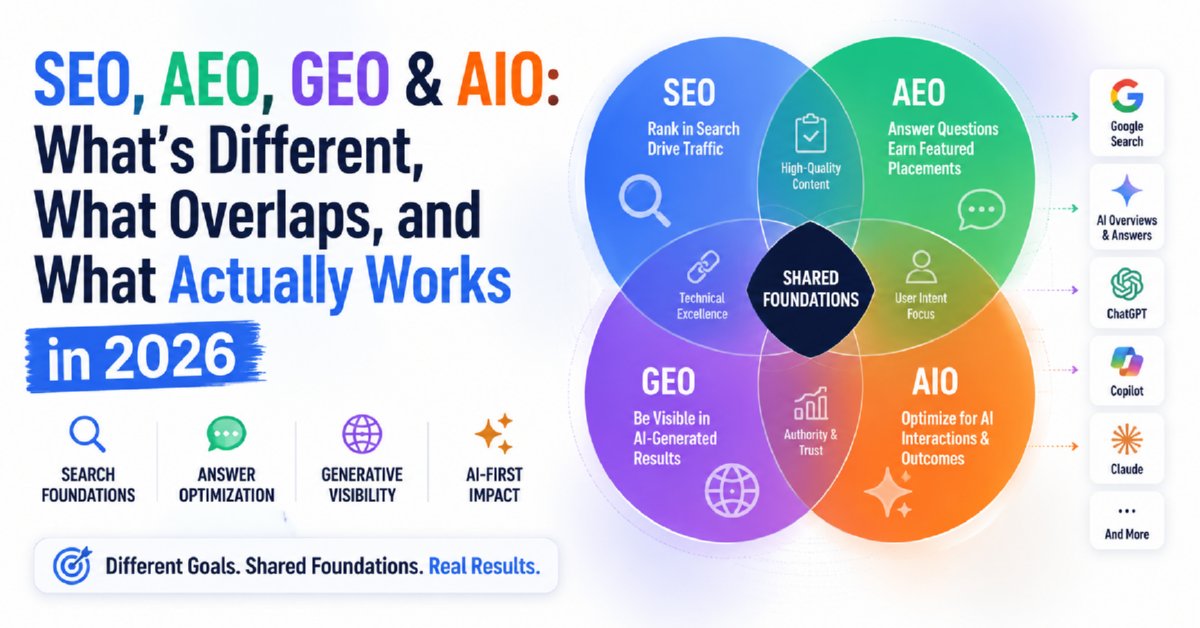
Over 58% of Google searches in the US now end without a single click — and AI-generated answers are resolving millions of queries before users ever visit a website. Four distinct frameworks have emerged to address this new reality: SEO (Search Engine Optimization), AEO (Answer Engine Optimization), GEO (Generative Engine Optimization), and AIO (AI Optimization) — each representing a different layer of how content is discovered, extracted, synthesized, and presented across both traditional and AI-powered search. Understanding what separates these four approaches, where they converge, and which tactics deliver measurable results is no longer optional for anyone serious about digital visibility in 2026 and beyond.
- Introduction
- The Evolution of Search: From SEO to AIO
- The Four Pillars: SEO, AEO, GEO & AIO Defined
- What Is Traditional SEO?
- What Is AEO (Answer Engine Optimization)?
- What Is GEO (Generative Engine Optimization)?
- What Is AIO (AI Optimization)?
- Key Differences: Side-by-Side Comparison
- Where They Overlap: The Shared Foundation
- Signal Strength by Framework
- How AI Search Actually Works
- What Actually Works: Proven Tactics in 2026
- Building a Unified Content Strategy
- Tools to Optimize Across All Four Frameworks
- Common Mistakes to Avoid
- The Future of Search Optimization
- Frequently Asked Questions
The Evolution of Search: From SEO to AIO
Search engine optimization did not stand still. What began as a practice of matching keywords to pages has evolved through four distinct generations — each triggered by a fundamental shift in how machines understand and serve information to humans. Each framework below represents a new layer added on top of the last, not a replacement of it.
The Four Pillars: SEO, AEO, GEO & AIO at a Glance
Before diving deep into each framework in the sections below, here is your at-a-glance reference for all four pillars — what each one is, where it operates, and what success looks like.
- Target: Google, Bing SERPs
- Goal: Rank high; earn clicks
- Tools: Keywords, backlinks, technical health
- Metric: Rankings, organic sessions
- Era: 1990s – ongoing
- Target: Featured Snippets, Voice, PAA
- Goal: Be the chosen direct answer
- Tools: Q&A structure, schema, concise answers
- Metric: Snippet wins, voice placements
- Era: 2015 – ongoing
- Target: Perplexity, ChatGPT Search, Google AI Overviews
- Goal: Be cited in AI-synthesized answers
- Tools: E-E-A-T, original data, authority
- Metric: AI citation frequency, brand mentions
- Era: 2023 – ongoing
- Target: All AI algorithms & LLMs
- Goal: Be machine-readable & synthesizable
- Tools: Semantic clarity, structured data, NLP-friendly writing
- Metric: AI indexation, synthesis accuracy
- Era: 2024 – ongoing
What Is Traditional SEO?
SEO (Search Engine Optimization) is the foundation. It is the practice of optimizing content to rank highly on standard Search Engine Results Pages (SERPs) like Google or Bing to drive organic traffic. SEO has been the cornerstone of digital marketing since the late 1990s and remains the bedrock upon which AEO, GEO, and AIO are built.
Without a properly indexed, technically healthy, and authoritative website, none of the more advanced frameworks can function. AI systems cannot cite content they cannot crawl. Snippet algorithms cannot extract answers from pages that don’t rank. The hierarchy is non-negotiable.
The Three Pillars of Traditional SEO
- Technical SEO: Site speed, crawlability, mobile-friendliness, Core Web Vitals, structured data, and clean indexation.
- On-Page SEO: Keyword research, title tags, meta descriptions, header hierarchy (H1–H4), internal linking, and content depth.
- Off-Page SEO: Backlink acquisition, brand mentions, domain authority, and digital PR campaigns.
- The #1 Google result earns an average CTR of 27.6% (Backlinko, 2024).
- 68% of all online experiences begin with a search engine (BrightEdge).
- Organic search drives 53% of all website traffic across industries.
- Yet over 58% of US searches are now zero-click — the urgency of layering AEO, GEO, and AIO on top of SEO has never been greater.
What Is AEO (Answer Engine Optimization)?
AEO (Answer Engine Optimization) is the practice of structuring content to provide direct, instant answers for featured snippets and voice search queries. When someone asks Siri, Alexa, or Google Assistant a question, it reads out exactly one answer — AEO is the discipline of competing to be that single chosen response.
AEO emerged as voice search grew rapidly post-2015. Today, it extends beyond voice to encompass Google’s Featured Snippets, People Also Ask (PAA) boxes, knowledge panels, and zero-position results. As you’ll see when comparing to GEO, AEO targets deterministic, rule-based extraction — a specific formatted slot — while GEO targets probabilistic AI synthesis.
- Featured snippets appear in approximately 12.3% of all searches (Ahrefs, 2024).
- Voice search answers come from Featured Snippets over 40% of the time.
- Pages winning featured snippets see 20–30% higher CTR on average vs. position #1 without a snippet.
- People Also Ask boxes now appear in over 43% of all Google SERPs.
Core AEO Techniques
- Question-Based Headings: Use complete natural-language questions as H2/H3 headings (Who, What, When, Where, Why, How).
- Concise Direct Answers: Provide a crisp 40–60 word answer immediately after each question heading.
- Structured Data Markup: FAQ, HowTo, and Q&A schema signal answer intent to extraction algorithms.
- Inverted Pyramid Writing: Lead with the most important information, then expand with supporting detail.
- Definition Boxes: Clear “X is Y” definitions that search engines can extract cleanly.
- List and Table Formats: Numbered lists for processes; comparison tables for “vs.” queries.
What Is GEO (Generative Engine Optimization)?
GEO (Generative Engine Optimization) is the practice of optimizing your authority and content so that AI-powered search engines — like Perplexity or ChatGPT — cite and recommend your brand when synthesizing answers. Unlike AEO, which targets a specific formatted slot, GEO aims to make your content trustworthy and authoritative enough that an AI model pulls from it, paraphrases it, and cites it in a synthesized response [2].
GEO operates across Google AI Overviews (formerly SGE), Microsoft Copilot in Bing, Perplexity AI, ChatGPT Search, and similar platforms. A page ranked #8 organically can be cited by AI Overviews while the #1 ranked page is ignored — because GEO is about trustworthiness and authority signals, not just ranking position.
Core GEO Techniques
- E-E-A-T Maximization: Author credentials, first-hand experience signals, cited sources, transparent editorial policies.
- Original Research & Data: Proprietary statistics, surveys, and case studies that AI systems cite as primary sources.
- Citation-Worthy Writing: Quotable, citable sentences with clear statistics and attributions.
- Brand Mentions Across the Web: External mentions signal trustworthiness to AI training data and retrieval systems.
- Comprehensive Topic Coverage: Covering an entire subject deeply so AI models view your domain as a topical authority.
- Freshness Signals: Regular updates with current data, news, and developments.
What Is AIO (AI Optimization)?
AIO (AI Optimization or Artificial Intelligence Optimization) is the broadest and most foundational of the four frameworks — it is the process of making your content machine-readable and easy for any AI algorithm to index, understand, and synthesize. While GEO is specifically about being cited by generative search platforms, AIO is about ensuring that the full spectrum of AI systems — from search engine crawlers to LLMs to recommendation algorithms — can correctly parse, categorize, and use your content.
AIO is what sits underneath GEO. If your content is not AIO-compliant — if it is ambiguous, poorly structured, or inaccessible to machine parsers — then GEO tactics built on top of it will underperform regardless of how authoritative your brand is.
- Semantic Clarity: Write in clear, unambiguous language that NLP models can parse accurately. Avoid jargon, passive voice overload, and pronoun ambiguity.
- Machine-Readable Structure: Use proper HTML heading hierarchy, semantic HTML5 elements, clean URL structures, and comprehensive structured data (JSON-LD).
- Knowledge Graph Compatibility: Ensure your entities (people, places, organizations, concepts) are clearly defined and linked to established knowledge graph nodes via structured data and Wikidata-connected references.
- Accessibility & Crawlability: AI crawlers are as blocked by technical barriers as traditional bots — broken links, JavaScript-rendered content without SSR, and robots.txt errors all prevent AI indexation.
Why AIO Is the Missing Piece Most Brands Overlook
Most digital marketers are familiar with SEO and increasingly aware of GEO. But AIO — the technical and semantic layer that makes all AI optimization possible — is frequently ignored. The result is brands investing heavily in GEO content strategies that underperform because the underlying content is not machine-readable enough for AI systems to synthesize confidently.
1. Can Google’s Rich Results Test parse your structured data without errors?
2. Do your pages use semantic HTML5 elements (article, section, nav, main, aside)?
3. Are named entities on your site (people, organizations, products) described with enough context that an AI can identify them without prior knowledge?
4. Does your content render correctly without JavaScript for crawlers that don’t execute JS?
5. Are your key definitions written as standalone, self-contained sentences that make sense out of context?
Key Differences: SEO vs AEO vs GEO vs AIO — Complete Side-by-Side
Here is the definitive comparison across all four frameworks. Understanding these differences is the prerequisite for building the unified strategy that captures visibility across all search surfaces simultaneously.
| Dimension | 🔍 SEO | 🎙️ AEO | 🤖 GEO | 🧠 AIO |
|---|---|---|---|---|
| Full Name | Search Engine Optimization | Answer Engine Optimization | Generative Engine Optimization | AI Optimization |
| Primary Goal | Rank high; earn organic clicks | Win Featured Snippets & voice answers | Get cited in AI-generated responses | Be machine-readable by all AI systems |
| Target Platform | Google, Bing, Yahoo SERPs | Featured Snippets, Siri, Alexa, Google Assistant | Google AI Overviews, Perplexity, ChatGPT Search, Copilot | All AI: LLMs, search crawlers, recommendation engines |
| Algorithm Type | Rule-based ranking algorithm | Rule-based extraction algorithm | Probabilistic LLM synthesis | NLP parsing + semantic graph traversal |
| Content Format | Long-form, keyword-rich, linked | Q&A format, 40–60 word direct answers | Authoritative, data-rich, citable | Semantically clear, structured, unambiguous |
| Key Signals | Keywords, backlinks, Core Web Vitals | Answer format, schema markup, conciseness | E-E-A-T, original data, brand authority | Semantic HTML, JSON-LD, entity clarity, NLP-friendliness |
| Success Metric | Rankings, CTR, organic sessions | Snippet wins, PAA inclusions, voice placements | AI citation frequency, brand mentions in AI outputs | Correct AI parsing, entity recognition, synthesis accuracy |
| User Benefit | Finds your site in search results | Gets instant answer without clicking | Gets synthesized answer from your content | AI understands your content correctly |
| Backlinks Critical? | Yes — core ranking factor | Important but secondary to format | Yes — signals authority to AI systems | Indirect — authority helps AI trust |
| Schema Markup | Helpful for rich results | Very important (FAQ, HowTo, Q&A) | Moderately important | Critical for machine readability |
| Traffic Impact | Direct clicks to site | Can reduce clicks (zero-click) or boost CTR | Often zero-click; brand awareness play | Indirect — enables all other frameworks |
| Measurability | High — GSC, GA4, rank trackers | Medium — snippet tracking tools | Low-Medium — evolving tools | Low — technical audits required |
| Era | 1990s – ongoing | 2015 – ongoing | 2023 – ongoing | 2024 – ongoing |
Where SEO, AEO, GEO & AIO Overlap: The Shared Foundation
While the differences are real and meaningful, the four frameworks share a substantial common foundation — and this is the most strategically important insight in this entire guide. Investing in the shared foundation pays dividends across all four simultaneously, creating compound returns that far exceed siloed optimization.
High-Quality · Authoritative · Structured
E-E-A-T Rich · Technically Sound · User-First
Content at the center earns organic rankings and Featured Snippets and AI citations and correct machine synthesis — all at once.
- High-Quality, Accurate Content: All four frameworks penalize thin, inaccurate, or misleading content. Truth is non-negotiable.
- E-E-A-T Signals: Experience, Expertise, Authoritativeness, and Trustworthiness are valued by ranking algorithms, snippet extraction systems, AI citation decisions, and machine readability parsers alike.
- Technical Health: A crawlable, indexable, fast-loading site is the prerequisite for all four. AI cannot cite what it cannot access.
- User Intent Alignment: All four frameworks reward content that genuinely satisfies what the user is searching for — above all else.
- Internal Linking: Helps search engines and AI crawlers understand topical depth, hierarchy, and relationships between content assets.
- Freshness: Outdated content underperforms across all four frameworks — especially in fast-moving topics.
- Clear, Unambiguous Language: Natural language processing models and human readers alike prefer clear, direct, jargon-free writing.
The Overlap Map Explained
- SEO only: Technical link-building, meta tag CTR optimization, crawl budget management.
- AEO only: 40–60 word direct answer formatting, FAQ schema for PAA boxes.
- GEO only: Building brand authority across external publications, producing original proprietary data for AI primary source citation.
- AIO only: Knowledge graph entity disambiguation, semantic HTML5 structure, NLP-optimized sentence construction.
- SEO + AEO: Keyword-optimized Q&A content that ranks AND wins snippets.
- GEO + AIO: Authoritative, machine-readable content that gets cited AND correctly synthesized by AI.
- All four (the sweet spot): Comprehensive, well-structured, E-E-A-T-rich, technically sound, semantically clear content that ranks, wins snippets, gets cited, and is correctly parsed by every AI system.
Signal Strength by Framework: What Each One Cares About Most
Different ranking signals carry different weights across the four frameworks. This visual reference helps you prioritize your optimization efforts based on which framework matters most to your current business goals.
How AI Search Actually Works (And Why It Changes Everything)
To optimize effectively for GEO and AIO — and to understand why traditional SEO and AEO alone are no longer sufficient — you need a working model of how AI-powered search engines generate responses.
When a user submits a query, the AI search system first retrieves a candidate set of documents from its index using retrieval mechanisms heavily influenced by traditional SEO signals — relevance, authority, and freshness. Strong SEO gives your content a seat at the table for AI consideration.
From retrieved documents, the system filters for trustworthiness, factual accuracy, source credibility, and query-specific relevance. This is where E-E-A-T signals, citation patterns, and domain authority heavily influence GEO outcomes. A page ranked #8 organically can outperform the #1 result here.
Before synthesis can occur, the AI must correctly parse and understand your content. This is where AIO signals become critical — semantic HTML, structured data, clear entity definitions, and NLP-friendly sentence construction all determine how accurately the AI interprets your content.
The LLM synthesizes information from multiple selected sources into a coherent, conversational answer. Content that is clearly written, factually precise, and structured in citable units (statistics, definitions, step-by-step processes) survives synthesis most accurately — this is AEO meeting GEO.
In systems like Perplexity and Google AI Overviews, sources are cited with links. Being cited is a brand visibility and authority play even when it produces zero-click results — users who see your brand cited repeatedly begin to associate it with expertise in that domain.
What Actually Works: Proven Tactics Across All Four Frameworks
Theory is useful. Tactics are what move the needle. Here are the specific, actionable techniques demonstrating measurable impact across SEO, AEO, GEO, and AIO — and which framework each tactic serves.
1. Topical Authority Architecture (SEO + GEO + AIO)
Build topic clusters: one comprehensive pillar page per core topic, supported by 8–15 detailed cluster articles covering every related subtopic, interlinked with descriptive anchor text. This signals topical authority to ranking algorithms, gives AI systems a comprehensive knowledge base to cite from, and helps NLP parsers build accurate semantic maps of your domain.
2. The “Direct Answer + Deep Dive” Structure (AEO + GEO + SEO)
This is the single most universally effective content structure across all four frameworks:
- Open with a 40–60 word direct answer to the primary question → wins AEO Featured Snippets.
- Follow with 1,000–2,500 words of supporting context → earns SEO rankings through depth and relevance.
- Embed citable statistics and expert quotes throughout → increases GEO citation frequency.
- Use clean heading hierarchy and semantic HTML → improves AIO machine readability.
3. Original Research and Data (GEO + SEO)
Publishing proprietary statistics, surveys, case studies, and original research makes you a primary source. AI systems and journalists both cite primary sources. This generates backlinks (SEO), builds authority (GEO), and creates citation-worthy reference points that survive AI synthesis.
- Conduct annual industry surveys with 100+ respondents and publish full methodology.
- Analyze your platform’s anonymized data for unique industry benchmarks.
- Run documented experiments and publish findings transparently.
- Aggregate and reanalyze publicly available datasets with original expert commentary.
- Create original calculators or tools that generate personalized data for users.
4. E-E-A-T Implementation (All Four Frameworks)
- Experience: Include first-hand accounts, personal case studies, and “tested by” disclosures. AI systems favor content with observable experiential signals.
- Expertise: Every article needs a named, credentialed author with a linked bio listing qualifications and professional history.
- Authoritativeness: Build backlinks from respected publications. Pursue Wikipedia mentions, industry association citations, and news outlet coverage.
- Trustworthiness: Cite all sources with links to authoritative references. Maintain clear “last updated” dates. Publish transparent editorial policies and correction notices.
5. Semantic Clarity and NLP-Friendly Writing (AIO + GEO)
Write in the clearest possible language. Every sentence should be interpretable in isolation — without requiring context from surrounding paragraphs. Define every technical term the first time you use it. Use active voice. Avoid ambiguous pronouns. Structure information in logical, predictable patterns that NLP models process accurately.
6. Conversational, Natural-Language Content (AEO + GEO)
Voice search and AI chatbots process natural language — not keyword strings. Include full question phrases in your headings. Write answers in complete, natural sentences. Use conversational transitions. Avoid keyword stuffing, which reads unnaturally to both humans and AI parsers and can trigger quality filters.
7. Technical Excellence Across the Board (SEO + AIO foundation)
- Core Web Vitals: LCP under 2.5s, CLS under 0.1, INP under 200ms
- Mobile-first design and fast mobile page loading
- Clean crawlable architecture with logical internal linking — no page more than 3 clicks from the homepage
- Comprehensive structured data (JSON-LD): Article, FAQ, HowTo, Organization, BreadcrumbList schemas
- HTTPS across all pages; no mixed content warnings
- Server-side rendering (SSR) for JavaScript-heavy pages so AI crawlers can access content
8. Multi-Platform Brand Presence (GEO + AIO)
AI systems don’t just evaluate your website in isolation. They assess your brand’s overall reputation signal across the entire web. Mentions on reputable third-party sites, podcast appearances, YouTube video transcripts, academic citations, and news coverage all contribute to the trustworthiness signals that influence GEO citation frequency and AIO entity recognition.
Building a Unified SEO + AEO + GEO + AIO Content Strategy
The most effective approach in 2026 is not to choose between the four frameworks — it is to build a single integrated strategy where each piece of content is optimized to perform across all four dimensions simultaneously. Here is the actionable six-phase framework:
Use keyword research tools (Ahrefs, Semrush, GSC) to identify high-intent keywords (SEO). Layer question research using AlsoAsked and AnswerThePublic to find voice-friendly queries (AEO). Note which queries trigger AI Overviews in Google — these are GEO priority targets. Identify ambiguous entity terms in your niche that need clearer definition — these are AIO opportunities.
For every content piece, define: (a) primary SEO keyword and ranking target, (b) specific Featured Snippet question to win (AEO), (c) the authoritative angle or original data point that makes this citable by AI (GEO), and (d) the entities and technical terms that need clear first-use definitions for machine readability (AIO).
Open with a 40–60 word direct answer to the primary question (AEO). Build comprehensive coverage of the topic with proper H2/H3 hierarchy (SEO). Embed original insights, statistics, and expert quotes (GEO). Define all technical terms, use semantic HTML5 elements, and write in NLP-friendly, unambiguous language (AIO).
Add FAQ schema for question-answer pairs (AEO). Implement Article schema with author entity markup (E-E-A-T/GEO). Use JSON-LD for all applicable schema types. Ensure fast loading, mobile optimization, and clean crawlability. Build internal links with descriptive anchor text (SEO + AIO).
Promote to generate backlinks (SEO authority + GEO trust signals). Pitch original data to journalists (GEO primary source citations). Share in industry communities. Pursue strategic guest posting on high-authority domains. Seek Wikipedia citations where appropriate (GEO + AIO entity recognition).
Track organic rankings and CTR in Google Search Console (SEO). Monitor Featured Snippet wins in Semrush or Ahrefs (AEO). Test target queries in incognito Google for AI Overview inclusions (GEO). Run quarterly technical audits for structured data and semantic HTML (AIO). Update content with fresh data every 90 days.
Tools to Optimize Across All Four Frameworks
No single tool covers all four frameworks — but the right combination gives you comprehensive coverage. Here is the 2026 toolkit mapped to each framework as described in the unified strategy.
| Tool | Best For | Framework(s) |
|---|---|---|
| Google Search Console | Rankings, CTR, indexation, Core Web Vitals monitoring | SEO |
| Ahrefs / Semrush | Keyword research, backlink analysis, Featured Snippet tracking, AI Overview detection | SEO + AEO + GEO |
| AlsoAsked / AnswerThePublic | Question-based keyword discovery for voice and Q&A content | AEO |
| Surfer SEO / Clearscope / MarketMuse | Content optimization for topical depth, NLP relevance, and semantic coverage | SEO + GEO + AIO |
| Google Rich Results Test | Validating structured data / schema markup implementation | AEO + AIO |
| Perplexity AI (manual testing) | Checking if your brand/content is cited in AI-generated answers | GEO |
| ChatGPT / Claude (manual testing) | Testing how LLMs describe your brand and whether they cite your content accurately | GEO + AIO |
| Brand24 / Mention / BuzzSumo | Monitoring brand mentions across the web for GEO trust signal building | GEO |
| PageSpeed Insights / GTmetrix | Technical performance measurement and Core Web Vitals optimization | SEO + AIO foundation |
| Screaming Frog | Technical SEO audits, crawlability, internal link analysis, schema discovery | SEO + AIO |
| SparkToro | Audience research — where your audience reads, so you can pursue GEO PR placement | GEO |
| InLinks / WordLift | Entity optimization, knowledge graph integration, semantic internal linking | AIO + GEO |
| Google’s NLP API (Cloud Natural Language) | Testing how Google’s NLP parser categorizes entities and sentiment in your content | AIO |
Common Mistakes to Avoid Across All Four Frameworks
As AEO, GEO, and AIO gain attention, misinformation and misapplication are widespread. Here are the most damaging mistakes — and the corrections that will save you months of wasted effort.
AEO, GEO, and AIO are layers built on top of SEO — not alternatives to it. The hierarchy is non-negotiable: Technical SEO → On-Page SEO → AEO → GEO → AIO. Skip a layer and the layers above it collapse.
GEO is about being trusted and cited by generative AI platforms. AIO is about being machine-readable by any AI system. GEO is the outcome; AIO is the prerequisite. You can have excellent GEO content strategy built on AIO-poor technical infrastructure — and it will underperform because AI systems will misparse your content before they get to the question of whether to cite it.
Stuffing content with Q&A pairs to game AEO while ignoring readability and genuine value produces content that satisfies no one. Google’s Helpful Content System increasingly demotes content that serves machines over humans. Write for people first. The optimization layer is a refinement, not the foundation.
If GEO is working, AI systems are citing your content — and users may be getting answers without clicking. Measuring this purely as “organic traffic decline” misses the picture entirely. Track brand search volume, direct traffic trends, PR citation volume, and lead quality separately from session counts.
If your content refers to “the platform” or “it” without clearly establishing what entity you mean, AI parsers will misidentify or skip the reference. Every named entity — your brand, products, people, concepts — must be clearly identified, defined in context, and used consistently throughout your content.
Single orphan articles targeting individual questions rarely achieve topical authority strong enough to trigger GEO citations. AI systems favor domains with comprehensive, interconnected knowledge bases. Build topic clusters as described in the unified strategy section.
AI systems actively deprioritize outdated information, especially on fast-moving topics. Establish a content refresh calendar: update statistics, expand thin sections, add new developments, and revise outdated claims at least quarterly for your most important pages.
The Future of Search Optimization: Where All Four Frameworks Are Heading
The search landscape is converging rapidly. The distinction between SEO, AEO, GEO, and AIO may matter less in three years than the underlying principle that unites all four: the most trustworthy, helpful, comprehensively authoritative, and machine-readable content wins — regardless of what we call the framework.
- AI Overviews Expansion: Google is rolling AI Overviews to more query types globally. The percentage of searches with AI-generated answers will approach 30–40% of all informational queries by 2026, making GEO + AIO optimization increasingly non-optional.
- Multimodal AI Search: AI search is moving beyond text. Images, video transcripts, podcast audio, and infographics will all become citation surfaces. AIO must extend to visual and audio content accessibility and machine parsing.
- Personalized AI Responses: As AI search becomes more personalized, brand familiarity and repeated exposure across multiple touchpoints will influence citation likelihood — amplifying the importance of consistent multi-platform brand presence.
- Paid AI Placements: Early signals suggest Google and other AI search platforms will introduce sponsored placements within AI-generated responses — a paid GEO channel emerging alongside organic GEO.
- GEO Measurement Standardization: Industry tools are developing standards for AI citation tracking. Within 12–18 months, expect dedicated GEO analytics dashboards in major SEO tools that systematically track AI citation frequency and brand mention rates in AI outputs.
- AIO as the New Technical SEO: Just as technical SEO became a standard discipline in the 2010s, AIO — semantic markup, entity optimization, NLP-friendly content architecture — will become a standard component of every content team’s workflow by 2026.
Frequently Asked Questions
What is the difference between SEO, AEO, GEO, and AIO?
SEO (Search Engine Optimization) optimizes content to rank highly on traditional search engine results pages like Google or Bing to drive organic clicks. AEO (Answer Engine Optimization) structures content to provide direct, instant answers for featured snippets and voice search queries (Siri, Alexa, Google Assistant). GEO (Generative Engine Optimization) optimizes your brand authority so AI-powered engines like Perplexity, ChatGPT Search, and Google AI Overviews cite and recommend your content when synthesizing answers. AIO (AI Optimization) is the broadest layer — making your content machine-readable and easy for any AI algorithm to index, understand, and synthesize correctly. They are cumulative layers, not competing alternatives.
Which framework should I focus on first — SEO, AEO, GEO, or AIO?
Always start with SEO — it is the non-negotiable foundation. Without proper indexation, site authority, and technical health, none of the advanced frameworks can function: AI systems cannot cite content they cannot crawl, and snippet algorithms cannot extract answers from pages that don’t rank. Once your SEO foundation is solid, layer on AEO (content structure for answer extraction), then GEO (authority building for AI citation), and finally AIO (semantic and technical machine-readability). The hierarchy exists for a reason — respect it.
What is AIO (AI Optimization) and how is it different from GEO?
AIO (AI Optimization) is the process of making your content machine-readable and easy for any AI algorithm — search crawlers, LLMs, recommendation engines — to index, parse, and understand correctly. GEO (Generative Engine Optimization) is specifically about being trusted and cited by generative AI search platforms like Perplexity and Google AI Overviews. AIO is the technical prerequisite; GEO is the outcome built on top of it. You can invest heavily in GEO content strategy, but if your content fails AIO standards — ambiguous entities, poor semantic structure, JavaScript-only rendering — AI systems will misparse it before they ever consider citing it.
How do I know if my content is being cited in Google AI Overviews or Perplexity?
The most reliable current method is manual testing: search your primary target queries in an incognito browser and check whether Google’s AI Overview section cites your domain. For Perplexity, search your key topics directly on Perplexity.ai — it displays citations clearly for each synthesized answer. Semrush and Ahrefs have begun adding AI Overview visibility tracking to their toolsets. Brand monitoring tools like Brand24 can also surface indirect AI citations when your content is referenced in articles that AI systems subsequently cite.
Does AEO reduce my website traffic by creating zero-click searches?
Featured Snippets can reduce clicks for some queries while increasing them for others — the net impact depends heavily on the query type. For simple factual queries, Featured Snippets often produce zero-click results. For complex queries where users want to explore further, winning the snippet can actually increase CTR by signaling authority. The strategic response is not to avoid AEO but to pursue it selectively: target snippet wins for queries where brand visibility and authority signals matter, while optimizing for direct CTR on transactional and high-value informational queries where clicks drive conversions.
What content format works best across all four frameworks simultaneously?
The “Direct Answer + Deep Dive” structure works best across all four. Open with a 40–60 word direct answer to the primary question (AEO). Build comprehensive coverage of 1,000–2,500 words with proper heading hierarchy (SEO). Embed citable original statistics and expert insights throughout (GEO). Structure with semantic HTML5 elements, clean JSON-LD schema, and entity-clear language (AIO). This single structure, applied consistently, creates content assets that rank organically, win Featured Snippets, get cited by AI systems, and are correctly parsed by machine learning models.
How important are backlinks for GEO and AIO compared to traditional SEO?
Backlinks remain critical for SEO as direct ranking signals. For GEO, backlinks matter indirectly — they signal domain authority that AI systems factor into source trustworthiness assessments when deciding which content to cite. For AIO, backlinks are less directly relevant to machine readability but contribute to the overall authority signal that makes AI systems more willing to trust and correctly attribute your content. Original data and research that earns natural citations (backlinks AND brand mentions) is the highest-leverage GEO tactic because it builds authority signals that benefit both SEO ranking and AI citation simultaneously.
Can small businesses compete with large brands in AEO, GEO, and AIO?
Yes — and this is one of the most compelling aspects of the new search landscape. AEO rewards precise answer formatting over brand size. GEO rewards genuine topical authority and original data over budget. AIO rewards clear, well-structured content over domain age. A small business with deep niche expertise, original research, and well-structured content will consistently outperform a large brand publishing generic, AIO-poor content on the same topic. Niche authority beats broad brand recognition in AI citation decisions far more often than in traditional SERP rankings.
How do I make my content more “AIO-compliant” or machine-readable?
Start with five core improvements: (1) Use semantic HTML5 elements — article, section, main, nav, aside — instead of generic div containers. (2) Define every named entity (people, brands, products, concepts) clearly the first time they appear, with enough context that an AI can identify them without prior knowledge. (3) Write in active voice with clear subject-verb-object sentence structures that NLP parsers process accurately. (4) Implement comprehensive JSON-LD structured data for all applicable schema types. (5) Ensure your pages render correctly without JavaScript for crawlers that don’t execute JS, using server-side rendering (SSR) or static generation for important pages.
What is the single most impactful thing I can do right now to improve across all four frameworks?
Audit your top 10 organic pages and upgrade them with four specific changes: add a named, credentialed author with a linked professional bio (E-E-A-T/GEO); add a clear 40–60 word direct answer at the top of the page’s primary question (AEO); embed at least one original or cited statistic with a source link (GEO); and update the page’s HTML to use semantic heading hierarchy and FAQ schema for question-answer pairs (AIO). These four targeted upgrades applied to existing high-traffic pages can show measurable improvement in Featured Snippet wins, AI citation frequency, and organic engagement within 4–8 weeks.
Last Updated: 2026 | Content reviewed for accuracy against current Google Search documentation, Google Quality Rater Guidelines, industry SEO research, and observed AI search platform behavior. Statistics should be verified against current sources for time-sensitive decisions. This article represents editorial opinion based on current best practices and does not constitute a guarantee of specific search results.