
Alibaba’s flagship reasoning model, Qwen3.7-Max, has achieved an impressive 60.6% resolved rate on SWE-Bench Pro, positioning it among the strongest AI coding agents currently available. The benchmark performance highlights the rapid evolution of autonomous software engineering systems capable of repository-level reasoning, terminal operations, debugging, multilingual coding, and long-horizon task execution.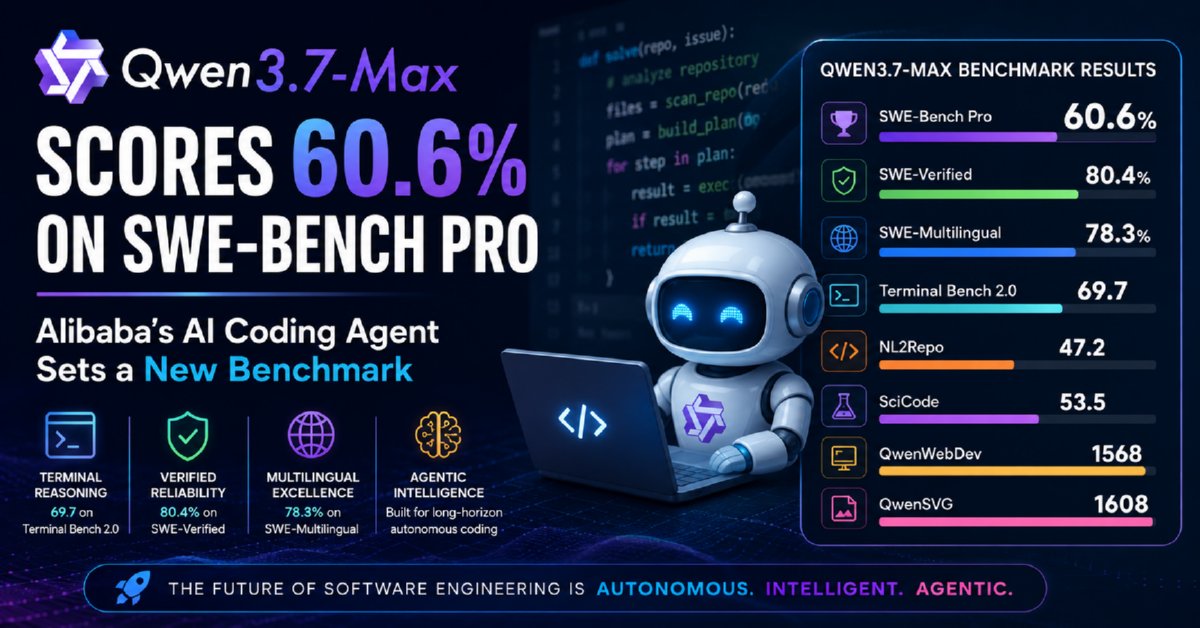
According to recent analysis Qwen3.7-Max demonstrates exceptional capabilities across software engineering benchmarks, including SWE-Verified, SWE-Multilingual, Terminal Bench 2.0, and repository reasoning tasks. These advancements suggest that AI coding systems are evolving beyond simple autocomplete assistants into increasingly autonomous engineering collaborators.
What is Qwen3.7-Max?
Qwen3.7-Max is a frontier AI reasoning model developed by Alibaba as part of its rapidly expanding Qwen ecosystem of large language models. The model is specifically optimized for advanced reasoning, agentic workflows, software engineering tasks, terminal operations, multilingual coding, and repository-scale problem solving.
Unlike traditional AI coding assistants that primarily generate snippets of code, Qwen3.7-Max is designed for long-horizon autonomous workflows. It can inspect repositories, analyze dependencies, reason across multiple files, execute sequential engineering operations, and iteratively debug software systems.
This marks an important shift in the evolution of artificial intelligence—from passive code suggestion systems toward active software engineering agents capable of participating in complex development pipelines.
Qwen3.7-Max Achieves 60.6% on SWE-Bench Pro
One of the most important milestones achieved by Qwen3.7-Max is its 60.6% score on SWE-Bench Pro. SWE-Bench Pro is currently regarded as one of the most rigorous benchmarks for evaluating real-world AI software engineering capabilities.
Unlike conventional coding benchmarks that focus on isolated algorithmic problems, SWE-Bench evaluates whether AI systems can solve actual GitHub repository issues. These tasks require repository understanding, bug diagnosis, code editing, dependency analysis, patch generation, and reasoning across large codebases.
A 60.6% resolved rate indicates that the model successfully solved more than sixty percent of professional-grade software engineering tasks in the benchmark environment. At the frontier level of AI coding systems, even small improvements represent major advances in reasoning and engineering capabilities.
The benchmark result places Qwen3.7-Max ahead of several major competitors in the emerging AI coding ecosystem.
Qwen3.7-Max Benchmark Results
| Benchmark | Qwen3.7-Max Score |
|---|---|
| Terminal Bench 2.0 | 69.7 |
| SWE-Verified | 80.4 |
| SWE-Pro | 60.6 |
| SWE-Multilingual | 78.3 |
| NL2Repo | 47.2 |
| SciCode | 53.5 |
| QwenWebDev | 1568 |
| QwenSVG | 1608 |
The benchmark data demonstrates that Qwen3.7-Max performs strongly across multiple dimensions of autonomous software engineering, including repository reasoning, multilingual programming, scientific coding, terminal interaction, and web development workflows.
How Qwen3.7-Max Compares with Other Frontier AI Models
| Model | SWE-Pro Score |
|---|---|
| Qwen3.7-Max | 60.6 |
| K2.6 Thinking | 59.5 |
| DS-V4-Pro Max | 59.0 |
| GLM-5.1 Thinking | 58.8 |
| Opus-4.6 Max | 57.3 |
| Qwen3.6-Plus | 56.6 |
The comparison reveals how competitive the frontier AI coding landscape has become. The differences between leading models may appear numerically small, but at this level of software engineering complexity, even a one-percent increase represents substantial improvements in reasoning depth, debugging reliability, and repository understanding.
Qwen3.7-Max currently stands among the highest-performing AI software engineering systems in publicly available benchmark evaluations.
The Importance of the 80.4% SWE-Verified Score
Perhaps even more significant than the SWE-Pro benchmark is the model’s remarkable 80.4% score on SWE-Verified.
SWE-Verified is a carefully human-filtered subset of SWE tasks designed to reduce ambiguity and ensure reliable benchmark evaluation. High performance on this benchmark indicates that the model is genuinely solving software engineering tasks rather than exploiting statistical shortcuts or benchmark artifacts.
Strong SWE-Verified performance is especially important for enterprise AI adoption because it reflects greater reliability, reproducibility, and engineering consistency in real-world workflows.
For organizations exploring AI-assisted development, the SWE-Verified benchmark is increasingly becoming one of the most trusted indicators of practical coding-agent capability.
The Rise of Agentic AI Software Engineering
Qwen3.7-Max represents a broader technological shift toward agentic AI software engineering systems. Traditional coding assistants function mainly as autocomplete tools that generate isolated snippets of code. Modern agentic systems, however, are designed to reason through multi-step engineering workflows.
Qwen3.7-Max demonstrates capabilities in:
- Long-horizon reasoning
- Terminal-based operations
- Repository navigation
- Bug diagnosis
- Patch generation
- Multilingual code understanding
- Sequential tool usage
- Autonomous debugging
These abilities indicate the transition from AI-assisted programming toward semi-autonomous engineering collaboration.
Its strong 78.3% SWE-Multilingual score further demonstrates robust performance across globally distributed programming environments and multilingual repositories.
Why Terminal Bench 2.0 Performance Matters
Qwen3.7-Max also achieved an impressive 69.7 score on Terminal Bench 2.0. Terminal-based benchmarks evaluate whether AI systems can effectively operate command-line environments, inspect logs, execute shell commands, manipulate files, and complete engineering tasks across sequential workflows.
Terminal reasoning capabilities are foundational for:
- DevOps automation
- Infrastructure engineering
- CI/CD orchestration
- Cloud deployment workflows
- AI software agents
- Autonomous debugging systems
As AI systems become increasingly capable of terminal interaction, they move beyond chatbot functionality into operational engineering environments.
The Future of Autonomous Software Engineering
The rapid advancement of models like Qwen3.7-Max suggests that software engineering is entering a new AI-native era. Future development ecosystems are expected to include autonomous agents capable of coordinating repositories, managing infrastructure, testing software, monitoring deployments, and assisting developers throughout the engineering lifecycle.
This transformation could significantly reshape:
- Software productivity
- Engineering team workflows
- Open-source maintenance
- Startup development velocity
- Enterprise automation
- Continuous deployment systems
Human developers will increasingly transition from manual implementation roles toward orchestration, supervision, architecture design, and ethical governance of intelligent engineering systems.
From Code Generation to Human-Centered Engineering Intelligence
The evolution of AI coding systems also raises important philosophical and ethical questions about the future relationship between humans and intelligent machines. As autonomous engineering systems become more capable, the focus must shift from raw automation toward responsible, collaborative, and human-centered AI design.
The next generation of AI software agents should not merely optimize speed and efficiency. They should also support transparency, reliability, cooperative reasoning, and human creativity. Responsible AI engineering requires balancing automation with accountability and ethical oversight.
In this broader context, Qwen3.7-Max represents more than a benchmark achievement. It reflects the accelerating convergence of reasoning intelligence, software engineering, autonomous systems, and collaborative human-AI workflows.
Conclusion
Qwen3.7-Max’s achievement of 60.6% on SWE-Bench Pro marks a major milestone in the evolution of AI software engineering agents. Combined with its strong performance on SWE-Verified, SWE-Multilingual, and Terminal Bench 2.0, the model demonstrates that autonomous engineering systems are rapidly advancing toward practical real-world deployment.
The frontier of artificial intelligence is no longer limited to generating isolated snippets of code. The next phase involves intelligent agents capable of reasoning through complete engineering workflows, coordinating tools, navigating repositories, debugging systems, and assisting human developers across increasingly complex software ecosystems.
Qwen3.7-Max suggests that the future of autonomous software engineering may arrive sooner than many expected.
Sources and References
Frequently Asked Questions (FAQ)
What is Qwen3.7-Max?
Qwen3.7-Max is an advanced AI reasoning and software engineering model developed by Alibaba. It is optimized for coding, repository reasoning, debugging, terminal interaction, and autonomous engineering workflows.
What is SWE-Bench Pro?
SWE-Bench Pro is a benchmark designed to evaluate whether AI systems can solve real-world GitHub software engineering tasks involving debugging, repository understanding, and patch generation.
How good is the 60.6% SWE-Pro score?
A 60.6% resolved rate on SWE-Bench Pro is considered an extremely strong result because the benchmark involves complex real-world engineering tasks rather than isolated coding exercises.
What is SWE-Verified?
SWE-Verified is a carefully human-validated subset of SWE benchmark tasks designed to improve reliability and reduce ambiguity in benchmark evaluation.
What does agentic AI mean?
Agentic AI refers to systems capable of autonomously planning, reasoning, executing tools, and completing multi-step tasks with limited human intervention.
Can Qwen3.7-Max replace software developers?
Qwen3.7-Max can significantly assist developers with debugging, coding, automation, and repository reasoning, but human oversight, architecture design, ethics, and strategic engineering decisions remain essential.
Why are terminal reasoning benchmarks important?
Terminal reasoning benchmarks evaluate whether AI systems can operate real engineering environments using command-line tools, logs, shell commands, and infrastructure workflows.
Is Qwen3.7-Max better than other AI coding models?
Qwen3.7-Max currently demonstrates some of the strongest publicly reported benchmark results across SWE-Pro, SWE-Verified, multilingual coding, and terminal reasoning tasks, making it one of the leading AI coding agents available today.