
The 108 Names of Lord Ganesha, traditionally recited as the Ganesha Ashtottara Shatanamavali, form a sacred garland of mantras honoring the many qualities, powers and spiritual dimensions of Lord Ganapati. Each name becomes a short contemplative mantra through the traditional form Om [Divine Name] Namah.
Ganesha is worshipped across Hindu traditions as Vighneshvara, Lord of obstacles; Vinayaka, the supreme guide; Ganapati, Lord of the ganas; and the divine presence invoked at the beginning of prayer, study, journeys, ceremonies and important undertakings. Yet the deeper significance of the 108 names extends beyond asking for obstacles to disappear. They invite meditation on wisdom, discrimination, courage, humility, disciplined action, auspicious beginnings, inner stability and spiritual awakening.
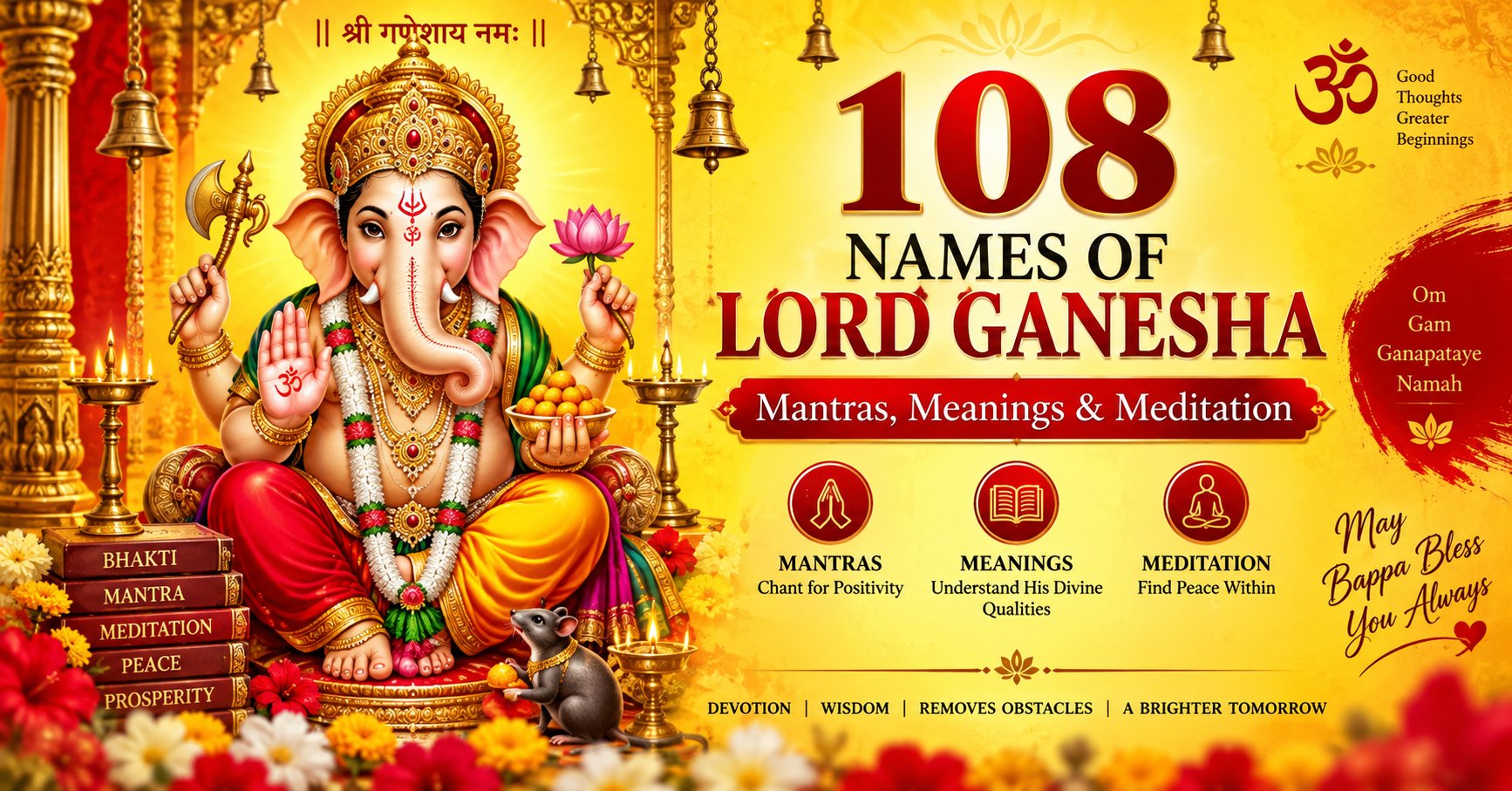
This guide presents the 108 names of Lord Ganesha with Sanskrit mantras, transliteration and concise meanings, followed by practical methods for mantra meditation, japa, visualization and contemplative practice.
What Are the 108 Names of Lord Ganesha?
The Sanskrit expression Ashtottara Shatanamavali refers to a devotional sequence of 108 sacred names. Each name points toward a particular aspect of the deity. In Ganesha worship, some names describe his sacred form, some his relationship with Shiva and Parvati, some his cosmic functions, and others qualities such as wisdom, strength, joy, protection, compassion and spiritual accomplishment.
The names therefore should not be viewed merely as a list of titles. In meditation, every name can function as a seed of contemplation. For example, Sumukha evokes auspiciousness; Prājña evokes wisdom; Vighnahartā evokes the removal of obstacles; Dhṛtimān evokes steadiness; and Bhāvagamya points toward a Divine Reality approached through sincere devotion.
Traditional mantra pattern:
ॐ [नाम] नमः
Om [Divine Name] Namah
Example: ॐ गजाननाय नमः
Namah expresses reverence, salutation and a movement away from ego-centeredness toward the sacred quality represented by the name.
Why Are There 108 Names of Ganesha?
The number 108 has a deeply established place in Indian spiritual culture. Traditional japa malas commonly contain 108 beads, and cycles of 108 repetitions are widely used for mantra practice, contemplation and devotional worship.
Rather than reducing 108 to a single numerical explanation, it is more useful spiritually to understand it as a traditional symbol of completeness, sacred repetition and contemplative wholeness. Moving through 108 names turns prayer into a gradual journey through many dimensions of Ganesha-consciousness.
108 Names of Lord Ganesha with Mantras and Meanings
The following sequence gives one complete traditional Ganesha Ashtottara Shatanamavali. Variations in spelling, pronunciation and even individual names may occur among regional and lineage-based traditions. Devotees following a specific guru, temple or family tradition may continue to use the recension given within that tradition.
| No. | Name | Sanskrit Mantra | Roman Mantra | Meaning / Meditation Quality |
|---|---|---|---|---|
| 1 | Gajānana गजानन |
ॐ गजाननाय नमः | Om Gajananaya Namah | Elephant-faced Lord; wisdom and expansive awareness. |
| 2 | Gaṇādhyakṣa गणाध्यक्ष |
ॐ गणाध्यक्षाय नमः | Om Ganadhyakshaya Namah | Leader of the divine hosts. |
| 3 | Vighnarāja विघ्नराज |
ॐ विघ्नराजाय नमः | Om Vighnarajaya Namah | Lord over obstacles and their removal. |
| 4 | Vināyaka विनायक |
ॐ विनायकाय नमः | Om Vinayakaya Namah | Supreme guide and remover of impediments. |
| 5 | Dvaimātura द्वैमातुर |
ॐ द्वैमातुराय नमः | Om Dvaimaturaya Namah | The one associated with two mothers. |
| 6 | Dvimukha द्विमुख |
ॐ द्विमुखाय नमः | Om Dvimukhaya Namah | The two-faced form; multidirectional awareness. |
| 7 | Pramukha प्रमुख |
ॐ प्रमुखाय नमः | Om Pramukhaya Namah | The foremost one. |
| 8 | Sumukha सुमुख |
ॐ सुमुखाय नमः | Om Sumukhaya Namah | The auspicious and gracious-faced one. |
| 9 | Kṛtī कृती |
ॐ कृतिने नमः | Om Kritine Namah | The accomplished and skillful one. |
| 10 | Supradīpa सुप्रदीप |
ॐ सुप्रदीपाय नमः | Om Supradipaya Namah | The radiant lamp of wisdom. |
| 11 | Sukhanidhi सुखनिधि |
ॐ सुखनिधये नमः | Om Sukhanidhaye Namah | Treasure-house of happiness. |
| 12 | Surādhyakṣa सुराध्यक्ष |
ॐ सुराध्यक्षाय नमः | Om Suradhyakshaya Namah | Lord of the devas. |
| 13 | Surārighna सुरारिघ्न |
ॐ सुरारिघ्नाय नमः | Om Surarighnaya Namah | Destroyer of forces hostile to the divine. |
| 14 | Mahāgaṇapati महागणपति |
ॐ महागणपतये नमः | Om Mahaganapataye Namah | The great Ganapati. |
| 15 | Mānya मान्य |
ॐ मान्याय नमः | Om Manyaya Namah | The honored and venerable one. |
| 16 | Mahākāla महाकाल |
ॐ महाकालाय नमः | Om Mahakalaya Namah | Lord beyond the limitations of time. |
| 17 | Mahābala महाबल |
ॐ महाबलाय नमः | Om Mahabalaya Namah | The greatly powerful one. |
| 18 | Heramba हेरम्ब |
ॐ हेरम्बाय नमः | Om Herambaya Namah | Compassionate protector and beloved son of the Mother. |
| 19 | Lambajaṭhara लम्बजठर |
ॐ लम्बजठराय नमः | Om Lambajatharaya Namah | The large-bellied one. |
| 20 | Hrasvagrīva ह्रस्वग्रीव |
ॐ ह्रस्वग्रीवाय नमः | Om Hrasvagrivaya Namah | The short-necked one. |
| 21 | Mahodara महोदर |
ॐ महोदराय नमः | Om Mahodaraya Namah | The great-bellied one; vast capacity. |
| 22 | Madotkaṭa मदोत्कट |
ॐ मदोत्कटाय नमः | Om Madotkataya Namah | The intensely powerful one. |
| 23 | Mahāvīra महावीर |
ॐ महावीराय नमः | Om Mahaviraya Namah | The great hero. |
| 24 | Mantrī मन्त्री |
ॐ मन्त्रिणे नमः | Om Mantrine Namah | Master of sacred counsel and mantra. |
| 25 | Maṅgalasvara मङ्गलस्वर |
ॐ मङ्गलस्वराय नमः | Om Mangalasvaraya Namah | Whose sound is auspicious. |
| 26 | Pramadha प्रमध |
ॐ प्रमधाय नमः | Om Pramadhaya Namah | Master of primal divine powers. |
| 27 | Prathama प्रथम |
ॐ प्रथमाय नमः | Om Prathamaya Namah | The first; worshipped at beginnings. |
| 28 | Prājña प्राज्ञ |
ॐ प्राज्ञाय नमः | Om Prajnaya Namah | The wise and discerning one. |
| 29 | Vighnakartā विघ्नकर्ता |
ॐ विघ्नकर्त्रे नमः | Om Vighnakartre Namah | Controller who can place obstacles when spiritually necessary. |
| 30 | Vighnahartā विघ्नहर्ता |
ॐ विघ्नहर्त्रे नमः | Om Vighnahartre Namah | Remover of obstacles. |
| 31 | Viśvanetā विश्वनेता |
ॐ विश्वनेत्रे नमः | Om Vishvanetre Namah | Guide and seer of the universe. |
| 32 | Virāṭpati विराट्पति |
ॐ विराट्पतये नमः | Om Viratpataye Namah | Lord of the cosmic form. |
| 33 | Śrīpati श्रीपति |
ॐ श्रीपतये नमः | Om Shripataye Namah | Lord of auspicious abundance. |
| 34 | Vākpati वाक्पति |
ॐ वाक्पतये नमः | Om Vakpataye Namah | Lord of speech and expression. |
| 35 | Śṛṅgārī शृङ्गारी |
ॐ शृङ्गारिणे नमः | Om Shringarine Namah | The beautifully adorned one. |
| 36 | Āśritavatsala अश्रितवत्सल |
ॐ अश्रितवत्सलाय नमः | Om Ashritavatsalaya Namah | Compassionate toward those who seek refuge. |
| 37 | Śivapriya शिवप्रिय |
ॐ शिवप्रियाय नमः | Om Shivapriyaya Namah | Beloved of Lord Shiva. |
| 38 | Śīghrakārī शीघ्रकारी |
ॐ शीघ्रकारिणे नमः | Om Shighrakarine Namah | The swift-acting one. |
| 39 | Śāśvata शाश्वत |
ॐ शाश्वताय नमः | Om Shashvataya Namah | The eternal and enduring one. |
| 40 | Bala बल |
ॐ बलाय नमः | Om Balaya Namah | Embodiment of strength. |
| 41 | Balotthita बलोत्थित |
ॐ बलोत्थिताय नमः | Om Balotthitaya Namah | One whose strength continually rises. |
| 42 | Bhavātmaja भवात्मज |
ॐ भवात्मजाय नमः | Om Bhavatmajaya Namah | Son of Bhava, Lord Shiva. |
| 43 | Purāṇapuruṣa पुराणपुरुष |
ॐ पुराणपुरुषाय नमः | Om Puranapurushaya Namah | The ancient primordial being. |
| 44 | Pūṣā पूषा |
ॐ पूष्णे नमः | Om Pushne Namah | The nourisher. |
| 45 | Puṣkarotṣiptavārī पुष्करोत्षिप्तवारी |
ॐ पुष्करोत्षिप्तवारिणे नमः | Om Pushkarotshiptavarine Namah | Associated with lotus-filled sacred waters. |
| 46 | Agragaṇya अग्रगण्य |
ॐ अग्रगण्याय नमः | Om Agraganyaya Namah | Foremost among the worthy. |
| 47 | Agrapūjya अग्रपूज्य |
ॐ अग्रपूज्याय नमः | Om Agrapujyaya Namah | The one worshipped first. |
| 48 | Agragāmī अग्रगामी |
ॐ अग्रगामिने नमः | Om Agragamine Namah | One who leads the way. |
| 49 | Mantrakṛt मन्त्रकृत् |
ॐ मन्त्रकृते नमः | Om Mantrakrite Namah | Originator and knower of mantra. |
| 50 | Cāmīkaraprabha चामीकरप्रभ |
ॐ चामीकरप्रभाय नमः | Om Chamikaraprabhaya Namah | Radiant like gold. |
| 51 | Sarva सर्व |
ॐ सर्वाय नमः | Om Sarvaya Namah | The all-encompassing one. |
| 52 | Sarvopāsya सर्वोपास्य |
ॐ सर्वोपास्याय नमः | Om Sarvopasyaya Namah | Worthy of universal worship. |
| 53 | Sarvakartā सर्वकर्ता |
ॐ सर्वकर्त्रे नमः | Om Sarvakartre Namah | Source and master of action. |
| 54 | Sarvanetā सर्वनेता |
ॐ सर्वनेत्रे नमः | Om Sarvanetre Namah | Guide and overseer of all. |
| 55 | Sarvasiddhiprada सर्वसिद्धिप्रद |
ॐ सर्वसिद्धिप्रदाय नमः | Om Sarvasiddhipradaya Namah | Bestower of accomplishment. |
| 56 | Siddhi सिद्धि |
ॐ सिद्धये नमः | Om Siddhaye Namah | Embodiment of spiritual accomplishment. |
| 57 | Pañcahasta पञ्चहस्त |
ॐ पञ्चहस्ताय नमः | Om Panchahastaya Namah | The symbolic five-handed form. |
| 58 | Pārvatīnandana पार्वतीनन्दन |
ॐ पार्वतीनन्दनाय नमः | Om Parvatinandanaya Namah | Beloved son of Goddess Parvati. |
| 59 | Prabhu प्रभु |
ॐ प्रभवे नमः | Om Prabhave Namah | The sovereign Lord. |
| 60 | Kumāraguru कुमारगुरु |
ॐ कुमारगुरवे नमः | Om Kumaragurave Namah | The teacher associated with Kumara. |
| 61 | Akṣobhya अक्षोभ्य |
ॐ अक्षोभ्याय नमः | Om Akshobhyaya Namah | Unshaken and imperturbable. |
| 62 | Kuñjarāsurabhañjana कुञ्जरासुरभञ्जन |
ॐ कुञ्जरासुरभञ्जनाय नमः | Om Kunjarasurabhanjanaya Namah | Destroyer of Kunjarasura. |
| 63 | Pramoda प्रमोद |
ॐ प्रमोदाय नमः | Om Pramodaya Namah | Embodiment of joy. |
| 64 | Modakapriya मोदकप्रिय |
ॐ मोदकप्रियाय नमः | Om Modakapriyaya Namah | Lover of modaka. |
| 65 | Kāntimān कान्तिमान् |
ॐ कान्तिमते नमः | Om Kantimate Namah | The radiant and resplendent one. |
| 66 | Dhṛtimān धृतिमान् |
ॐ धृतिमते नमः | Om Dhritimate Namah | Steadfast, patient and courageous. |
| 67 | Kāmī कामी |
ॐ कामिने नमः | Om Kamine Namah | Fulfiller of worthy aspirations. |
| 68 | Kapitthapanasapriya कपित्थपनसप्रिय |
ॐ कपित्थपनसप्रियाय नमः | Om Kapitthapanasapriyaya Namah | Fond of kapittha and jackfruit. |
| 69 | Brahmacārī ब्रह्मचारी |
ॐ ब्रह्मचारिणे नमः | Om Brahmacharine Namah | Established in disciplined spiritual life. |
| 70 | Brahmarūpī ब्रह्मरूपी |
ॐ ब्रह्मरूपिणे नमः | Om Brahmarupine Namah | Whose essential nature is Brahman. |
| 71 | Brahmavidyādidānabhū ब्रह्मविद्यादिदानभू |
ॐ ब्रह्मविद्यादिदानभुवे नमः | Om Brahmavidyadidanabhuve Namah | Giver of sacred and spiritual knowledge. |
| 72 | Jiṣṇu जिष्णु |
ॐ जिष्णवे नमः | Om Jishnave Namah | The victorious one. |
| 73 | Viṣṇupriya विष्णुप्रिय |
ॐ विष्णुप्रियाय नमः | Om Vishnupriyaya Namah | Beloved of Lord Vishnu. |
| 74 | Bhaktajīvita भक्तजीवित |
ॐ भक्तजीविताय नमः | Om Bhaktajivitaya Namah | Life and support of devotees. |
| 75 | Jitamanmatha जितमन्मथ |
ॐ जितमन्मथाय नमः | Om Jitamanmathaya Namah | Conqueror of restless desire. |
| 76 | Aiśvaryakāraṇa ऐश्वर्यकारण |
ॐ ऐश्वर्यकारणाय नमः | Om Aishvaryakaranaya Namah | Source of prosperity and divine sovereignty. |
| 77 | Jyāyas ज्यायस् |
ॐ ज्यायसे नमः | Om Jyayase Namah | The greater and supreme one. |
| 78 | Yakṣakinnarasevita यक्षकिन्नरसेवित |
ॐ यक्षकिन्नरसेविताय नमः | Om Yakshakinnarasevitaya Namah | Served by yakshas and kinnaras. |
| 79 | Gaṅgāsuta गङ्गासुत |
ॐ गङ्गासुताय नमः | Om Gangasutaya Namah | Son associated with sacred Ganga. |
| 80 | Gaṇādhīśa गणाधीश |
ॐ गणाधीशाय नमः | Om Ganadhishaya Namah | Lord of the ganas. |
| 81 | Gambhīraninada गम्भीरनिनद |
ॐ गम्भीरनिनदाय नमः | Om Gambhiraninadaya Namah | One of deep and resonant sound. |
| 82 | Vaṭu वटु |
ॐ वटवे नमः | Om Vatave Namah | The youthful spiritual form. |
| 83 | Abhīṣṭavarada अभीष्टवरद |
ॐ अभीष्टवरदाय नमः | Om Abhishtavaradaya Namah | Granter of cherished blessings. |
| 84 | Jyotis ज्योतिस् |
ॐ ज्योतिषे नमः | Om Jyotishe Namah | Embodiment of light and luminous knowledge. |
| 85 | Bhaktanidhi भक्तनिधि |
ॐ भक्तनिधये नमः | Om Bhaktanidhaye Namah | Treasure of devotees. |
| 86 | Bhāvagamya भावगम्य |
ॐ भावगम्याय नमः | Om Bhavagamyaya Namah | Reached through sincere devotion. |
| 87 | Maṅgalaprada मङ्गलप्रद |
ॐ मङ्गलप्रदाय नमः | Om Mangalapradaya Namah | Bestower of auspiciousness. |
| 88 | Avyakta अव्यक्त |
ॐ अव्यक्ताय नमः | Om Avyaktaya Namah | The unmanifest reality. |
| 89 | Aprākṛtaparākrama अप्राकृतपराक्रम |
ॐ अप्राकृतपराक्रमाय नमः | Om Aprakritaparakramaya Namah | Possessor of extraordinary divine valor. |
| 90 | Satyadharmī सत्यधर्मी |
ॐ सत्यधर्मिणे नमः | Om Satyadharmine Namah | Established in truth and dharma. |
| 91 | Sakhā सखा |
ॐ सखये नमः | Om Sakhaye Namah | Friend and companion of devotees. |
| 92 | Sarasāmbunidhi सरसाम्बुनिधि |
ॐ सरसाम्बुनिधये नमः | Om Sarasambunidhaye Namah | Repository of sacred abundance and grace. |
| 93 | Maheśa महेश |
ॐ महेशाय नमः | Om Maheshaya Namah | The great Lord. |
| 94 | Divyāṅga दिव्याङ्ग |
ॐ दिव्याङ्गाय नमः | Om Divyangaya Namah | One whose form is divine. |
| 95 | Maṇikiṅkiṇīmekhala मणिकिङ्किणीमेखल |
ॐ मणिकिङ्किणीमेखलाय नमः | Om Manikinkinimekhalaya Namah | Adorned with a jeweled, tinkling girdle. |
| 96 | Samastadevatāmūrti समस्तदेवतामूर्ति |
ॐ समस्तदेवतामूर्तये नमः | Om Samastadevatamurtaye Namah | Embodiment of divine powers. |
| 97 | Sahiṣṇu सहिष्णु |
ॐ सहिष्णवे नमः | Om Sahishnave Namah | Patient, forbearing and enduring. |
| 98 | Satatotthita सततोत्थित |
ॐ सततोत्थिताय नमः | Om Satatotthitaya Namah | Ever-rising and ever-active. |
| 99 | Vighātakārī विघातकारी |
ॐ विघातकारिणे नमः | Om Vighatakarine Namah | Destroyer of harmful obstruction. |
| 100 | Viśvagdṛk विश्वग्दृक् |
ॐ विश्वग्दृशे नमः | Om Vishvagdrishe Namah | The all-seeing witness of the universe. |
| 101 | Viśvarakṣākṛt विश्वरक्षाकृत् |
ॐ विश्वरक्षाकृते नमः | Om Vishvarakshakrite Namah | Protector of the universe. |
| 102 | Kalyāṇaguru कल्याणगुरु |
ॐ कल्याणगुरवे नमः | Om Kalyanagurave Namah | Teacher who leads toward well-being. |
| 103 | Unmattaveṣa उन्मत्तवेष |
ॐ उन्मत्तवेषाय नमः | Om Unmattaveshaya Namah | Ecstatic and unconventional divine form. |
| 104 | Aparājita अपराजित |
ॐ अपराजिते नमः | Om Aparajite Namah | The unconquered one. |
| 105 | Samastajagadādhāra समस्तजगदाधार |
ॐ समस्तजगदाधाराय नमः | Om Samastajagadadharaya Namah | Support of the entire universe. |
| 106 | Sarvaiśvaryaprada सर्वैश्वर्यप्रद |
ॐ सर्वैश्वर्यप्रदाय नमः | Om Sarvaishvaryapradaya Namah | Bestower of true prosperity. |
| 107 | Ākrāntacidacitprabhu आक्रान्तचिदचित्प्रभु |
ॐ आक्रान्तचिदचित्प्रभवे नमः | Om Akrantachidachitprabhave Namah | Lord pervading conscious and insentient existence. |
| 108 | Śrī Vighneśvara श्री विघ्नेश्वर |
ॐ श्री विघ्नेश्वराय नमः | Om Shri Vighneshvaraya Namah | The auspicious Lord of obstacles. |
॥ इति श्री गणेश अष्टोत्तरशतनामावलिः सम्पूर्णा ॥
The Deeper Spiritual Meaning of the 108 Ganesha Names
The 108 names can be approached as a map of spiritual development. Ganesha is not presented only as the deity who removes external difficulties. He is also invoked as wisdom, discernment, strength, patience, illumination, auspicious speech, joy, disciplined consciousness and the power that guides a person through difficult transitions.
Ganesha as Wisdom and Discrimination
Names such as Prājña, Vākpati, Supradīpa and Jyotis can be contemplated as symbols of intelligence illuminated by awareness. Before beginning important work, the practitioner does not merely ask, “Remove every difficulty.” A deeper prayer is: Give me the wisdom to recognize which difficulties should be removed, which should be understood, and which should be transformed through disciplined effort.
Ganesha as the Master of Obstacles
The paired ideas of Vighnakartā and Vighnahartā reveal an important spiritual principle. Ganesha is traditionally not merely a mechanical remover of every obstacle. Some obstacles redirect us from unwise action; others reveal weaknesses that need transformation. Meditation therefore develops discrimination between an unnecessary obstruction and a necessary lesson.
Ganesha as Inner Stability
Names such as Akṣobhya, Dhṛtimān, Sahiṣṇu and Mahābala invite meditation on equanimity, patience and inner strength. The spiritual goal is not a life containing no challenges, but a consciousness increasingly capable of meeting challenges without losing clarity.
Ganesha as Joy
Pramoda, Modakapriya and Sukhanidhi emphasize joy. In Ganesha symbolism, spiritual discipline and sacred joy are not opposites. Wisdom becomes complete when strength, intelligence, humility and delight can coexist.
Ganesha Meditation with the 108 Names
The 108 names can become a structured meditation rather than simply a rapid recitation. The following method emphasizes attention, devotion and contemplation.
1. Prepare the Meditation Space
Sit in a clean, peaceful place. A Ganesha murti, picture, flower or lamp may be used if it supports your devotional practice. Sit comfortably with the spine naturally upright.
2. Establish the Breath
Allow the breath to become calm without forcing it. Observe several natural inhalations and exhalations. Let attention move away from external activity toward the sacred purpose of the practice.
3. Invoke Ganesha
ॐ गं गणपतये नमः
Om Gam Ganapataye Namah
This widely used Ganesha mantra may be recited several times before beginning the 108 names.
4. Visualize the Presence of Ganesha
Visualize Lord Ganesha seated in radiant stillness. His elephant head can be contemplated as spacious intelligence; his large ears as deep listening; his trunk as adaptability and discriminating power; his stable body as grounded strength; and his peaceful presence as freedom from unnecessary agitation.
5. Chant the 108 Names
Recite each mantra slowly. Instead of treating the names as a race toward number 108, allow each mantra to receive complete attention.
Sound → Meaning → Feeling → Silence → Next Mantra
This rhythm transforms Namavali chanting into meditation.
6. Rest in Silence
After the 108th name, remain silent for a few minutes. Let the vibration of the chanting subside naturally. Observe the breath, body and mind without immediately returning to activity.
How to Chant the 108 Names with a Japa Mala
A traditional mala containing 108 beads can help maintain rhythm and attention. One mantra may be recited for each bead. Alternatively, the complete sequence of 108 different names itself forms one full cycle.
The purpose of the mala is not merely numerical counting. Touching one bead after another provides a physical anchor for attention and can help unite voice, breath, touch, memory and devotion in a single contemplative process.
Three Ways to Practice
Vācika Japa: chant audibly and clearly. This is useful for learning pronunciation and maintaining attention.
Upāṃśu Japa: chant very softly, with minimal audible sound. The practice becomes more inward.
Mānasa Japa: repeat the mantra mentally. This requires greater concentration and can develop into subtle meditation.
Important Ganesha Mantras for Meditation
Om Gam Ganapataye Namah
ॐ गं गणपतये नमः
Om Gam Ganapataye Namah
A foundational Ganapati mantra traditionally used for invocation, new beginnings, concentration and the removal of obstacles.
Om Vighnahartre Namah
ॐ विघ्नहर्त्रे नमः
Om Vighnahartre Namah
A focused meditation on Ganesha as the remover of obstruction. While chanting, contemplate both external obstacles and internal obstacles such as confusion, fear, procrastination, pride and lack of discrimination.
Om Prajnaya Namah
ॐ प्राज्ञाय नमः
Om Prajnaya Namah
A contemplative name associated with wisdom and discernment. It is especially meaningful before study, writing, teaching, research or important decisions.
Om Akshobhyaya Namah
ॐ अक्षोभ्याय नमः
Om Akshobhyaya Namah
Meditate on inner steadiness: the capacity to remain centered even when external circumstances become difficult.
Om Mangalapradaya Namah
ॐ मङ्गलप्रदाय नमः
Om Mangalapradaya Namah
A prayer for auspiciousness—not merely favorable circumstances, but the emergence of actions and conditions aligned with dharma and well-being.
Ganesha Meditation for Removing Inner Obstacles
One of the most valuable ways to meditate on Ganesha is to bring awareness to the difference between an external obstruction and an internal pattern that creates obstruction.
Before chanting, quietly identify one obstacle. It may involve work, study, creativity, relationships, spiritual practice or an important decision. Instead of immediately imagining the obstacle disappearing, ask:
What wisdom is this situation asking me to develop?
Then chant:
ॐ विघ्नहर्त्रे नमः
Om Vighnahartre Namah
Visualize confusion becoming clarity, fragmentation becoming ordered action, fear becoming intelligent courage, and inertia becoming disciplined movement. Conclude by identifying one practical action that you can take. In this way, devotion is integrated with responsibility.
Ganesha Meditation for Wisdom and Learning
Students, writers, teachers, researchers and seekers may use Ganesha meditation as a contemplative preparation for learning. Sit quietly before beginning intellectual work and repeat:
ॐ प्राज्ञाय नमः
Om Prajnaya Namah
With each repetition, contemplate three qualities:
Attention: May my mind remain present.
Discrimination: May I distinguish truth from assumption and the essential from the trivial.
Humility: May knowledge deepen understanding rather than ego.
This makes Ganesha worship particularly meaningful at the threshold between information and wisdom.
Ganesha Mantras for New Beginnings
Ganesha is traditionally invoked before beginnings because beginnings contain uncertainty. Starting something meaningful requires vision, courage, correct sequencing and the ability to respond intelligently when conditions change.
Before beginning a project, journey, course of study or spiritual discipline, you may meditate on:
ॐ प्रथमाय नमः — Om Pratha-mAya Namah
ॐ अग्रपूज्याय नमः — Om Agra-pujyaya Namah
ॐ अग्रगामिने नमः — Om Agra-gamine Namah
ॐ विघ्नहर्त्रे नमः — Om Vighna-hartre Namah
Together these names symbolize beginning consciously, giving priority to wisdom, moving forward with guidance and overcoming avoidable obstacles.
A Simple Daily Ganesha Meditation Practice
A meaningful practice does not always require reciting all 108 names every day. Consistency and attention may be more valuable than hurried repetition.
Short Daily Practice
Sit quietly, take several natural breaths, chant Om Gam Ganapataye Namah, select one Ganesha name relevant to your present spiritual need, repeat it attentively, and conclude with a short period of silence.
Complete Practice
On days devoted more fully to worship, recite the entire 108 Names of Lord Ganesha. Ganesh Chaturthi, Sankashti Chaturthi, important beginnings and personal days of spiritual significance are natural occasions for a complete recitation according to one’s tradition.
Which Ganesha Name Should I Meditate On?
| Intention | Name | Mantra |
|---|---|---|
| Removing obstacles | Vighnahartā | Om Vighnahartre Namah |
| Wisdom and study | Prājña | Om Prajnaya Namah |
| Beginning something new | Prathama | Om Prathamaya Namah |
| Inner strength | Mahābala | Om Mahabalaya Namah |
| Steadiness | Akṣobhya | Om Akshobhyaya Namah |
| Patience | Sahiṣṇu | Om Sahishnave Namah |
| Joy | Pramoda | Om Pramodaya Namah |
| Auspiciousness | Maṅgalaprada | Om Mangalapradaya Namah |
| Spiritual knowledge | Brahmavidyādidānabhū | Om Brahmavidyadidanabhuve Namah |
| Devotion | Bhāvagamya | Om Bhavagamyaya Namah |
Spiritual Benefits of Chanting the 108 Names of Ganesha
Within devotional practice, the 108 names are traditionally used for invoking Ganesha’s blessings and cultivating auspiciousness. From the perspective of meditation practice, their value can also be understood through the qualities deliberately cultivated during chanting.
Attentive recitation can become a discipline of concentration, devotional awareness, rhythmic breathing, remembrance, self-reflection and intentional stillness. Names connected with wisdom remind the practitioner to seek clarity; names connected with strength encourage perseverance; names connected with compassion and devotion soften excessive self-centeredness; and names connected with obstacles invite reflection on what must be changed within ourselves.
Spiritual traditions describe additional blessings in devotional language. Such claims belong to the domain of faith and practice and should not be presented as guaranteed medical or material outcomes.
Does Perfect Sanskrit Pronunciation Matter?
Respectful pronunciation is valuable, particularly because Sanskrit mantra traditions place importance on sound. A beginner, however, should not allow fear of imperfection to prevent sincere practice. Learn gradually, listen carefully to competent traditional recitation when available, and improve pronunciation over time.
For formal ritual practice governed by a particular sampradaya, temple or guru lineage, follow the pronunciation and textual recension taught within that tradition.
Frequently Asked Questions About the 108 Names of Lord Ganesha
What are the 108 Names of Lord Ganesha called?
The devotional sequence is commonly called the Ganesha Ashtottara Shatanamavali or Ganapati Ashtottara Shatanamavali.
What does Ashtottara Shatanamavali mean?
Ashtottara Shata refers to 108, while Namavali means a garland or sequence of names. It therefore refers to a garland of 108 sacred names.
What is the mantra form used with Ganesha’s names?
The common devotional pattern is Om + the name in its appropriate grammatical form + Namah, for example: ॐ गजाननाय नमः — Om Gajananaya Namah.
Which Ganesha mantra is good for beginning meditation?
Om Gam Ganapataye Namah is one of the most widely used Ganapati mantras and is suitable as a simple invocation before meditation or Namavali recitation.
Which Ganesha name means remover of obstacles?
Vighnahartā expresses Ganesha as the remover of obstacles. The mantra is Om Vighnahartre Namah.
Which Ganesha name is associated with wisdom?
Prājña refers to wisdom and discernment. Supradīpa evokes illumination, while Vākpati is associated with speech and expression.
Do I need to chant all 108 names every day?
No. A practitioner may chant the complete Namavali or select one or several names for focused meditation. Tradition, personal discipline and available time can guide the choice.
Can I use a mala for the 108 Ganesha names?
Yes. A 108-bead japa mala can be used as an aid to attention and counting during mantra practice.
When can the 108 Ganesha names be chanted?
They may be recited during regular devotional practice, before important beginnings, during Ganesha worship, or on sacred occasions such as Ganesh Chaturthi and Chaturthi observances according to one’s tradition.
Why do different websites sometimes show different 108 names of Ganesha?
Different textual recensions, regional traditions, temples and devotional lineages may preserve different Ashtottara sequences. It is therefore better to follow one coherent traditional Namavali rather than combine names from several unrelated lists.
Can beginners chant the Ganesh Ashtottara Shatanamavali?
Yes. Beginners can approach it respectfully, learn pronunciation gradually, understand the meanings and chant at a comfortable pace.
What should I meditate on while chanting Ganesha’s names?
Rather than repeating mechanically, contemplate the quality represented by each name—wisdom, courage, auspiciousness, steadiness, devotion, compassion, joy or the transformation of obstacles.
108 Names of Ganesha as a Journey from Obstacles to Wisdom
The 108 Names of Lord Ganesha present far more than 108 ways of addressing a deity. Together they form a contemplative portrait of wisdom that can guide action, strength that remains grounded, joy joined with discipline, devotion joined with discernment, and spiritual intelligence capable of transforming obstacles into opportunities for deeper awareness.
Begin with one name if necessary. Understand its meaning. Chant it attentively. Allow its quality to enter meditation and then carry that quality into action. Over time, the full Ganesha Ashtottara Shatanamavali can become a complete practice of sacred sound, contemplation and inner transformation.
ॐ गं गणपतये नमः
Om Gam Ganapataye Namah
ॐ श्री विघ्नेश्वराय नमः
Om Shri Vighneshvaraya Namah
॥ श्री गणेशाय नमः ॥
You can also read 108 Havan Ahuti Mantras.