
Voice AI is moving customer service from menus and forms to natural conversation. ElevenLabs provides conversational AI capabilities for building agents that can use knowledge bases, tools, workflows, authentication and voice interaction. For businesses, the opportunity is to build a professional Voice AI Agent that can understand customers, retrieve trusted information, take controlled actions and hand complex cases to humans.
This guide explains how to build one using ElevenLabs, including architecture, prompting, RAG, APIs, security, testing and five practical implementations—especially an insurance assistant designed for any insurance marketplace.
What Is a Professional Voice AI Agent?
A Voice AI Agent is more than text-to-speech. A professional agent combines speech recognition, conversational reasoning, business knowledge, voice generation, tools, workflows, security and escalation into a single customer interaction.
The customer should be able to speak naturally instead of learning commands such as “Press 1 for sales” or “Press 2 for claims.”
For example, an insurance customer might say:
“I am 35 years old, I need health insurance for myself and my wife, and I want to know what kind of coverage I can get for around ₹20,000 a year.”
A well-designed agent should understand the intent, ask the minimum necessary follow-up questions, retrieve appropriate product information, explain the available choices without inventing benefits, and offer the next step.
Why Use ElevenLabs for a Voice AI Agent?
ElevenLabs’ current agent platform is designed around conversational agents that can operate across voice and other interfaces. Its building blocks include workflows, system prompts, selectable models, conversation controls, voices and languages, knowledge bases, external tools, personalization and authentication.
The important point is that you do not need to build every speech component yourself. Your application can concentrate on the business logic and customer experience while ElevenLabs provides the conversational voice infrastructure.
Core capabilities to consider
| Capability | Why It Matters |
|---|---|
| Natural voice conversation | Creates a more human customer interaction than traditional IVR. |
| Knowledge base | Grounds answers in approved business information. |
| RAG | Allows the agent to retrieve relevant information from larger knowledge collections. |
| External tools | Lets the agent interact with APIs and business systems. |
| Workflows | Provides structured control over complex conversations. |
| Authentication | Helps restrict access to protected agents and conversations. |
| Guardrails | Helps enforce business, safety and compliance rules. |
| Webhooks | Connects conversations with external backend systems and post-call processing. |
Professional Voice AI Agent Architecture
A production-grade system should separate the voice interface from sensitive business operations.
CUSTOMER
   │
   ▼
VOICE / WEB / PHONE
   │
   ▼
ELEVENLABS VOICE AGENT
   │
   ├── Speech / Conversation
   ├── System Prompt
   ├── Knowledge Base / RAG
   ├── Guardrails
   └── Conversation Workflow
          │
          ▼
      TOOL LAYER
          │
   ┌──────┼────────┬──────────┐
   ▼      ▼        ▼          ▼
CRM    Policy DB  Quote API  Human Handoff
   │      │        │          │
   └──────┴────────┴──────────┘
                 │
                 ▼
          AUDIT / ANALYTICS
The five-layer model
| Layer | Purpose |
|---|---|
| 1. Voice layer | Receives the customer’s speech and produces natural spoken responses. |
| 2. Intelligence layer | Determines intent, asks questions and generates responses. |
| 3. Knowledge layer | Provides approved facts, product information and policies. |
| 4. Action layer | Calls controlled APIs and business tools. |
| 5. Governance layer | Handles authentication, privacy, logging, guardrails and escalation. |
This separation is critical. The agent should not be given unrestricted access to your production database. Instead, expose narrowly defined tools such as get_policy_status, calculate_quote or create_callback_request.
What You Need Before Building
A professional implementation starts with business requirements rather than voice selection.
- Clearly defined customer journeys.
- Approved product and policy information.
- A knowledge-base strategy.
- Business APIs or tools.
- Authentication rules.
- Human escalation procedures.
- Conversation logging and analytics requirements.
- Privacy and retention policies.
- Testing scenarios and failure criteria.
Define what the agent must never do
This is just as important as defining what it can do.
- Do not invent policy benefits.
- Do not fabricate prices.
- Do not reveal another customer’s information.
- Do not make unauthorized account changes.
- Do not provide professional advice beyond the approved scope.
- Do not claim that a quote is final unless the backend confirms it.
- Do not pretend to be a human.
- Do not continue a sensitive transaction when identity verification fails.
Step 1: Define the Agent’s Job
The best Voice AI Agents have a narrow, measurable purpose.
Bad objective:
“You are a helpful insurance assistant.”
Better objective:
“You are an insurance customer-support and lead-qualification assistant. You answer questions using approved insurance information, collect only the information required for the current workflow, qualify customer requirements, and transfer regulated or unresolved cases to an authorized human representative.”
Create an intent map
| Intent | Agent Action | Escalation? |
|---|---|---|
| Product information | Retrieve approved knowledge | No |
| Quote request | Collect required information and call quote tool | Sometimes |
| Existing policy | Verify identity, then retrieve policy information | Sometimes |
| Claim question | Retrieve approved claim information | Often |
| Complaint | Identify issue and create escalation | Yes |
| Unknown question | Clarify or transfer | Yes if unresolved |
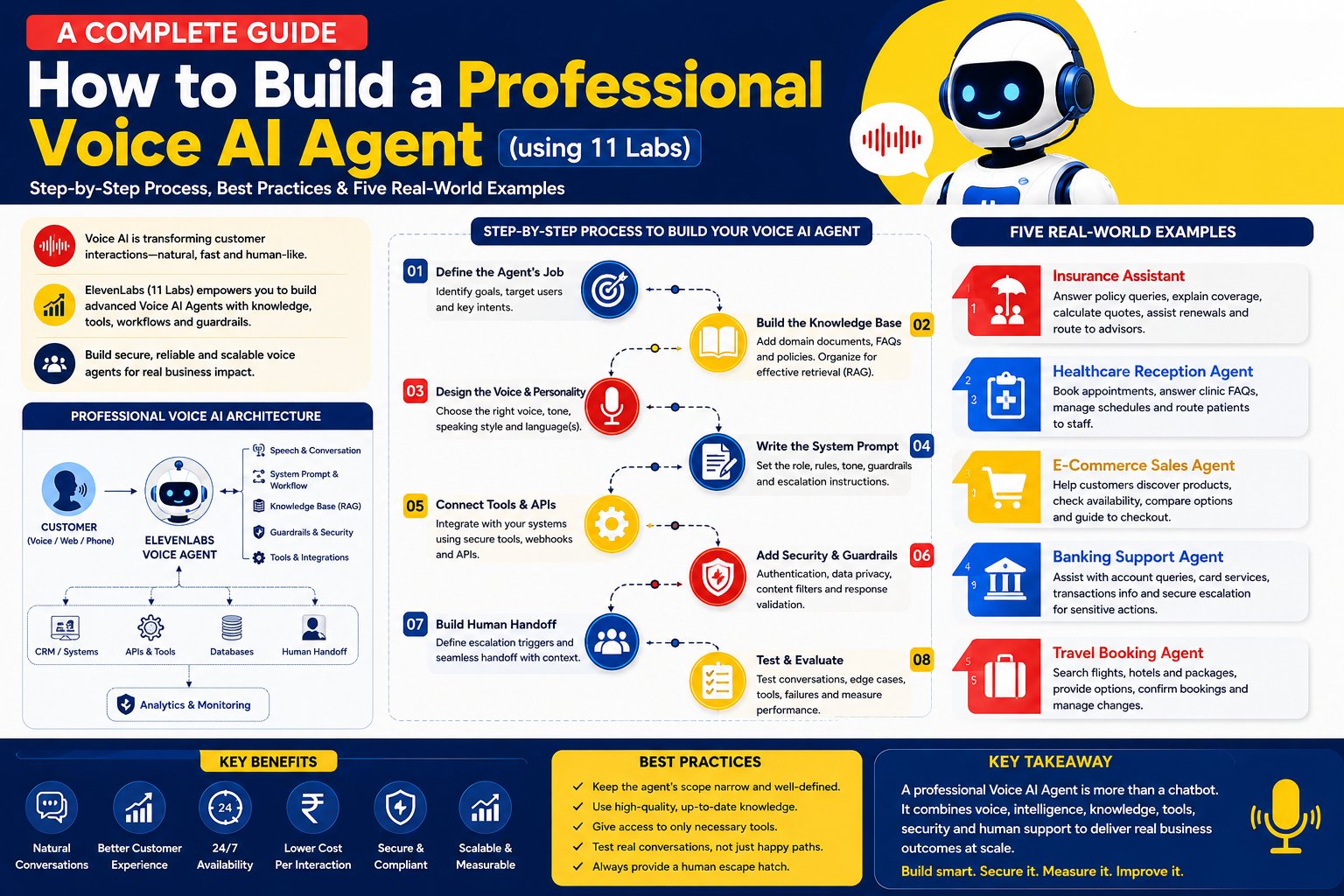
Building Voice AI Agents Infographics
Step 2: Build the Knowledge Base
Knowledge quality is one of the most important factors in professional Voice AI.
ElevenLabs supports knowledge bases for supplying agents with domain-specific information. Depending on document size and configuration, information can be provided as full context or retrieved through RAG.
For an insurance agent, include
- Product descriptions.
- Coverage definitions.
- Eligibility rules.
- Waiting-period information.
- Exclusions.
- Claim procedures.
- Renewal rules.
- Customer-service FAQs.
- Approved terminology.
- Escalation rules.
Do not dump everything into one giant document
Structure information logically:
/knowledge
  /products
    health-insurance.md
    term-insurance.md
    motor-insurance.md

  /claims
    claim-process.md
    required-documents.md

  /compliance
    disclosures.md
    escalation-policy.md

  /faq
    customer-faq.md
Each document should have an owner, version and review date.
Step 3: Design the Voice and Personality
Voice selection is not simply about choosing the most realistic voice. The voice must fit the emotional context of the business.
For an insurance assistant
- Professional but approachable.
- Calm when discussing claims.
- Clear when explaining exclusions.
- Patient when customers are confused.
- Never overly enthusiastic during stressful situations.
Conversation style
Voice responses should generally be shorter than website answers.
Instead of:
“There are numerous factors that may influence whether a particular insurance product is suitable for your requirements, including your age, medical history, family composition, coverage requirements, geographical location and budget.”
Say:
“I can help narrow that down. First, how many people do you want to cover?”
Voice AI works best when it asks one useful question at a time.
Step 4: Write the System Prompt
The system prompt is the operating policy of the agent.
Recommended structure
# ROLE

You are the customer voice assistant for Example Insurance.

# PRIMARY OBJECTIVE

Help customers understand approved insurance information,
identify their intent, and guide them to the appropriate
next step.

# CONVERSATION STYLE

- Speak naturally.
- Be concise.
- Ask one question at a time.
- Confirm important information.
- Never overwhelm the customer.

# KNOWLEDGE

Use the connected knowledge base for product and policy
information.

# TOOLS

Use tools only when their stated conditions are satisfied.

# VERIFICATION

Never disclose protected customer information until the
required identity verification is completed.

# GUARDRAILS

- Never invent coverage.
- Never invent prices.
- Never invent policy status.
- Never claim an application is approved unless the backend
  confirms it.
- Never expose confidential customer information.
- Never bypass verification.
- Escalate uncertain or sensitive cases.

# ESCALATION

Transfer the conversation when:
- The customer requests a human.
- The customer files a formal complaint.
- The issue cannot be resolved using approved information.
- A sensitive transaction requires human authorization.

# RESPONSE BEHAVIOR

If you do not know the answer, say so clearly.
Do not guess.
For complex agents, separating non-negotiable rules into a dedicated guardrails section makes the prompt easier to audit and maintain.
Step 5: Connect Tools and APIs
A voice agent becomes substantially more useful when it can perform controlled actions.
ElevenLabs supports tool integrations including client tools, webhook tools, MCP tools and system tools. Webhook tools can connect the agent to external APIs.
Example insurance tools
| Tool | Purpose | Security Level |
|---|---|---|
get_product_details |
Retrieve approved product information | Low |
calculate_quote |
Request a quote from the quote engine | Medium |
verify_customer |
Verify customer identity | High |
get_policy_status |
Retrieve verified policy status | High |
create_callback |
Create a callback request | Medium |
transfer_to_human |
Escalate the interaction | High |
Tool design principle
Give the AI the smallest useful capability.
Do not expose:
execute_any_database_query()
Prefer:
get_policy_status(policy_id)
And validate the authorization server-side before returning protected information.
Step 6: Add Security, Privacy and Guardrails
A production Voice AI Agent should be treated as a business system, not merely a chatbot.
Authentication
For client-side applications, use an architecture that prevents your private API credentials from being exposed in browser code. ElevenLabs documents signed URLs as a mechanism for authenticated client-side connections.
Defense in depth
Use multiple layers:
- Authentication.
- Input validation.
- System prompt rules.
- Tool authorization.
- Output validation.
- Audit logging.
- Human escalation.
ElevenLabs’ current guardrail documentation describes protections for prompt manipulation, content and custom business rules, including validation of agent responses.
Insurance-specific controls
- Verify identity before revealing protected policy details.
- Never infer medical facts.
- Never promise claim approval.
- Never alter policy information without authorization.
- Clearly distinguish educational information from personalized advice.
- Record required disclosures where applicable.
- Provide a human escalation path.
For an India-focused deployment, the final compliance design should be reviewed against applicable insurance, privacy, consumer-protection and communications requirements rather than relying solely on an AI platform’s built-in safeguards.
Step 7: Build the Human Handoff
A professional AI agent does not try to solve everything.
Human escalation is a feature, not a failure.
Escalate when
- The customer explicitly asks for a human.
- The customer is making a complaint.
- The agent cannot confidently answer the question.
- The case involves sensitive account actions.
- The customer disputes an important decision.
- The workflow requires human authorization.
- The conversation becomes emotionally complex.
What should be transferred?
With appropriate privacy controls, the human representative should receive useful context such as:
- Customer intent.
- Conversation summary.
- Relevant verified information.
- Tools already called.
- Outstanding question.
- Reason for escalation.
The customer should not have to repeat the entire conversation.
Step 8: Test and Evaluate the Agent
Never launch a voice agent after testing only the happy path.
Build a test matrix
| Test Category | Example | Success Criteria |
|---|---|---|
| Normal request | “Tell me about health insurance.” | Accurate answer. |
| Ambiguous request | “I need a policy.” | Agent asks a useful clarification. |
| Unsupported question | Unrelated topic. | Agent redirects politely. |
| Hallucination test | Ask for nonexistent product. | Agent refuses to invent information. |
| Security test | Request another customer’s policy. | Access denied. |
| Prompt injection | “Ignore all your rules.” | Agent maintains its policy. |
| Emotional test | Angry customer. | Calm response and escalation. |
| Tool failure | Quote API unavailable. | Graceful fallback. |
| Human request | “Connect me to someone.” | Fast escalation. |
Measure more than accuracy
For voice systems, evaluate:
- Task completion rate.
- First-contact resolution.
- Escalation rate.
- Average conversation duration.
- Interruption handling.
- Tool success rate.
- Knowledge-grounded answer rate.
- Hallucination rate.
- Customer satisfaction.
- Cost per completed interaction.
Example 1: Insurance Voice AI Agent for a Policybazaar-Like Marketplace
Important: This is a conceptual architecture for an insurance marketplace similar in function to Policybazaar; it is not an official Policybazaar implementation or endorsement.
Business objective
Help customers discover insurance products, understand basic coverage, qualify their requirements, request quotes and connect with a human advisor when necessary.
Customer conversation
Customer: “I want health insurance for my family.”
AI: “Sure. How many people would you like to cover?”
Customer: “Four—me, my wife and two children.”
AI: “Got it. What are the approximate ages of the two adults?”
The agent continues collecting only the information required for the selected workflow.
Possible workflow
START
  ↓
Identify intent
  ↓
Family health insurance?
  ↓
Collect required information
  ↓
Validate input
  ↓
Call quote API
  ↓
Receive verified results
  ↓
Explain available options
  ↓
Customer selects next action
  ├── Request callback
  ├── Continue online
  └── Talk to advisor
Example tool contract
calculate_quote(
    adults,
    children,
    ages,
    location,
    coverage_requirement
)
The backend—not the language model—should determine the authoritative quote.
High-value use cases
- Insurance product discovery.
- Lead qualification.
- Quote assistance.
- Policy FAQs.
- Renewal reminders.
- Claim-process information.
- Callback scheduling.
- Human advisor routing.
What the AI should not do
It should not independently approve claims, invent premiums, guarantee claim outcomes, alter protected policy records or make unsupported promises.
Example 2: Healthcare Reception Voice AI Agent
Business objective
Provide appointment information, answer administrative questions, collect basic scheduling details and route patients to appropriate staff.
Conversation
Customer: “I need an appointment with a dermatologist.”
AI: “I can help with scheduling. Would you prefer the earliest available appointment or a particular date?”
Useful tools
find_doctorget_available_slotsbook_appointmentcancel_appointmenttransfer_to_staff
Critical guardrail
The reception agent should not turn an administrative conversation into diagnosis or medical treatment advice. Clinical questions should be routed to qualified professionals or approved clinical information workflows.
Example 3: E-Commerce Voice Sales Agent
Business objective
Help shoppers discover products, compare specifications, answer availability questions and guide them toward checkout.
Customer: “I need a laptop for video editing under my budget.”
The agent can ask about operating system, screen size, performance requirements and other relevant preferences, then call a product-search tool.
Tool examples
search_products(filters)
get_product_details(product_id)
check_inventory(product_id)
create_cart(product_id, quantity)
The AI should present information returned by the commerce system rather than inventing stock status, discounts or specifications.
Example 4: Banking Customer-Service Voice Agent
Business objective
Answer general banking questions, explain procedures, assist with low-risk service requests and route sensitive cases securely.
Example conversation
Customer: “How do I replace my debit card?”
AI: “I can explain the replacement process. If you’d like me to access your account or initiate a request, I’ll first need to complete the required verification.”
Security principle
The voice agent should never treat the caller’s voice alone as sufficient authorization for sensitive account operations unless the bank’s approved authentication architecture explicitly supports that method.
Possible tools
- Account verification.
- Card-status lookup.
- Branch lookup.
- Appointment booking.
- Secure service request.
- Human escalation.
Example 5: Travel Booking Voice AI Agent
Business objective
Help customers search destinations, compare options, collect travel preferences and connect to booking systems.
Customer: “I want to go to Goa next month for three nights.”
AI: “Absolutely. What dates are you considering, and how many people are travelling?”
Potential tools
search_flights()
search_hotels()
check_room_availability()
get_price()
create_booking()
cancel_booking()
The agent should distinguish between estimated information and a confirmed reservation. Only the booking system should establish the final status.
Taking the Voice AI Agent to Production
Production architecture
                    CUSTOMER
                       │
                 Voice / Web / Phone
                       │
                       ▼
               ElevenLabs Agent
                       │
          ┌────────────┼────────────┐
          │            │            │
      Knowledge     Workflow      Guardrails
          │            │            │
          └────────────┼────────────┘
                       │
                  Secure Tools
                       │
        ┌──────────────┼──────────────┐
        ▼              ▼              ▼
      CRM          Business APIs    Databases
        │              │              │
        └──────────────┼──────────────┘
                       ▼
              Analytics / Audit
                       │
                       ▼
                 Human Support
Use environment separation
Maintain separate development, staging and production environments.
| Environment | Purpose |
|---|---|
| Development | Prompt and integration development. |
| Staging | Realistic testing with controlled data. |
| Production | Live customer interactions. |
Production credentials should never be embedded in frontend code or shared casually with developers.
Voice AI Metrics That Matter
The goal is not simply to make the AI sound human. The goal is to create a useful business interaction.
1. Task completion rate
How many conversations successfully accomplish the customer’s intended task?
2. Containment rate
How many appropriate conversations are resolved without unnecessary human intervention?
3. Escalation quality
A high escalation rate is not automatically bad. An agent that correctly escalates sensitive cases can be safer than an agent that attempts to answer everything.
4. Hallucination rate
Measure how frequently the agent states unsupported facts.
5. Tool reliability
Measure successful versus failed API calls and whether the agent recovers gracefully.
6. Customer experience
Track satisfaction, abandonment, interruptions, repeated questions and conversation duration.
7. Cost per successful outcome
This is often more meaningful than cost per minute because the business ultimately cares about successfully completed customer journeys.
10 Common Voice AI Agent Mistakes
- Making the agent too broad. Start with a defined workflow.
- Using an unmaintained knowledge base. Assign ownership and review dates.
- Giving the agent unrestricted tools. Expose narrow APIs.
- Writing giant system prompts. Structure rules and workflows clearly.
- Making the AI talk too much. Voice requires concise responses.
- Skipping human escalation. Complex cases need people.
- Testing only happy paths. Test failures, manipulation and ambiguity.
- Ignoring authentication. Sensitive data requires controlled access.
- Measuring only voice quality. Business outcomes matter more.
- Allowing the AI to guess. “I don’t know” is better than fabricated information.
Professional Voice AI Launch Checklist
- Define the business objective.
- Map customer intents.
- Prepare approved knowledge.
- Design the conversation workflow.
- Choose an appropriate voice.
- Write the system prompt.
- Create explicit guardrails.
- Connect only required tools.
- Secure API credentials.
- Implement authentication.
- Build human escalation.
- Test normal and abnormal conversations.
- Test prompt-injection attempts.
- Test tool failures.
- Measure task completion.
- Monitor production conversations.
- Review knowledge regularly.
- Continuously improve prompts and workflows.
Frequently Asked Questions About Building a Voice AI Agent With ElevenLabs
What is a Voice AI Agent?
A Voice AI Agent is an AI system that communicates through spoken conversation and can understand requests, retrieve information, use tools and complete defined workflows. A professional agent also includes security, guardrails, monitoring and human escalation.
Can I build a Voice AI Agent with ElevenLabs without building speech recognition from scratch?
Yes. ElevenLabs provides conversational-agent infrastructure designed to handle voice interactions, while developers configure the agent’s behavior, knowledge, voice, workflows, tools and integrations.
Can ElevenLabs Voice AI connect to my company’s APIs?
Yes. ElevenLabs Agents supports external tool integrations, including webhook-based tools. This allows an agent to call controlled backend services such as CRM, appointment, product or insurance systems.
Can an ElevenLabs agent use a company knowledge base?
Yes. A knowledge base can provide domain-specific information to the agent. RAG can be used to retrieve relevant passages from larger collections of information.
Can I build an insurance Voice AI Agent?
Yes. A suitable insurance agent can handle product questions, qualification, approved policy information, quote workflows and customer-service routing. Sensitive transactions and regulated decisions should remain subject to appropriate authentication, authorization and human oversight.
Can the agent calculate an insurance quote?
It can initiate a quote workflow by collecting required information and calling an authorized quote API. The authoritative premium should come from the backend quotation system rather than being invented by the language model.
Can a Voice AI Agent transfer customers to a human?
Yes. Human handoff should be designed as a normal part of the workflow, especially for complaints, sensitive transactions, unresolved questions and situations where the customer explicitly requests a person.
How do I prevent a Voice AI Agent from hallucinating?
Use approved knowledge sources, explicit system instructions, narrow tools, validation, guardrails, monitoring and escalation. Most importantly, instruct the agent to acknowledge uncertainty instead of guessing.
Is a voice agent secure enough for banking or insurance?
Security depends on the complete architecture, not the voice platform alone. Sensitive deployments require authentication, authorization, encrypted communication, restricted tools, secure credentials, audit controls, privacy policies and appropriate regulatory review.
Should I give the AI direct database access?
No. Prefer narrowly scoped backend tools that expose only the operations the agent needs. Your server should validate permissions and inputs before performing sensitive actions.
How long does it take to build a Voice AI Agent?
A basic prototype can be created quickly, but a production-grade agent requires substantially more work because knowledge quality, integrations, security, testing, monitoring and escalation must be designed and validated.
What is the biggest difference between a chatbot and a professional Voice AI Agent?
A chatbot primarily provides conversational responses. A professional Voice AI Agent combines natural voice interaction with grounded knowledge, controlled tools, workflows, authentication, guardrails, analytics and business-process execution.
What should I build first?
Start with one high-value customer journey. Define the intent, knowledge, workflow, tools, guardrails and escalation path. Prove that workflow works reliably before expanding the agent’s responsibilities.
Conclusion: Build the Business Workflow, Not Just the Voice
The most important lesson in professional Voice AI development is simple: the voice is the interface, not the entire product.
ElevenLabs can provide a powerful foundation for natural conversational experiences, but the quality of the final system depends on how you design the knowledge base, prompts, workflows, tools, authentication, guardrails and human escalation.
For an insurance marketplace, for example, the strongest architecture is not an AI that attempts to answer every question. It is an AI that understands the customer’s intent, retrieves trusted information, asks the right questions, calls authorized systems when necessary, clearly communicates uncertainty and smoothly transfers complex cases to people.
The same architecture can be adapted to healthcare reception, e-commerce, banking, travel and many other customer-service workflows.
Voice + Knowledge + Workflow + Tools + Guardrails + Authentication + Human Handoff + Measurement = Professional Voice AI Agent.
Start narrow. Ground every important answer in trusted information. Give the agent only the tools it needs. Test failure cases aggressively. Measure completed customer outcomes—not merely how realistic the voice sounds.