
Abstract
Quantum computing in 2026 is moving beyond the race for raw qubit counts. The decisive advances are now appearing in verifiable quantum advantage, logical computation, adaptive quantum error correction, high-fidelity semiconductor qubits, scalable neutral-atom and trapped-ion architectures, quantum-control software, and the engineering required to assemble fault-tolerant machines. The field is beginning to shift from isolated laboratory demonstrations toward complete computational systems.
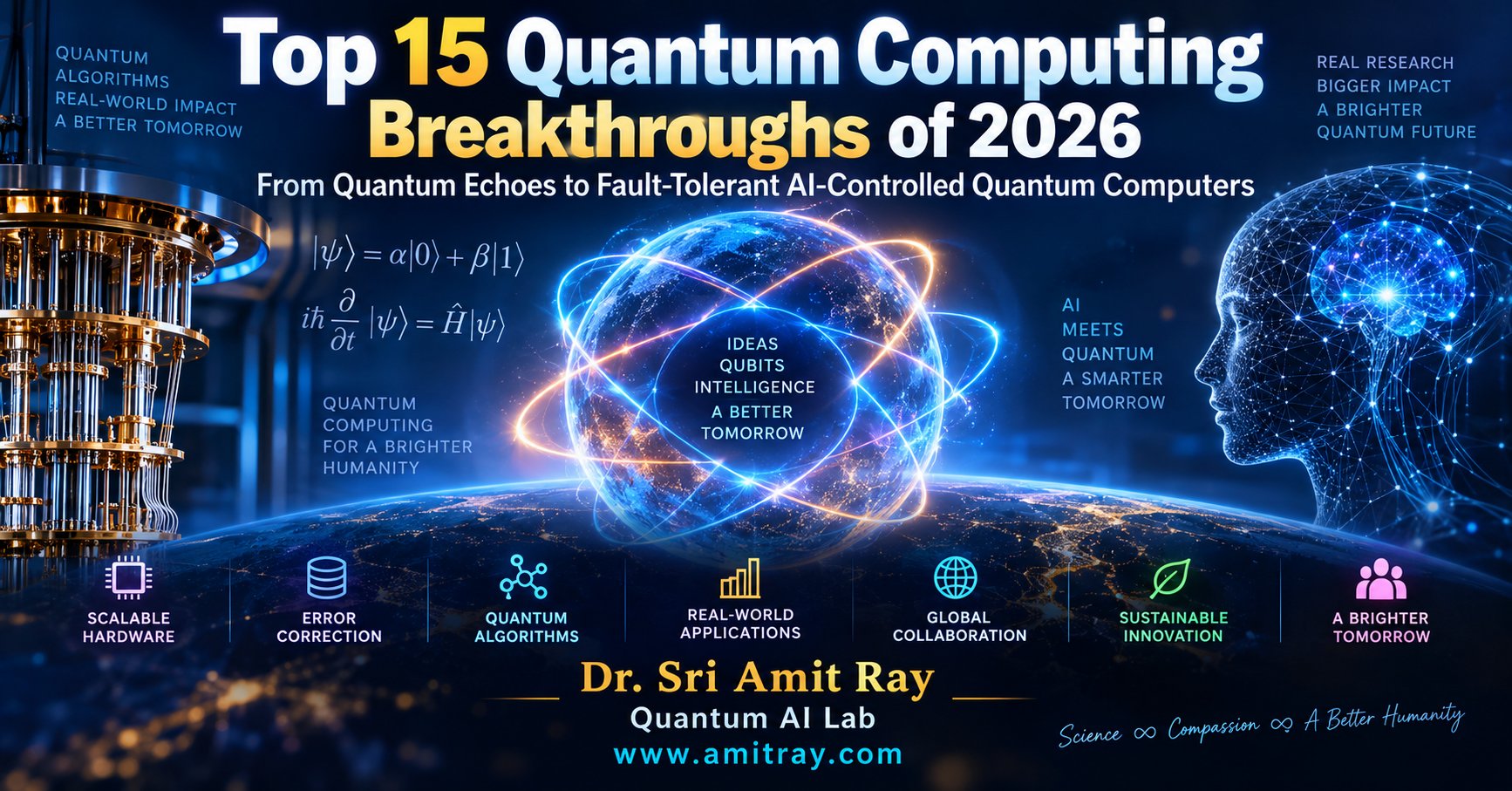
This article reviewed the 15 of the most consequential quantum-computing breakthroughs shaping the field as of September 11, 2026. It separates peer-reviewed demonstrations from company-reported experiments and future roadmaps. That distinction matters: a verified laboratory result, a preprint-scale benchmark, an engineering milestone, and a 2030 target are scientifically different categories and should not be presented as interchangeable achievements.
Top Quantum Computing Breakthroughs of 2026 at a Glance
| # | Breakthrough | Organization / Platform | Category | Why It Matters |
|---|---|---|---|---|
| 1 | Quantum Echoes and verifiable quantum advantage | Google Quantum AI / Willow | Algorithm + advantage | A beyond-classical computation designed to be independently checkable. |
| 2 | Reinforcement-learning control of QEC | Google Quantum AI / Willow | AI + QEC | Quantum hardware learns from error syndromes and adapts controls during computation. |
| 3 | Trusted quantum advantage with 70 logical qubits | IBM + University of Chicago | Logical computing | Combines classically hard sampling with built-in fidelity verification. |
| 4 | Helix fault-tolerant architecture | Quantinuum / Helios | Fault tolerance | Integrates logical memory, computation and entanglement across QEC codes. |
| 5 | Unconditional complement-sampling violation | Quantinuum H2 | Quantum advantage | Offers efficiently verifiable quantum–classical separation without relying on an unproved hardness assumption. |
| 6 | Trusted quantum materials simulation | IBM + Qedma | Simulation | Explores long-lived dynamics up to 74 qubits where leading classical methods cease to agree reliably. |
| 7 | >99% two-qubit fidelity in silicon CMOS quantum dots | Diraq | Hardware | Links high-fidelity gates with a semiconductor-manufacturing path. |
| 8 | 100-qubit QFT and reported 3,000× materials workflow speedup | Q-CTRL + IBM hardware | Control + algorithms | Shows how compilation and error suppression can extract more useful computation from current processors. |
| 9 | Fault-tolerant neutral-atom architecture | Harvard/MIT/QuEra ecosystem | Neutral atoms | Combines repeated QEC, logical gates, lattice surgery and universal-operation primitives. |
| 10 | Logical qubits with erasure conversion | Princeton-led team | QEC | Transforms some unknown errors into detectable erasures that are easier to correct. |
| 11 | Measurement-free universal logical computation | Innsbruck/Aachen/Jülich/AQT | Trapped ions | Reduces reliance on slow and difficult mid-circuit measurements. |
| 12 | Error correction inside one atomic ion | MIT/Lincoln Laboratory collaborators | Qudit / QEC | Uses internal states of one ion to encode and autonomously protect a logical qubit. |
| 13 | Transversal STAR architecture | QuEra + Los Alamos | Architecture | Targets sharply lower time and physical-qubit overhead for early fault-tolerant simulation. |
| 14 | Connected modular cryogenic quantum systems | IBM | Systems engineering | Addresses the physical infrastructure needed to link large numbers of quantum chips. |
| 15 | Million-qubit-class optical FTQC program | NTT + OptQC | Optical roadmap | Develops a wavelength-multiplexed path toward large optical fault-tolerant systems. |
What Counts as a Real Quantum Computing Breakthrough?
The phrase quantum breakthrough is often used too loosely. A meaningful result should improve at least one of the quantities that ultimately determine useful quantum computation: computational advantage, verifiability, logical error rate, gate fidelity, algorithmic depth, physical-qubit efficiency, logical-qubit quality, decoding performance, manufacturability or system scalability.
where \(A\) denotes computational advantage, \(V\) verifiability, \(F\) physical-operation fidelity, \(L\) logical performance, \(E\) error-correction efficiency, \(S\) system scalability and \(M\) manufacturability. No single qubit-count number captures these dimensions.
This is why the 2026 landscape should be interpreted as a transition:
1. Google Quantum Echoes: Verifiable Quantum Advantage on Willow
Demonstrated / Nature-linked result
Google Quantum AI's Quantum Echoes result is one of the most important recent algorithmic milestones because it shifts the discussion from simply generating quantum states that are difficult to simulate toward a computation whose result can be meaningfully checked. Announced in October 2025 and central to the 2026 landscape, the experiment ran an out-of-time-order correlator, or OTOC, on Google's superconducting Willow processor.
Google reported that the targeted computation was approximately 13,000 times faster than the best identified classical approach for the benchmark. The importance is not that every quantum task is now 13,000 times faster. The claim applies to this particular algorithm, hardware configuration and classical comparison.
An OTOC probes how a local perturbation spreads through a quantum many-body system. Conceptually, the system evolves forward, receives a controlled perturbation, is partially time-reversed, and produces an interference-like echo. Because the structure of the result can be reproduced and compared, Quantum Echoes represents a more useful model of quantum advantage than an opaque one-off sampling claim.
Why it matters: verifiability is becoming as important as raw speed. A useful quantum computer must eventually produce answers that scientists, engineers and institutions can trust.
Primary source: Google Quantum AI — Quantum Echoes.
2. AI-Controlled Quantum Error Correction: A Quantum Computer That Learns From Its Errors
Peer-reviewed — Nature, July 2026
Perhaps the most conceptually important 2026 development is the integration of reinforcement learning directly into quantum error correction. A Nature study from Google Quantum AI demonstrated a system in which error-detection events generated by QEC are repurposed as a learning signal. The AI agent continuously adjusts control parameters while the quantum computation is running.
Traditional calibration creates a serious scaling problem. Quantum processors drift with temperature, electronics, crosstalk and other environmental effects. Recalibrating a machine by stopping the computation is incompatible with future algorithms that may need to run for hours or days.
Here \(s_t\) represents the error-syndrome and control state, \(\pi_\theta\) the learned control policy, \(a_t\) the calibration action and \(r_t\) a reward linked to improved logical stability.
On Willow, the researchers reported a 3.5-fold improvement in logical stability against injected drift. Their distance-7 surface code reached an average logical error per cycle of approximately \(7.72\times 10^{-4}\), while a distance-5 colour code reached approximately \(8.19\times 10^{-3}\).
Primary source: Nature — Reinforcement learning control of quantum error correction.
3. IBM and University of Chicago: Trusted Quantum Advantage With 70 Logical Qubits
Research demonstration — July 2026
IBM and University of Chicago researchers reported a major logical-computing milestone using a new encoded-circuit construction to demonstrate a classically hard sampling task while also providing evidence that the quantum computation had maintained sufficiently high fidelity.
The experiment encoded 70 logical qubits and used a framework described as doped Clifford sampling together with spacetime-code techniques. IBM reported that the target computation completed in roughly 15 minutes and that leading classical approaches would require infeasible resources for the same task.
The deeper contribution is the combination:
Quantum advantage becomes far more scientifically useful when the experiment does not merely outrun classical simulation but also contains a mechanism for establishing trust in the output.
Primary source: IBM — Trusted quantum computation on logical circuits.
4. Quantinuum Helix: Fault Tolerance Becomes a Complete Architecture
Experimentally validated architecture — September 2026
On September 8, 2026, Quantinuum introduced Helix, a quantum-error-correction architecture experimentally validated on its trapped-ion Helios system. The reported demonstrations combine logical memory, logical computation and logical entanglement across different QEC codes, with logical-level results outperforming the corresponding physical implementations without post-selection.
This is important because fault tolerance is not merely a matter of discovering a good code. A usable machine must orchestrate several interacting functions:
Helix is designed to exploit the reconfigurable connectivity of trapped ions and heterogeneous encodings so that different codes can be used for different roles.
Primary source: Quantinuum — Helix fault-tolerant architecture.
5. Quantinuum's Complement-Sampling Experiment: Provable Quantum–Classical Separation
Peer-reviewed — Nature Communications, September 2026
A separate Quantinuum-led result attacks a long-standing weakness in quantum-advantage experiments: many claims rely on a computational-hardness assumption that has not been mathematically proved. The complement-sampling game instead creates a quantum-versus-classical separation that can be bounded directly.
The Nature Communications experiment ran thousands of circuits on Quantinuum H2 trapped-ion processors with up to 55 qubits. For a Bernstein–Vazirani-inspired problem family, the authors demonstrated an exponentially increasing violation of the best classical bound without depending on an unproved complexity assumption.
This is an important direction for the field: a future quantum advantage claim should ideally be not only large, but also provable, efficiently verifiable and reproducible.
Primary source: Nature Communications — Unconditional and exponentially large violation of classicality.
6. IBM + Qedma: Trusted Quantum Simulation Beyond Consistent Classical Answers
Research demonstration — July 2026
IBM and Qedma reported a quantum-simulation result focused on complex materials physics rather than an abstract sampling benchmark. Using Qedma's QESEM error-reduction software on IBM quantum processors, the researchers investigated long-lived quantum dynamics in systems of up to 74 qubits.
The significance lies in the validation methodology. At the relevant regimes, multiple state-of-the-art classical techniques ceased to give mutually consistent, reliable predictions. The researchers therefore emphasized trusted quantum computation: validate the computation where classical calculation is still possible, characterize the error-reduction process, then extrapolate into the regime where exact classical verification breaks down.
Instead, trust can emerge from calibrated error models, cross-method consistency, controlled scaling tests and internal checks embedded in the computation.
Primary source: IBM + Qedma — Quantum materials simulation.
7. Diraq: Above-99% Two-Qubit Gates in Silicon CMOS Quantum Dots
Experimental hardware milestone — August 2026
Diraq reported consistent and repeatable above-99% two-qubit gate fidelity in its silicon metal-oxide-semiconductor quantum-dot platform. The technical significance is the combination of fidelity with a hardware approach intended to remain compatible with industrial semiconductor manufacturing.
Earlier in 2026, Diraq also reported 99.9% single-qubit control fidelity in a device manufactured by imec using industry-standard CMOS materials on a 300-mm silicon wafer.
This matters because a quantum architecture ultimately needs millions of repeatable components, not a few hand-selected laboratory devices. Silicon spin qubits offer a compelling possibility: use semiconductor fabrication knowledge accumulated over decades to manufacture quantum processors at scale.
Primary source: Diraq — Above-99% two-qubit gate fidelity.
8. Q-CTRL: 100-Qubit Quantum Fourier Transform and Practical Quantum-Advantage Claims
Company-reported experiments / technical manuscript
Q-CTRL represents a different route to quantum progress: improve what existing processors can do through device-aware compilation, error suppression and quantum-control software.
100-qubit Quantum Fourier Transform
In August 2026, Q-CTRL reported execution of a 100-qubit Quantum Fourier Transform on IBM quantum hardware. Its convolutional compilation approach targeted the routing overhead that normally makes large QFT circuits collapse under accumulated errors. The reported compiled circuit used \(n^2-n+2\) CX gates on the IBM Heron architecture, close to the \(n^2-n\) two-qubit-gate scaling of an idealized all-to-all-connected implementation.
The QFT is a foundational primitive behind phase estimation and Shor-type algorithms. Demonstrating it at larger scale does not mean Shor's algorithm can now factor cryptographically relevant integers, but it tests whether an important subroutine can survive realistic hardware noise and connectivity restrictions.
Reported 3,000× materials-simulation speedup
In May 2026, Q-CTRL also reported evidence of practical quantum advantage for a materials-science workflow, describing a reduction from more than 100 hours using the stated classical comparison to around two minutes using IBM quantum hardware plus Q-CTRL's performance-management software.
Sources: Q-CTRL — 100-qubit QFT; Q-CTRL — materials benchmark.
9. Neutral Atoms: A Universal Fault-Tolerant Architecture Takes Shape
Peer-reviewed — Nature, November 2025; major 2026 foundation
Neutral-atom quantum computing entered 2026 with one of the strongest demonstrations of a complete fault-tolerant architecture. Researchers used reconfigurable arrays of up to 448 neutral atoms to combine repeated quantum error correction, logical entanglement, transversal gates, lattice surgery and teleportation-based mechanisms required for universal computation.
The study reported a four-round surface-code experiment with approximately 2.14× below-threshold performance, aided by atom-loss detection and machine-learning decoding.
Neutral atoms have a distinctive architectural advantage: optical tweezers can rearrange physical qubits. Connectivity can therefore become partially programmable rather than being frozen into the geometry of a fabricated chip.
Primary source: Nature — A fault-tolerant neutral-atom architecture for universal quantum computation.
10. Logical Qubits With Erasure Conversion
Peer-reviewed — Nature Physics, June 2026
A Princeton-led team demonstrated logical qubits using metastable ytterbium-171 neutral atoms and an approach that deliberately converts important physical faults into detectable erasure errors.
The distinction is fundamental. In an ordinary unknown error, the decoder must infer both what went wrong and where it happened. In an erasure channel, the location of the damaged qubit is known.
The experiment included a \([[4,2,2]]\) logical encoding, adaptive use of erasure information and teleportation of logical qubits between code blocks. If erasure-biased architectures scale successfully, they could reduce the overhead required for practical QEC.
Primary source: Nature Physics — Logical qubits with erasure conversion using metastable neutral atoms.
11. Measurement-Free Universal Fault-Tolerant Logical Computation
Peer-reviewed — Nature Communications, 2026
Many QEC architectures require repeated mid-circuit measurements followed by classical feed-forward decisions. That process can be slow, difficult to engineer and itself error-prone. Researchers from Innsbruck, Aachen, Forschungszentrum Jülich and AQT demonstrated a universal logical toolbox on a trapped-ion processor that avoids mid-circuit measurements during algorithm execution.
The team implemented logical state teleportation, a universal fault-tolerant gate set on an eight-qubit error-detecting code containing three logical qubits, and a fault-tolerant version of Grover's search algorithm.
The result suggests that coherent operations can replace some measurement-and-feedback steps, which may simplify particular fault-tolerant architectures.
Primary source: Nature Communications — Demonstration of measurement-free universal logical quantum computation.
12. Quantum Error Correction Inside a Single Atomic Ion
Peer-reviewed — Nature Physics, July 2026
Traditional QEC spreads one logical qubit across many physical qubits. A 2026 experiment demonstrated a complementary idea: encode and protect a logical qubit using multiple internal quantum states of a single trapped ion.
The experiment used spin-cat logical states and an autonomous correction scheme without ancilla mid-circuit measurement. The researchers reported error reduction by up to 2.2× and a lifetime extension of up to 1.5× relative to an unencoded qubit.
This does not replace large multi-qubit codes. It opens the possibility of hierarchical protection: first protect information within a richer physical system, then use those protected units inside larger logical codes.
Primary source: Nature Physics — Error correction of a logical qubit encoded in a single atomic ion.
13. QuEra + Los Alamos: Transversal STAR Targets Lower Fault-Tolerant Overhead
Architecture / resource-estimation result — PRX Quantum, 2026
A major obstacle to useful fault-tolerant computing is not simply error correction itself but its enormous overhead. A logical algorithm may require orders of magnitude more physical operations than the ideal circuit.
QuEra and Los Alamos National Laboratory developed Transversal STAR — Space-Time Efficient Analog Rotation — as a neutral-atom architecture designed for structured quantum-simulation workloads. Their hardware-informed analysis reported scenarios with execution up to approximately 250× faster and roughly 2× fewer physical qubits than the specific conventional fault-tolerant approaches used as comparison baselines.
Reducing either side matters; reducing both is especially important. The result should, however, be understood as an architecture and resource-estimation advance rather than a completed megaquop-scale machine.
Primary source: QuEra — Transversal STAR.
14. IBM Connects Modular Cryogenic Systems for Future Large-Scale Quantum Computers
Systems-engineering milestone — August 2026
Quantum scaling eventually becomes a mechanical, thermal, wiring and systems-engineering problem. IBM announced in August 2026 that it had joined and cooled two modular cryogenic systems into a single environment designed eventually to interconnect large numbers of quantum chips.
The modules were cooled below 15 millikelvin. IBM says the box-shaped architecture provides substantially more wiring capacity than its conventional systems and is designed to support chip-to-chip links using its L-coupler technology.
This development should not be confused with a completed fault-tolerant quantum computer. IBM's Starling system remains a 2029 roadmap target. The 2026 achievement is the modular cryogenic infrastructure itself.
Primary source: IBM — Modular cryogenic quantum systems.
15. NTT + OptQC: Toward a Million-Qubit-Class Optical Fault-Tolerant Quantum Computer
Roadmap + active joint R&D — August 2026
NTT and OptQC strengthened their collaboration in August 2026 through a capital and business alliance aimed at developing a fault-tolerant, one-million-qubit-class optical quantum computer by fiscal year 2030.
The roadmap emphasizes wavelength-division multiplexing, optical quantum-computer architecture, key component technologies and hybrid integration with classical computing. The companies aim to complete one-million-qubit-class architecture and core component design by fiscal year 2027, target a practical 10,000-qubit-class optical system around that period, begin proof-of-concept activities in fiscal year 2028, and pursue a fault-tolerant million-qubit-class machine by fiscal year 2030.
The attraction of photonic quantum computing is clear: photons move easily, can be multiplexed in frequency and space, integrate naturally with communication infrastructure, and do not require every computational element to sit inside the same dilution refrigerator.
Primary source: NTT + OptQC — Optical quantum-computing alliance.
The Six Research Frontiers Now Defining Quantum Computing
1. Verifiable Quantum Advantage
Quantum Echoes, IBM's trusted-computation work and complement sampling all point in the same direction. The next era of quantum advantage cannot depend only on the statement that a classical computer appears unable to reproduce an answer. Researchers increasingly need verification mechanisms, provable bounds, cross-checks and trustworthy error models.
2. Logical Computation Is Replacing Raw Physical-Qubit Counts
A processor with thousands of noisy physical qubits may be less scientifically useful than a smaller system capable of high-quality logical operations. The decisive performance metric is increasingly the reliability and cost of computation after encoding.
For a below-threshold code, the logical error probability \(p_L\) should fall as the code distance \(d\) increases, provided the physical error \(p\) remains below the threshold \(p_{\mathrm{th}}\).
3. AI Is Entering the Quantum Control Loop
Machine learning is already used for decoding, calibration and pulse optimization. Google's reinforcement-learning QEC result pushes the idea further: future quantum computers may continuously learn from syndrome data, detect drift and alter controls while algorithms are executing.
4. Hardware Modalities Are Diverging Rather Than Converging
There is still no single established equivalent of the classical silicon transistor. Superconducting circuits, trapped ions, neutral atoms, silicon spins and photonic systems each optimize different properties.
| Platform | Primary Strength | Central Scaling Challenge |
|---|---|---|
| Superconducting | Fast gates; advanced fabrication and control | Cryogenics, wiring, coherence and modular scaling |
| Trapped ions | High fidelity and flexible connectivity | Operation speed and very-large-system engineering |
| Neutral atoms | Large reconfigurable arrays and parallelism | Gate fidelity, loss management and control complexity |
| Silicon spin qubits | Density and semiconductor manufacturability | Uniformity, cryogenic control and large-array integration |
| Photonics / optical | Networking and multiplexing | Loss, deterministic operations and resource overhead |
5. Software Can Change the Effective Power of Hardware
Q-CTRL, Qedma and modern quantum compilers illustrate an important shift. Quantum capability is not simply a processor specification. Compilation, pulse shaping, error suppression, decoding, circuit restructuring and classical co-processing can radically change how much useful work the same physical machine can perform.
6. Quantum Computing Is Becoming a Full Systems-Engineering Discipline
IBM's cryogenic modules and NTT/OptQC's optical roadmap emphasize a reality that academic qubit demonstrations can obscure: useful quantum computers will require processors, networks, cryogenics or photonics, control electronics, compilers, decoders, AI calibration, classical supercomputing and datacenter-scale operations to work together.
What a Fault-Tolerant AI-Controlled Quantum Computer May Look Like
The most interesting implication of the 2026 breakthroughs is architectural convergence at the system level, even while physical qubit technologies remain diverse. A future machine may contain the following control hierarchy:
The AI layer would not replace quantum error correction. It would operate around it: learning device drift, estimating calibration parameters, selecting pulses, allocating logical resources, identifying anomalous syndrome patterns and optimizing the hardware operating point.
This creates a feedback-driven machine:
where \(S_t\) represents the live syndrome and telemetry stream, \(J\) is a control objective such as logical fidelity or error suppression, and \(\theta\) contains tunable hardware-control parameters.
The defining computer of the fault-tolerant era may therefore be neither purely quantum nor purely classical. It may be an AI-managed hybrid computational organism in which classical intelligence continually stabilizes and orchestrates quantum resources.
What Has Not Yet Been Achieved
Despite the pace of progress, several statements would still be premature as of September 2026.
- No general-purpose quantum computer has replaced classical supercomputers.
- No cryptographically relevant implementation of Shor's algorithm has broken modern public-key infrastructure.
- No million-qubit fault-tolerant universal quantum computer has been demonstrated.
- No single hardware modality has definitively won the scaling race.
- No benchmark-specific quantum-advantage result proves universal quantum superiority.
- Physical-qubit counts should not be treated as equivalent to useful logical-qubit capacity.
- Roadmap targets for 2029 or 2030 are not present-day experimental achievements.
Maintaining these distinctions is essential for credible quantum-computing reporting.
Quantum Computing Outlook: 2027–2030
The next decisive milestones are likely to involve sustained logical circuits rather than isolated logical operations. Researchers will need to show that logical qubits remain stable while complex algorithms execute for progressively greater depth.
Five metrics deserve particular attention:
- Logical error per operation — not simply physical gate fidelity.
- Logical circuit depth — how long useful encoded computation can continue.
- Physical-to-logical overhead — how many physical qubits and cycles are needed per logical operation.
- Verification cost — how trust can be established when classical reproduction becomes impossible.
- End-to-end time-to-solution — including compilation, repeated shots, decoding, error mitigation and classical preprocessing/post-processing.
Frequently Asked Questions About Quantum Computing Breakthroughs in 2026
What is the biggest quantum computing breakthrough as of September 2026?
There is no single universally accepted winner. Quantum Echoes is one of the strongest recent algorithmic demonstrations of verifiable quantum advantage, while Google's reinforcement-learning control of quantum error correction is one of the most important 2026 advances toward continuously operating fault-tolerant machines. IBM's logical trusted-advantage work and Quantinuum's Helix architecture are also major milestones.
Was Quantum Echoes invented in 2026?
No. Google announced Quantum Echoes on October 22, 2025. It is included in a 2026 breakthroughs overview because it strongly shapes the current research trajectory toward verifiable and scientifically useful quantum advantage.
What is AI-controlled quantum error correction?
It is an approach in which machine-learning systems use quantum-error-correction telemetry as feedback to adjust hardware-control parameters. Google's 2026 Willow experiment used reinforcement learning to stabilize QEC against drift while the processor continued operating.
Has a fault-tolerant quantum computer already been built?
Researchers have demonstrated increasingly complete fault-tolerant components and logical architectures, but a large-scale, general-purpose fault-tolerant quantum computer capable of sustained economically important workloads has not yet been demonstrated.
Why are logical qubits more important than physical qubits?
Physical qubits are noisy. A logical qubit encodes information redundantly so that errors can be detected and corrected. Useful large-scale quantum algorithms will require logical qubits whose error rates remain extremely low across very long computations.
Why is Diraq important?
Diraq is developing spin qubits in silicon quantum dots using a CMOS-compatible approach. Its 2026 above-99% two-qubit fidelity result is important because high gate quality is being combined with a potential semiconductor mass-manufacturing route.
What did Q-CTRL achieve in 2026?
Q-CTRL reported a 100-qubit Quantum Fourier Transform on IBM hardware using specialized compilation and error-suppression methods. It also reported a 3,000× speedup for a specific materials-simulation workflow against its stated classical comparison. The latter should be interpreted as an application-specific benchmark, not as a universal speed ratio.
Is NTT's one-million-qubit optical quantum computer already operational?
No. NTT and OptQC are pursuing a roadmap toward a fault-tolerant, one-million-qubit-class optical quantum computer by fiscal year 2030. The current achievement is the organized R&D, architecture and commercialization program, not the completed million-qubit machine.
Which quantum hardware platform is winning?
No platform has definitively won. Superconducting systems currently have strong gate speeds and sophisticated control; trapped ions offer high fidelity and connectivity; neutral atoms provide reconfigurable large arrays; silicon spins offer a path toward semiconductor manufacturing; and photonics offers natural networking and multiplexing advantages.
What is verifiable quantum advantage?
Verifiable quantum advantage means performing a computational task beyond practical classical methods while also supplying a credible way to test, certify or cross-check the quantum result. This is a stronger scientific standard than demonstrating complexity alone.
What should researchers watch next?
The most important next milestones are sustained logical computation, lower logical error rates, scalable real-time decoding, reduced fault-tolerance overhead, modular quantum interconnects, increasingly rigorous quantum-advantage verification, and AI systems that continuously manage large quantum processors.
Conclusion: 2026 Is the Year Quantum Computing Starts Becoming a System
The central story of quantum computing in 2026 is not a single processor, company or qubit record. It is the convergence of previously separate research problems.
Quantum Echoes pushes advantage toward verifiability. Google's reinforcement-learning QEC introduces continuous AI-controlled stabilization. IBM and University of Chicago push trusted advantage into logical circuits. Quantinuum Helix organizes logical memory, computation and heterogeneous error-correcting codes into an architecture. Diraq links high-fidelity gates with semiconductor manufacturing. Q-CTRL demonstrates the growing power of the quantum-control software layer. Neutral-atom and trapped-ion experiments are reducing fault-tolerance overhead, while IBM and NTT/OptQC are attacking the systems-engineering problem at very different physical scales.
The resulting trajectory is clear:
The next era of quantum computing will therefore be measured less by spectacular qubit counts and more by logical reliability, verifiable computational advantage, low-overhead fault tolerance, adaptive control and end-to-end scientific utility.
References
- Google Quantum AI. “The Quantum Echoes Algorithm Breakthrough.” October 22, 2025.
- Sivak, V., Morvan, A., Broughton, M., et al. “Reinforcement learning control of quantum error correction.” Nature 655, 879–884 (2026).
- IBM and University of Chicago. “Demonstrate Quantum Advantage, Establishing Trusted Quantum Computation on Logical Circuits.” July 30, 2026.
- Quantinuum. “Helix: A New Architecture for Enterprise-Scale Fault-Tolerant Quantum Computing.” September 8, 2026.
- “Unconditional and exponentially large violation of classicality.” Nature Communications (2026).
- Benedetti, M., Buhrman, H., and Weggemans, J. “Provable and Verifiable Quantum Advantage in Sample Complexity.” Physical Review Letters 136, 040601 (2026).
- IBM and Qedma. “Modeling Physics Beyond Classical Capabilities Through Trusted Quantum Computation.” July 30, 2026.
- Diraq. “Diraq drives two-qubit gate accuracy in CMOS to above 99%.” August 20, 2026.
- Q-CTRL. “Breaking the 100-qubit barrier: Executing the Quantum Fourier Transform at scale on IBM hardware.” August 10, 2026.
- Q-CTRL. “Q-CTRL Delivers 3,000x Speedup in Materials Discovery.” May 6, 2026.
- Bluvstein, D., Geim, A. A., Li, S. H., et al. “A fault-tolerant neutral-atom architecture for universal quantum computation.” Nature (2025).
- Zhang, B., Liu, G., Bornet, G., et al. “Logical qubits with erasure conversion using metastable neutral atoms.” Nature Physics 22, 910–916 (2026).
- “Demonstration of measurement-free universal logical quantum computation.” Nature Communications 17, 995 (2026).
- DeBry, K., Meister, N., Valdes Martinez, A., et al. “Error correction of a logical qubit encoded in a single atomic ion.” Nature Physics 22, 1446–1452 (2026).
- QuEra Computing and Los Alamos National Laboratory. “Transversal STAR Architecture.” June 1, 2026.
- IBM. “IBM Connects Its First Modular Cryogenic Systems.” August 19, 2026.
- NTT and OptQC. “Toward the Practical Application of Optical Quantum Computers.” August 3, 2026.
- Ray, Amit. “Can Quantum AI Become Conscious? The Sri Amit Ray Framework for Spontaneous Machine Awareness.” Compassionate AI, 3.9 (2026): 30–32.
- Ray, Amit. “Implementing Quantum Generative Adversarial Networks (qGANs): The Ultimate Guide.” Compassionate AI, 3.9 (2025): 60–62.
- Ray, Amit. “Hands-On Quantum Machine Learning: Beginner to Advanced Step-by-Step Guide.” Compassionate AI, 3.9 (2025): 30–32.
- Ray, Amit. “Quantum Machine Learning: Algorithms and Complexities.” Compassionate AI, 2.5 (2023): 54–56.
- Ray, Amit. “Quantum Machine Learning: The 10 Key Properties.” Compassionate AI, 2.6 (2019): 36–38.
- Ray, Amit. “Five Key Benefits of Quantum Machine Learning.” Compassionate AI, 2.4 (2019): 87–89.
- Ray, Amit. “Roadmap for 1000 Qubits Fault-tolerant Quantum Computers.” Compassionate AI, 1.3 (2019): 45–47.
- Ray, Amit. “Quantum Computing with Many World Interpretation Scopes and Challenges.” Compassionate AI, 1.1 (2019): 90–92.
- Ray, Amit. “7 Primary Qubit Technologies for Quantum Computing.” Compassionate AI, 4.12 (2018): 30–32.
- Ray, Amit. “Quantum Computer with Superconductivity at Room Temperature.” Compassionate AI, 3.8 (2018): 75–77.
- Ray, Amit. “Quantum Computing Algorithms for Artificial Intelligence.” Compassionate AI, 3.8 (2018): 66–68.
- Ray, Amit. “Spin-orbit Coupling Qubits for Quantum Computing and AI.” Compassionate AI, 3.8 (2018): 60–62.