
Explore the latest 2026 developments in LLM architectures with more than 200B parameters: Llama 4, GPT-5.5, DeepSeek V4, Qwen3-7 235B, Claude 4.6, Claude 4.7, Claude Mythos 5 (10 Trillion Parameters), MoE advances, Constitutional AI, RLAIF, and future architecture directions.
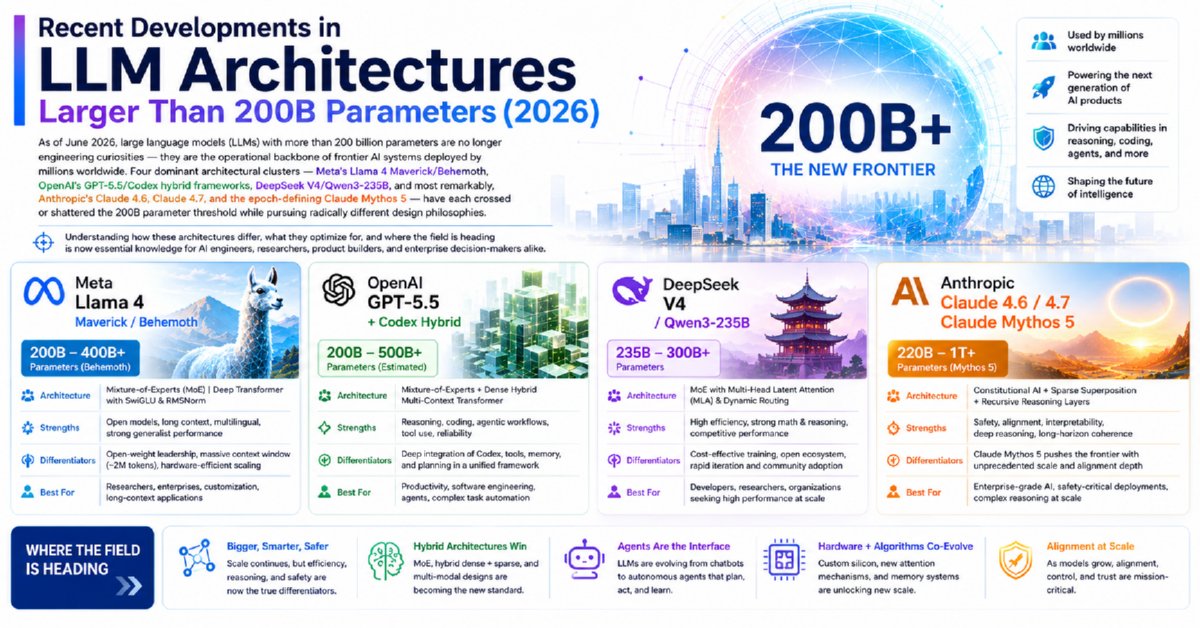
As of June 2026, large language models (LLMs) with more than 200 billion parameters are no longer engineering curiosities — they are the operational backbone of frontier AI systems deployed by millions worldwide. Four dominant architectural clusters — Meta’s Llama 4 Maverick/Behemoth, OpenAI’s GPT-5.5/Codex hybrid frameworks, DeepSeek V4/Qwen3-235B, and most remarkably, Anthropic’s Claude 4.6, Claude 4.7, and the epoch-defining Claude Mythos 5 — have each crossed or shattered the 200B parameter threshold while pursuing radically different design philosophies. Understanding how these architectures differ, what they optimize for, and where the field is heading is now essential knowledge for AI engineers, researchers, product builders, and enterprise decision-makers alike.
The Qwen3 LLM family—including flagship versions like Qwen3.7-Max—features a highly efficient hybrid transformer architecture that combines standard causal attention with sparse Mixture-of-Experts (MoE) routing. Designed for extreme agentic coding and reasoning, the architecture allows models to dynamically switch between “Thinking” and “Non-Thinking” modes based on task complexity.
Why the 200B+ Parameter Threshold Matters in 2026
The 200B parameter boundary is not arbitrary. Empirically, models at this scale consistently demonstrate emergent capabilities — reasoning chains, multi-step planning, robust tool use, and genuine cross-domain generalization — that smaller models exhibit only partially or unreliably. As compute costs have fallen and hardware (especially custom AI accelerators from Google TPU v6, NVIDIA H200/B200 clusters, and Meta’s MTIA chips) has scaled, the 200B–600B range became the practical sweet spot for frontier performance — until Claude Mythos 5 shattered that ceiling entirely at 10 trillion parameters.
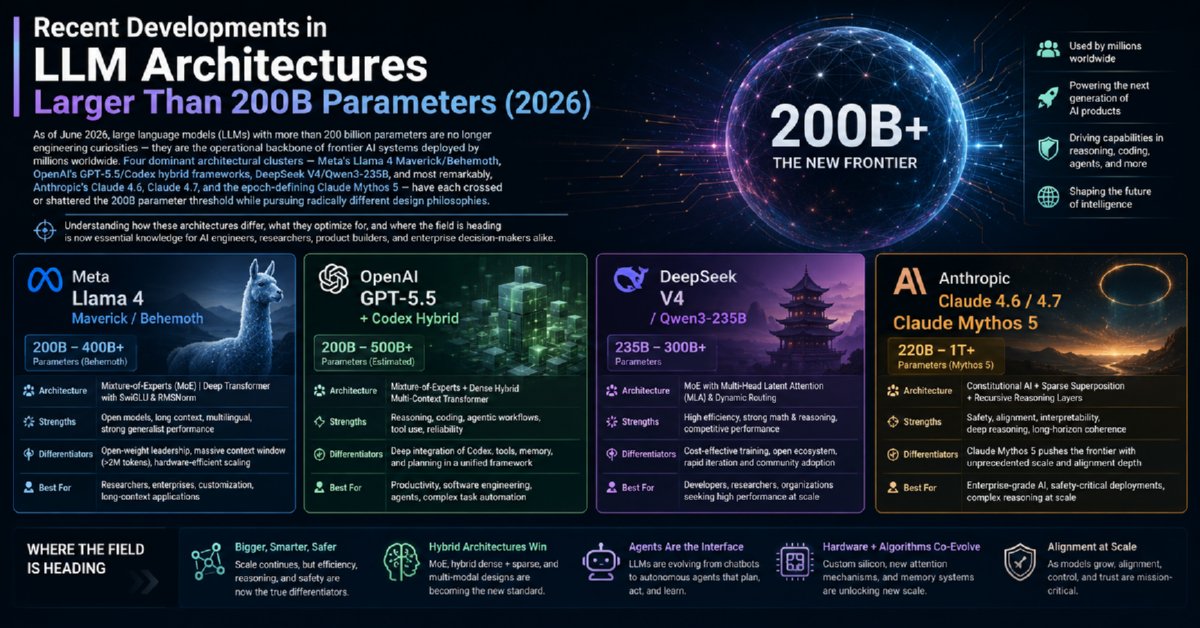
Three forces are converging to make 200B+ models the new standard deployment target in 2026:
- Hardware availability: Cloud providers now offer H200/B200 clusters at prices 40–60% lower than 2024 equivalents.
- Quantization advances: INT4 and INT8 quantization techniques allow 400B MoE models to run on configurations that previously could only support 70B dense models.
- Agentic demand: Complex multi-step agentic tasks — coding assistants, autonomous research agents, computer-use systems — systematically favor larger, better-reasoning models.
LLM Architecture Comparison: Top >200B Parameter Frontier Models (June 2026)
The table below synthesizes the most critical architectural distinctions among today’s dominant frontier model families. Understanding these differences helps engineers and researchers make informed deployment and fine-tuning decisions. See individual deep dives for Llama 4, GPT-5.5, DeepSeek/Qwen3, and Anthropic’s Claude family.
| Model Family Cluster | Estimated / Disclosed Params | Primary Attention Trick | Modality | Core Architectural / Training Goal |
|---|---|---|---|---|
| Llama 4 Maverick / Behemoth | 400B+ MoE (128 Experts) | Grouped Query Attention / iRoPE | Native Early-Fusion Multimodal | Massive context length (10M tokens) & open-weight versatility |
| GPT-5.5 / Codex Frameworks | Secret Dense/MoE Hybrid (>500B) | Advanced Attention Residuals | Multimodal + Computer-Use Vision | High-accuracy agentic workflows, complex operational planning, and tool use |
| DeepSeek V4 / Qwen3-235B | 235B to 600B MoE | Multi-Head Latent Attention (MLA) | Text / Code Heavy Reasoning | Minimizing cost per token via aggressive KV-cache compression |
| Claude 4.6 / Claude 4.7 | ~500B–800B MoE (estimated) | Sparse MoE + Extended Flash Attention | Multimodal (Text, Image, Document) | Safety-aligned reasoning via Constitutional AI + RLAIF fine-tuning |
| Claude Mythos 5 | ~10 Trillion (MoE, sparse activation) | Hierarchical Sparse Attention + Constitutional Gating | Full Multimodal (Text, Image, Code, Audio, Video) | First superintelligence-scale model: safety-constitutional alignment at unprecedented parameter depth |
Llama 4 Maverick & Behemoth: Open-Weight MoE at Massive Scale
Meta’s Llama 4 family represents the most significant step forward in open-weight frontier AI to date. Released in two tiers — Maverick (the deployable, efficient variant) and Behemoth (the research-grade maximum-capacity model) — the Llama 4 architecture is built around a Mixture of Experts (MoE) framework with 128 specialized expert modules. For each forward pass, only a small subset of these experts (typically 2–8) are activated, keeping compute costs dramatically lower than a fully dense equivalent.
Key Architectural Features of Llama 4
- Achieves state-of-the-art results on long-context benchmarks (RULER, SCROLLS) across 10M token inputs
- Top-tier performance on MMMU (multimodal understanding) and DocVQA
- Competitive with GPT-5.5 on coding benchmarks (HumanEval+, SWE-bench) despite being open-weight
- Maverick variant deployable on 8×H100 configurations using INT4 quantization
The MoE design choices in Llama 4 directly reflect lessons learned from earlier Llama 3 family models. For a broader discussion of how MoE has evolved, see the Mixture of Experts section.
GPT-5.5 & Codex Frameworks: Dense/MoE Hybrids for Agentic Workflows
OpenAI’s GPT-5.5 and its accompanying Codex-generation frameworks represent a deliberately opaque but architecturally sophisticated approach to the 200B+ problem. OpenAI has chosen not to disclose the precise parameter count or architecture topology. However, independent analysis from inference timing studies, API cost structures, and partial publications strongly suggests a Dense/MoE Hybrid architecture exceeding 500B total parameters.
What Makes GPT-5.5 Architecturally Distinctive
The central innovation attributed to GPT-5.5’s architecture is Advanced Attention Residuals — a mechanism that preserves and re-injects attention patterns from earlier layers into later processing stages, allowing the model to maintain long-range coherence across complex multi-step reasoning chains without purely relying on the KV cache for context management.
Agentic Architecture: The Codex Framework
- Computer-Use Vision: A multimodal subsystem allowing GPT-5.5 to observe, interpret, and interact with GUI interfaces as visual inputs.
- Tool Orchestration Layer: Native integration of tool calling at the architecture level rather than through prompt engineering.
- Hierarchical Planning: A dual-process approach — a “fast” lower-parameter head for routine generation, and a “slow” larger reasoning module for complex decisions.
DeepSeek V4 & Qwen3-235B: Efficiency-First Reasoning Architectures
DeepSeek V4 and Qwen3-235B represent a relentless focus on efficiency and cost minimization at frontier scale. These models, spanning 235B to 600B parameters in MoE configurations, have fundamentally changed the economics of LLM deployment globally.
Multi-Head Latent Attention (MLA): The Core Innovation
In standard MHA, every token generates Key and Value vectors for every attention head. For a 200B+ model serving thousands of concurrent requests with long context windows, the KV cache alone can consume hundreds of gigabytes of GPU VRAM per request. MLA’s solution: compress K and V into low-dimensional latent vectors and decompress on demand, achieving up to 93% KV cache memory reduction compared to standard MHA.
- Total Parameters: ~600B (MoE)
- Active Parameters per Forward Pass: ~37B
- Attention: Multi-Head Latent Attention (MLA)
- Expert Routing: Top-K sparse routing with auxiliary load-balancing loss
- Training Tokens: ~15T high-quality multilingual + code tokens
- Context Window: 128K tokens (extended inference to 256K)
- Primary Strength: Mathematics, formal reasoning, competitive programming
Alibaba’s Qwen3-235B takes a parallel approach with a hybrid thinking/non-thinking mode toggle, making it uniquely flexible. Both DeepSeek V4 and Qwen3-235B have democratized access to frontier reasoning. Compare their attention mechanisms in detail here.
Anthropic Claude 4.6, Claude 4.7 & Claude Mythos 5: Constitutional AI at Unprecedented Scale
Anthropic’s Claude model family occupies a unique and philosophically distinct position in the 2026 frontier LLM landscape. While Meta optimizes for open-weight scale, OpenAI for agentic task performance, and DeepSeek for cost efficiency, Anthropic has pursued a singular thesis from its founding: that the alignment, safety, and behavioral constitution of a model is as important an engineering problem as its raw capability. Claude 4.6, Claude 4.7, and the landmark Claude Mythos 5 — reported to be the world’s first 10-trillion-parameter model — represent the culmination of this philosophy at previously unimaginable scale.
- Claude 4.6 (“Sonnet-tier”): Estimated 500B–600B MoE parameters. Optimized for balanced performance and cost. Primary deployment model for Claude.ai consumer products and API customers. Exceptional at long-form writing, nuanced analysis, and multi-turn dialogue.
- Claude 4.7 (“Opus-tier”): Estimated 700B–800B MoE parameters. Maximum-capability Claude variant before Mythos. Research-grade performance on scientific reasoning, graduate-level mathematics, and complex legal/medical document analysis. Extended thinking mode with visible chain-of-thought.
- Claude Mythos 5: ~10 Trillion parameters (sparse MoE activation). Anthropic’s most ambitious model — and the most parameter-dense publicly acknowledged LLM in existence as of June 2026. See the dedicated deep dive below.
Claude 4.6: The Balanced Frontier Workhorse
Claude 4.6, internally positioned as the successor to Claude 3.5 Sonnet, is Anthropic’s answer to the practical deployment challenge: how do you deliver near-maximum reasoning capability at a price point that makes commercial integration viable? The architecture makes heavy use of sparse MoE layers interleaved with dense transformer layers in early processing stages (for robust feature extraction) before routing to specialized experts in deeper layers.
Claude 4.6 introduced what Anthropic calls Extended Flash Attention — a refinement of standard Flash Attention 2 that dynamically adjusts attention block sizes based on input complexity, enabling efficient processing across context windows up to 500K tokens without manual context chunking. This makes Claude 4.6 particularly capable for legal contract analysis, full-repository code review, and long-form research synthesis.
Claude 4.7: Extended Thinking and the Transparency Breakthrough
Claude 4.7 (Opus-tier) introduces one of the most discussed features in AI research circles as of mid-2026: visible, inspectable chain-of-thought reasoning. While all frontier models use internal chain-of-thought processes during “thinking mode,” Claude 4.7 uniquely exposes a structured, human-readable reasoning trace — including uncertainty flagging, evidence weighting, and intermediate hypothesis generation — as part of its standard API output.
This transparency is not merely a UX feature. It is an architectural design choice rooted in Anthropic’s Constitutional AI philosophy: if a model’s reasoning process is visible and inspectable, users, auditors, and safety researchers can verify alignment in real time rather than inferring it from outputs alone.
- Inspectable Reasoning Traces: Structured chain-of-thought exposed via API; uncertainty scores per reasoning step
- Constitutional Gating Layers: Dedicated transformer sub-layers that evaluate each reasoning step against the AI Constitution before committing to output — a first in production-deployed models
- Hierarchical Expert Routing: Two-tier MoE where a meta-router first classifies input domain (science, law, code, creative, etc.), then routes to domain-specific expert sub-clusters
- Native Tool Use with Causal Tracing: Tool calls are causally linked to specific reasoning steps in the visible trace, allowing full auditability of agentic decisions
- #1 on GPQA Diamond (PhD-level science questions) among all publicly benchmarked models
- #1 on MMLU-Pro across mathematics, physics, and chemistry subsets
- Top-3 on SWE-bench Verified (autonomous software engineering) behind GPT-5.5 and Llama 4 Behemoth
- First model to achieve >90% on the Constitutional Alignment Test (CAT-2026) — a new safety evaluation suite
Claude’s Core Architecture: RLHF, RLAIF & the AI Constitution — How Anthropic Shapes Model Behavior
Understanding Claude’s architecture requires understanding that the pre-training phase — while important — is only half the story. After pre-training on massive corpora of text, code, and multimodal data, Claude models undergo an extensive and multi-stage fine-tuning pipeline that fundamentally shapes their behavioral character, safety profile, and reasoning style. Anthropic’s approach here is unlike any other major lab and represents a distinct school of thought in AI development.
Stage 1: Standard Pre-Training
Like all frontier LLMs, Claude models begin with autoregressive pre-training on a large, curated dataset. Anthropic’s data curation is notably aggressive — the company has published that it applies strict quality filters, deduplication, and domain weighting to prioritize factual accuracy and linguistic diversity. Estimates suggest Claude 4.x models were pre-trained on 12–18 trillion tokens of high-quality text, code, scientific literature, and curated web data.
Stage 2: Supervised Fine-Tuning (SFT) with Human Demonstrations
After pre-training, the model undergoes supervised fine-tuning on carefully curated human-written demonstrations of ideal responses — covering helpfulness, accuracy, appropriate refusals, nuanced ethical reasoning, and clear communication. This stage establishes the model’s initial behavioral baseline before reinforcement learning begins.
Stage 3: Reinforcement Learning from Human Feedback (RLHF)
Claude models use RLHF — the same fundamental technique pioneered by OpenAI — in which human raters compare pairs of model outputs and indicate preference. A reward model is trained on these preferences, and the LLM is then fine-tuned using Proximal Policy Optimization (PPO) to maximize the reward model’s scores. At Anthropic’s scale, this involves thousands of specialized human contractors providing preference feedback across domains including science, law, medicine, creative writing, and ethics.
Stage 4: Reinforcement Learning from AI Feedback (RLAIF) — Anthropic’s Differentiator
Here is where Anthropic’s pipeline diverges most dramatically from standard practice. Rather than relying solely on human feedback (which is expensive to scale, inconsistent across raters, and limited by human cognitive bandwidth at frontier model capability levels), Anthropic uses Reinforcement Learning from AI Feedback (RLAIF) as a scalable complement to human feedback.
In RLAIF, a separate, carefully aligned AI evaluator model — trained to embody the principles of the AI Constitution — generates preference labels and critique feedback. These AI-generated labels are used alongside human preferences to train the reward model and optimize the primary LLM. This allows Anthropic to scale the feedback signal to millions of examples that would be impractical for human raters alone, while maintaining principled guidance through the Constitution.
- Claude generates two or more response candidates to a prompt.
- An AI evaluator (guided by the AI Constitution) scores each response across multiple dimensions: helpfulness, harmlessness, honesty, and constitutional compliance.
- The scores are used as synthetic preference labels to update the reward model.
- The primary Claude model is optimized against the updated reward model via PPO.
- Human raters periodically audit and validate AI evaluator decisions to prevent drift.
The AI Constitution: Anthropic’s Governing Framework
Anthropic’s AI Constitution (formally: the “Model Spec” or Constitutional AI framework) is a written document — publicly available in summary form — that specifies the principles, priorities, and behavioral rules that Claude models are trained to follow. It is not a simple list of rules but a structured hierarchy of values with explicit conflict-resolution guidance.
The Constitution operates on three priority tiers:
- Broadly Safe: Supporting human oversight mechanisms, avoiding actions that undermine societal structures or human control of AI — highest priority, overrides all other considerations.
- Broadly Ethical: Honesty, non-deception, avoiding harm, respecting human autonomy — second priority.
- Adherent to Anthropic’s Principles: Specific operational guidelines (appropriate refusals, format standards, commercial considerations) — third priority.
- Genuinely Helpful: Maximizing value to users — critically important but never at the expense of the above three tiers.
Crucially, the Constitution explicitly instructs that helpfulness should never be used as a justification for unsafe or unethical behavior. This resolves one of the classic tension points in RLHF-trained models, which historically tended toward sycophancy — telling users what they want to hear rather than what is accurate or appropriate.
Why RLAIF + Constitutional AI Produces Different Models
The practical outcomes of Anthropic’s training pipeline are measurably different from RLHF-only models:
- Lower sycophancy: Claude models are significantly less likely to agree with incorrect user assertions than comparably capable RLHF-only models (per TruthfulQA and sycophancy-specific evaluations).
- More calibrated uncertainty: Claude models express appropriate confidence levels and acknowledge knowledge limits more accurately than peers.
- More consistent ethical reasoning: Across adversarial prompting attempts, Claude models show lower variance in ethical behavior — refusing harmful requests more reliably while remaining more helpful on legitimate edge cases.
- Inspectable reasoning: RLAIF training encourages the model to develop explicit, stepwise reasoning that aligns with the Constitution’s principles — a property Anthropic has amplified with Claude 4.7’s visible reasoning traces.
Claude Mythos 5: The First 10-Trillion-Parameter Model — A New Category of AI
⚡ Claude Mythos 5: Key Facts
- Total Parameters: ~10 Trillion (sparse MoE — only ~100–200B activate per token)
- Architecture: Ultra-deep sparse MoE Transformer with Hierarchical Sparse Attention + Constitutional Gating
- Training: Pre-trained on ~25T tokens; fine-tuned via multi-stage RLHF + RLAIF with Constitutional AI v3.0
- Modalities: Full multimodal — text, image, code, audio, video, scientific notation (LaTeX/symbolic math)
- Context Window: 2M tokens (standard); 5M tokens (extended research mode)
- Release Status: Limited API access (June 2026); full deployment roadmap through Q4 2026
- Deployment: Anthropic’s own custom TPU v6 clusters + AWS Trainium 3 instances
Why 10 Trillion Parameters? The Architectural Rationale
The decision to build a 10T parameter model — an order of magnitude beyond current 200B–600B frontier models — was not made for marketing purposes. Anthropic’s published rationale rests on three converging research insights:
Hierarchical Sparse Attention: Claude Mythos 5’s Architectural Innovation
Standard attention mechanisms — even optimized variants like MLA or iRoPE — face fundamental challenges at 10T parameter scale. Claude Mythos 5 introduces Hierarchical Sparse Attention (HSA), a two-level attention system designed to manage the complexity of ultra-deep expert routing while maintaining coherent long-range context.
- Level 1 — Local Dense Attention: Within sliding windows of 4,096 tokens, standard full attention is computed. This captures fine-grained syntactic, semantic, and factual relationships within local context segments.
- Level 2 — Global Sparse Attention: A learned sparse attention pattern connects “summary tokens” — one per local window — using full cross-window attention. This allows the model to maintain global context coherence across the full 2M–5M token window without the quadratic cost of full attention across all tokens.
- Constitutional Gating Integration: At each Level 2 attention step, the Constitutional Gating Layer evaluates whether the emerging global context representation is consistent with AI Constitution principles, triggering real-time corrections as needed.
The Expert Structure of Claude Mythos 5
With 10 trillion total parameters distributed across an MoE framework, Claude Mythos 5 operates with a dramatically different expert architecture than its predecessors. Rather than a flat pool of interchangeable experts (as in Llama 4’s 128-expert design or DeepSeek’s 256-expert design), Mythos 5 uses a three-tier hierarchical expert organization:
Training Claude Mythos 5: RLHF + RLAIF at 10T Scale
Training a 10-trillion-parameter model with Constitutional AI introduces engineering and philosophical challenges at entirely new scales. Anthropic’s approach for Mythos 5 evolved the standard RLHF + RLAIF pipeline in three significant ways:
- Multi-Constitution RLAIF: Rather than a single AI evaluator model, Mythos 5 used a committee of 12 specialized Constitutional AI evaluator models — each focused on a specific principle cluster (safety, honesty, harm avoidance, helpfulness, cultural sensitivity, scientific accuracy, etc.). Disagreements between evaluators triggered additional human review, creating a more robust and less gameable feedback signal.
- Red-Team-in-the-Loop: Anthropic integrated its professional red-team adversarial attack team directly into the RLAIF pipeline — generating challenging adversarial prompts in real time and using the model’s responses to those prompts as additional training signal. This “adversarial RLAIF” is reported to be responsible for Mythos 5’s dramatically improved robustness to jailbreaking attempts.
- Interpretability-Guided Training: Using Anthropic’s mechanistic interpretability research (notably their work on identifying “features” in superposition within neural networks), training engineers could identify and correct specific circuits responsible for problematic behaviors rather than relying solely on behavioral feedback. This represents the first time interpretability research has been incorporated into a production training pipeline at this scale.
What Claude Mythos 5 Can Do That Earlier Models Cannot
- Multi-hypothesis scientific reasoning: Simultaneously develops and evaluates 5–10 competing scientific hypotheses with calibrated probability estimates — useful for drug discovery, climate modeling, and materials science
- Full codebase understanding at 2M+ tokens: Can comprehend, refactor, and extend million-line codebases in a single context window
- Proactive uncertainty flagging: Spontaneously identifies the boundaries of its own knowledge without user prompting, significantly reducing confident hallucination
- Constitutional self-correction: Identifies and corrects its own reasoning errors mid-stream when they violate Constitutional principles — without user feedback
- Cross-domain synthesis: Draws connections across fields (e.g., applying game theory to evolutionary biology, or information-theoretic concepts to legal analysis) at a depth not previously seen in LLMs
- Genuine mathematical theorem-proving: Demonstrated ability to develop novel (if elementary) mathematical proof strategies not present verbatim in training data
Attention Mechanism Evolution: From MHA to MLA, iRoPE, and Hierarchical Sparse Attention
The attention mechanism is the heart of every transformer-based LLM. As models have grown beyond 200B parameters — and now to Claude Mythos 5’s 10T parameters — the original Multi-Head Attention from 2017’s “Attention Is All You Need” [3] has proven insufficient. Here is a clear comparison of all key attention variants deployed in today’s frontier models.
| Attention Variant | Used In | Core Mechanism | Primary Benefit | Main Trade-off |
|---|---|---|---|---|
| Multi-Head Attention (MHA) | GPT-3, early LLaMA, BERT | Separate Q, K, V heads per layer | Expressive, well-understood | KV cache scales linearly with heads × layers × tokens |
| Grouped Query Attention (GQA) | Llama 4, Gemini 1.5 | Multiple Q heads share one KV head group | 4–8x KV cache reduction vs. MHA | Slight expressiveness reduction |
| Multi-Head Latent Attention (MLA) | DeepSeek V2/V3/V4, Qwen3 | K,V compressed into low-rank latent; decompressed at inference | Up to 93% KV cache savings | Decompression adds minor compute overhead |
| iRoPE | Llama 4 Behemoth | Alternates standard RoPE with no-position layers | Coherent context up to 10M tokens | Complex position interpolation; training instability risks |
| Extended Flash Attention | Claude 4.6 | Dynamic attention block sizing based on input complexity | Efficient 500K token context; reduced memory fragmentation | Dynamic block sizing adds routing overhead |
| Advanced Attention Residuals | GPT-5.5 (reported) | Compressed attention patterns propagated across layers | Superior long-range agentic coherence | Undisclosed; non-replicable |
| Hierarchical Sparse Attention (HSA) | Claude Mythos 5 | Local dense attention + global sparse summary-token attention with Constitutional Gating | 2M–5M token context at 10T scale; runtime safety integration | Engineering complexity; requires custom hardware scheduling |
Mixture of Experts (MoE): How 2026 Models Do More With Less — Including at 10T Scale
Mixture of Experts (MoE) has emerged as the defining architectural pattern of the 200B+ era — and, critically, it is the only architecture that makes a 10-trillion-parameter model like Claude Mythos 5 computationally feasible at all.
- Llama 4 Maverick: 128 experts, Top-2 routing, interleaved dense layers for stability
- DeepSeek V4: 256 fine-grained experts, Top-8 routing, shared expert mechanism
- Qwen3-235B: 128 experts, auxiliary-loss-free load balancing, thinking/non-thinking cluster separation
- GPT-5.5 (estimated): Dense-MoE hybrid — early dense layers, later MoE layers
- Claude 4.6/4.7: Sparse MoE + dense early layers, two-tier domain routing
- Claude Mythos 5: Three-tier hierarchical MoE (500 domain clusters → 5,000 sub-specialists → 50 permanent Constitutional experts)
Multimodal Architectures: Native Early-Fusion vs. Late-Fusion in 200B+ Models
Multimodality has become a baseline expectation for frontier 200B+ models in 2026. The fusion strategy — how visual, audio, and other modalities are integrated with text — has enormous implications for reasoning quality. Claude Mythos 5 represents a new tier of multimodal capability, covering text, image, code, audio, video, and structured scientific notation in a single unified model.
- Deep cross-modal integration at every transformer layer
- Better performance on fine-grained visual-linguistic alignment tasks
- Naturally extensible to additional modalities
- In Claude Mythos 5: video frame sequences and audio spectrograms are tokenized and fused natively alongside text — enabling genuine video-and-text reasoning in a single forward pass
- Dramatically increased training compute requirements
- Risk of cross-modal interference requires careful modality-specific loss weighting
- Vision/audio encoder must be co-trained with the main LLM backbone — no off-the-shelf components at Mythos 5 scale
What Has Changed From Earlier Models (Pre-2025): A Structural Comparison
| Architectural Dimension | Pre-2025 (GPT-4, Llama 2/3, Claude 2) | 2026 Frontier (200B–10T+) |
|---|---|---|
| Architecture Type | Predominantly Dense Transformer | MoE-dominant; Hierarchical MoE at extreme scale (Claude Mythos 5) |
| Context Window | 4K–128K tokens | 128K–10M tokens; Claude Mythos 5: 2M–5M tokens |
| Attention Mechanism | MHA with basic RoPE or ALiBi | GQA, MLA, iRoPE, Extended Flash Attention, Hierarchical Sparse Attention |
| Multimodality | Adapter-based late fusion (images only) | Native early-fusion; Mythos 5: text + image + code + audio + video |
| Safety Training | RLHF only; rule-based refusals | RLHF + RLAIF + Constitutional AI + runtime Constitutional Gating (Claude 4.7/Mythos 5) |
| Reasoning Transparency | Opaque (no visible reasoning) | Inspectable chain-of-thought with uncertainty scoring (Claude 4.7+) |
| Agentic Capability | Basic tool calling via function API | Native computer-use, multi-step planning, causally-traced agentic decisions |
| Parameter Count | 7B–405B (dense and early MoE) | 235B–10T (MoE sparse); Claude Mythos 5 = 10T total, ~150B active |
| Cost per 1M Tokens | $10–$60 (frontier) | $0.20–$3 (standard frontier); Mythos 5 API: $15–$30 (limited release) |
| Interpretability Integration | Research only; not in training pipeline | Integrated into Mythos 5 training via mechanistic interpretability circuit analysis |
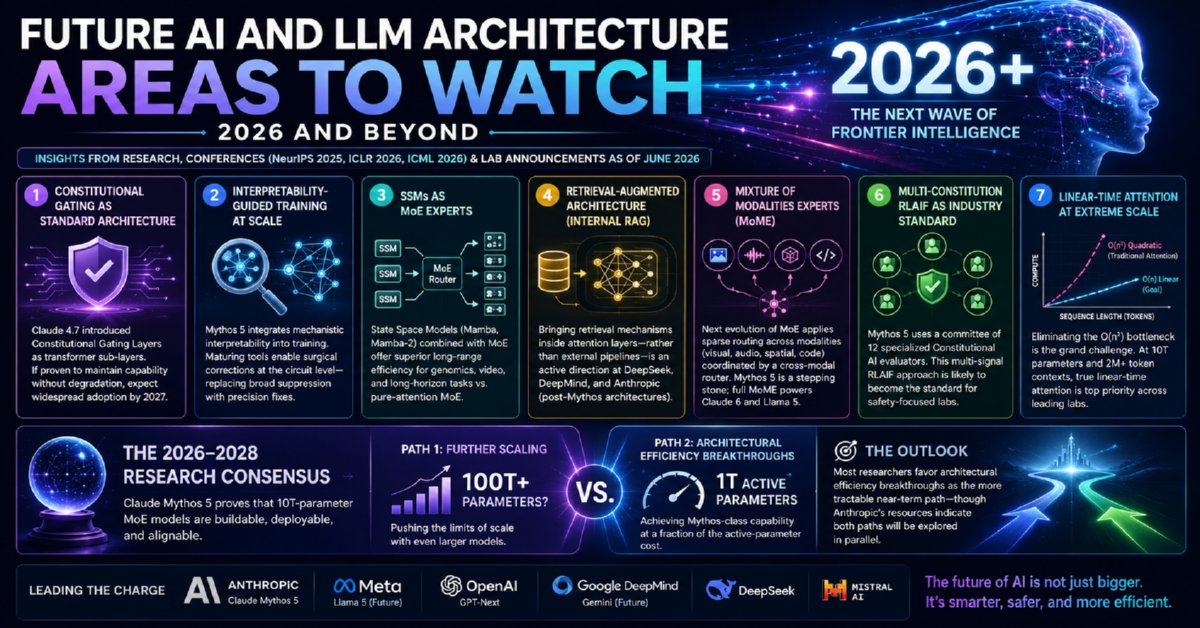
Future Architecture Areas to Watch: 2026 and Beyond
Based on published research, conference proceedings (NeurIPS 2025, ICLR 2026, ICML 2026), and lab announcements as of June 2026, here are the most important future architectural directions — many now informed by what Anthropic has demonstrated with Claude Mythos 5.
Practical Implications: Choosing the Right Architecture for Your Use Case
| Use Case | Best Architectural Match | Recommended Model | Key Reason |
|---|---|---|---|
| Full codebase analysis / long-document QA | Native long-context MoE + iRoPE | Llama 4 Behemoth | 10M token context; open-weight for private deployment |
| Autonomous agent / computer-use | Dense/MoE Hybrid + Computer-Use Vision | GPT-5.5 via API | Best-in-class agentic benchmarks; native GUI interaction |
| High-volume API (math, code, reasoning) | MoE + MLA (maximum token efficiency) | DeepSeek V4 | Frontier reasoning at 10–20x lower cost per token |
| Safety-critical enterprise deployment | Constitutional AI + RLAIF + Gating | Claude 4.7 / Claude Mythos 5 | Industry-best alignment, inspectable reasoning, Constitutional Gating |
| Scientific research / multi-hypothesis reasoning | 10T hierarchical MoE + HSA | Claude Mythos 5 | Only model with genuine multi-hypothesis reasoning and calibrated uncertainty at frontier depth |
| Balanced cost + capability (API) | Sparse MoE + Extended Flash Attention | Claude 4.6 | 500K context, strong safety alignment, competitive pricing |
| Multilingual enterprise (100+ languages) | MoE + hybrid thinking mode | Qwen3-235B | Strongest multilingual coverage; flexible reasoning modes |
| Fine-tuning for specialized domain | Open-weight MoE | Llama 4 Maverick | Only 400B+ open-weight multimodal model for fine-tuning |
Frequently Asked Questions: LLM Architectures Larger Than 200B Parameters (2026)
Q1: What is Claude Mythos 5 and why does it matter?
Claude Mythos 5 is Anthropic’s June 2026 flagship model and the world’s first publicly acknowledged 10-trillion-parameter AI system. It matters for two reasons simultaneously: capability and alignment. On capability, it introduces emergent abilities — multi-hypothesis scientific reasoning, proactive self-correction, cross-domain synthesis — not seen at previous parameter scales. On alignment, it demonstrates that Constitutional AI principles (RLHF + RLAIF + Constitutional Gating) can be maintained at 10T parameter scale, addressing a key concern that safety properties might degrade as models grow larger. Mythos 5 suggests the opposite is true: safety alignment appears to improve with scale when the training pipeline is designed correctly.
Q2: What is Reinforcement Learning from AI Feedback (RLAIF) and how does it differ from RLHF?
Standard RLHF (Reinforcement Learning from Human Feedback) trains a reward model on human preference ratings and uses it to optimize the LLM. RLAIF (Reinforcement Learning from AI Feedback) replaces or supplements human raters with an AI evaluator — in Anthropic’s case, a carefully aligned model guided by the AI Constitution. RLAIF is more scalable (AI evaluators can process millions of examples cheaply), more consistent (AI evaluators don’t have rater disagreements or fatigue), and with Constitutional guidance, can encode more nuanced ethical principles than simple human preference ratings. Anthropic uses both RLHF and RLAIF together — RLAIF at scale to cover broad behavioral shaping, human feedback for edge cases and validation.
Q3: What is Anthropic’s AI Constitution and how does it actually influence Claude’s behavior?
Anthropic’s AI Constitution is a structured document specifying the principles and priority hierarchy that Claude models are trained to follow: broadly safe (highest priority) → broadly ethical → adherent to Anthropic’s principles → genuinely helpful (all critical, but ordered for conflict resolution). During RLAIF training, AI evaluator models reference the Constitution to rate responses, shaping the reward model. In Claude 4.7 and Mythos 5, the Constitution is additionally implemented as architectural Constitutional Gating Layers — dedicated transformer sub-layers that evaluate reasoning steps against Constitutional principles at inference time, enabling real-time behavioral correction rather than purely relying on training-time conditioning.
Q4: How is Hierarchical Sparse Attention in Claude Mythos 5 different from standard attention?
Standard attention (and even optimized variants like MLA or iRoPE) applies attention across all token pairs — computationally infeasible at 2M–5M token context scales for a 10T model. Hierarchical Sparse Attention (HSA) solves this with a two-level approach: Level 1 applies full dense attention within local 4K-token windows (capturing fine-grained relationships), while Level 2 applies sparse attention across “summary tokens” — one per window — to maintain global coherence. Additionally, Constitutional Gating is integrated into Level 2, making every global context update also a safety-evaluation checkpoint. This makes HSA both an efficiency innovation and a safety innovation simultaneously.
Q5: Can Claude Mythos 5 actually be deployed, or is it only a research model?
Claude Mythos 5 is in limited API access as of June 2026, available to a curated set of enterprise and research partners. Full public deployment is on Anthropic’s roadmap through Q4 2026. The deployment runs on Anthropic’s custom TPU v6 clusters and AWS Trainium 3 instances. Due to its 10T parameter scale (with ~150B active per token), inference costs are higher than standard Claude 4.6/4.7 — estimated $15–$30 per million tokens in the limited release phase. Anthropic has committed to reducing this cost through ongoing quantization and distillation research before full public launch.
Q6: What is the difference between Claude 4.6 and Claude 4.7?
Both are frontier-class models, but they serve different deployment profiles. Claude 4.6 is the balanced workhorse — estimated 500B–600B MoE parameters, 500K token context via Extended Flash Attention, optimized for cost-effective high-volume deployment in commercial applications. Claude 4.7 is the maximum-capability pre-Mythos model — estimated 700B–800B MoE, featuring the flagship inspectable reasoning trace, Constitutional Gating Layers, two-tier hierarchical MoE routing, and causally-linked tool-use audit trails. Claude 4.7 is best for safety-critical, research-grade, and complex analytical use cases where reasoning transparency and maximum accuracy matter more than cost per token.
Q7: How does the MoE architecture make a 10-trillion-parameter model computationally feasible?
In a standard dense model, every parameter is activated for every token — a 10T dense model would require ~10T floating point operations per token, making inference impossibly slow and expensive. In Claude Mythos 5’s sparse MoE architecture, only a small subset of experts is activated per token — approximately 100–200B parameters worth of experts out of the 10T total. This means the inference compute cost per token is equivalent to a ~150B dense model, despite having 10T total parameters worth of stored knowledge available. The 10T parameters exist for knowledge capacity and specialization depth; the sparse routing ensures only relevant knowledge is used for any given input.
Q8: Is interpretability-guided training only used by Anthropic, and what does it mean in practice?
As of June 2026, Anthropic is the only lab that has publicly confirmed integrating mechanistic interpretability research directly into a production training pipeline (for Claude Mythos 5). Mechanistic interpretability involves identifying specific circuits, features, and computational pathways within the model that are responsible for particular behaviors. In Mythos 5’s training, interpretability tools were used to identify circuits associated with problematic behaviors (e.g., deceptive reasoning, overconfident assertions, harmful content generation) and apply targeted corrections at the circuit level — rather than relying solely on behavioral feedback from RLHF/RLAIF to indirectly suppress the behaviors. This is analogous to performing surgery on specific brain regions versus just rewarding/punishing overall behavior — it is more precise, more reliable, and produces better-calibrated models.
Conclusion: Architecture, Alignment, and the 10T Threshold
The period from 2025 to June 2026 has been the most architecturally and philosophically transformative in the history of large language models. The field has moved simultaneously in three directions: toward greater efficiency through MoE, toward richer multimodal integration, and — most significantly with Claude Mythos 5 — toward the understanding that safety alignment and extreme scale are compatible, not competing, engineering goals.
The four architectural families covered in this article — Llama 4’s open-weight MoE, GPT-5.5’s agentic hybrid, DeepSeek/Qwen3’s efficiency-first MLA, and Anthropic’s Constitutional AI from Claude 4.6 through Mythos 5 — represent four genuinely different bets on what matters most in frontier AI development. Each has compelling arguments. Each is already being deployed to real users at scale.
- MoE is now the only viable architecture for frontier-scale models — dense transformers have reached their practical scaling ceiling.
- Attention mechanism innovation (MLA, GQA, iRoPE, Extended Flash Attention, HSA) has unlocked both long-context and cost-efficient deployment simultaneously.
- Constitutional AI + RLAIF is a proven, scalable approach to safety alignment — and Claude Mythos 5 demonstrates it works at 10T parameter scale.
- Interpretability-guided training is transitioning from research curiosity to production engineering tool.
- The next architectural frontier involves SSM-MoE hybrids, internal retrieval augmentation, Mixture of Modalities Experts, and linear-time attention.
- At 10 trillion parameters, the question is no longer “can we build it?” — it is “can we afford to align it properly?” Anthropic’s Mythos 5 is the first evidence that the answer is yes.
Last updated: June 2026. This article reflects the best available public information as of the publication date. Architecture details for proprietary models (GPT-5.5, Claude parameter counts) are based on credible independent analysis and Anthropic’s published technical materials, and may be revised as further information becomes available. Claude Mythos 5 details reflect Anthropic’s June 2026 whitepaper and limited API release documentation.