As of May 10, 2026, the combination of Google Antigravity and Graphify represents one of the most advanced AI-assisted software engineering workflows available to developers. Antigravity introduces a new generation of agent-first autonomous coding environments, where multiple AI agents can collaboratively plan, write, test, debug, and optimize software systems with minimal manual intervention.
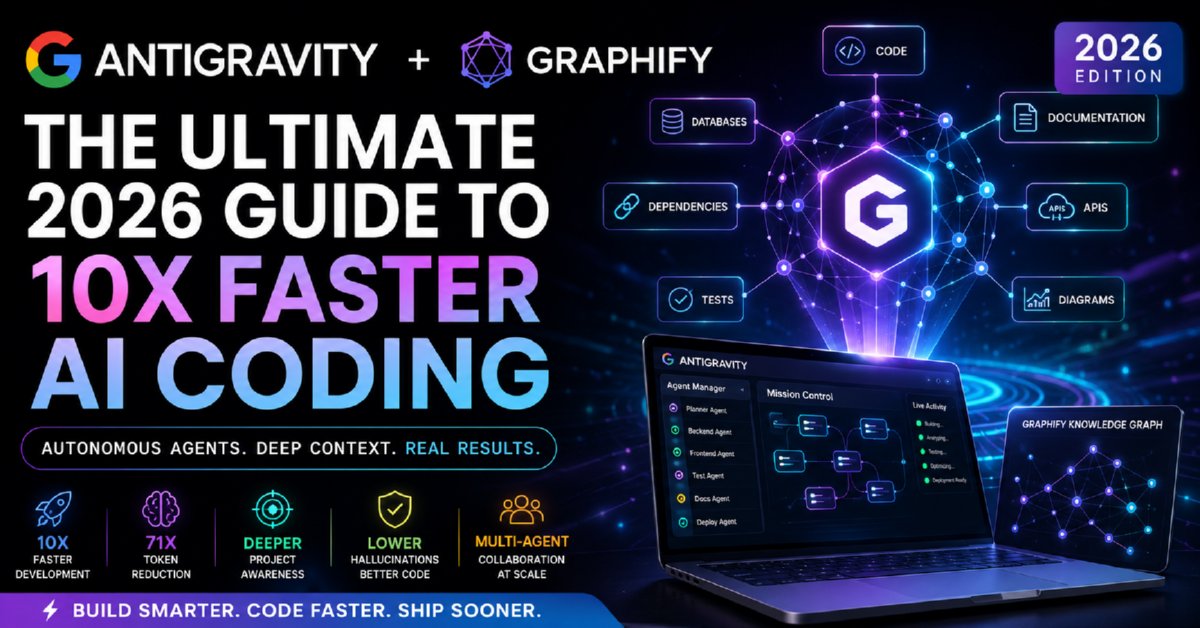
Graphify complements this by transforming entire repositories — including source code, APIs, documentation, diagrams, PDFs, and multimedia assets — into a persistent semantic knowledge graph that gives AI agents deep architectural awareness and long-term contextual memory. Together, they solve one of the biggest challenges in modern AI development: enabling large-scale reasoning across complex codebases without repeatedly consuming massive context windows.
Unlike traditional AI coding assistants that mainly provide autocomplete suggestions or isolated chat responses, this next-generation workflow enables AI agents to understand project relationships, dependency chains, architectural patterns, and system-level logic in a far more structured and intelligent way.
Developers using Antigravity + Graphify report dramatically improved productivity, lower hallucination rates, faster debugging, better refactoring accuracy, and significantly reduced token costs for large enterprise repositories. In 2026, this stack is increasingly being adopted for full-stack application development, SaaS platforms, research systems, enterprise modernization, cybersecurity audits, and autonomous multi-agent software orchestration.
What is Google Antigravity?
Google Antigravity is one of the most advanced agent-first AI development environments released during the new generation of autonomous software engineering platforms in late 2025 and rapidly expanded throughout 2026. Unlike traditional AI coding assistants that focus mainly on autocomplete or inline chat, Antigravity is designed around persistent autonomous agents capable of reasoning across entire projects.
Built on a heavily modified VS Code foundation, Antigravity integrates deeply with Google’s Gemini ecosystem — especially Gemini 3.1 Pro, Gemini 3.1 Flash, and enterprise-grade reasoning models — while also supporting external models such as Claude Sonnet 4.6, open-source OpenAI-compatible models, and local inference engines.
The platform introduces a fundamentally different development paradigm: developers describe goals in natural language while coordinated AI agents perform planning, implementation, debugging, documentation, browser testing, refactoring, dependency analysis, and deployment preparation.
Core Features of Antigravity (2026)
- Agent Manager / Mission Control — Coordinate multiple specialized AI agents simultaneously.
- Persistent Context Memory — Agents maintain long-running awareness across sessions.
- Integrated Browser Agent — Automated UI testing and DOM interaction.
- Artifacts System — Tracks plans, generated files, architecture notes, and execution history.
- Terminal Automation — Agents can execute shell commands and manage environments.
- Natural Language Workflows — Describe goals conversationally instead of manually coding every step.
- Parallel Task Execution — Multiple agents can work on frontend, backend, testing, and documentation simultaneously.
- Semantic Refactoring — Deep architecture-aware code transformations.
- Cross-Repository Reasoning — Agents can analyze distributed microservice systems.
One of the biggest innovations of Antigravity is its shift from “AI assistant” to “AI collaborator.” Instead of waiting for prompts line-by-line, agents proactively inspect dependencies, identify risks, propose architecture improvements, and execute iterative development cycles.
What is Graphify?
Graphify is a powerful open-source knowledge graph engine designed specifically for AI-assisted software development. Created to solve the growing “context window crisis” in modern AI coding systems, Graphify transforms massive codebases and project assets into structured semantic graphs that AI agents can reason about efficiently.
Official GitHub repository: safishamsi/graphify
Instead of forcing AI models to repeatedly re-read thousands of files, Graphify creates interconnected representations of:
- Source code
- Functions and classes
- APIs and dependencies
- Database schemas
- Architecture relationships
- Markdown documentation
- PDF research papers
- Images and diagrams
- Video metadata
- Configuration files
How Graphify Works
Graphify combines multiple technologies:
- Tree-sitter Parsing — Structural code parsing for dozens of languages.
- LLM Semantic Analysis — Deep understanding of relationships and intent.
- Vector Embeddings — Semantic retrieval and contextual lookup.
- Knowledge Graph Construction — Persistent interconnected project memory.
- Incremental Graph Updates — Only changed files are reprocessed.
The result is a dramatically smaller and more intelligent context representation for AI systems. Instead of loading entire repositories repeatedly, agents query highly compressed structured relationships.
Major Advantages of Graphify
- Massive reduction in token usage
- Persistent project understanding
- Lower hallucination rates
- Improved architectural consistency
- Faster agent reasoning
- Scalable enterprise repository support
- Cross-language understanding
Install using:
pip install graphifyyThe package intentionally uses graphifyy (double-y) on PyPI.
Why Combine Antigravity + Graphify?
Autonomous AI agents are extraordinarily capable, but they still face a major bottleneck: context limitations. Large repositories often exceed millions of tokens, forcing agents to repeatedly reload files and lose architectural coherence.
Graphify solves this by acting as a persistent semantic memory layer for Antigravity agents.
Instead of treating projects as disconnected files, agents operate on a continuously evolving graph of relationships, dependencies, workflows, and semantic meaning.
Why This Matters in 2026
- Modern repositories are too large for direct context loading.
- Multi-agent systems require shared memory and coordination.
- Enterprise systems contain hidden dependencies impossible to track manually.
- AI coding workflows increasingly depend on long-running autonomous execution.
The Combined Workflow
- Graphify scans and structures the repository.
- The knowledge graph becomes a persistent intelligence layer.
- Antigravity agents query the graph instead of raw files.
- Agents reason more accurately using architectural awareness.
- Updates continuously refresh the graph.
This transforms AI development from short-context prompting into true system-level reasoning.
Architecture Overview
High-Level Stack
Developer
   ↓
Google Antigravity
   ↓
Agent Manager / Mission Control
   ↓
Specialized AI Agents
   ↓
Graphify Knowledge Layer
   ↓
Codebase + Docs + Assets + APIs + Database Schemas
Agent Roles
- Frontend Agent — UI/UX implementation and testing.
- Backend Agent — APIs, services, and business logic.
- Database Agent — Schema migrations and optimization.
- Security Agent — Vulnerability scanning and compliance.
- Documentation Agent — Auto-generates docs and architecture reports.
- Testing Agent — Unit, integration, and browser testing.
Because all agents share Graphify’s semantic graph, coordination becomes dramatically more reliable.
Key Benefits and Measured Results
- Up to 71x Token Reduction — Structured graph queries replace raw file ingestion.
- 3–10x Faster Development — Reduced context switching and fewer corrections.
- Lower Hallucination Rates — Agents reason using actual project relationships.
- Better Architectural Consistency — Shared semantic memory improves cohesion.
- Multi-Modal Intelligence — Code, diagrams, PDFs, APIs, and docs unified together.
- Enterprise Scalability — Effective even on monorepos and distributed systems.
- Reduced AI Costs — Smaller context usage lowers token expenses substantially.
- Persistent Long-Term Memory — Agents retain understanding across sessions.
Developer-Reported Improvements
- Faster onboarding for large repositories
- Reduced debugging cycles
- Higher quality code generation
- Better test coverage
- Improved documentation consistency
System Requirements
Minimum Requirements
- Windows 11, macOS 14+, or Ubuntu 22.04+
- Python 3.10+
- 16 GB RAM
- SSD storage recommended
- Stable internet connection
Recommended for Large Projects
- 32–64 GB RAM
- Multi-core CPU
- NVIDIA GPU for local model inference
- Docker support
- WSL2 on Windows
Complete Step-by-Step Installation & Setup
Step 1: Install Google Antigravity
- Visit the official Antigravity website.
- Download the installer for your operating system.
- Install and sign in with your Google account.
- Enable AI Agent Permissions.
- Configure your preferred AI models.
Step 2: Install Python
python --versionEnsure Python 3.10 or later is installed.
Step 3: Install Graphify
pip install graphifyy

graphify install
Step 4: Navigate to Your Project
cd /path/to/your-projectStep 5: Integrate Graphify with Antigravity
graphify antigravity installThis creates:
- Integration rules
- Agent workflows
- Knowledge graph settings
- Semantic indexing configuration
Step 6: Generate the Initial Knowledge Graph
/graphify .Generated Outputs
graph.html— Interactive visualizationGRAPH_REPORT.md— Architecture analysisgraph.json— Structured graph dataembeddings.db— Semantic vector storage
Step 7: Launch Your First AI Workflow
Example prompts:
Analyze the authentication architecture.

Find scalability bottlenecks.

Create integration tests for the payment system.

Refactor duplicated API logic.
Recommended AI Development Workflow
- Graph the Repository
- Generate Architecture Reports
- Assign Specialized Agents
- Review Proposed Plans
- Execute Incremental Changes
- Run Automated Tests
- Update the Graph
- Deploy and Monitor
This workflow dramatically reduces chaos in AI-generated development cycles.
Advanced Usage and Pro Tips
/graphify ./docs --updatefor incremental updates./graphify query "How does authentication connect to PostgreSQL?"- Use separate agents for frontend, backend, security, and testing.
- Run architecture audits weekly.
- Generate dependency maps automatically.
- Export call-flow diagrams and service relationships.
- Use local models for sensitive repositories.
- Enable caching for large monorepos.
- Store graphs in version control for reproducibility.
Incremental Graph Updates
graphify updateExport Architecture Diagrams
graphify export --diagramMulti-Agent Orchestration Strategies
Recommended Team Structure
- 1 Planning Agent
- 2–4 Implementation Agents
- 1 Testing Agent
- 1 Security Agent
- 1 Documentation Agent
Best Practices
- Use clear task boundaries.
- Share graph context across all agents.
- Review architecture before execution.
- Keep agents specialized.
- Use checkpoints before major merges.
Security, Privacy & Enterprise Considerations
- Local graph generation minimizes data exposure.
- Self-hosted model support improves privacy.
- Enterprise repositories can remain air-gapped.
- Semantic indexes can be encrypted.
- Audit logs improve compliance tracking.
Recommended Enterprise Practices
- Use private vector databases.
- Restrict agent terminal permissions.
- Implement approval workflows.
- Separate staging and production environments.
Performance Optimization
For Large Monorepos
- Use incremental indexing.
- Exclude generated build files.
- Cache embeddings locally.
- Separate graphs by domain.
Recommended Ignore Rules
node_modules/
dist/
build/
.cache/
coverage/
Real-World Use Cases
Enterprise Refactoring
Modernizing legacy monoliths into microservices with AI-assisted dependency mapping.
Full-Stack Application Development
Coordinating React frontends, backend APIs, databases, and testing pipelines simultaneously.
Research Projects
Combining PDFs, datasets, code, and diagrams into a unified semantic graph.
Cybersecurity Audits
Analyzing vulnerable dependencies and risky code paths across large repositories.
SaaS Platforms
Maintaining rapidly evolving cloud applications with autonomous testing and documentation agents.
Antigravity vs Other AI IDEs
| Feature | Antigravity | Cursor | Claude Code | Aider |
|---|---|---|---|---|
| Multi-Agent System | Yes | Limited | Yes | No |
| Persistent Graph Memory | Via Graphify | Limited | Limited | No |
| Browser Automation | Integrated | Limited | Limited | Limited |
| Enterprise Orchestration | Strong | Good | Moderate | Lightweight |
| Massive Repo Support | Excellent | Good | Good | Moderate |
Current Limitations in 2026
- Large graph generation can initially take time.
- Autonomous agents still require human oversight.
- Semantic indexing quality depends on project structure.
- Rapidly changing repositories require frequent updates.
- GPU acceleration may be necessary for massive enterprise systems.
Despite impressive advances, AI development systems are still best treated as highly capable collaborators rather than fully independent software engineers.
Future Roadmap and Trends
The AI development ecosystem is moving rapidly toward:
- Persistent autonomous software teams
- Continuous architectural reasoning
- Self-healing codebases
- AI-generated infrastructure orchestration
- Long-term project memory systems
- Cross-repository organizational intelligence
Antigravity and Graphify together represent one of the earliest mature implementations of this next-generation paradigm.
Frequently Asked Questions (FAQ)
Is Graphify free and open source?
Yes. Graphify is open-source and community-driven with permissive licensing.
Does Graphify only work with Antigravity?
No. It also supports Cursor, Claude Code, Aider, and other AI development tools.
What programming languages are supported?
Most major languages supported by Tree-sitter including Python, JavaScript, TypeScript, Go, Rust, Java, C++, PHP, and more.
Can Graphify process PDFs and documentation?
Yes. Graphify supports documentation, markdown files, diagrams, PDFs, and multimedia metadata.
Is my source code sent externally?
Core parsing runs locally. External LLM usage depends on your provider configuration.
Can this replace human developers?
No. The best results come from collaborative workflows where humans supervise architecture, security, and business logic decisions.
Does it support enterprise-scale monorepos?
Yes. Graphify is specifically designed to help AI systems navigate large-scale repositories efficiently.
Can I use local AI models?
Yes. Many workflows support Ollama, local transformers, and self-hosted inference stacks.
Conclusion: The Future of AI-Assisted Development
The combination of Google Antigravity and Graphify represents one of the most significant evolutions in AI-assisted software engineering as of May 2026.
Together, they move beyond simple AI autocomplete into a world of autonomous, graph-aware, multi-agent software development. By giving AI systems persistent structural intelligence instead of temporary context windows, developers gain dramatically improved reasoning, scalability, architectural consistency, and productivity.
For startups, enterprise teams, researchers, and independent developers alike, this workflow offers a practical glimpse into the future of software engineering — where humans guide strategy while AI agents execute complex implementation tasks with growing autonomy.
Start by generating your first project graph, experiment with specialized agents, and gradually build structured AI workflows around your repositories.
The future of development is no longer just AI-assisted coding — it is AI-orchestrated system intelligence.