
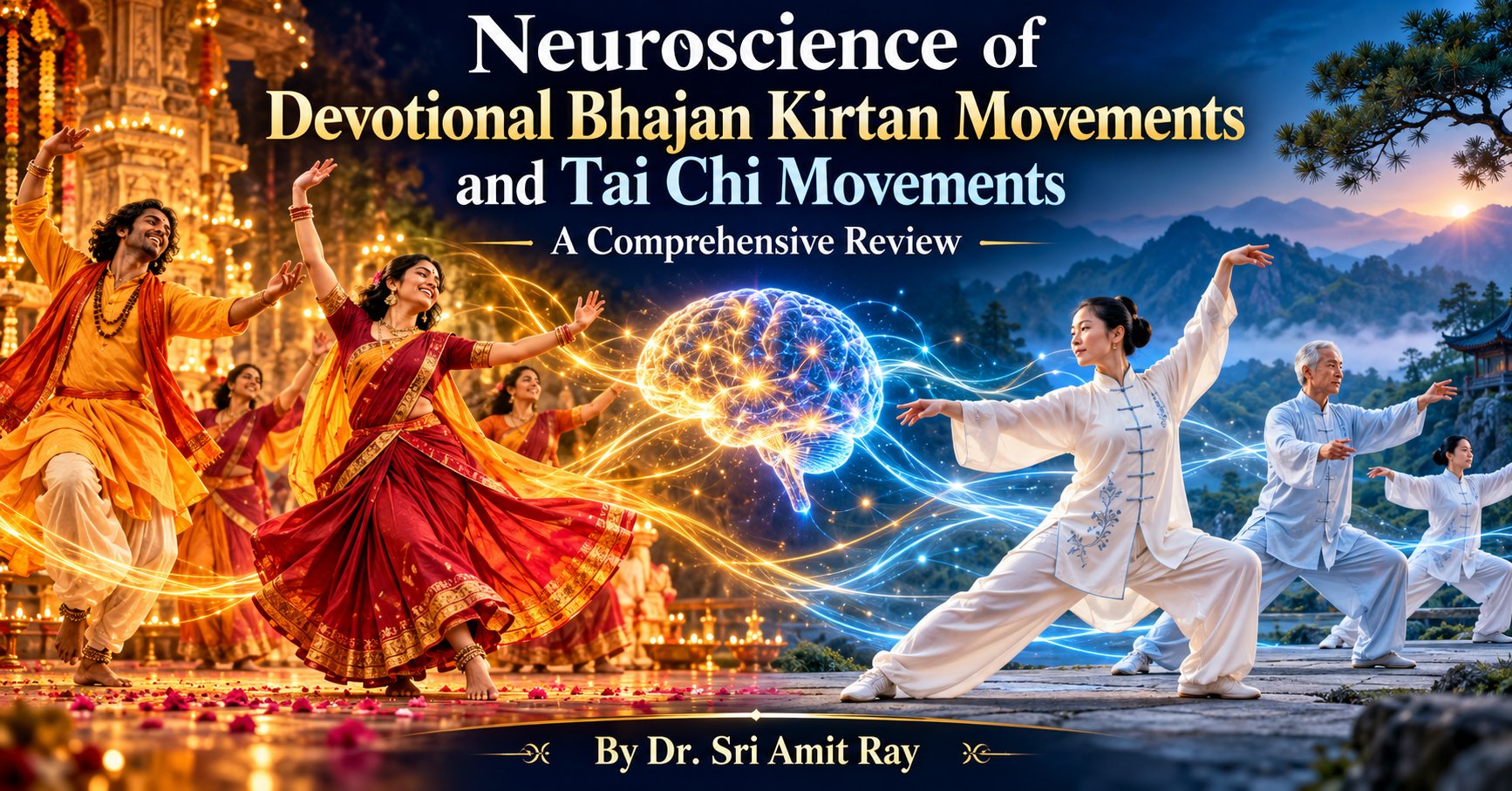
In the tradition of Sri Amit Ray, there are 114 chakras in human body: the 108 chakras are inside the body and the 6 chakras ore outside the body. The dances in Devotional Bhajan Kirtan movements focus on activating the total 114 chakras, and in the Tai Chi movements the 108 internal chakras are focused deeply. The Bhajan Kirtan with mantra chanting releases the stress chakras, and the Tai chi movements releases the weight-reduction body chakras. This article reviews the neuroscientific analysis of the both the techniques.
Abstract
Devotional Bhajan Kirtan and Tai Chi are two rich forms of embodied practice in which rhythm, attention, breathing, movement, and subjective experience become closely linked. Tai Chi is a slow, continuous mind–body movement system with a substantial scientific literature spanning balance, executive function, memory, functional connectivity, and neural plasticity. Bhajan, including Kirtan and related devotional singing traditions, introduces a different configuration of mind–body engagement: rhythmic vocalization, melody, meaningful sacred language, emotional expression, interpersonal synchrony, and—often—coordinated physical movement.
Recent neuroscience provides a useful bridge between these traditions. A 2025 systematic review of 24 neuroimaging studies of chanting reported recurring involvement of prefrontal, insular, and cingulate regions associated with attention and emotional regulation, together with changes in default-mode-network activity and increased theta activity in EEG studies [1]. Experimental studies of religious chanting have reported changes in posterior cingulate network organization and altered neural responses during exposure to negative emotional stimuli. Tai Chi research, including systematic reviews and a recent activation-likelihood meta-analysis, has identified changes in functional brain organization and networks associated with cognitive and motor control.
The central scientific value of comparing Bhajan and Tai Chi is not to reduce either tradition to a single brain region or biomarker. It is to understand how different combinations of rhythm, movement, attention, emotion, sound, breath, meaning, and social participation may organize the brain and body. Bhajan offers a particularly interesting multimodal model because devotional sound and rhythmic movement can operate simultaneously across auditory, motor, affective, interoceptive, and social systems. Tai Chi provides a complementary model in which continuous movement, balance, proprioception, breathing, and attentional control are integrated into a sustained sensorimotor practice. This review synthesizes the current evidence, proposes an integrated six-stage model of Bhajan movement, and outlines concrete research directions for direct comparative studies.
Keywords: Bhajan; Kirtan; devotional singing; religious chanting; Tai Chi; neuroscience; EEG; fMRI; default mode network; emotion regulation; social synchrony; embodied awareness; contemplative movement.
Cite as: Ray, Amit. “Neuroscience of Devotional Bhajan Kirtan and Tai Chi Movements – A Comparative Study.” Compassionate AI 3.9 (2026): 78-80, Compassionate AI Lab, https://sriamitray.com/neuroscience-of-devotional-bhajan-kirtan-and-tai-chi-movements/.
1. Introduction
Human beings have always used rhythm and coordinated movement to regulate attention, express emotion, strengthen social relationships, and create shared states of meaning. Devotional singing and Tai Chi represent two sophisticated cultural expressions of this broader human capacity. They differ in history and form, yet both provide unusually rich natural settings for studying the interaction between brain, body, attention, and consciousness.
Bhajan is commonly experienced as sung devotion. Depending on tradition and setting, it may involve repeated sacred names, melodic phrases, call-and-response, harmonium or other instruments, clapping, swaying, walking, circular movement, or ecstatic dance. Kirtan similarly places repetition and collective musical participation at the center of practice. The experience is therefore simultaneously auditory, vocal, motor, emotional, cognitive, and social. Contemporary forms such as collective “bhajan clubbing” further illustrate how these practices continue to evolve while retaining their core rhythmic and affective architecture.
Tai Chi, by contrast, organizes attention through slow and continuous movement. Posture, weight transfer, balance, breathing, proprioception, visual orientation, and intentional control are woven into flowing sequences. Contemporary research increasingly describes Tai Chi as a multimodal intervention rather than simply a form of exercise. Its scientific literature is substantially larger than that of Bhajan, especially with respect to cognitive aging, balance, and structural neuroplasticity.
This review brings these two traditions into a common neuroscientific framework organized around five themes: rhythm, attention, emotion, embodied awareness, and social synchrony. The discussion gives particular attention to the emerging neuroscience of chanting and devotional vocal practice, while drawing on music and synchrony research to illuminate the additional dimensions introduced when singing is combined with coordinated movement. The goal is both explanatory and generative: to clarify what each practice uniquely reveals about the brain, and to propose a research agenda that can test these claims more rigorously.
2. A Neuroscientific Framework for Rhythmic Mind–Body Practice
A useful way to understand both traditions is as interacting layers rather than isolated techniques. The brain does not process a movement, a sound, an emotion, and a social cue in separate compartments. Rhythmic practices continually couple prediction, perception, action, breathing, interoception, memory, and affect. The following table summarizes the principal layers and how each tradition instantiates them.
| Layer | Bhajan / Kirtan | Tai Chi |
|---|---|---|
| Rhythm | Repetition of sacred syllables, melody, percussion, clapping and coordinated movement. | Continuous temporal sequencing of posture, weight transfer and breath. |
| Attention | Sustained attention to voice, text, melody, rhythm and devotional object. | Attention distributed across movement, balance, breathing, spatial orientation and bodily sensation. |
| Emotion | Devotional meaning, musical expression, memory, awe, joy, calm and shared affect. | Calm, focused engagement and stress regulation through controlled movement and breathing. |
| Embodied awareness | Voice, breath, movement, hearing, touch, vestibular sensation and interoception may converge. | Proprioception, vestibular processing, posture, balance, respiration and motor prediction are central. |
| Social synchrony | Call-and-response, group singing, clapping and coordinated movement can synchronize participants. | Class practice can create shared timing, although the movement sequence itself remains the principal organizing structure. |
| Meaning | Sacred names, narratives, prayer and devotional intention can shape the emotional and attentional context. | Traditional martial-art and health philosophy provides meaning, while contemporary practice may be secular or therapeutic. |
This layered view makes clear that the two practices are not competitors for a single “best” neural outcome. They are complementary experimental systems that weight the same underlying processes differently. Bhajan weights auditory–vocal rhythm, semantic–devotional meaning, and social synchrony more heavily; Tai Chi weights continuous motor prediction, balance, and proprioceptive control more heavily. See also the comparative table in Section 6.
3. Neuroscience of Devotional Bhajan and Chanting
3.1 Chanting as rhythmic attention
The strongest current neuroscience synthesis is the systematic review by Perry, Wolff, Powers, Thompson, and Baumann (2025) in WIREs Cognitive Science. The review identified 24 neuroimaging studies from an initial pool of 899 records. Across chanting, mantra, and repetitive prayer studies, the literature repeatedly implicated prefrontal, insular, and cingulate regions involved in attention, salience, emotional regulation, and bodily awareness. Changes in default-mode-network regions, particularly the posterior cingulate cortex and hippocampus, were also reported, while EEG studies frequently observed increased theta activity.
For Bhajan, the significance of these findings lies in the combination of repetition and meaning. Repeated vocal phrases reduce the number of competing linguistic choices while melody and rhythm provide a predictable temporal structure. The performer can therefore maintain attention on a stable auditory and semantic object while breathing, vocalization, and bodily movement unfold within the same rhythmic frame. This dual constraint—acoustic predictability plus semantic stability—may be especially effective at reducing mind-wandering and stabilizing the attentional network.
3.2 Posterior cingulate cortex and self-referential processing
Gao et al. (2019), in Scientific Reports, used multimodal electrophysiological and neuroimaging methods to study religious chanting. During chanting, the posterior cingulate cortex (PCC) showed the largest decrease in eigenvector centrality, accompanied by evidence of endogenous delta activity in that region. The reported effects were not explained by peripheral cardiac or respiratory changes or by implicit language processing. The posterior cingulate is a major component of the default mode network, making this result especially relevant to theories of reduced self-referential processing during contemplative repetition.
In practical terms, the finding provides a neural framework for an experience frequently described in sustained devotional practice: attention becomes less occupied by spontaneous internal narrative and more continuously organized around the repeated sound, devotional object, and shared rhythm. Subsequent work has shown that religious chanting produces stronger PCC centrality decreases and higher delta power than non-religious chanting, suggesting that the intentional and semantic content of the practice contributes measurably to the observed neural pattern. These findings are directly relevant to the proposed six-stage model of Bhajan movement.
3.3 Emotion and devotional meaning
Religious meaning adds another layer to rhythmic repetition. Gao et al. (2020) used multimodal MRI while experienced participants practiced religious chanting while viewing fearful images. Relative to non-religious chanting and no chanting, religious chanting was associated with greater activity in several cortical and subcortical regions, including prefrontal cortex, parietal regions, amygdala, thalamus, and midbrain. The investigators interpreted the pattern as consistent with a positive emotional schema that can counterbalance negative emotional processing.
This is important for understanding devotional Bhajan because the words are not acoustically neutral. Sacred names and verses can carry autobiographical memory, cultural identity, spiritual expectation, and emotional significance. Sound and meaning therefore arrive together. In a Bhajan setting, melody and rhythm can repeatedly reactivate that meaning while the body participates through breathing, clapping, swaying, or dance. The combination of semantic depth and rhythmic structure may help explain why group kirtan often produces rapid shifts in reported affect and physiological calm.
3.4 Music, reward, and emotional arousal
Music research provides an additional mechanistic bridge. Salimpoor et al. (2011), using PET and fMRI, demonstrated endogenous dopamine release in the striatum during peak emotional responses to music. The caudate was particularly involved during anticipation, while the nucleus accumbens was associated with peak pleasurable experience. This finding helps explain why musical structure can create powerful cycles of anticipation, resolution, emotional arousal, and reward.
Devotional music can add semantic and personal meaning to this general musical architecture. A repeated refrain may build anticipation; the group response may provide rhythmic reinforcement; and the return of a familiar sacred phrase can combine musical expectation with memory and emotional significance. The result is a reward system that is simultaneously musical, mnemonic, and motivational. See also the discussion of social synchrony and oxytocin in the next section.
4. Movement, Rhythm, and Embodied Awareness in Bhajan
Bhajan movement is especially interesting from the perspective of embodied neuroscience. A person who sings while clapping, swaying, stepping, or dancing is not performing an auditory task followed by a motor task. The two are coupled in time. Auditory rhythm can predict movement; movement generates proprioceptive and vestibular feedback; vocalization regulates respiration; and emotional expression changes posture, facial movement, and autonomic state.
This coupling creates a continuously updating sensorimotor loop. The rhythm provides temporal prediction, the body supplies feedback, and the emotional meaning of the song determines how the experience is interpreted. In group Kirtan, this loop extends beyond the individual: each participant hears the collective sound, observes or senses the movement of others, and adjusts timing in relation to the group. The resulting state is therefore both intrapersonal and interpersonal.
Research on musical synchrony supports the importance of this social dimension. Launay, Tarr, and Dunbar (2014) reviewed evidence linking musical synchrony with social bonding through interpersonal synchrony and neurochemical mechanisms involving the endogenous opioid system. A meta-analysis by Rennung and Göritz (2016), covering 42 independent studies and 4,327 participants, found positive effects of synchronous action on prosocial behavior, perceived social bonding, social cognition, and positive affect.
Group singing provides a more direct physiological example. In a controlled study of young adult choir participants, Fancourt and colleagues examined singing versus speaking and together versus alone. Oxytocin and cortisol changed across conditions, with the oxytocin decrease being smaller after singing than speaking and oxytocin concentrations higher after singing together than speaking together after adjustment for baseline differences. Such findings make collective vocalization an important model for investigating affiliation and social regulation. When collective vocalization is further coupled with coordinated movement—as is common in many Bhajan and Kirtan settings—the social and physiological effects may be amplified.
5. Neuroscience of Tai Chi Movements
5.1 Neural organization of continuous movement
Tai Chi offers a complementary model of embodied attention. The movement is deliberately slow, continuous, and temporally structured. Weight shifts, trunk rotation, limb trajectories, balance, breathing, and visual orientation must be integrated while the practitioner maintains an internally guided attentional state. This sustained integration places continuous demands on motor planning, proprioceptive monitoring, and executive control.
Pan et al. (2018) systematically reviewed neuroimaging and EEG studies of Tai Chi in healthy older adults. Eleven studies were included: six fMRI studies, four EEG studies, and one MRI study. The review reported changes involving cortical thickness, functional connectivity, regional brain homogeneity, and executive-network function. The authors concluded that Tai Chi was associated with beneficial neurological changes and highlighted the value of integrating neuroimaging into well-controlled intervention trials.
5.2 Functional neuroimaging synthesis
Wang et al. (2025) performed an activation-likelihood-estimation meta-analysis of functional neuroimaging studies of Tai Chi. The synthesis identified consistent functional brain changes across the included literature, with significant convergence involving the superior frontal gyrus among other reported findings. The study strengthens the case that Tai Chi has reproducible neural correlates beyond individual experimental observations. Additional work has linked long-term practice to increased gray-matter volume in hippocampal and prefrontal regions and to improved functional connectivity within and between large-scale networks.
5.3 Cognitive and physical function
The clinical literature adds an important behavioral dimension. Park et al. (2023) analyzed 17 randomized studies involving 2,365 older adults and found significant effects of Tai Chi/Qigong on cognitive and physical functions. Cognitive effects remained significant when physical function was considered in meta-regression, supporting both direct and indirect pathways between movement practice and cognitive health.
A 2023 systematic review and meta-analysis focused specifically on older adults with mild cognitive impairment and included 11 randomized trials with 905 participants. Tai Chi produced significant improvements in executive function, episodic memory, visuospatial function, and global cognition. Together, these studies position Tai Chi as a strong example of how sustained mind–body movement can influence both behavior and brain-related function. Its evidence base for cognitive aging and motor rehabilitation remains substantially larger and more mature than the corresponding literature for Bhajan.
6. Comparative Neuroscience: Two Pathways of Rhythmic Embodiment
The most revealing contrast between Bhajan and Tai Chi is the way each practice organizes rhythm. In Tai Chi, rhythm is primarily generated through the timing of movement and breath. In Bhajan, rhythm is often externally and internally reinforced by voice, melody, percussion, repetition, and group response, with movement becoming coupled to that musical structure. This difference has downstream consequences for the systems that are recruited and for the kinds of outcomes each practice most readily produces.
| Dimension | Devotional Bhajan / Kirtan | Tai Chi | Neuroscientific significance |
|---|---|---|---|
| Rhythm | Voice, melody, percussion, repetition, call-and-response, movement. | Continuous movement sequences and breath. | Both use temporal prediction; Bhajan adds a strong auditory-vocal scaffold. |
| Attention | Sacred words, melody, repetition and collective participation. | Movement precision, balance, breathing and bodily sensation. | Both train sustained attention, but through different sensory anchors. |
| Emotion | Devotional meaning, musical reward, memory, shared affect. | Calm, focused movement and stress regulation. | Bhajan explicitly integrates affective meaning into the practice. |
| Embodied awareness | Auditory, vocal, respiratory, motor, vestibular and interoceptive coupling. | Proprioceptive, vestibular, motor and respiratory coupling. | Bhajan can create a particularly broad multimodal loop. |
| Social synchrony | Central in group Kirtan through shared voice and movement. | Present in group classes but not intrinsic to every form. | Synchrony provides a pathway for bonding and collective regulation. |
| Neural adaptation | Emerging evidence from chanting and contemplative practice. | Substantial neuroimaging and intervention literature. | Tai Chi has the larger movement-specific evidence base; Bhajan offers a distinctive research opportunity. |
7. The Value of a Multimodal Bhajan Model
The neuroscientific value of Bhajan becomes especially visible when its components are considered together. Vocalization engages auditory and speech-motor systems. Melody organizes prediction and emotional response. Repetition stabilizes attention. Sacred language activates semantic and autobiographical meaning. Movement adds proprioceptive and vestibular feedback. Breath links vocal production to autonomic regulation. Group participation adds interpersonal synchrony and social meaning.
This creates a distinctive architecture of practice: sound organizes movement; movement reinforces rhythm; rhythm stabilizes attention; attention deepens the experience of meaning; and shared participation can transform an individual practice into a collective experience. The resulting state is not simply meditation with music. It is a coordinated auditory-motor-affective-social process.
Tai Chi demonstrates a different but equally sophisticated architecture. The practitioner repeatedly predicts the next movement, controls weight transfer, monitors balance, regulates breathing, and maintains a continuous internal attentional map. Over time, repeated practice provides a rich training environment for sensorimotor integration and cognitive-motor coordination. Seen this way, Bhajan and Tai Chi are complementary scientific models rather than competitors for a single explanatory prize. The six-stage model below formalizes the Bhajan architecture for experimental use.
8. A Proposed Neuroscientific Model for Bhajan Movement
Building on the evidence reviewed above, a useful working model can be expressed as a six-stage loop:
- Rhythmic entrainment — repeated beat, melody and vocal phrase provide temporal prediction.
- Attentional anchoring — repeated sacred sound and text stabilize attention and reduce competing streams of thought.
- Embodied coupling — vocalization, breathing, clapping, swaying or dancing connect auditory timing with motor and interoceptive feedback.
- Emotional amplification — melody, devotional meaning, autobiographical memory and reward processes give the rhythmic pattern emotional significance.
- Social synchrony — shared singing and coordinated movement align participants in time and can strengthen affiliation and prosocial experience.
- Integration — repeated practice may reinforce a learned relationship among sound, body, emotion, attention and meaning.
This model provides a practical research architecture for future Bhajan neuroscience. Rather than measuring meditation as a single variable, investigators can separately measure vocal rhythm, movement synchrony, respiratory coupling, emotional valence, devotional meaning, autonomic response, EEG dynamics, and functional connectivity. Each stage of the loop can be experimentally isolated or jointly manipulated, allowing causal tests of the proposed mechanisms. See Section 9 for concrete experimental designs.
9. Research Directions
The next generation of studies can move beyond parallel literatures toward direct experimental comparisons. A particularly useful design would compare matched sessions of (a) devotional Bhajan with movement, (b) devotional singing without movement, (c) non-devotional rhythmic singing with movement, (d) silent rhythmic movement such as Tai Chi, and (e) quiet resting control.
- Use simultaneous EEG, ECG/HRV, respiration, and motion capture to measure neural, autonomic, and movement synchrony.
- Use fMRI or mobile neuroimaging where practical to examine default-mode, salience, auditory, motor, limbic, and executive networks.
- Measure the semantic and devotional meaning of the repertoire rather than treating all chanting as equivalent.
- Separate the effects of music, vocalization, movement, breath, group synchrony, and devotional intention.
- Track both acute responses and long-term changes in cognition, emotional regulation, social connectedness, and embodied awareness.
- Include practitioners from different Bhajan and Kirtan traditions so that the neuroscience reflects the diversity of actual practice.
10. Conclusion
Devotional Bhajan and Tai Chi reveal two powerful ways in which rhythmic practice can organize the human brain and body. Tai Chi develops a sustained conversation between movement, balance, breathing, proprioception, attention, and cognitive control. Bhajan adds a highly expressive auditory and social dimension in which voice, melody, repetition, sacred meaning, emotional experience, and rhythmic movement can operate together.
The neuroscience of chanting now provides evidence for involvement of attention and emotion-regulation networks, changes in default-mode-network organization, and characteristic EEG activity. Research on music and interpersonal synchrony further shows how rhythmic participation can influence reward, affiliation, prosocial behavior, and shared experience. At the same time, Tai Chi has accumulated a substantial evidence base demonstrating neural, cognitive, and physical effects.
The deeper scientific opportunity lies in studying these traditions as distinct architectures of embodied consciousness. Tai Chi demonstrates how deliberate movement and breath can become a sustained attentional practice. Bhajan demonstrates how sound, rhythm, devotion, emotion, movement, and social synchrony can converge into a unified experience. Together, they point toward a broader neuroscience of rhythmic embodiment—one in which brain, body, emotion, meaning, and relationship are studied as a connected system.
References
- Perry G, Wolff L, Powers N, Thompson WF, Baumann O. Neural Correlates of Chanting: A Systematic Review. WIREs Cognitive Science. 2025;16(6):e70018. doi:10.1002/wcs.70018.
- Gao J, Leung HK, Wu BWY, Skouras S, et al. The neurophysiological correlates of religious chanting. Scientific Reports. 2019;9:4262. doi:10.1038/s41598-019-40200-w.
- Gao J, Skouras S, Leung HK, Wu BWY, Wu H, Chang C, Sik HH. Repetitive Religious Chanting Invokes Positive Emotional Schema to Counterbalance Fear: A Multi-Modal Functional and Structural MRI Study. Frontiers in Behavioral Neuroscience. 2020;14:548856. doi:10.3389/fnbeh.2020.548856.
- Pan Z, Su X, Fang Q, Hou L, Lee Y, Chen CC, Lamberth J, Kim ML. The Effects of Tai Chi Intervention on Healthy Elderly by Means of Neuroimaging and EEG: A Systematic Review. Frontiers in Aging Neuroscience. 2018;10:110. doi:10.3389/fnagi.2018.00110.
- Wang S, Liu T, Du J, Chen J, Luo X, Meng Y, Zeng C, Zhang X, Shao B. Taichi on the brain: an activation likelihood estimated meta-analysis of functional neuroimaging data. Frontiers in Human Neuroscience. 2025;18:1493677. doi:10.3389/fnhum.2024.1493677.
- Park M, Song R, Ju K, Shin JC, Seo J, Fan X, Gao X, Ryu A, Li Y, et al. Effects of Tai Chi and Qigong on cognitive and physical functions in older adults: systematic review, meta-analysis, and meta-regression of randomized clinical trials. BMC Geriatrics. 2023;23:352. doi:10.1186/s12877-023-04070-2.
- Salimpoor VN, Benovoy M, Larcher K, Dagher A, Zatorre RJ. Anatomically distinct dopamine release during anticipation and experience of peak emotion to music. Nature Neuroscience. 2011;14:257–262. doi:10.1038/nn.2726.
- Launay J, Tarr B, Dunbar RIM. Synchrony in music and social bonding. Frontiers in Psychology. 2014;5:1096. doi:10.3389/fpsyg.2014.01096.
- Rennung M, Göritz AS. Prosocial consequences of interpersonal synchrony: a meta-analysis. Social Psychology. 2016;47(6):354–367. doi:10.1027/1864-9335/a000286.
- Fancourt D, et al. Endogenous oxytocin, cortisol, and testosterone in response to group singing. Peer-reviewed study, 2022. PMCID: PMC8915780.
- Effectiveness of Tai Chi on cognitive function among older adults with mild cognitive impairment: a systematic review and meta-analysis of randomized controlled trials. Aging & Mental Health. 2023;28(2):285–293. doi:10.1080/13607863.2023.2253183.
- Alvarez VY. The Underlying Mechanisms of Social Bonding in Choral Singing: A Review of the Literature. Applications of Research in Music Education. 2026. doi:10.1177/87551233261445085.
- Ray, Amit. "Meditation and the Oxygen Consumption of the Brain." Compassionate AI, 4.12 (2017): 21-23. https://sriamitray.com/research/meditation-oxygen-consumption-brain/.
- Ray, Amit. "Deep Compassion: Neuroscience and the 114 Chakras." Compassionate AI, 1.3 (2021): 66-68. https://sriamitray.com/research/compassion-neuroscience-nadis-114-chakras/.
- Ray, Amit. "Reticular Activating System for Manifestation and Visualization and 114 Chakras." Compassionate AI, 1.5 (2021): 3-5. https://sriamitray.com/research/reticular-activating-system-manifestation/.
- Ray, Amit. "Neurotransmitters and Your Seven Chakras: Balancing Your Body, Mind, and Brain." Compassionate AI, 1.3 (2023): 6-8. https://sriamitray.com/teachings/neurotransmitters-seven-chakras/.
- Ray, Amit. "The Neuroscience of a Winning Mindset: The Brain’s Blueprint for Success." Yoga and Ayurveda Research, 15.1 (2023): 45-49. https://sriamitray.com/research/neuroscience-winning-mindset-brains-blueprint-success/.
- Ray, Amit. "Slow Breathing Yoga Pranayama to Reduce Oxidative Stress." Compassionate AI, 1.3 (2024): 15-17. https://sriamitray.com/teachings/slow-breathing-yoga-pranayam-reduce-oxidative-stress/.
- Ray, Amit. "Neuroscience of Samadhi: Brainwaves, Neuroplasticity, and Deep Meditation." Compassionate AI, 3.9 (2024): 48-50. https://sriamitray.com/research/neuroscience-samadhi/.
- Ray, Amit. "Benefits and Neuroscience of Ek-Sruti Mantra Chanting." Yoga and Ayurveda Research, 3.9 (2024): 90-92. https://sriamitray.com/research/benefits-neuroscience-ek-sruti-mantra-chanting/.
- Ray, Amit. "Brain Fluid Dynamics of CSF, ISF, and CBF: A Computational Model." Compassionate AI, 4.11 (2024): 87-89. https://sriamitray.com/teachings/brain-fluid-dynamics-csf-isf-cbf-computational/.
- Ray, Amit. "Brain Metabolism and Ayurveda Agni: A Mathematical Model for Personalized Medicine." Yoga and Ayurveda Research, 3.7 (2025): 57-59. https://sriamitray.com/teachings/brain-metabolism-ayurveda/.
- Ray, Amit. "Music Therapy and BDNF Signaling in Aging Brain: A Systematic Review." Compassionate AI, 3.8 (2025): 84-86. https://sriamitray.com/teachings/music-therapy-bdnf-signaling-aging-brain-systematic/.
- Ray, Amit. "Neuroscience of the HPA Axis: 9 Primary Functions – A Scientific Review." Compassionate AI, 4.12 (2025): 69-71. https://sriamitray.com/research/neuroscience-hpa-axis/.
- Ray, Amit. "Neuroscience of the Soul’s Journey Through Uttarayana: Biology and Consciousness." Yoga and Ayurveda Research, 1.1 (2026): 15-17. https://sriamitray.com/research/neuroscience-souls-journey-through-uttarayana/.
- Ray, Amit. "Neuroscience of Sri Rudram Chamakam Anuvaka 11: Brain Chakras, RAS & Numbering Meditation – The Sri Amit Ray 114 Chakras." Compassionate AI, 2.6 (2026): 72-74. https://sriamitray.com/research/neuroscience-sri-rudram-chamakam-anuvaka-11-brain/.
- Ray, Amit. "Neuroscience of Devotional Bhajan Kirtan and Tai Chi Movements – A Comparative Study." Compassionate AI, 3.9 (2026): 78-80. https://sriamitray.com/research/neuroscience-devotional-bhajan-kirtan-tai-chi-movements/.
Source and Editorial Note
The principal references were checked against publisher, PubMed, or PubMed Central records during preparation, including the 2025 chanting systematic review, the Scientific Reports religious-chanting study, the 2020 multimodal MRI study, the Tai Chi neuroimaging systematic review, and the 2025 Tai Chi activation-likelihood meta-analysis. This document is intended for educational and research purposes and is not a substitute for clinical advice, diagnosis, or treatment.
Author: Dr. Sri Amit Ray, PhD · Compassionate AI Lab · amitray.com