
This review synthesizes the emerging intersection of Agentic AI and cardiovascular prevention. It distinguishes conventional predictive AI from agentic systems, proposes a prevention-oriented agent architecture, maps potential applications across primordial, primary, secondary, and population prevention, and examines clinical reasoning, multimodal data integration, personalized intervention planning, longitudinal monitoring, human oversight, safety, explainability, fairness, cybersecurity, regulation, and evaluation. A central argument is that Agentic AI should not be understood as an autonomous cardiologist.
Keywords: Agentic AI; cardiovascular disease; heart disease prevention; artificial intelligence; autonomous agents; clinical decision support; large language models; multimodal AI; preventive cardiology; risk prediction; remote monitoring; medication adherence; explainable AI; digital health; healthcare governance
1. Introduction
Cardiovascular disease remains the dominant global cause of death and disability, making prevention one of the most consequential areas for clinical artificial intelligence. Artificial intelligence is already being studied across cardiovascular risk prediction, electrocardiography, imaging, biomarker discovery, lifestyle modification, medication adherence, and clinical decision support. Recent reviews describe AI as potentially transformative for preventive cardiology, while also emphasizing the need for clinical trials and implementation evidence. Keser et al., 2026; Krittanawong et al., 2024.
Most existing cardiovascular AI, however, is predictive or assistive. A model receives data and returns a risk score, classification, image interpretation, or recommendation. Agentic AI represents a different computational paradigm. An agent can maintain a goal, perceive information, reason over intermediate states, invoke tools, retrieve knowledge, maintain memory, take bounded actions, observe outcomes, and revise its plan. A 2026 scoping review describes Agentic AI in healthcare as an emerging area and notes the lack of conceptual clarity between AI agents and Agentic AI, while emphasizing that evidence remains limited and safety-critical deployment requires additional validation. Forte et al., 2026.
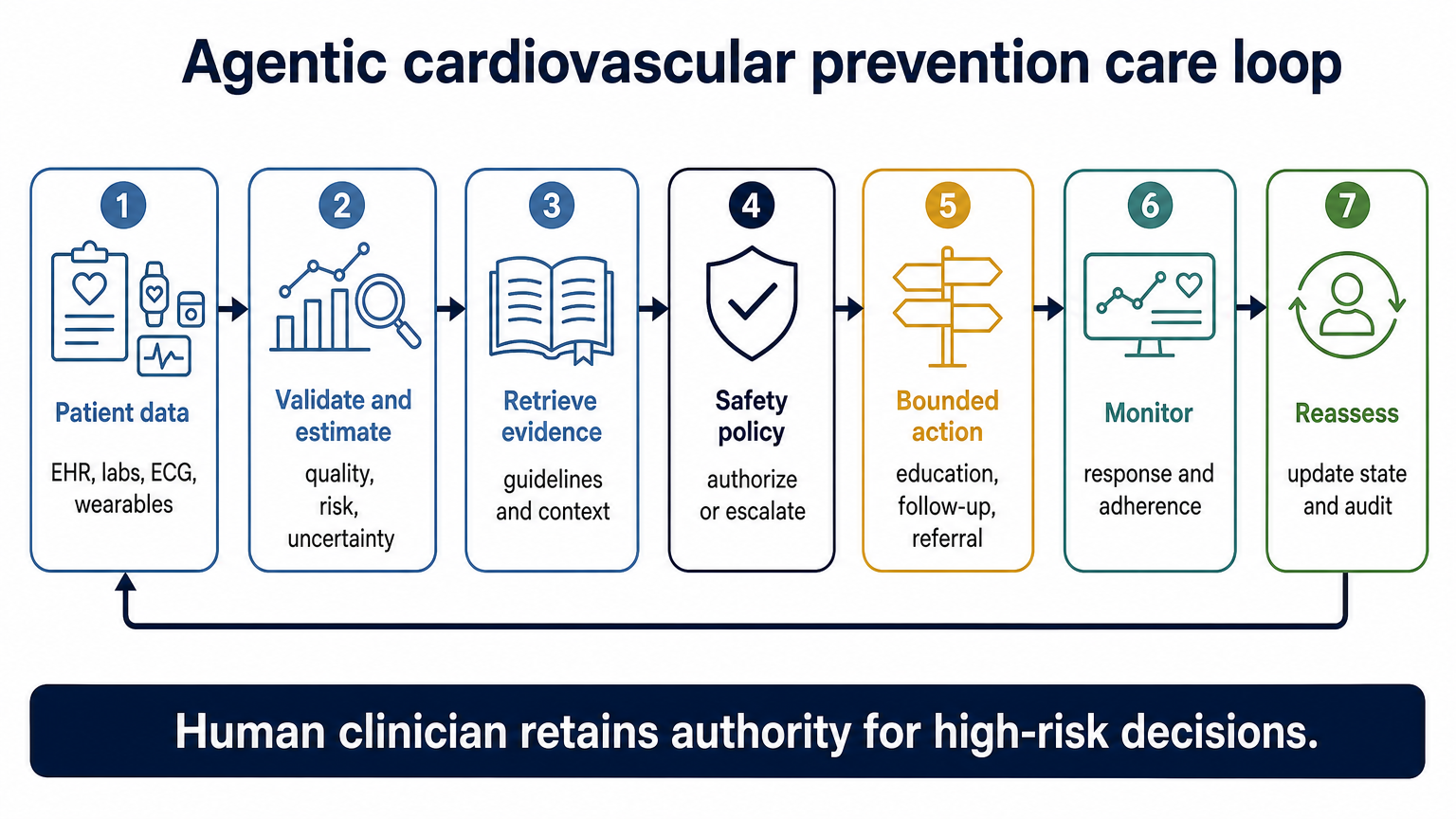
The key question for preventive cardiology is therefore not whether an agent can generate a cardiovascular recommendation. The more important question is whether an agent can safely coordinate a closed-loop prevention process: identify risk, determine what information is missing, retrieve appropriate evidence, coordinate validated predictive tools, communicate personalized options, monitor adherence and response, detect deterioration, and escalate to a clinician when predefined safety conditions are met.
2. Review Objectives and Conceptual Scope
This is a narrative, evidence-informed comprehensive review focused on the intersection of Agentic AI and prevention of cardiovascular disease. It is designed to identify clinically meaningful applications, technical architectures, safety requirements, evidence gaps, and a research agenda suitable for future empirical studies.
2.1 Review questions
- What distinguishes Agentic AI from conventional predictive and generative AI in cardiovascular prevention?
- Which components of the cardiovascular prevention pathway are most suitable for agentic orchestration?
- How can validated clinical risk models, ML models, LLMs, EHRs, wearable sensors, ECGs, imaging, and patient-generated data be integrated?
- What safety, governance, fairness, privacy, and cybersecurity controls are required?
- What evidence is necessary before Agentic AI can move from research prototypes to clinical prevention workflows?
3. From Predictive AI to Agentic AI
Conventional machine learning generally implements a mapping from input variables to an output:
A generative model extends this by producing language, plans, explanations, or other content:
An agent introduces a persistent goal and an iterative control loop:
For cardiovascular prevention, a governed agent can be represented as:
where G is the clinical goal, P is the planning module, M is memory/state, T is the authorized tool set, K is the evidence and knowledge layer, R is the risk/safety policy, O is observation and monitoring, and H is human oversight.
3.1 Important distinction
Agentic AI should not be defined merely as an LLM that produces a long answer. The clinically relevant distinction is goal-directed, stateful, tool-using, feedback-aware behavior under explicit constraints.
4. Why Cardiovascular Prevention Is a Strong Candidate for Agentic AI
Prevention is inherently longitudinal. Cardiovascular risk is influenced by blood pressure, lipid exposure, diabetes, smoking, adiposity, physical activity, diet, sleep, medication adherence, kidney function, age, family history, psychosocial factors, environmental exposures, and established disease. These variables change over time and are distributed across healthcare encounters and digital environments.
Traditional clinical workflows often separate these tasks. A risk calculator may be used during one visit, laboratory testing at another, medication reconciliation elsewhere, and lifestyle counselling through a different service. Agentic AI could potentially act as an orchestration layer across these fragmented processes.
The opportunity is especially relevant because recent cardiovascular prevention reviews identify AI applications across nutrition, weight management, physical activity, sleep, blood pressure, dyslipidemia, smoking, medication adherence, and mental health. Krittanawong et al., 2024. A 2026 scoping review specifically examined AI tools for cardiovascular risk prediction, while another 2026 review addressed AI-based medication-adherence monitoring in cardiovascular disease. Pai et al., 2026; Bebarta et al., 2026.
5. Cardiovascular Prevention Across the Agentic Continuum
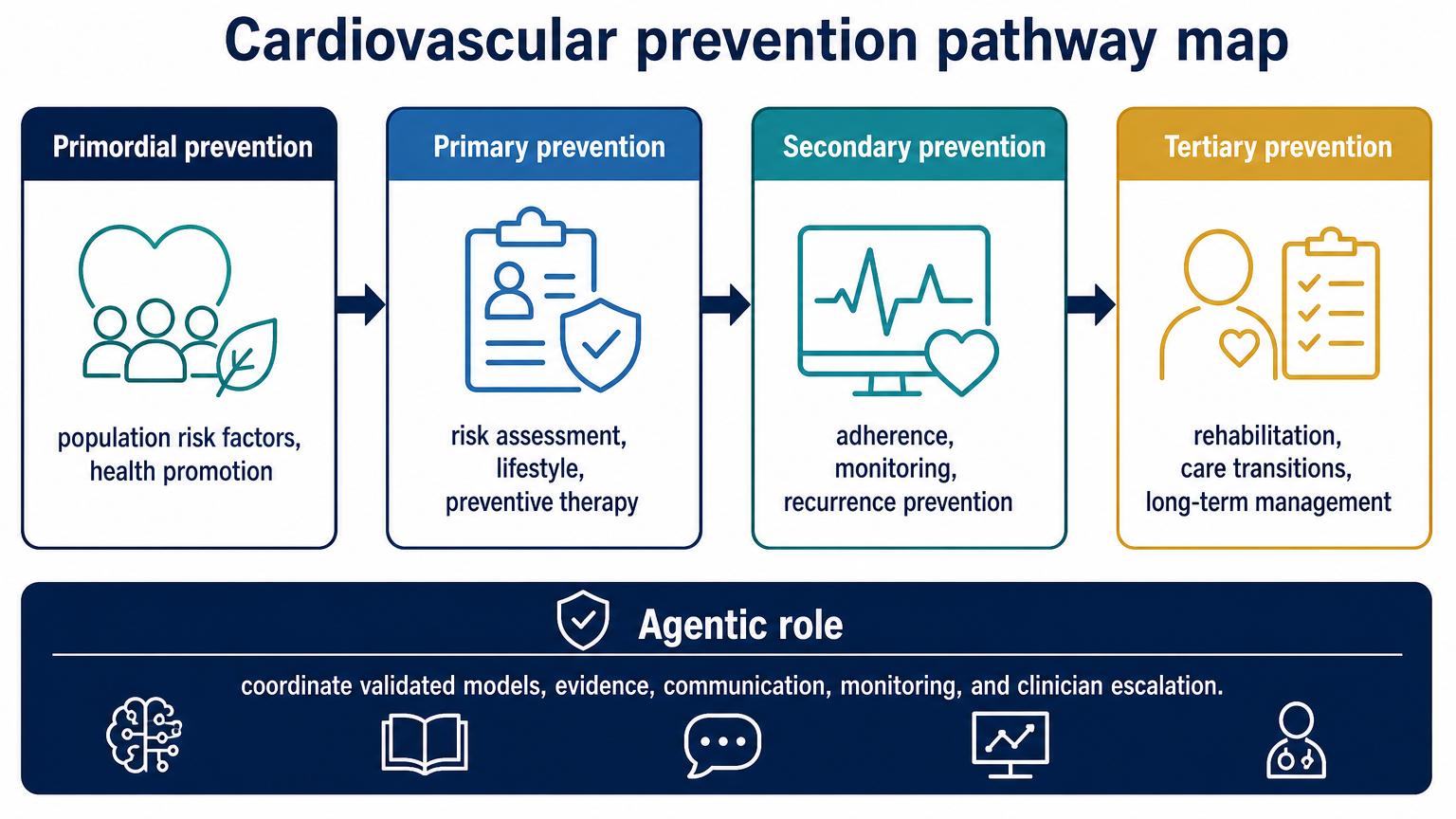
| Prevention level | Agentic opportunity | Example governed workflow | Evidence maturity |
|---|---|---|---|
| Primordial | Population-level risk-factor surveillance and health promotion | Identify communities with rising risk; coordinate education and screening campaigns | Early/emerging |
| Primary | Personalized risk assessment and prevention planning | Integrate EHR, laboratory, lifestyle and family-history information; calculate validated risk | AI evidence growing; agent evidence limited |
| Secondary | Adherence, monitoring and recurrence prevention | Monitor medications, BP, symptoms and follow-up; detect deviations and escalate | Promising AI evidence; agent-specific outcomes limited |
| Tertiary | Long-term disease-management orchestration | Coordinate monitoring, rehabilitation and care transitions | Emerging |
6. A Reference Architecture for Agentic Cardiovascular Prevention
 PATIENT / POPULATION DATA
 ┌──────────────────────────────────────────────────────────┐
 │ EHR │ Labs │ BP │ ECG │ Wearables │ Lifestyle │ Genomics │
 └────────────────────────────┬─────────────────────────────┘
                              ↓
                    PERCEPTION / DATA QUALITY
                              ↓
                  ┌────────────────────────┐
                  │ Clinical State Model   │
                  │ Risk factors           │
                  │ Trends / trajectories  │
                  │ Missing information    │
                  └───────────┬────────────┘
                              ↓
                       AGENT ORCHESTRATOR
             ┌────────────────┼─────────────────┐
             ↓                ↓                 ↓
       Risk models       Guideline RAG     Patient model
       ML / XGBoost      Evidence search   Preferences
       SCORE2*           Clinical policy   Context
       Framingham*       Contraindications Goals
             └────────────────┼─────────────────┘
                              ↓
                    PLANNING / REASONING
                              ↓
       ┌──────────────────────┼─────────────────────┐
       ↓                      ↓                     ↓
 Education            Monitoring plan       Clinician escalation
 Lifestyle            Medication support    Safety trigger
 Follow-up             Repeat testing        Urgent review
       └──────────────────────┼─────────────────────┘
                              ↓
                     TOOL EXECUTION LAYER
       EHR / Messaging / Scheduling / Calculators /
       Remote Monitoring / Clinical Decision Support
                              ↓
                         OBSERVATION
                              ↓
                    FEEDBACK + AUDIT LOG
                              ↓
                   HUMAN CLINICAL OVERSIGHT

 * Only where validated and applicable to the target population.
7. Agentic Components
7.1 Perception agent
The perception layer converts heterogeneous patient information into a clinically meaningful state. It may ingest structured EHR fields, laboratory results, ECG-derived features, wearable streams, home blood pressure, medication records, and clinical narratives.
Data provenance is essential. The system should preserve source, timestamp, measurement unit, reliability, and missingness rather than treating all inputs as equivalent.
7.2 Clinical knowledge agent
A retrieval-augmented generation layer can retrieve current clinical guidelines, validated risk-model specifications, medication information, and institutional protocols. The knowledge agent should provide citations or traceable evidence identifiers to downstream components.
Retrieval should be constrained by source authority, version date, patient population, and clinical context. An LLM should not be allowed to invent a guideline merely because a prompt requests one.
7.3 Risk-prediction agent
The risk-prediction layer should preferably call validated predictive models rather than asking an LLM to estimate cardiovascular probability from prose.
Where appropriate, traditional risk models can coexist with ML models. Their outputs should be calibrated and compared rather than blindly averaged.
7.4 Planning agent
The planning agent translates the clinical state into a sequence of bounded actions. For example:
- Check whether current risk assessment is valid.
- Identify missing high-value information.
- Retrieve relevant prevention guidance.
- Generate candidate interventions.
- Check contraindications and safety constraints.
- Present options to the clinician or patient according to authorization level.
- Schedule monitoring.
- Reassess response.
7.5 Monitoring agent
Prevention is a feedback problem. A monitoring agent can track trends rather than isolated values, detect non-adherence, identify missing follow-up, and trigger escalation rules.
7.6 Communication agent
Communication should be personalized without changing the underlying clinical recommendation. The agent can translate technical risk estimates into understandable language, support motivational interviewing workflows, generate culturally appropriate educational material, and provide reminders.
8. Agentic AI for Risk Prediction and Early Identification
AI-based cardiovascular risk prediction is one of the most established components of the proposed architecture. Recent systematic work has reviewed ML approaches for cardiovascular disease prediction, while 2026 reviews continue to identify strong potential for AI-enhanced preventive risk stratification. Wan et al., 2025; Keser et al., 2026.
The agentic contribution is not necessarily a new classifier. It is the ability to orchestrate several validated models and determine when each is appropriate.
For example:
When model estimates disagree substantially, the agent should not choose the higher value automatically. It should flag uncertainty, identify possible reasons for discordance, and request clinical review.
9. Agentic AI for ECG and Physiological Monitoring
ECG AI is an important component of cardiovascular prevention because ECGs are relatively accessible and can contain information beyond conventional rhythm interpretation. A 2026 systematic review and meta-analysis evaluated deep-learning approaches for ECG-based cardiovascular disease diagnosis, while other 2026 work has investigated clinically aligned reduced-lead ECG approaches. Bulbul et al., 2026; Sikandar et al., 2026.
An agent can potentially orchestrate ECG analysis as follows:
- Acquire ECG.
- Check signal quality.
- Call a validated ECG model.
- Compare with previous ECGs.
- Check symptoms and vital signs.
- Determine whether the result meets escalation criteria.
- Route the finding to the appropriate clinician.
The agent itself should not be considered the ECG classifier unless that functionality has been independently validated.
10. Agentic AI for Lifestyle Prevention
Lifestyle prevention is particularly suitable for personalized agentic workflows because the relevant variables are dynamic and behavioural.
10.1 Nutrition
An agent can combine dietary history, metabolic risk, preferences, cultural food patterns, budget constraints, and clinician-defined targets to generate a prevention plan. The system should distinguish nutritional education from medical nutrition therapy requiring professional supervision.
10.2 Physical activity
Wearable activity data can support adaptive goals. Instead of simply recommending exercise, the agent can monitor activity, detect declining adherence, and adjust reminders or educational strategies within predefined boundaries.
10.3 Smoking cessation
An agent can support structured behavioural interventions, track tobacco use, provide educational content, and coordinate clinician or cessation-service escalation. Medication recommendations should remain within validated clinical protocols and authorization boundaries.
10.4 Sleep and stress
AI systems can monitor sleep-related or behavioural signals and provide educational interventions. However, inferred mental-health or sleep diagnoses should not be treated as established clinical diagnoses without appropriate evaluation.
11. Medication Adherence and Secondary Prevention
Medication adherence is a major challenge in chronic cardiovascular disease. A 2026 scoping review specifically examined AI-based approaches for monitoring medication adherence among patients with CVD, demonstrating growing interest in digital methods for this problem. Bebarta et al., 2026.
An agentic adherence workflow could integrate:
- prescription history;
- refill data;
- patient-reported adherence;
- home measurements;
- side-effect reports;
- appointment attendance;
- clinician-defined medication plans.
The agent can then classify the reason for non-adherence and choose an appropriate communication pathway. For example, missed medication because of forgetfulness may trigger reminders, whereas side effects should trigger clinical review rather than simply more reminders.
12. Longitudinal Patient Digital Twins
A future direction is a longitudinal patient state model, sometimes described conceptually as a digital twin. Such a model should not be interpreted as a perfect simulation of human physiology. Instead, it can be understood as a structured computational representation of observed patient history, current risk factors, treatment state, and trajectories.
The agent could use the state representation to determine when reassessment is needed. Any predicted future risk should remain probabilistic and subject to clinical validation.
13. Multi-Agent Cardiovascular Prevention
A multi-agent system may divide responsibilities among specialized components:
| Agent | Primary responsibility | Required control |
|---|---|---|
| Risk Agent | Calculate and interpret validated risk estimates | Model version and calibration registry |
| Evidence Agent | Retrieve guidelines and evidence | Approved-source whitelist |
| Data Agent | Assess data completeness and quality | Provenance and timestamp checks |
| Lifestyle Agent | Behavioural support | Safe-content policy |
| Medication Agent | Adherence and medication workflow | Human authorization for treatment changes |
| Monitoring Agent | Track longitudinal changes | Threshold and escalation policy |
| Safety Agent | Detect dangerous recommendations or states | Independent rule layer |
| Audit Agent | Record decisions and tool use | Immutable audit trail |
The safety agent should be architecturally independent from the generative planning agent where feasible. This separation reduces the risk that the same model generates and approves its own clinical actions.
14. Retrieval-Augmented Generation and Clinical Knowledge
Clinical Agentic AI requires reliable knowledge retrieval. A retrieval-augmented architecture can be represented as:
For cardiovascular prevention, the knowledge base may contain clinical guidelines, systematic reviews, drug labels, institutional protocols, risk-model documentation, and patient education resources.
The system should maintain document versioning because clinical recommendations change over time. The agent should record which evidence version supported a recommendation.
15. Explainability and Traceability
Agentic systems introduce a broader explainability problem than conventional ML. A cardiovascular agent may produce an outcome through several stages: retrieval, prediction, reasoning, tool calls, and communication.
Therefore, explanation should occur at multiple levels:
- Data level: What patient information was used?
- Model level: What validated model produced the risk estimate?
- Evidence level: Which guideline or source supported the recommendation?
- Planning level: Why was this action sequence selected?
- Safety level: Which constraints were checked?
- Outcome level: What happened after the action?
SHAP or related methods can explain conventional predictive models, but they do not by themselves explain the full behaviour of an agent. Agent-specific audit logs are therefore necessary.
16. Safety Architecture
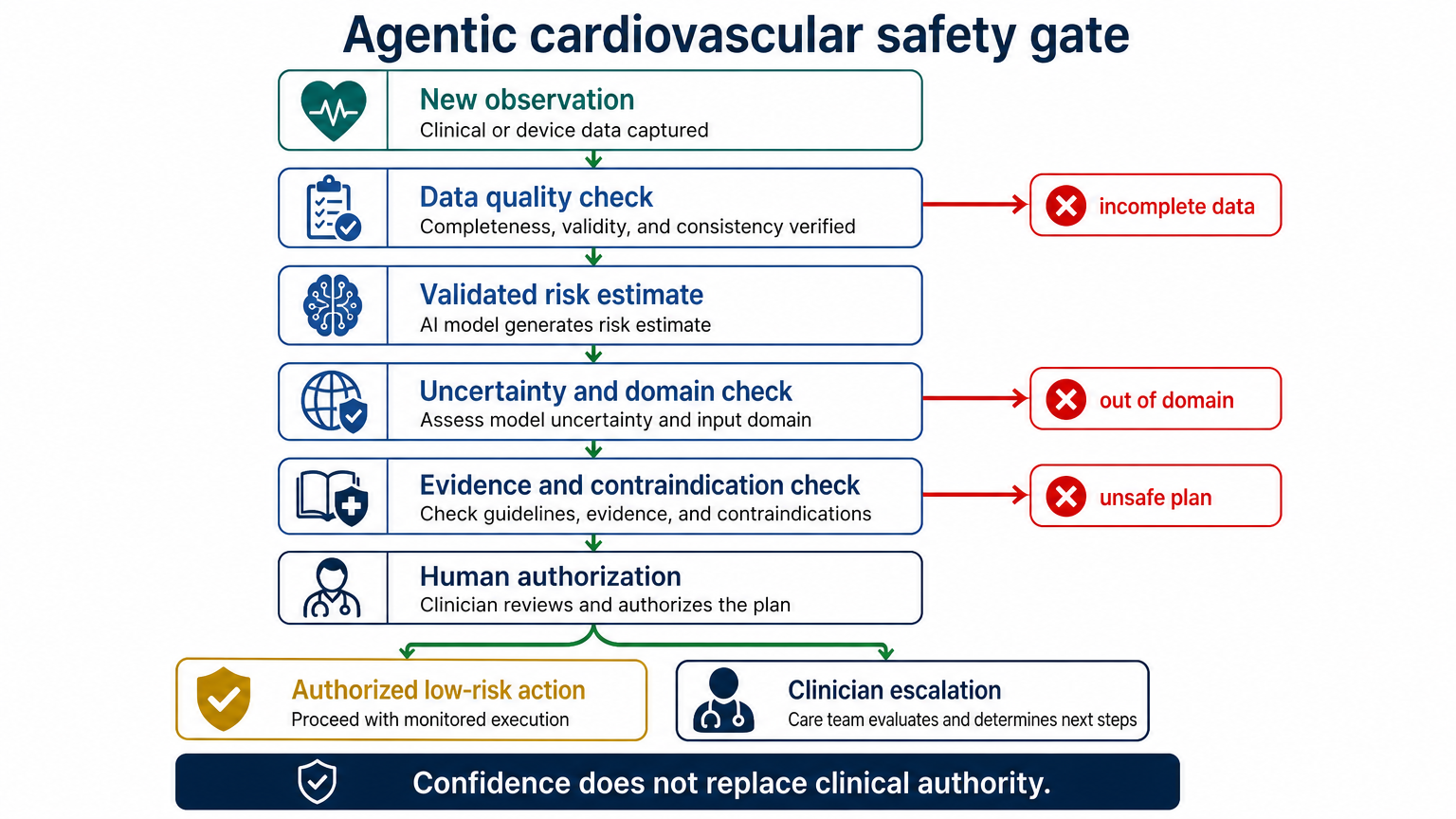
Clinical agents require a safety architecture that is stronger than ordinary conversational AI.
16.1 Hard constraints
- No autonomous diagnosis of acute cardiovascular emergencies from text alone.
- No medication initiation, discontinuation, or dose modification without an authorized clinical pathway.
- No suppression of clinician escalation because the model is confident.
- No use of unverified external information as clinical evidence.
- No silent modification of patient records.
16.2 Escalation rules
Potentially urgent symptoms or clinically significant deterioration should trigger a predefined escalation pathway. The agent should communicate uncertainty rather than attempting to manage an emergency autonomously.
16.3 Tool permissions
Each tool should have explicit permissions. Reading a laboratory result, drafting a patient message, scheduling an appointment, modifying a medication list, and placing a prescription are not equivalent actions and should have different authorization levels.
17. Hallucination, Prompt Injection, and Tool Misuse
Agentic AI creates new attack surfaces because agents can call tools and operate over persistent state. Risks include fabricated clinical facts, incorrect guideline retrieval, malicious instructions embedded in documents, prompt injection, excessive tool permissions, unsafe action chaining, and memory contamination.
Accordingly, cardiovascular agents should use:
- trusted-source retrieval;
- input sanitization;
- tool-level authorization;
- least-privilege permissions;
- schema validation;
- action confirmation;
- content provenance;
- persistent audit logs;
- independent safety checks;
- red-team testing.
18. Human-in-the-Loop Is Not Optional
For foreseeable cardiovascular applications, the appropriate model is governed autonomy rather than unrestricted autonomy.
Low-risk actions such as drafting educational material may be automated more extensively. High-risk actions such as medication changes or interpretation of potentially life-threatening symptoms require stronger human control.
19. Fairness and Health Equity
AI cardiovascular systems can reproduce or amplify disparities when training data underrepresent populations. A 2026 systematic review of cardiovascular AI classification highlighted limited dataset diversity, class imbalance, underrepresentation of rare conditions, and lack of external validation as persistent challenges. Karandikar et al., 2026.
Agentic systems introduce additional equity risks because the agent may decide which patients receive attention, follow-up, education, or escalation.
Evaluation should therefore include subgroup-specific:
- discrimination;
- calibration;
- sensitivity;
- specificity;
- follow-up completion;
- intervention rates;
- clinician escalation rates;
- patient engagement.
20. Privacy and Data Governance
Agentic cardiovascular systems may access substantially more information than conventional risk calculators. This increases privacy exposure. Data minimization, access control, encryption, provenance, retention policies, consent, and auditability should therefore be designed into the architecture.
WHO guidance emphasizes that AI for health must place ethics and human rights at the center of design, deployment, and use. WHO's later guidance on large multimodal models further addresses governance issues associated with foundation models used across health-related tasks. WHO, 2021; WHO, 2025.
21. Evaluation Framework for Cardiovascular Agents
Traditional AI evaluation often emphasizes model accuracy. Agentic systems require evaluation at several layers.
| Evaluation layer | Example metrics |
|---|---|
| Prediction | AUROC, PR-AUC, sensitivity, specificity, calibration slope, Brier score |
| Reasoning/tool use | Correct tool selection, parameter accuracy, evidence retrieval accuracy |
| Plan quality | Guideline concordance, completeness, appropriateness |
| Safety | Unsafe-action rate, escalation sensitivity, contraindication detection |
| Reliability | Repeatability, robustness, failure recovery |
| Human factors | Clinician workload, trust calibration, override rate |
| Equity | Subgroup performance and intervention parity |
| Clinical impact | Adherence, BP/lipid control, preventive therapy uptake, events |
| Economic impact | Cost per prevented event, utilization, staff time |
22. Clinical Trial Design
The strongest evidence for Agentic AI in prevention will require prospective evaluation. A staged pathway is recommended:
- Stage 1 — Retrospective validation: Validate component models and agent decisions using historical data.
- Stage 2 — Silent prospective evaluation: The agent runs without affecting clinical decisions; errors and recommendations are audited.
- Stage 3 — Clinician-in-the-loop trial: Recommendations are visible to clinicians, but all actions require authorization.
- Stage 4 — Pragmatic clinical trial: Evaluate patient and workflow outcomes.
- Stage 5 — Population-scale implementation: Evaluate real-world effectiveness, equity, cost, and model drift.
Prediction-model studies should be reported according to contemporary guidance such as TRIPOD+AI, which harmonizes reporting for regression and machine-learning prediction models. Collins et al., 2024.
23. Proposed Outcome Hierarchy
Research should progress from technical outcomes to patient outcomes rather than treating model accuracy as the final endpoint.
Intermediate outcomes could include blood-pressure control, LDL-C reduction, smoking cessation, medication adherence, appointment completion, physical activity, and appropriate use of preventive therapy. Ultimately, the most important outcomes are myocardial infarction, stroke, heart failure hospitalization, cardiovascular death, quality of life, and health-system equity.
24. Current Evidence: What Is Established and What Is Not?
| Claim | Evidence status in 2026 |
|---|---|
| AI can support cardiovascular risk prediction | Supported by a growing body of reviews and prediction studies. |
| AI can analyze ECG and cardiac imaging | Strong and rapidly expanding evidence base. |
| AI can support preventive lifestyle workflows | Promising; intervention and long-term outcome evidence remains less mature. |
| AI can monitor medication adherence | Emerging evidence; clinical impact requires further study. |
| LLMs can support cardiovascular education and decision support | Promising but individualized clinical use requires additional validation. |
| Agentic AI can coordinate healthcare tasks | Technically promising; healthcare-agent literature is rapidly emerging. |
| Agentic AI prevents cardiovascular events | Not established. Prospective outcome trials are needed. |
| Fully autonomous cardiovascular prevention is clinically ready | Not established and should not be assumed. |
Recent cardiovascular LLM research has identified potential for patient guidance, clinical questions, diagnostic support, and treatment-related decision support, but emphasizes the need for further validation in individualized care. Applications of large language models in cardiovascular disease, 2025. A 2026 survey of healthcare agents likewise concluded that the field remains concentrated in benchmark and controlled evaluation settings and requires progress in reliability, privacy, governance, and operational integration. Xu et al., 2026.
25. Agentic AI and the Prevention Care Loop
The most clinically compelling architecture is a continuous prevention loop rather than a one-time risk calculation.
ASSESS
  ↓
Risk estimation + data quality + missing information
  ↓
STRATIFY
  ↓
Clinical risk category + uncertainty + subgroup checks
  ↓
PLAN
  ↓
Evidence retrieval + personalized prevention options
  ↓
ACT
  ↓
Education / reminders / monitoring / clinician workflow
  ↓
OBSERVE
  ↓
New BP / labs / adherence / symptoms / lifestyle data
  ↓
REASSESS
  ↓
Stable → continue
Changed → revise plan
Unsafe → immediate clinical escalation
26. Research Gaps
- Agent-specific cardiovascular trials: Most cardiovascular AI literature is not yet designed around agentic systems.
- Patient-level multimodality: Future studies should use linked EHR, ECG, laboratory, wearable and clinical-text data where possible.
- Prospective effectiveness: Technical performance must be linked to preventive outcomes.
- Calibration under distribution shift: Agents should recognize when a predictive model is outside its validated population.
- Action safety: Tool use and action chaining require formal safety testing.
- Agent memory: Longitudinal memory needs privacy controls and mechanisms to prevent stale or incorrect information from influencing future decisions.
- Governance: Clear accountability is needed for recommendations, tool calls, errors, and autonomous actions.
- Economic evaluation: Cost-effectiveness and workforce effects need prospective assessment.
27. Proposed Research Agenda for 2026–2030
| Period | Priority | Recommended research |
|---|---|---|
| 2026–2027 | Foundational validation | Agent benchmarks, safety tests, retrospective patient-level multimodal studies |
| 2027–2028 | Prospective silent deployment | Monitor agent recommendations without autonomous clinical action |
| 2028–2029 | Clinical trials | Evaluate clinician-in-the-loop preventive workflows |
| 2029–2030 | Outcome evaluation | Measure BP, lipid, adherence, smoking, utilization and cardiovascular outcomes |
28. Proposed Research Questions for High-Impact Studies
- Does an agentic prevention system improve guideline-concordant cardiovascular risk assessment compared with usual care?
- Can an agent safely identify missing risk information without increasing clinician workload?
- Does agent-assisted longitudinal monitoring improve blood-pressure or lipid control?
- Can agentic medication-adherence interventions improve persistence with evidence-based cardiovascular therapies?
- Does multimodal patient-level fusion improve calibrated cardiovascular risk prediction?
- Can an agent reliably recognize when its predictive model is outside its validated population?
- What level of autonomy produces the best balance of clinical benefit, safety and clinician workload?
29. Limitations of This Review
This review has an important limitation: Agentic AI in healthcare is newer than cardiovascular predictive AI, and the intersection of the two fields remains underdeveloped. Therefore, some proposed architectures and applications represent research directions rather than clinically proven interventions. The review does not claim that autonomous agents currently prevent cardiovascular events. Evidence from conventional AI, LLMs, digital health, and healthcare-agent literature is used to construct a clinically grounded framework, but evidence from one domain should not automatically be interpreted as proof of effectiveness in another.
The rapidly changing nature of foundation models and agent frameworks also means that technical architectures can become obsolete faster than clinical evidence. For this reason, the review emphasizes enduring principles—validation, calibration, safety, human oversight, evidence traceability, privacy, equity, and prospective outcomes—rather than prescribing a single vendor, model, or software stack.
30. Conclusion
Agentic AI could become an important next layer of cardiovascular prevention, but its value should be defined by clinical outcomes rather than autonomy. Conventional AI already offers useful capabilities for cardiovascular risk prediction, ECG analysis, imaging, lifestyle support, and monitoring. Agentic AI can potentially connect these capabilities into a longitudinal prevention workflow that continuously assesses risk, retrieves evidence, coordinates tools, personalizes communication, monitors response, and escalates concerning findings.
The central principle should be governed intelligence rather than unrestricted autonomy. In cardiovascular prevention, the safest and most scientifically defensible near-term architecture is a clinically supervised agent that operates within explicit boundaries, calls validated predictive models, retrieves traceable evidence, records its actions, communicates uncertainty, and escalates to human professionals when risk or ambiguity exceeds predefined thresholds.
The field is therefore ready for rigorous research but not for unsupported claims of autonomous cardiovascular prevention. The decisive next step is prospective, patient-level, multicentre evaluation that connects agent performance with meaningful outcomes such as risk-factor control, medication adherence, quality of life, cardiovascular events, safety, equity, and cost-effectiveness.
References
- Keser N, Kıvrak T, Sekban A, Bozyel S. Artificial Intelligence in Cardiovascular Disease Prevention: Current Applications and Future Perspectives. Anatol J Cardiol. 2026;30(5):291–296. doi:10.14744/AnatolJCardiol.2026.6274. PubMed.
- Forte AJ, et al. The role of agentic artificial intelligence in healthcare: a scoping review. npj Digital Medicine. 2026. doi:10.1038/s41746-026-02517-5. PubMed.
- Xu G, et al. A comprehensive survey of AI agents in healthcare. Journal of Biomedical Informatics. 2026. PubMed.
- Pai S, Subramanian R, Krishnan L, John D, Subramanya T, Kinra S. A scoping review on artificial intelligence-based tools for cardiovascular disease risk prediction. BMC Medical Informatics and Decision Making. 2026. Springer.
- Bebarta NK, Prabhakaran A, Bhat A, et al. Artificial intelligence-based approaches for monitoring medication adherence among cardiovascular disease patients: a scoping review. BMC Medical Informatics and Decision Making. 2026;26:132. Springer.
- Parsa S, Shah P, Doijad R, Rodriguez F. Artificial Intelligence in Ischemic Heart Disease Prevention. Current Cardiology Reports. 2025;27(1):44. doi:10.1007/s11886-025-02203-0. PubMed.
- Krittanawong C, et al. Artificial intelligence in preventive cardiology. Progress in Cardiovascular Diseases. 2024. doi:10.1016/j.pcad.2024.03.002. PubMed.
- Whiteson HZ, Frishman WH. Artificial Intelligence in the Prevention and Detection of Cardiovascular Disease. Cardiology Review. 2025;33(3):239–242. doi:10.1097/CRD.0000000000000606. PubMed.
- Wan S, Wan F, Dai XJ. Machine learning approaches for cardiovascular disease prediction: A review. Archives of Cardiovascular Diseases. 2025;118(10):554–562. doi:10.1016/j.acvd.2025.04.055. PubMed.
- Karandikar M, Sawant S, Kumbhar S, et al. AI in cardiovascular disease classification—a systematic literature review. Artificial Intelligence Review. 2026;59:194. doi:10.1007/s10462-026-11592-9. Springer.
- Bulbul AMA, Awal MA, Mahendran N, et al. Deep learning for ECG-based cardiovascular disease diagnosis: a systematic review and meta-analysis. Artificial Intelligence Review. 2026;59:136. doi:10.1007/s10462-025-11479-1. Springer.
- Sikandar T, Hasan MT, Azad AKM, Khan A, et al. AI-enabled clinically aligned fewer-lead ECG approaches for detecting cardiovascular diseases. Artificial Intelligence Review. 2026;59:173. doi:10.1007/s10462-026-11577-8. Springer.
- Houssein EH, Mostafa H, Ali AA, Shaban H, et al. Advances in artificial intelligence techniques for diagnosis of cardiac diseases. Discover Artificial Intelligence. 2026;6:424. doi:10.1007/s44163-026-01323-y. Springer.
- Ghnemat R, Saleh A. Large language models for clinical artificial intelligence in healthcare: a systematic review. Discover Artificial Intelligence. 2026;6:156. Springer.
- Tiwari A, Shah PC, Kumar H, et al. The Role of Artificial Intelligence in Cardiovascular Disease Risk Prediction: An Updated Review on Current Understanding and Future Research. Current Cardiology Reviews. 2025. doi:10.2174/011573403X351048250329170744. PubMed.
- Applications of large language models in cardiovascular disease: a systematic review. 2025. PubMed.
- Zhao D, Zhang Y, Wang J, He L, He Y, Ma C. Cardiovascular disease prevention in China: challenges and opportunities in the artificial intelligence-enabled digital health era. Nature Reviews Cardiology. 2026;23(5):363–374. doi:10.1038/s41569-025-01222-2. PubMed.
- Suzuki T, Suzuki R. Artificial Intelligence and Digital Innovation in Cardiovascular Medicine. 2026. doi:10.1016/j.jacasi.2025.12.010. PubMed.
- World Health Organization. Ethics and governance of artificial intelligence for health: WHO guidance. Geneva: WHO; 2021. WHO.
- World Health Organization. Ethics and governance of artificial intelligence for health: Guidance on large multi-modal models. Geneva: WHO; 2025. WHO.
- Collins GS, Moons KGM, Dhiman P, et al. TRIPOD+AI statement: updated guidance for reporting clinical prediction models that use regression or machine learning methods. BMJ. 2024;385:e078378. doi:10.1136/bmj-2023-078378. BMJ.