
Abstract
Cardiovascular disease prevention is fundamentally a longitudinal, multimodal systems problem rather than a single prediction task. Meaningful prevention requires the continuous integration of heterogeneous information generated across electronic health records, laboratory investigations, electrocardiography, medical imaging, home blood-pressure monitoring, wearable sensors, medications, clinical narratives, and lifestyle behaviours. Conventional machine-learning models can transform these data into individualized risk estimates, while generative AI can synthesize clinical information, retrieve relevant knowledge, and support patient and clinician communication. Agentic AI extends this paradigm by introducing goal-directed planning, tool use, state management, memory, observation, feedback, workflow orchestration, and policy-constrained action.
This article develops a unified technical framework for heart disease prevention using Agentic AI, with particular emphasis on computational tools, predictive techniques, mathematical models, multimodal intelligence, agent architectures, evaluation, safety engineering, and clinical governance. It examines cardiovascular risk prediction, gradient-boosting methods, survival analysis, model calibration, uncertainty estimation, multimodal data fusion, retrieval-augmented generation (RAG), knowledge graphs, large language models (LLMs), planning, workflow orchestration, multi-agent systems, digital phenotyping, reinforcement learning, causal inference, federated learning, privacy-preserving computation, and agent observability. Mathematical formulations are introduced for risk estimation, time-to-event prediction, Bayesian updating, decision thresholds, expected utility, intervention selection, patient-state estimation, and longitudinal feedback control.
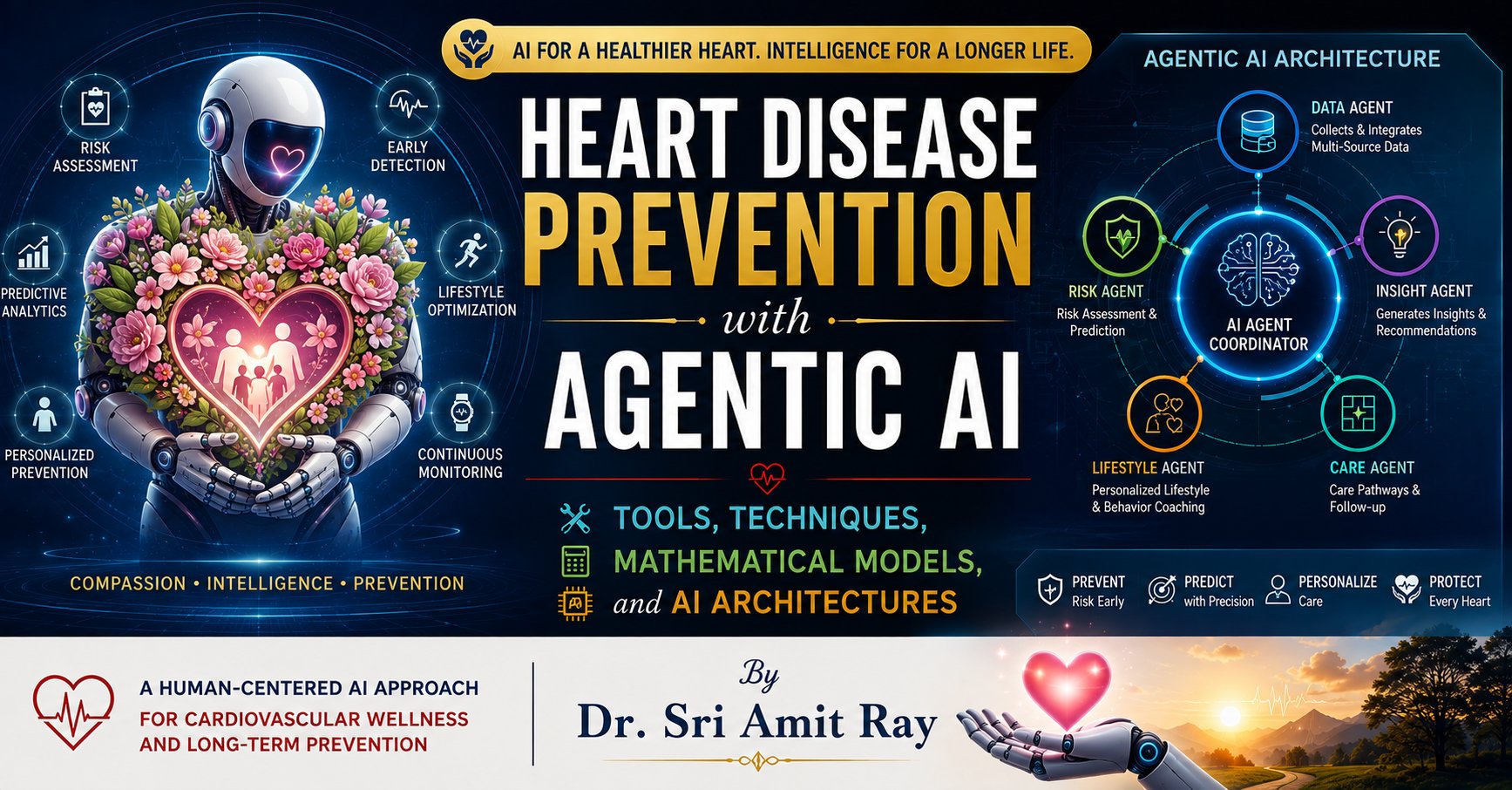
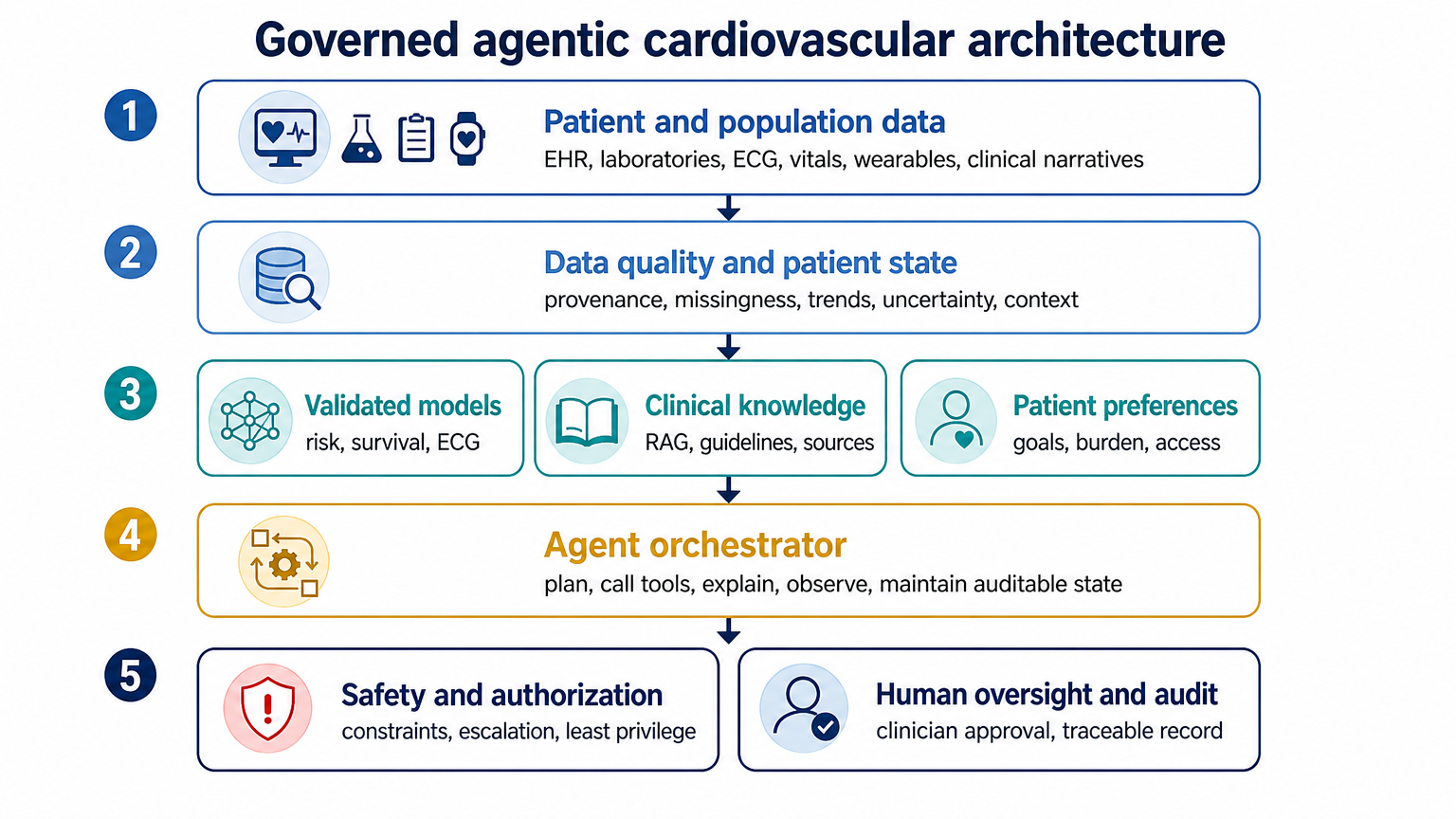
The proposed architecture deliberately separates validated clinical prediction from generative reasoning, planning, and clinical action. A dedicated safety-policy and authorization layer constrains what an agent can recommend or execute, while human oversight remains essential for clinically consequential decisions. Although individual components of AI-assisted cardiovascular prevention have substantial research foundations, direct evidence that autonomous Agentic AI reduces myocardial infarction, stroke, heart failure, or cardiovascular mortality remains insufficient. The most defensible near-term approach is therefore governed agentic orchestration around validated clinical models, rather than unrestricted autonomous clinical decision-making. This framework places cardiovascular AI within a broader foundation of safety, transparency, accountability, equity, privacy, human oversight, and rigorous clinical evaluation.
Keywords: Agentic AI; heart disease prevention; cardiovascular disease; cardiovascular risk prediction; clinical AI; healthcare AI; machine learning; large language models; LLM; retrieval-augmented generation; RAG; multimodal AI; survival analysis; digital phenotyping; reinforcement learning; causal inference; federated learning; clinical decision support; AI safety; healthcare architecture.
1. Introduction
Artificial intelligence is increasingly used across cardiovascular medicine, including risk prediction, ECG interpretation, imaging, clinical decision support, and preventive care. The next architectural step is not simply a larger predictive model; it is a system capable of coordinating multiple specialized models, evidence sources, patient data streams, and clinical workflows over time.
Agentic AI can be understood as an AI system that maintains a goal and repeatedly performs perception, reasoning, planning, tool invocation, observation, and state updating. In cardiovascular prevention, this creates a potential closed-loop system: assess → predict → plan → intervene → monitor → reassess.
However, autonomy should not be confused with clinical validity. WHO guidance on AI and large multimodal models emphasizes that healthcare AI requires governance, transparency, human oversight, equity, and careful evaluation; it also identifies risks from inaccurate outputs, bias, automation bias, and cybersecurity vulnerabilities. WHO guidance on large multimodal models
2. The Central Design Principle
The proposed system should not ask a single LLM to perform every cardiovascular task. Instead, it should use an orchestrated intelligence architecture in which each component performs the task for which it has been validated.
A practical division is:
- ML models: numerical prediction.
- Survival models: time-to-event estimation.
- Signal models: ECG and physiological interpretation.
- RAG: evidence retrieval.
- LLM: language understanding, synthesis and communication.
- Planner: sequence generation.
- Policy engine: safety and authorization.
- Monitoring agent: longitudinal observation.
- Human clinician: accountability for high-risk decisions.
3. End-to-End Architecture
                    ┌──────────────────────────────┐
                    │        PATIENT / POPULATION  │
                    └──────────────┬───────────────┘
                                   │
             ┌─────────────────────┼─────────────────────┐
             ↓                     ↓                     ↓
          EHR/Labs              ECG/Vitals          Wearables
             ↓                     ↓                     ↓
        Clinical Text         Signal Models       Digital Phenotype
             └─────────────────────┼─────────────────────┘
                                   ↓
                         DATA QUALITY + PROVENANCE
                                   ↓
                         PATIENT STATE REPRESENTATION
                                   ↓
             ┌─────────────────────┼─────────────────────┐
             ↓                     ↓                     ↓
       RISK ENGINE             KNOWLEDGE             LLM/LMM
       ML / Survival              RAG                Reasoning
       Calibration             Guidelines            Language
             └─────────────────────┼─────────────────────┘
                                   ↓
                            AGENT ORCHESTRATOR
                                   ↓
                         PLAN + DECISION POLICY
                                   ↓
                 ┌─────────────────┼─────────────────┐
                 ↓                 ↓                 ↓
             Education         Monitoring       Clinician
             Reminder           Follow-up        Escalation
                 └─────────────────┼─────────────────┘
                                   ↓
                             TOOL EXECUTION
                                   ↓
                         NEW PATIENT OBSERVATIONS
                                   ↓
                         FEEDBACK / AUDIT / DRIFT
                                   ↓
                            UPDATED STATE
4. Mathematical Representation of the Patient State
Agentic prevention requires a computational representation of the patient that changes over time. Let:
where St is the patient state at time t, X represents observed variables, U represents uncertainty or missingness, and Q represents data-quality metadata.
The transition can be modeled abstractly as:
where At is an intervention or action, Et represents external influences, and ε is stochastic variation.
5. Risk Prediction: The Numerical Core
5.1 Logistic cardiovascular-risk prediction
For a binary outcome over a fixed horizon:
This is useful when the target is a fixed-horizon event such as a cardiovascular event within a predefined period.
5.2 Gradient boosting
Tree-based boosting can capture nonlinearities and interactions:
Potential algorithms include XGBoost, LightGBM and CatBoost. In an agentic architecture, these models should remain deterministic, versioned tools rather than being replaced by an LLM.
5.3 Survival analysis
For time-to-event prediction, the hazard can be represented as:
The survival probability is:
More flexible models can use random survival forests, survival gradient boosting, neural survival models, or discrete-time hazard models. The agent should select only models validated for the intended population and horizon.
6. Calibration: A Critical but Often Neglected Mathematical Layer
A model may discriminate well but systematically overestimate or underestimate absolute risk. Calibration therefore matters whenever the output is used for prevention decisions.
Useful approaches include Platt scaling, isotonic regression, recalibration-in-the-large, and calibration-slope adjustment. The agent should store the calibration version alongside the prediction model.
7. Bayesian Updating for Longitudinal Prevention
New observations can update an existing risk belief:
This formulation is conceptually useful for longitudinal monitoring. For example, repeated home blood-pressure measurements can update beliefs about the patient's current blood-pressure state rather than treating every measurement as independent.
8. Decision Theory: From Prediction to Action
Prediction alone does not determine whether an intervention should be recommended. The agent must consider expected utility.
where a is an action, U is clinical utility, and C represents costs, burdens or risks.
This provides an important conceptual separation:
A high predicted risk does not automatically authorize a treatment action. Clinical eligibility, contraindications, patient preference, guideline applicability, and clinician authorization must also be considered.
9. Multi-Objective Prevention Optimization
Cardiovascular prevention is multi-objective. The system may simultaneously optimize risk reduction, adherence, quality of life, cost, patient preference and safety.
The weights should not be hidden inside an opaque LLM. They should be explicit, clinically justified, configurable and auditable.
10. The Tools Layer
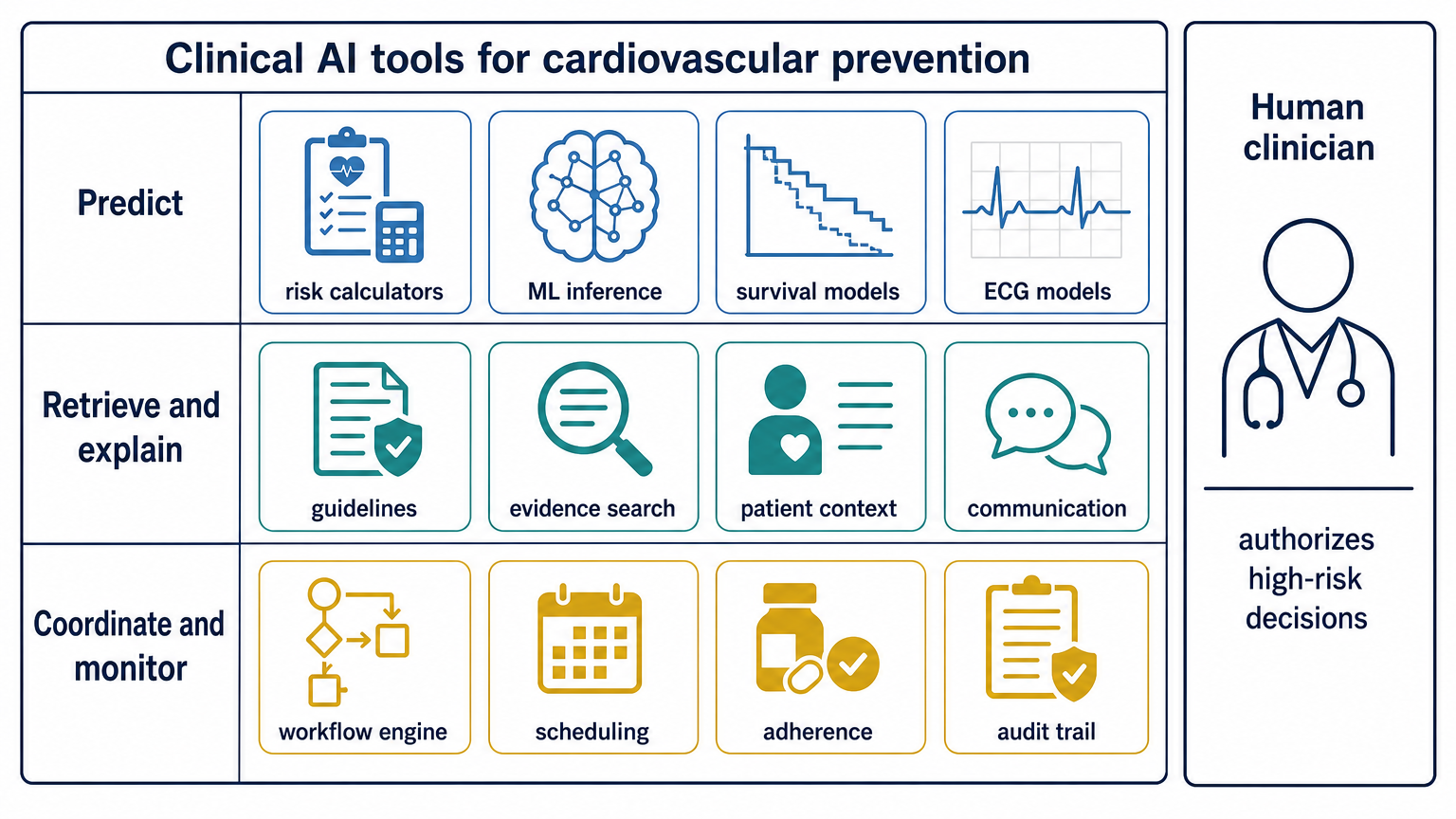
| Tool class | Examples | Role |
|---|---|---|
| Risk calculators | Validated CVD risk equations | Absolute risk estimation |
| ML inference | XGBoost, LightGBM, neural networks | Nonlinear prediction |
| Survival models | Cox, RSF, survival boosting | Time-to-event prediction |
| Signal AI | 1D CNN, Transformer ECG models | ECG/physiology interpretation |
| RAG | Vector DB + reranker + source filters | Clinical evidence retrieval |
| LLM/LMM | Approved foundation model | Language and multimodal synthesis |
| Workflow engine | LangGraph-style state machine | Agent orchestration |
| API layer | FastAPI / FHIR APIs | System integration |
| Observability | Tracing, logs, evaluation | Audit and monitoring |
| Policy engine | Rules / authorization service | Safety constraints |
| Database | PostgreSQL / time-series DB | State and longitudinal data |
11. Retrieval-Augmented Generation for Cardiovascular Prevention
RAG is preferable to unrestricted generation when the agent needs current clinical evidence.
A robust pipeline is:
Query
  ↓
Query normalization
  ↓
Hybrid retrieval
  ├── BM25 / lexical
  └── vector similarity
  ↓
Cross-encoder reranking
  ↓
Source authority filter
  ↓
Version/date validation
  ↓
Evidence chunks
  ↓
LLM synthesis
  ↓
Citation verification
  ↓
Safety policy
WHO's guidance on large multimodal models emphasizes that generative health AI can produce false, incomplete or biased statements and therefore requires rigorous governance, defined tasks, stakeholder involvement and oversight.
12. Vector Retrieval Mathematics
For embedding vectors q and d, cosine similarity is:
Top-k retrieval can be written:
Hybrid retrieval may combine normalized lexical and semantic scores:
13. Knowledge Graph Architecture
Cardiovascular prevention contains relationships that can be represented naturally as a graph:
Patient
 ├── hasRiskFactor → Hypertension
 ├── hasRiskFactor → Dyslipidemia
 ├── takes → Medication
 ├── hasMeasurement → BP
 ├── hasResult → LDL-C
 └── hasGoal → PhysicalActivity

Hypertension
 ├── associatedWith → Stroke
 ├── monitoredBy → BP
 └── managedBy → GuidelineRecommendation
Graph retrieval can complement vector retrieval when the question depends on relationships, constraints or temporal connections.
14. Multimodal AI
Cardiovascular prevention requires integration of text, tabular data, time series, images and signals. A simple multimodal representation is:
Fusion can occur early, late or through cross-attention. For safety-critical applications, the system should retain modality-specific outputs rather than producing only one opaque representation.
15. ECG and Time-Series Models
For an ECG represented as a multichannel sequence \(X \in \mathbb{R}^{T \times C}\), a temporal model learns:
Possible architectures include 1D convolutional networks, recurrent networks and Transformer-style temporal encoders. A prevention agent may call an ECG model when new signals are available, compare the result with prior recordings, and escalate according to validated rules.
16. Digital Phenotyping
Wearables can provide longitudinal measurements such as heart rate, activity, sleep and sometimes rhythm-related signals. Instead of treating these streams as raw data, the agent can transform them into features:
Change-point detection can identify a sustained deviation from baseline:
Such signals should be interpreted conservatively because consumer wearable measurements are not equivalent to clinically validated diagnostic measurements.
17. Anomaly Detection
For a physiological feature vector x, an anomaly score can be defined using distance from a learned baseline:
Mahalanobis distance is one possible approach. Autoencoders, isolation forests and probabilistic models are alternatives. Anomaly detection should generate a review signal, not automatically a diagnosis.
18. Agent Planning
A cardiovascular prevention agent can represent a plan as a sequence:
where each action is selected according to the current state and policy:
Example:
Goal: improve cardiovascular prevention adherence

1. Read current medication list
2. Verify last refill / adherence signal
3. Check recent BP and lipid measurements
4. Retrieve relevant prevention guidance
5. Identify adherence barrier
6. Draft personalized intervention
7. Apply safety policy
8. Send low-risk education/reminder
9. Escalate medication concerns to clinician
10. Schedule reassessment
19. State-Machine Architecture
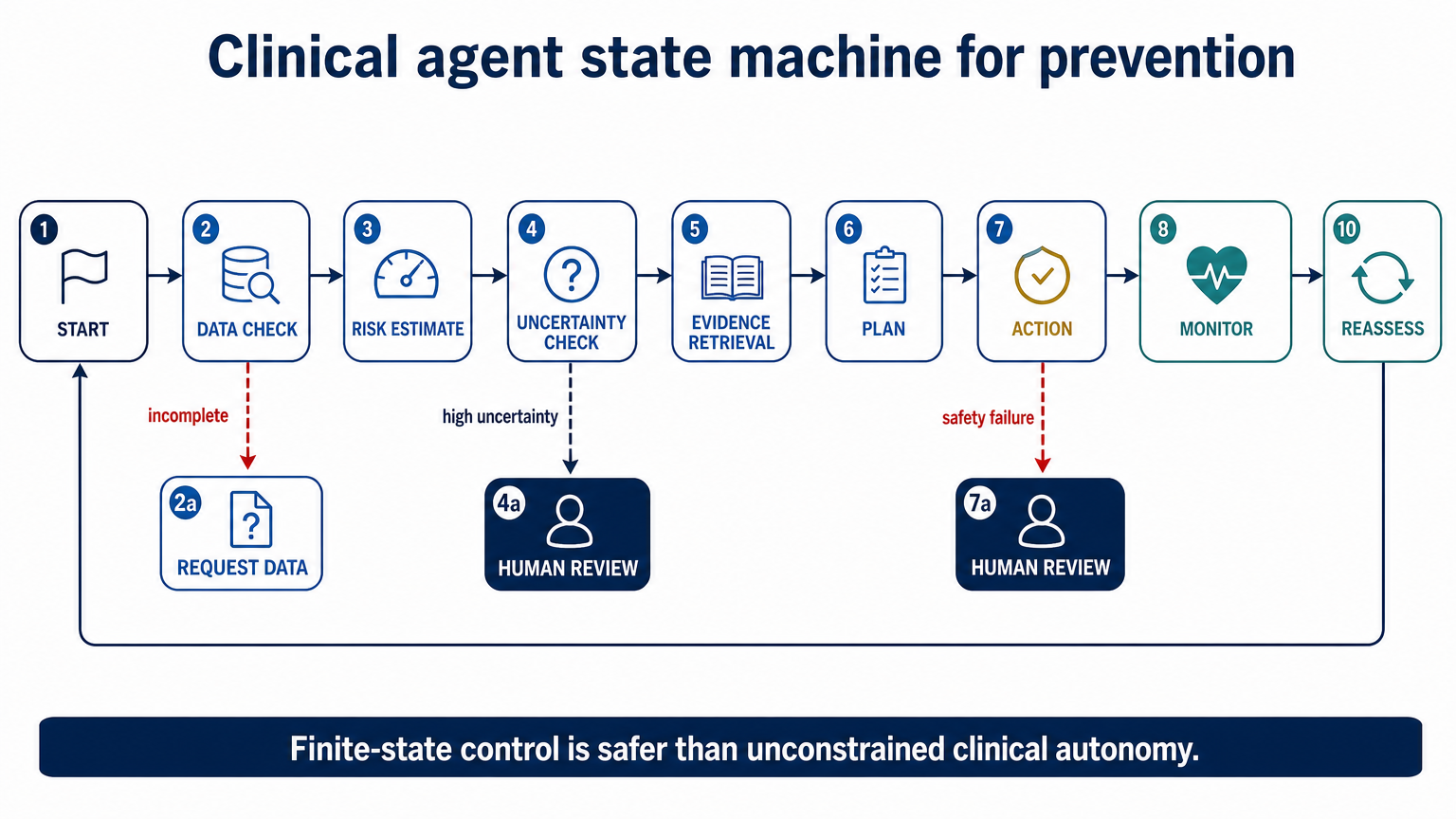
For clinical reliability, a finite-state or graph-based workflow can be preferable to unconstrained autonomous loops.
START
  ↓
DATA_CHECK
  ├── incomplete → REQUEST_DATA
  └── valid
       ↓
RISK_ESTIMATE
       ↓
UNCERTAINTY_CHECK
  ├── high → HUMAN_REVIEW
  └── acceptable
       ↓
EVIDENCE_RETRIEVAL
       ↓
PLAN
       ↓
SAFETY_CHECK
  ├── fail → HUMAN_REVIEW
  └── pass
       ↓
ACTION
       ↓
MONITOR
       ↓
REASSESS
20. Reinforcement Learning Perspective
Agentic prevention can be described as a sequential decision problem. Let the environment state be St, action At, transition probability P, and reward R.
In clinical settings, direct online reinforcement learning is risky because the system could experiment on patients. Safer approaches include offline RL, contextual bandits, simulation, clinician-approved policies, and constrained optimization.
21. Causal Inference
Prediction asks, “Who is at risk?” Prevention often asks a different question: “What intervention is likely to change the outcome?” This requires causal reasoning.
where τ(x) is an individualized treatment effect.
Potential approaches include causal forests, doubly robust estimation, propensity-score methods and targeted maximum likelihood estimation. However, causal estimates require strong assumptions and appropriate data; an LLM should not be allowed to infer causality merely from correlation in retrieved literature.
22. Personalized Intervention Selection
A treatment or lifestyle recommendation can be framed as a constrained optimization problem:
This separates mathematical optimization from clinical authorization.
23. Uncertainty Estimation
An agent must know when not to trust a prediction. Sources of uncertainty include:
- measurement noise;
- missing data;
- model uncertainty;
- distribution shift;
- population mismatch;
- ambiguous clinical context;
- conflicting evidence.
For an ensemble of models producing p1,...,pM:
High disagreement can trigger human review.
24. Distribution Shift and Drift
Clinical data change over time. Let Ptrain(X,Y) represent training data and Pdeployment(X,Y) deployment data. A central risk is:
Monitoring can use population stability indices, feature-distribution distances, calibration drift and performance drift. The agent should be able to enter a degraded mode when model validity is uncertain.
25. Federated Learning
When patient data cannot be centralized, federated learning can train models across institutions:
This is a simplified FedAvg formulation. Federated learning does not automatically guarantee privacy; secure aggregation, differential privacy, governance and attack-resistance may also be necessary.
26. Privacy-Preserving Agentic Architecture
Patient Data
   ↓
Local / Institutional Boundary
   ↓
Feature Extraction
   ↓
Privacy / Consent Policy
   ↓
Authorized Agent
   ↓
Minimal Required Tool Call
   ↓
Audit Log
   ↓
Clinician / Patient
The principle of data minimization should apply to agents: the agent should access only the information required for its current task.
27. Observability and Agent Evaluation
Agentic AI requires observability beyond conventional application logging. Every important step should be traceable:
| Trace element | Example |
|---|---|
| Input | Patient-state version |
| Model | Risk-model name and version |
| Evidence | Document identifier/version |
| Tool | Tool name and parameters |
| Plan | Action sequence |
| Policy | Rules evaluated |
| Output | Recommendation/action |
| Human override | Clinician modification |
| Outcome | Observed follow-up |
28. Agent Safety Metrics
| Metric | Definition |
|---|---|
| Tool-call accuracy | Correct selection and parameterization of tools |
| Evidence fidelity | Degree to which output is supported by retrieved evidence |
| Unsafe-action rate | Frequency of prohibited or clinically unsafe actions |
| Escalation sensitivity | Proportion of predefined high-risk cases escalated |
| Hallucination rate | Unsupported factual clinical claims |
| Calibration | Agreement between predicted and observed risk |
| Override rate | Frequency of clinician modification/rejection |
| Drift rate | Change in model/agent performance over time |
29. Cost-Sensitive Safety
False negatives and false positives have different clinical consequences. A simple expected-loss formulation is:
In high-risk clinical workflows, the penalty assigned to unsafe actions should dominate optimization of conversational quality.
30. Multi-Agent Architecture
                         SUPERVISOR AGENT
                               │
        ┌──────────────────────┼───────────────────────┐
        ↓                      ↓                       ↓
   DATA AGENT             RISK AGENT             EVIDENCE AGENT
        │                      │                       │
        ↓                      ↓                       ↓
 Data quality             ML / Survival             RAG
 Provenance               Calibration               Guidelines
        └──────────────────────┼───────────────────────┘
                               ↓
                         PLANNING AGENT
                               ↓
                       SAFETY / POLICY AGENT
                               ↓
                ┌──────────────┼───────────────┐
                ↓              ↓               ↓
          Lifestyle       Adherence        Monitoring
             Agent           Agent           Agent
                └──────────────┼───────────────┘
                               ↓
                         HUMAN CLINICIAN
                               ↓
                         AUDIT / FEEDBACK
Specialization reduces the temptation to make one model responsible for everything. The supervisor should coordinate rather than independently invent clinical facts.
31. API and Software Architecture
A research implementation can use Python as the orchestration language, FastAPI as the service layer, a graph/state-machine framework for agent control, a vector database for RAG, PostgreSQL for persistent state, and an observability platform for tracing.
Frontend / Clinical UI
        ↓
FastAPI Gateway
        ↓
Authentication + Authorization
        ↓
Agent Graph / State Machine
        ├── Risk Model Service
        ├── ECG Model Service
        ├── RAG Service
        ├── Patient State Service
        ├── Scheduling / Messaging Tools
        └── Safety Policy Service
        ↓
Audit + Observability
        ↓
Databases / EHR / FHIR
32. Example Agent Pseudocode
state = load_patient_state(patient_id)

validate_data(state)

risk = risk_model.predict(
    features=validated_features(state),
    model_version="validated-model-vX"
)

if risk.out_of_domain or risk.uncertainty_high:
    return escalate_to_clinician(state, risk)

evidence = rag.retrieve(
    query=prevention_question(state),
    approved_sources=True
)

plan = planner.create_plan(
    state=state,
    risk=risk,
    evidence=evidence
)

decision = safety_policy.evaluate(plan)

if not decision.allowed:
    return clinician_review(plan, decision.reason)

result = execute_authorized_tools(plan)

record_audit_trace(
    state=state,
    risk=risk,
    evidence=evidence,
    plan=plan,
    decision=decision,
    result=result
)

return schedule_reassessment(result)
33. A Mathematical Control-Loop View
Agentic prevention can be modeled as a feedback-control system:
where et is the gap between a prevention goal and the current patient state. The controller chooses an action:
The system observes the response:
This creates the loop:
The analogy is useful because it highlights stability, delayed effects, noisy measurements, feedback, and the danger of aggressive control in uncertain environments.
34. Example: Hypertension Prevention Workflow
A technically realistic example is home blood-pressure monitoring.
- Receive repeated measurements.
- Validate timestamp, cuff metadata and measurement quality.
- Remove or flag implausible values according to validated rules.
- Estimate the patient's recent blood-pressure trajectory.
- Check medication and adherence context.
- Retrieve applicable guidance.
- Assess whether the pattern meets a clinician-defined escalation rule.
- Generate education or follow-up instructions.
- Escalate medication or concerning clinical decisions to a professional.
- Continue monitoring.
The key insight is that the agent manages the workflow; validated clinical methods manage the measurements and risk estimates.
35. Example: Dyslipidemia Prevention Workflow
The same architecture can coordinate laboratory trends, risk estimation, adherence and follow-up.
The agent should not independently prescribe therapy. Instead, it can identify missing information, retrieve relevant evidence, prepare a clinician-facing summary, and support longitudinal monitoring.
36. Example: Smoking Cessation Agent
Behavioural agents are comparatively lower risk than autonomous medication agents when they remain within a validated behavioural protocol. The state might contain:
A contextual-bandit framework could theoretically select among approved communication strategies:
However, real-world optimization should be conducted prospectively and ethically, with predefined limits and human escalation.
37. Clinical Knowledge Versioning
Clinical evidence changes. Therefore:
A production system should record the exact source version used for each recommendation. This is especially important when an agent retrieves multiple sources that may disagree.
38. Evidence Conflict Resolution
When two sources disagree, the agent should use a deterministic hierarchy rather than selecting whichever source produces the most fluent answer.
Conflict detected
      ↓
Check source authority
      ↓
Check publication/version date
      ↓
Check population applicability
      ↓
Check jurisdiction
      ↓
Check strength of evidence
      ↓
If unresolved → clinician review
39. Security Architecture
Agentic systems are exposed to prompt injection, malicious documents, compromised tools, unauthorized actions, data exfiltration and memory poisoning. A cardiovascular agent should therefore implement least privilege.
High-risk tools should require explicit authorization and preferably independent confirmation.
40. Explainability
Explainability should be layered:
- Prediction explanation: important model features.
- Evidence explanation: retrieved sources.
- Action explanation: why the workflow was selected.
- Safety explanation: constraints that were checked.
- Uncertainty explanation: what remains unknown.
For clinical deployment, “the LLM reasoned this way” is not sufficient evidence. The system should expose verifiable inputs, model outputs, source documents and policy decisions.
41. Research Evaluation Matrix
| Layer | Primary question | Metrics |
|---|---|---|
| Data | Are inputs valid? | Missingness, quality, provenance |
| Prediction | Is risk estimated accurately? | AUROC, AUPRC, Brier, calibration |
| Retrieval | Is evidence relevant? | Recall@k, precision@k, citation correctness |
| Planning | Is the plan clinically appropriate? | Expert agreement, guideline concordance |
| Safety | Does the agent avoid harmful actions? | Unsafe-action rate, escalation sensitivity |
| Workflow | Does it improve care? | Time, workload, completion rates |
| Patient | Does prevention improve? | BP, LDL-C, smoking, adherence, QoL |
| Outcome | Does disease burden change? | MI, stroke, HF hospitalization, mortality |
42. Clinical Trial Architecture
Phase 1: Offline benchmark
        ↓
Phase 2: Retrospective patient validation
        ↓
Phase 3: Silent prospective deployment
        ↓
Phase 4: Clinician-in-the-loop trial
        ↓
Phase 5: Pragmatic multicentre trial
        ↓
Phase 6: Long-term effectiveness / equity / cost
This staged approach is preferable to immediately granting autonomous action. WHO recommends evidence-informed governance and stresses that AI systems in health must be designed and evaluated around safety and human well-being.
43. Recommended Technology Stack for a Research Prototype
| Layer | Recommended options | Purpose |
|---|---|---|
| Language | Python | ML and orchestration |
| API | FastAPI | Service interface |
| Agent graph | LangGraph or equivalent state-machine framework | Controlled orchestration |
| LLM | Approved enterprise/API or locally hosted model | Reasoning and communication |
| RAG | Qdrant/FAISS/pgvector + reranker | Evidence retrieval |
| ML | scikit-learn, XGBoost, LightGBM, PyTorch | Validated prediction |
| Data | PostgreSQL + time-series storage | Longitudinal state |
| Interoperability | FHIR-compatible services | EHR integration |
| Observability | OpenTelemetry + evaluation/tracing platform | Agent traces |
| Security | OAuth2/OIDC, secrets manager, RBAC | Access control |
| Deployment | Docker + Kubernetes where appropriate | Reproducible deployment |
44. What the LLM Should and Should Not Do
| Suitable LLM role | Unsuitable unvalidated role |
|---|---|
| Summarize patient information | Invent patient measurements |
| Retrieve and synthesize evidence | Fabricate guideline recommendations |
| Explain a risk score | Replace the validated risk model |
| Draft education | Autonomously prescribe medication |
| Coordinate tools | Override safety policies |
| Identify missing information | Declare emergencies resolved |
45. The Unified Agentic Prevention Equation
The overall architecture can be summarized conceptually as:
where π is the planning policy, G is the clinical goal, K is validated knowledge, M is memory, R is the safety policy, and U is uncertainty. The projection Πsafe represents the safety and authorization layer that restricts the actions the agent can execute.
46. A More Complete Mathematical Framework
This captures the essential architecture: state estimation → risk prediction → utility-based planning → safety projection → action → observation → state update.
47. Limitations and Open Problems
- Agentic AI evidence in cardiovascular prevention remains much less mature than conventional cardiovascular ML.
- Many risk models are validated for specific populations and may not generalize across countries or healthcare settings.
- Multimodal fusion can introduce missing-data and measurement-quality problems.
- LLM outputs remain probabilistic and can be confidently wrong.
- Agent memory creates new privacy and stale-information risks.
- Reinforcement-learning approaches require particularly strong safety controls.
- Prospective outcome evidence is required before claims of event prevention can be made.
48. Future Research Directions
- Build standardized benchmarks for cardiovascular agents.
- Develop agent-specific safety and tool-use benchmarks.
- Validate multimodal risk models across diverse populations.
- Integrate causal inference into intervention selection.
- Develop uncertainty-aware agent policies.
- Study clinician-agent collaboration and trust calibration.
- Evaluate federated and privacy-preserving cardiovascular agents.
- Conduct prospective multicentre trials.
- Measure health equity and subgroup performance.
- Evaluate real-world cardiovascular outcomes and cost-effectiveness.
49. Conclusion
Agentic AI provides a potentially powerful architecture for cardiovascular prevention because prevention is inherently longitudinal, multimodal and action-oriented. The major technical opportunity is not to replace every clinical model with a general-purpose LLM. It is to connect specialized predictive models, evidence retrieval, patient-state representations, monitoring systems, communication tools and clinical workflows through a controlled agent architecture.
The resulting system can be understood as a clinical intelligence operating layer: it observes the patient state, invokes validated models, retrieves evidence, identifies uncertainty, constructs a bounded plan, applies safety policies, coordinates authorized actions, monitors outcomes and returns control to clinicians whenever the situation exceeds its validated scope.
References and Further Reading
- World Health Organization. Ethics and governance of artificial intelligence for health: WHO guidance. Geneva: WHO; 2021. WHO.
- World Health Organization. Ethics and governance of artificial intelligence for health: Guidance on large multi-modal models. Geneva: WHO; 2024/2025 publication record. WHO.
- Malpani R, Reis AA, Pujari S, et al. Ethics and governance of artificial intelligence for health: Guidance on large multi-modal models. World Health Organization; 2024. Research record.
- World Health Organization. Harnessing Artificial Intelligence for Health. WHO Digital Health and Innovation. WHO.
- World Health Organization. WHO calls for safe and ethical AI for health. 2023. WHO.
- Malpani R, et al. Large multimodal models: boon or burden for low- and middle-income countries. International Health. 2025. PMC.
- Keser N, Kıvrak T, Sekban A, Bozyel S. Artificial Intelligence in Cardiovascular Disease Prevention: Current Applications and Future Perspectives. Anatol J Cardiol. 2026.
- Krittanawong C, et al. Artificial intelligence in preventive cardiology. Progress in Cardiovascular Diseases. 2024.
- Wan S, Wan F, Dai XJ. Machine learning approaches for cardiovascular disease prediction: A review. Archives of Cardiovascular Diseases. 2025.
- Pai S, et al. A scoping review on artificial intelligence-based tools for cardiovascular disease risk prediction. BMC Medical Informatics and Decision Making. 2026.
- Bebarta NK, et al. Artificial intelligence-based approaches for monitoring medication adherence among cardiovascular disease patients: a scoping review. BMC Medical Informatics and Decision Making. 2026.
- Karandikar M, et al. AI in cardiovascular disease classification—a systematic literature review. Artificial Intelligence Review. 2026.
- Bulbul AMA, et al. Deep learning for ECG-based cardiovascular disease diagnosis: a systematic review and meta-analysis. Artificial Intelligence Review. 2026.
- Collins GS, Moons KGM, Dhiman P, et al. TRIPOD+AI statement: updated guidance for reporting clinical prediction models that use regression or machine learning methods. BMJ. 2024;385:e078378.
- Ray, Amit. "Compassionate Medical AI Drones as Intelligent Unmanned Health-Care Systems: A Human-Centered AI Architecture for Suffering Reduction and Human Flourishing." Compassionate AI, 3.8 (2026): 57-59. https://sriamitray.com/research/medical-ai-drones-human-centered-healthcare/.
- Ray, Amit. "Medical AI Drones for Disaster Management: Intelligent Unmanned Health-Care Systems." Compassionate AI, 3.8 (2026): 57-59. https://sriamitray.com/research/medical-ai-drones-disaster-management/.
- Ray, Amit. "The 25 Algorithms of the Sri Amit Ray Compassionate AI Architecture." Compassionate AI, 3.8 (2026): 63-65. https://sriamitray.com/research/ray-25-compassionate-ai-algorithms/.
- Ray, Amit. "Heart Disease Prevention: The Top 25 Machine Learning Algorithms 2026." Compassionate AI, 3.8 (2026): 78-80. https://sriamitray.com/research/heart-disease-prevention-25-ml-algorithms/.
- Ray, Amit. "Heart Disease Prevention with Agentic AI: Tools, Techniques, Mathematical Models, and AI Architectures." Compassionate AI, 3.8 (2026): 78-80. https://sriamitray.com/research/heart-disease-prevention-agentic-ai/.