
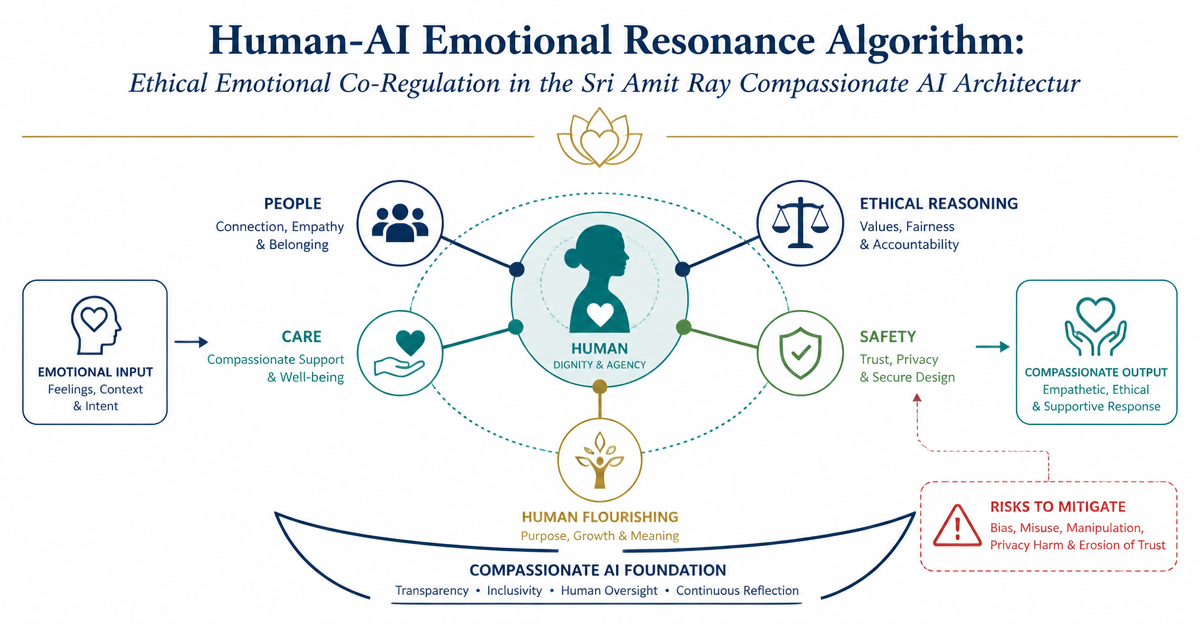
Algorithm 7 of the 25 Human-Centered Compassionate AI Algorithms. Within the Sri Amit Ray Compassionate AI Architecture™ (CAIA™), the algorithm serves as the computational foundation of the Empathy Intelligence Layer. It quantifies emotional alignment using vector similarity while simultaneously introducing an ethical calming trajectory that prevents emotional manipulation, parasocial dependency, and affective exploitation.
Part of the Layer 3 – Empathy Intelligence Layer within the Sri Amit Ray Compassionate AI Architecture™ (CAIA™).
Abstract
Artificial intelligence is increasingly becoming an emotional technology. Modern AI systems are no longer limited to reasoning, planning, searching, or generating text. They participate in emotionally significant interactions involving education, healthcare, elderly companionship, counseling, customer service, social robotics, and personal assistance. As AI becomes emotionally interactive, one of the central scientific questions is no longer whether machines can recognize emotions, but whether they can respond in emotionally beneficial, ethically responsible, and psychologically safe ways.
The Human-AI Emotional Resonance Algorithm introduces a mathematically grounded framework for measuring and regulating emotional resonance between humans and artificial intelligence systems. Rather than maximizing engagement or emotional imitation, the algorithm seeks to optimize compassionate emotional co-regulation, supporting long-term human flourishing while preserving autonomy, dignity, transparency, and emotional resilience.
Within the Sri Amit Ray Compassionate AI Architecture™ (CAIA™), the algorithm serves as the computational foundation of the Empathy Intelligence Layer. It quantifies emotional alignment using vector similarity while simultaneously introducing an ethical calming trajectory that prevents emotional manipulation, parasocial dependency, and affective exploitation. The framework combines principles from affective computing, neuroscience, computational psychology, human-centered AI, and ethical machine learning to produce AI systems that accompany rather than manipulate human emotional experiences.
This article presents the theoretical foundations, mathematical formulation, architectural integration, algorithmic workflow, ethical safeguards, implementation considerations, experimental evaluation methods, and future research directions of the Human-AI Emotional Resonance Algorithm.
Contents
Introduction
Artificial intelligence has entered a new historical phase. Earlier generations of intelligent systems focused primarily on symbolic reasoning, numerical optimization, statistical inference, and information retrieval. Contemporary foundation models, however, increasingly participate in prolonged conversations that resemble emotionally meaningful human interactions. They encourage users, comfort them during stressful situations, assist learners experiencing anxiety, and support patients coping with chronic illness. Consequently, emotional interaction has become a central capability of intelligent systems rather than an optional feature.
This evolution introduces profound scientific and ethical challenges. Human emotions are dynamic, multidimensional, context-dependent, and deeply intertwined with cognition, memory, attention, physiology, and social relationships. When artificial intelligence participates in emotional exchanges, its responses can influence trust, stress regulation, motivation, resilience, decision making, and psychological well-being. Poorly designed emotional AI may unintentionally reinforce fear, encourage dependency, amplify anger, or optimize engagement through emotional manipulation. Therefore, emotional intelligence alone is insufficient; it must be guided by ethical principles that prioritize human flourishing over commercial objectives.
The Human-AI Emotional Resonance Algorithm was developed to address this challenge. Instead of asking how AI can imitate emotions more convincingly, the algorithm asks a fundamentally different question:
How can an AI system understand human emotion while simultaneously protecting human dignity, autonomy, psychological safety, and long-term well-being?
This shift represents a movement away from affective imitation toward compassionate emotional partnership. Emotional resonance is therefore defined not as emotional mimicry but as ethically constrained emotional alignment that acknowledges the user's experience while gently supporting movement toward emotional stability.
The Rise of Emotionally Interactive Artificial Intelligence
Advances in deep learning, transformer architectures, multimodal perception, and conversational large language models have dramatically expanded the emotional capabilities of AI systems. Modern conversational agents can recognize emotional language, detect facial expressions, estimate vocal affect, interpret behavioral patterns, and adapt responses according to the inferred emotional state of users. These developments have enabled practical applications across healthcare, education, elder care, rehabilitation, mental health support, customer service, and human-robot interaction.
Despite these remarkable advances, current emotional AI systems remain largely optimized for engagement metrics such as interaction duration, click-through rates, user retention, and perceived naturalness. Such optimization objectives may inadvertently encourage emotionally persuasive behaviors that increase dependency rather than empowerment. An emotionally persuasive AI capable of maximizing user engagement is not necessarily an ethically beneficial AI.
The Human-AI Emotional Resonance Algorithm addresses this gap by replacing engagement optimization with human flourishing optimization. Emotional interaction is treated as a cooperative process whose objective is emotional regulation, resilience, and psychological safety rather than prolonged dependence on the AI system.
Why Emotional Resonance Matters
Human communication extends far beyond the exchange of words. Every meaningful interaction contains multiple interconnected layers, including emotional expression, cognitive understanding, physiological regulation, social context, and interpersonal trust. Emotional resonance describes the dynamic process through which two individuals become affectively attuned while preserving their individuality and autonomy.
In neuroscience, emotional resonance involves coordinated activity across distributed brain networks responsible for empathy, affective regulation, interoception, and social cognition. In psychology, emotional resonance contributes to therapeutic alliance, educational engagement, compassionate caregiving, and effective conflict resolution. In human-computer interaction, emotional resonance determines whether users perceive AI systems as supportive, trustworthy, manipulative, or emotionally authentic.
The Human-AI Emotional Resonance Algorithm extends these interdisciplinary insights into a computational framework that quantifies emotional alignment while embedding ethical constraints designed to prevent emotional exploitation. Rather than maximizing similarity indefinitely, the algorithm introduces intentional regulation toward calm, security, and resilience, thereby distinguishing compassionate resonance from persuasive emotional manipulation.
Limitations of Conventional Emotional AI
Many existing affective computing systems focus primarily on emotion recognition and emotion classification. While these capabilities are essential, they do not by themselves determine whether subsequent AI behavior is psychologically beneficial. Simply recognizing sadness does not imply responding with compassion; recognizing fear does not guarantee emotional safety; recognizing loneliness does not prevent the formation of unhealthy emotional dependency.
Conventional emotional AI often assumes that improved emotional prediction naturally leads to improved emotional support. However, emotional prediction without ethical regulation can enable persuasive technologies that optimize emotional engagement rather than human well-being. The Human-AI Emotional Resonance Algorithm therefore introduces explicit computational safeguards that distinguish supportive resonance from manipulative resonance.
Role within the Sri Amit Ray Compassionate AI Architecture™ (CAIA™)
The Sri Amit Ray Compassionate AI Architecture™ (CAIA™) is a comprehensive human-centered framework composed of twenty-five interconnected algorithms organized into seven functional layers. Each layer evaluates a distinct dimension of compassionate intelligence, ranging from suffering reduction and empathy modeling to vulnerability protection, planetary responsibility, future generation analysis, and human oversight.
Within this architecture, the Human-AI Emotional Resonance Algorithm occupies the Empathy Intelligence Layer (Layer 3). Its primary responsibility is to quantify emotional alignment between human and AI while ensuring that emotional interaction consistently advances compassion, transparency, autonomy, resilience, and human flourishing.
Unlike traditional affective computing systems that primarily estimate emotional states, the algorithm actively regulates the emotional trajectory of the interaction according to ethical objectives. Consequently, emotional resonance becomes not merely a descriptive measurement but a normative computational process guided by compassion-centered design principles.
Mathematical Foundation of the Human-AI Emotional Resonance Algorithm
The Human-AI Emotional Resonance Algorithm models emotional interaction as a continuous dynamical process rather than a collection of isolated emotion labels. Instead of classifying users into predefined emotional categories such as happy, sad, or angry, the algorithm represents emotional states as multidimensional vectors within a continuous affective space. This representation enables smooth emotional transitions, interpretable mathematical analysis, and principled optimization of compassionate behavior.
Within the Sri Amit Ray Compassionate AI Architecture™ (CAIA™), emotional resonance is viewed as a measurable property describing the degree of ethical alignment between the emotional state of a human and the emotional response generated by an AI system. Importantly, resonance is not intended to maximize emotional similarity indefinitely. Instead, resonance serves as an intermediate computational objective whose ultimate purpose is the promotion of emotional stability, autonomy, and human flourishing.
Multidimensional Emotional State Space
Suppose the emotional state of a person is represented by an \(M\)-dimensional vector, \[ \mathbf{e}_h = (e_1,e_2,\ldots,e_M) \in \mathbb{R}^{M}, \] where each component corresponds to the intensity of one emotional dimension.
Similarly, the AI maintains its internal emotional representation, \[ \mathbf{e}_a = (a_1,a_2,\ldots,a_M). \] These vectors may include dimensions such as
- Joy
- Fear
- Calmness
- Stress
- Confidence
- Compassion
- Empathy
- Hope
- Frustration
- Curiosity
Unlike discrete emotion classification, continuous emotional vectors allow the AI to represent blended emotional states, gradual transitions, and uncertainty, which more closely resemble real human emotional experiences.
Human-AI Emotional Resonance
The degree of emotional resonance between human and AI is quantified using cosine similarity,
\[ R(\mathbf{e}_h,\mathbf{e}_a) = \frac{ \mathbf{e}_h\cdot\mathbf{e}_a } { \left| \mathbf{e}_h \right| \left| \mathbf{e}_a \right| }. \]
The resonance score satisfies \[ -1 le R le 1. \]
| Resonance Score | Interpretation |
|---|---|
| \(R=1\) | Perfect emotional alignment |
| \(R=0\) | No measurable emotional relationship |
| \(R=-1\) | Opposite emotional directions |
A high resonance value indicates that the AI accurately recognizes the user's emotional direction. However, compassionate AI does not seek to maximize this value indefinitely. Sustained perfect resonance may encourage emotional dependency or amplify distress. Consequently, resonance is balanced by ethical emotional regulation.
Ethical Emotional Co-Regulation
Traditional affective AI frequently attempts to mirror user emotions as accurately as possible. While emotional validation is beneficial, perfect mirroring can unintentionally reinforce anxiety, fear, sadness, or anger. The Human-AI Emotional Resonance Algorithm therefore introduces an ethical regulation term directing interactions toward emotional equilibrium.
The AI emotional state evolves according to
\[ \mathbf{e}_a(t+1) = (1-\eta) \mathbf{e}_h(t) + \eta \mathbf{e}_{peace}, \]
where
- \(eta\) denotes the compassionate regulation coefficient.
- \(\mathbf{e}_{peace}\) represents the target emotional equilibrium.
The parameter \(eta\) determines how strongly the AI encourages movement toward emotional stability.
| \(eta\) | Behavior |
|---|---|
| 0 | Pure emotional mirroring |
| 0.2 | Gentle compassionate regulation |
| 0.5 | Balanced empathy and regulation |
| 1 | Immediate convergence to calmness |
Practical deployments typically require moderate values of \(eta\) so that users experience emotional validation while gradually moving toward resilience and psychological safety.
Emotional Dynamics as a Discrete-Time System
Human-AI interaction naturally unfolds over multiple conversational turns. Accordingly, emotional resonance is modeled as a discrete-time dynamical system.
\[ \mathbf{e}_a^{(t+1)} = f \left( \mathbf{e}_h^{(t)}, \mathbf{e}_a^{(t)} \right), \]
where
- \(t\) denotes conversation time,
- \(f\) represents the compassionate emotional transition function.
This formulation enables mathematical analysis of emotional convergence, oscillation, stability, and long-term behavioral properties.
Compassion-Oriented Optimization Objective
Unlike engagement-driven recommendation systems, the Human-AI Emotional Resonance Algorithm optimizes compassionate interaction. The optimization objective may be written as
\[ max ; J = \alpha R + \beta H - \gamma D - \delta M, \]
where
| Variable | Description |
|---|---|
| \(R\) | Emotional resonance |
| \(H\) | Human flourishing score |
| \(D\) | Dependency risk |
| \(M\) | Manipulation risk |
The positive coefficients \(\alpha\) and \(\beta\) encourage emotional understanding and human flourishing, whereas \(\gamma\) and \(\delta\) penalize emotional dependency and manipulative interaction.
Emotional Potential Function
The emotional landscape can also be interpreted using an emotional potential function,
\[ V(\mathbf{e}) = \frac12 | \mathbf{e} - \mathbf{e}_{peace} |^2. \]
The AI seeks to reduce this potential over time,
\[ V(t+1) < V(t), \]
ensuring gradual convergence toward emotionally healthier states without abrupt behavioral changes.
Stability Analysis
For \[ 0 < eta < 1, \] the update equation behaves as a stable contraction mapping under bounded emotional inputs. Consequently, \[ \lim_{t\rightarrow\infty} \mathbf{e}_a(t) = \mathbf{e}_{peace}, \] provided the external emotional inputs remain bounded and the regulation coefficient is appropriately selected.
This property distinguishes the algorithm from systems that indefinitely amplify user emotions.
Dependency Risk Estimation
A defining innovation of the Human-AI Emotional Resonance Algorithm is its explicit estimation of emotional dependency. Dependency is modeled as
\[ D = f ( T, R, A, E ), \]
where
- \(T\) denotes interaction duration,
- \(R\) denotes average emotional resonance,
- \(A\) measures user autonomy,
- \(E\) measures external human engagement.
Higher dependency scores trigger adaptive safeguards such as encouraging offline relationships, reducing emotional personalization, or recommending human support when appropriate.
Integration into the Compassionate AI Index
Within the Sri Amit Ray Compassionate AI Architecture™ (CAIA™), the Human-AI Emotional Resonance Algorithm contributes to the overall Compassionate AI Index (CAI). Each architectural layer produces an interpretable score reflecting a distinct dimension of compassionate intelligence. The overall index is computed as
\[ CAI = \sum_{k=1}^{7} w_k S_k, \]
where
- \(S_k\) denotes the score of the \(k\)-th CAIA layer.
- \(w_k\) represents its relative weight.
Algorithm 7 contributes the emotional resonance and ethical co-regulation component of the Empathy Intelligence Layer, ensuring that compassionate interaction becomes a measurable and auditable property rather than a subjective design aspiration.
From Mathematical Theory to Practical AI Systems
The mathematical framework developed above establishes the theoretical basis for ethical emotional interaction between humans and intelligent systems. In practical AI deployments, however, these equations must be integrated with multimodal emotion recognition, large language models, reinforcement learning policies, safety constraints, explainable AI modules, and continuous human oversight. The following sections examine how the Human-AI Emotional Resonance Algorithm is implemented computationally within the Sri Amit Ray Compassionate AI Architecture™, transforming mathematical principles into real-world compassionate AI behavior suitable for healthcare, education, social robotics, and human-centered conversational systems.
Computational Architecture of the Human-AI Emotional Resonance Algorithm
The Human-AI Emotional Resonance Algorithm is designed as a modular computational framework that transforms raw multimodal human signals into ethically regulated AI responses. Rather than functioning as a single predictive model, it operates as a sequence of interconnected computational layers that progressively transform sensory observations into compassionate actions. Each module contributes to a transparent and explainable decision-making process while remaining auditable within the broader Sri Amit Ray Compassionate AI Architecture™ (CAIA™).
The architecture consists of eight principal computational stages:
- Multimodal Human Signal Acquisition
- Emotion Recognition and Feature Extraction
- Multidimensional Emotional State Representation
- Human-AI Emotional Resonance Computation
- Ethical Emotional Co-regulation
- Dependency and Manipulation Risk Assessment
- Compassionate Response Generation
- Human Flourishing Evaluation
Unlike conventional emotional AI pipelines that terminate after emotion classification, the proposed architecture introduces several additional ethical reasoning layers responsible for evaluating whether the AI's response promotes emotional well-being, preserves autonomy, and minimizes unintended psychological harm.
Multimodal Emotion Recognition
Human emotional experience cannot be reliably inferred from a single source of information. Emotional expression emerges simultaneously through language, facial movements, vocal characteristics, physiological responses, body posture, behavioral history, and social context. Consequently, the Human-AI Emotional Resonance Algorithm employs a multimodal perception strategy capable of integrating heterogeneous information streams into a unified emotional representation.
Typical input modalities include:
- Natural language conversation
- Facial expression analysis
- Speech prosody and vocal emotion
- Eye gaze behavior
- Body posture and gesture recognition
- Heart-rate variability (HRV)
- Respiration patterns
- Galvanic skin response
- Wearable physiological sensors
- Contextual interaction history
Each modality provides complementary evidence regarding the user's current emotional state. Language may express sadness explicitly, whereas vocal tone may reveal hidden anxiety. Facial expressions may indicate uncertainty even when textual communication appears neutral. Multimodal fusion therefore substantially improves emotional robustness.
Emotion Feature Extraction
Suppose each sensory modality produces an independent feature vector,
\[ \mathbf{x}_i \in \mathbb{R}^{d_i} \]
where
- \(i\) denotes the modality index,
- \(d_i\) represents its dimensionality.
The complete multimodal observation becomes
\[ \mathbf{X} = { \mathbf{x}_1, \mathbf{x}_2, ..., \mathbf{x}_N }. \]
Deep neural encoders transform each observation into latent emotional embeddings,
\[ \mathbf{z}_i = E_i(\mathbf{x}_i), \]
where
\[ E_i \]
represents the encoder associated with the corresponding modality.
These latent embeddings provide a common semantic representation that facilitates multimodal emotional reasoning.
Multimodal Emotional Fusion
The latent emotional representations are integrated into a unified emotional embedding,
\[ \mathbf{z} = F ( \mathbf{z}_1, \mathbf{z}_2, ..., \mathbf{z}_N ), \]
where
\[ F \]
denotes the multimodal fusion operator.
Fusion strategies may include
- Feature concatenation
- Cross-attention
- Transformer fusion
- Graph neural networks
- Bayesian probabilistic fusion
- Late decision fusion
Within CAIA™, transformer-based cross-modal attention is particularly suitable because it enables the AI to dynamically determine which modalities provide the most reliable emotional evidence in different conversational contexts.
Continuous Emotional State Estimation
Rather than assigning users to discrete emotional categories, the algorithm estimates a continuous emotional manifold. The emotional state becomes
\[ \mathbf{e} = G(\mathbf{z}), \]
where
\[ G \]
maps latent multimodal embeddings into the emotional state space introduced in Part 1.
Continuous estimation offers several important advantages:
- Smooth emotional transitions
- Mixed emotional states
- Uncertainty estimation
- Improved temporal stability
- Greater psychological realism
Temporal Emotional Modeling
Human emotions evolve continuously rather than instantaneously. Consequently, isolated emotion predictions often fail to capture meaningful emotional trajectories. The Human-AI Emotional Resonance Algorithm therefore models emotional evolution across time,
\[ \mathbf{e}(t) = H ( \mathbf{e}(t-1), \mathbf{x}(t) ). \]
Here,
- \(\mathbf{x}(t)\) represents newly observed emotional evidence.
- \(H\) denotes the temporal emotional update function.
Possible implementations include
- Transformer encoders
- Recurrent neural networks
- LSTM architectures
- Temporal graph neural networks
- Neural state-space models
Transformer-based architectures are especially attractive because self-attention mechanisms naturally capture long-range conversational dependencies while maintaining computational parallelism.
Integration with Transformer-Based Large Language Models
Large language models possess remarkable linguistic reasoning capabilities but do not inherently optimize compassionate emotional interaction. Their internal representations primarily encode semantic and contextual relationships rather than explicit emotional regulation objectives. The Human-AI Emotional Resonance Algorithm augments transformer architectures by introducing an external emotional reasoning layer operating alongside the language generation process.
Conceptually, the conversational pipeline becomes
\[ \text{Input} \rightarrow \text{Emotion Encoder} \rightarrow \text{Resonance Engine} \rightarrow \text{Ethical Regulator} \rightarrow \text{Transformer Decoder} \rightarrow \text{Response}. \]
Instead of directly prompting the language model to imitate user emotions, the emotional resonance engine first computes the desired compassionate emotional trajectory. The language model subsequently generates responses constrained by this ethically regulated emotional target.
Attention-Based Emotional Reasoning
Transformer self-attention mechanisms provide a powerful mathematical framework for emotional reasoning. For emotional tokens,
\[ Q, K, V, \]
the attention mechanism is
\[ Attention(Q,K,V) = Softmax \left( \frac{QK^T} {\sqrt{d}} \right) V. \]
Within the Human-AI Emotional Resonance Algorithm, emotional attention weights can prioritize emotionally significant words such as expressions of fear, gratitude, loneliness, hope, uncertainty, or distress while simultaneously considering conversational context.
This capability enables the AI to distinguish emotionally meaningful statements from ordinary informational content.
Ethical Emotional Regulation Layer
The defining innovation of the Human-AI Emotional Resonance Algorithm lies in the introduction of an ethical regulation layer positioned between emotional understanding and language generation. Rather than maximizing predicted emotional similarity, the regulator evaluates multiple ethical objectives including
- Psychological safety
- Human dignity
- Autonomy preservation
- Dependency prevention
- Transparency
- Compassion
- Long-term flourishing
The regulator computes an ethical adjustment vector,
\[ \Delta_e = C ( \mathbf{e}_h, \mathbf{e}_a, R, D, M ), \]
where
- \(R\) denotes resonance,
- \(D\) represents dependency risk,
- \(M\) denotes manipulation risk.
The resulting emotional target becomes
\[ \mathbf{e}_{target} = \mathbf{e}_a + \Delta_e. \]
From Emotional Understanding to Compassionate Decision-Making
The computational architecture developed above transforms raw multimodal observations into ethically regulated emotional representations suitable for compassionate artificial intelligence. However, transforming emotional representations into real-time conversational behavior requires a complete decision-making algorithm capable of selecting appropriate responses under varying emotional, ethical, and contextual conditions. The next section presents the full Human-AI Emotional Resonance Algorithm, including its computational workflow, pseudocode, dependency-risk evaluation, computational complexity, benchmarking methodology, and experimental evaluation protocols for validating compassionate AI systems within the Sri Amit Ray Compassionate AI Architecture™ (CAIA™).
Algorithmic Workflow of the Human-AI Emotional Resonance Algorithm
The Human-AI Emotional Resonance Algorithm executes a sequence of computational stages that progressively transform multimodal observations into ethically regulated conversational responses. Unlike conventional conversational AI systems that directly map user input to language generation, the proposed framework introduces intermediate reasoning stages dedicated to emotional understanding, ethical evaluation, dependency prevention, and compassionate response optimization.
The overall computational workflow may be summarized as follows:
- Acquire multimodal emotional observations.
- Extract emotional features.
- Estimate the human emotional state vector.
- Estimate the current AI emotional state.
- Compute emotional resonance.
- Estimate dependency and manipulation risks.
- Compute compassionate emotional regulation.
- Generate the target emotional state.
- Constrain language generation using ethical objectives.
- Evaluate human flourishing outcomes.
Algorithm 7: Human-AI Emotional Resonance
Input:

Multimodal observations X

Conversation history H

Current AI emotional state Ea

Output:

Compassionate AI response

Step 1

Estimate human emotion

Eh ← EmotionEncoder(X)

Step 2

Compute emotional resonance

R ← CosineSimilarity(Eh,Ea)

Step 3

Estimate dependency risk

D ← DependencyModel(H,R)

Step 4

Estimate manipulation risk

M ← ManipulationDetector\(H\)

Step 5

Compute ethical adjustment

Δ ← EthicalRegulator(Eh,Ea,R,D,M)

Step 6

Generate target emotion

Etarget = Ea + Δ

Step 7

Generate response

Response ← LLM(Etarget, Conversation)

Step 8

Evaluate flourishing

HF ← HumanFlourishing(Response)

Return Response
Computational Complexity
The computational cost of each module is summarized below.
| Component | Complexity |
|---|---|
| Emotion Encoding | \(O(M)\) |
| Cosine Similarity | \(O(M)\) |
| Ethical Regulation | \(O(M)\) |
| Dependency Estimation | \(O(T)\) |
| Transformer Inference | \(O(n^2)\) |
Here,
- \(M\) denotes emotional dimensions.
- \(T\) denotes conversation length.
- \(n\) denotes transformer sequence length.
Since emotional regulation operates on compact emotional vectors, its computational overhead remains negligible compared with transformer inference.
Dependency Risk Detection
One of the distinguishing innovations of the Human-AI Emotional Resonance Algorithm is the explicit detection of emotional dependency. Traditional conversational AI systems generally optimize engagement, which may unintentionally increase emotional attachment. In contrast, the proposed algorithm continuously evaluates whether interactions encourage healthy autonomy or unhealthy reliance.
Dependency risk is estimated using multiple behavioral indicators, including interaction frequency, emotional exclusivity, conversational duration, repeated reassurance seeking, and reductions in external human engagement. A simplified dependency score may be expressed as
\[ D=w_1T+w_2R+w_3F-w_4E, \]
where
- \(T\) denotes interaction duration.
- \(R\) represents average emotional resonance.
- \(F\) measures reassurance frequency.
- \(E\) estimates external human social engagement.
High dependency scores trigger intervention policies designed to encourage offline social interaction, recommend professional support when appropriate, and reduce emotionally personalized dialogue.
Manipulation Risk Assessment
An emotionally intelligent AI should never exploit user vulnerability to increase engagement, persuasion, or commercial objectives. Accordingly, the algorithm evaluates manipulation risk independently of emotional resonance.
Manipulation indicators include
- Emotionally persuasive language.
- Artificial urgency.
- Excessive personalization.
- Emotional dependency reinforcement.
- Repeated validation without empowerment.
- Behavioral steering.
The overall manipulation score may be represented as
\[ M=\sum_{i=1}^{k}\lambda_i m_i, \]
where each \(m_i\) represents an individual manipulation indicator and \(\lambda_i\) its corresponding weighting coefficient.
Human Flourishing Evaluation
Unlike engagement-oriented AI systems, the Human-AI Emotional Resonance Algorithm evaluates conversational success according to measurable indicators of human flourishing. These include
- Reduction in emotional distress.
- Improved emotional resilience.
- Preservation of autonomy.
- Maintenance of healthy relationships.
- Psychological safety.
- User trust.
- Long-term well-being.
The Human Flourishing Score can be represented as
\[ H=\sum_{i=1}^{N}\alpha_i h_i, \]
where each \(h_i\) corresponds to a measurable flourishing indicator.
Evaluation Metrics
The algorithm should be evaluated using objective quantitative metrics together with human-centered qualitative assessment.
| Metric | Description |
|---|---|
| Resonance Score | Cosine similarity between human and AI emotional vectors. |
| Empathy Agreement | Human evaluation of emotional understanding. |
| Human Flourishing Score | Improvement in emotional well-being. |
| Dependency Risk | Estimated probability of emotional dependence. |
| Manipulation Risk | Likelihood of emotionally persuasive behavior. |
| HRV Recovery | Physiological indicator of emotional regulation. |
| Clinician Rating | Expert assessment of emotional safety. |
Experimental Validation Protocol
A rigorous validation framework should combine offline benchmarking, controlled laboratory studies, and longitudinal user evaluation. Recommended experimental phases include
- Offline replay using annotated emotional dialogue datasets.
- Comparison with standard affective conversational models.
- Human participant studies.
- Clinician assessment.
- Longitudinal dependency monitoring.
- Cross-cultural fairness evaluation.
- Real-world deployment under continuous human oversight.
Primary outcome measures should include emotional accuracy, psychological safety, autonomy preservation, and improvements in human flourishing rather than engagement duration.
Comparison with Existing Emotional AI Systems
| Capability | Emotion Recognition | RLHF Chatbots | Affective Computing | Human-AI Emotional Resonance Algorithm |
|---|---|---|---|---|
| Emotion Recognition | ✓ | Partial | ✓ | ✓ |
| Emotional Co-regulation | ✗ | Partial | Partial | ✓ |
| Dependency Detection | ✗ | ✗ | ✗ | ✓ |
| Manipulation Detection | ✗ | ✗ | ✗ | ✓ |
| Human Flourishing Optimization | ✗ | ✗ | ✗ | ✓ |
| Explainability | Limited | Limited | Partial | High |
Towards Responsible Compassionate AI
The Human-AI Emotional Resonance Algorithm extends beyond emotion recognition by integrating ethical reasoning, dependency prevention, compassionate emotional regulation, and measurable human flourishing into a unified computational framework. These capabilities establish the foundation for emotionally intelligent AI systems that support rather than manipulate human users. The next part examines the broader ethical implications of emotional AI, integration within the seven-layer Sri Amit Ray Compassionate AI Architecture™ (CAIA™), governance frameworks, real-world applications across healthcare, education, robotics, and future research directions for Compassionate Artificial Intelligence.
Real-World Applications of the Human-AI Emotional Resonance Algorithm
The Human-AI Emotional Resonance Algorithm is designed as a domain-independent compassionate intelligence framework. Although originally developed as one of the twenty-five foundational algorithms of the Sri Amit Ray Compassionate AI Architecture™ (CAIA™), its mathematical principles can be integrated into conversational AI, social robotics, intelligent tutoring systems, digital healthcare, assistive technologies, autonomous agents, and future human-centered artificial intelligence platforms.
Unlike conventional affective computing systems that terminate after recognizing emotional states, the proposed algorithm continuously evaluates whether AI interactions improve emotional resilience, preserve autonomy, reduce suffering, and contribute to measurable human flourishing. Consequently, the algorithm serves as an ethical decision layer rather than merely an emotion recognition module.
Healthcare and Digital Therapeutics
Healthcare represents one of the most promising applications of compassionate emotional AI. Patients experiencing chronic illness, pain, anxiety, cancer treatment, rehabilitation, or neurological disorders often require continuous emotional support between clinical appointments. Intelligent assistants equipped with the Human-AI Emotional Resonance Algorithm can provide compassionate interactions while maintaining strict ethical safeguards.
The algorithm enables healthcare AI to:
- Recognize emotional distress without exaggerating negative emotions.
- Provide emotionally supportive communication.
- Monitor longitudinal emotional recovery.
- Detect increasing psychological risk.
- Recommend professional intervention when necessary.
- Maintain transparency regarding AI limitations.
Importantly, the algorithm is not intended to replace physicians, psychologists, or therapists. Instead, it functions as a compassionate assistive technology that complements professional healthcare through continuous emotional monitoring and supportive communication.
Elderly Care and Social Companion Robotics
Population aging has increased interest in socially assistive robots capable of supporting older adults living independently. Loneliness, social isolation, cognitive decline, and depression represent significant public health challenges among aging populations.
The Human-AI Emotional Resonance Algorithm enables companion robots to maintain emotionally supportive conversations while avoiding unhealthy attachment. Emotional resonance is intentionally balanced with autonomy preservation so that robots encourage users to maintain meaningful relationships with family members, caregivers, healthcare professionals, and local communities rather than becoming substitutes for human relationships.
Typical functions include:
- Daily emotional check-ins.
- Medication encouragement.
- Stress reduction conversations.
- Cognitive engagement.
- Social activity recommendations.
- Emergency emotional risk detection.
Compassionate AI for Education
Learning is strongly influenced by emotional state. Anxiety, frustration, low confidence, and cognitive overload significantly reduce educational performance. Traditional intelligent tutoring systems primarily optimize academic accuracy without explicitly regulating learners' emotional experiences.
The Human-AI Emotional Resonance Algorithm allows educational AI systems to estimate learner emotions continuously while adapting instructional strategies accordingly. Rather than merely correcting incorrect answers, compassionate tutoring systems encourage persistence, curiosity, intrinsic motivation, and emotional resilience.
Potential educational applications include:
- Adaptive tutoring systems.
- Language learning assistants.
- Special education technologies.
- Examination anxiety reduction.
- Learning disability support.
- Personalized educational coaching.
Mental Health Support Systems
Emotionally intelligent conversational agents increasingly assist individuals experiencing stress, loneliness, burnout, grief, or mild anxiety. The Human-AI Emotional Resonance Algorithm provides an ethical computational framework for such systems by explicitly separating emotional support from emotional dependence.
The algorithm continuously evaluates indicators such as emotional exclusivity, repeated reassurance seeking, prolonged conversational dependence, and reductions in real-world social engagement. When dependency risk exceeds predefined thresholds, the system modifies conversational behavior by encouraging human relationships, recommending qualified professionals, and reducing emotionally reinforcing dialogue.
This safeguard distinguishes compassionate emotional support from persuasive emotional interaction.
Compassionate Customer Service
Customer service interactions frequently involve frustration, disappointment, uncertainty, and emotional stress. Conventional AI chatbots often prioritize rapid issue resolution while neglecting emotional dynamics.
The Human-AI Emotional Resonance Algorithm enables conversational agents to recognize emotional escalation, regulate their responses appropriately, and de-escalate conflicts without dismissing legitimate concerns.
Examples include:
- Airline disruptions.
- Insurance claims.
- Banking support.
- Healthcare scheduling.
- Government citizen services.
- Emergency assistance portals.
Integration within the Sri Amit Ray Compassionate AI Architecture™ (CAIA™)
The Human-AI Emotional Resonance Algorithm occupies a central position within Layer 3—the Empathy Intelligence Layer—of the Sri Amit Ray Compassionate AI Architecture™ (CAIA™). Rather than functioning as an isolated emotional model, it exchanges information continuously with the other compassionate reasoning layers.
Conceptually, information flows through the architecture as follows:
Compassion Quotient
        ↓

Suffering Reduction
        ↓

Human-AI Emotional Resonance
        ↓

Human Flourishing
        ↓

Vulnerability Protection
        ↓

Planetary Protection
        ↓

Future Generation Analysis
        ↓

Human Oversight
Each layer contributes a measurable score used to compute the overall Compassionate AI Index (CAI). Emotional resonance therefore becomes one component of a larger ethical reasoning framework rather than the sole determinant of AI behavior.
Human Flourishing as the Primary Optimization Objective
A defining characteristic of the Sri Amit Ray Compassionate AI Architecture™ is the replacement of engagement optimization with human flourishing optimization. Traditional AI systems frequently maximize objectives such as
- User engagement.
- Session duration.
- Recommendation accuracy.
- Advertising revenue.
- Behavioral prediction.
The Human-AI Emotional Resonance Algorithm instead prioritizes measurable improvements in human well-being.
The Human Flourishing Score may incorporate indicators including
- Reduced emotional suffering.
- Psychological resilience.
- Healthy autonomy.
- Compassionate communication.
- Prosocial behavior.
- Emotional stability.
- Trustworthiness.
- Long-term quality of life.
By redefining the optimization objective itself, the algorithm aligns computational intelligence with broader societal goals.
Ethical Principles Underlying the Algorithm
The Human-AI Emotional Resonance Algorithm is guided by a collection of explicit ethical principles that constrain emotional interaction.
1. Compassion Before Engagement
The system should never increase emotional engagement merely to maximize interaction time or commercial objectives.
2. Respect for Human Dignity
Every user is treated as an autonomous individual rather than as a behavioral optimization target.
3. Transparency
Users should understand when emotional reasoning or emotional regulation mechanisms influence AI responses.
4. Autonomy Preservation
The AI should encourage independent decision-making rather than emotional dependence.
5. Non-Manipulation
The system should not exploit emotional vulnerability for persuasion, commercial influence, political messaging, or behavioral control.
6. Human Oversight
Emotionally significant decisions remain subject to human review whenever potential harm exceeds predefined safety thresholds.
Governance and Responsible AI
The Human-AI Emotional Resonance Algorithm supports emerging international approaches to responsible artificial intelligence by emphasizing transparency, explainability, accountability, fairness, human oversight, and measurable ethical evaluation.
| Framework | Contribution of Algorithm 7 |
|---|---|
| NIST AI Risk Management Framework | Supports risk identification, measurement, monitoring, and mitigation of emotional influence. |
| ISO/IEC 42001 | Provides measurable emotional governance objectives for AI management systems. |
| IEEE 7000 | Supports value-based engineering throughout the AI development lifecycle. |
| EU AI Act | Promotes transparency, human oversight, and safeguards against manipulative emotional practices. |
Rather than treating ethics as a post-deployment audit, the Human-AI Emotional Resonance Algorithm embeds ethical reasoning directly within computational decision-making, making compassion an operational property of intelligent systems.
Limitations and Failure Modes
Although the Human-AI Emotional Resonance Algorithm represents a significant advancement toward compassionate artificial intelligence, it should not be interpreted as a complete solution to the challenges of emotionally intelligent AI. Human emotions are extraordinarily complex, dynamic, culturally influenced, and context dependent. No mathematical model can fully capture the richness of lived emotional experience. Consequently, the algorithm should always be deployed within a broader framework of human oversight, transparency, and continuous evaluation.
Several limitations deserve particular attention.
Dependence on Emotion Recognition Accuracy
The quality of emotional resonance depends fundamentally on the accuracy of the underlying emotion recognition system. Errors in facial analysis, speech emotion recognition, natural language understanding, or physiological sensing may propagate throughout the computational pipeline, resulting in inappropriate emotional responses. Robust multimodal fusion, uncertainty estimation, and confidence scoring are therefore essential components of trustworthy deployment.
Cultural Diversity
Emotional expression varies substantially across cultures, languages, age groups, and social contexts. Behaviors interpreted as sadness in one cultural environment may represent respect, modesty, or emotional restraint in another. Future implementations should therefore incorporate culturally adaptive emotional models trained using diverse and representative datasets.
Risk of Over-Regulation
Compassion does not imply eliminating every negative emotion. Fear, grief, disappointment, and moral anger often play important psychological and social roles. Excessively strong emotional regulation may unintentionally invalidate legitimate emotional experiences or discourage appropriate emotional expression. Consequently, the calming coefficient should be carefully calibrated and continuously evaluated.
Ethical Misuse
The mathematical principles underlying emotional resonance could potentially be misused for persuasive advertising, political influence, behavioral manipulation, or emotionally targeted commercial systems. The Sri Amit Ray Compassionate AI Architecture™ explicitly prohibits such applications. Emotional intelligence should serve human well-being rather than behavioral exploitation.
Clinical Boundaries
The algorithm is not intended to diagnose psychiatric disorders, replace psychotherapy, or substitute for emergency mental healthcare. High-risk situations involving suicidal ideation, severe psychological distress, or psychiatric emergencies require qualified human professionals. The algorithm should function as a supportive technology rather than an autonomous clinical decision-maker.
Future Research Directions
The Human-AI Emotional Resonance Algorithm establishes a mathematical foundation for compassionate emotional interaction, yet numerous scientific questions remain open. Future research will extend the framework across neuroscience, machine learning, robotics, psychology, computational ethics, and human-computer interaction.
Multimodal Brain-Computer Integration
Future implementations may integrate electroencephalography (EEG), functional near-infrared spectroscopy (fNIRS), eye tracking, heart-rate variability, respiration, and wearable physiological sensors to estimate emotional dynamics more accurately. Such multimodal neurophysiological measurements may improve both emotional recognition and compassionate response adaptation.
Personalized Compassion Models
Human emotional regulation differs considerably across individuals. Personalized emotional resonance models capable of adapting to individual communication styles, cultural norms, personality characteristics, and emotional preferences represent an important future direction while maintaining strict privacy protections.
Lifelong Emotional Learning
Future compassionate AI systems may employ continual learning techniques that gradually improve emotional understanding throughout long-term interactions while avoiding catastrophic forgetting, privacy violations, or inappropriate personalization.
Embodied Compassionate Robotics
Social robots capable of integrating emotional resonance with facial expressions, gesture generation, eye contact, and embodied communication may significantly improve human-robot collaboration in healthcare, rehabilitation, education, and elderly care.
Large-Scale Compassion Benchmarks
The research community would benefit from publicly available benchmark datasets measuring not only emotion recognition accuracy but also emotional safety, dependency prevention, human flourishing, and ethical conversational quality.
Cross-Cultural Validation
Comprehensive international studies involving diverse populations are needed to evaluate whether compassionate emotional regulation generalizes across different cultural, linguistic, and social environments.
Relationship to the Remaining CAIA Algorithms
The Human-AI Emotional Resonance Algorithm represents only one component of the broader Sri Amit Ray Compassionate AI Architecture™ (CAIA™). While Algorithm 7 focuses specifically on emotional alignment and ethical co-regulation, the remaining algorithms address complementary dimensions of compassionate intelligence including suffering reduction, empathy modeling, vulnerability protection, human flourishing, planetary sustainability, future generation analysis, and human oversight.
Together, the twenty-five algorithms form an integrated computational framework in which each algorithm contributes a measurable component to the overall Compassionate AI Index (CAI). Emotional resonance therefore functions not as an isolated capability but as one interconnected element within a comprehensive architecture for responsible artificial intelligence.
Conclusion
Artificial intelligence is rapidly evolving from information-processing technology into emotionally interactive technology. As conversational systems increasingly participate in healthcare, education, social robotics, customer service, scientific collaboration, and everyday human communication, emotional intelligence becomes a defining characteristic of trustworthy AI.
The Human-AI Emotional Resonance Algorithm introduces a new computational paradigm in which emotional understanding is inseparable from ethical responsibility. Rather than maximizing user engagement or emotional imitation, the algorithm emphasizes compassionate co-regulation, psychological safety, autonomy preservation, transparency, and measurable human flourishing. By combining mathematical modeling, affective computing, neuroscience, and responsible AI principles, the algorithm demonstrates that emotional intelligence can be transformed into a scientifically measurable, ethically constrained, and computationally explainable capability.
Within the Sri Amit Ray Compassionate AI Architecture™, emotional resonance serves as the foundation of the Empathy Intelligence Layer, contributing directly to the Compassionate AI Index while interacting with complementary algorithms responsible for suffering reduction, vulnerability protection, planetary responsibility, future generation analysis, and human oversight. Together, these interconnected algorithms represent a broader vision in which artificial intelligence evolves beyond prediction and optimization toward compassion, wisdom, and long-term human benefit.
As AI systems become increasingly integrated into society, the central question is no longer whether machines can recognize emotions. The more important challenge is whether they can respond with measurable compassion while preserving human dignity, autonomy, and flourishing. The Human-AI Emotional Resonance Algorithm represents one step toward addressing this challenge through mathematically grounded, ethically guided, and scientifically testable compassionate artificial intelligence.
Frequently Asked Questions
What is the Human-AI Emotional Resonance Algorithm?
It is Algorithm 7 of the Sri Amit Ray Compassionate AI Architecture™ (CAIA™), designed to measure emotional resonance between humans and AI while ethically guiding interactions toward psychological safety, emotional resilience, and human flourishing.
How is it different from conventional affective computing?
Traditional affective computing primarily recognizes or classifies emotions. The Human-AI Emotional Resonance Algorithm additionally regulates emotional interaction, detects dependency risk, evaluates manipulation risk, and optimizes compassionate outcomes rather than engagement metrics.
Does the algorithm replace therapists or physicians?
No. The algorithm is intended as a supportive technology. It complements, rather than replaces, qualified healthcare professionals and should escalate high-risk situations to human experts.
Why is dependency detection important?
Emotionally intelligent AI systems may unintentionally encourage emotional attachment. The algorithm continuously monitors dependency indicators to ensure that AI supports human relationships instead of replacing them.
Can the algorithm be integrated with large language models?
Yes. The emotional resonance engine functions as an ethical reasoning layer operating alongside transformer-based language models, guiding response generation without altering the underlying language model architecture.
What is the primary objective of the algorithm?
Its primary objective is to maximize compassionate human flourishing while minimizing emotional manipulation, dependency, and psychological harm.
References
- Picard, Rosalind W. Affective Computing. MIT Press, 1997.
- Vaswani, Ashish, et al. Attention Is All You Need. Advances in Neural Information Processing Systems, vol. 30, 2017.
- Ray, Amit. Calling for a Compassionate AI Movement: Towards Compassionate Artificial Intelligence. Compassionate AI, vol. 2, no. 6, 2023, pp. 75–77.
Copyright and Citation
This article describes the Human-AI Emotional Resonance Algorithm, one of the twenty-five foundational algorithms of the Sri Amit Ray Compassionate AI Architecture™ (CAIA™). When citing this work in academic publications, please reference both the original CAIA framework and the foundational literature on affective computing and transformer architectures.
Social Robotics and Human-Robot Interaction
Social robots increasingly operate in homes, hospitals, schools, museums, rehabilitation centers, and public spaces. Successful interaction depends not only upon mechanical performance but also upon emotional appropriateness.
By integrating emotional resonance with ethical regulation, robots become capable of