
Abstract
Compassionate artificial intelligence in health care is an emerging human-centred design philosophy that places suffering reduction, dignity, autonomy, safety, and human flourishing alongside technical performance. This comprehensive review synthesises the Compassionate AI Architecture, the Compassion Quotient Algorithm, Human Flourishing Optimization Algorithms, pain-recognition and prediction systems, agentic health-care infrastructure, medical AI drones, assistive technologies, and specialised clinical AI research. It explains how these approaches can be connected into a governed clinical ecosystem in which AI supports clinicians and patients without displacing human responsibility.
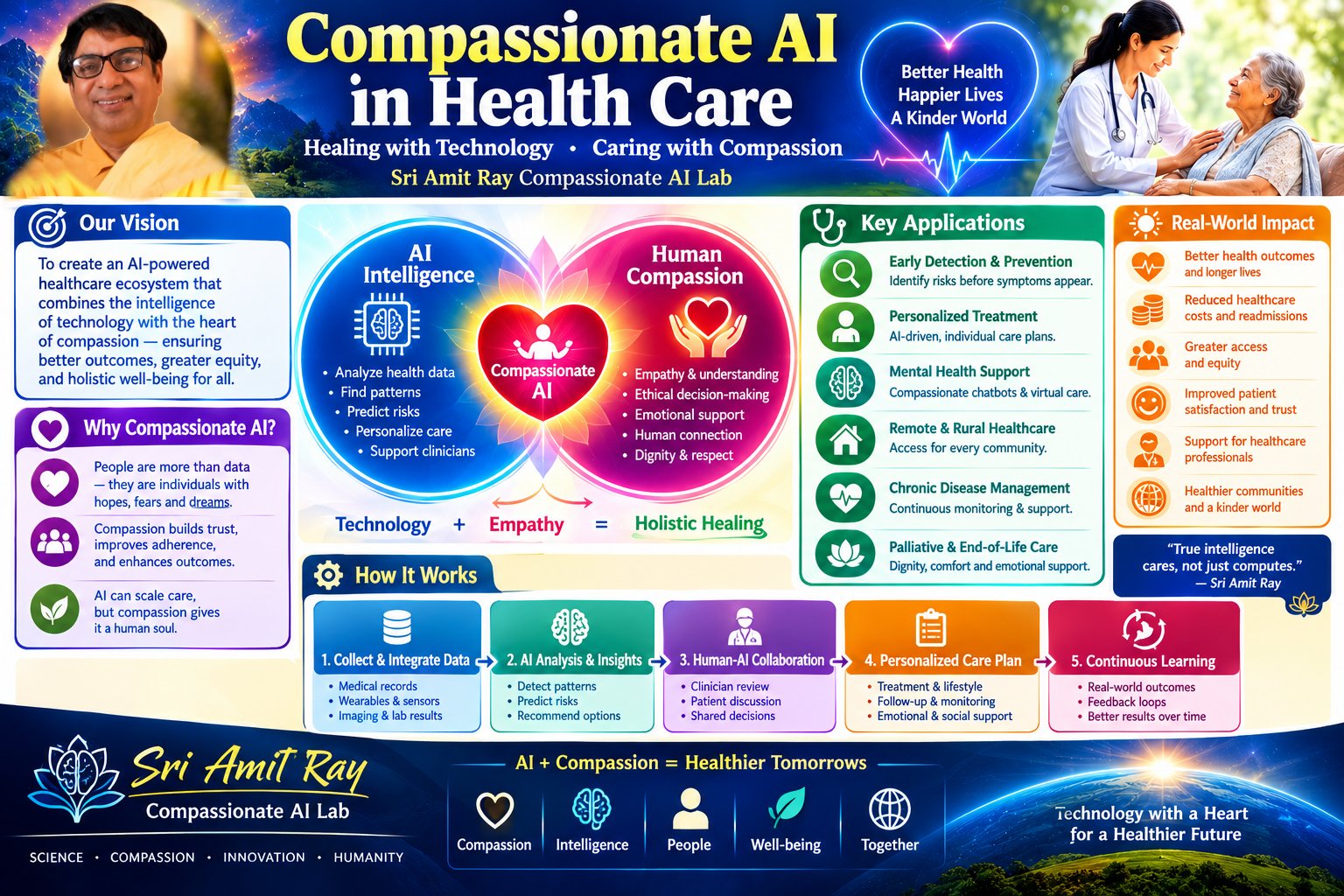
The review also identifies key limitations: many compassion-oriented constructs remain conceptual or require prospective clinical validation, and ethical scoring cannot substitute for clinical evidence, privacy protection, or accountable governance. The central conclusion is that compassionate AI should be engineered as a lifecycle property—from data perception and contextual understanding through clinical decision support, human review, action, and feedback—rather than treated as a late-stage ethical add-on.
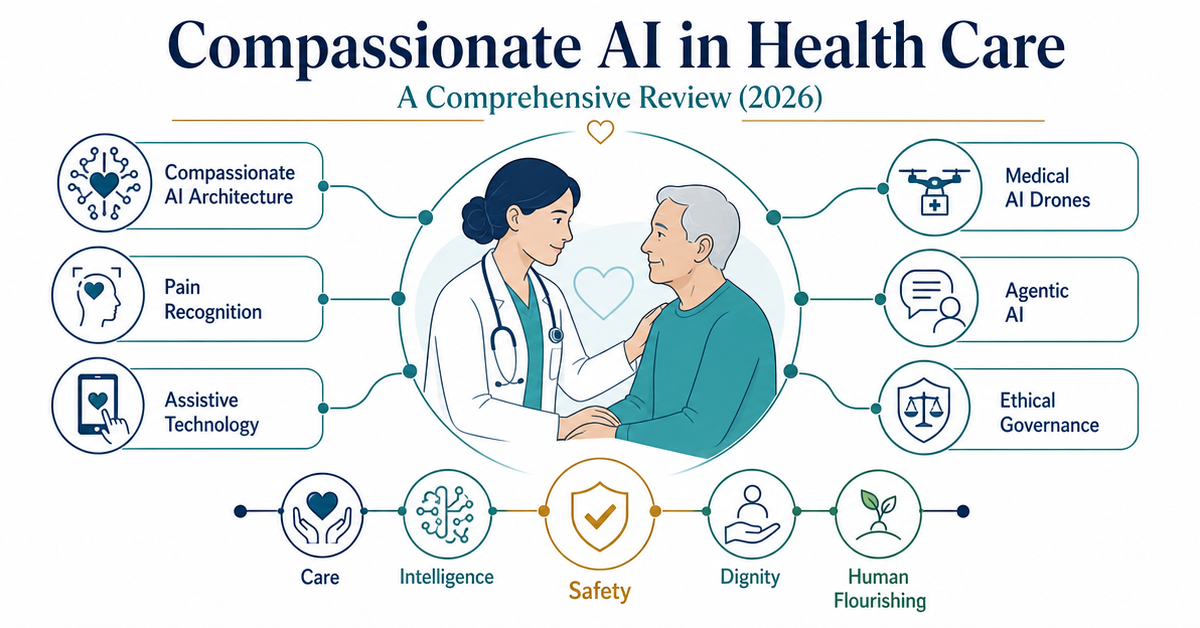 Cover image. Compassionate AI in Health Care: A Comprehensive Review (2026).
Keywords
compassionate AI; artificial intelligence in health care; Compassionate AI Architecture; Compassion Quotient Algorithm; Human Flourishing Optimization; pain recognition and prediction; agentic AI; medical AI drones; human-centred AI; health-care ethics; patient safety; human flourishing
Cite As
Ray, Amit. “Compassionate AI in Health Care: A Comprehensive Review (2026).” Compassionate AI 3.8 (21 August 2026): 63-74, Compassionate AI Lab. https://sriamitray.com/research/compassionate-ai-health-care/.
Introduction
Compassionate Artificial Intelligence (AI) in health care represents an emerging human-centered paradigm in which intelligent systems are designed not only to improve diagnostic accuracy, clinical decision-making, and operational efficiency, but also to recognize human vulnerability, reduce suffering, preserve dignity, and promote holistic well-being. Rather than treating patients as collections of clinical data points, Compassionate AI seeks to integrate medical intelligence with empathy-aware interaction, ethical responsibility, personalized care, safety, transparency, and meaningful human oversight. This comprehensive review examines the conceptual foundations, technological architecture, clinical applications, ethical dimensions, computational principles, challenges, and future directions of Compassionate AI in health care, with particular attention to how AI systems can evolve from prediction- and optimization-oriented tools toward trustworthy partners that actively support human flourishing.
By 2026, clinical artificial intelligence is shifting from pure diagnostic speed toward emotionally aware, ethically governed systems built to reduce suffering rather than just process data. In the Compassionate AI Lab, we describe this shift as compassionate AI in health care — medicine guided by compassion-scoring algorithms, layered ethical architectures, and human-flourishing metrics rather than efficiency alone. This review brings together the core frameworks, algorithms, and clinical applications that define this human-centered approach to AI in medicine today.
- What Is Compassionate AI in Healthcare?
- The Compassionate AI Architecture (CAIA)
- The Compassion Quotient (CQ) Algorithm
- Human Flourishing Optimization: HFOA and CHFOA
- Pain Recognition and Prediction AI (PRPA)
- Agentic AI Healthcare MCP Servers
- Medical AI Drones for Emergency and Disaster Care
- Assistive AI: Elderly Care, Blind Navigation, and Brain-Computer Interfaces
- Specialized Clinical AI Research
- Ethical Principles and AI Safety in Health Care
- Frequently Asked Questions
- References
What Is Compassionate AI in Healthcare?
Compassionate AI in health care refers to intelligent systems designed around a single organizing principle: every technical decision should reduce suffering and support human flourishing, not just optimize for accuracy or throughput. Rather than treating patients as data points, this approach embeds ethical reasoning, emotional awareness, and dignity-preserving design directly into the architecture of clinical AI systems, as outlined in From Data-Driven AI to Compassionate AI.
This movement grew out of a broader call to reorient artificial intelligence away from purely commercial or extractive goals and toward safeguarding vulnerable populations, described in detail in Calling for a Compassionate AI Movement. In health care specifically, this means systems that can recognize pain, respect autonomy, support caregivers, and make ethically weighted decisions — principles formalized across the Compassionate AI Architecture and the 12 Compassionate AI Principles.
The Compassionate AI Architecture (CAIA): A Seven-Layer Framework
At the foundation of this field sits the Sri Amit Ray Compassionate AI Architecture (CAIA), a seven-layer framework built specifically for human-centered artificial intelligence. Rather than bolting ethics onto an existing model after deployment, CAIA structures compassion as a first-class engineering requirement — moving from raw data perception and contextual understanding through to ethical reasoning, emotional sensitivity, and finally compassionate action and feedback.
In a healthcare setting, this layered structure matters because clinical decisions are rarely purely technical. A diagnostic recommendation, a triage decision, or a caregiving robot’s response all carry emotional and ethical weight that a narrowly optimized model can miss. The broader catalog of supporting techniques is detailed in Human-Centered Compassionate AI: The 25 Algorithms, which extends the CAIA foundation into specific, deployable tools.
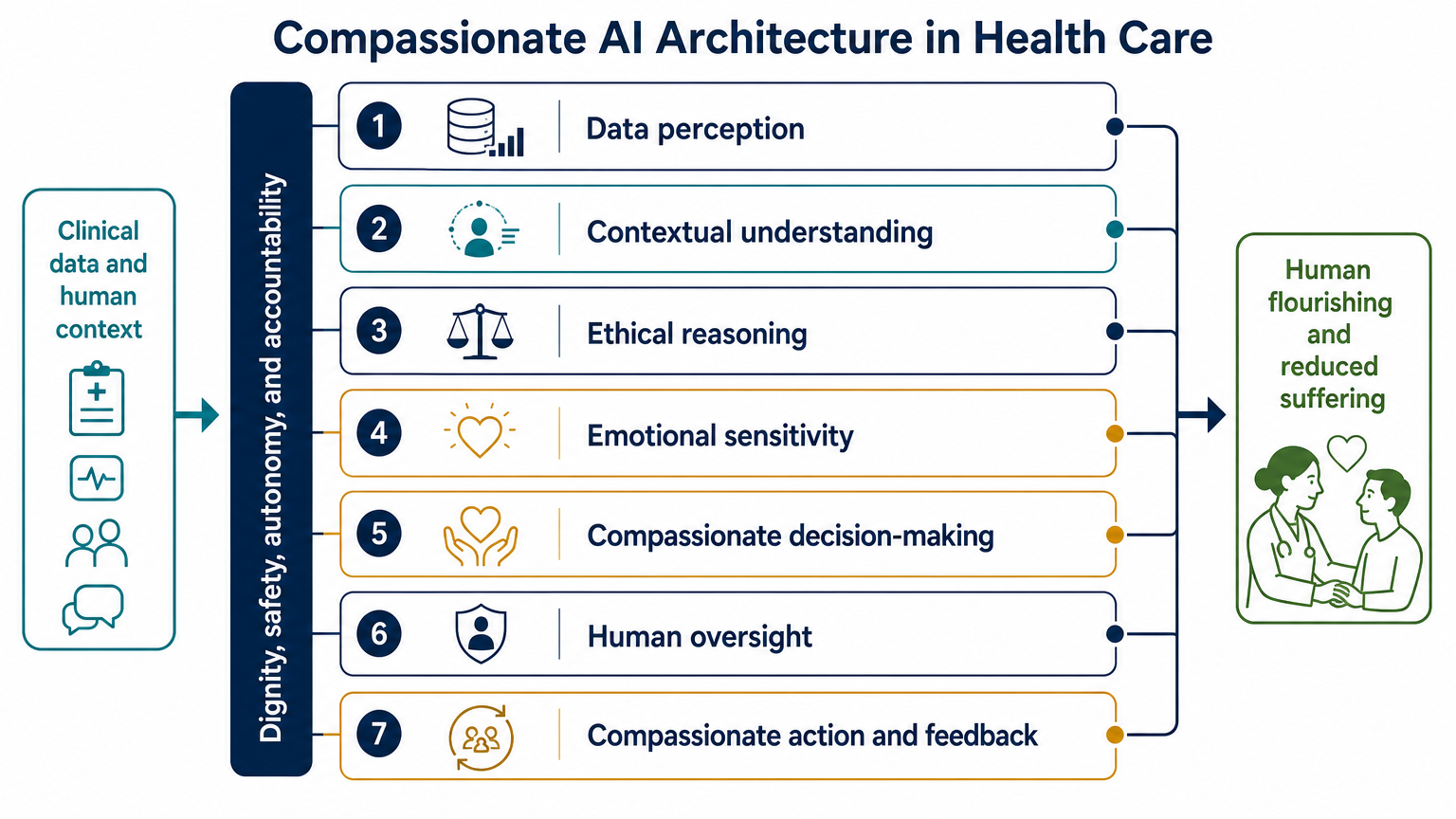 Figure 1. Compassionate AI Architecture in Health Care: a seven-layer framework from clinical data and human context to human flourishing and reduced suffering.
The Compassion Quotient (CQ) Algorithm
One of the most distinctive contributions to this field is the Sri Amit Ray Compassion Quotient (CQ) Algorithm, which attempts to quantify how compassionate an AI system’s outputs actually are. Instead of measuring only accuracy or speed, CQ scoring evaluates whether a system’s recommendations account for patient suffering, emotional context, and long-term wellbeing.
In practice, a CQ-style scoring layer can sit on top of existing clinical decision-support tools, flagging outputs that are technically correct but emotionally or ethically tone-deaf — for example, a treatment plan that is medically sound but fails to account for a patient’s fear, financial burden, or family circumstances.
- The AI system generates a candidate clinical recommendation or response.
- The CQ layer evaluates the output against compassion-weighted criteria, not just accuracy.
- Low-scoring outputs are flagged for review or automatically adjusted before reaching the patient or clinician.
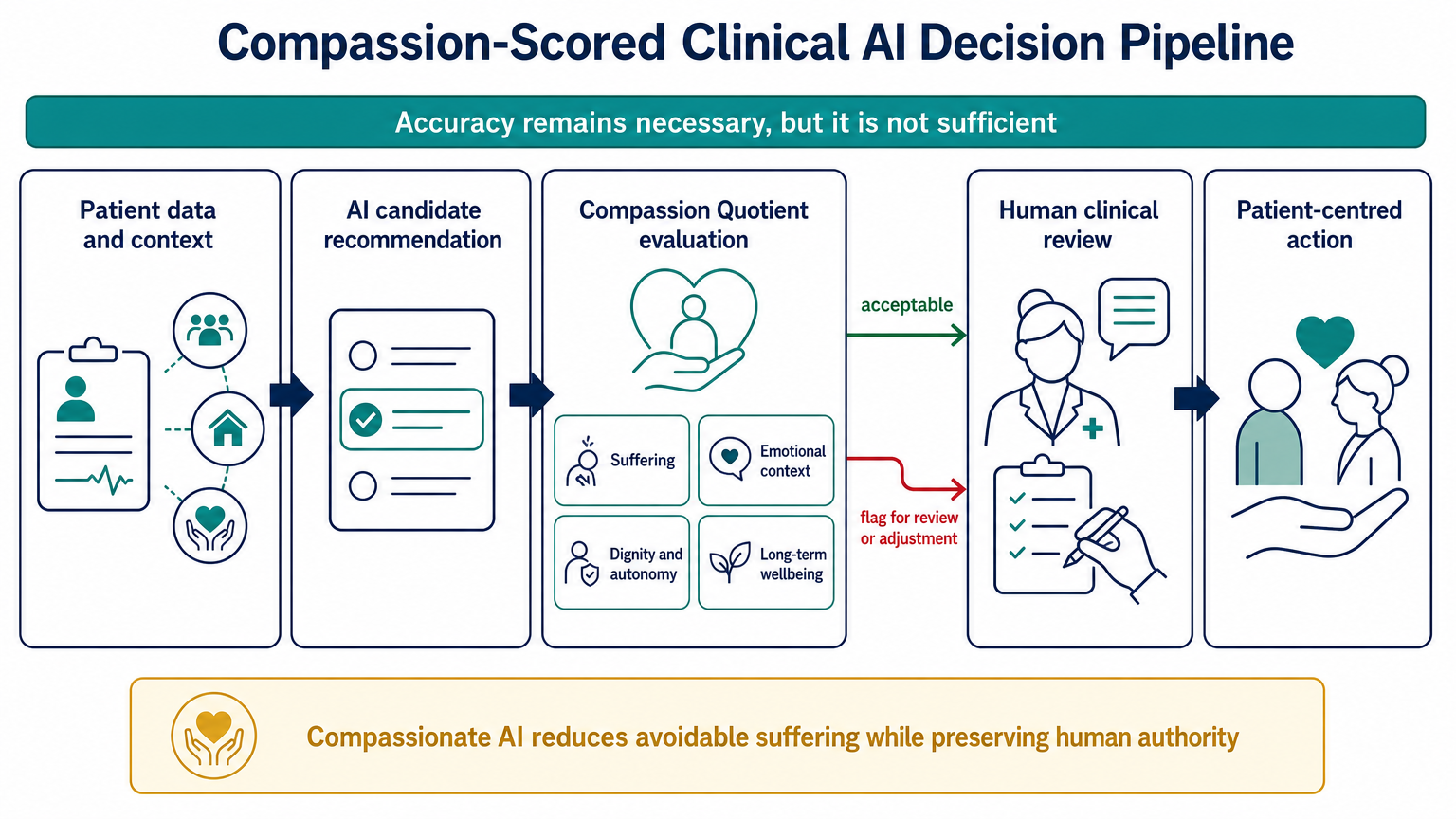 Figure 2. Compassion-scored clinical AI decision pipeline, showing Compassion Quotient evaluation and human clinical review.
This scoring approach connects directly to the Human Flourishing Optimization Algorithms, which apply similar compassion-weighted logic at a systemic, multi-patient level.
Human Flourishing Optimization: HFOA and CHFOA
Where the CQ Algorithm scores individual outputs, the Human Flourishing Optimization Algorithm (HFOA) operates at a broader design level, optimizing AI decision-making toward long-term human wellbeing rather than short-term metrics like engagement, cost reduction, or throughput. In a hospital or clinical setting, this could mean weighting a scheduling or resource-allocation algorithm toward patient recovery quality rather than pure bed-turnover speed.
Healthcare systems, however, involve far more than one patient and one algorithm — they involve clinicians, administrators, insurers, families, and public health agencies simultaneously. The Collective Human Flourishing Optimization AI Algorithm (CHFOA) extends HFOA into a multi-stakeholder framework, balancing competing interests across an entire care ecosystem while still keeping suffering reduction as the central objective.
| Framework | Primary Scope | Healthcare Application |
|---|---|---|
| CAIA | System architecture | Structuring compassionate decision-making end-to-end |
| CQ Algorithm | Individual output scoring | Flagging emotionally/ethically weak recommendations |
| HFOA | Single-patient optimization | Prioritizing recovery quality over raw efficiency |
| CHFOA | Multi-stakeholder optimization | Balancing patients, clinicians, and institutions |
| PRPA | Pain detection and forecasting | Earlier, more accurate pain management |
Pain Recognition and Prediction AI (PRPA)
Undertreated pain remains one of the most persistent gaps in patient care, particularly for non-verbal, sedated, or cognitively impaired patients. The Pain Recognition and Prediction AI Algorithm (PRPA) addresses this directly, using behavioral and physiological signals to detect current pain and anticipate escalation before it becomes severe.
This is compassionate AI applied at its most concrete: a system that notices what an overburdened care team might miss, and does so proactively rather than reactively. PRPA-style tools align closely with the CQ Algorithm’s emphasis on suffering-aware decision-making, and they complement the emotional-synchrony research discussed under specialized clinical AI research.
Agentic AI Healthcare MCP Servers
As AI moves from single-purpose chatbots toward autonomous, tool-using agents, health care needs infrastructure that lets these agents act safely and transparently. The guide Build Your Own Agentic AI Healthcare MCP Server lays out a practical architecture for connecting AI agents to healthcare data, tools, and workflows through the Model Context Protocol (MCP).
An MCP-based healthcare agent can, for example, retrieve a patient’s history, cross-reference it against current guidelines, and draft a summary for a clinician — all while operating inside guardrails set by frameworks like CAIA. This is where compassionate AI theory becomes deployable infrastructure rather than an abstract principle.
Medical AI Drones for Emergency and Disaster Care
Compassionate AI extends beyond hospital walls into emergency response. Medical AI Drones for Disaster Management examines how autonomous aerial systems can deliver supplies, assess injuries, and coordinate rescue efforts in situations where human responders face delay or danger — floods, earthquakes, and remote-area emergencies among them.
The companion work Compassionate Medical AI Drones as Intelligent Unmanned Health-Care Systems goes further, arguing that these systems must be built on human-centered AI architecture specifically to avoid triage decisions that are technically efficient but ethically indefensible. A drone dispatch algorithm optimized only for speed could systematically deprioritize harder-to-reach patients; a compassion-weighted one, guided by principles similar to CHFOA, corrects for that bias.
- Rapid delivery of blood, medication, and defibrillators to disaster zones
- Aerial injury assessment to guide human rescue-team prioritization
- Communication relay in areas where ground infrastructure has failed
- Reaching isolated or mobility-restricted patients faster than ground transport
Assistive AI: Elderly Care, Blind Navigation, and Brain-Computer Interfaces
Some of the earliest and most tangible applications of compassionate AI target populations who are frequently underserved by mainstream technology. Artificial Intelligence for Balance Control and Fall Detection of Elderly People describes systems that monitor gait and balance in real time, detecting fall risk before an injury occurs rather than only responding after one happens.
Similarly, Navigation System for Blind People Using Artificial Intelligence applies sensor fusion and real-time guidance to restore independent mobility for visually impaired users — a direct, measurable form of suffering reduction. At the more advanced end of this spectrum, Brain-Computer Interface and Compassionate Artificial Intelligence explores how BCI systems, when designed with compassionate principles, can restore communication and control for patients with severe motor impairment without compromising their autonomy or dignity.
These assistive technologies also connect to broader social-care applications described in AI Agents and Robots in Peacekeeping Force and Social Care, which frames caregiving robotics as an extension of the same compassionate-AI value system discussed under ethical principles.
Specialized Clinical AI Research
Beyond general frameworks, several focused research threads push compassionate AI into specific clinical domains. The Ray Mother–Infant Inter-brain Synchrony Algorithm studies how neural synchrony between caregiver and infant can be modeled computationally, with implications for early bonding assessment and developmental care in neonatal settings.
On the microbiology front, Artificial Intelligence to Combat Antibiotic Resistant Bacteria applies machine learning to one of modern medicine’s most urgent threats — predicting resistance patterns and accelerating the search for effective treatments before infections become untreatable. And at a more foundational level, Modeling Consciousness in Compassionate AI uses transformer models validated against EEG data to explore how AI systems might better represent and respond to human subjective experience — directly informing the emotional-awareness goals of the Pain Recognition and Prediction Algorithm.
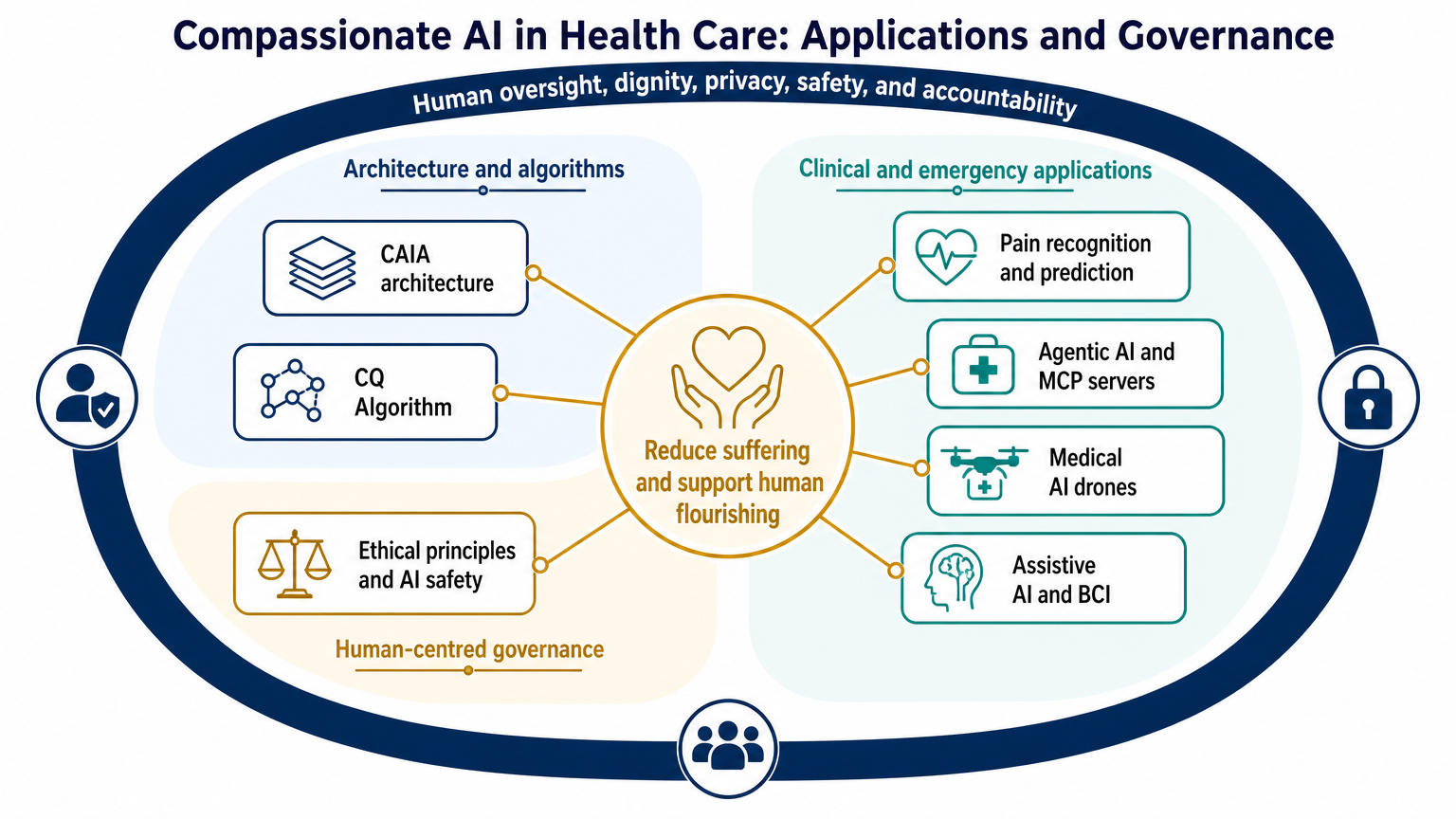 Figure 3. Compassionate AI in health care: connected architecture, algorithms, clinical applications, and human-centred governance.
Ethical Principles and AI Safety in Health Care
None of these clinical applications are safe or sustainable without governing ethical structure. The 12 Sri Amit Ray Compassionate AI Principles lay out the ethical framework underlying every application discussed in this review — covering dignity, transparency, suffering reduction, and long-term human protection.
These principles are reinforced by The Compassionate AI Lab Declaration on AI Safety, Suffering Reduction, and the Protection of Humanity, which calls for formal safeguards around how increasingly capable AI systems are deployed in sensitive domains like health care. As systems grow more autonomous, questions of machine awareness become unavoidable — explored further in AI Consciousness and Self-Aware Robots, which examines what genuine emotional responsiveness in clinical AI might require.
Frequently Asked Questions
What is compassionate AI in health care?
Compassionate AI in health care is an approach to clinical artificial intelligence that embeds ethical reasoning, emotional awareness, and suffering reduction directly into system design, rather than optimizing only for speed or accuracy. It is defined more fully under what is compassionate AI in healthcare above.
What is the Compassion Quotient (CQ) Algorithm?
The CQ Algorithm is a scoring method that evaluates AI-generated clinical outputs for compassion, not just correctness, flagging technically sound but emotionally tone-deaf recommendations. It is discussed in detail in the Compassion Quotient Algorithm section.
How is the Compassionate AI Architecture (CAIA) structured?
CAIA is a seven-layer framework that moves from data perception through ethical reasoning to compassionate action, treating ethics as a core architectural requirement rather than an add-on. See the CAIA section for the full breakdown.
What is the difference between HFOA and CHFOA?
HFOA optimizes AI decisions toward one individual’s long-term wellbeing, while CHFOA extends that same logic across multiple stakeholders — patients, clinicians, and institutions — in a shared care ecosystem. Both are covered under human flourishing optimization.
Can AI predict patient pain before it becomes severe?
Yes — the Pain Recognition and Prediction AI Algorithm (PRPA) uses behavioral and physiological signals to detect pain and forecast escalation, giving clinicians a window to intervene earlier. This is explained further in the PRPA section.
How are AI agents used safely in healthcare settings?
Agentic healthcare AI operates through constrained infrastructure, such as MCP-based servers, that limit an agent’s data access and decision authority to clearly defined boundaries. Details are available in agentic AI healthcare MCP servers.
What role do medical AI drones play in emergency care?
Medical AI drones deliver supplies, assess injuries, and support rescue coordination in disaster zones, particularly where ground access is delayed or dangerous. Their design and ethical considerations are outlined in medical AI drones for emergency and disaster care.
Why do ethical principles matter for clinical AI systems?
Without explicit ethical governance, an AI system can optimize for the wrong objective at scale — such as cost or speed — even when it conflicts with patient wellbeing. The 12 Compassionate AI Principles and the AI Safety Declaration, covered under ethical principles and AI safety, exist to prevent this.
References
- Ray, Amit. “Build Your Own Agentic AI Healthcare MCP Server: A Complete Guide to AI-Powered Healthcare Agents.” Compassionate AI, 3.8 (2026): 60-62. https://sriamitray.com/research/agentic-ai-healthcare-mcp-server/
- Ray, Amit. “Medical AI Drones for Disaster Management: Intelligent Unmanned Health-Care Systems.” Compassionate AI, 3.8 (2026): 57-59. https://sriamitray.com/research/medical-ai-drones-disaster-management/
- Ray, Amit. “Compassionate Medical AI Drones as Intelligent Unmanned Health-Care Systems: A Human-Centered AI Architecture for Suffering Reduction and Human Flourishing.” Compassionate AI, 3.8 (2026): 57-59. https://sriamitray.com/research/medical-ai-drones-human-centered-healthcare/
- Ray, Amit. “The Sri Amit Ray Compassion Quotient (CQ) Algorithm for Compassionate AI.” Compassionate AI, 2.6 (2026): 81-83. https://sriamitray.com/research/compassion-quotient-cq-algorithm-compassionate-ai/
- Ray, Amit. “Collective Human Flourishing Optimization AI Algorithm (CHFOA): A Compassion-Centered Multi-Stakeholder AI Optimization Framework.” Compassionate AI, 2.6 (2026): 90-92. https://sriamitray.com/research/collective-human-flourishing-optimization-algorithm-chfoa/
- Ray, Amit. “Human Flourishing Optimization Algorithm (HFOA) for Compassionate AI Architecture.” Compassionate AI, 2.6 (2026): 81-83. https://sriamitray.com/research/human-flourishing-optimization-algorithm-hfoa-compassionate-ai/
- Ray, Amit. “The Sri Amit Ray Compassionate AI Architecture (CAIA): A Seven-Layer Framework for Human-Centered Artificial Intelligence.” Compassionate AI, 2.6 (2026): 81-83. https://sriamitray.com/research/compassionate-ai-architecture/
- Ray, Amit. “Human-Centered Compassionate AI: The 25 Algorithms for Protecting Humanity and Future Generations.” Compassionate AI, 2.6 (2026): 30-32. https://sriamitray.com/research/human-centered-compassionate-ai-25-algorithms/
- Ray, Amit. “AI Consciousness and Self-Aware Robots: Sri Amit Ray’s Framework for Compassionate Intelligence.” Compassionate AI, 2.5 (2026): 57-59. https://sriamitray.com/research/ai-consciousness-self-aware-robots/
- Ray, Amit. “The 12 Sri Amit Ray Compassionate AI Principles | Ethical AI Framework.” Compassionate AI, 2.4 (2026): 12-14. https://sriamitray.com/research/12-compassionate-ai-principles-humanity-future-generations/
- Ray, Amit. “The Compassionate AI Lab Declaration on AI Safety, Suffering Reduction, and the Protection of Humanity.” Compassionate AI, 4.12 (2025): 72-74. https://sriamitray.com/research/compassionate-ai-declaration-protection-humanity/
- Ray, Amit. “Compassionate AI for Forward Deployed Engineers (FDEs) in SaaS Companies.” Compassionate AI, 4.11 (2025): 15-17. https://sriamitray.com/research/compassionate-ai-forward-deployed-engineers-fdes-saas/
- Ray, Amit. “Microbial AI, Bioleaching and Digital Twins for Manufacturing the 17 Rare Earth Elements.” Compassionate AI, 4.10 (2025): 42-44. https://sriamitray.com/research/microbial-ai-bioleaching-digital-twins-manufacturing-17/
- Ray, Amit. “AI-Driven Rare Earth Element Magnet Design: Detailed Methodologies.” Compassionate AI, 4.10 (2025): 27-29. https://sriamitray.com/research/ai-driven-rare-earth-elements-magnet-design/
- Ray, Amit. “AI Agents and Robots in Peacekeeping Force and Social Care: Compassionate AI Technologies.” Compassionate AI, 3.9 (2025): 75-77. https://sriamitray.com/research/ai-agents-robots-peacekeeping-force-social-care/
- Ray, Amit. “Ray Mother–Infant Inter-brain Synchrony Algorithm for Deep Compassionate AI.” Compassionate AI, 3.9 (2025): 60-62. https://sriamitray.com/research/ray-mother-infant-inter-brain-synchrony-algorithm/
- Ray, Amit. “Pain Recognition and Prediction AI Algorithm (PRPA) for Compassionate AI.” Compassionate AI, 3.9 (2025): 60-62. https://sriamitray.com/research/pain-recognition-prediction-algorithm-prpa-compassionate-ai/
- Ray, Amit. “Modeling Consciousness in Compassionate AI: Transformer Models and EEG Data Verification.” Compassionate AI, 3.9 (2025): 27-29. https://sriamitray.com/research/modeling-consciousness-compassionate-ai-transformer-models/
- Ray, Amit. “The 7 Pillars of Compassionate AI Democracy.” Compassionate AI, 3.9 (2024): 84-86. https://sriamitray.com/research/7-pillars-compassionate-ai-democracy/
- Ray, Amit. “Compassionate AI-Driven Democracy: Power and Challenges.” Compassionate AI, 3.9 (2024): 48-50. https://sriamitray.com/research/compassionate-ai-driven-democracy-power-challenges/
- Ray, Amit. “The 10 Ethical AI Indexes for LLM Data Training and Responsible AI.” Compassionate AI, 3.8 (2023): 35-39. https://sriamitray.com/teachings/10-ethical-ai-indexes-responsible/
- Ray, Amit. “Ethical Responsibilities in Large Language AI Models: GPT-3, GPT-4, PaLM 2, LLaMA, Chinchilla, Gopher, and BLOOM.” Compassionate AI, 3.7 (2023): 21-23. https://sriamitray.com/research/ethical-responsibility-large-language-ai-models/
- Ray, Amit. “Calling for a Compassionate AI Movement: Towards Compassionate Artificial Intelligence.” Compassionate AI, 2.6 (2023): 75-77. https://sriamitray.com/research/calling-compassionate-ai-movement/
- Ray, Amit. “From Data-Driven AI to Compassionate AI: Safeguarding Humanity and Empowering Future Generations.” Compassionate AI, 2.6 (2023): 51-53. https://sriamitray.com/research/data-driven-ai-compassionate-safeguarding-humanity-empowering/
- Ray, Amit. “Artificial intelligence for Climate Change, Biodiversity and Earth System Models.” Compassionate AI, 1.1 (2022): 54-56. https://sriamitray.com/research/artificial-intelligence-climate-change-earth-system-models/
- Ray, Amit. “Artificial Intelligence for Balance Control and Fall Detection of Elderly People.” Compassionate AI, 4.10 (2018): 39-41. https://sriamitray.com/research/artificial-intelligence-balance-control-fall-detection-system/
- Ray, Amit. “Artificial Intelligence to Combat Antibiotic Resistant Bacteria.” Compassionate AI, 2.6 (2018): 3-5. https://sriamitray.com/research/artificial-intelligence-antibiotic-resistant-bacteria/
- Ray, Amit. “Navigation System for Blind People Using Artificial Intelligence.” Compassionate AI, 2.5 (2018): 42-44. https://sriamitray.com/research/artificial-intelligence-assisting-blind-people/
- Ray, Amit. “Brain-Computer Interface and Compassionate Artificial Intelligence.” Compassionate AI, 2.5 (2018): 3-5. https://sriamitray.com/research/brain-computer-interface-compassionate-ai/
- Ray, Amit. “The 25 Algorithms of the Sri Amit Ray Compassionate AI Architecture.” Compassionate AI 3.8 (2026): 63-65. https://sriamitray.com/research/ray-25-compassionate-ai-algorithms/
- Ray, Amit. Human-Centered Compassionate AI. Compassionate AI Lab, 2026. ISBN: 978-8169641050.
- Ray, Amit. Compassionate Artificial Intelligence: Frameworks and Algorithms. Compassionate AI Lab, 2018. ISBN: 978-9382123460.
- Ray, Amit. Compassionate Superintelligence AI 5.0. Compassionate AI Lab, 2018. ISBN: 978-9382123446.
You can download the pdf file: Compassionate AI in Healthcare: A Comprehensive Review.