
Lord Vishnu — the Preserver of the universe in Hindu theology — is worshipped through 24 distinct sacred forms, each carrying a unique name and a specific arrangement of four divine symbols. According to the Ahirbudhnya Samhita and other Pancharatra texts, these 24 permutations of the Shankha (conch), Chakra (discus), Gada (mace), and Padma (lotus) represent 24 aspects of the Supreme Being. Understanding the 24 sacred names of Lord Vishnu is an essential part of Vaishnava devotion, theology, and iconography.
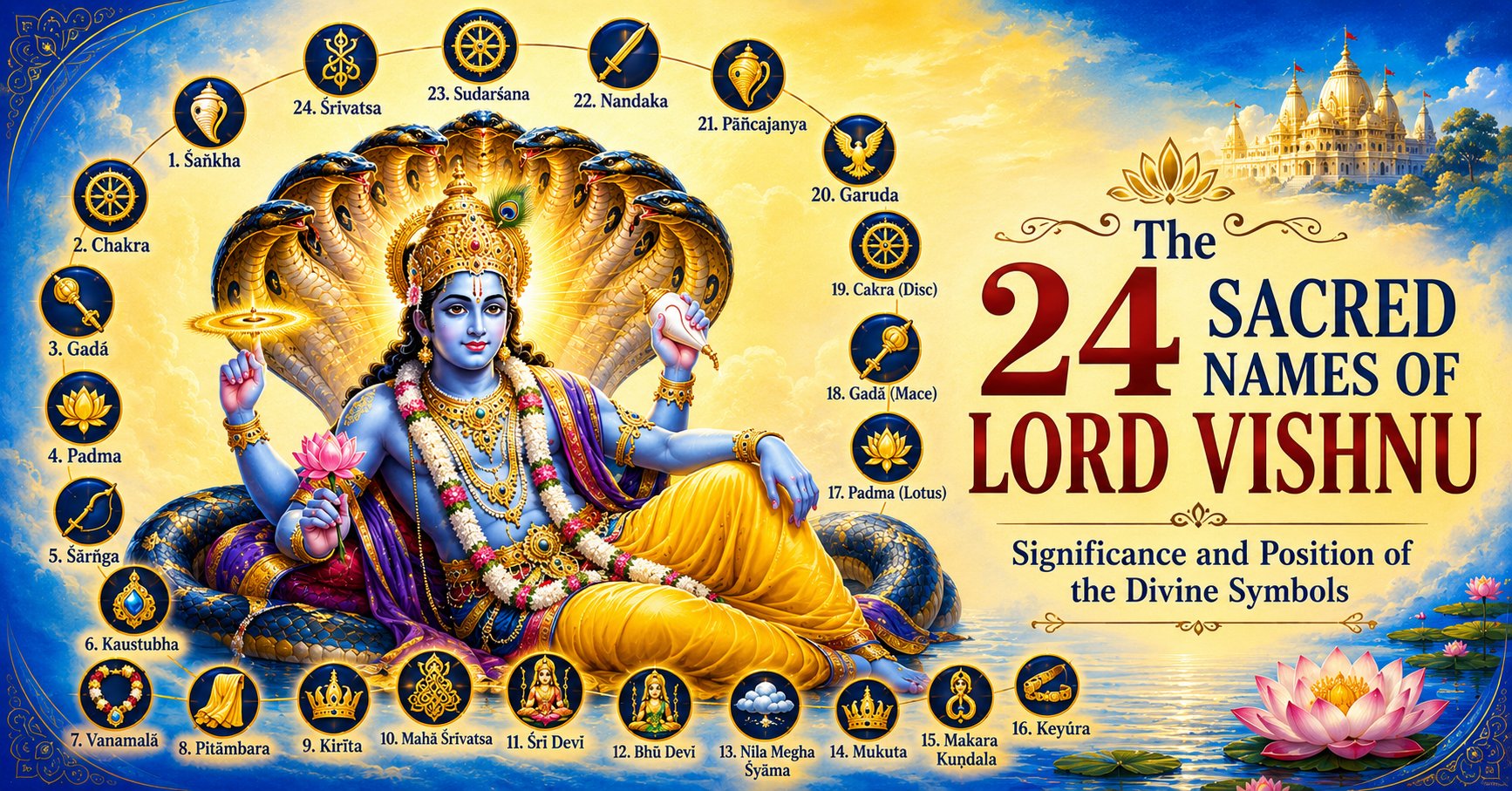
Jump to: Why 24 Forms? | The Four Symbols | All 24 Sacred Names | Detailed Name Profiles | Spiritual Significance | FAQ
Why Does Lord Vishnu Have 24 Sacred Names?
The number 24 is mathematically significant: it is the total number of unique permutations of four objects (4! = 24). Each of the four divine attributes — Shankha, Chakra, Gada, and Padma — held by Lord Vishnu can be arranged in all possible orders across his four hands (lower right, upper right, upper left, lower left). Each unique arrangement gives rise to a distinct divine form with its own name, qualities, and spiritual function.
This system is described in detail in the Pancharatra Agamas — a body of Vaishnava scripture. The Ahirbudhnya Samhita, in particular, names all 24 Chaturvimshati murtis (forms) and explains their cosmic roles. These 24 names collectively represent the complete sovereignty of Lord Vishnu over creation, preservation, and dissolution.
The Four Divine Symbols of Lord Vishnu
Before exploring all 24 sacred names, it is essential to understand the spiritual meaning of each of the four symbols Lord Vishnu holds. The position of these symbols in each hand changes with every form, and this positional shift is the defining characteristic of each of the 24 names.
| Symbol | Sanskrit Name | Spiritual Meaning |
|---|---|---|
| 🐚 Conch | Shankha | The primordial sound of creation (Om); dharmic proclamation; victory over evil |
| ☸️ Discus | Chakra (Sudarshana) | The wheel of time and cosmic law; destruction of ego and ignorance; divine will |
| 🏏 Mace | Gada (Kaumodaki) | Strength of knowledge; punishment of adharma; sovereignty and power |
| 🌸 Lotus | Padma | Purity, liberation, and spiritual enlightenment; the unfolding of creation |
The order of the hands in all descriptions below follows the traditional iconographic convention: lower right → upper right → upper left → lower left. This is the standard used in Pancharatra texts and Agamic temple traditions across South India and beyond.
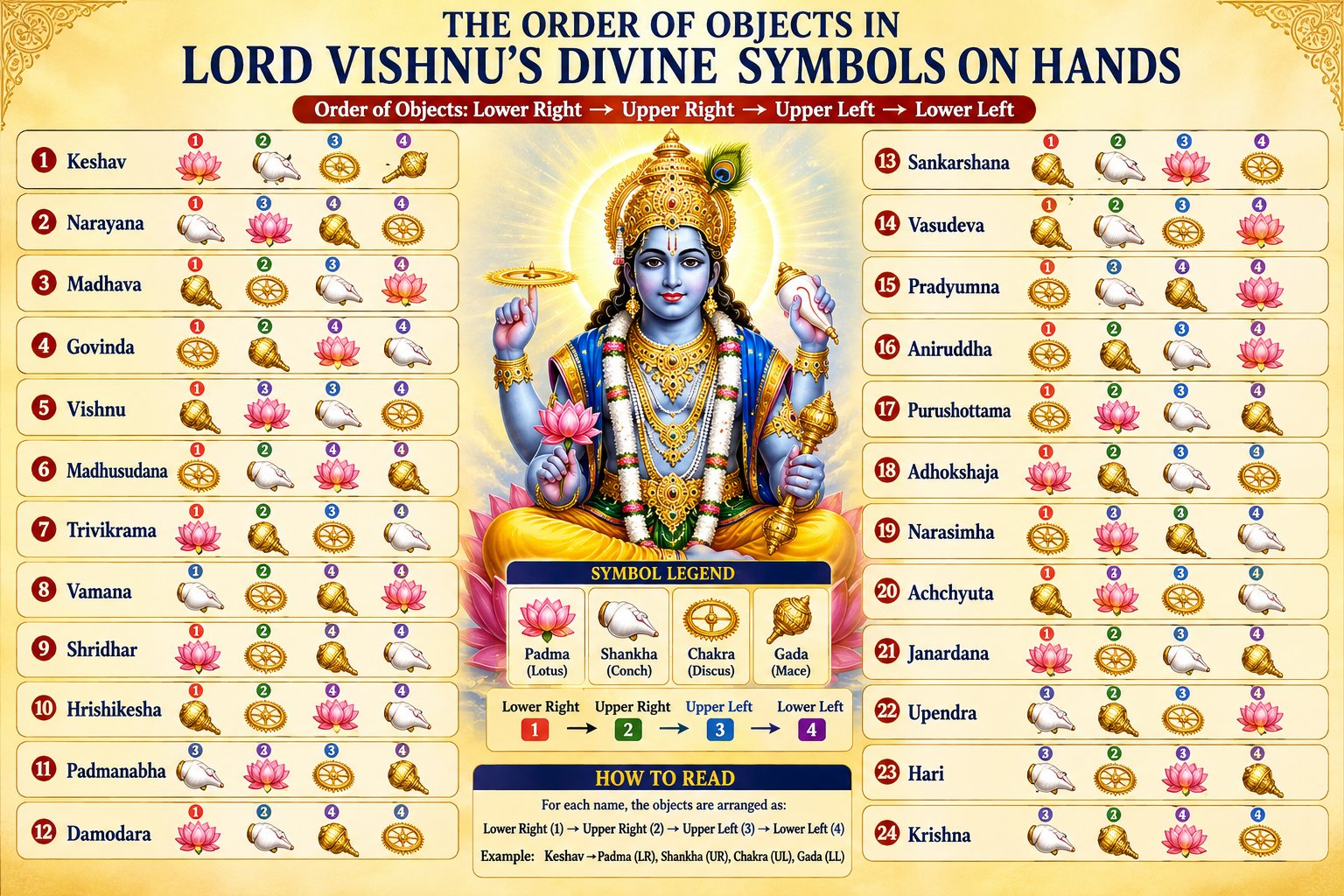
All 24 Sacred Names of Lord Vishnu – Quick Reference Table
The following table gives a complete, at-a-glance overview of all 24 divine forms of Lord Vishnu with the unique arrangement of symbols in each of his four hands. Use the links to jump to the detailed profile of any name.
| # | Sacred Name | Lower Right | Upper Right | Upper Left | Lower Left |
|---|---|---|---|---|---|
| 1 | Keshav | Padma | Shankha | Chakra | Gada |
| 2 | Narayana | Shankha | Padma | Gada | Chakra |
| 3 | Madhava | Gada | Chakra | Shankha | Padma |
| 4 | Govinda | Chakra | Gada | Padma | Shankha |
| 5 | Vishnu | Gada | Padma | Shankha | Chakra |
| 6 | Madhusudana | Chakra | Shankha | Padma | Gada |
| 7 | Trivikrama | Padma | Gada | Chakra | Shankha |
| 8 | Vamana | Shankha | Chakra | Gada | Padma |
| 9 | Shridhar | Padma | Chakra | Gada | Shankha |
| 10 | Hrishikesha | Gada | Chakra | Padma | Shankha |
| 11 | Padmanabha | Shankha | Padma | Chakra | Gada |
| 12 | Damodara | Padma | Shankha | Gada | Chakra |
| 13 | Sankarshana | Gada | Shankha | Padma | Chakra |
| 14 | Vasudeva | Gada | Shankha | Chakra | Padma |
| 15 | Pradyumna | Chakra | Shankha | Gada | Padma |
| 16 | Aniruddha | Chakra | Gada | Shankha | Padma |
| 17 | Purushottama | Chakra | Padma | Shankha | Gada |
| 18 | Adhokshaja | Padma | Gada | Shankha | Chakra |
| 19 | Narasimha | Chakra | Padma | Gada | Shankha |
| 20 | Achchyuta | Gada | Padma | Chakra | Shankha |
| 21 | Janardana | Padma | Chakra | Shankha | Gada |
| 22 | Upendra | Shankha | Gada | Chakra | Padma |
| 23 | Hari | Shankha | Chakra | Padma | Gada |
| 24 | Krishna | Shankha | Gada | Padma | Chakra |
Detailed Profiles of All 24 Sacred Names of Lord Vishnu
Each profile below explains the meaning of the name, the unique arrangement of divine symbols, and the spiritual significance of that form of Vishnu. These 24 names are traditionally recited in sequence during Vaishnava puja (worship).
1. Keshav (केशव)
Meaning: “One with beautiful, flowing locks of hair” or “Slayer of the demon Keshi.” The root kesha means hair, and Keshav is celebrated for his divine beauty. Some scholars also derive it as “Ka + Isha + Va” — signifying the controller of Brahma (Ka) and Shiva (Isha).
Hands (Lower Right → Upper Right → Upper Left → Lower Left):
🌸 Padma 🐚 Shankha ☸️ Chakra 🏏 Gada
Significance: Keshav is considered the first and foremost of the 24 forms. He is the cosmic beauty of the divine — the one whose very appearance liberates devotees. The Vishnu Sahasranama opens with salutations to Vishvam and quickly venerates Keshav as the embodiment of divine splendor. Devotees invoke Keshav especially during the morning ritual (Pratah-puja).
2. Narayana (नारायण)
Meaning: “The refuge of all beings” or “One who dwells in the waters of existence (Nara).” Nara refers to the primordial waters or the cosmic soul of humanity; Ayana means abode or goal. Narayana is the ultimate resting place and refuge of all souls.
Hands (Lower Right → Upper Right → Upper Left → Lower Left):
🐚 Shankha 🌸 Padma 🏏 Gada ☸️ Chakra
Significance: Narayana is one of the most universally revered names of Vishnu. The Narayana Upanishad identifies him with the Supreme Brahman. He is the eternal resting place of creation — reclining on Adi Shesha in the cosmic ocean of Vaikuntha. This form is worshipped during midday puja (Madhyana-puja). Om Namo Narayanaya is one of the most powerful Vaishnava mantras.
3. Madhava (माधव)
Meaning: “Consort of Lakshmi (Ma)” or “Born of the Madhu dynasty” or “Lord of wisdom and spring.” The name is also interpreted as “Sweet as honey (Madhu)” — representing the divine sweetness of liberation.
Hands (Lower Right → Upper Right → Upper Left → Lower Left):
🏏 Gada ☸️ Chakra 🐚 Shankha 🌸 Padma
Significance: Madhava represents the knowledge-aspect of Vishnu — the divine wisdom that liberates. He is associated with the spring season (Vasanta), a time of renewal and joy. As the husband of Madhavi (Lakshmi), he embodies divine grace and abundance. The name Madhava appears prominently in the Bhagavad Gita as Arjuna’s address to Krishna.
4. Govinda (गोविन्द)
Meaning: “Protector of cows and the earth” or “One who gives joy to the senses.” From Go (cows/earth/Vedas/senses) and Vinda (one who finds or gives). Govinda is the divine cowherd — a beloved form closely linked to Krishna’s pastoral lila in Vrindavan.
Hands (Lower Right → Upper Right → Upper Left → Lower Left):
☸️ Chakra 🏏 Gada 🌸 Padma 🐚 Shankha
Significance: Govinda is the pastoral, playful, and accessible form of the divine. He is the lord who descends to the level of his devotees and plays among them. The name is among the most emotionally intimate in Vaishnava bhakti — it evokes the image of Krishna amid the cows of Gokul. The Brahma Samhita famously begins: “Govindam adi-purusham tam aham bhajami.”
5. Vishnu (विष्णु)
Meaning: “The all-pervading one.” From the Sanskrit root Vish — to enter or pervade. Vishnu is the cosmic presence that permeates every atom of existence. He is omnipresent, omniscient, and omnipotent.
Hands (Lower Right → Upper Right → Upper Left → Lower Left):
🏏 Gada 🌸 Padma 🐚 Shankha ☸️ Chakra
Significance: Vishnu is the name of the deity himself — the Preserver of the Trimurti (alongside Brahma the Creator and Shiva the Destroyer). The Rigveda mentions Vishnu as one who takes three strides to measure the entire universe. His all-pervading nature means that every being, every moment, every action is within him. This is the fifth and central name among the 24, reflecting his universal sovereignty.
6. Madhusudana (मधुसूदन)
Meaning: “Slayer of the demon Madhu.” Madhu was a powerful asura who, along with Kaitabha, stole the Vedas from Brahma during creation. Vishnu destroyed them, earning this name. It also signifies the destroyer of ego and ignorance (metaphorical demons within).
Hands (Lower Right → Upper Right → Upper Left → Lower Left):
☸️ Chakra 🐚 Shankha 🌸 Padma 🏏 Gada
Significance: Madhusudana represents the protective and warrior aspect of Vishnu — the divine force that destroys the demonic and restores cosmic order. Arjuna addresses Krishna as Madhusudana at a pivotal moment in the Bhagavad Gita (Chapter 1), acknowledging his power as the destroyer of inner and outer adversaries.
7. Trivikrama (त्रिविक्रम)
Meaning: “One who took three strides (Vikrama).” This name refers to the Vamana Avatar lila — specifically the moment when the dwarf Vamana expanded to cosmic proportions and measured the three worlds (earth, sky, and heaven) in three steps.
Hands (Lower Right → Upper Right → Upper Left → Lower Left):
🌸 Padma 🏏 Gada ☸️ Chakra 🐚 Shankha
Significance: Trivikrama is a cosmic form — the universe-spanning manifestation of Vishnu that reclaimed the three worlds from the demon king Bali. This form symbolizes that no matter how vast the universe seems, it is entirely contained within the Lord. Trivikrama temples exist across South India, with the famous Trivikrama shrine at Tirukkovilur being among the most ancient.
8. Vamana (वामन)
Meaning: “The dwarf” — from Vamana (short-statured). This is the fifth Avatar of Vishnu in the Dashavatara, where he appeared as a Brahmin dwarf boy to reclaim the three worlds from the benevolent but overly powerful demon king Mahabali.
Hands (Lower Right → Upper Right → Upper Left → Lower Left):
🐚 Shankha ☸️ Chakra 🏏 Gada 🌸 Padma
Significance: Vamana represents the divine principle of humility preceding grandeur. The Lord chose to appear as the smallest of forms before revealing his universal expanse as Trivikrama. This name teaches that the infinite can dwell in the finite. The festival of Onam in Kerala celebrates the legend of Vamana and Mahabali.
9. Shridhar (श्रीधर)
Meaning: “Bearer of Shri (Lakshmi).” Shri refers to Goddess Lakshmi — the divine consort and the energy of prosperity, auspiciousness, and grace. Shridhar is the lord who eternally holds and is inseparable from Shri.
Hands (Lower Right → Upper Right → Upper Left → Lower Left):
🌸 Padma ☸️ Chakra 🏏 Gada 🐚 Shankha
Significance: Shridhar emphasizes the inseparable union of Vishnu and Lakshmi — the cosmic masculine and feminine principles. All prosperity, beauty, and grace in the universe flows from this divine union. Worshipping Shridhar is believed to bring blessings of both material prosperity (Shri) and spiritual liberation (Mukti). The famous Shridhar Swami, a medieval Vaishnava saint, took his name from this form.
10. Hrishikesha (हृषीकेश)
Meaning: “Master of the senses.” Hrishika means senses and Isha means lord. Hrishikesha is the one who governs and controls all the senses — both within individuals and across the cosmos. Alternatively, it means “one with hair that causes joy.”
Hands (Lower Right → Upper Right → Upper Left → Lower Left):
🏏 Gada ☸️ Chakra 🌸 Padma 🐚 Shankha
Significance: Hrishikesha is addressed by Arjuna in the Bhagavad Gita (Chapter 1) as the “Master of the Senses” — recognizing that Krishna-Vishnu is the ultimate controller of perception and cognition. This name is significant in yoga philosophy: the goal of yoga is to offer one’s senses back to Hrishikesha. The city of Rishikesh (Hrishikesh) in Uttarakhand is named after this form.
11. Padmanabha (पद्मनाभ)
Meaning: “One from whose navel (Nabha) the lotus (Padma) emerges.” In the cosmic creation narrative, Brahma (the Creator) is born from a lotus that sprouts from the navel of Vishnu as he rests on Adi Shesha in the primordial ocean.
Hands (Lower Right → Upper Right → Upper Left → Lower Left):
🐚 Shankha 🌸 Padma ☸️ Chakra 🏏 Gada
Significance: Padmanabha represents the creative source of the cosmos. This iconic image — Vishnu in Anantashayana (cosmic repose) with a lotus emerging from his navel bearing Brahma — is one of Hinduism’s most profound theological and artistic symbols. The Padmanabhaswamy Temple in Thiruvananthapuram, Kerala, is dedicated to this form and is considered one of the wealthiest and most sacred temples in the world.
12. Damodara (दामोदर)
Meaning: “One who was bound by a rope (Dama) around the belly (Udara).” This name refers to the beloved childhood lila of baby Krishna in Vrindavan, when his foster mother Yashoda tied him to a mortar with a rope after he broke a pot of butter.
Hands (Lower Right → Upper Right → Upper Left → Lower Left):
🌸 Padma 🐚 Shankha 🏏 Gada ☸️ Chakra
Significance: Damodara is the most intimate form of Vishnu-Krishna — the Supreme Being who willingly submits to be bound by the love of a devotee. The Damodarashtaka (eight prayers to Damodara) composed by Shatakopa and Sanatana Goswami is among the most beloved devotional hymns in Vaishnavism. The month of Kartik is specifically dedicated to worship of Damodara.
13. Sankarshana (संकर्षण)
Meaning: “One who draws together” or “He by whom all is attracted.” Sankarshana is identified with Balarama, the elder brother of Krishna, and also with Adi Shesha (the cosmic serpent). The name refers to the divine power of attraction — the force that draws souls toward the divine.
Hands (Lower Right → Upper Right → Upper Left → Lower Left):
🏏 Gada 🐚 Shankha 🌸 Padma ☸️ Chakra
Significance: In the Pancharatra Vyuha (emanation) theology, Sankarshana is the second emanation of Vasudeva, representing the principle of individual consciousness (Jiva) and cosmic dissolution. He embodies the power of knowledge (Jnana-shakti). Together with Vasudeva, Pradyumna, and Aniruddha, Sankarshana forms the Chaturvyuha — the four cosmic emanations of Vishnu.
14. Vasudeva (वासुदेव)
Meaning: “Son of Vasudeva” (Krishna’s earthly father) or “The divine being (Deva) who dwells (Vasa) in all things.” At the cosmic level, Vasudeva is the primary emanation — the transcendent Supreme Being from whom all other forms proceed.
Hands (Lower Right → Upper Right → Upper Left → Lower Left):
🏏 Gada 🐚 Shankha ☸️ Chakra 🌸 Padma
Significance: In Pancharatra theology, Vasudeva is the Para-Brahman — the highest transcendent form from which the entire universe and all 24 Vishnu forms emanate. The Bhagavad Gita (7.19) states: “Vasudevah sarvam iti” — “Vasudeva is everything.” The famous Om Namo Bhagavate Vasudevaya is the Dvadakshari mantra (12-syllable mantra), one of Vaishnavism’s supreme mantras.
15. Pradyumna (प्रद्युम्न)
Meaning: “Supremely luminous” or “Most glorious.” Pra (most/supremely) + Dyumna (luminous/glorious). Pradyumna is identified with the god of love (Kama reborn), the son of Krishna and Rukmini in the Mahabharata tradition.
Hands (Lower Right → Upper Right → Upper Left → Lower Left):
☸️ Chakra 🐚 Shankha 🏏 Gada 🌸 Padma
Significance: In the Chaturvyuha system, Pradyumna is the third cosmic emanation, representing the principle of mind (Manas) and the power of action (Kriya-shakti). He governs the creative impulse of the cosmos. Pradyumna’s identification with love (Kama) restored after its destruction by Shiva suggests the eternal renewal of devotional and creative energy.
16. Aniruddha (अनिरुद्ध)
Meaning: “The unstoppable one” or “One who cannot be obstructed.” An (not) + Niruddha (obstructed/checked). In the Mahabharata and Puranas, Aniruddha is the son of Pradyumna and grandson of Krishna.
Hands (Lower Right → Upper Right → Upper Left → Lower Left):
☸️ Chakra 🏏 Gada 🐚 Shankha 🌸 Padma
Significance: Aniruddha is the fourth and final form in the Chaturvyuha, representing the principle of ego/self (Ahamkara) and the power of strength (Bala-shakti). He governs the individual’s sense of identity within the cosmic order. Spiritually, Aniruddha represents the aspect of the divine that cannot be bound or stopped — even by the most powerful forces.
17. Purushottama (पुरुषोत्तम)
Meaning: “The Supreme Person (Purusha).” Purusha (person/consciousness) + Uttama (highest/best). Purushottama transcends both the perishable (Kshara Purusha) and the imperishable (Akshara Purusha) and is therefore the Supreme Being beyond all categories.
Hands (Lower Right → Upper Right → Upper Left → Lower Left):
☸️ Chakra 🌸 Padma 🐚 Shankha 🏏 Gada
Significance: The Bhagavad Gita’s Chapter 15, titled Purushottama Yoga, is entirely dedicated to explaining this concept. Krishna tells Arjuna that by knowing him as Purushottama, one achieves perfect wisdom. The famous Jagannath Temple in Puri, Odisha, is located in what is called Purushottama Kshetra — the sacred land of the Supreme Person.
18. Adhokshaja (अधोक्षज)
Meaning: “One who is beyond the perception of the senses.” Adhas (below/beyond) + Aksha (senses/eye) + Ja (born/arising). Adhokshaja is the transcendent form that cannot be perceived or fully comprehended by any sense organ or faculty of the mind.
Hands (Lower Right → Upper Right → Upper Left → Lower Left):
🌸 Padma 🏏 Gada 🐚 Shankha ☸️ Chakra
Significance: Adhokshaja represents the philosophical core of Vaishnavism: the Supreme is ultimately beyond all empirical and intellectual grasp. He can only be known through grace (Kripa) and devotion (Bhakti), not through sensory experience or intellectual analysis alone. The Bhagavata Purana frequently uses this name to emphasize the transcendence of the divine.
19. Narasimha (नृसिंह)
Meaning: “Man-Lion.” Nara (man) + Simha (lion). Narasimha is the fourth Avatar of Vishnu — the half-man, half-lion form who appeared to protect his devotee Prahlada and destroy the tyrannical demon king Hiranyakashipu.
Hands (Lower Right → Upper Right → Upper Left → Lower Left):
☸️ Chakra 🌸 Padma 🏏 Gada 🐚 Shankha
Significance: Narasimha is the fierce, protective form of Vishnu — the guardian who destroys even the most fearsome evil to protect his devotees. His appearance defied the boons given to Hiranyakashipu (neither man nor animal, neither inside nor outside, neither day nor night). This represents the divine capacity to transcend all limitations in order to uphold dharma and protect the faithful. The Narasimha mantra is considered highly protective.
20. Achchyuta (अच्युत)
Meaning: “The infallible one” or “One who never falls (from his divine position).” A (not) + Chyuta (fallen/declined). Achchyuta is the eternally perfect, never-failing, immovable Supreme Being.
Hands (Lower Right → Upper Right → Upper Left → Lower Left):
🏏 Gada 🌸 Padma ☸️ Chakra 🐚 Shankha
Significance: Achchyuta assures devotees of the absolute reliability of the divine. While everything in the material world is subject to change, decay, and failure, Achchyuta is eternally steadfast. Arjuna addresses Krishna as Achchyuta at key moments in the Bhagavad Gita, implying his trust in the infallible nature of the divine guide. Many traditional Ayurvedic texts and formulations invoke Achchyuta for their efficacy.
21. Janardana (जनार्दन)
Meaning: “One who is petitioned by all people (Jana)” for liberation, boons, and protection. Jana (people/beings) + Ardana (worshipped/approached/one who grants). Janardana is the divine refuge to whom all beings — gods, humans, and even demons — turn in time of need.
Hands (Lower Right → Upper Right → Upper Left → Lower Left):
🌸 Padma ☸️ Chakra 🐚 Shankha 🏏 Gada
Significance: Janardana is the universally accessible form of Vishnu — the one who responds to the prayers of all beings regardless of their status or nature. This name appears frequently in the Bhagavad Gita and the Mahabharata, where Arjuna seeks guidance from Krishna-Janardana in moments of moral crisis. The name signifies Vishnu’s role as the ultimate responder and grantor of salvation.
22. Upendra (उपेन्द्र)
Meaning: “Younger brother of Indra” or “The Indra of Indras.” Upa (near/subordinate) + Indra. As the Vamana Avatar, Vishnu was born as the son of Kashyapa and Aditi — the same parents as Indra — making him Indra’s younger brother. Paradoxically, Upendra surpasses Indra in glory.
Hands (Lower Right → Upper Right → Upper Left → Lower Left):
🐚 Shankha 🏏 Gada ☸️ Chakra 🌸 Padma
Significance: Upendra illustrates a profound teaching: that the Supreme, though appearing in a subordinate or humble role, always transcends his apparent position. Just as Vamana appeared as a humble dwarf before revealing himself as the cosmos-spanning Trivikrama, Upendra reminds us that divine greatness is often veiled in humility. This form is worshipped for blessings of divine wisdom that transcends worldly power.
23. Hari (हरि)
Meaning: “The remover of sins and suffering.” From the root Hara — to take away, to steal, to remove. Hari is the one who steals away the sins, sorrows, and bondage of his devotees. The name also means “golden/yellow-colored” (Harita), referring to Vishnu’s radiant golden complexion.
Hands (Lower Right → Upper Right → Upper Left → Lower Left):
🐚 Shankha ☸️ Chakra 🌸 Padma 🏏 Gada
Significance: Hari is perhaps the most emotionally evocative and widely used name of Vishnu in devotional practice. Hari Om and Hare Krishna are among the most universally chanted Vaishnava mantras. The name encapsulates the devotional promise of bhakti — that the Lord actively reaches out to remove the devotee’s burdens. Hari bol! (Chant the name of Hari!) is the devotional battle cry of Vaishnavas across the world.
24. Krishna (कृष्ण)
Meaning: “The dark-complexioned one” or “The all-attractive one.” From the Sanskrit root Krish — to attract or to draw. Krishna is the one whose divine qualities — beauty, wisdom, love, strength, and joy — attract all beings in the universe. He is also the eighth Avatar of Vishnu.
Hands (Lower Right → Upper Right → Upper Left → Lower Left):
🐚 Shankha 🏏 Gada 🌸 Padma ☸️ Chakra
Significance: Krishna is the culminating name in the list of 24 — and for the Vaishnava tradition, he is the Svayam Bhagavan (the original Supreme Person from whom all forms emanate). The Bhagavata Purana (1.3.28) declares: “Krishnas tu Bhagavan Svayam” — “Krishna alone is the Original Supreme Lord.” His life, teachings (Bhagavad Gita), and divine play (Lila) are the foundation of the entire Vaishnava theological tradition, touching hundreds of millions of devotees worldwide.
The Spiritual Significance of the 24 Sacred Names of Lord Vishnu
The Theological Framework: Chaturvimshati Murtis
The 24 forms (Chaturvimshati Murtis) are not merely artistic variations — they represent a sophisticated theological system. Each arrangement of the four symbols (Shankha, Chakra, Gada, Padma) corresponds to a specific aspect of the divine that governs different dimensions of creation, time, and cosmic function. The Ahirbudhnya Samhita and Jayakhya Samhita of the Pancharatra tradition detail these correspondences extensively.
How These Names Are Used in Worship
In traditional Vaishnava puja, the worshipper mentally (or verbally) identifies each flower or ritual offering with one of the 24 names. The Pushpanjali (flower offering) ritual involves offering 24 flowers, each dedicated to one form. This practice is especially prominent in temples following the Pancharatra Agama, particularly in South India.
The Names in the Vishnu Sahasranama
The majority of these 24 names appear in the Vishnu Sahasranama (the 1000 names of Vishnu from the Mahabharata, Anushasana Parva), recited by Bhishma to Yudhishthira on his deathbed. Names like Keshav, Narayana, Madhava, Govinda, Hari, and Krishna are among the most celebrated verses in this monumental hymn.
Recitation Mantra Format
In daily Vaishnava worship, the 24 names are sometimes chanted in sequence during the Dwadasha Nama Stotra or the full Chaturvimshati Nama ritual. Each name may be prefixed with Om and suffixed with Namah:
Reciting all 24 names is considered equivalent to meditating on all aspects of the divine simultaneously — a comprehensive act of devotion.
The Four Symbols as Cosmic Principles
Beyond the physical objects, the four symbols held by Vishnu represent four fundamental cosmic principles that operate in different arrangements in every aspect of existence:
- Shankha (Conch): Shabda Brahman — the primordial sound from which creation emerges
- Chakra (Discus): Kala — the wheel of time and the cycle of cosmic law
- Gada (Mace): Jnana-shakti — the power of knowledge and divine authority
- Padma (Lotus): Moksha — liberation, purity, and the unfolding of consciousness
The varying positions of these symbols across the 24 forms reflect how these cosmic principles manifest differently in different dimensions and functions of reality.
Frequently Asked Questions – The 24 Sacred Names of Lord Vishnu
Q1. What are the 24 sacred names of Lord Vishnu?
The 24 sacred names of Lord Vishnu, known as the Chaturvimshati Murtis, are: Keshav, Narayana, Madhava, Govinda, Vishnu, Madhusudana, Trivikrama, Vamana, Shridhar, Hrishikesha, Padmanabha, Damodara, Sankarshana, Vasudeva, Pradyumna, Aniruddha, Purushottama, Adhokshaja, Narasimha, Achchyuta, Janardana, Upendra, Hari, and Krishna. Each form is defined by a unique arrangement of four divine symbols across four hands.
Q2. Why does Lord Vishnu hold four symbols — Shankha, Chakra, Gada, and Padma?
Each of the four symbols (conch, discus, mace, and lotus) represents a fundamental cosmic principle: primordial sound and creation (Shankha), the wheel of time and divine law (Chakra), the power of knowledge and authority (Gada), and liberation and purity (Padma). Together, they represent the complete sovereignty of Vishnu over all aspects of the cosmos. The 24 permutations of these four symbols across his four hands give rise to the 24 sacred forms and names.
Q3. What scriptural source describes the 24 forms of Vishnu?
The primary scriptural sources are the Pancharatra Agamas, especially the Ahirbudhnya Samhita and the Jayakhya Samhita. The Vishnu Purana, Bhagavata Purana, and Vishnu Sahasranama (from the Mahabharata) also refer to many of these names extensively. The Chaturvimshati Murti system is a cornerstone of the Pancharatra theological tradition.
Q4. Which of the 24 names of Vishnu is considered the most important?
Different traditions emphasize different names. In the Sri Vaishnava tradition, Narayana is considered the highest name. In the Gaudiya Vaishnava tradition, Krishna is considered the original Supreme Person (Svayam Bhagavan). Theologically, Vasudeva is considered the primary cosmic form in Pancharatra theology. Hari is the most widely used name in devotional practice, while Keshav is listed first in the traditional sequence.
Q5. How do the 24 names relate to the Dashavatara (10 avatars of Vishnu)?
The 24 names and the 10 main avatars (Dashavatara) are related but distinct concepts. Names like Vamana (dwarf avatar), Narasimha (man-lion avatar), Trivikrama (the expanded form of Vamana), and Krishna appear in both lists. The 24 names are theological/iconographic forms defined by symbol arrangements, while the Dashavatara describes the historical/mythological incarnations of Vishnu for specific cosmic purposes.
Q6. What is the correct order of Lord Vishnu’s four hands for describing the 24 forms?
The traditional iconographic order is: Lower Right hand → Upper Right hand → Upper Left hand → Lower Left hand. This is the convention used in Pancharatra Agamic texts and is followed in the descriptions of all 24 forms in this article. Different scholarly sources may occasionally use different ordering conventions, but the Agamic standard is lower-right, upper-right, upper-left, lower-left.
Q7. Are the 24 names of Vishnu chanted in daily puja (worship)?
Yes. In traditional Vaishnava puja, especially in temples following the Pancharatra Agama tradition, the 24 names are chanted in sequence — often while offering flowers (Pushpanjali) or during the Abhisheka (ritual bathing) of the deity. Each name is typically prefixed with Om and suffixed with Namah. The sequence begins with Om Kesavaya Namah and ends with Om Krishnaya Namah.
Q8. What does “Chaturvimshati Murtis” mean?
Chaturvimshati is a Sanskrit compound: Chatur (four) + Vimshat (twenty) = twenty-four. Murti means form or image. So “Chaturvimshati Murtis” simply means “the 24 forms (of Vishnu).” This is the technical theological term used in Pancharatra and Vaikhanasa Agamic traditions for the system of 24 divine forms defined by the arrangement of the four symbols.
Q9. Is Narasimha one of the 24 names of Vishnu?
Yes. Narasimha (the man-lion form) is the 19th in the list of 24 sacred names of Lord Vishnu. In this form, Vishnu holds the Chakra in the lower right, Padma in the upper right, Gada in the upper left, and Shankha in the lower left hand. As both an avatar and one of the 24 Chaturvimshati Murtis, Narasimha holds a uniquely significant place in Vaishnava theology.
Q10. Which temple is most famous for worshipping all 24 forms of Vishnu?
While individual temples tend to have one primary presiding deity (e.g., Padmanabhaswamy Temple for Padmanabha, Tirumala for Venkateswara/Vishnu), temples following the Pancharatra Agama tradition often enshrine subsidiary shrines for multiple forms. The Ranganathaswamy temples in Srirangam and Shrirangapattana, and the Ahobila temples in Andhra Pradesh (associated with Narasimha), are particularly comprehensive. The Chaturvimshati Murti system is most fully represented in the ritual rather than architectural layout of Agamic temples.