
A Comprehensive Review of Heart Disease Prevention Algorithms, Mathematics, Clinical Applications, Evaluation, and Integration — 2026
Keywords: heart disease; cardiovascular disease; machine learning; artificial intelligence; risk prediction; prevention; XGBoost; random forest; logistic regression; neural networks; survival analysis; ECG; clinical decision support.
1. Introduction
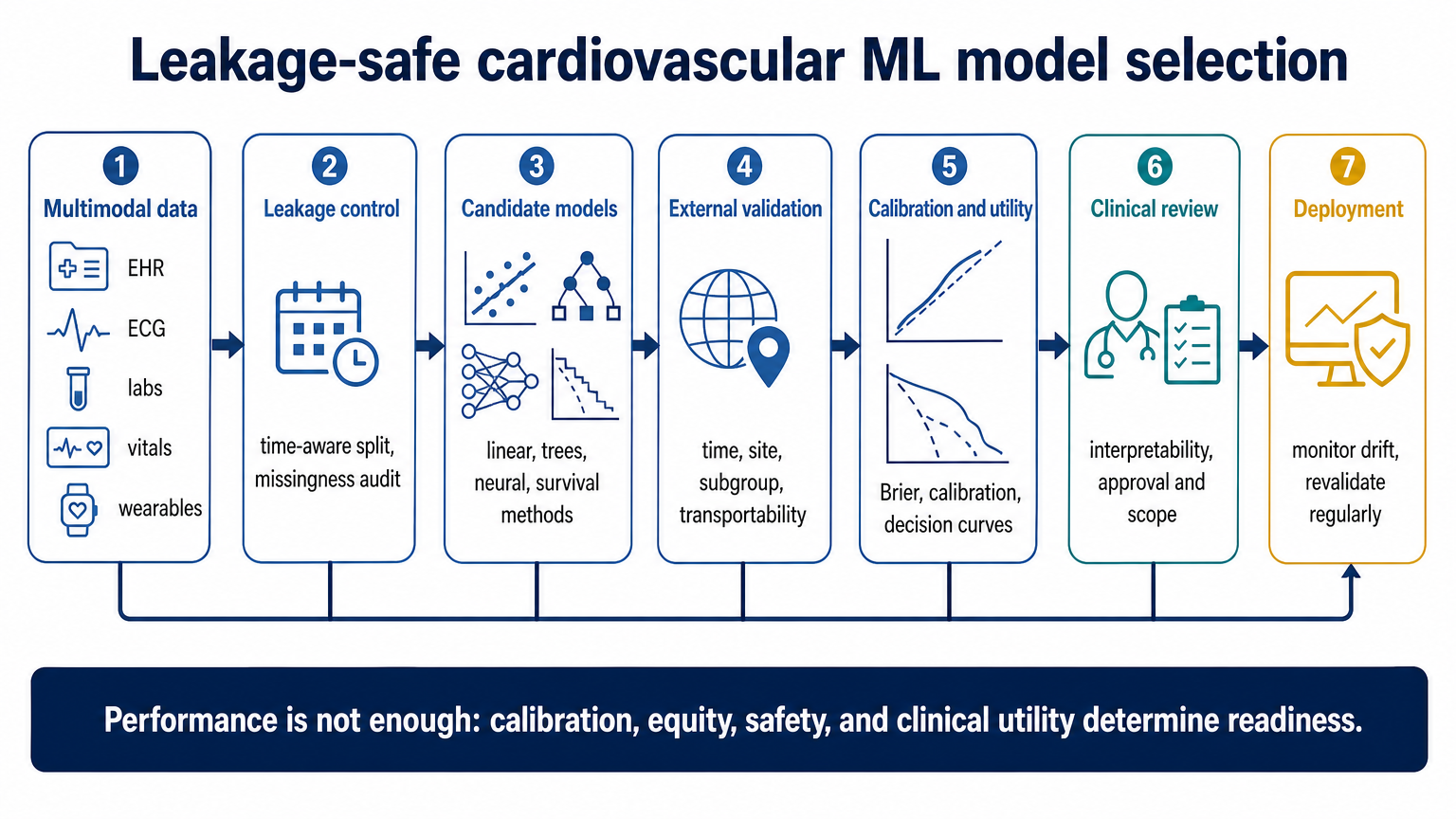
Cardiovascular prevention requires estimation of future risk, identification of modifiable risk factors, longitudinal monitoring, and selection of interventions. Traditional risk equations remain clinically important, but modern ML can represent nonlinear relationships, high-dimensional predictors, repeated observations, signals, images, and multimodal data. A 2025 review of ML approaches for cardiovascular disease examined algorithmic comparison, implementation, and regulatory and ethical issues. PubMed.
A 2026 scoping review specifically assessed AI-based tools for cardiovascular disease risk prediction, illustrating the rapid growth of this field. A separate systematic review found that ensemble learning dominates many structured-data benchmarks, while deep learning is increasingly applied to ECG and cardiac imaging, but emphasized limited external validation and dependence on restricted datasets.
2. Unified Cardiovascular ML Pipeline
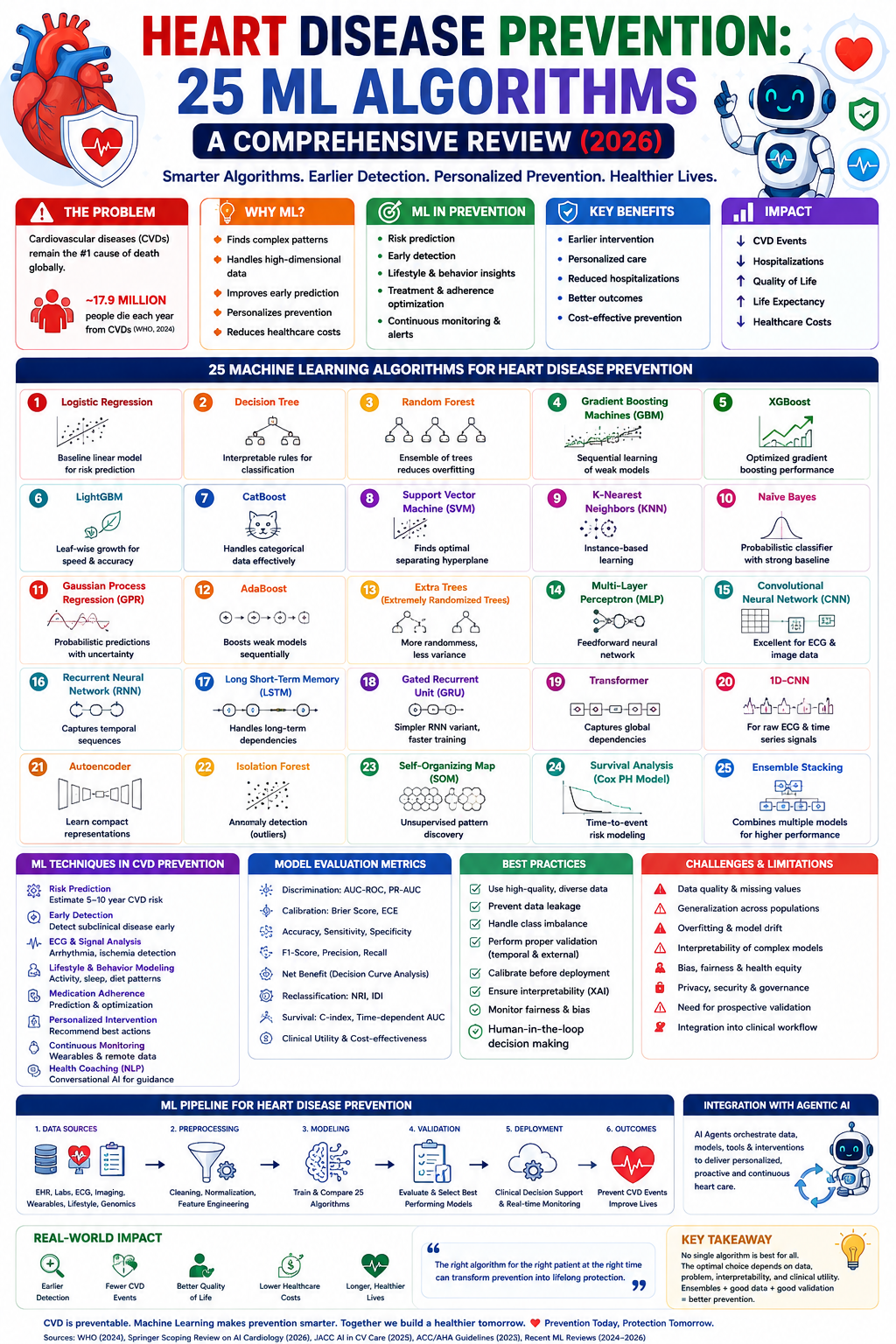
Patient / Population
        ↓
EHR • laboratories • vitals • ECG • imaging • wearables
        ↓
Data quality + missingness + leakage control
        ↓
Feature engineering / representation learning
        ↓
Candidate ML models
        ↓
Internal + external validation
        ↓
Calibration + uncertainty
        ↓
Clinical utility / decision curves
        ↓
Decision support / Agentic orchestration
        ↓
Human authorization
        ↓
Monitoring + drift detection
3. The 25 Algorithms
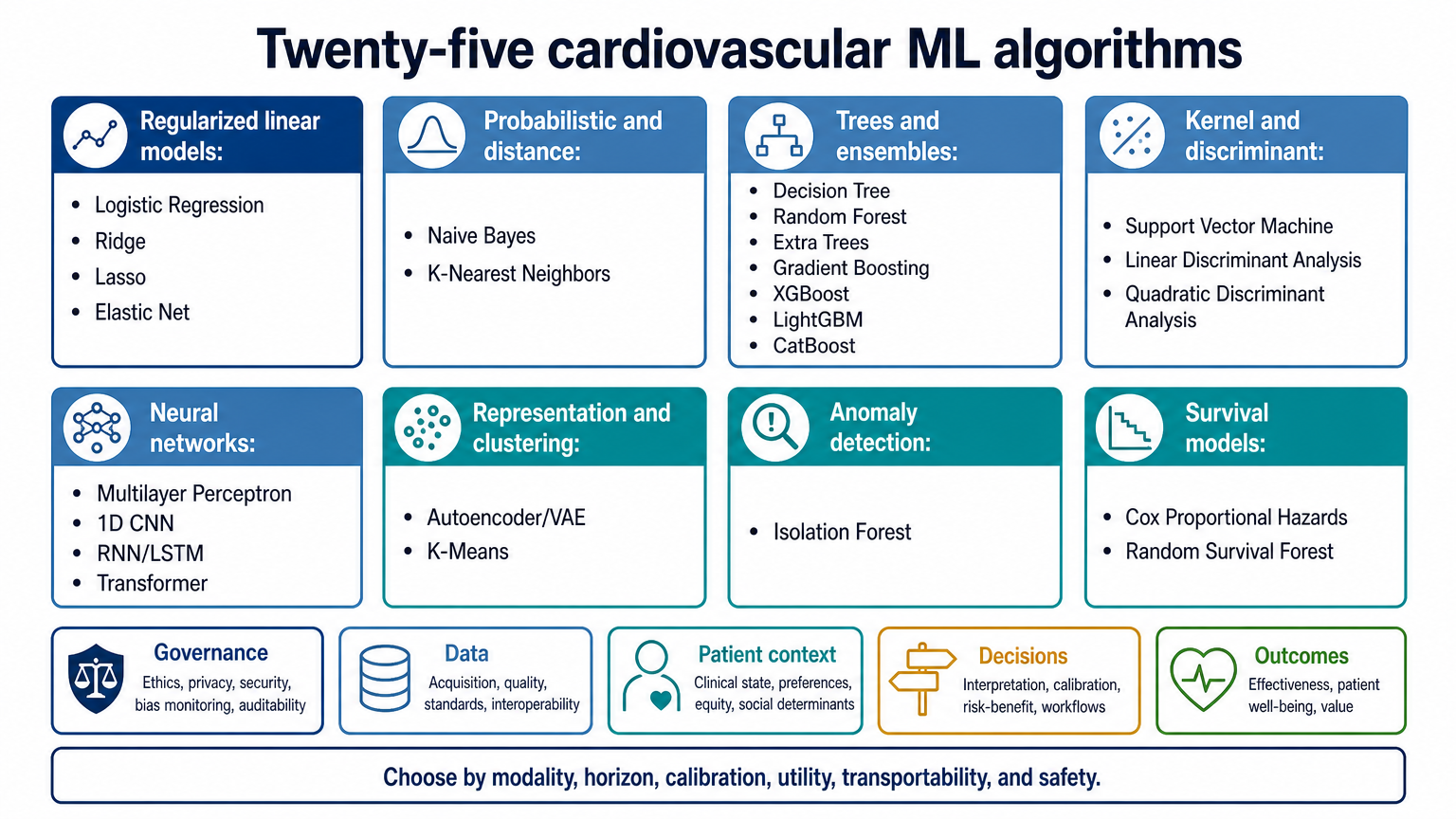
| # | Algorithm | Typical use | Key strength |
|---|---|---|---|
| 1 | Logistic Regression | Binary CVD risk | Interpretability |
| 2 | Ridge Regression | Correlated predictors | Stable regularization |
| 3 | Lasso Regression | Feature selection | Sparse model |
| 4 | Elastic Net | High-dimensional data | L1 + L2 regularization |
| 5 | Naive Bayes | Fast classification | Low computation |
| 6 | K-Nearest Neighbors | Similarity classification | Simple nonparametric baseline |
| 7 | Decision Tree | Rule-like stratification | Readable structure |
| 8 | Random Forest | Tabular risk | Robust nonlinear ensemble |
| 9 | Extra Trees | Tabular prediction | Randomized trees |
| 10 | Gradient Boosting | Risk prediction | Strong nonlinear learning |
| 11 | XGBoost | Structured CVD prediction | Regularized boosting |
| 12 | LightGBM | Large EHR datasets | Speed/scalability |
| 13 | CatBoost | Mixed clinical data | Categorical variables |
| 14 | Support Vector Machine | Small/medium datasets | Kernel methods |
| 15 | Linear Discriminant Analysis | Classification baseline | Statistical simplicity |
| 16 | Quadratic Discriminant Analysis | Nonlinear boundaries | Class-specific covariance |
| 17 | Multilayer Perceptron | Nonlinear tabular prediction | Flexible representation |
| 18 | 1D CNN | ECG/time series | Local temporal patterns |
| 19 | RNN/LSTM | Longitudinal signals | Sequence modeling |
| 20 | Transformer | ECG/text/multimodal sequences | Long-range attention |
| 21 | Autoencoder/VAE | Representation/anomaly detection | Unsupervised learning |
| 22 | K-Means | Patient phenotyping | Cohort segmentation |
| 23 | Isolation Forest | Anomaly monitoring | Efficient outlier detection |
| 24 | Cox Proportional Hazards | Time-to-event risk | Established survival framework |
| 25 | Random Survival Forest | Nonlinear survival risk | Censoring-aware ensemble |
4. Algorithms 1–4: Regularized Linear Models
4.1 Logistic Regression
Logistic regression is an essential cardiovascular baseline. Its coefficients can be interpreted through odds ratios and its probability outputs can be calibrated. Nonlinear effects and interactions must be explicitly modeled.
4.2 Ridge
Ridge stabilizes coefficients when predictors are correlated.
4.3 Lasso
Lasso performs embedded variable selection but can select one variable arbitrarily among highly correlated predictors.
4.4 Elastic Net
Elastic Net combines sparsity and stability and is useful for high-dimensional clinical or biomarker datasets.
5. Algorithms 5–7: Probabilistic, Distance, and Rule-Based Models
5.1 Naive Bayes
Fast and useful as a benchmark, although conditional independence is often unrealistic for cardiovascular variables.
5.2 KNN
KNN is intuitive but sensitive to scaling, irrelevant features, and dimensionality.
5.3 Decision Tree
Decision trees recursively partition the feature space and can express nonlinear interactions in clinically readable form. Overfitting requires depth limits, pruning, and validation.
6. Algorithms 8–13: Tree Ensembles
6.1 Random Forest
Random Forest averages randomized trees and is robust for tabular clinical prediction.
6.2 Extra Trees
Extremely Randomized Trees add randomization to split selection, often reducing variance and providing a useful benchmark.
6.3 Gradient Boosting
Sequential weak learners optimize residual error and can capture nonlinear clinical interactions.
6.4 XGBoost
XGBoost adds regularization and efficient tree construction. It is a strong candidate for structured EHR data.
6.5 LightGBM
LightGBM targets large-scale gradient boosting with efficient memory use and training speed.
6.6 CatBoost
CatBoost is useful when categorical clinical variables are important and extensive manual encoding is undesirable.
7. Algorithms 14–16: Kernel and Discriminant Models
7.1 Support Vector Machine
SVM maximizes margin and can use kernels for nonlinear boundaries. It can be attractive for smaller datasets.
7.2 Linear Discriminant Analysis
LDA assumes class-specific Gaussian distributions with common covariance and provides a transparent statistical baseline.
7.3 Quadratic Discriminant Analysis
QDA allows class-specific covariance and therefore curved decision boundaries but needs sufficient data.
8. Algorithms 17–20: Neural Networks
8.1 Multilayer Perceptron
MLPs model nonlinear interactions in structured data. Their advantage over boosted trees should be demonstrated rather than assumed.
8.2 1D CNN
1D CNNs learn local morphology and are well suited to ECG and other physiological waveforms.
8.3 RNN/LSTM
LSTMs represent longitudinal patterns and repeated measurements.
8.4 Transformer
Transformers can model long-range dependencies in ECG, text, and multimodal sequences, but computational cost and data requirements are important.
9. Algorithms 21–23: Representation, Clustering, and Anomaly Detection
9.1 Autoencoder / VAE
Autoencoders learn compact representations and reconstruction-based anomaly scores. VAEs add a probabilistic latent space.
9.2 K-Means
K-means can identify patient phenotypes but clusters require clinical interpretation and independent validation.
9.3 Isolation Forest
Isolation Forest detects unusual observations efficiently and may be useful for monitoring physiological data. An anomaly should prompt verification rather than automatically imply disease.
10. Algorithms 24–25: Survival Models
10.1 Cox Proportional Hazards
Cox regression is a foundational time-to-event model for cardiovascular outcomes and an important comparator for modern survival ML.
10.2 Random Survival Forest
Random Survival Forest extends tree ensembles to censored time-to-event data and can capture nonlinear interactions.
11. Choosing Algorithms by Data Modality
| Data type | Strong candidates | Rationale |
|---|---|---|
| Small structured cohort | Logistic, Ridge, Elastic Net, SVM | Stable, regularized baselines |
| Large EHR | XGBoost, LightGBM, CatBoost, Random Forest | Nonlinear tabular learning |
| ECG | 1D CNN, Transformer | Waveform representation |
| Longitudinal vitals | LSTM, Transformer, survival models | Temporal information |
| Time-to-event | Cox, Random Survival Forest | Censoring-aware prediction |
| Phenotyping | K-Means | Unsupervised segmentation |
| Anomaly monitoring | Isolation Forest, Autoencoder | Outlier detection |
12. Accuracy, Calibration, and Clinical Utility
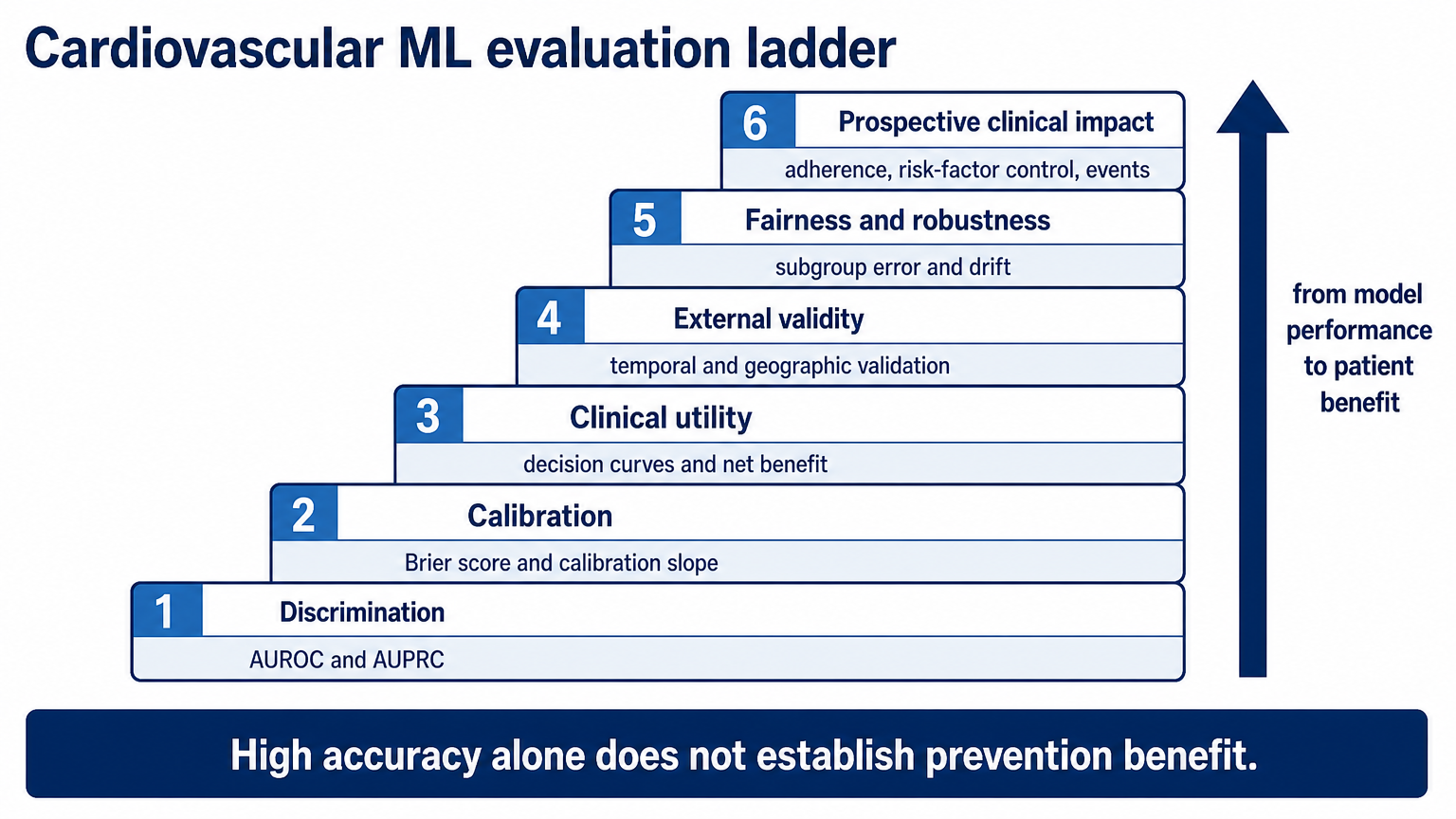
Discrimination alone is insufficient. AUROC and AUPRC describe ranking performance, while calibration measures whether predicted probabilities correspond to observed frequencies.
A model with slightly lower AUROC but superior calibration and clinical utility may be preferable.
13. External Validation and Leakage
Random train/test splitting cannot establish transportability. Models should be tested across time, institutions, geography, and relevant patient subgroups. Recent reviews identify inadequate external validation as a major translational limitation. A 2026 JACC systematic review/meta-analysis of ML/DL for hypertrophic cardiomyopathy reported pooled AUC of 0.79 across four studies and explicitly noted the need for prospective validation.
Leakage must also be prevented:
14. Missing Data and Class Imbalance
Clinical missingness can be informative. Appropriate methods include multiple imputation, missingness indicators, and models designed for missing values, with all preprocessing performed within the validation pipeline.
For imbalanced outcomes, accuracy may be misleading. Class weighting, threshold selection, focal loss, resampling, AUPRC, sensitivity/specificity, and decision-curve analysis can provide a more meaningful assessment.
15. Explainability
Linear models provide coefficient-based explanations; tree models can use feature attribution; neural networks can use carefully interpreted attribution or saliency techniques. Explanations should support clinical inspection of model inputs and behavior, not imply causality.
16. Fairness and Generalizability
Performance can differ across demographic and healthcare-access groups. Subgroup reporting should include discrimination, calibration, error rates, missingness, and threshold behavior. A model should not be deployed merely because its overall AUC is high.
17. Integrating the 25 Algorithms with Agentic AI
Patient data
    ↓
25-algorithm ML library
    ↓
Risk + calibration + uncertainty
    ↓
Clinical RAG / evidence retrieval
    ↓
LLM / reasoning layer
    ↓
Agent planner
    ↓
Safety and authorization policy
    ↓
Human clinician
    ↓
Monitoring + drift detection
The LLM should not replace validated numerical prediction. It is better positioned for evidence synthesis, communication, workflow coordination, and tool orchestration.
18. Unified Mathematical Architecture
19. Benchmarking Strategy
| Dimension | Metrics |
|---|---|
| Discrimination | AUROC, AUPRC |
| Calibration | Brier score, calibration intercept/slope, calibration plots |
| Clinical utility | Decision-curve analysis, net benefit |
| Robustness | Temporal/geographic external validation |
| Fairness | Subgroup discrimination, calibration, error rates |
| Safety | False-negative rate, unsafe recommendation rate |
| Operational | Latency, cost, clinician workload |
20. Reporting Standards
TRIPOD+AI, published in BMJ in 2024, updated reporting guidance for clinical prediction models using regression or machine-learning methods. It provides a harmonized 27-item framework and supersedes the earlier TRIPOD checklist. BMJ: TRIPOD+AI.
21. AI Governance
WHO guidance on large multimodal models emphasizes safety, transparency, accountability, equity, human oversight, and governance for health AI. These principles are particularly relevant when ML predictions are combined with generative models or autonomous workflow tools. WHO guidance.
22. Research Gaps in 2026
- Prospective multicentre validation remains insufficient for many cardiovascular ML models.
- Many studies prioritize discrimination over calibration and clinical utility.
- Public datasets may poorly represent routine clinical populations.
- Multimodal models face missing-modality and distribution-shift problems.
- Fairness and subgroup validation need stronger standardization.
- Agentic systems introduce additional risks from tool use, memory, autonomy, and action execution.
- Clinical outcome trials are required to establish actual prevention benefit.
23. Recommended 2026 Research Agenda
- Benchmark all 25 algorithms under identical leakage-safe preprocessing.
- Compare models using discrimination, calibration and decision utility.
- Perform geographic and temporal external validation.
- Develop multimodal ECG/EHR/laboratory/wearable models.
- Integrate causal inference for intervention selection.
- Evaluate uncertainty-aware prediction.
- Integrate validated ML models into governed Agentic AI workflows.
- Study clinician-agent collaboration.
- Conduct prospective pragmatic trials.
- Measure outcomes, safety, equity, cost-effectiveness, and patient experience.
24. Conclusion
The 25 algorithms reviewed here form a practical methodological toolbox for heart-disease prevention. Linear and regularized models provide transparent baselines; tree ensembles are powerful for structured EHR data; kernel and discriminant methods remain useful in selected cohorts; neural networks dominate many signal and multimodal applications; clustering and anomaly detection support phenotyping and monitoring; and survival methods address time-to-event outcomes.
The scientifically defensible conclusion is not that one algorithm is universally superior. The preferred model is the one that demonstrates appropriate discrimination, calibration, clinical utility, external validity, subgroup robustness, operational reliability, and measurable benefit for the intended clinical population.
References
- Pai S, Subramanian R, Krishnan L, John D, Subramanya T, Kinra S, et al. A scoping review on artificial intelligence-based tools for cardiovascular disease risk prediction. BMC Medical Informatics and Decision Making. 2026; published 18 July 2026. Springer Nature.
- Wan S, Wan F, Dai XJ. Machine learning approaches for cardiovascular disease prediction: A review. Archives of Cardiovascular Diseases. 2025. DOI: 10.1016/j.acvd.2025.04.055. PubMed.
- Liu T, Krentz AJ, Huo Z, Ćurčin V. Opportunities and Challenges of Cardiovascular Disease Risk Prediction for Primary Prevention Using Machine Learning and Electronic Health Records: A Systematic Review. Reviews in Cardiovascular Medicine. 2025;26(4):37443. DOI: 10.31083/RCM37443. PubMed.
- Mao Y, Jimma BL, Mihretie TB. Machine learning algorithms for heart disease diagnosis: A systematic review. Current Problems in Cardiology. 2025;50(8):103082. DOI: 10.1016/j.cpcardiol.2025.103082. ScienceDirect.
- Collins GS, Moons KGM, Dhiman P, Riley RD, Beam AL, Van Calster B, Ghassemi M, Liu X, Reitsma JB, et al. TRIPOD+AI statement: updated guidance for reporting clinical prediction models that use regression or machine learning methods. BMJ. 2024;385:e078378. DOI: 10.1136/bmj-2023-078378. BMJ.
- World Health Organization. Ethics and governance of artificial intelligence for health: Guidance on large multi-modal models. Geneva: WHO; 2024. ISBN 978-92-4-008475-9. WHO.
- Senapati SG, Sivakumar T, Mohammed A, et al. Machine Learning/Deep Learning Models Predicting Acute Cardiovascular Risk in Hypertrophic Cardiomyopathy: A Systematic Review and Meta-Analysis. JACC. 2026;87(13 Supplement):A172–A173. DOI: 10.1016/j.jacc.2026.02.429. JACC.
- Sonicki Z. Large multi-modal models – the present or future of artificial intelligence in medicine? Croatian Medical Journal. 2024;65(1):1–2. DOI: 10.3325/cmj.2024.65.1. PMC.
- Ray, Amit. "Compassionate Medical AI Drones as Intelligent Unmanned Health-Care Systems: A Human-Centered AI Architecture for Suffering Reduction and Human Flourishing." Compassionate AI, 3.8 (2026): 57-59. https://sriamitray.com/research/medical-ai-drones-human-centered-healthcare/.
- Ray, Amit. "Medical AI Drones for Disaster Management: Intelligent Unmanned Health-Care Systems." Compassionate AI, 3.8 (2026): 57-59. https://sriamitray.com/research/medical-ai-drones-disaster-management/.
- Ray, Amit. "The 25 Algorithms of the Sri Amit Ray Compassionate AI Architecture." Compassionate AI, 3.8 (2026): 63-65. https://sriamitray.com/research/ray-25-compassionate-ai-algorithms/.
- Ray, Amit. "Heart Disease Prevention: The Top 25 Machine Learning Algorithms 2026." Compassionate AI, 3.8 (2026): 78-80. https://sriamitray.com/research/heart-disease-prevention-25-ml-algorithms/.
- Ray, Amit. "Heart Disease Prevention with Agentic AI: Tools, Techniques, Mathematical Models, and AI Architectures." Compassionate AI, 3.8 (2026): 78-80. https://sriamitray.com/research/heart-disease-prevention-agentic-ai/.