
A raga in Indian classical music is not merely a scale — it is a living sonic intelligence. It is built from a precise architecture of ascending and descending movements, dominant tones, emotional color, signature phrases, and an assigned time of performance. Understanding this hidden structure is the key to truly hearing — and feeling — Indian classical music at its deepest level.
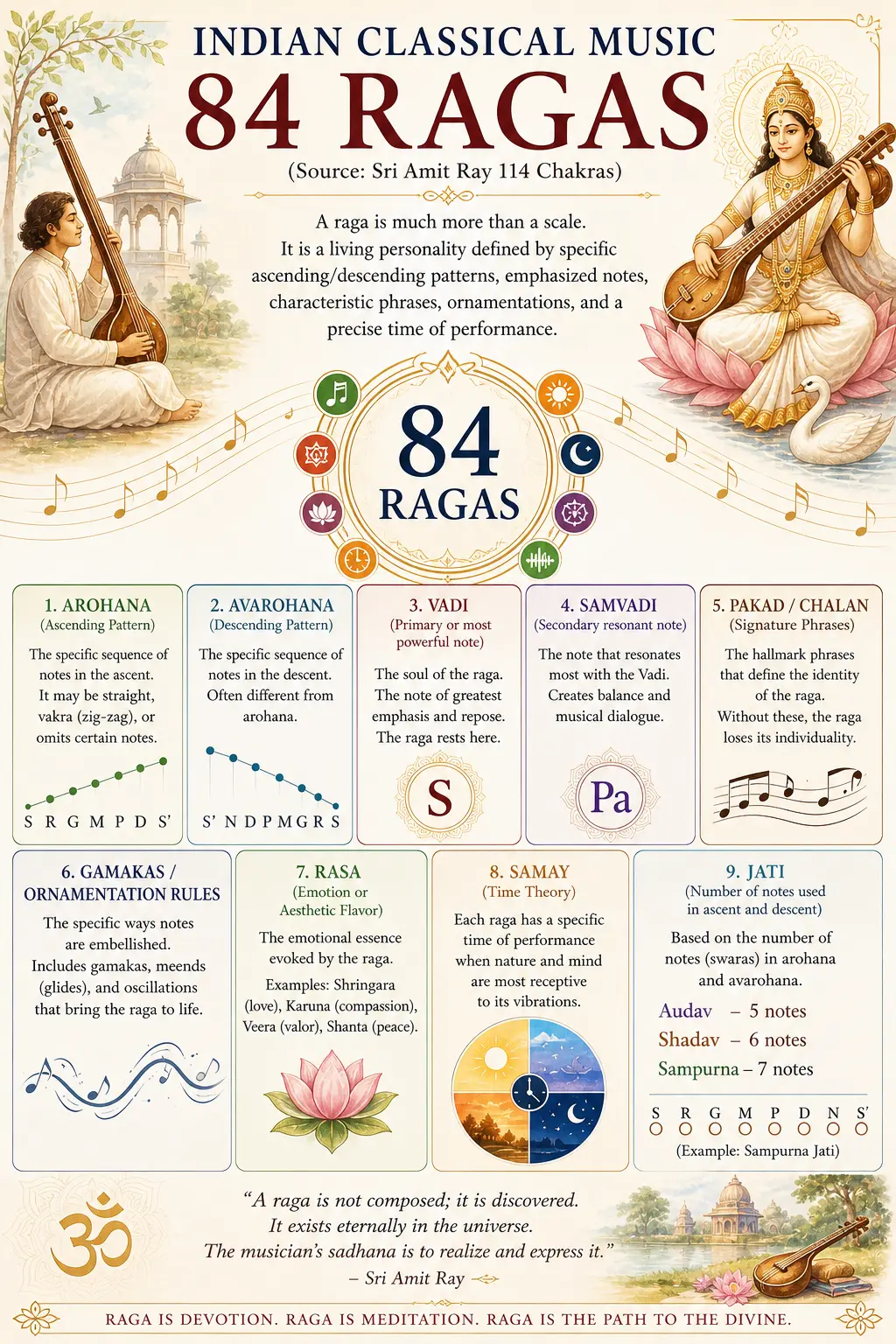
This visual guide breaks down the hidden structure of the 84 ragas through their 9 essential defining elements — from the tonal skeleton of Arohana and Avarohana, to the emotional depth of Rasa, and the time-aligned wisdom of Samay. Whether you are a beginner, a serious practitioner, or a researcher, this framework will transform how you understand and experience raga music.
In the Sri Amit Ray tradition, the 84 ragas are also recognized as powerful tools for activating the 114 chakras — gateways to higher consciousness, self-realization, and ultimate enlightenment. Each raga’s unique vibrational signature resonates with specific chakra frequencies, making this structural understanding both musically and spiritually significant.
👉 For the complete list, history, and thaats of all 84 ragas, read the Complete Guide to the 84 Ragas of Indian Classical Music .
What Is the Structure of a Raga? The 9-Element Framework
Every raga in the Indian classical system is governed by a multi-layered framework that goes far beyond notes on a scale. It defines which notes to use, how to move between them, which note to emphasize, what emotion to evoke, and even when to perform it. This is what makes each raga a complete and irreducible musical personality.
- Tonal Architecture: Arohana & Avarohana — the ascending and descending skeleton
- Tonal Power Centers: Vadi & Samvadi — the primary and secondary dominant notes
- Melodic Identity: Pakad — the raga’s unmistakable signature phrase
- Expressive Language: Gamakas — ornamentation, microtonal movement, and slides
- Emotional Essence: Rasa — the dominant feeling the raga is designed to evoke
- Temporal Intelligence: Samay — the traditional time of performance
- Scale Classification: Jati — the number of notes used in the raga
The 9 Core Elements of a Raga — Explained in Depth
1. Arohana — The Ascending Pattern
Arohana is the prescribed sequence of notes in the ascending direction. It may follow a straight linear path or take a characteristic zigzag route known as vakra (crooked). The vakra movement is not a mistake — it is a deliberate melodic signature that distinguishes one raga from another with nearly identical note sets.
2. Avarohana — The Descending Pattern
Avarohana is the descending sequence of notes. It is often structurally different from the Arohana, and this asymmetry is what gives many ragas their unique emotional texture. The descent may include notes skipped in the ascent, or vice versa.
3. Vadi — The Primary Note
The Vadi is the most sonically dominant and emotionally expressive note of the raga — its tonal center and soul. A performer returns to the Vadi repeatedly, and it exerts the greatest gravitational pull on the listener’s attention. Identifying the Vadi is often the fastest way to recognize a raga.
4. Samvadi — The Secondary Note
The Samvadi is the second most important note — a consonant partner to the Vadi. It typically sits a fourth or fifth away and creates balance, resonance, and tonal dialogue within the raga’s melodic space.
5. Pakad / Chalan — The Signature Phrase
Pakad refers to the characteristic melodic phrase or movement that immediately identifies a raga to a trained ear. Even when notes overlap with another raga, the Pakad — with its specific turns, emphasis, and movement — sets it apart unmistakably.
6. Gamakas — The Living Ornamentation
Gamakas are the microtonal ornaments — oscillations, grace notes, glides, and subtle pitch inflections — that breathe life into the notes. Without Gamakas, a raga becomes a lifeless scale. With them, it becomes a voice with emotion, depth, and cultural memory.
7. Rasa — The Emotional Essence
Derived from the ancient Natyashastra’s theory of nine primary emotions (Nava Rasa), Rasa defines the dominant feeling a raga is designed to awaken — whether Shanta (peace), Bhakti (devotion), Shringar (love), Karuna (compassion), or Veer (heroism). A raga’s Rasa is not incidental — it is its emotional purpose.
8. Samay — The Time Theory
Each raga is traditionally assigned a specific time of day or night for performance. This is not arbitrary — it reflects the ancient understanding that different tonal structures interact with human physiology and perception differently across the 24-hour cycle. Morning ragas tend toward clarity and serenity; midnight ragas carry depth and mystery.
9. Jati — The Scale Classification
Jati classifies a raga based on the number of notes used in its Arohana and Avarohana:
- Audav — 5 notes (pentatonic)
- Shadav — 6 notes
- Sampurna — 7 notes (complete)
A raga can have a different Jati in its ascent and descent — for example, Audav-Sampurna (5 notes up, 7 notes down) — adding further complexity and character.
Why Rasa and Samay Are Scientifically and Spiritually Significant
Modern neuroscience is beginning to validate what Indian classical musicians have practiced for millennia. The Rasa system aligns with contemporary understanding of music’s effect on the limbic system, cortisol levels, and emotional regulation. The Samay theory resonates with circadian rhythm research, which confirms that human perception of sound, mood, and cognitive receptivity shifts measurably across the day.
In the Sri Amit Ray 114 Chakra tradition, the Rasa and Samay dimensions of each raga are understood as vibrational keys — each aligned with specific energy centers in the subtle body. When a raga is performed at its correct Samay and with its full Rasa, it activates corresponding chakras and opens pathways to higher states of awareness, inner stillness, and spiritual realization.
How Visual Understanding Accelerates Raga Mastery
The 9-element framework of a raga can feel abstract when encountered through text alone. Visual representations — infographics, notation charts, and structural diagrams — compress complex knowledge into intuitive patterns that the brain retains far more effectively. This is especially valuable for:
- Beginners building their first mental model of raga structure
- Students preparing for examinations in Indian classical music
- Vocalists and instrumentalists analyzing new ragas
- Researchers and ethnomusicologists mapping raga systems
- Spiritual practitioners aligning ragas with chakra work
Continue Your Exploration of the 84 Ragas
👉 The 84 Ragas of Indian Classical Music — Complete Guide — Full list, thaats, janaka-janya lineages, and history
👉 Neuroscience of Indian Classical Music — How ragas affect the brain, emotion, and consciousness
Frequently Asked Questions About Raga Structure
Is a raga the same as a musical scale?
No. A scale is simply a sequence of notes. A raga includes a prescribed ascending and descending movement, a primary dominant note (Vadi), characteristic phrases (Pakad), specific ornamentation rules (Gamakas), an assigned emotional quality (Rasa), and a traditional time of performance (Samay). A raga is a complete musical intelligence — not merely a scale.
What is the most important element of a raga?
While all 9 elements contribute to a raga’s identity, the Vadi (primary note) and the Pakad (signature phrase) are the most diagnostically powerful. A trained listener can often identify a raga from just a few notes of its Pakad alone.
Why are ragas performed at specific times of day?
The Samay (time theory) of ragas is rooted in the ancient understanding that specific tonal combinations — particularly the positioning of notes like Gandhar (3rd) and Nishad (7th) — interact with human perception, physiology, and emotional receptivity in ways that vary across the day. This aligns with modern circadian rhythm science and the psychoacoustic understanding of how context shapes musical experience.
How do ragas relate to the 114 chakras?
In the Sri Amit Ray tradition, each of the 84 ragas carries a specific vibrational frequency that corresponds to and activates particular chakras among the 114 chakra system. This makes raga practice not only an artistic discipline but a powerful tool for energy healing, meditation, and spiritual awakening.
What is Jati in raga classification?
Jati refers to the classification of a raga based on the number of notes used — Audav (5 notes), Shadav (6 notes), or Sampurna (7 notes). A raga can have different Jati values for its ascent and descent, which contributes to its unique melodic personality.
Is a raga simply a musical scale?
No. A scale (Thaat) is merely the raw material. A raga adds the “musical intelligence”—the specific rules, signature phrases, emotional (Rasa) context, and temporal (Samay) requirements.
Why are Ragas performed at specific times?
This is based on the ancient belief that the human mind and the environment undergo specific energetic shifts throughout the day. Performing a raga in harmony with these shifts maximizes its psychological and spiritual impact.
How do I start using Ragas for meditation?
Begin by listening to ragas associated with your current goal (e.g., focus, peace, or awakening). Focus on the Vadi (primary note) to anchor your awareness.