
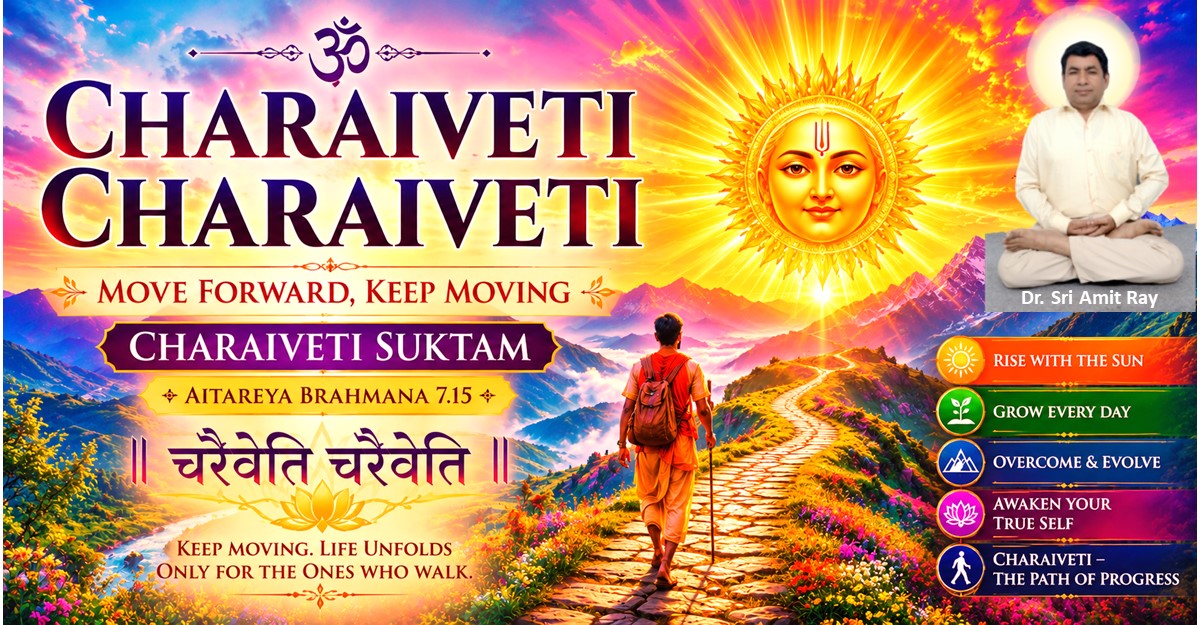
Charaiveti Charaiveti (चरैवेति चरैवेति) — “Move Forward, Keep Moving” — is one of the most inspiring mantras of the Aitareya Brahmana 7.15, associated with the ancient Rig Veda tradition. The repeated expression “Charaiveti” teaches that life flourishes through purposeful motion — physical, intellectual, moral, and spiritual — while stagnation leads to decay.
The hymn emerged in the context of the legendary dialogue connected with King Harishchandra, Rohita, and the deeper Vedic understanding of human evolution, growth, and destiny. Across centuries, the mantra has inspired countless spiritual seekers, social reformers, philosophers, monks, scientists, leaders, travelers, and modern innovators to embrace perseverance, resilience, and a lifelong journey of growth and resilience.
In 1825, Raja Ram Mohan Roy founded the Vedanta College in Kolkata. Around 1816, he translated several Upanishads into English and other languages. He went to England in 1830 and helped spread the wisdom of the Upanishads and Vedas to the West. He emphasized the ancient Vedic mantra “Charaiveti Charaiveti” (“Keep moving forward, keep progressing”), which became particularly influential, inspiring generations of young Indians to pursue continuous learning, self-development, and social progress without losing their spiritual foundations. In 1893, Swami Vivekananda, and later many others, went to the West and followed in the footsteps of Raja Ram Mohan Roy, helping to spread this eternal wisdom around the world.
This article explores the Introduction, the historical and philosophical Context & Story, the complete Five Verses of the Charaiveti Suktam, detailed explanations of Verse 1, Verse 2, Verse 3, Verse 4, and Verse 5, along with its timeless Summary, Ray 114 chakras, cultural and spiritual Legacy, and a practical FAQ section for modern readers.
Hindi Audio:
English Audio:
What is Charaiveti Charaiveti?
“Charaiveti Charaiveti” is an ancient Sanskrit expression from the Aitareya Brahmana (7.15) meaning “Keep moving forward.” It symbolizes perseverance, continuous growth, spiritual evolution, and the dynamic philosophy of life in Vedic wisdom. The Charaiveti Suktam is an eternal anthem for human resilience. It teaches that life is a journey, and the purpose of life is evolution.
— Aitareya Brahmana 7.15, Rigveda
The Charaiveti Suktam is the timeless Vedic philosophy of continuous evolution, resilience, consciousness, and forward movement. Prosperity comes to the one who exerts. Sin befalls the one who sits idle. Indra is the friend of the one who moves. When action is aligned with purpose, life flowers. Depression and negativity dissolve through meaningful movement. The hymn does not merely say “work hard.” It declares:
Life belongs to the one who participates in it.
चरैवेति। चरैवेति।
To stop evolving is to spiritually die.
Like a river that flows, a man should keep moving. Even the sun, the greatest of lights, never tires of its journey. Moving forward is the essential honey of life. So, the Ancient Rishis did not give a doctrine. They gave a mantra for success. They gave a formula of life:
Keep moving forward.
Keep helping.
The Charaiveti Suktam from the Aitareya Brahmana (7.15), an ancient text attached to the Rigveda, is one of the most profound and motivating hymns in Vedic literature. Its five verses form a complete philosophy of life — from the necessity of effort to cosmic alignment with the divine order. Explore the full verse-by-verse breakdown to understand its timeless depth.
The Story of Rohita & Indra: The Context of Charaiveti Suktam
To understand its deeper meaning, we must first look at its context. The verses are spoken by Lord Indra (in the guise of a Brahmin) to Prince Rohita, the son of King Harishchandra. Rohita has fled to the forest to escape being offered as a human sacrifice. Wandering in the wilderness, Rohita repeatedly gets tired and thinks of returning home — which would mean stagnation and spiritual death.
Every time Rohita stops, Indra appears and tells him “Charaiveti, Charaiveti” — Keep moving, march on! This ancient dialogue is one of the most powerful motivational exchanges in all of Vedic literature.
On a deeper, philosophical level, this Suktam is an allegory for the human soul’s journey. It is a powerful rejection of fatalism, lethargy, and stagnation, and a celebration of continuous effort, evolution, and dynamic action (Karma). Rohita’s forest wandering mirrors every human being’s inner struggle between comfort and growth.
Raja Ram Mohan Roy was one of the earliest modern visionaries to bring the wisdom of the Vedas and Upanishads to both the Indian public and the Western intellectual world. He believed that the essential spirit of Hindu philosophy was universal, rational, deeply motivational, and spiritual. Around 1816, he translated several important Sanskrit scriptures into vernacular and European languages. His efforts helped revive interest in India’s ancient philosophical heritage during a period of intense social and cultural transition.
In many ways, his life embodied the spirit of Charaiveti — “Move Forward, Keep Moving” — the courage to challenge stagnation, cross intellectual boundaries, and continue advancing toward truth, reform, and higher human consciousness. Later generations of spiritual leaders, reformers, educators, and national thinkers carried forward this same Vedic impulse of continuous progress and fearless transformation.
Charaiveti Suktam: All Five Verses Explained — Aitareya Brahmana 7.15
Here is the deeper philosophical and spiritual explanation of each verse of the Charaiveti Suktam. Each verse is a complete teaching in itself, yet together they form a unified Vedic philosophy of dynamic, conscious, purposeful living. Click any verse below or use the FAQ section for quick answers.
Verse 1: The Necessity of Struggle
पापो नृषद्वरो जन इन्द्र इच्चरतः सखा ॥
चरैवेति चरैवेति ॥ १ ॥
Deeper Meaning
- No Growth in Comfort Zones: The word Shri means wealth, success, beauty, and spiritual grace. The verse states that Shri is impossible without Shrama (exhaustion through hard work). You cannot achieve physical success or spiritual enlightenment by remaining in your comfort zone. This is the foundation of the entire Charaiveti Suktam philosophy.
- Inertia is Sin: “A man sitting idle becomes prone to sin.” Stagnation of the body breeds disease; stagnation of the mind breeds negative thoughts. This echoes the teaching of the Bhagavad Gita, where inaction (Akarmanyata) is as destructive as wrong action.
- Divine Alignment: “Indra is the friend of the wanderer.” God helps those who help themselves. The universe aligns its forces to support the person who takes the first step and maintains momentum. As Verse 3 will show, your fortune literally moves when you move.
Verse 2: Action as a Purifying Fire
शेरेऽस्य सर्वे पाप्मानः श्रमेण प्रपथे हताः ॥
चरैवेति चरैवेति ॥ २ ॥
Deeper Meaning
- The Flowering of Potential: “Legs blooming with flowers” is a beautiful metaphor. It means that action brings vitality, beauty, and health. When you are active, you are truly alive. Your very body becomes sacred ground through purposeful movement — an idea deeply connected to the Rohita narrative.
- Self-Actualization: “His soul grows and bears fruit.” Spiritual realization is not a passive event. The soul evolves and matures only through the experiences, hardships, and interactions of the life journey. This connects to modern psychology’s concept of post-traumatic growth.
- Karmic Cleansing: The “sins” (Paapmanah) mentioned here are past karmas, psychological blocks, and impurities. The intense effort (Tapas/Shrama) of moving forward acts as a purifying fire, burning away the baggage of the past. This is why the rishis called Charaiveti a mantra, not just advice.
Verse 3: Destiny is a Mirror of Your Action
शेते निपद्यमानस्य चराति चरतो भगः ॥
चरैवेति चरैवेति ॥ ३ ॥
Deeper Meaning
- Rejection of Fatalism: This is a profound statement against the idea that our destiny is pre-written and out of our control. Your luck (Bhaga) is not a separate entity waiting to bless you — it is inextricably linked to your actions. This verse directly addresses the fatalistic mindset that Verse 1 warns against.
- The Law of Momentum: If you are lazy, your destiny is dormant. If you are alert, your destiny awakens. If you take action, your destiny propels you forward. You create your own luck through your momentum. Change your physical and mental state, and you change your future — a principle that Verse 4 deepens with the Yuga metaphor.
Key Insight: The Sanskrit word Bhaga (fortune, destiny) shares its root with Bhagavan (God, the one who bestows fortune). This verse implies that God’s grace itself is activated by human effort — a uniquely empowering theological statement.
Verse 4: The Internalization of Time — The Yugas Within You
उत्तिष्ठंस्त्रेता भवति कृतं संपद्यते चरन् ॥
चरैवेति चरैवेति ॥ ४ ॥
Deeper Meaning: A Psychological Masterpiece
In Hindu cosmology, the four Yugas represent the declining cycle of time — from the golden age (Satya) to the dark age (Kali). This verse beautifully internalizes this cosmic concept. The Yugas are not just historical epochs — they are states of human consciousness. This connects the cosmic message of Verse 5 (the Sun) to our inner world.
| State of Being | Corresponding Yuga | Quality (Guna) | Inner Meaning |
|---|---|---|---|
| Lying down / asleep | Kali Yuga | Tamas (Inertia) | Ignorance, depression, darkness of the mind |
| Waking up / stirring | Dvapara Yuga | Mixed | Dawning awareness, partial understanding |
| Standing up / ready | Treta Yuga | Rajas (Activity) | Readiness, intention, preparation for action |
| Moving forward | Satya/Krita Yuga | Sattva (Purity) | Pure, aligned, purposeful action — the Golden Age |
When you are actively pursuing your highest purpose, you are living in the Golden Age — regardless of the condition of the external world. This is perhaps the most empowering message of the Charaiveti Suktam: you can choose your Yuga by choosing your action.
Verse 5: The Sun as the Ultimate Cosmic Role Model
सूर्यस्य पश्य श्रेमाणं यो न तन्द्रयते चरन् ॥
चरैवेति चरैवेति ॥ ५ ॥
Deeper Meaning
- The Reward of the Quest: “Honey” and the “Sweet Udumbara fruit” represent the ultimate goals of human life — both material success (Artha/Kama) and spiritual liberation (Moksha/Ananda). They cannot be found by standing still. As Verse 2 teaches, even your soul blooms only through movement.
- The Sun as the Ultimate Yogi: The verse points to the Sun (Surya) as the supreme role model. The Sun is always in motion, never resting, never sleeping. Because the Sun moves, it brings light, warmth, and life to the entire universe. In Vedic thought, the Sun is the visible manifestation of the cosmic principle of Rta (divine order). To emulate the Sun is to become divine.
- Aligning with Cosmic Law (Rta): The universe is fundamentally dynamic — everything from galaxies to atoms is in constant motion. When a human being gives in to lethargy (Tandrayate), they fall out of sync with the rhythm of the cosmos. By keeping moving, you align yourself with the divine cosmic order — becoming what Verse 4 calls Satya Yuga consciousness.
The Supreme Message of Charaiveti Suktam
The Charaiveti Suktam is an eternal anthem for human resilience. It teaches that life is a journey, and the purpose of life is evolution. Obstacles, fatigue, and despair will come, but the only fatal mistake is to stop. Whether you are facing a career crisis, a spiritual dry spell, or deep despair, the ancient Vedic rishis offer a simple, profound mantra:
“Do not stop. Take the next step.”
The fortune that mirrors your action, the Golden Age that lives within you, the honey found only by moving — all of it waits for you on the other side of your next step.
चरैवेति। चरैवेति।
Keep moving. Keep evolving. Keep helping.
Across the five verses of the Suktam, the Ancient Rishis gave us a complete map of conscious living:
- Verse 1: Effort is the price of grace. Inertia invites sin. Indra walks with the walker.
- Verse 2: Action is purification. The body blooms. The soul ripens. Past karma dissolves.
- Verse 3: Destiny is not fixed — it mirrors your state. Move, and your fortune moves.
- Verse 4: The Yugas are inner states. Choose action and you live in the Golden Age now.
- Verse 5: The Sun never tires. Honey is found only by moving. Align with cosmic law.
The Living Legacy of Charaiveti: From Vedic Rishis to Modern India
The timeless philosophy of Charaiveti Charaiveti did not remain confined to the pages of the Aitareya Brahmana. Across centuries, it evolved into a living civilizational force that inspired India’s saints, reformers, philosophers, freedom fighters, educators, travelers, scientists, and spiritual seekers. The deeper spirit of Rohita’s journey through the forest — to continue moving despite uncertainty, suffering, fear, or exhaustion — became a symbolic call for courage, resilience, discovery, and self-transformation.
The ideal of continuous movement and progressive awakening profoundly influenced many architects of modern Indian thought, including Raja Ram Mohan Roy, Bankim Chandra Chattopadhyay, Rabindranath Tagore, Sir Surendranath Banerjee, Sri Aurobindo, and Syama Prasad Mukherjee. Whether through social reform, spiritual renaissance, national awakening, education, literature, or scientific inquiry, they embodied the Vedic principle that stagnation weakens both the individual and society, while movement generates renewal, creativity, and higher consciousness.
Modern Relevance: The message of the Charaiveti Suktam is extraordinarily relevant in the modern age. In a world shaped by distraction, comparison culture, burnout, anxiety, and emotional fatigue, the mantra “Keep Moving Forward” offers a profound psychological and spiritual framework for resilience. The Suktam teaches that growth does not require perfection; it requires continuity. One step forward is still evolution. As Verse 4 explains, even awakening from inertia is progress. Standing is better than sleeping. Walking is greater than standing. The Golden Age of life begins when one consciously moves toward truth, wisdom, compassion, and inner expansion.
The supreme message of the Charaiveti Suktam is not blind ambition, mechanical productivity, or restless activity. Rather, it advocates conscious, purposeful, soul-aligned movement — movement rooted in awareness, dharma, self-discovery, and higher aspiration. The hymn honors rest as part of the journey, but never as the final destination. It reminds every seeker, traveler, and dreamer that the sweetness and honey of life — wisdom, fulfillment, liberation, and spiritual joy — are discovered only by those who continue moving forward.
Charaiveti and the Journey Through the 114 Chakras
The deeper spiritual meaning of Charaiveti Charaiveti — “Move Forward, Keep Moving” — can also be understood as an inner journey through the progressive awakening of consciousness within the subtle energy system of the human being. Within this broader framework, the concept of the 114 chakras symbolizes the vast potential of human evolution, transformation, creativity, intuition, compassion, and transcendence. In the tradition of Sri Amit Ray, the Charaiveti mantra is associated with the higher illuminating chakras, including the Vishwajyoti Chakra (विश्वज्योति चक्र) — the Chakra of Universal Illumination.
Each chakra represents a stage of movement from limitation toward expansion, from unconsciousness toward awareness, and from fragmentation toward wholeness. Spiritual stagnation occurs when consciousness becomes trapped in fear, inertia, attachment, or repetitive patterns. The Vedic call of “Charaiveti” reminds the seeker to continue evolving through every layer of existence — physical, emotional, intellectual, ethical, and spiritual.
In this interpretation, the journey through the chakras is not a sudden mystical event but a continuous unfolding. One moves from survival to creativity, from personal ambition to compassion, from mental turbulence to clarity, and ultimately toward expanded states of unity consciousness. The essence of Charaiveti is therefore not restless movement, but conscious inner evolution. Every moment of awareness, meditation, self-discipline, learning, service, love, and self-transcendence becomes part of the sacred journey forward.
Inner Meaning: The philosophy of Charaiveti Charaiveti teaches that spiritual growth is dynamic, not static. Whether understood through the ancient Vedic vision or the symbolic framework of the 114 chakras, the message remains the same: consciousness must continue to expand. The path itself becomes the awakening.
Frequently Asked Questions: Charaiveti Charaiveti & the Aitareya Brahmana
What does “Charaiveti Charaiveti” mean in English?
“Charaiveti Charaiveti” (चरैवेति चरैवेति) is a Sanskrit phrase meaning “Keep moving, keep moving” or “March on, march on.” It is derived from the root word Chara (to move, to walk, to live) and Iti (thus, so). In its fullest meaning, it translates as “Keep evolving, keep moving forward, keep helping.” It is the central mantra of the Charaiveti Suktam from the Aitareya Brahmana 7.15.
Where does the Charaiveti Suktam come from? Which Veda?
The Charaiveti Suktam comes from the Aitareya Brahmana (Chapter 7, Section 15), which is an ancient prose text attached to the Rigveda — the oldest of the four Vedas. The Brahmanas are explanatory texts that provide ritual, philosophical, and narrative context for the Vedic hymns. The Aitareya Brahmana is one of the oldest surviving prose texts in human history.
Who is Prince Rohita in the Charaiveti Suktam?
Prince Rohita is the son of the legendary King Harishchandra, the king celebrated for his absolute truthfulness in Hindu tradition. In the story embedded in the Aitareya Brahmana 7.15, Rohita flees to the forest to escape being offered as a human sacrifice. His wandering in the wilderness — and Indra’s repeated exhortations to “keep moving” — forms the narrative backdrop for the five verses of the Charaiveti Suktam.
What is the meaning of “Bhaga” in Charaiveti Verse 3?
Bhaga in Verse 3 of the Charaiveti Suktam means fortune, luck, destiny, or divine grace. The verse declares that your Bhaga is not a fixed, pre-determined force — it literally mirrors your state of being. If you sit, your fortune sits. If you move, your fortune moves with you. This makes Bhaga a dynamic, responsive force co-created by human will and divine energy. Interestingly, Bhaga shares its root with Bhagavan (God), implying that God’s grace is activated by human effort.
How do the four Yugas relate to human consciousness in Charaiveti Verse 4?
Verse 4 of the Charaiveti Suktam is a revolutionary re-interpretation of the Yuga cosmology. Rather than seeing the four Yugas (Kali, Dvapara, Treta, Satya) as external historical epochs, the verse maps them onto inner human states: lying down is the Kali Yuga (ignorance, inertia), waking up is Dvapara (dawning awareness), standing up is Treta (readiness), and moving forward is the Satya/Krita Yuga — the Golden Age. This means any human being can choose to live in the Golden Age right now, through conscious, purposeful action.
Why is the Sun mentioned in the Charaiveti Suktam?
In Verse 5, the Sun (Surya) is presented as the supreme cosmic role model. The verse invites the reader: “Look at the magnificence of the Sun, who never gets tired of moving.” In Vedic cosmology, the Sun is the visible manifestation of Rta (divine cosmic order). The Sun’s ceaseless movement brings light, warmth, and life to all beings. By moving ceaselessly with purpose — without fatigue (tandrayate) — a human being aligns with this cosmic order and becomes a source of light to others, just like the Sun.
What is the difference between the Charaiveti Suktam and the Bhagavad Gita’s teaching on action?
Both the Charaiveti Suktam and the Bhagavad Gita celebrate purposeful action (Karma) over inaction. However, while the Bhagavad Gita’s Nishkama Karma (desireless action) focuses on detachment from the fruits of action, the Charaiveti Suktam is more primal and kinetic — it focuses on the act of movement itself as sacred. As Verse 2 teaches, even the physical act of walking purifies the soul. The two teachings are deeply complementary: the Gita teaches how to act; Charaiveti teaches that you must act.
How can I apply “Charaiveti Charaiveti” in modern daily life?
The practical application of Charaiveti Charaiveti is both simple and profound. In times of stagnation, low motivation, or indecision, the Vedic prescription is: take one small step forward. Start. Move. The lessons from each verse apply practically: overcome your comfort zone (Verse 1), let effort purify you (Verse 2), take ownership of your fortune (Verse 3), choose your inner Yuga by choosing action (Verse 4), and model the tireless Sun in your purpose (Verse 5). Do not wait for perfect conditions. Move — and the honey of life will find you.
Is “Charaiveti Charaiveti” the national motto of any institution?
Yes. Charaiveti Charaiveti has been adopted as the motto of several Indian educational and cultural institutions, reflecting its timeless relevance as a philosophy of continuous progress. India’s national motto, Satyameva Jayate (Truth Alone Triumphs), comes from the Mundaka Upanishad, but Charaiveti is equally iconic in Indian philosophical culture. Its message — keep evolving, keep moving forward, keep helping — resonates as a universal principle of human excellence across cultures and ages.